
Report Feature
Crypto Hardware Wallet Market Trends and Forecast
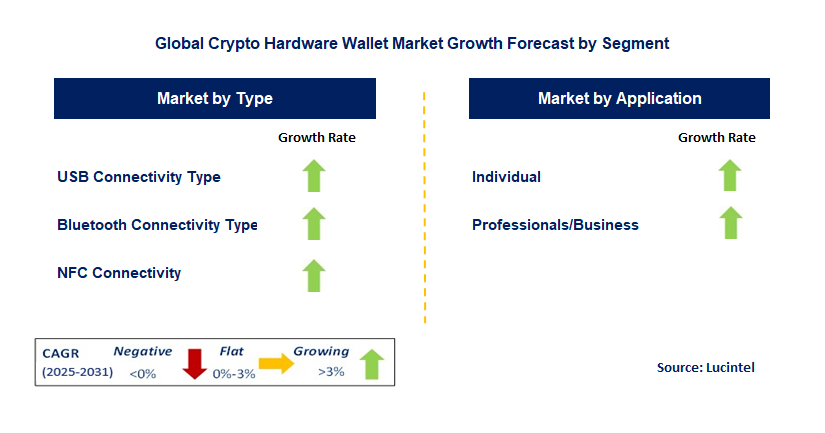
The future of the global crypto hardware wallet market looks promising with opportunities in the individual and professionals/business markets. The global crypto hardware wallet market is expected to grow with a CAGR of 23.2% from 2025 to 2031. The major drivers for this market are growing concerns over online security and hacking incidents boost the need for offline storage options, regulatory developments and efforts to enhance the security of digital assets support the market for hardware wallets, and the increasing adoption of cryptocurrencies drives demand for secure storage solutions like hardware wallets. Lucintel forecasts that, within the type category, USB connectivity type is expected to witness the highest growth over the forecast period due to widely compatible with various devices like pcs, laptops, and some mobile devices. Within the application category, individual is expected to witness the higher growth due to the growing popularity of cryptocurrency among retail investors and hobbyists. In terms of region, North America is expected to witness the highest growth over the forecast period due to the early and widespread adoption of cryptocurrencies, a large number of crypto investors, and strong regulatory frameworks. Gain valuable insights for your business decisions with our comprehensive 150+ page report. Sample figures with some insights are shown below.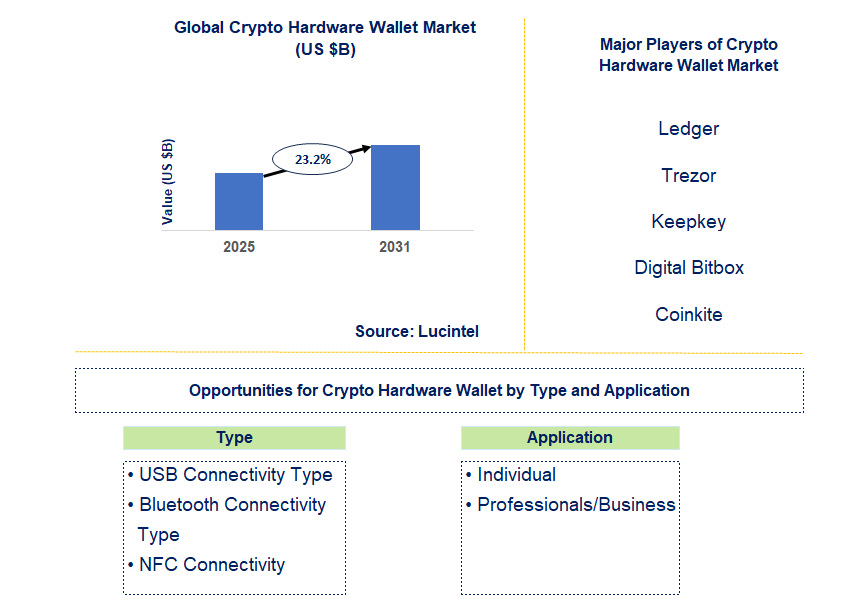
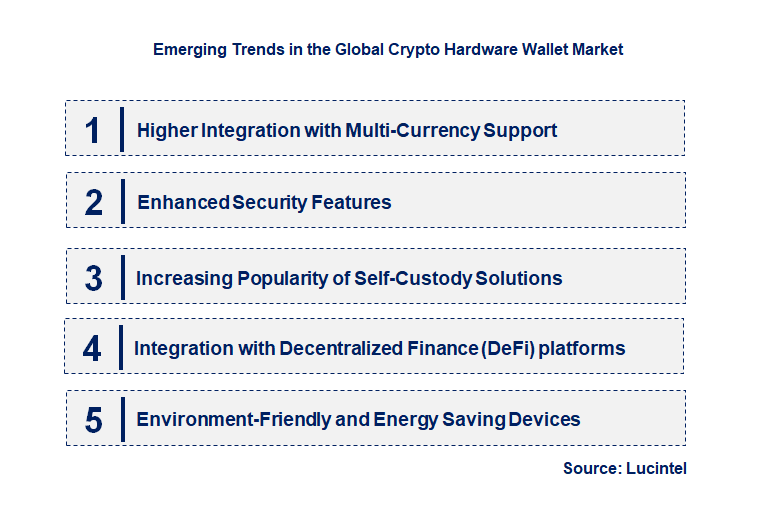
Emerging Trends in the Crypto Hardware Wallet Market
The crypto hardware wallet market is changing fast due to technological innovations and shifting consumer demands. The trends below are the ones that will shape the future of the market and unlock new opportunities for growth and innovation.• Higher Integration with Multi-Currency Support: As the crypto market continues to diversify, hardware wallets are incorporating support for a wider range of cryptocurrencies. Users are seeking wallets that can manage multiple digital assets seamlessly, from Bitcoin to emerging altcoins. Hardware wallet manufacturers are responding to this demand by developing devices capable of storing a broad spectrum of cryptocurrencies, offering convenience and flexibility to users. This trend drives the market toward more versatile hardware wallet solutions, appealing to investors who own diversified crypto portfolios.
• Enhanced Security Features: Crypto hardware wallets will continue to ensure security as a prime aspect. The producers of the devices keep on updating them with newer and advanced security features in order to prevent the rising risk of cyberattacks. Innovations like biometric authentication, PIN protection, and multi-signature capabilities are becoming standard. These advancements ensure that digital assets are stored safely and cannot be accessed or stolen without permission. Security breaches are on the rise, so the demand for hardware wallets with cutting-edge security features is expected to rise.
• Increasing Popularity of Self-Custody Solutions: As the crypto space matures, more investors opt for self-custody solutions, meaning that the private keys of the account will be solely controlled by them. Self-custody wallets are, in general, preferred over the others for storing cryptocurrencies as they ensure offline storage. This offers them better security from hacking attempts. With a shift toward decentralization and personal control, this shift is going to change the storage landscape for cryptos as more and more users will opt for the wallet where their assets are kept under personal management, without custodian reliance.
• Integration with Decentralized Finance (DeFi) platforms: There has been the advent of DeFi, with many opportunities coming out in hardware crypto wallets. Such DeFi systems provide access for lending, borrowing, and trade without having middlemen around and require proper safe, hardware-based storage compatible with the mentioned applications. This new, wide-decentralized market for applications also comes in a sense in developing new and better compatibility integrations in terms of DeFi ecosystems where users would benefit through these integrations regarding the use of secure means toward access and acquisition of assets with their growing participations within this market.
• Environment-Friendly and Energy Saving Devices: As sustainability becomes an emerging concern in the tech industry, including that of crypto hardware wallets, manufacturers will use this trend to create friendly, energy-saving devices with a reduced carbon footprint. This is both due to consumer demand and regulatory pressure for greener technologies. As the world moves toward minimal energy consumption, ecologically friendly ingredients, less-energy-consumption hardware wallets will be in vogue by many consciences green investors. Eco-friendly hardware wallets are now and will be one of the crucial market trends as the industry really starts to advance toward sustainable policies. Emerging trends in the crypto hardware wallet market are revolutionizing the way digital assets are stored and managed. Increased integration with multi-currency support, enhanced security features, and the growing demand for self-custody solutions are driving the market toward more advanced and user-friendly products. Moreover, the rise of DeFi and the focus on sustainability are pushing manufacturers to innovate and cater to evolving market needs. These trends are reshaping the market by fostering more secure, versatile, and environmentally friendly hardware wallet solutions that meet the demands of modern cryptocurrency users.
Recent Development in the Crypto Hardware Wallet Market
The crypto hardware wallets market has undergone several key developments that have altered the way users store and secure their digital assets. These include developments in enhancing security, usability, and compatibility with emerging crypto technologies.• Compatibility with Blockchain Networks: Hardware wallets are increasingly being designed to integrate seamlessly with blockchain networks. This enables users to easily store, send, and receive cryptocurrencies without needing third-party services. By supporting direct interaction with blockchain networks, hardware wallets are providing more autonomy and security for users. This development is a significant step towards decentralization, allowing crypto holders to manage their assets independently and securely.
• Partnerships with Crypto Exchanges: A new trend in the crypto hardware wallet space is partnership with hardware wallet manufacturers by crypto exchanges, which allows the easy storage and trade of cryptocurrencies through secure channels. Hardware wallets may be directly connected to exchange platforms in such a manner that a user can instantaneously transfer assets between their wallet and the platform. These collaborations have made it easy for users to access the wider market of crypto hardware wallets.
• Enhancement of Mobile Wallet Capabilities: Another significant development in the crypto hardware wallet market is the expansion of mobile wallet capabilities. Manufacturers are trying to make hardware wallets more compatible with smartphones and mobile applications, allowing users to manage their assets on the go. Mobile integration enhances the convenience of using hardware wallets while maintaining the security advantages of offline storage. This development is crucial as it addresses the growing demand for mobile-first solutions in the crypto space.
• Improved User Experience: New user-friendly designs and support for customers in the production of hardware wallets are changing the market. Manufacturers in this industry focus on customer convenience by providing hassle-free designs, easy setup processes, and open communications channels. As the use of cryptocurrencies expands to increase market growth, developing hardware wallets that are user-friendly and adaptable to larger groups of users is crucial. Focus on the customer experience in hardware wallets has made the products appealing to both beginning users and seasoned investors.
• Regulatory Compliance and Certification: Hardware wallet manufacturers are stepping up efforts to achieve global regulatory standards in response to the rising demand for secure digital asset storage. Having a certification by the regulatory body helps boost consumer trust, and thereby hardware wallets get assurance of attaining high-level security standards. Such certifications prove vital for widening the adoption among institutional investors and individual users alike in the markets governed with strict financial regulations. The consequences of recent developments on the crypto hardware wallet market are such that they are making it easy and safe to store digital assets for individuals as well as businesses. Integration with blockchain networks, partnership with exchanges, and mobile wallet capabilities enhance the user experience. These innovations are leading to increased adoption of hardware wallets, which provide a more secure and user-friendly environment for storing cryptocurrencies. As regulatory compliance and certification processes evolve, the market is expected to see significant growth with these developments leading to greater acceptance of hardware wallet solutions in the global market.
Strategic Growth Opportunities in the Crypto Hardware Wallet Market
The crypto hardware wallets market is booming with more and more people and businesses realizing that digital assets have to be secured. As cryptocurrencies continue to gain more popularity and threats of cyberattacks escalate, users look for hardware wallets to protect private keys and their assets. In this regard, innovation across several sectors is coming into the market, thereby creating a number of strategic growth opportunities in the market. These areas, on the basis of technological advancement, regulatory changes, and ever-growing demand for secure storage solutions, constitute five key growth opportunities by application and their implications within the market.• Expansion within Decentralized Finance (DeFi) Platforms: DeFi applications have widely found adoption due to their decentralized nature, which offers financial services to individuals in the absence of any intermediary. Hardware wallets are increasingly integrating with DeFi applications, enabling safe interaction with DeFi protocols. This integration would allow users to safely manage and interact with DeFi assets, protecting against the risks associated with centralized exchanges. As DeFi continues to grow, demand for hardware wallets that can connect securely with these platforms will rise, offering a new opportunity for manufacturers to innovate and offer specialized solutions for DeFi users.
• Increasing Demand for Cross-Currency Compatibility: With the growing number of cryptocurrencies in circulation, there is a need for hardware wallets that support multiple digital currencies. Users are looking for wallets that can store safely different assets, such as Bitcoin, Ethereum, and emerging altcoins. Manufacturers of crypto wallets are responding to this demand by developing products that support multiple blockchain networks. This versatility is the key to attracting a broader market, including users with diverse crypto portfolios. These will be a huge potential for growth in the cross-currency compatibility space given that users will be attracted more to hardware wallets based on the size of the supported assets.
• Growing Adoption in Institutional Markets: With institutional investors increasingly venturing into cryptocurrency, there‘s a significant need for secure storage solutions for institutional quantities of digital assets. Enterprise-grade security, scalability, and multi-signature support from crypto hardware wallets have become a necessity for businesses, financial institutions, and hedge funds. By providing a solution that balances security with ease of use, hardware wallet manufacturers can tap into the institutional market. This shift towards institutional adoption presents a tremendous growth opportunity, as crypto hardware wallets move beyond individual investors and become a critical part of institutional asset management.
• Enhanced Mobile Wallet Integration: With the rise of mobile-first users and smartphones becoming the primary device for cryptocurrency transactions, there is an increasing demand for hardware wallets that integrate seamlessly with mobile applications. Hardware wallet manufacturers are focusing on improving mobile compatibility, making it easier for users to manage their crypto assets on the go. Manufacturers can address this increasing mobile-centric crypto user section by allowing users to access crypto with mobile usability while retaining offline security benefits on the hardware wallets. This growth will be instrumental in driving consumer adoption among younger technology-savvy users and widen the market presence.
• Ecological Hardware Wallet Solutions: An increasingly conscious ecosystem of environmental hazards demands more sustainability and eco-friendly products in any sector, as well as even in cryptocurrency wallets. To that, hardware wallet companies are designing more energy-efficient and sustainable products, using green material. Such devices will attract an environmentally aware customer who seeks a reduction in their carbon footprint, yet they would like to be secure. If sustainability is now becoming the buzzword for more consumers, eco-friendly hardware wallets will become highly sought after in the market and continue growing as a niche market. The future of the market is being shaped by the growing integration of crypto hardware wallets with DeFi platforms, cross-currency compatibility, institutional adoption, mobile wallet integration, and eco-friendly solutions. These opportunities cater to the diverse needs of consumers, from individual users seeking secure, multi-asset storage solutions to institutional investors requiring high-level security for large portfolios. As these trends continue to evolve, hardware wallet manufacturers will need to innovate and adapt, ensuring that their products meet the changing demands of a rapidly expanding market.
Crypto Hardware Wallet Market Driver and Challenges
The crypto hardware wallet market is subject to several factors, which act as both drivers and challenges that influence the direction of growth in the market. These include technological advancement, economic conditions, and regulatory frameworks. It is very important for the players in the market to understand the various drivers and challenges that would define the growth landscape of the market. Five drivers and three major challenges that will influence the market are as follows. The factors responsible for driving the crypto hardware wallet market include: 1. Growing Popularity of Cryptocurrencies: The increasing adoption of cryptocurrencies has driven the demand for secure storage solutions. As more people invest in digital currencies, the need for hardware wallets to safeguard private keys becomes critical. This growing interest in cryptocurrency is one of the primary drivers for the expansion of the hardware wallet market as it aligns with the need for heightened security and self-custody. 2. Increasing Cybersecurity Threats: As cryptocurrencies grow in value, they also draw hackers‘ attention. Cyber-attacks on exchanges and wallets have exposed the need for a more secure means of storage. Hardware wallets provide an offline solution, which means avoiding risks from hacking online. With the increased cases of cybersecurity threats, hardware wallets are among the drivers for this market since people are seeking protection for their digital assets. 3. Institutional Investment in Crypto Assets: Institutional investors are increasingly interested in cryptocurrencies as an asset class, driving the demand for safe storage solutions. Such investors require top-of-the-line, enterprise-level hardware wallets; these hardware wallets would support multi-signature support, raise security, and scale. With institutional investment increasing rapidly, hardware wallet manufacturers can expand into the institutional markets that hold promising growth prospects. 4. Self-Custody Solutions Demand: Growing demand for hardware wallets in the face of decentralization and self-custody. Users are increasingly interested in taking complete control over their private keys and digital assets rather than storing them on the centralized exchanges or with some other custodian. Hardware wallets allow users to control their assets entirely without relying on others, driving growth in the self-custody solutions market, and thus making hardware wallets a must-have product for many investors. 5. Regulatory Clarity and Legislation: Growing transparency and regulation of the cryptocurrency markets build trust within the sector. More governments worldwide are implementing regulations in an effort to protect users and curb scandals, thus increasing the need for secure hardware wallets. Advancements in regulations continue to diminish risks associated with investing in crypto, hence having a positive influence on the demand for hardware wallets that come with the latest legal requirements. Challenges in the crypto hardware wallet market are: 1. Higher upfront cost for consumers: One of the primary challenges for the crypto hardware wallet market is the high initial cost of these devices. While hardware wallets provide enhanced security, the upfront cost can deter some users from adopting them, particularly in emerging markets where crypto adoption is still in its infancy. To overcome this challenge, manufacturers must find ways to offer more affordable options without compromising security. 2. Complex User Experience: Although hardware wallets offer enhanced security, they are not so easy to use for new users. The installation process and the requirement of technical knowledge may hinder people who are not familiar with the crypto environment. The simplification of user experience and proper customer support will be critical to increasing adoption among less tech-savvy people. 3. Regulatory Uncertainty: Even with increasing regulatory clarity, there are still many regions that are still uncertain about how to regulate cryptocurrencies. Changes in regulations, particularly in key markets, may impact the demand for hardware wallets. Manufacturers need to be agile and ensure that their products comply with the varying legal standards in different regions to mitigate regulatory risks. The growing use of cryptocurrencies, increasing cybersecurity incidents, and institutional investments are opening windows for hardware wallet producers to scale up and innovate. However, the persistent high cost of devices, complex user experiences, and uncertainty of regulations need to be addressed before the sector can realize its full potential. In sum, these factors will shape the trend of the crypto hardware wallet market, with their influence being equally reflected in demand for secure storage solutions and manufacturer strategies in catering to evolving needs in the market.List of Crypto Hardware Wallet Companies
Companies in the market compete on the basis of product quality offered. Major players in this market focus on expanding their manufacturing facilities, R&D investments, infrastructural development, and leverage integration opportunities across the value chain. With these strategies crypto hardware wallet companies cater increasing demand, ensure competitive effectiveness, develop innovative products & technologies, reduce production costs, and expand their customer base. Some of the crypto hardware wallet companies profiled in this report include-• Ledger
• Trezor
• Keepkey
• Digital Bitbox
• Coinkite
• Bitlox
• Coolwallet
• Cryobit
• Ellipal
• Keystone
Crypto Hardware Wallet Market by Segment
The study includes a forecast for the global crypto hardware wallet market by type, application, and region.Crypto Hardware Wallet Market by Type [Value from 2019 to 2031]:
• USB Connectivity Type
• Bluetooth Connectivity Type
• NFC Connectivity
Crypto Hardware Wallet Market by Application [Value from 2019 to 2031]:
• Individual
• Professionals/Business
Crypto Hardware Wallet Market by Region [Value from 2019 to 2031]:
• North America
• Europe
• Asia Pacific
• The Rest of the World
Country Wise Outlook for the Crypto Hardware Wallet Market
The crypto hardware wallets market has witnessed high growth due to the increasing need for safe storage options within the cryptocurrency sector. As digital assets, such as Bitcoin, Ethereum, and many others have proliferated, people are focusing more on securing these assets against cyber-attacks and hacking. Hardware wallets that hold one‘s private key offline are on the frontiers of resolving this very issue. Key research in technology as well as enhancing security and being accessible in past years have experienced some boom to date. Presently, with advancements taking shape in many geographical locations including USA, China, Germany, India, and even Japan, etc., this has influenced growth significantly.• USA: Demand for crypto hardware wallets surged in the United States due to rising adoption in cryptocurrency. An ever-increasing crypto user base is always seeking stronger secure storage, so in recent years, in the United States, the top player was Ledger followed by Trezor; however, there has also been significant innovative developments such as offering features of fingerprint lock and more, supporting multi-currencies. Besides, U.S.-based startups are also coming out with more sophisticated wallet designs that are using blockchain technology for greater security. There is also a growing regulatory interest in the security of cryptocurrencies, which further adds fuel to the urgency for robust hardware wallets.
• China: Hardware crypto wallets have gained maximum traction in the China region, considering the increasing interest in digital currencies amid the country‘s focus on blockchain technology. This creates a massive, yet serviced, local market in China in the pursuit of safe storage solutions for their cryptocurrencies. Manufacturers-from both China and other parts of the world-offer domestic products, primarily catering to wallets that can strongly encrypt transactions using China‘s local infrastructure for blockchain interaction. In this ever-changing market, digital assets are protected against cyber threats through hardware wallets.
• Germany: Germany has positively witnessed a rise in the adoption of crypto hardware wallets due to the country‘s liberal approach toward regulations on cryptocurrencies. Germany has considered cryptocurrencies as legal tender, thus forming the community of crypto enthusiasts and investors. German consumers value privacy and security, making hardware wallets an ideal solution for digital asset storage. Companies like Ledger and local players are addressing the demand for wallets with high security standards and user-friendly interfaces. Furthermore, Germany’s blockchain-friendly environment is encouraging the development and adoption of crypto hardware wallets, particularly in the fintech sector.
• India: In India, crypto hardware wallet demand is booming while there is an upward interest in the investments despite growing regulatory uncertainty. More Indian investors in cryptocurrency prefer to invest with the security that a hardware wallet ensures their digital assets against hacking and other malicious attacks in the crypto wallets. There are now exploratory moves made by local manufacturers for creating cost-effective hardware wallets which cater specifically to the Indian market. The further digitization taking place in India means there is increased potential for higher growth in safe storage of cryptocurrency solutions.
• Japan: Being crypto-friendly, especially on regulations and population-wise highly advanced in tech, Japan saw increased adoption rates in the usage of crypto hardware wallets. The strong support from Japan to blockchain and cryptocurrency initiatives has led to a mature and growing market for secure storage solutions. Companies in Japan, such as Rakuten and local hardware wallet developers, continue to innovate to keep up with the needs of crypto investors. Products should be wallets that offer stronger security, easier usability, and integration with popular cryptocurrencies. As Japan continues to be a leader in crypto adoption, the demand for hardware wallets will continue to rise.

Features of the Global Crypto Hardware Wallet Market
Market Size Estimates: Crypto hardware wallet market size estimation in terms of value ($B). Trend and Forecast Analysis: Market trends (2019 to 2024) and forecast (2025 to 2031) by various segments and regions. Segmentation Analysis: Crypto hardware wallet market size by type, application, and region in terms of value ($B). Regional Analysis: Crypto hardware wallet market breakdown by North America, Europe, Asia Pacific, and Rest of the World. Growth Opportunities: Analysis of growth opportunities in different type, application, and regions for the crypto hardware wallet market. Strategic Analysis: This includes M&A, new product development, and competitive landscape of the crypto hardware wallet market. Analysis of competitive intensity of the industry based on Porter’s Five Forces model.
FAQ
Q1. What is the growth forecast for crypto hardware wallet market? Answer: The global crypto hardware wallet market is expected to grow with a CAGR of 23.2% from 2025 to 2031. Q2. What are the major drivers influencing the growth of the crypto hardware wallet market? Answer: The major drivers for this market are growing concerns over online security and hacking incidents boost the need for offline storage options, regulatory developments and efforts to enhance the security of digital assets support the market for hardware wallets, and the increasing adoption of cryptocurrencies drives demand for secure storage solutions like hardware wallets. Q3. What are the major segments for crypto hardware wallet market? Answer: The future of the crypto hardware wallet market looks promising with opportunities in the individual and professionals/business markets. Q4. Who are the key crypto hardware wallet market companies? Answer: Some of the key crypto hardware wallet companies are as follows:• Ledger
• Trezor
• Keepkey
• Digital Bitbox
• Coinkite
• Bitlox
• Coolwallet
• Cryobit
• Ellipal
• Keystone Q5. Which crypto hardware wallet market segment will be the largest in future? Answer: Lucintel forecasts that USB connectivity type is expected to witness the highest growth over the forecast period due to widely compatible with various devices like pcs, laptops, and some mobile devices. Q6. In crypto hardware wallet market, which region is expected to be the largest in next 5 years? Answer: North America is expected to witness the highest growth over the forecast period due to the early and widespread adoption of cryptocurrencies, a large number of crypto investors, and strong regulatory frameworks. Q7. Do we receive customization in this report? Answer: Yes, Lucintel provides 10% customization without any additional cost.
Table of Contents
Methodology
- In-depth interviews of the major players in this market
- Detailed secondary research from competitors’ financial statements and published data
- Extensive searches of published works, market, and database information pertaining to industry news, company press releases, and customer intentions
- A compilation of the experiences, judgments, and insights of Lucintel’s professionals, who have analyzed and tracked this market over the years.


Buy Now
Choose a license that fits your team. Instant PDF delivery.
Prices exclude taxes. Instant delivery. Custom licensing available on request.
Key Questions
- • What are some of the most promising, high-growth opportunities for the crypto hardware wallet market by type (USB connectivity type, bluetooth connectivity type, and NFC connectivity), application (individual and professionals/business), and region (North America, Europe, Asia Pacific, and the Rest of the World)?
- • Which segments will grow at a faster pace and why?
- • Which region will grow at a faster pace and why?
- • What are the key factors affecting market dynamics? What are the key challenges and business risks in this market?
- • What are the business risks and competitive threats in this market?
- • What are the emerging trends in this market and the reasons behind them?
- • What are some of the changing demands of customers in the market?
- • What are the new developments in the market? Which companies are leading these developments?
- • Who are the major players in this market? What strategic initiatives are key players pursuing for business growth?
- • What are some of the competing products in this market and how big of a threat do they pose for loss of market share by material or product substitution?
- • What M&A activity has occurred in the last 5 years and what has its impact been on the industry? For any questions related to Crypto Hardware Wallet Market, Crypto Hardware Wallet Market Size, Crypto Hardware Wallet Market Growth, Crypto Hardware Wallet Market Analysis, Crypto Hardware Wallet Market Report, Crypto Hardware Wallet Market Share, Crypto Hardware Wallet Market Trends, Crypto Hardware Wallet Market Forecast, Crypto Hardware Wallet Companies, write Lucintel analyst at email: helpdesk@lucintel.com. We will be glad to get back to you soon.


