
Report Feature
Cryogenic Superconductor Material Market Trends and Forecast
The future of the global cryogenic superconductor material market looks promising with opportunities in the medical & healthcare, energy & power, fusion energy & research, quantum computing & electronic, transportation, and industrial & scientific markets. The global cryogenic superconductor material market is expected to grow with a CAGR of 9.3% from 2025 to 2031. The major drivers for this market are the increasing demand for efficient power transmission, the rising adoption of renewable energy technologies, and the growing need for advanced cooling systems.• Lucintel forecasts that, within the material type category, high temperature superconductor is expected to witness the highest growth over the forecast period.
• Within the end use category, quantum computing & electronic is expected to witness the highest growth.
• In terms of region, North America will remain the largest region over the forecast period. Gain valuable insights for your business decisions with our comprehensive 150+ page report. Sample figures with some insights are shown below.

Emerging Trends in the Cryogenic Superconductor Material Market
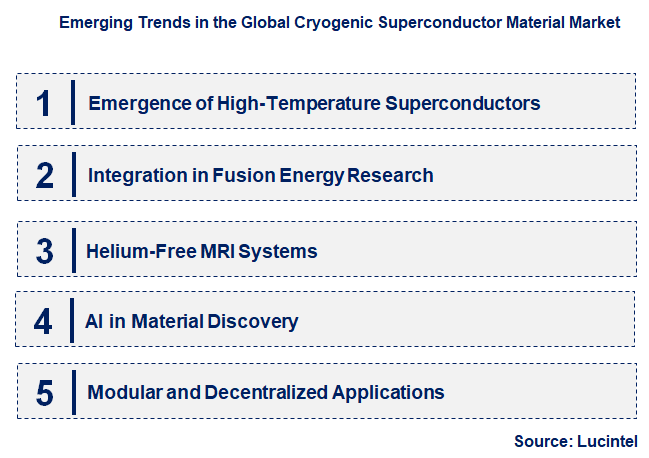
The cryogenic superconductor material market is being influenced by a number of prominent emerging trends that are advancing the technology from a niche industry to a mainstream market. These trends are a global response to challenges in energy efficiency, healthcare, and high-performance computing. They are radically transforming superconductor production, application, and commercialization, making the market more accessible and usable. The sector is heading toward a reality where superconducting technologies are part of everyday infrastructure and scientific research.• Emergence of High-Temperature Superconductors: The biggest trend is the increasing dominance of High-Temperature Superconductors (HTS). These compounds function at temperatures far higher than conventional superconductors, which are generally cooled by liquid nitrogen rather than the costly liquid helium. The effect is a reduction in cooling costs and complication, which makes superconducting technology more commercially viable for more widespread applications, such as power grids and industrial motors. This is driving the transition from research to large-scale implementation.
• Integration in Fusion Energy Research: There is a new trend of incorporating superconducting materials, especially HTS magnets, into nuclear fusion reactors. Fusion offers the hope of clean, unlimited energy, but it needs ultra-strong magnetic fields to hold back the superheated plasma. The effect is a new, high-growth application area for superconductors. Large initiatives such as the SPARC reactor are being based on HTS technology, which is stimulating high investment and innovation in the industry, putting it at the epicenter of the world’s clean energy shift.
• Helium-Free MRI Systems: One of the major trends in the healthcare industry is the creation of helium-free or low-helium MRI systems. Conventional MRI machines need enormous quantities of liquid helium for cooling, which is a rare and costly commodity. The result is cost savings in operation and a greener model of healthcare. This technology, spearheaded by researchers and manufacturers, is bringing advanced medical imaging within reach, particularly in areas where liquid helium is hard to access, thus broadening the scope of the market.
• AI in Material Discovery: One of the trends that is speeding up innovation is artificial intelligence (AI) and machine learning use in the discovery of new superconducting materials. AI methods can sift through massive datasets to forecast and invent new materials with enhanced properties, like increased critical temperature. The result is a much accelerated and optimized research and development process. This is giving rise to the swift identification of new materials, like some hydrides and iron-based superconductors, that have the capability of transforming the sector.
• Modular and Decentralized Applications: A trend towards modular and decentralized applications for superconductors is increasing. This encompasses small-scale compact units for stabilizing grids, such as SMES units, and quantum computing modular systems. The effect is a more scalable and flexible market. These smaller, distributed devices may be put where the need is greatest, rendering the technology more flexible and available for a greater range of industrial and commercial applications. These trends cumulatively are transforming the market by making cryogenic superconductors more available, affordable, and versatile, setting the industry up for substantial growth in a variety of high-impact fields.
Recent Development in the Cryogenic Superconductor Material Market
The cryogenic superconductor material industry is currently undergoing a phase of substantial development, transitioning from an advanced research application to a realm of viable commercial use. These advancements are not in isolation but are associated with an enhanced global consensus on exploiting the distinctive properties of superconductors for practical functions. The innovations are focused on enhancing material performance, costs reduction, and opening up a wider variety of industries that can tap into this technology. All these changes are important for the market to continue growing and be sustainable in the long term.• HTS Critical Current Density Breakthroughs: The key innovation is the enhancement of High-Temperature Superconductors’ (HTS) critical current density (JC). Scientists are applying emerging fabrication methods and material compositions to design HTS tapes that can carry higher current without losing superconductivity. The result is a more compact and intense conductor. This breakthrough is key to uses such as high-field fusion reactor magnets and smaller but more powerful MRI machines, extending the limits of what can be achieved with superconducting technology.
• Adoption in Grid Modernization: One of the primary developments is increasing adoption of superconducting cables for grid modernization initiatives. Superconducting cables are able to transfer a lot of electricity with no loss, which is a principal inefficiency of the old power grids. The effect is a more resilient and efficient power infrastructure. Governments and utility operators across the globe are investing in demonstration projects for testing and deploying these cables, which is establishing a new and important commercial market for superconducting materials.
• Progress in Quantum Computing: The quantum computing industry is leading a tremendous growth in the market. Superconducting materials are an essential building block of superconducting quantum bits (qubits). New advances in materials quality and manufacturing processes are yielding more stable, more reliable qubits. The effect is that this is speeding the process of making practical quantum computers. This is a high-tech, high-value application that is drawing major investment and driving demand for specialized cryogenic superconductor materials.
• Helium-Recycling and Helium-Free Technologies: The key innovation is the emphasis on creating technologies for minimizing liquid helium dependence. It encompasses new helium recycling systems for widespread application and the design of helium-free MRI magnets. The effect is a cost-efficient and more sustainable operation model. This innovation solves the problem of helium shortage and expense, making the superconducting technology more financially viable and lowering its environmental impact.
• Standardization and Automation of Production: One of the most significant developments is the shift in the industry towards standardization and automation of the manufacturing process of superconducting wires and tapes. Conversion from a process on a laboratory scale to an industrial scale is important for mass production. The effect is a tremendous decrease in cost of production and an improvement in consistency of the product. This development is crucial for rendering superconductors an economically feasible substitute for traditional materials in commercial-scale applications. These advancements are contributing to the market as a whole, decreasing barriers to entry, raising the efficiency of the operation, and expanding the applicability of cryogenic superconductor materials, setting the industry up for an era of far-reaching adoption.
Strategic Growth Opportunities in the Cryogenic Superconductor Material Market
The cryogenic superconductor material industry is replete with strategic growth opportunities in a range of key applications. Businesses that can strategically position themselves to address these will be set for long-term success. These opportunities lie outside basic applications and into new, high-growth areas, based on worldwide demands for efficiency, sustainability, and technological innovation. Strategic growth will result from the capacity to innovate and deliver specialized solutions for targeted segments.• Fusion Energy and High-Field Magnets: The new and exciting technology of fusion energy is a large strategic growth opportunity. Fusion reactors, including tokamaks, need incredibly powerful superconducting magnets to confine the plasma. Firms can excel at manufacturing high-field, High-Temperature Superconductor (HTS) magnets. The effect is access to a high-growth, high-value market that is seeing enormous public and private investment.
• Medical Imaging and Diagnostics: The health sector, namely for MRI and NMR systems, is a central strategic growth prospect. The market awaits the development of helium-free magnet technology. Businesses can focus on creating and producing these magnets, which are less expensive and more convenient. The effect is a diversified revenue stream and a wider customer base, especially in emerging markets, where the expense and logistics of liquid helium have been a significant limitation to adoption.
• Power Transmission and Smart Grids: The worldwide drive for grid modernization and energy efficiency presents a strategic growth opportunity. Businesses can offer superconducting power cables and fault current limiters to electric utility firms. The effect is access to a vast, established market and participation in national infrastructure initiatives. By providing solutions that decrease energy loss and enhance grid stability, firms can become critical collaborators in the shift to a more efficient and sustainable energy system.
• Advanced Electronics and Quantum Computing: The quantum computing industry is a new, high-growth industry. Firms can focus on manufacturing high-performance, custom-designed superconducting materials for application in qubits and interconnects. The effect is a presence in a state-of-the-art, high-tech sector. This entails emphasis on precision manufacturing and cooperative working with quantum computing research organizations to create materials that will satisfy the extreme demands for quantum coherence and stability.
• Industrial Motors and Generators: Industrial motors and generators represent a strategic potential for the use of superconductors. Industrial motors, which power manufacturing and transportation, may be compacted, lightened, and made more powerful with superconducting materials. The effect is energy savings and a new market for high-grade superconducting materials. By focusing on energy-hungry industries, businesses can offer solutions with substantial operational cost savings and reduced environmental impact. These strategic growth opportunities are making their mark on the market by fueling specialization and innovation. The market is heading toward a future in which custom, high-performance superconducting solutions are the key to success in several, high-impact applications.
Cryogenic Superconductor Material Market Driver and Challenges
The cryogenic superconductor material industry is defined by a group of strong drivers and notable challenges. Drivers are mostly based on a worldwide requirement for energy efficiency, medical innovation, and technological development. Challenges, however, lie in the natural technical complexity, high price tag, and supply chain challenges of the business. The trajectory of its markets will depend on how effectively it can capitalize on these drivers while methodically conquering its challenges. The factors responsible for driving the cryogenic superconductor material market include: 1. Energy Efficiency Demand: Global efforts to save energy and minimize carbon emissions are a key driver. Superconductors present a novel solution by making power transmission and storage at zero loss possible. This aspect is especially compelling for upgrading old power grids and incorporating renewable sources of power, which are leading to strong investment in superconducting cables and energy storage systems. 2. Medical Imaging Technology Advances: The healthcare industry is one of the major push factors with growing need for advanced diagnostic equipment. MRI and NMR equipment is based on superconducting magnets, and with the development of healthcare facilities worldwide, there is an expanded demand for such materials. This is a stable and profitable market that makes it a strong commercial backbone for the business. 3. Government and Private R&D Funding: Heavy government support and private investment in research and development are strong accelerators. This applies to research ventures in areas like fusion energy, quantum computing, and high-energy physics. These long-term, high-risk projects establish a steady and increasing need for sophisticated superconducting materials, driving the technology to new levels. 4. Technological Breakthroughs: Ongoing technological innovation is a major driver. This encompasses the creation of more easily cooled High-Temperature Superconductors (HTS) and new production techniques that are lowering production costs and boosting material performance, rendering the technology more commercially attractive for novel applications. 5. Development of Quantum Computing: A key driver is the explosive growth of the quantum computing market. Superconductors are the building material for most forms of quantum computers, and as the competition to develop the first viable quantum machine becomes greater, so does the need for high-quality specialist superconducting materials. Challenges in the cryogenic superconductor material market are: 1. High Operating and Manufacturing Cost: One of the biggest challenges is the high cost of fabricated and operating superconducting systems. Superconducting materials themselves have high cost, and the requirement for complicated and expensive cryogenic coolers, particularly for Low-Temperature Superconductors (LTS), is often a limitation for fabricated applications for many. 2. Technical and Material Limitations: The industry faces significant technical challenges. Many HTS materials are brittle and difficult to manufacture in long, continuous lengths, which limits their use in large-scale projects. Additionally, maintaining the extreme cold temperatures required for superconductivity is technically complex and requires constant energy input. 3. Raw Material Shortage and Supply Chain: One of the main challenges is the scarce and politically sensitive supply of some raw materials like yttrium and rare earth elements, which are essential to manufacture some kinds of superconductors. This can lead to supply chain bottlenecks and price fluctuations, which can delay large-scale manufacturing. Overall, the cryogenic superconductor material market is driven by powerful drivers in energy, healthcare, and technology with strong support from funding for research. Yet, it needs to overcome vast challenges involving high cost, technical constraints, and supply chain risks. The long-term success of the markets depends upon how it reduces the barriers to entry and brings the technology more within reach and cost-effective for a broader array of uses.List of Cryogenic Superconductor Material Companies
Companies in the market compete on the basis of product quality offered. Major players in this market focus on expanding their manufacturing facilities, R&D investments, infrastructural development, and leverage integration opportunities across the value chain. With these strategies cryogenic superconductor material companies cater increasing demand, ensure competitive effectiveness, develop innovative products & technologies, reduce production costs, and expand their customer base. Some of the cryogenic superconductor material companies profiled in this report include-• American Superconductor Corporation
• SuperPower
• Sumitomo Electric Industries
• Bruker Energy & Supercon Technologies
• Hyper Tech Research
• THEVA Dünnschichttechnik
• Western Superconducting Technologies
• SAMRI Advanced Material
• Sam Dong
• Cryomagnetics
Cryogenic Superconductor Material Market by Segment
The study includes a forecast for the global cryogenic superconductor material market by material type, product form, end use, and region.Cryogenic Superconductor Material Market by Material Type [Value from 2019 to 2031]:
• Low Temperature Superconductors
• High Temperature Superconductors
• Emerging Superconductor Materials
Cryogenic Superconductor Material Market by Product Form [Value from 2019 to 2031]:
• Superconducting Wires
• Bulk Superconductor Materials
• Thin Film Superconductors
• Superconducting Powders & Precursors
Cryogenic Superconductor Material Market by End Use [Value from 2019 to 2031]:
• Medical & Healthcare
• Energy & Power
• Fusion Energy & Research
• Quantum Computing & Electronics
• Transportation
• Industrial & Scientific
Cryogenic Superconductor Material Market by Region [Value from 2019 to 2031]:
• North America
• Europe
• Asia Pacific
• The Rest of the World
Country Wise Outlook for the Cryogenic Superconductor Material Market
The cryogenic superconductor material industry is experiencing a phase of swift development, fueled by an international drive toward more efficient energy systems, cutting-edge medical technologies, and new-generation computing. Superconductors, materials that can pass electric current without resistance at cryogenic temperatures, are no longer limited to specialized research facilities. Recent breakthroughs are directed towards enhancing material properties, lowering manufacturing costs, and increasing commercial uses of both Low-Temperature Superconductors (LTS) and High-Temperature Superconductors (HTS). This is making the market switch from scientific novelty to commercially successful business with a plethora of practical applications.• United States: In the United States, recent advancements are primarily driven by major government investment and private sector investment in priority areas. The US Department of Energy’s (DOE) Super Mat initiative is enabling superconducting tape manufacturing automation, with faster innovation. High emphasis is placed on High-Temperature Superconductors (HTS) in grid modernization and fusion power initiatives, such as the SPARC reactor. The market also observes steady expansion in the healthcare industry, with helium-free MRI system research used to save operation costs.
• China: China is also one of the strongest players in the market, with progress driven by a national strategy aimed at attaining technological supremacy. Large-scale production of High-Temperature Superconductor (HTS) cables for power transmission has a strong government momentum. Current developments encompass strong research in iron-based superconductors as well as applying them in leading-edge technologies. China is also heavily investing in fusion energy research, with superconducting magnets forming the core part of its ambitious projects, further increasing domestic consumption.
• Germany: Germany’s economy is dominated by a high focus on research and advanced manufacturing. Current developments involve manufacturing high-quality superconducting materials, particularly High-Temperature Superconductors (HTS), for industrial and energy uses. German industries are leading the development of superconducting magnetic energy storage (SMES) systems for grid stabilization. Germany remains a market leader in the medical imaging business, with ongoing research to enhance the efficiency and performance of MRI systems.
• India: India’s superconductor material market for cryogenics is in its infancy stage but expanding, with advancements fueled by a national drive for energy efficiency and an emerging healthcare industry. Indigenous development of superconducting material, especially for medical diagnostic and power transmission applications, is emphasized. One of the major developments is the creation of affordable MRI scanners that are independent of rare liquid helium, a significant milestone in terms of making advanced healthcare technology affordable throughout the nation.
• Japan: Japan’s economy is one of the most innovative in the world, with advances centered on precision engineering and advanced applications. Japan is a leader in magnetic levitation (maglev) train technology, which is based on superconducting magnets. Recent advances have seen breakthroughs in the synthesis of advanced materials and ongoing advances on High-Temperature Superconductors (HTS) to enhance efficiency. Japanese industry also leads the way in the research and development of high-field superconducting magnets for application in medical equipment and advanced research.

Features of the Global Cryogenic Superconductor Material Market
Market Size Estimates: Cryogenic superconductor material market size estimation in terms of value ($B). Trend and Forecast Analysis: Market trends (2019 to 2024) and forecast (2025 to 2031) by various segments and regions. Segmentation Analysis: Cryogenic superconductor material market size by material type, product form, end use, and region in terms of value ($B). Regional Analysis: Cryogenic superconductor material market breakdown by North America, Europe, Asia Pacific, and Rest of the World. Growth Opportunities: Analysis of growth opportunities in different material types, product forms, end uses, and regions for the cryogenic superconductor material market. Strategic Analysis: This includes M&A, new product development, and competitive landscape of the cryogenic superconductor material market. Analysis of competitive intensity of the industry based on Porter’s Five Forces model.
FAQ
Q1. What is the growth forecast for cryogenic superconductor material market? Answer: The global cryogenic superconductor material market is expected to grow with a CAGR of 9.3% from 2025 to 2031. Q2. What are the major drivers influencing the growth of the cryogenic superconductor material market? Answer: The major drivers for this market are the increasing demand for efficient power transmission, the rising adoption of renewable energy technologies, and the growing need for advanced cooling systems. Q3. What are the major segments for cryogenic superconductor material market? Answer: The future of the cryogenic superconductor material market looks promising with opportunities in the medical & healthcare, energy & power, fusion energy & research, quantum computing & electronic, transportation, and industrial & scientific markets. Q4. Who are the key cryogenic superconductor material market companies? Answer: Some of the key cryogenic superconductor material companies are as follows:• American Superconductor Corporation
• SuperPower
• Sumitomo Electric Industries
• Bruker Energy & Supercon Technologies
• Hyper Tech Research
• THEVA Dünnschichttechnik
• Western Superconducting Technologies
• SAMRI Advanced Material
• Sam Dong
• Cryomagnetics Q5. Which cryogenic superconductor material market segment will be the largest in future? Answer: Lucintel forecasts that, within the material type category, high temperature superconductor is expected to witness the highest growth over the forecast period. Q6. In cryogenic superconductor material market, which region is expected to be the largest in next 5 years? Answer: In terms of region, North America will remain the largest region over the forecast period. Q7. Do we receive customization in this report? Answer: Yes, Lucintel provides 10% customization without any additional cost.
Table of Contents
List of Figures
List of Tables
Methodology
- In-depth interviews of the major players in this market
- Detailed secondary research from competitors’ financial statements and published data
- Extensive searches of published works, market, and database information pertaining to industry news, company press releases, and customer intentions
- A compilation of the experiences, judgments, and insights of Lucintel’s professionals, who have analyzed and tracked this market over the years.


Buy Now
Choose a license that fits your team. Instant PDF delivery.
Prices exclude taxes. Instant delivery. Custom licensing available on request.
Key Questions
- • What are some of the most promising, high-growth opportunities for the cryogenic superconductor material market by material type (low temperature superconductors, high temperature superconductors, and emerging superconductor materials), product form (superconducting wires, bulk superconductor materials, thin film superconductors, and superconducting powders & precursors), end use (medical & healthcare, energy & power, fusion energy & research, quantum computing & electronics, transportation, and industrial & scientific), and region (North America, Europe, Asia Pacific, and the Rest of the World)?
- • Which segments will grow at a faster pace and why?
- • Which region will grow at a faster pace and why?
- • What are the key factors affecting market dynamics? What are the key challenges and business risks in this market?
- • What are the business risks and competitive threats in this market?
- • What are the emerging trends in this market and the reasons behind them?
- • What are some of the changing demands of customers in the market?
- • What are the new developments in the market? Which companies are leading these developments?
- • Who are the major players in this market? What strategic initiatives are key players pursuing for business growth?
- • What are some of the competing products in this market and how big of a threat do they pose for loss of market share by material or product substitution?
- • What M&A activity has occurred in the last 5 years and what has its impact been on the industry? For any questions related to Cryogenic Superconductor Material Market, Cryogenic Superconductor Material Market Size, Cryogenic Superconductor Material Market Growth, Cryogenic Superconductor Material Market Analysis, Cryogenic Superconductor Material Market Report, Cryogenic Superconductor Material Market Share, Cryogenic Superconductor Material Market Trends, Cryogenic Superconductor Material Market Forecast, Cryogenic Superconductor Material Companies, write Lucintel analyst at email: helpdesk@lucintel.com. We will be glad to get back to you soon.


