
Market Report · July 22, 2026

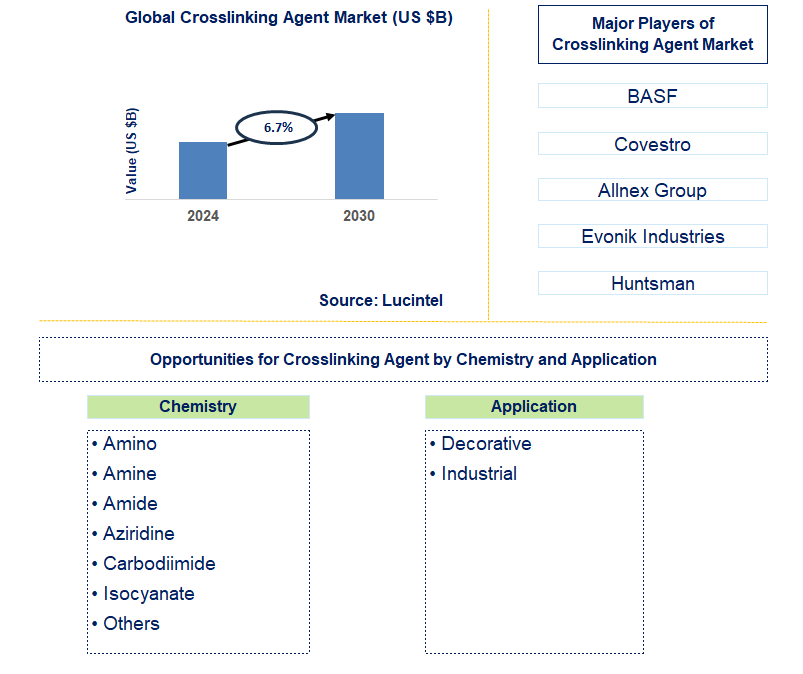
Key data points: The growth forecast = 6.7% annually for the next 6 years. Scroll below to get more insights. This market report covers trends, opportunities, and forecasts in the global crosslinking agent market to 2030 by chemistry (amino, amine, amide, aziridine, carbodiimide, isocyanate, and others), application (decorative and industrial), and region (North America, Europe, Asia Pacific, and the Rest of the World)
We'll send your sample report shortly.
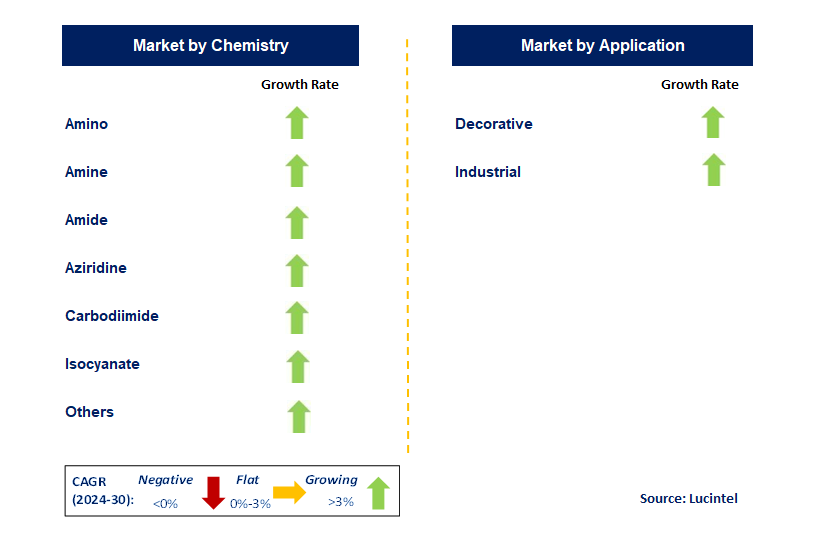
• Lucintel forecasts that, within the chemistry category, the amino segment will remain the largest segment over the forecast period because they have strong cross-linking capabilities and compatibility with a variety of polymers.
• Within the application category, industrial will remain a larger segment because it improves the performance and durability of materials in these sectors.
• In terms of regions, APAC is expected to witness the highest growth over the forecast period due to the region's strong industrial and manufacturing sector which generates substantial demand for cross-linking agents in various industries. Gain valuable insights for your business decisions with our comprehensive 150+ page report.
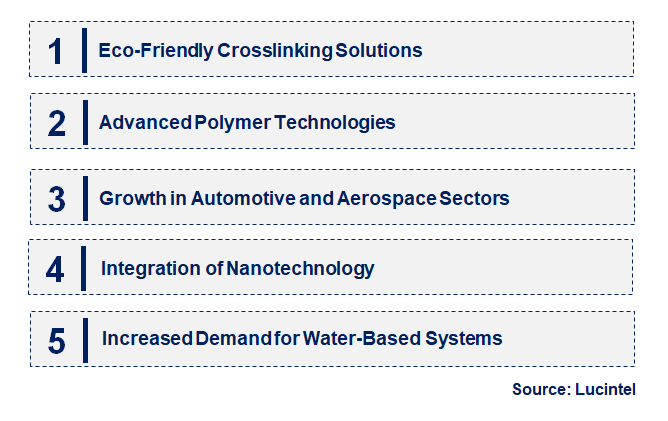
• Eco-Friendly Crosslinking Solutions: There is growing demand for crosslinking agents with reduced environmental impact, driven by regulatory standards. Manufacturers are focusing on low-VOC and biodegradable options to meet sustainability goals and reduce toxic emissions.
• Advanced Polymer Technologies: Innovations in polymer chemistry are leading to the development of more efficient crosslinking agents, offering enhanced durability, flexibility, and heat resistance. These advancements are expanding the market across high-performance applications.
• Growth in Automotive and Aerospace Sectors: Lightweight materials are becoming increasingly important in the automotive and aerospace industries. Crosslinking agents are being used to create lightweight composites and coatings that improve fuel efficiency and meet stringent emissions regulations.
• Integration of Nanotechnology: Nanotechnology is playing a pivotal role in the development of crosslinking agents, enabling better control over material properties. This allows for greater precision in industrial applications, enhancing product strength and longevity.
• Increased Demand for Water-Based Systems: The market is seeing a shift toward water-based crosslinking systems, which offer better environmental performance and safety. These systems are gaining popularity, particularly in coatings and adhesives, where reducing solvent use is a key focus. These trends are reshaping the crosslinking agent market by promoting innovation, improving product performance, and meeting environmental regulations while expanding applications in industries like automotive, construction, and electronics.
• Development of Bio-Based Crosslinking Agents: Manufacturers are investing in bio-based crosslinking agents to meet the growing demand for sustainable products. These agents reduce reliance on petrochemical-based materials and align with global environmental goals.
• Advancements in UV-Curable Crosslinking: UV-curable crosslinking agents are gaining traction due to their fast curing times and reduced energy consumption. This technology is increasingly used in coatings and inks, improving production efficiency.
• Growth of Epoxy-Based Crosslinking Agents: Epoxy-based crosslinking agents are witnessing high demand in the construction and automotive sectors due to their superior adhesion and resistance to environmental factors, driving innovation in these industries.
• Focus on Low-Emission Crosslinking Agents: In response to stringent environmental regulations, manufacturers are developing low-emission crosslinking agents that meet regulatory standards while maintaining performance across various applications.
• Technological Integration in Production: Automation and AI integration in crosslinking agent manufacturing have increased production efficiency, lowered costs, and improved quality control, driving the adoption of advanced technologies in the market. These developments are accelerating the growth of the crosslinking agent market by promoting sustainability, enhancing performance, and improving production efficiency across key industries.
• Construction Industry: The growing demand for durable and weather-resistant materials in construction is driving the use of crosslinking agents in coatings and sealants. These agents improve the longevity and performance of building materials, particularly in harsh environmental conditions.
• Automotive Industry: Crosslinking agents are increasingly used in the production of lightweight composite materials for automotive applications. This contributes to improved fuel efficiency and reduced emissions, aligning with global trends in vehicle electrification and sustainability.
• Aerospace Industry: The aerospace sector is focusing on advanced crosslinking technologies to produce high-performance materials that offer greater heat resistance and durability. This is essential for manufacturing components used in extreme conditions.
• Electronics Industry: The electronics market is expanding its use of crosslinking agents to improve the reliability and performance of components such as adhesives, coatings, and encapsulants, which are critical in the production of high-tech devices.
• Medical Applications: Crosslinking agents are being utilized in medical devices and pharmaceuticals, particularly in the development of biocompatible materials. This is driving innovations in medical coatings, drug delivery systems, and tissue engineering. These growth opportunities are shaping the future of the crosslinking agent market, driving innovation, and expanding its applications across a wide range of industries.
• Technological Advancements: Innovations in polymer chemistry and production processes improve the efficiency and performance of crosslinking agents, driving demand across industries.
• Sustainability Goals: Increasing environmental regulations push manufacturers to develop eco-friendly crosslinking agents, aligning with global sustainability trends.
• Growing Industrial Demand: The rise of industrial applications, particularly in construction, automotive, and electronics, boosts the demand for high-performance crosslinking agents.
• Lightweight Material Adoption: The automotive and aerospace sectors increasingly adopting lightweight materials, driving the use of crosslinking agents for composites and coatings.
• R&D Investments: Ongoing research and development efforts lead to the creation of new crosslinking technologies that offer better performance and environmental benefits. Challenges in the crosslinking agent market include:
• High Production Costs: The cost of producing high-performance crosslinking agents remains a challenge, particularly for small and mid-sized manufacturers.
• Regulatory Pressure: Stricter environmental regulations increase production costs and push manufacturers to adopt more sustainable practices, which may limit profitability.
• Supply Chain Issues: Disruptions in the global supply chain impact the availability of raw materials, leading to delays and increased costs in production. Overall, these drivers and challenges shape the future of the crosslinking agent market, creating both opportunities and obstacles for growth and innovation.
• BASF
• Covestro
• Allnex Group
• Evonik Industries
• Huntsman
• Aditya Birla
• Wanhua Chemicals Group
• The Dow Chemical Company
• DSM Coatings Resins
• INEOS
• Amino
• Amine
• Amide
• Aziridine
• Carbodiimide
• Isocyanate
• Others
• Decorative
• Industrial
• North America
• Europe
• Asia Pacific
• The Rest of the World
• United States: The USA market witnesses a focus on eco-friendly crosslinking agents due to strict environmental regulations. Major players invest in low-VOC (volatile organic compounds) solutions, advancing product sustainability while improving performance across coatings and adhesives sectors.
• China: The Chinese crosslinking agent market is expanding rapidly due to industrial growth in manufacturing and construction. Recent investments in research led to the development of novel crosslinking technologies aimed at improving strength and durability in industrial applications.
• Germany: In Germany, the automotive and aerospace industries drive innovations in crosslinking technologies. Manufacturers focus on lightweight, high-performance materials that enhance energy efficiency and reduce environmental impact, aligning with the country’s green energy goals.
• India: The Indian market for crosslinking agents is experiencing growth due to increased demand in construction and electronics. Local manufacturers expand production capacities, driven by the government’s infrastructure projects and the rise of consumer electronics industries.
• Japan: The Japanese crosslinking agent market evolves with a focus on high-performance coatings and adhesives, especially in the automotive sector. Technological advancements enable the production of crosslinking agents that offer better heat resistance and durability for demanding applications.


• BASF
• Covestro
• Allnex Group
• Evonik Industries
• Huntsman
• Aditya Birla
• Wanhua Chemicals Group
• The Dow Chemical Company
• DSM Coatings Resins
• INEOS Q5. Which crosslinking agent market segment will be the largest in future? Answer: Lucintel forecasts that amino segment will remain the largest segment over the forecast period because they have strong cross-linking capabilities and compatibility with a variety of polymers. Q6. In crosslinking agent market, which region is expected to be the largest in next 5 years? Answer: APAC is expected to witness the highest growth over the forecast period due to the region's strong industrial and manufacturing sector which generate substantial demand for cross-linking agents in various industries. Q.7 Do we receive customization in this report? Answer: Yes, Lucintel provides 10% customization without any additional cost.


Choose a license that fits your team. Instant PDF delivery.
Prices exclude taxes. Instant delivery. Custom licensing available on request.
Market Report · July 22, 2026
Market Report · July 22, 2026
Market Report · July 22, 2026
Trusted partner for strategic intelligence and business growth


Receive a complimentary market analysis tailored to your industry. Our analysts will identify key growth opportunities and competitive dynamics specific to your business.

Market size, growth rate, and key trend analysis for your specific sector.

Top competitor positioning and market share analysis.

Strategic recommendations backed by data-driven insights.
Get curated market intelligence and competitive moves straight to your inbox.
By subscribing, you agree to receive our monthly insights. Unsubscribe anytime.
Receive a complimentary market analysis tailored to your industry. Our analysts will identify key growth opportunities and competitive dynamics specific to your business.
Market size, growth rate, and key trend analysis for your specific sector.
Top competitor positioning and market share analysis.
Strategic recommendations backed by data-driven insights.
Get curated market intelligence, emerging trends, and competitive moves straight to your inbox each month.
By subscribing, you agree to receive our monthly insights. Unsubscribe anytime.
We'll send your sample report shortly.