
Close Lucintel Chat
Didn't Find What You're Looking for?
Call us at +1972 636 5056 or write at helpdesk@Lucintel.com
Ask an Expert Provide Custom Requirements Download Sample Report Search Available Reports
  • helpdesk@Lucintel.com
  • |
  • Call Lucintel +1 972 636 5056
  • |
  • Login
  • |
  • Register
  • |
  • Search
  • |
'
...

The Impact of COVID-19 is included in Cosmetic Oil Market Report. Buy it today to get an advantage.

Request the impact of COVID-19 on your product or industry


Cosmetic Oil Market Trends and Forecast

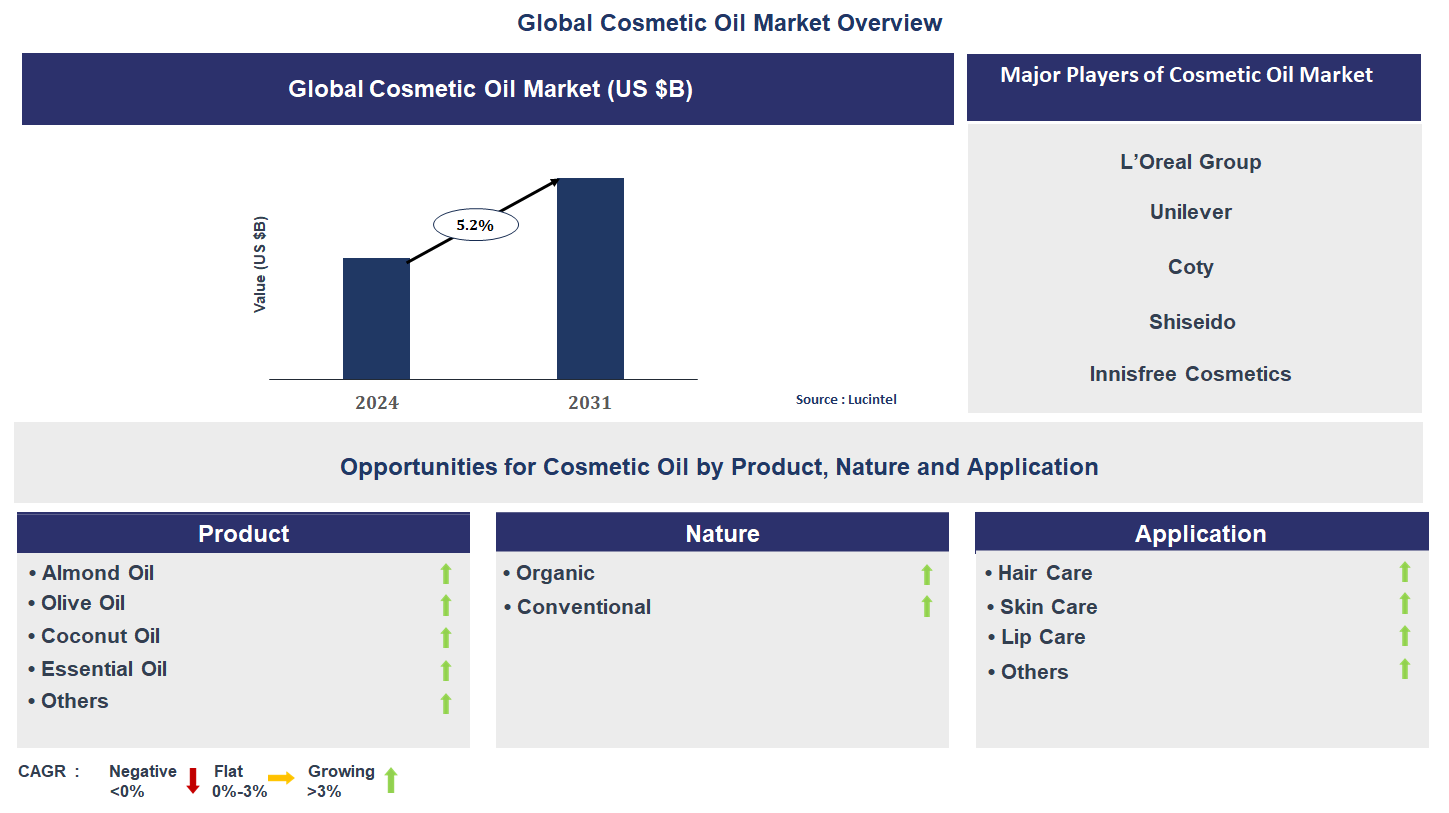
The future of the global cosmetic oil market looks promising with opportunities in the hair care, skin care, and lip care markets. The global cosmetic oil market is expected to grow with a CAGR of 5.2% from 2025 to 2031. The major drivers for this market are the increasing preference for natural skincare, the rising demand for organic beauty products, and the growing awareness of skin health benefits.

• Lucintel forecasts that, within the product category, essential oil is expected to witness the highest growth over the forecast period.
• Within the application category, hair care is expected to witness the highest growth.
• In terms of region, North America is expected to witness the highest growth over the forecast period.
Gain valuable insights for your business decisions with our comprehensive 150+ page report. Sample figures with some insights are shown below.
Cosmetic Oil Market Trends and Forecast

Emerging Trends in the Cosmetic Oil Market

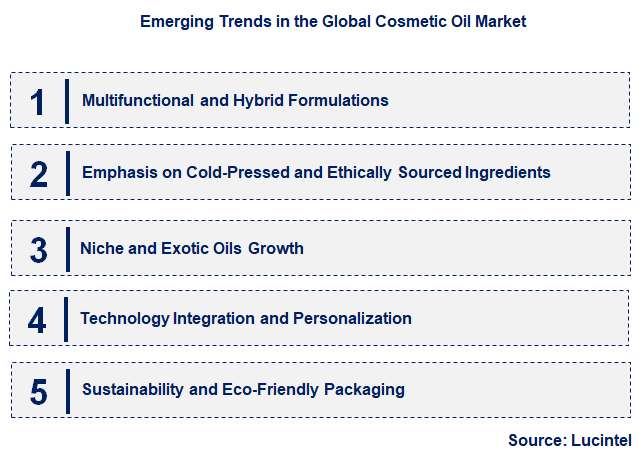
The beauty oil industry is being redefined by a number of important up-and-coming trends that mirror a global movement towards a more integrated and personalized beauty and wellness routine. These trends are more than about new items; they are about altered consumer values, the incorporation of technology, and a greater emphasis on sustainability. From multi-functional products to the use of advanced extraction technologies, all these innovations are leading the industry into a more innovative and dynamic direction.
• Multifunctional and Hybrid Formulations: One of the key trends is the creation of multifunctional and hybrid cosmetic oils. People are steering away from single-use products and looking for oils that can be applied on the face, body, and hair, or in both skincare and makeup routines. This has been bringing about hybrid products such as oil cleansers, which clean off makeup while hydrating the skin, and face oils which also double up as a primer.
• Emphasis on Cold-Pressed and Ethically Sourced Ingredients: One of the major trends is the demand from consumers for cold-pressed and ethically sourced cosmetic oils. With increasing awareness of the impact of their purchases on the environment and society, consumers are opting for products that do not disturb the natural integrity of the ingredients. This movement is pushing brands towards creating pure supply chains and collaborating with local communities. Such an emphasis on purity and moral manufacturing instills consumer confidence and makes brands stand out in a crowded market.
• Niche and Exotic Oils Growth: The market is witnessing a shift towards the incorporation of niche and exotic oils from around the globe. In addition to the conventional oils of coconut and jojoba, consumers are now turning to ingredients like marula, baobab, and prickly pear seed oil for their distinct properties and nutritional profiles. Social media and global travel bring consumers into contact with new beauty routines and ingredients, driving the movement.
• Technology Integration and Personalization: The cosmetic oil industry is increasingly being integrated with technology to provide personalized experiences. This involves the employment of AI to scan a consumer’s skin type and suggest a customized blend of oil. Certain brands are employing digital platforms to conduct virtual consultations and workshops on the optimal use of their products.
• Sustainability and Eco-Friendly Packaging: Sustainability is also a dominant trend shaping the market outside of ingredients. Brands are shifting towards eco-friendly packaging options like glass bottles, recyclables, and refillable containers in order to minimize their ecological impact. This is in reaction to increased consumer demand for less waste and more sustainable business practices. This is not only a marketing campaign but also a seismic change in how businesses design, make, and sell their products.
These new trends are together transforming the market for cosmetic oils by driving it towards a more rounded and consumer-driven model. The emergence of multifunctional products and niche oils are extending the reach and applications of the market. Concurrently, an emphasis on sustainability, responsible sourcing, and technology integration is establishing a new platform of trust and transparency. These are shifting the industry away from a sole emphasis on efficacy towards a commitment to health, wellness, and earth stewardship.
Emerging Trends in the Cosmetic Oil Market

Recent Development in the Cosmetic Oil Market

The cosmetic oil industry is undergoing a period of swift evolution, fueled by a convergence of consumer behavior, technological advances, and an increasing focus on sustainability. These trends are not only changing the kinds of products out there but also deeply transforming how cosmetic oils are manufactured, marketed, and used. The five points that follow describe five major trends that are shaping the market right now.
• Innovation in Dry-Finish and Lightweight Formulations: One important development is the innovation in the formulation of lightweight and dry-finish cosmetic oils. In the past, a downfall for oils was their oily consistency and slow absorption. With advanced technology, manufacturers are now employing methods to design formulations that weigh nothing on skin and hair. This evolution has been instrumental in breaking one of the biggest adoption barriers, especially in humid climates regions, and has made oils more attractive to a wider range of consumers.
• Emergence of CBD and Hemp-Based Oils: One of the latest trends is the explosive expansion of the CBD and hemp-based oil segment. As laws regarding cannabis-infused products have relaxed across much of the world, brands are taking advantage of the anti-inflammatory, soothing, and skin-calming properties of these ingredients. This has created a new category of cosmetic oils specifically sold for their wellness and therapeutic benefits, targeting consumers who want an integrated beauty solution.
• Hair and Scalp Treatment Expansion: Although cosmetic oils have long been applied to hair, one of the newer trends is their expansion into targeted hair and scalp treatment uses. Brands are creating specifically designed oil formulations that target specific issues like dandruff, baldness, and dry scalp. These products tend to be concentrated with essential oils and plant extracts, offering a more natural alternative to conventional chemical treatments and responding to a burgeoning appeal for holistic hair care.
• Creation of Water-Soluble Oils: Yet another recent innovation is the formulation of water-soluble cosmetic oils. This technology is enabling the use of oils in a broader category of products, such as lotions, serums, and masks, without compromising the texture or stability of the product. This innovation increases the advantages of cosmetic oils and makes them more versatile for both formulators and consumers, which results in new product segments and applications.
• Blockchain Technology and Traceability: To address consumers’ calls for transparency, one of the significant developments is the utilization of blockchain technology to trace cosmetic oils’ sourcing. This technology enables brands to establish a traced record of a product’s pathway from the source plant to the finished bottle. This innovation fosters trust among consumers through the guarantee of authenticity and ethical origin of ingredients, especially high-value ingredients such as argan and rosehip.
These new trends are collectively changing the cosmetic oil industry by making it a more advanced and consumer-oriented marketplace. The advances in light texture formulations and water-dispersion oils are enhancing the versatility and attractiveness of the products. The emerging niche markets such as CBD oils and specialist hair treatments reflect a maturing market that is addressing a broad range of demands. At the same time, the use of blockchain technology for traceability is raising the standard for transparency and ethical practices across the board.

Strategic Growth Opportunities in the Cosmetic Oil Market

The cosmetic oil industry presents numerous strategic opportunities for growth in major applications based on a combination of consumer trends and technology development. Developing on these opportunities needs to be underpinned by a penetrating insight into market demands and an active innovation culture. Firms with the ability to focus on these areas of growth have the potential to expand significantly and lead the market.
• Senior and Mature Consumer Market: The major growth potential lies in creating cosmetic oils for the senior and mature consumer demographic. This segment is increasing and has high disposable income. Their particular concerns, like treating dryness, wrinkles, and age spots, can be addressed with specific oil compositions that are full of anti-aging substances such as antioxidants and essential fatty acids.
• Professional and Spa Channel Growth: There is a strategic expansion opportunity in growing the market through professional channels such as spas, salons, and dermatologists’ offices. They offer a platform for expert recommendation and product education, essential for cosmetic oils. By providing professional-level formulas and sizes, brands can establish a new revenue source and gain brand trust.
• Creating Niche Products for Certain Skin Issues: One of the growth potential areas is to develop niche lines that cater to particular skin issues like acne skin, sensitive skin, or eczema skin. While oils were previously considered to not be appropriate for these conditions, new studies are showing their advantages. By developing oils with active ingredients such as tea tree or grapeseed oil for acne, or chamomile for sensitivity, companies can command a loyal consumer base.
• Riding the Men’s Grooming Segment: The men’s grooming market represents a sizeable growth opportunity. As more men show a preference for skincare, there is an increasing need for easy-to-use products that are effective. Cosmetic oils are a good fit in this regard, as they can be applied for pre-shave, beard conditioning, and overall skin moisturizing. With the promotion of products by highlighting convenience and stripped-down packaging, brands can reach this segment and earn a new and growing revenue stream.
• Sustainable and Zero-Waste Models: A last strategic growth area is to create and sell products using sustainable and zero-waste business models. This can involve selling refillable bottles, bulk formats, and upcycled-material packaging. By meeting consumer values and environmental aspirations, companies create a strong, passionate base of customers. This strategy not only minimizes environmental footprint but also develops a distinct selling point in a saturated market.
These strategic opportunities for growth are markedly influencing the cosmetic oil market through their push toward increased innovation and consumerism. Targeting specific groups such as seniors and men, and designing products for niche skin afflictions, companies are broadening the reach of the market. The emphasis on alternative distribution channels and sustainable business models similarly shows evidence of a progressive outlook that is in line with shifting consumer values and guarantees the ongoing growth and viability of the industry.

Cosmetic Oil Market Driver and Challenges

The path of the cosmetic oil market is characterized by a complicated interplay of key drivers and issues. Its growth is driven by a growing consumer demand for natural and clean products, which is transforming the beauty regimen all over the world. Yet, this growth is moderated by major challenges associated with the cost of production, market saturation, and intricate regulations. Any company that hopes to thrive in this volatile industry needs a clear grasp of these forces.
The factors responsible for driving the cosmetic oil market include:
1. Increasing Consumer Demand for Natural Ingredients: One of the key drivers of the market is the rising consumer demand for natural and plant-based ingredients. Consumers are becoming increasingly aware of what they put on their skin and are looking for alternatives to synthetic chemicals and mineral oils. Cosmetic oils, which tend to be produced from botanical sources, are perceived to be healthier and safer.
2. Oils’ Versatility and Multi-functionality: The built-in flexibility of cosmetic oils is a key driver. One oil can serve multiple purposes, such as moisturizing the face and body, hair conditioning, makeup removal, and a base oil for essential oil mixtures. This multi-functional appeal is sought after by consumers who are interested in streamlining beauty regimens and minimizing the amount of products they have to apply.
3. Social Media and Beauty Influencer Impact: Social media sites are a driving force behind market growth. Beauty influencers and bloggers are teaching their audience about the advantages of various oils and how to use them in their daily skin care. This aspect of online promotion is very good at getting their message heard worldwide and generating buzz around novel and specialized oils.
4. Increased Demand for Clean Beauty and Wellness Products: Clean beauty is a major force. People are not only seeking products that perform; they are seeking products that are good for people and the world. Cosmetic oils clearly fall under this category, as they tend to be paraben-free, sulfate-free, and free from other unwanted ingredients. This movement associates beauty with health and well-being, making oils a central part of an holistic self-care regimen.
5. Formulation Technology Advancements: Ongoing improvements in formulation and extraction technology are fueling innovation. New methods are being employed to develop cosmetic oils that are more fluid on the skin, absorb more quickly, and are more stable. These innovations are resolving longstanding issues of concern around greasiness and product shelf life. They are also making it possible to develop new oil-based products that fit perfectly into conventional cosmetic ranges.
Challenges in the cosmetic oil market are:
1. Premium Ingredient Cost: One of the biggest hurdles is the premium cost of premium, ethically produced, and organic ingredients. It can be a pricey endeavor to source unusual oils such as argan or prickly pear oil, and it is frequently passed on to the consumer. This renders cosmetic oils a high-end product, restricting their availability to more than a niche market and closing the gap to lower-priced, mineral oil-based products.
2. Misconceptions Regarding Product Effectiveness: Misconceptions regarding the effectiveness of cosmetic oils are another significant challenge. Oils still have a reputation with many consumers that they can clog pores or are intended for use only by individuals with dry skin. These long-standing myths must be reversed through considerable expenditure on consumer education and promotion. Brands need to articulate the advantages of their products and back them with scientific facts.
3. Mass-Market Competition: The market is experiencing direct competition from mass-market substitutes. Conventional lotions, creams, and serums are available everywhere and are usually cheaper. Cosmetic oils can only compete if they consistently prove to have greater benefits. This calls for a very strong marketing effort and a well-defined value proposition to compel consumers to make the switch from their traditional products.
The net effect of these drivers and challenges is a market in a state of fast change. The drivers, spearheaded by consumer demand for natural and ethical products, are driving big opportunities for growth and innovation. They are driving the market to a more technologically driven, sustainable, and transparent future. The challenges, such as high cost of production and consumer misconception, are, however, dampening this growth. In order to realize its full potential, the market needs to develop methods of cost savings, consumer education, and discrimination from mainstream substitutes.

List of Cosmetic Oil Companies

Companies in the market compete on the basis of product quality offered. Major players in this market focus on expanding their manufacturing facilities, R&D investments, infrastructural development, and leverage integration opportunities across the value chain. With these strategies cosmetic oil companies cater increasing demand, ensure competitive effectiveness, develop innovative products & technologies, reduce production costs, and expand their customer base. Some of the cosmetic oil companies profiled in this report include-
• L’Oreal Group
• Unilever
• Coty
• Shiseido
• Innisfree Cosmetics
• Bramble Berry
• Kao Corporation
• Uncle Harry;s Natural Products
• FARSALI
• SOPHIM IBERIA

Cosmetic Oil Market by Segment

The study includes a forecast for the global cosmetic oil market by product, nature, application, and region.

Cosmetic Oil Market by Product [Value from 2019 to 2031]:


• Almond Oil
• Olive Oil
• Coconut Oil
• Essential Oil
• Others

Cosmetic Oil Market by Nature [Value from 2019 to 2031]:


• Organic
• Conventional

Cosmetic Oil Market by Application [Value from 2019 to 2031]:


• Hair Care
• Skin Care
• Lip Care
• Others

Cosmetic Oil Market by Region [Value from 2019 to 2031]:


• North America
• Europe
• Asia Pacific
• The Rest of the World

Country Wise Outlook for the Cosmetic Oil Market

The cosmetic oil industry around the world is undergoing a dramatic shift, with rising consumer demand for natural, plant-based, and multitasking products. This trend is changing beauty habits and forcing companies to get creative with fresh formulas and sustainable sourcing strategies. The growth of clean beauty and the growing consumer demand for products providing both aesthetic and therapeutic functions are the major drivers of this market.
• United States: The United States cosmetic oil industry is booming as a result of the clean beauty movement and high consumer interest in natural ingredients. American consumers are demanding more plant-based oils such as jojoba and argan oil, focusing more on cruelty-free and ethically produced products. Direct-to-consumer brands are capturing a significant share of the market through social media education that informs consumers about the value that various oils offer for particular skincare and hair issues.
• China: China’s cosmetic oil market is growing very fast, driven by an emerging middle class and a growing trend towards natural and traditional beauty regimens. Although global brands remain popular, local brands are popularizing themselves by combining traditional Chinese medicine with advanced cosmetic science. Live streaming and e-commerce websites have emerged as essential channels for product discovery and sales, with influencers endorsing multi-purpose oils for hair and skin care.
• Germany: In Germany, the market for cosmetic oils is established and strictly regulated, with deep roots in natural and organic certifications. German consumers are highly educated and prefer products that are not only effective but also eco-friendly. There’s an inclination towards minimalistic beauty regimens, emphasizing high-quality cold-pressed oils. Brands that offer transparent details on ingredient sourcing and manufacturing processes earn considerable consumer trust.
• India: India’s cosmetics oil industry is steeped in ancient Ayurvedic customs and is currently experiencing a mix of ancient knowledge with contemporary formulations. The industry is experiencing an upsurge in demand for hair and body oils that include traditional elements such as coconut, amla, and neem. The pervasiveness of e-commerce websites is ensuring a variety of products reaches consumers in urban and rural India. This is a price-conscious market, but more and more city consumers are prepared to pay a premium for certified organic and natural oils.
• Japan: The Japanese market for cosmetic oils is dominated by an emphasis on quality, technology, and a liking for lightweight, non-greasy textures. Japanese consumers are increasingly incorporating oils in their multi-step skincare regimens for cleansing and moisturizing. They feature a high demand for oils that provide a luminous or "glass skin" and anti-aging benefits. They are creating new products with traditional Japanese ingredients such as camellia and rice bran oil, while also adopting sustainability and environmentally friendly packaging.

Lucintel Analytics Dashboard

Features of the Global Cosmetic Oil Market

Market Size Estimates: Cosmetic oil market size estimation in terms of value ($B).
Trend and Forecast Analysis: Market trends (2019 to 2024) and forecast (2025 to 2031) by various segments and regions.
Segmentation Analysis: Cosmetic oil market size by product, nature, application, and region in terms of value ($B).
Regional Analysis: Cosmetic oil market breakdown by North America, Europe, Asia Pacific, and Rest of the World.
Growth Opportunities: Analysis of growth opportunities in different products, nature, applications, and regions for the cosmetic oil market.
Strategic Analysis: This includes M&A, new product development, and competitive landscape of the cosmetic oil market.
Analysis of competitive intensity of the industry based on Porter’s Five Forces model.

Lucintel Consulting Services

FAQ

Q1. What is the growth forecast for cosmetic oil market?
Answer: The global cosmetic oil market is expected to grow with a CAGR of 5.2% from 2025 to 2031.
Q2. What are the major drivers influencing the growth of the cosmetic oil market?
Answer: The major drivers for this market are the increasing preference for natural skincare, the rising demand for organic beauty products, and the growing awareness of skin health benefits.
Q3. What are the major segments for cosmetic oil market?
Answer: The future of the cosmetic oil market looks promising with opportunities in the hair care, skin care, and lip care markets.
Q4. Who are the key cosmetic oil market companies?
Answer: Some of the key cosmetic oil companies are as follows:
• L’Oreal Group
• Unilever
• Coty
• Shiseido
• Innisfree Cosmetics
• Bramble Berry
• Kao Corporation
• Uncle Harry;s Natural Products
• FARSALI
• SOPHIM IBERIA
Q5. Which cosmetic oil market segment will be the largest in future?
Answer: Lucintel forecasts that, within the product category, essential oil is expected to witness the highest growth over the forecast period.
Q6. In cosmetic oil market, which region is expected to be the largest in next 5 years?
Answer: In terms of region, North America is expected to witness the highest growth over the forecast period.
Q7. Do we receive customization in this report?
Answer: Yes, Lucintel provides 10% customization without any additional cost.

This report answers following 11 key questions:

Q.1. What are some of the most promising, high-growth opportunities for the cosmetic oil market by product (almond oil, olive oil, coconut oil, essential oil, and others), nature (organic and conventional), application (hair care, skin care, lip care, and others), and region (North America, Europe, Asia Pacific, and the Rest of the World)?
Q.2. Which segments will grow at a faster pace and why?
Q.3. Which region will grow at a faster pace and why?
Q.4. What are the key factors affecting market dynamics? What are the key challenges and business risks in this market?
Q.5. What are the business risks and competitive threats in this market?
Q.6. What are the emerging trends in this market and the reasons behind them?
Q.7. What are some of the changing demands of customers in the market?
Q.8. What are the new developments in the market? Which companies are leading these developments?
Q.9. Who are the major players in this market? What strategic initiatives are key players pursuing for business growth?
Q.10. What are some of the competing products in this market and how big of a threat do they pose for loss of market share by material or product substitution?
Q.11. What M&A activity has occurred in the last 5 years and what has its impact been on the industry?

For any questions related to Cosmetic Oil Market, Cosmetic Oil Market Size, Cosmetic Oil Market Growth, Cosmetic Oil Market Analysis, Cosmetic Oil Market Report, Cosmetic Oil Market Share, Cosmetic Oil Market Trends, Cosmetic Oil Market Forecast, Cosmetic Oil Companies, write Lucintel analyst at email: helpdesk@lucintel.com. We will be glad to get back to you soon.
                                           Table of Contents

            1. Executive Summary

            2. Market Overview

                        2.1 Background and Classifications
                        2.2 Supply Chain

            3. Market Trends & Forecast Analysis

                        3.1 Macroeconomic Trends and Forecasts
                        3.2 Industry Drivers and Challenges
                        3.3 PESTLE Analysis
                        3.4 Patent Analysis
                        3.5 Regulatory Environment
                        3.6 Global Cosmetic Oil Market Trends and Forecast

            4. Global Cosmetic Oil Market by Product

                        4.1 Overview
                        4.2 Attractiveness Analysis by Product
                        4.3 Almond Oil : Trends and Forecast 2025 to 2031
                        4.4 Olive Oil : Trends and Forecast 2025 to 2031
                        4.5 Coconut Oil : Trends and Forecast 2025 to 2031
                        4.6 Essential Oil : Trends and Forecast 2025 to 2031
                        4.7 Others : Trends and Forecast 2025 to 2031

            5. Global Cosmetic Oil Market by Nature

                        5.1 Overview
                        5.2 Attractiveness Analysis by Nature
                        5.3 Organic : Trends and Forecast 2025 to 2031
                        5.4 Conventional : Trends and Forecast 2025 to 2031

            6. Global Cosmetic Oil Market by Application

                        6.1 Overview
                        6.2 Attractiveness Analysis by Application
                        6.3 Hair Care : Trends and Forecast 2025 to 2031
                        6.4 Skin Care : Trends and Forecast 2025 to 2031
                        6.5 Lip Care : Trends and Forecast 2025 to 2031
                        6.6 Others : Trends and Forecast 2025 to 2031

            7. Regional Analysis

                        7.1 Overview
                        7.2 Global Cosmetic Oil Market by Region

            8. North American Cosmetic Oil Market

                        8.1 Overview
                        8.2 North American Cosmetic Oil Market by Product
                        8.3 North American Cosmetic Oil Market by Application
                        8.4 The United States Cosmetic Oil Market
                        8.5 Canadian Cosmetic Oil Market
                        8.6 Mexican Cosmetic Oil Market

            9. European Cosmetic Oil Market

                        9.1 Overview
                        9.2 European Cosmetic Oil Market by Product
                        9.3 European Cosmetic Oil Market by Application
                        9.4 German Cosmetic Oil Market
                        9.5 French Cosmetic Oil Market
                        9.6 Italian Cosmetic Oil Market
                        9.7 Spanish Cosmetic Oil Market
                        9.8 The United Kingdom Cosmetic Oil Market

            10. APAC Cosmetic Oil Market

                        10.1 Overview
                        10.2 APAC Cosmetic Oil Market by Product
                        10.3 APAC Cosmetic Oil Market by Application
                        10.4 Chinese Cosmetic Oil Market
                        10.5 Indian Cosmetic Oil Market
                        10.6 Japanese Cosmetic Oil Market
                        10.7 South Korean Cosmetic Oil Market
                        10.8 Indonesian Cosmetic Oil Market

            11. ROW Cosmetic Oil Market

                        11.1 Overview
                        11.2 ROW Cosmetic Oil Market by Product
                        11.3 ROW Cosmetic Oil Market by Application
                        11.4 Middle Eastern Cosmetic Oil Market
                        11.5 South American Cosmetic Oil Market
                        11.6 African Cosmetic Oil Market

            12. Competitor Analysis

                        12.1 Product Portfolio Analysis
                        12.2 Operational Integration
                        12.3 Porter’s Five Forces Analysis
                                    • Competitive Rivalry
                                    • Bargaining Power of Buyers
                                    • Bargaining Power of Suppliers
                                    • Threat of Substitutes
                                    • Threat of New Entrants
                        12.4 Market Share Analysis

            13. Opportunities & Strategic Analysis

                        13.1 Value Chain Analysis
                        13.2 Growth Opportunity Analysis
                                    13.2.1 Growth Opportunity by Product
                                    13.2.2 Growth Opportunity by Nature
                                    13.2.3 Growth Opportunity by Application
                        13.3 Emerging Trends in the Global Cosmetic Oil Market
                        13.4 Strategic Analysis
                                    13.4.1 New Product Development
                                    13.4.2 Certification and Licensing
                                    13.4.3 Mergers, Acquisitions, Agreements, Collaborations, and Joint Ventures

            14. Company Profiles of the Leading Players Across the Value Chain

                        14.1 Competitive Analysis
                        14.2 L’Oreal Group
                                    • Company Overview
                                    • Cosmetic Oil Market Business Overview
                                    • New Product Development
                                    • Merger, Acquisition, and Collaboration
                                    • Certification and Licensing
                        14.3 Unilever
                                    • Company Overview
                                    • Cosmetic Oil Market Business Overview
                                    • New Product Development
                                    • Merger, Acquisition, and Collaboration
                                    • Certification and Licensing
                        14.4 Coty
                                    • Company Overview
                                    • Cosmetic Oil Market Business Overview
                                    • New Product Development
                                    • Merger, Acquisition, and Collaboration
                                    • Certification and Licensing
                        14.5 Shiseido
                                    • Company Overview
                                    • Cosmetic Oil Market Business Overview
                                    • New Product Development
                                    • Merger, Acquisition, and Collaboration
                                    • Certification and Licensing
                        14.6 Innisfree Cosmetics
                                    • Company Overview
                                    • Cosmetic Oil Market Business Overview
                                    • New Product Development
                                    • Merger, Acquisition, and Collaboration
                                    • Certification and Licensing
                        14.7 Bramble Berry
                                    • Company Overview
                                    • Cosmetic Oil Market Business Overview
                                    • New Product Development
                                    • Merger, Acquisition, and Collaboration
                                    • Certification and Licensing
                        14.8 Kao Corporation
                                    • Company Overview
                                    • Cosmetic Oil Market Business Overview
                                    • New Product Development
                                    • Merger, Acquisition, and Collaboration
                                    • Certification and Licensing
                        14.9 Uncle Harry;s Natural Products
                                    • Company Overview
                                    • Cosmetic Oil Market Business Overview
                                    • New Product Development
                                    • Merger, Acquisition, and Collaboration
                                    • Certification and Licensing
                        14.10 FARSALI
                                    • Company Overview
                                    • Cosmetic Oil Market Business Overview
                                    • New Product Development
                                    • Merger, Acquisition, and Collaboration
                                    • Certification and Licensing
                        14.11 SOPHIM IBERIA
                                    • Company Overview
                                    • Cosmetic Oil Market Business Overview
                                    • New Product Development
                                    • Merger, Acquisition, and Collaboration
                                    • Certification and Licensing

            15. Appendix

                        15.1 List of Figures
                        15.2 List of Tables
                        15.3 Research Methodology
                        15.4 Disclaimer
                        15.5 Copyright
                        15.6 Abbreviations and Technical Units
                        15.7 About Us
                        15.8 Contact Us

                                               List of Figures


            Chapter 1

                        Figure 1.1: Trends and Forecast for the Global Cosmetic Oil Market

            Chapter 2

                        Figure 2.1: Usage of Cosmetic Oil Market
                        Figure 2.2: Classification of the Global Cosmetic Oil Market
                        Figure 2.3: Supply Chain of the Global Cosmetic Oil Market

            Chapter 3

                        Figure 3.1: Trends of the Global GDP Growth Rate
                        Figure 3.2: Trends of the Global Population Growth Rate
                        Figure 3.3: Trends of the Global Inflation Rate
                        Figure 3.4: Trends of the Global Unemployment Rate
                        Figure 3.5: Trends of the Regional GDP Growth Rate
                        Figure 3.6: Trends of the Regional Population Growth Rate
                        Figure 3.7: Trends of the Regional Inflation Rate
                        Figure 3.8: Trends of the Regional Unemployment Rate
                        Figure 3.9: Trends of Regional Per Capita Income
                        Figure 3.10: Forecast for the Global GDP Growth Rate
                        Figure 3.11: Forecast for the Global Population Growth Rate
                        Figure 3.12: Forecast for the Global Inflation Rate
                        Figure 3.13: Forecast for the Global Unemployment Rate
                        Figure 3.14: Forecast for the Regional GDP Growth Rate
                        Figure 3.15: Forecast for the Regional Population Growth Rate
                        Figure 3.16: Forecast for the Regional Inflation Rate
                        Figure 3.17: Forecast for the Regional Unemployment Rate
                        Figure 3.18: Forecast for Regional Per Capita Income
                        Figure 3.19: Driver and Challenges of the Cosmetic Oil Market

            Chapter 4

                        Figure 4.1: Global Cosmetic Oil Market by Product in 2019, 2024, and 2031
                        Figure 4.2: Trends of the Global Cosmetic Oil Market ($B) by Product
                        Figure 4.3: Forecast for the Global Cosmetic Oil Market ($B) by Product
                        Figure 4.4: Trends and Forecast for Almond Oil in the Global Cosmetic Oil Market (2019-2031)
                        Figure 4.5: Trends and Forecast for Olive Oil in the Global Cosmetic Oil Market (2019-2031)
                        Figure 4.6: Trends and Forecast for Coconut Oil in the Global Cosmetic Oil Market (2019-2031)
                        Figure 4.7: Trends and Forecast for Essential Oil in the Global Cosmetic Oil Market (2019-2031)
                        Figure 4.8: Trends and Forecast for Others in the Global Cosmetic Oil Market (2019-2031)

            Chapter 5

                        Figure 5.1: Global Cosmetic Oil Market by Nature in 2019, 2024, and 2031
                        Figure 5.2: Trends of the Global Cosmetic Oil Market ($B) by Nature
                        Figure 5.3: Forecast for the Global Cosmetic Oil Market ($B) by Nature
                        Figure 5.4: Trends and Forecast for Organic in the Global Cosmetic Oil Market (2019-2031)
                        Figure 5.5: Trends and Forecast for Conventional in the Global Cosmetic Oil Market (2019-2031)

            Chapter 6

                        Figure 6.1: Global Cosmetic Oil Market by Application in 2019, 2024, and 2031
                        Figure 6.2: Trends of the Global Cosmetic Oil Market ($B) by Application
                        Figure 6.3: Forecast for the Global Cosmetic Oil Market ($B) by Application
                        Figure 6.4: Trends and Forecast for Hair Care in the Global Cosmetic Oil Market (2019-2031)
                        Figure 6.5: Trends and Forecast for Skin Care in the Global Cosmetic Oil Market (2019-2031)
                        Figure 6.6: Trends and Forecast for Lip Care in the Global Cosmetic Oil Market (2019-2031)
                        Figure 6.7: Trends and Forecast for Others in the Global Cosmetic Oil Market (2019-2031)

            Chapter 7

                        Figure 7.1: Trends of the Global Cosmetic Oil Market ($B) by Region (2019-2024)
                        Figure 7.2: Forecast for the Global Cosmetic Oil Market ($B) by Region (2025-2031)

            Chapter 8

                        Figure 8.1: Trends and Forecast for the North American Cosmetic Oil Market (2019-2031)
                        Figure 8.2: North American Cosmetic Oil Market by Product in 2019, 2024, and 2031
                        Figure 8.3: Trends of the North American Cosmetic Oil Market ($B) by Product (2019-2024)
                        Figure 8.4: Forecast for the North American Cosmetic Oil Market ($B) by Product (2025-2031)
                        Figure 8.5: North American Cosmetic Oil Market by Nature in 2019, 2024, and 2031
                        Figure 8.6: Trends of the North American Cosmetic Oil Market ($B) by Nature (2019-2024)
                        Figure 8.7: Forecast for the North American Cosmetic Oil Market ($B) by Nature (2025-2031)
                        Figure 8.8: North American Cosmetic Oil Market by Application in 2019, 2024, and 2031
                        Figure 8.9: Trends of the North American Cosmetic Oil Market ($B) by Application (2019-2024)
                        Figure 8.10: Forecast for the North American Cosmetic Oil Market ($B) by Application (2025-2031)
                        Figure 8.11: Trends and Forecast for the United States Cosmetic Oil Market ($B) (2019-2031)
                        Figure 8.12: Trends and Forecast for the Mexican Cosmetic Oil Market ($B) (2019-2031)
                        Figure 8.13: Trends and Forecast for the Canadian Cosmetic Oil Market ($B) (2019-2031)

            Chapter 9

                        Figure 9.1: Trends and Forecast for the European Cosmetic Oil Market (2019-2031)
                        Figure 9.2: European Cosmetic Oil Market by Product in 2019, 2024, and 2031
                        Figure 9.3: Trends of the European Cosmetic Oil Market ($B) by Product (2019-2024)
                        Figure 9.4: Forecast for the European Cosmetic Oil Market ($B) by Product (2025-2031)
                        Figure 9.5: European Cosmetic Oil Market by Nature in 2019, 2024, and 2031
                        Figure 9.6: Trends of the European Cosmetic Oil Market ($B) by Nature (2019-2024)
                        Figure 9.7: Forecast for the European Cosmetic Oil Market ($B) by Nature (2025-2031)
                        Figure 9.8: European Cosmetic Oil Market by Application in 2019, 2024, and 2031
                        Figure 9.9: Trends of the European Cosmetic Oil Market ($B) by Application (2019-2024)
                        Figure 9.10: Forecast for the European Cosmetic Oil Market ($B) by Application (2025-2031)
                        Figure 9.11: Trends and Forecast for the German Cosmetic Oil Market ($B) (2019-2031)
                        Figure 9.12: Trends and Forecast for the French Cosmetic Oil Market ($B) (2019-2031)
                        Figure 9.13: Trends and Forecast for the Spanish Cosmetic Oil Market ($B) (2019-2031)
                        Figure 9.14: Trends and Forecast for the Italian Cosmetic Oil Market ($B) (2019-2031)
                        Figure 9.15: Trends and Forecast for the United Kingdom Cosmetic Oil Market ($B) (2019-2031)

            Chapter 10

                        Figure 10.1: Trends and Forecast for the APAC Cosmetic Oil Market (2019-2031)
                        Figure 10.2: APAC Cosmetic Oil Market by Product in 2019, 2024, and 2031
                        Figure 10.3: Trends of the APAC Cosmetic Oil Market ($B) by Product (2019-2024)
                        Figure 10.4: Forecast for the APAC Cosmetic Oil Market ($B) by Product (2025-2031)
                        Figure 10.5: APAC Cosmetic Oil Market by Nature in 2019, 2024, and 2031
                        Figure 10.6: Trends of the APAC Cosmetic Oil Market ($B) by Nature (2019-2024)
                        Figure 10.7: Forecast for the APAC Cosmetic Oil Market ($B) by Nature (2025-2031)
                        Figure 10.8: APAC Cosmetic Oil Market by Application in 2019, 2024, and 2031
                        Figure 10.9: Trends of the APAC Cosmetic Oil Market ($B) by Application (2019-2024)
                        Figure 10.10: Forecast for the APAC Cosmetic Oil Market ($B) by Application (2025-2031)
                        Figure 10.11: Trends and Forecast for the Japanese Cosmetic Oil Market ($B) (2019-2031)
                        Figure 10.12: Trends and Forecast for the Indian Cosmetic Oil Market ($B) (2019-2031)
                        Figure 10.13: Trends and Forecast for the Chinese Cosmetic Oil Market ($B) (2019-2031)
                        Figure 10.14: Trends and Forecast for the South Korean Cosmetic Oil Market ($B) (2019-2031)
                        Figure 10.15: Trends and Forecast for the Indonesian Cosmetic Oil Market ($B) (2019-2031)

            Chapter 11

                        Figure 11.1: Trends and Forecast for the ROW Cosmetic Oil Market (2019-2031)
                        Figure 11.2: ROW Cosmetic Oil Market by Product in 2019, 2024, and 2031
                        Figure 11.3: Trends of the ROW Cosmetic Oil Market ($B) by Product (2019-2024)
                        Figure 11.4: Forecast for the ROW Cosmetic Oil Market ($B) by Product (2025-2031)
                        Figure 11.5: ROW Cosmetic Oil Market by Nature in 2019, 2024, and 2031
                        Figure 11.6: Trends of the ROW Cosmetic Oil Market ($B) by Nature (2019-2024)
                        Figure 11.7: Forecast for the ROW Cosmetic Oil Market ($B) by Nature (2025-2031)
                        Figure 11.8: ROW Cosmetic Oil Market by Application in 2019, 2024, and 2031
                        Figure 11.9: Trends of the ROW Cosmetic Oil Market ($B) by Application (2019-2024)
                        Figure 11.10: Forecast for the ROW Cosmetic Oil Market ($B) by Application (2025-2031)
                        Figure 11.11: Trends and Forecast for the Middle Eastern Cosmetic Oil Market ($B) (2019-2031)
                        Figure 11.12: Trends and Forecast for the South American Cosmetic Oil Market ($B) (2019-2031)
                        Figure 11.13: Trends and Forecast for the African Cosmetic Oil Market ($B) (2019-2031)

            Chapter 12

                        Figure 12.1: Porter’s Five Forces Analysis of the Global Cosmetic Oil Market
                        Figure 12.2: Market Share (%) of Top Players in the Global Cosmetic Oil Market (2024)

            Chapter 13

                        Figure 13.1: Growth Opportunities for the Global Cosmetic Oil Market by Product
                        Figure 13.2: Growth Opportunities for the Global Cosmetic Oil Market by Nature
                        Figure 13.3: Growth Opportunities for the Global Cosmetic Oil Market by Application
                        Figure 13.4: Growth Opportunities for the Global Cosmetic Oil Market by Region
                        Figure 13.5: Emerging Trends in the Global Cosmetic Oil Market

                                               List of Tables


            Chapter 1

                        Table 1.1: Growth Rate (%, 2023-2024) and CAGR (%, 2025-2031) of the Cosmetic Oil Market by Product, Nature, and Application
                        Table 1.2: Attractiveness Analysis for the Cosmetic Oil Market by Region
                        Table 1.3: Global Cosmetic Oil Market Parameters and Attributes

            Chapter 3

                        Table 3.1: Trends of the Global Cosmetic Oil Market (2019-2024)
                        Table 3.2: Forecast for the Global Cosmetic Oil Market (2025-2031)

            Chapter 4

                        Table 4.1: Attractiveness Analysis for the Global Cosmetic Oil Market by Product
                        Table 4.2: Market Size and CAGR of Various Product in the Global Cosmetic Oil Market (2019-2024)
                        Table 4.3: Market Size and CAGR of Various Product in the Global Cosmetic Oil Market (2025-2031)
                        Table 4.4: Trends of Almond Oil in the Global Cosmetic Oil Market (2019-2024)
                        Table 4.5: Forecast for Almond Oil in the Global Cosmetic Oil Market (2025-2031)
                        Table 4.6: Trends of Olive Oil in the Global Cosmetic Oil Market (2019-2024)
                        Table 4.7: Forecast for Olive Oil in the Global Cosmetic Oil Market (2025-2031)
                        Table 4.8: Trends of Coconut Oil in the Global Cosmetic Oil Market (2019-2024)
                        Table 4.9: Forecast for Coconut Oil in the Global Cosmetic Oil Market (2025-2031)
                        Table 4.10: Trends of Essential Oil in the Global Cosmetic Oil Market (2019-2024)
                        Table 4.11: Forecast for Essential Oil in the Global Cosmetic Oil Market (2025-2031)
                        Table 4.12: Trends of Others in the Global Cosmetic Oil Market (2019-2024)
                        Table 4.13: Forecast for Others in the Global Cosmetic Oil Market (2025-2031)

            Chapter 5

                        Table 5.1: Attractiveness Analysis for the Global Cosmetic Oil Market by Nature
                        Table 5.2: Market Size and CAGR of Various Nature in the Global Cosmetic Oil Market (2019-2024)
                        Table 5.3: Market Size and CAGR of Various Nature in the Global Cosmetic Oil Market (2025-2031)
                        Table 5.4: Trends of Organic in the Global Cosmetic Oil Market (2019-2024)
                        Table 5.5: Forecast for Organic in the Global Cosmetic Oil Market (2025-2031)
                        Table 5.6: Trends of Conventional in the Global Cosmetic Oil Market (2019-2024)
                        Table 5.7: Forecast for Conventional in the Global Cosmetic Oil Market (2025-2031)

            Chapter 6

                        Table 6.1: Attractiveness Analysis for the Global Cosmetic Oil Market by Application
                        Table 6.2: Market Size and CAGR of Various Application in the Global Cosmetic Oil Market (2019-2024)
                        Table 6.3: Market Size and CAGR of Various Application in the Global Cosmetic Oil Market (2025-2031)
                        Table 6.4: Trends of Hair Care in the Global Cosmetic Oil Market (2019-2024)
                        Table 6.5: Forecast for Hair Care in the Global Cosmetic Oil Market (2025-2031)
                        Table 6.6: Trends of Skin Care in the Global Cosmetic Oil Market (2019-2024)
                        Table 6.7: Forecast for Skin Care in the Global Cosmetic Oil Market (2025-2031)
                        Table 6.8: Trends of Lip Care in the Global Cosmetic Oil Market (2019-2024)
                        Table 6.9: Forecast for Lip Care in the Global Cosmetic Oil Market (2025-2031)
                        Table 6.10: Trends of Others in the Global Cosmetic Oil Market (2019-2024)
                        Table 6.11: Forecast for Others in the Global Cosmetic Oil Market (2025-2031)

            Chapter 7

                        Table 7.1: Market Size and CAGR of Various Regions in the Global Cosmetic Oil Market (2019-2024)
                        Table 7.2: Market Size and CAGR of Various Regions in the Global Cosmetic Oil Market (2025-2031)

            Chapter 8

                        Table 8.1: Trends of the North American Cosmetic Oil Market (2019-2024)
                        Table 8.2: Forecast for the North American Cosmetic Oil Market (2025-2031)
                        Table 8.3: Market Size and CAGR of Various Product in the North American Cosmetic Oil Market (2019-2024)
                        Table 8.4: Market Size and CAGR of Various Product in the North American Cosmetic Oil Market (2025-2031)
                        Table 8.5: Market Size and CAGR of Various Nature in the North American Cosmetic Oil Market (2019-2024)
                        Table 8.6: Market Size and CAGR of Various Nature in the North American Cosmetic Oil Market (2025-2031)
                        Table 8.7: Market Size and CAGR of Various Application in the North American Cosmetic Oil Market (2019-2024)
                        Table 8.8: Market Size and CAGR of Various Application in the North American Cosmetic Oil Market (2025-2031)
                        Table 8.9: Trends and Forecast for the United States Cosmetic Oil Market (2019-2031)
                        Table 8.10: Trends and Forecast for the Mexican Cosmetic Oil Market (2019-2031)
                        Table 8.11: Trends and Forecast for the Canadian Cosmetic Oil Market (2019-2031)

            Chapter 9

                        Table 9.1: Trends of the European Cosmetic Oil Market (2019-2024)
                        Table 9.2: Forecast for the European Cosmetic Oil Market (2025-2031)
                        Table 9.3: Market Size and CAGR of Various Product in the European Cosmetic Oil Market (2019-2024)
                        Table 9.4: Market Size and CAGR of Various Product in the European Cosmetic Oil Market (2025-2031)
                        Table 9.5: Market Size and CAGR of Various Nature in the European Cosmetic Oil Market (2019-2024)
                        Table 9.6: Market Size and CAGR of Various Nature in the European Cosmetic Oil Market (2025-2031)
                        Table 9.7: Market Size and CAGR of Various Application in the European Cosmetic Oil Market (2019-2024)
                        Table 9.8: Market Size and CAGR of Various Application in the European Cosmetic Oil Market (2025-2031)
                        Table 9.9: Trends and Forecast for the German Cosmetic Oil Market (2019-2031)
                        Table 9.10: Trends and Forecast for the French Cosmetic Oil Market (2019-2031)
                        Table 9.11: Trends and Forecast for the Spanish Cosmetic Oil Market (2019-2031)
                        Table 9.12: Trends and Forecast for the Italian Cosmetic Oil Market (2019-2031)
                        Table 9.13: Trends and Forecast for the United Kingdom Cosmetic Oil Market (2019-2031)

            Chapter 10

                        Table 10.1: Trends of the APAC Cosmetic Oil Market (2019-2024)
                        Table 10.2: Forecast for the APAC Cosmetic Oil Market (2025-2031)
                        Table 10.3: Market Size and CAGR of Various Product in the APAC Cosmetic Oil Market (2019-2024)
                        Table 10.4: Market Size and CAGR of Various Product in the APAC Cosmetic Oil Market (2025-2031)
                        Table 10.5: Market Size and CAGR of Various Nature in the APAC Cosmetic Oil Market (2019-2024)
                        Table 10.6: Market Size and CAGR of Various Nature in the APAC Cosmetic Oil Market (2025-2031)
                        Table 10.7: Market Size and CAGR of Various Application in the APAC Cosmetic Oil Market (2019-2024)
                        Table 10.8: Market Size and CAGR of Various Application in the APAC Cosmetic Oil Market (2025-2031)
                        Table 10.9: Trends and Forecast for the Japanese Cosmetic Oil Market (2019-2031)
                        Table 10.10: Trends and Forecast for the Indian Cosmetic Oil Market (2019-2031)
                        Table 10.11: Trends and Forecast for the Chinese Cosmetic Oil Market (2019-2031)
                        Table 10.12: Trends and Forecast for the South Korean Cosmetic Oil Market (2019-2031)
                        Table 10.13: Trends and Forecast for the Indonesian Cosmetic Oil Market (2019-2031)

            Chapter 11

                        Table 11.1: Trends of the ROW Cosmetic Oil Market (2019-2024)
                        Table 11.2: Forecast for the ROW Cosmetic Oil Market (2025-2031)
                        Table 11.3: Market Size and CAGR of Various Product in the ROW Cosmetic Oil Market (2019-2024)
                        Table 11.4: Market Size and CAGR of Various Product in the ROW Cosmetic Oil Market (2025-2031)
                        Table 11.5: Market Size and CAGR of Various Nature in the ROW Cosmetic Oil Market (2019-2024)
                        Table 11.6: Market Size and CAGR of Various Nature in the ROW Cosmetic Oil Market (2025-2031)
                        Table 11.7: Market Size and CAGR of Various Application in the ROW Cosmetic Oil Market (2019-2024)
                        Table 11.8: Market Size and CAGR of Various Application in the ROW Cosmetic Oil Market (2025-2031)
                        Table 11.9: Trends and Forecast for the Middle Eastern Cosmetic Oil Market (2019-2031)
                        Table 11.10: Trends and Forecast for the South American Cosmetic Oil Market (2019-2031)
                        Table 11.11: Trends and Forecast for the African Cosmetic Oil Market (2019-2031)

            Chapter 12

                        Table 12.1: Product Mapping of Cosmetic Oil Suppliers Based on Segments
                        Table 12.2: Operational Integration of Cosmetic Oil Manufacturers
                        Table 12.3: Rankings of Suppliers Based on Cosmetic Oil Revenue

            Chapter 13

                        Table 13.1: New Product Launches by Major Cosmetic Oil Producers (2019-2024)
                        Table 13.2: Certification Acquired by Major Competitor in the Global Cosmetic Oil Market

.

Buy full report or by chapter as follows

Limited Time Offer

Price by License Type:
[-] Hide Chapter Details
[Chapter Number] [Chapter Name] [Chapter Number Of Pages] [Chapter Price]
Title/Chapter Name Pages Price
Full Report: Cosmetic Oil Market Report: Trends, Forecast and Competitive Analysis to 2031 Full Report $ 2,990
A 150 Page Report
Lucintel has been in the business of market research and management consulting since 2000 and has published over 1000 market intelligence reports in various markets / applications and served over 1,000 clients worldwide. This study is a culmination of four months of full-time effort performed by Lucintel's analyst team. The analysts used the following sources for the creation and completion of this valuable report:
  • In-depth interviews of the major players in this market
  • Detailed secondary research from competitors’ financial statements and published data 
  • Extensive searches of published works, market, and database information pertaining to industry news, company press releases, and customer intentions
  • A compilation of the experiences, judgments, and insights of Lucintel’s professionals, who have analyzed and tracked this market over the years.
Extensive research and interviews are conducted across the supply chain of this market to estimate market share, market size, trends, drivers, challenges, and forecasts. Below is a brief summary of the primary interviews that were conducted by job function for this report.
 
Thus, Lucintel compiles vast amounts of data from numerous sources, validates the integrity of that data, and performs a comprehensive analysis. Lucintel then organizes the data, its findings, and insights into a concise report designed to support the strategic decision-making process. The figure below is a graphical representation of Lucintel’s research process. 
 

Please sign in below to get report brochure - Cosmetic Oil Market Report.

At Lucintel, we respect your privacy and maintain the confidentiality of information / data provided by you
(Please enter your corporate email. * These fields are mandatory )

Follow us on