
Report Feature
Continuous Authentication Market Trends and Forecast
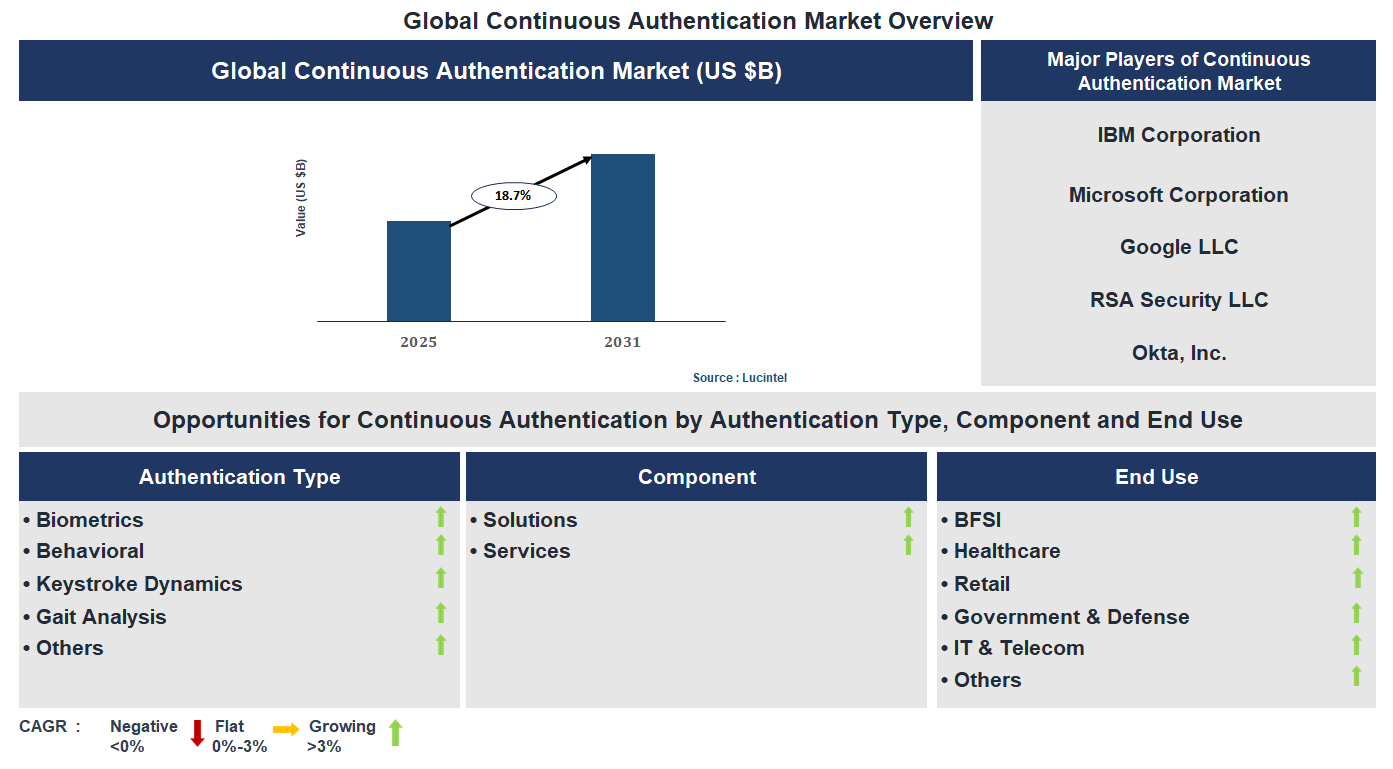
The future of the global continuous authentication market looks promising with opportunities in the BFSI, healthcare, retail, government & defense, and IT & telecom markets. The global continuous authentication market is expected to grow with a CAGR of 18.7% from 2025 to 2031. The major drivers for this market are the increasing need for enhanced security measures, the rising demand for seamless user authentication, and the growing adoption of biometric authentication solutions.• Lucintel forecasts that, within the authentication type category, biometric is expected to witness the highest growth over the forecast period.
• Within the end use category, BFSI is expected to witness the highest growth.
• In terms of region, North America is expected to witness the highest growth over the forecast period. Gain valuable insights for your business decisions with our comprehensive 150+ page report. Sample figures with some insights are shown below.
Emerging Trends in the Continuous Authentication Market
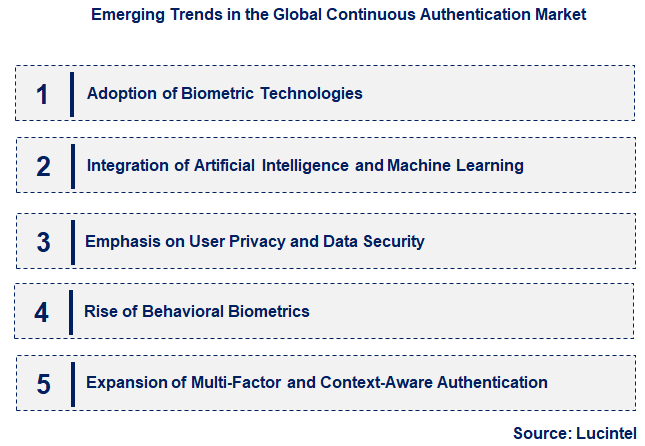
The continuous authentication market is experiencing rapid evolution driven by increasing security concerns, technological advancements, and the need for seamless user experiences. As digital interactions become more complex and frequent, traditional authentication methods are proving insufficient. Emerging trends focus on integrating advanced biometric solutions, leveraging artificial intelligence, and enhancing user convenience without compromising security. These developments are transforming how organizations protect sensitive data and authenticate users in real-time, fostering a more secure and user-friendly digital environment. The following key trends highlight the major shifts shaping this markets future landscape.• Adoption of Biometric Technologies: The market is witnessing a surge in biometric authentication methods such as fingerprint, facial recognition, and voice recognition. These technologies offer high accuracy and convenience, enabling continuous verification without interrupting user activity. Their integration into mobile devices, enterprise systems, and IoT devices enhances security by reducing reliance on passwords, which are vulnerable to theft and hacking. As biometric sensors become more affordable and sophisticated, their adoption is expected to grow exponentially, making continuous biometric authentication a standard security measure across various sectors.
• Integration of Artificial Intelligence and Machine Learning: AI and ML are increasingly being incorporated into continuous authentication systems to analyze behavioral patterns, device usage, and contextual data in real-time. These intelligent algorithms improve detection of anomalies and potential threats, enabling proactive security measures. They also reduce false positives, ensuring a seamless user experience. The ability to adapt to evolving user behaviors and sophisticated attack methods makes AI-driven solutions vital for maintaining robust security. This trend is significantly enhancing the accuracy, efficiency, and responsiveness of continuous authentication systems.
• Emphasis on User Privacy and Data Security: As continuous authentication involves collecting and analyzing vast amounts of personal data, privacy concerns are paramount. Market players are focusing on developing privacy-preserving techniques such as data encryption, anonymization, and decentralized processing. Regulatory frameworks like GDPR and CCPA are also influencing product development, emphasizing transparency and user control over data. Balancing security with privacy is critical to gaining user trust and ensuring compliance, which is driving innovation in secure data handling and consent management within the continuous authentication landscape.
• Rise of Behavioral Biometrics: Behavioral biometrics, which analyze unique user behaviors such as keystroke dynamics, mouse movements, and gait patterns, are gaining traction. These passive, unobtrusive methods enable continuous verification without requiring explicit user actions. They are particularly effective in detecting subtle anomalies indicative of fraud or unauthorized access. The scalability and low cost of behavioral biometrics make them attractive for large-scale deployment across online banking, e-commerce, and enterprise applications. This trend enhances security while maintaining a frictionless user experience, making behavioral biometrics a key component of future authentication strategies.
• Expansion of Multi-Factor and Context-Aware Authentication: Combining multiple authentication factors—biometric, behavioral, device, and contextual data—is becoming standard practice. Context-aware systems assess factors like location, device health, and network environment to dynamically adjust security levels. This layered approach significantly reduces the risk of breaches and unauthorized access. The integration of multi-factor and context-aware authentication provides a flexible, adaptive security framework that responds to real-time threats while minimizing user inconvenience. This trend is reshaping the market by offering more comprehensive, intelligent, and user-centric security solutions. In summary, these emerging trends are collectively transforming the continuous authentication market by making security more intelligent, seamless, and privacy-conscious. They are enabling organizations to implement more effective, adaptive, and user-friendly authentication solutions, ultimately redefining the standards of digital security in an increasingly connected world.
Recent Development in the Continuous Authentication Market
The continuous authentication market is experiencing rapid evolution driven by increasing cybersecurity threats and the need for seamless user verification. As digital interactions grow more complex, traditional authentication methods are proving insufficient, prompting the adoption of advanced, continuous solutions. Recent developments reflect technological innovations, regulatory changes, and shifting consumer expectations, all contributing to a dynamic landscape. These advancements aim to enhance security, improve user experience, and reduce fraud. Stakeholders are investing heavily in research and development to stay ahead of cyber threats. The following key developments highlight the current trajectory and future potential of the continuous authentication market.• Integration of AI and Machine Learning: Enhanced security through adaptive algorithms that analyze user behavior in real-time, reducing false positives and negatives, and providing more accurate continuous authentication. This development improves user experience while strengthening security measures, making systems more resilient against sophisticated cyber threats.
• Biometric Authentication Advancements: Increased adoption of biometric methods such as facial recognition, fingerprint scanning, and voice recognition for continuous verification. These technologies offer seamless, contactless authentication, boosting convenience and security, especially in mobile and remote environments.
• Regulatory and Compliance Frameworks: Implementation of stricter data privacy and security regulations globally, such as GDPR and CCPA, influencing market practices. Companies are investing in compliant solutions to avoid penalties and build consumer trust, which accelerates the adoption of continuous authentication systems.
• Edge Computing and IoT Integration: Deployment of continuous authentication solutions at the edge to support IoT devices and remote access points. This reduces latency, enhances real-time security, and enables scalable authentication across diverse environments, expanding market reach.
• User-Centric Authentication Solutions: Focus on developing user-friendly, frictionless authentication methods that do not compromise security. Innovations include behavioral biometrics and contextual analysis, which improve user acceptance and engagement, driving broader adoption. In summary, these developments are significantly transforming the continuous authentication market by making security more adaptive, seamless, and compliant. The integration of AI, biometric advancements, regulatory adherence, edge computing, and user-centric approaches collectively enhance the robustness and usability of authentication solutions. As a result, the market is poised for accelerated growth, with increased adoption across industries seeking to safeguard digital assets while maintaining a positive user experience.
Strategic Growth Opportunities in the Continuous Authentication Market
The continuous authentication market is experiencing rapid evolution driven by increasing security concerns and the need for seamless user experiences across various applications. As digital interactions expand, the demand for real-time, unobtrusive security solutions grows, prompting key industries to adopt innovative authentication methods. This markets growth is fueled by technological advancements, rising cyber threats, and the shift towards remote and mobile work environments. Companies are exploring diverse applications to enhance security without compromising user convenience. The following five key growth opportunities highlight the potential for expansion across different sectors, shaping the future landscape of continuous authentication solutions.• Enhanced Fraud Prevention : Continuous authentication enables real-time monitoring of user activity, reducing fraud risks and unauthorized access. Financial institutions benefit from improved security measures that protect sensitive data and transactions, fostering customer trust and compliance with regulations. This application drives market growth by addressing the increasing sophistication of cyber threats targeting banking and payment systems.
• Securing Patient Data : In healthcare, continuous authentication ensures that only authorized personnel access sensitive patient information. It supports compliance with data protection regulations like HIPAA and enhances data security in telemedicine and electronic health records. This application reduces data breaches and safeguards patient privacy, promoting trust in digital health solutions.
• Seamless Customer Experience : Continuous authentication facilitates frictionless transactions by verifying user identity in the background during online shopping. It minimizes cart abandonment caused by cumbersome login processes and enhances security against fraud. This growth opportunity boosts consumer confidence and encourages digital commerce expansion.
• Protecting Corporate Assets : Organizations adopt continuous authentication to secure internal networks, cloud services, and remote work environments. It provides ongoing verification of user identities, reducing insider threats and unauthorized access. This application supports digital transformation initiatives and strengthens overall cybersecurity posture.
• Safeguarding Critical Infrastructure : Governments utilize continuous authentication to protect sensitive data, national security systems, and critical infrastructure from cyber threats. It enables secure access control for remote government services and inter-agency communication. This application enhances national security and operational resilience. In summary, these growth opportunities across key applications are significantly impacting the continuous authentication market by expanding its adoption, improving security protocols, and enhancing user experiences. As industries increasingly prioritize cybersecurity and seamless access, the market is poised for sustained growth driven by technological innovation and evolving threat landscapes.
Continuous Authentication Market Driver and Challenges
The continuous authentication market is influenced by a variety of technological, economic, and regulatory factors that shape its growth and development. Advances in biometric technologies, increasing cyber threats, and the need for enhanced security solutions are primary drivers. Economic factors such as rising digital transformation investments and the proliferation of connected devices further propel market expansion. Regulatory frameworks emphasizing data privacy and security also play a crucial role in shaping market dynamics. However, the market faces challenges including technological complexities, high implementation costs, and concerns over user privacy. Understanding these drivers and challenges is essential for stakeholders aiming to capitalize on emerging opportunities while mitigating risks. The factors responsible for driving the continuous authentication market include:• Technological Advancements: The rapid development of biometric authentication methods such as fingerprint, facial recognition, and behavioral biometrics has significantly enhanced the accuracy and reliability of continuous authentication solutions. These innovations enable real-time user verification without disrupting user experience, making them highly attractive for industries like banking, healthcare, and government. As technology evolves, integration with AI and machine learning further improves threat detection and reduces false positives, fostering market growth. The increasing adoption of IoT devices also necessitates continuous authentication to secure interconnected systems, thereby expanding market opportunities.
• Rising Cybersecurity Threats: The escalating frequency and sophistication of cyberattacks, including data breaches, identity theft, and malware, have heightened the need for robust security measures. Traditional authentication methods such as passwords are often inadequate against modern threats. Continuous authentication offers a dynamic security layer that monitors user behavior and device activity in real-time, providing proactive threat detection. This shift towards more secure authentication methods is driven by the increasing financial and reputational risks associated with cyber incidents, compelling organizations to adopt continuous authentication solutions to safeguard sensitive data and maintain trust.
• Increasing Digital Transformation: The ongoing digital transformation across industries has led to a surge in online transactions, remote work, and cloud-based services. Organizations require seamless yet secure user verification methods to facilitate these digital interactions. Continuous authentication enables persistent user verification without interrupting workflows, thereby enhancing user experience and operational efficiency. The proliferation of mobile devices and remote access points further amplifies the need for continuous security measures. As businesses prioritize digital initiatives, the demand for continuous authentication solutions is expected to grow substantially, supporting secure digital ecosystems.
• Regulatory and Compliance Requirements: Governments and regulatory bodies worldwide are implementing stringent data privacy and security standards, such as GDPR, HIPAA, and PCI DSS. These regulations mandate organizations to adopt advanced security measures to protect user data and ensure compliance. Continuous authentication helps organizations meet these regulatory requirements by providing ongoing user verification and audit trails, reducing the risk of non-compliance penalties. The increasing emphasis on data security and privacy is driving organizations across sectors to integrate continuous authentication into their security frameworks, fostering market expansion and innovation.
• Growing Adoption of Biometric Technologies: The widespread acceptance of biometric authentication methods, including fingerprint, facial, iris, and voice recognition, is a key driver. Biometric solutions offer high accuracy, convenience, and non-intrusiveness, making them ideal for continuous authentication. The decreasing costs of biometric sensors and advancements in AI have further accelerated adoption across banking, retail, and government sectors. The integration of biometric data with behavioral analytics enhances security by continuously verifying user identity, reducing fraud, and improving user experience. This trend is expected to sustain market growth as biometric technologies become more sophisticated and accessible. The challenges facing this continuous authentication market include:
• Technological Complexities: Implementing continuous authentication systems involves integrating advanced biometric, behavioral, and contextual analytics, which can be technically complex. Ensuring interoperability across diverse devices and platforms requires significant development effort and expertise. Additionally, maintaining system accuracy and minimizing false positives or negatives pose ongoing challenges. Rapid technological changes can also lead to compatibility issues, necessitating continuous updates and investments. These complexities can hinder widespread adoption, especially among small and medium-sized enterprises lacking technical resources.
• High Implementation and Maintenance Costs: Deploying continuous authentication solutions often requires substantial initial investment in hardware, software, and infrastructure. Organizations must also allocate resources for ongoing maintenance, updates, and staff training. For many businesses, especially in cost-sensitive sectors, these expenses can be prohibitive. The high costs may delay or limit adoption, particularly in regions with limited budgets for cybersecurity. This financial barrier can slow market growth and restrict the deployment of advanced continuous authentication systems to larger organizations.
• Privacy and User Acceptance Concerns: Continuous authentication relies heavily on collecting and analyzing sensitive biometric and behavioral data, raising significant privacy issues. Users may be uncomfortable with constant monitoring and data collection, fearing misuse or breaches. Regulatory restrictions and public skepticism can impede implementation and acceptance. Ensuring data security and transparency about data usage is critical but challenging. Resistance from users and privacy advocates can limit market penetration, necessitating robust privacy-preserving technologies and clear communication strategies to build trust. In summary, the continuous authentication market is driven by technological innovations, increasing cyber threats, digital transformation, regulatory pressures, and biometric adoption. However, challenges such as technological complexity, high costs, and privacy concerns pose significant hurdles. These factors collectively influence the pace and scope of market growth. While opportunities for enhanced security and user experience are substantial, addressing the challenges effectively will be crucial for sustainable expansion. Stakeholders must balance innovation with privacy and cost considerations to capitalize on emerging trends and ensure widespread adoption.
List of Continuous Authentication Companies
Companies in the market compete on the basis of product quality offered. Major players in this market focus on expanding their manufacturing facilities, R&D investments, infrastructural development, and leverage integration opportunities across the value chain. With these strategies continuous authentication companies cater increasing demand, ensure competitive effectiveness, develop innovative products & technologies, reduce production costs, and expand their customer base. Some of the continuous authentication companies profiled in this report include-• IBM Corporation
• Microsoft Corporation
• Google LLC
• RSA Security LLC
• Okta, Inc.
• Ping Identity Corporation
• SecureAuth Corporation
• BioCatch Ltd.
• BehavioSec Inc.
• Entrust Datacard Corporation
Continuous Authentication Market by Segment
The study includes a forecast for the global continuous authentication market by authentication type, component, end use, and region.Continuous Authentication Market by Authentication Type [Value from 2019 to 2031]:
• Biometrics
• Behavioral
• Keystroke Dynamics
• Gait Analysis
• Others
Continuous Authentication Market by Component [Value from 2019 to 2031]:
• Solutions
• Services
Continuous Authentication Market by End Use [Value from 2019 to 2031]:
• BFSI
• Healthcare
• Retail
• Government & Defense
• IT & Telecom
• Others
Continuous Authentication Market by Region [Value from 2019 to 2031]:
• North America
• Europe
• Asia Pacific
• The Rest of the World
Country Wise Outlook for the Continuous Authentication Market
The continuous authentication market is experiencing rapid growth driven by increasing cybersecurity concerns, advancements in biometric technologies, and the need for seamless user verification across digital platforms. As organizations seek to enhance security without compromising user experience, countries are adopting innovative solutions tailored to their technological landscapes. The markets evolution reflects a shift towards more sophisticated, real-time authentication methods that can adapt to diverse environments and user behaviors. This global trend is marked by significant investments, regulatory developments, and technological breakthroughs, shaping the future of secure digital interactions worldwide.• United States: The US market is leading with innovations in biometric authentication, including facial recognition and behavioral analytics. Major tech firms are integrating continuous authentication into their platforms, driven by stringent data privacy regulations and increasing cyber threats. The adoption of AI-powered solutions is accelerating, with a focus on user convenience and security. Government agencies are also investing in advanced authentication systems for national security and public services, fostering a competitive and dynamic environment.
• China: China is rapidly expanding its continuous authentication capabilities, leveraging its strong digital infrastructure and large user base. The market sees widespread adoption of fingerprint and facial recognition technologies in mobile payments and public security. Government initiatives promote the integration of biometric solutions in smart city projects and surveillance systems. Domestic companies are innovating with AI-driven behavioral biometrics, aiming to enhance security while maintaining user privacy and convenience.
• Germany: The German market emphasizes privacy and data protection, aligning with the European Union’s GDPR standards. There is a growing adoption of multi-factor authentication solutions that combine biometrics with traditional methods. Industries such as automotive, manufacturing, and finance are deploying continuous authentication to safeguard sensitive data and ensure compliance. Research institutions are also exploring innovative approaches like passive biometrics and contextual authentication to improve security without intrusiveness.
• India: India’s market is witnessing significant growth due to government initiatives like Digital India and Aadhaar. The adoption of biometric authentication, especially fingerprint and iris scans, is widespread in banking, telecom, and government services. Startups and tech giants are developing affordable, scalable solutions tailored to the diverse Indian population. The focus is on enhancing security in digital payments and reducing fraud, with increasing investments in AI and machine learning-based behavioral biometrics.
• Japan: Japan is advancing its continuous authentication technologies, primarily in the automotive and robotics sectors. The emphasis is on integrating biometric solutions into consumer electronics and smart devices for enhanced security. The government promotes the development of secure authentication standards for critical infrastructure and financial services. Japanese companies are also exploring passive authentication methods, such as gait analysis and voice recognition, to provide seamless security experiences aligned with cultural preferences for privacy and reliability.

Features of the Global Continuous Authentication Market
Market Size Estimates: Continuous authentication market size estimation in terms of value ($B). Trend and Forecast Analysis: Market trends (2019 to 2024) and forecast (2025 to 2031) by various segments and regions. Segmentation Analysis: Continuous authentication market size by authentication type, component, end use, and region in terms of value ($B). Regional Analysis: Continuous authentication market breakdown by North America, Europe, Asia Pacific, and Rest of the World. Growth Opportunities: Analysis of growth opportunities in different authentication type, component, end use, and regions for the continuous authentication market. Strategic Analysis: This includes M&A, new product development, and competitive landscape of the continuous authentication market. Analysis of competitive intensity of the industry based on Porter’s Five Forces model.
FAQ
Q1. What is the growth forecast for continuous authentication market? Answer: The global continuous authentication market is expected to grow with a CAGR of 18.7% from 2025 to 2031. Q2. What are the major drivers influencing the growth of the continuous authentication market? Answer: The major drivers for this market are the increasing need for enhanced security measures, the rising demand for seamless user authentication, and the growing adoption of biometric authentication solutions. Q3. What are the major segments for continuous authentication market? Answer: The future of the continuous authentication market looks promising with opportunities in the BFSI, healthcare, retail, government & defense, and IT & telecom markets. Q4. Who are the key continuous authentication market companies? Answer: Some of the key continuous authentication companies are as follows:• IBM Corporation
• Microsoft Corporation
• Google LLC
• RSA Security LLC
• Okta, Inc.
• Ping Identity Corporation
• SecureAuth Corporation
• BioCatch Ltd.
• BehavioSec Inc.
• Entrust Datacard Corporation Q5. Which continuous authentication market segment will be the largest in future? Answer: Lucintel forecasts that, within the authentication type category, biometric is expected to witness the highest growth over the forecast period. Q6. In continuous authentication market, which region is expected to be the largest in next 5 years? Answer: In terms of region, North America is expected to witness the highest growth over the forecast period. Q7. Do we receive customization in this report? Answer: Yes, Lucintel provides 10% customization without any additional cost.
Table of Contents
List of Figures
List of Tables
Methodology
- In-depth interviews of the major players in this market
- Detailed secondary research from competitors’ financial statements and published data
- Extensive searches of published works, market, and database information pertaining to industry news, company press releases, and customer intentions
- A compilation of the experiences, judgments, and insights of Lucintel’s professionals, who have analyzed and tracked this market over the years.


Buy Now
Choose a license that fits your team. Instant PDF delivery.
Prices exclude taxes. Instant delivery. Custom licensing available on request.
Key Questions
- • What are some of the most promising, high-growth opportunities for the continuous authentication market by authentication type (biometrics, behavioral, keystroke dynamics, gait analysis, and others), component (solutions and services), end use (BFSI, healthcare, retail, government & defense, IT & telecom, and others), and region (North America, Europe, Asia Pacific, and the Rest of the World)?
- • Which segments will grow at a faster pace and why?
- • Which region will grow at a faster pace and why?
- • What are the key factors affecting market dynamics? What are the key challenges and business risks in this market?
- • What are the business risks and competitive threats in this market?
- • What are the emerging trends in this market and the reasons behind them?
- • What are some of the changing demands of customers in the market?
- • What are the new developments in the market? Which companies are leading these developments?
- • Who are the major players in this market? What strategic initiatives are key players pursuing for business growth?
- • What are some of the competing products in this market and how big of a threat do they pose for loss of market share by material or product substitution?
- • What M&A activity has occurred in the last 5 years and what has its impact been on the industry? For any questions related to Continuous Authentication Market, Continuous Authentication Market Size, Continuous Authentication Market Growth, Continuous Authentication Market Analysis, Continuous Authentication Market Report, Continuous Authentication Market Share, Continuous Authentication Market Trends, Continuous Authentication Market Forecast, Continuous Authentication Companies, write Lucintel analyst at email: helpdesk@lucintel.com. We will be glad to get back to you soon.


