
Report Feature
Contingent Staffing Solution Market Trends and Forecast
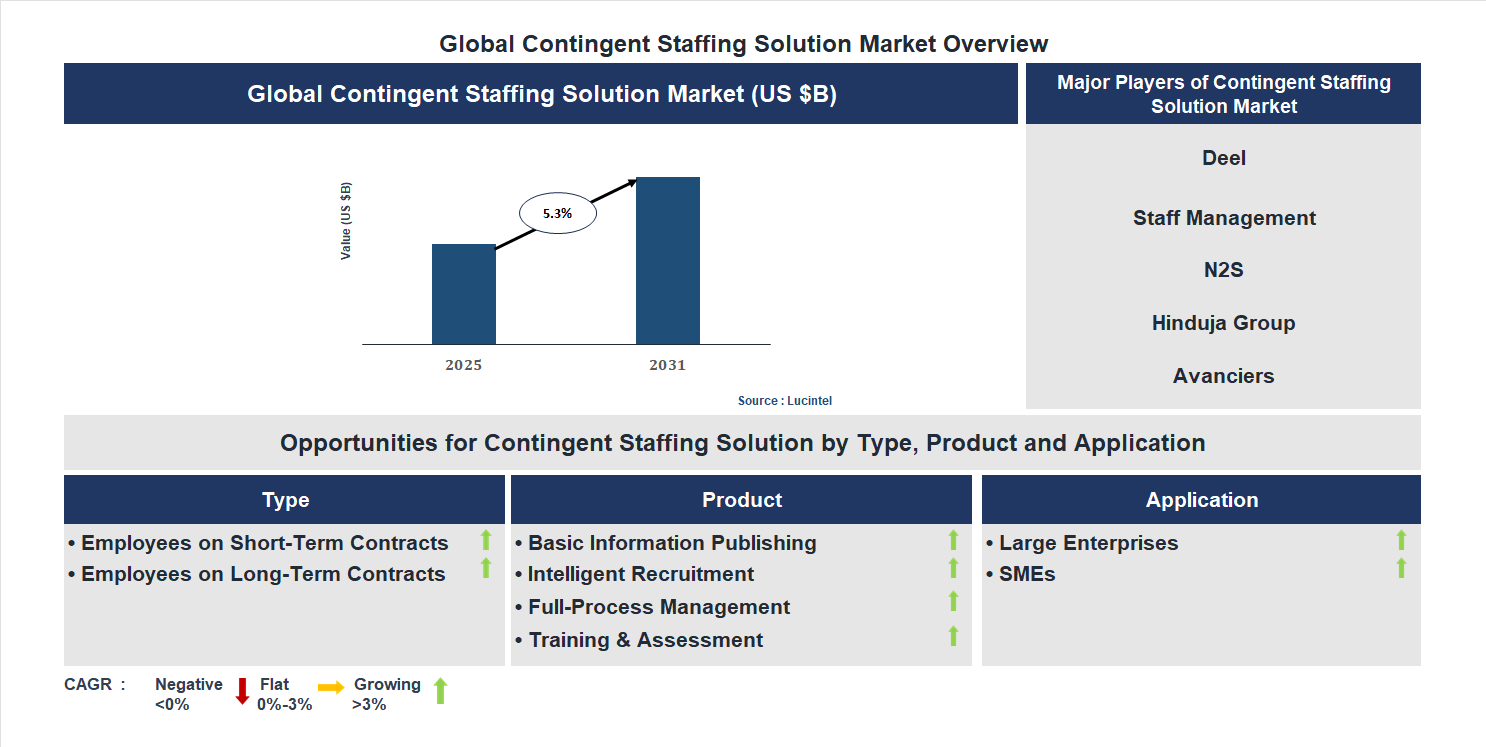
The future of the global contingent staffing solution market looks promising with opportunities in the large enterprise and SME markets. The global contingent staffing solution market is expected to grow with a CAGR of 5.3% from 2025 to 2031. The major drivers for this market are the increasing demand for flexible workforce solutions, the rising need for cost effective hiring, and the growing adoption of project based staffing.• Lucintel forecasts that, within the type category, employee on short-term contract is expected to witness higher growth over the forecast period.
• Within the application category, large enterprise is expected to witness higher growth.
• In terms of region, APAC is expected to witness the highest growth over the forecast period. Gain valuable insights for your business decisions with our comprehensive 150+ page report. Sample figures with some insights are shown below.
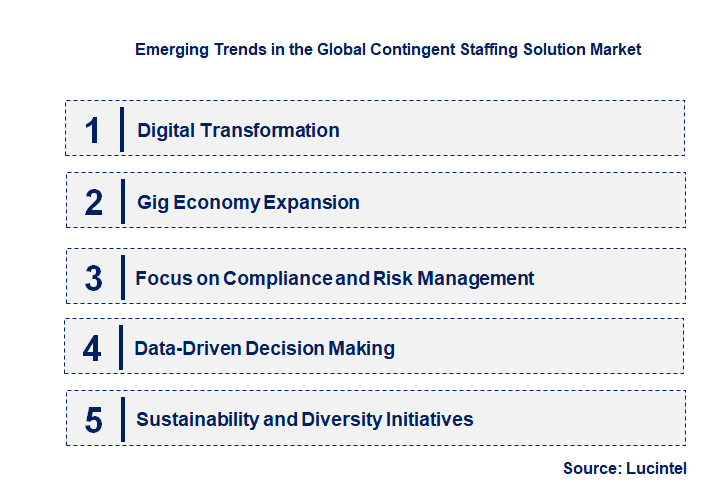
Emerging Trends in the Contingent Staffing Solution Market
The contingent staffing solution market is experiencing rapid transformation driven by technological advancements, shifting workforce dynamics, and evolving client needs. As organizations seek flexible, cost-effective staffing options, new trends are emerging to meet these demands. These developments are reshaping how companies source, manage, and optimize their contingent workforce, leading to increased efficiency, better talent matching, and enhanced compliance. Understanding these key trends is essential for stakeholders aiming to stay competitive and leverage emerging opportunities in this dynamic market landscape.• Digital Transformation: The adoption of artificial intelligence and automation tools is streamlining the recruitment process, enabling faster candidate screening, matching, and onboarding. These technologies improve accuracy, reduce manual effort, and enhance candidate experience, making staffing solutions more efficient and scalable. As a result, companies can respond quickly to fluctuating workforce needs while maintaining high-quality talent acquisition.
• Gig Economy Expansion: The gig economy is significantly influencing the contingent staffing landscape by providing organizations with flexible, on-demand talent pools. This trend allows companies to access specialized skills without long-term commitments, reducing costs and increasing agility. It also offers workers greater flexibility, attracting a broader talent base and fostering innovation through diverse, project-based collaborations.
• Focus on Compliance and Risk Management: As contingent staffing grows, so does the importance of compliance with labor laws, tax regulations, and industry standards. Market players are investing in sophisticated compliance management systems to mitigate risks associated with misclassification, legal penalties, and reputational damage. This trend ensures safer, more transparent staffing practices, building trust among clients and workers alike.
• Data-Driven Decision Making: Advanced data analytics are enabling organizations to make informed staffing decisions based on real-time insights. By analyzing workforce trends, performance metrics, and market conditions, companies can optimize staffing levels, improve retention, and forecast future needs more accurately. This trend enhances strategic planning and operational efficiency across the contingent staffing ecosystem.
• Sustainability and Diversity Initiatives: Increasing focus on diversity, equity, and inclusion is shaping staffing strategies. Organizations are prioritizing sustainable hiring practices that promote diverse talent pools and equitable opportunities. This trend not only aligns with corporate social responsibility goals but also enhances innovation, employee satisfaction, and market competitiveness. In summary, these emerging trends are fundamentally reshaping the contingent staffing solution market by fostering greater efficiency, flexibility, compliance, and inclusivity. As technology advances and workforce expectations evolve, market participants must adapt to stay competitive and capitalize on new opportunities. These developments are driving a more dynamic, responsive, and responsible staffing landscape that benefits organizations, workers, and stakeholders alike.
Recent Development in the Contingent Staffing Solution Market
The contingent staffing solution market is experiencing rapid growth driven by evolving workforce needs, technological advancements, and increasing demand for flexible staffing options. Organizations seek agile staffing models to adapt to market fluctuations, reduce costs, and access specialized talent quickly. Recent developments are reshaping the industry landscape, offering new opportunities for providers and clients alike. These innovations are enhancing efficiency, expanding service offerings, and improving overall market competitiveness, ultimately transforming how businesses manage their contingent workforce.• Digital Platform Integration: The integration of advanced digital platforms has revolutionized staffing solutions by enabling real-time matching, automated onboarding, and seamless communication. This development reduces operational costs, accelerates placement times, and enhances user experience for both employers and job seekers. As a result, market players can handle larger volumes efficiently, increase transparency, and improve client satisfaction, fostering growth and competitiveness in the contingent staffing industry.
• AI and Data Analytics Adoption: The adoption of AI and data analytics tools has significantly improved talent sourcing and candidate screening processes. These technologies enable predictive analytics, skill matching, and performance forecasting, leading to better candidate-job fit. This results in higher retention rates, reduced hiring time, and increased client trust. Consequently, the market benefits from more precise staffing solutions, driving demand and expanding service capabilities across various industries.
• Focus on Niche and Specialized Staffing: The market is witnessing a shift toward niche and specialized staffing services tailored to specific industries such as healthcare, IT, and engineering. This focus allows providers to offer highly skilled talent, meet regulatory requirements, and address unique client demands. The growth of specialized staffing enhances market segmentation, increases revenue streams, and positions providers as industry experts, thereby strengthening their competitive edge and expanding market share.
• Expansion of On-Demand Staffing Services: On-demand staffing services are gaining popularity by offering flexible, short-term employment options. This development caters to fluctuating business needs and gig economy trends, providing employers with scalable workforce solutions. For workers, it offers greater autonomy and diverse opportunities. The expansion of on-demand services boosts market agility, attracts new clients, and supports economic resilience, making the contingent staffing market more adaptable and responsive to changing labor dynamics.
• Regulatory and Compliance Innovations: Recent developments include enhanced regulatory frameworks and compliance tools that help staffing firms adhere to labor laws, safety standards, and ethical practices. These innovations reduce legal risks, improve worker protections, and foster trust among clients and workers. As compliance becomes more streamlined and transparent, market stability increases, attracting more investment and encouraging sustainable growth within the contingent staffing industry. The overall impact of these developments is a more efficient, flexible, and technologically advanced market. They enable providers to deliver higher quality services, meet diverse client needs, and adapt swiftly to economic changes. Consequently, the market is poised for sustained growth, increased competitiveness, and broader adoption of innovative staffing solutions, shaping the future landscape of contingent staffing.
Strategic Growth Opportunities in the Contingent Staffing Solution Market
The contingent staffing solution market is increasingly vital for organizations seeking flexibility, cost efficiency, and access to specialized talent. As businesses adapt to rapid market changes, the demand for scalable staffing options grows, creating significant opportunities for providers to innovate and expand. The markets evolution is driven by technological advancements, shifting workforce preferences, and the need for agile human resource strategies. Capitalizing on these factors can lead to substantial growth and competitive advantage in the contingent staffing industry.• Digital Platforms and Technology Integration: The adoption of advanced digital platforms enables real-time matching of talent with job requirements, streamlining the staffing process. AI and machine learning improve candidate screening and placement efficiency, reducing time-to-hire and operational costs. Cloud-based solutions facilitate remote management and data analytics, providing insights for strategic decision-making. As technology becomes more sophisticated, providers that leverage these tools can enhance service quality, expand their reach, and capture new market segments.
• Expansion into Niche and Specialized Markets: Growing industries such as healthcare, IT, and engineering demand highly specialized contingent workers. Developing expertise in these niche sectors allows staffing firms to differentiate themselves and command premium rates. Tailored solutions for highly regulated or technical roles increase client trust and satisfaction. By investing in industry-specific knowledge and networks, companies can tap into underserved markets, increase revenue streams, and build long-term client relationships.
• Geographic Market Diversification: Entering emerging and underserved regions offers significant growth potential. Expanding operations into new geographic areas reduces dependency on saturated markets and mitigates regional economic risks. Localized strategies, including understanding regional labor laws and cultural nuances, improve placement success rates. Geographic diversification also enables firms to capitalize on regional economic growth, attract diverse talent pools, and establish a broader client base, thereby enhancing overall market presence.
• Strategic Partnerships and Alliances: Collaborating with educational institutions, technology providers, and industry associations can enhance talent pipelines and service offerings. Partnerships facilitate access to fresh talent, innovative tools, and industry insights, strengthening competitive positioning. Joint ventures and alliances can also enable market entry into new sectors or regions more efficiently. These collaborations foster knowledge sharing, resource optimization, and brand credibility, ultimately driving growth and expanding the contingent staffing ecosystem.
• Focus on Workforce Flexibility and Compliance Solutions: As labor laws evolve, providing compliant and flexible staffing solutions becomes crucial. Offering services such as onboarding, payroll management, and legal compliance support helps clients navigate complex regulations. Emphasizing workforce flexibility addresses employer needs for scalable staffing during fluctuating demand. Developing comprehensive compliance frameworks and flexible engagement models attracts clients seeking risk mitigation and operational agility, positioning firms as trusted partners in dynamic labor markets. In conclusion, these growth opportunities collectively position the contingent staffing solution market for sustained expansion. Embracing technological innovation, market diversification, niche specialization, strategic collaborations, and compliance focus will enable providers to meet evolving client demands. This strategic approach fosters resilience, enhances competitiveness, and unlocks new revenue streams, ultimately shaping a robust future for the industry.
Contingent Staffing Solution Market Driver and Challenges
The contingent staffing solution market is influenced by a variety of technological, economic, and regulatory factors that shape its growth and development. Rapid technological advancements enable more efficient staffing processes, while economic fluctuations impact demand across industries. Regulatory changes, including labor laws and compliance standards, also play a crucial role in shaping market dynamics. Additionally, evolving workforce preferences and globalization contribute to the complexity of the market landscape. Understanding these drivers and challenges is essential for stakeholders to navigate the opportunities and risks effectively, ensuring sustainable growth and competitive advantage in this dynamic environment. The factors responsible for driving the contingent staffing solution market include:-• Technological Innovation: The integration of advanced technologies such as AI, machine learning, and data analytics has revolutionized staffing processes. These innovations enable faster candidate matching, improved workforce management, and enhanced decision-making capabilities. As organizations seek agility and efficiency, the adoption of digital platforms for contingent staffing continues to accelerate, reducing time-to-hire and operational costs. This technological evolution not only streamlines recruitment but also provides valuable insights for strategic planning, thereby driving market growth significantly.
• Increasing Gig Economy Adoption: The rise of the gig economy has transformed traditional employment models, encouraging companies to adopt flexible staffing solutions. Businesses increasingly prefer contingent workers for project-based tasks, seasonal demands, or specialized roles, which offer cost savings and operational flexibility. This shift is driven by the need for agility in responding to market fluctuations and the desire to access a broader talent pool without long-term commitments. As gig work becomes more mainstream, the demand for contingent staffing solutions is expected to grow substantially.
• Economic Uncertainty and Market Volatility: Fluctuations in the global economy, including recessions, inflation, and changing market conditions, influence organizations to adopt flexible staffing strategies. Contingent staffing allows companies to scale their workforce up or down quickly, minimizing financial risks during uncertain times. This economic volatility encourages businesses to rely more on temporary workers rather than permanent staff, thereby fueling demand for staffing solutions that offer adaptability and cost-effectiveness in unpredictable environments.
• Regulatory and Compliance Changes: Evolving labor laws, tax regulations, and compliance standards significantly impact the contingent staffing market. Organizations must navigate complex legal frameworks related to worker classification, benefits, and safety regulations. Changes in legislation can increase operational costs or restrict certain staffing practices, influencing market strategies. Companies that proactively adapt to these regulatory shifts can mitigate risks and maintain compliance, which in turn drives the development of compliant staffing solutions and services tailored to new legal requirements.
• Digital Transformation and Cloud-Based Platforms: The adoption of cloud-based staffing platforms and digital ecosystems has enhanced the efficiency and reach of contingent staffing services. These platforms facilitate real-time communication, streamlined onboarding, and seamless management of contingent workers across geographies. Digital transformation enables staffing providers to offer scalable, flexible, and integrated solutions, improving client satisfaction and operational efficiency. As organizations increasingly leverage digital tools, the market experiences accelerated growth driven by improved service delivery and expanded access to a global talent pool. The challenges in the contingent staffing solution market are:
• Regulatory Complexity and Legal Risks: Navigating the complex landscape of labor laws and compliance standards presents a significant challenge for staffing providers and organizations. Variations across regions and frequent regulatory updates increase operational risks, potential legal liabilities, and costs. Misclassification of workers or non-compliance can lead to penalties, lawsuits, and reputational damage. Ensuring adherence to evolving legal frameworks requires continuous monitoring, legal expertise, and adaptable processes, which can strain resources and hinder market growth.
• Talent Shortages and Skill Gaps: Despite the growing demand for contingent workers, shortages of qualified talent remain a critical challenge. Rapid technological changes and evolving skill requirements make it difficult for staffing firms to source suitable candidates promptly. This talent scarcity can lead to longer fill times, increased costs, and compromised service quality. Addressing skill gaps requires investment in training and development, which may not always align with the immediate needs of clients, thereby impacting overall market efficiency.
• Economic Fluctuations and Market Uncertainty: While contingent staffing offers flexibility, economic downturns and market uncertainties can adversely affect demand. During recessions or financial crises, organizations often reduce or freeze hiring, impacting staffing providers revenue streams. Additionally, unpredictable economic conditions can lead to reduced client budgets and delayed decision-making, creating volatility in the market. Managing these uncertainties requires strategic agility and diversified service offerings to sustain growth amid fluctuating demand. In summary, the contingent staffing solution market is shaped by rapid technological advancements, shifting workforce dynamics, and evolving regulatory landscapes. While these drivers foster growth by enhancing efficiency and flexibility, challenges such as regulatory complexities, talent shortages, and economic volatility pose risks that require strategic management. Overall, the markets future depends on how effectively stakeholders adapt to these factors, leveraging opportunities while mitigating risks to sustain competitive advantage and drive innovation in contingent staffing solutions.
List of Contingent Staffing Solution Companies
Companies in the market compete on the basis of product quality offered. Major players in this market focus on expanding their manufacturing facilities, R&D investments, infrastructural development, and leverage integration opportunities across the value chain. With these strategies contingent staffing solution companies cater increasing demand, ensure competitive effectiveness, develop innovative products & technologies, reduce production costs, and expand their customer base. Some of the contingent staffing solution companies profiled in this report include-• Deel
• Staff Management
• N2S
• Hinduja Group
• Avanciers
• ServiceNow
• ATA Services
• Artech
• IMCS Group
• Braintrust
Contingent Staffing Solution Market by Segment
The study includes a forecast for the global contingent staffing solution market by type, product, application, and region.Contingent Staffing Solution Market by Type [Value from 2019 to 2031]:
• Employees on Short-Term Contracts
• Employees on Long-Term Contracts
Contingent Staffing Solution Market by Product [Value from 2019 to 2031]:
• Basic Information Publishing
• Intelligent Recruitment
• Full-Process Management
• Training & Assessment
Contingent Staffing Solution Market by Application [Value from 2019 to 2031]:
• Large Enterprises
• SMEs
Contingent Staffing Solution Market by Region [Value from 2019 to 2031]:
• North America
• Europe
• Asia Pacific
• The Rest of the World
Country Wise Outlook for the Contingent Staffing Solution Market
The contingent staffing solution market has experienced significant shifts driven by technological advancements, evolving workforce demands, and global economic changes. As organizations seek flexible staffing options to adapt to fluctuating market conditions, countries are adopting innovative strategies to enhance their staffing solutions. The United States, China, Germany, India, and Japan are at the forefront of these developments, each reflecting unique trends influenced by their economic structures and labor policies. These countries are investing in digital platforms, automation, and strategic partnerships to optimize contingent workforce management and meet the dynamic needs of their industries.• United States: The US market has seen increased adoption of AI-driven staffing platforms, expanding gig economy roles, and a focus on compliance and worker classification issues. Companies are leveraging data analytics to improve talent matching and reduce onboarding times, with a growing emphasis on diversity and inclusion in contingent staffing.
• China: China’s contingent staffing market is rapidly growing, driven by digital transformation and government policies promoting flexible employment. Platforms integrating AI and big data are becoming prevalent, and there is a rising trend of outsourcing non-core functions to specialized staffing firms to enhance operational efficiency.
• Germany: Germany’s market emphasizes regulatory compliance and quality standards, with a focus on skilled labor and technical staffing. The adoption of digital HR solutions and automation tools is increasing, alongside initiatives to improve workforce flexibility while maintaining labor protections.
• India: India’s contingent staffing sector is expanding due to a burgeoning gig economy and digital recruitment platforms. The market is characterized by a surge in temporary and contract roles across IT, manufacturing, and retail sectors, supported by government initiatives promoting ease of doing business and digital infrastructure development.
• Japan: Japan’s market is witnessing a shift towards more flexible work arrangements, with an emphasis on integrating contingent workers into traditional employment frameworks. Technological innovations such as AI and robotics are being utilized to streamline staffing processes, and there is a focus on addressing demographic challenges through flexible staffing solutions.

Features of the Global Contingent Staffing Solution Market
Market Size Estimates: Contingent staffing solution market size estimation in terms of value ($B). Trend and Forecast Analysis: Market trends (2019 to 2024) and forecast (2025 to 2031) by various segments and regions. Segmentation Analysis: Contingent staffing solution market size by type, product, application, and region in terms of value ($B). Regional Analysis: Contingent staffing solution market breakdown by North America, Europe, Asia Pacific, and Rest of the World. Growth Opportunities: Analysis of growth opportunities in different types, products, applications, and regions for the contingent staffing solution market. Strategic Analysis: This includes M&A, new product development, and competitive landscape of the contingent staffing solution market. Analysis of competitive intensity of the industry based on Porter’s Five Forces model.
FAQ
Q1. What is the growth forecast for contingent staffing solution market? Answer: The global contingent staffing solution market is expected to grow with a CAGR of 5.3% from 2025 to 2031. Q2. What are the major drivers influencing the growth of the contingent staffing solution market? Answer: The major drivers for this market are the increasing demand for flexible workforce solutions, the rising need for cost effective hiring, and the growing adoption of project based staffing. Q3. What are the major segments for contingent staffing solution market? Answer: The future of the contingent staffing solution market looks promising with opportunities in the large enterprise and SME markets. Q4. Who are the key contingent staffing solution market companies? Answer: Some of the key contingent staffing solution companies are as follows:• Deel
• Staff Management
• N2S
• Hinduja Group
• Avanciers
• ServiceNow
• ATA Services
• Artech
• IMCS Group
• Braintrust Q5. Which contingent staffing solution market segment will be the largest in future? Answer: Lucintel forecasts that, within the type category, employee on short-term contract is expected to witness higher growth over the forecast period. Q6. In contingent staffing solution market, which region is expected to be the largest in next 5 years? Answer: In terms of region, APAC is expected to witness the highest growth over the forecast period. Q7. Do we receive customization in this report? Answer: Yes, Lucintel provides 10% customization without any additional cost.
Table of Contents
List of Figures
List of Tables
Methodology
- In-depth interviews of the major players in this market
- Detailed secondary research from competitors’ financial statements and published data
- Extensive searches of published works, market, and database information pertaining to industry news, company press releases, and customer intentions
- A compilation of the experiences, judgments, and insights of Lucintel’s professionals, who have analyzed and tracked this market over the years.


Buy Now
Choose a license that fits your team. Instant PDF delivery.
Prices exclude taxes. Instant delivery. Custom licensing available on request.
Key Questions
- • What are some of the most promising, high-growth opportunities for the contingent staffing solution market by type (employees on short-term contracts and employees on long-term contracts), product (basic information publishing, intelligent recruitment, full-process management, and training & assessment), application (large enterprises and SMEs), and region (North America, Europe, Asia Pacific, and the Rest of the World)?
- • Which segments will grow at a faster pace and why?
- • Which region will grow at a faster pace and why?
- • What are the key factors affecting market dynamics? What are the key challenges and business risks in this market?
- • What are the business risks and competitive threats in this market?
- • What are the emerging trends in this market and the reasons behind them?
- • What are some of the changing demands of customers in the market?
- • What are the new developments in the market? Which companies are leading these developments?
- • Who are the major players in this market? What strategic initiatives are key players pursuing for business growth?
- • What are some of the competing products in this market and how big of a threat do they pose for loss of market share by material or product substitution?
- • What M&A activity has occurred in the last 6 years and what has its impact been on the industry? For any questions related to Contingent Staffing Solution Market, Contingent Staffing Solution Market Size, Contingent Staffing Solution Market Growth, Contingent Staffing Solution Market Analysis, Contingent Staffing Solution Market Report, Contingent Staffing Solution Market Share, Contingent Staffing Solution Market Trends, Contingent Staffing Solution Market Forecast, Contingent Staffing Solution Companies, write Lucintel analyst at email: helpdesk@lucintel.com. We will be glad to get back to you soon.


