
Market Report · July 15, 2026

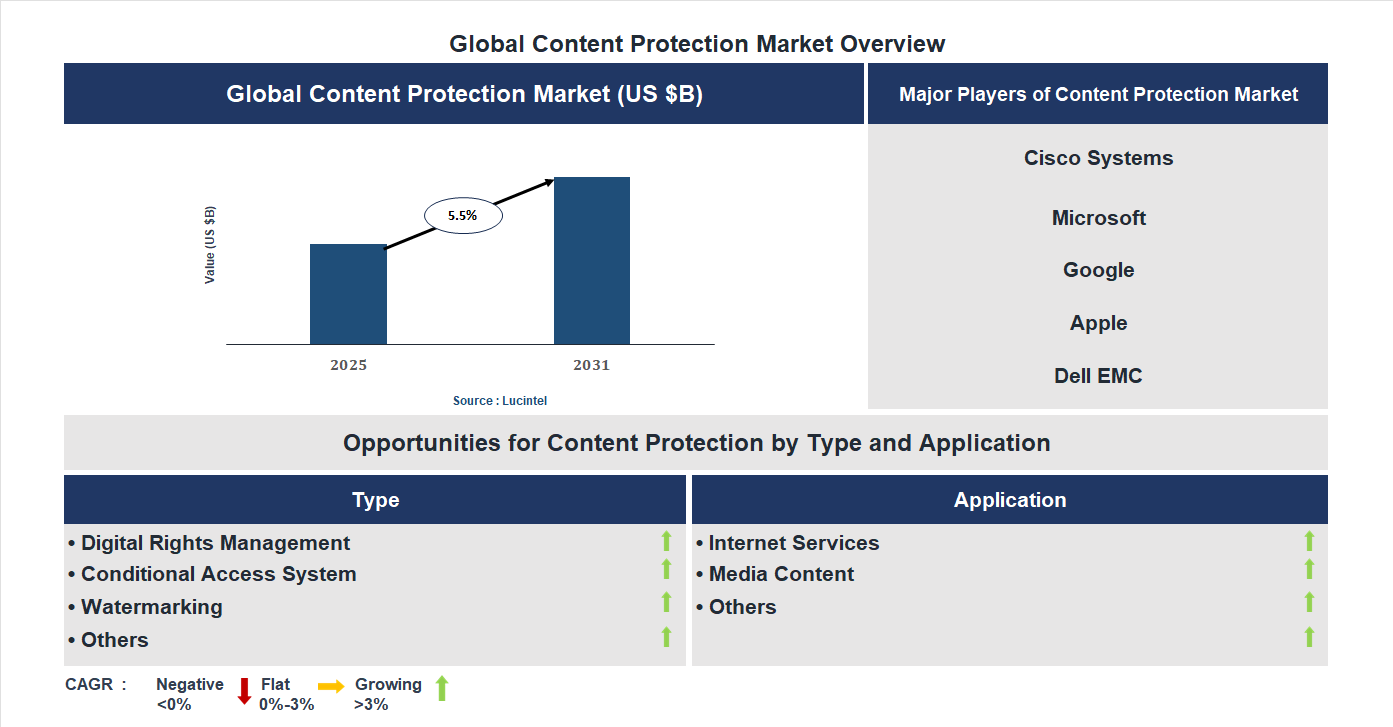
Key data points: The growth forecast = 5.5% annually for the next 7 years. Scroll below to get more insights. This market report covers trends, opportunities and forecasts in content protection market to 2031 by type (digital rights management, conditional access system, watermarking, and others), application (internet services, media content, and others), and region (North America, Europe, Asia Pacific, and the Rest of the World)
We'll send your sample report shortly.
• Lucintel forecasts that, within the type category, watermarking is expected to witness the highest growth over the forecast period.
• Within the application category, internet service is expected to witness higher growth.
• In terms of region, APAC is expected to witness the highest growth over the forecast period. Gain valuable insights for your business decisions with our comprehensive 150+ page report. Sample figures with some insights are shown below.
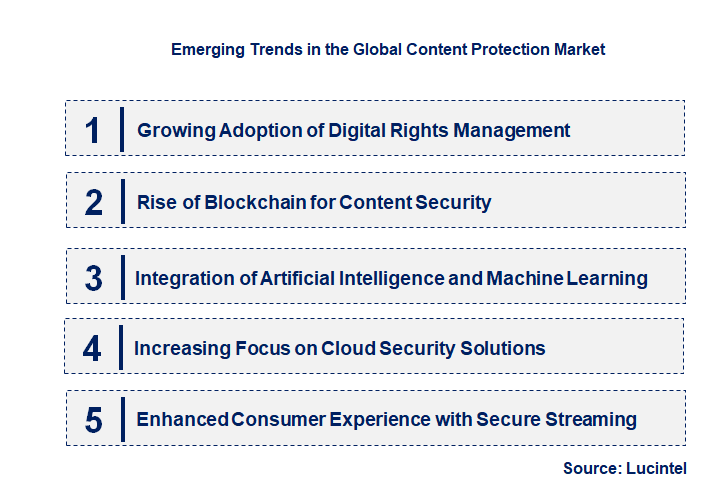
• Growing Adoption of Digital Rights Management (DRM): DRM solutions are increasingly integrated into streaming services, e-books, and digital media platforms to prevent piracy and unauthorized sharing. This trend enhances content security while allowing legitimate users seamless access. As digital content consumption surges, DRMs role becomes critical in safeguarding intellectual property, ensuring revenue streams for content creators and distributors. The market is witnessing innovations in DRM technology, making it more user-friendly and harder to bypass, thus strengthening overall content protection strategies.
• Rise of Blockchain for Content Security: Blockchain technology is emerging as a revolutionary tool for content protection by providing transparent, tamper-proof records of ownership and licensing rights. It enables secure digital transactions and rights management without intermediaries, reducing fraud and piracy. This trend offers a decentralized approach to verifying content authenticity and ownership, fostering trust among creators, distributors, and consumers. As blockchain adoption grows, it is expected to significantly reduce piracy and streamline licensing processes, transforming traditional content protection paradigms.
• Integration of Artificial Intelligence (AI) and Machine Learning (ML): AI and ML are increasingly employed to detect and prevent content piracy and unauthorized access in real-time. These technologies analyze vast amounts of data to identify suspicious activities, unauthorized sharing, or tampering attempts. AI-driven solutions can adapt to evolving threats, providing proactive security measures. This trend enhances the efficiency and accuracy of content protection, reducing losses for content owners. The integration of AI and ML is making content security more dynamic, scalable, and responsive to emerging cyber threats.
• Increasing Focus on Cloud Security Solutions: As content distribution shifts to cloud platforms, protecting data in cloud environments has become a priority. Cloud security solutions offer encryption, access controls, and monitoring tools to safeguard content stored and transmitted via cloud services. This trend addresses the vulnerabilities associated with remote access and multi-user environments, ensuring content integrity and confidentiality. The adoption of cloud security measures is critical for content providers to comply with data protection regulations and maintain consumer trust in digital ecosystems.
• Enhanced Consumer Experience with Secure Streaming: Market players are developing secure streaming technologies that balance content protection with user experience. Techniques like watermarking, secure tokens, and adaptive streaming ensure content is protected without compromising quality or accessibility. This trend is vital for attracting and retaining consumers who demand seamless, high-quality digital experiences. By integrating security measures transparently, companies can reduce piracy while providing a smooth, engaging user interface, thus driving market growth and consumer satisfaction. In summary, these trends are collectively reshaping the content protection market by making security more intelligent, transparent, and user-centric. They enable content owners to combat piracy effectively while delivering high-quality experiences to consumers. As technology advances, the market is poised for more innovative, integrated solutions that will further secure digital content and redefine industry standards.
• Adoption of AI and Machine Learning: AI and machine learning technologies are now integral to content protection strategies. They enable real-time threat detection, automated content monitoring, and adaptive security measures, significantly reducing piracy and unauthorized access. This innovation enhances the efficiency and accuracy of security protocols, providing a proactive defense mechanism. As a result, companies can better safeguard their digital assets, leading to increased trust among content creators and consumers. The integration of AI also allows for scalable solutions adaptable to evolving threats, strengthening overall market resilience.
• Expansion of Digital Rights Management (DRM) Solutions: Advanced DRM solutions are increasingly being adopted to control access and usage rights across multiple platforms. These solutions prevent unauthorized copying, sharing, and distribution of digital content, ensuring revenue protection for content owners. Enhanced DRM systems now support cross-device compatibility and user-friendly interfaces, encouraging wider adoption. This development helps content providers enforce licensing agreements effectively, reducing revenue losses from piracy. As digital content consumption continues to grow, DRM remains a critical component in maintaining content integrity and monetization.
• Regulatory and Legal Framework Enhancements: Governments and industry bodies are implementing stricter regulations and legal measures to combat digital piracy and enforce content protection. New laws focus on copyright enforcement, digital rights management, and international cooperation. These frameworks provide clearer guidelines for content protection practices and impose harsher penalties for violations. The strengthened legal environment encourages companies to invest in advanced protection technologies, knowing there is a supportive regulatory backdrop. This development fosters a more secure digital ecosystem, promoting fair revenue distribution and protecting intellectual property rights globally.
• Rise of Blockchain for Content Security: Blockchain technology is emerging as a revolutionary tool for content protection and rights management. Its decentralized ledger ensures transparent, tamper-proof records of content ownership and licensing transactions. Blockchain facilitates secure content distribution, royalty tracking, and rights verification, reducing fraud and unauthorized use. This innovation enhances trust among stakeholders and simplifies licensing processes. As blockchain adoption increases, it is expected to streamline content monetization and rights management, making the market more efficient and secure. This development signifies a shift towards more transparent and immutable content protection solutions.
• Growth of Cloud-Based Security Solutions: Cloud-based content protection solutions are gaining popularity due to their scalability, cost-effectiveness, and ease of deployment. These solutions enable real-time monitoring, encryption, and access control across distributed networks. They support remote content management and facilitate rapid updates to security protocols, essential in a fast-changing digital environment. Cloud security also allows for centralized control and analytics, improving threat detection and response times. The shift to cloud-based solutions helps organizations reduce infrastructure costs while maintaining high levels of security, thus expanding the market reach and adoption of content protection technologies. In summary, these recent developments are transforming the content protection market by enhancing security capabilities, ensuring legal compliance, and leveraging innovative technologies. The integration of AI, blockchain, and cloud solutions is making content protection more effective, scalable, and transparent. Stricter regulations are reinforcing the importance of robust security measures, while advanced DRM systems are safeguarding revenue streams. Collectively, these trends are fostering a more secure digital environment, encouraging investment, and supporting sustainable growth in the content industry.
• Media & Entertainment: Expanding digital content consumption drives demand for advanced content protection solutions, ensuring copyright enforcement and reducing piracy risks. This growth enhances revenue streams for content creators and distributors by safeguarding their intellectual property across streaming platforms, cinemas, and digital downloads.
• E-Learning & Education: The increasing adoption of online education platforms necessitates robust content protection to prevent unauthorized access and distribution. Implementing secure digital rights management (DRM) solutions helps protect educational content, fostering trust among providers and learners while enabling monetization.
• Healthcare & Pharmaceuticals: Sensitive medical data and proprietary research require stringent protection measures. Content protection solutions in this sector ensure compliance with regulations, prevent data breaches, and secure intellectual property, thereby supporting innovation and safeguarding patient privacy.
• Government & Defense: The need for secure communication and classified information management drives demand for advanced content protection. These solutions help prevent cyber espionage, ensure data integrity, and maintain national security, making them critical for government agencies and defense contractors.
• Corporate & Enterprise: As businesses increasingly rely on digital assets, protecting confidential information, trade secrets, and intellectual property becomes vital. Content protection solutions support secure collaboration, prevent data leaks, and ensure compliance with data protection regulations, thereby strengthening corporate security frameworks. In summary, these growth opportunities are significantly impacting the content protection market by expanding its scope across diverse sectors. They are fostering innovation, enhancing security, and enabling new revenue models, which collectively contribute to market expansion and increased adoption of advanced content protection solutions.
• Technological Innovation: The rapid development of advanced encryption algorithms, digital watermarking, and anti-piracy technologies enhances content security. These innovations enable content providers to safeguard their assets against unauthorized access and distribution, fostering consumer trust and enabling monetization. As technology continues to evolve, the market benefits from improved solutions that address emerging threats, making content protection more effective and scalable across various platforms.
• Growing Digital Content Consumption: The surge in online streaming, digital media, and mobile content consumption has significantly increased the need for content protection solutions. Consumers demand seamless access to high-quality content, prompting providers to implement robust security measures to prevent piracy and unauthorized sharing. This trend fuels market growth as content owners seek reliable protection mechanisms to safeguard their investments and revenue streams.
• Regulatory and Legal Frameworks: Governments and industry bodies are establishing stricter regulations and intellectual property laws to combat piracy and content theft. These legal frameworks compel content providers to adopt advanced protection measures to ensure compliance and avoid penalties. The evolving regulatory landscape creates a favorable environment for market expansion, encouraging the adoption of comprehensive content security solutions.
• Increasing Adoption of Cloud and Streaming Technologies: The migration to cloud-based platforms and the proliferation of streaming services require scalable and flexible content protection solutions. Cloud environments pose unique security challenges, prompting the development of specialized protection technologies. This shift supports market growth by enabling content providers to secure their assets across distributed networks efficiently.
• Strategic Partnerships and Mergers: Collaborations between technology providers, content owners, and platform operators facilitate the development and deployment of integrated content protection solutions. Mergers and acquisitions enable companies to expand their technological capabilities and market reach, accelerating innovation and adoption. These strategic moves strengthen the overall market ecosystem and foster competitive advantages. The challenges in the content protection market are:
• Evolving Cyber Threats: Cybercriminals continuously develop sophisticated methods such as hacking, digital piracy, and malware attacks to bypass security measures. These evolving threats demand constant innovation and adaptation of content protection technologies, increasing operational costs for providers. Failure to keep pace can result in content theft, revenue loss, and damage to brand reputation, making cybersecurity a persistent challenge.
• Complex Licensing and Rights Management: Managing licensing agreements and digital rights across multiple regions and platforms is complex and often involves intricate legal and technical considerations. Discrepancies and disputes can hinder content distribution and protection efforts, leading to revenue leakage and legal complications. Streamlining rights management remains a significant challenge for market participants.
• Regulatory Compliance and Data Privacy: Navigating diverse regulatory requirements across different jurisdictions complicates the deployment of content protection solutions. Ensuring compliance with data privacy laws, such as GDPR, adds layers of complexity and cost. Non-compliance can result in hefty fines and legal actions, emphasizing the need for adaptable and compliant security frameworks. In summary, the content protection market is driven by technological advancements, increasing digital content consumption, regulatory support, cloud adoption, and strategic collaborations. However, it faces challenges from evolving cyber threats, complex licensing issues, and regulatory compliance. These factors collectively influence the markets growth trajectory, requiring stakeholders to innovate continuously and adapt to changing landscapes. Successfully addressing these drivers and challenges will determine the markets ability to sustain growth and capitalize on emerging opportunities in the digital content ecosystem.
• Cisco Systems
• Microsoft
• Apple
• Dell EMC
• Ericsson
• Adobe Systems
• China Digital TV Holding
• ZTE
• Verimatrix
• Digital Rights Management
• Conditional Access System
• Watermarking
• Others
• Internet Services
• Media Content
• Others
• North America
• Europe
• Asia Pacific
• The Rest of the World
• United States: The US market has seen substantial advancements with the integration of AI and machine learning for real-time content monitoring and threat detection. Major players are investing in blockchain-based solutions to enhance transparency and traceability of digital rights. Regulatory initiatives like the DMCA continue to influence content protection strategies, while collaborations between tech firms and content providers are strengthening security frameworks. The rise of cloud-based protection services is also notable, offering scalable solutions for diverse content types.
• China: China has accelerated its focus on digital rights management (DRM) and anti-piracy measures, supported by government policies aimed at curbing online piracy. The adoption of AI-driven content identification tools has increased, enabling faster detection of unauthorized distribution. Local companies are developing integrated platforms that combine encryption, watermarking, and user authentication to secure streaming and download services. The market is also witnessing growth in legal enforcement and international cooperation to combat piracy.
• Germany: Germany emphasizes legal compliance and technological innovation in content protection. Recent developments include the deployment of advanced encryption standards and multi-factor authentication systems for digital media. The country is also investing in research on digital watermarking and fingerprinting techniques to track content usage. Regulatory bodies are promoting cross-border cooperation within the EU to strengthen anti-piracy efforts, while industry stakeholders are adopting more comprehensive digital rights management (DRM) solutions.
• India: India’s content protection market is rapidly expanding, driven by the surge in OTT platforms and digital media consumption. Recent initiatives include the adoption of AI-powered content filtering and automated takedown systems. The government has introduced stricter regulations and legal frameworks to combat piracy, alongside partnerships with technology firms to develop localized protection solutions. The market is also witnessing increased investment in watermarking and encryption technologies to secure live streaming and on-demand content.
• Japan: Japan has advanced its content protection strategies through the deployment of sophisticated digital watermarking and fingerprinting technologies. The country is focusing on integrating AI for predictive threat analysis and automated content monitoring. Recent collaborations between content creators and security firms aim to develop comprehensive protection ecosystems. Japan’s regulatory environment supports innovation in encryption standards, and there is a growing emphasis on protecting anime, gaming, and multimedia content through specialized solutions tailored to local industry needs.


• Cisco Systems
• Microsoft
• Apple
• Dell EMC
• Ericsson
• Adobe Systems
• China Digital TV Holding
• ZTE
• Verimatrix Q5. Which content protection market segment will be the largest in future? Answer: Lucintel forecasts that, within the type category, watermarking is expected to witness the highest growth over the forecast period. Q6. In content protection market, which region is expected to be the largest in next 5 years? Answer: In terms of region, APAC is expected to witness the highest growth over the forecast period. Q7. Do we receive customization in this report? Answer: Yes, Lucintel provides 10% customization without any additional cost.


Choose a license that fits your team. Instant PDF delivery.
Prices exclude taxes. Instant delivery. Custom licensing available on request.
Market Report · July 15, 2026
Market Report · June 26, 2026
Market Report · June 24, 2026
Trusted partner for strategic intelligence and business growth


Receive a complimentary market analysis tailored to your industry. Our analysts will identify key growth opportunities and competitive dynamics specific to your business.

Market size, growth rate, and key trend analysis for your specific sector.

Top competitor positioning and market share analysis.

Strategic recommendations backed by data-driven insights.
Get curated market intelligence and competitive moves straight to your inbox.
By subscribing, you agree to receive our monthly insights. Unsubscribe anytime.
Receive a complimentary market analysis tailored to your industry. Our analysts will identify key growth opportunities and competitive dynamics specific to your business.
Market size, growth rate, and key trend analysis for your specific sector.
Top competitor positioning and market share analysis.
Strategic recommendations backed by data-driven insights.
Get curated market intelligence, emerging trends, and competitive moves straight to your inbox each month.
By subscribing, you agree to receive our monthly insights. Unsubscribe anytime.
We'll send your sample report shortly.