
Market Report · May 18, 2026

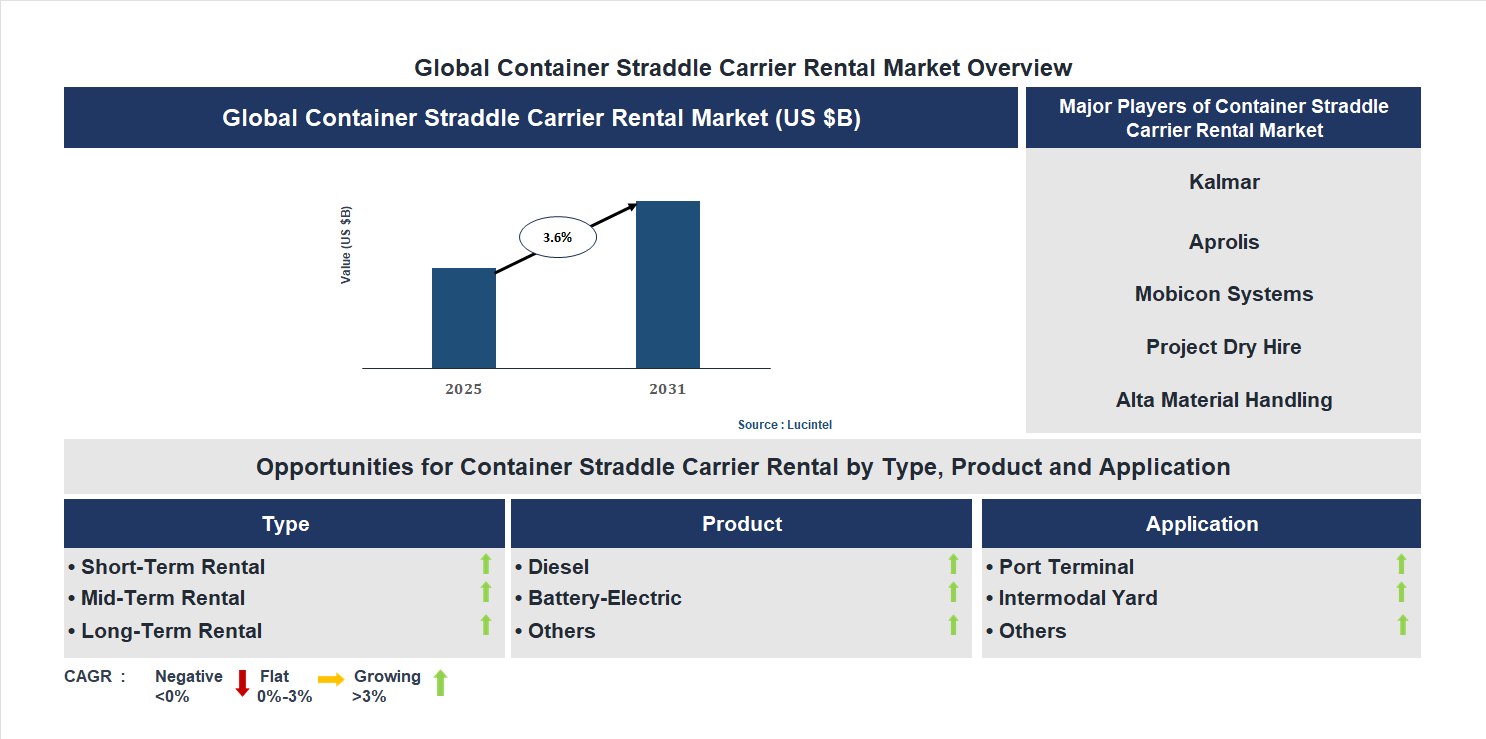
Key data points: The growth forecast = 3.6% annually for the next 6 years. Scroll below to get more insights. This market report covers trends, opportunities and forecasts in container straddle carrier rental market to 2031 by type (short-term rental, mid-term rental, and long-term rental), product (diesel, battery-electric, and others), application (port terminal, intermodal yard, and others), and region (North America, Europe, Asia Pacific, and the Rest of the World)
We'll send your sample report shortly.
• Lucintel forecasts that, within the type category, short-term rental is expected to witness the highest growth over the forecast period.
• Within the application category, port terminal is expected to witness higher growth.
• In terms of region, APAC is expected to witness the highest growth over the forecast period. Gain valuable insights for your business decisions with our comprehensive 150+ page report. Sample figures with some insights are shown below.
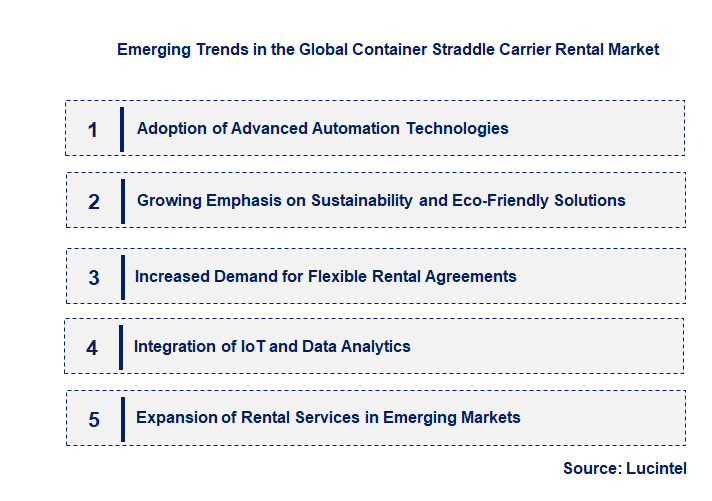
• Adoption of Advanced Automation Technologies: The integration of automation in container handling equipment is revolutionizing the market. Automated straddle carriers enhance operational efficiency, reduce labor costs, and improve safety standards. These systems utilize sensors, AI, and IoT connectivity to enable precise, faster, and more reliable operations. As automation becomes more affordable and scalable, rental companies are increasingly offering automated solutions to meet the demand for higher productivity and safety compliance. This trend is expected to significantly reduce operational costs and improve turnaround times for logistics providers.
• Growing Emphasis on Sustainability and Eco-Friendly Solutions: Environmental concerns are prompting the market to shift towards greener alternatives. Rental providers are investing in electric and hybrid straddle carriers to reduce carbon emissions and comply with stricter regulations. Customers are also prioritizing sustainable practices, which influence rental choices. The adoption of eco-friendly equipment not only aligns with corporate social responsibility goals but also offers long-term cost savings through lower energy consumption and maintenance. This trend is driving innovation in design and fueling demand for sustainable rental options across the industry.
• Increased Demand for Flexible Rental Agreements: The market is witnessing a move towards more adaptable rental contracts to accommodate fluctuating logistics needs. Short-term, pay-as-you-go, and customizable leasing options are gaining popularity among customers seeking operational flexibility. This approach allows companies to scale equipment usage based on seasonal peaks or project-specific requirements without long-term commitments. Rental providers are developing innovative leasing models to attract clients looking for cost-effective, scalable solutions, thereby expanding their customer base and enhancing market competitiveness.
• Integration of IoT and Data Analytics: The use of IoT devices and data analytics is transforming equipment management and operational decision-making. Real-time monitoring of straddle carriers enables predictive maintenance, reduces downtime, and optimizes fleet utilization. Data-driven insights help rental companies improve service quality, streamline logistics, and offer value-added solutions to clients. This technological integration enhances transparency, accountability, and efficiency, making rental services more reliable and tailored to customer needs. As data analytics become more sophisticated, they are expected to further revolutionize market operations.
• Expansion of Rental Services in Emerging Markets: Rapid industrialization and infrastructure development in emerging economies are driving demand for container handling equipment rentals. Rental companies are expanding their presence in regions such as Asia-Pacific, Africa, and Latin America to capitalize on growing trade volumes. Localized service offerings, competitive pricing, and strategic partnerships are key strategies for market entry and growth. This expansion not only broadens the market scope but also supports regional economic development by providing flexible, cost-effective equipment solutions to burgeoning logistics sectors. In summary, these trends are collectively reshaping the container straddle carrier rental market by fostering innovation, promoting sustainability, enhancing flexibility, and expanding geographic reach. They are enabling market participants to meet evolving customer demands more effectively, improve operational efficiencies, and stay competitive in a rapidly changing global logistics landscape.
• Digitalization and Automation: Enhancing Efficiency and Safety: The integration of digital technologies and automation in container straddle carriers is transforming operations. Automated systems improve precision, reduce labor costs, and enhance safety standards. Companies adopting these innovations benefit from increased productivity and reduced downtime. As automation becomes more affordable, rental providers are expanding their fleets with smart, connected equipment, attracting clients seeking modern, efficient solutions. This shift is expected to significantly boost market growth and competitiveness.
• Growing Infrastructure Investments in Emerging Markets: Expanding Port Facilities and Logistics Hubs: Emerging economies are investing heavily in port infrastructure and logistics hubs to support global trade. These investments drive demand for container handling equipment, including straddle carriers. Rental companies are capitalizing on this trend by offering flexible leasing options to accommodate fluctuating project needs. The expansion enhances regional trade capacity, reduces congestion, and accelerates supply chain efficiency. This development is crucial for market expansion and diversification, especially in Asia, Africa, and Latin America.
• Environmental Regulations Promoting Eco-Friendly Equipment: Adoption of Green Technologies: Straddle carrier manufacturers are developing eco-friendly models with lower emissions and energy consumption to comply with stricter environmental standards. Rental providers are increasingly offering these sustainable options to clients aiming to reduce carbon footprints. The shift towards electric and hybrid carriers not only aligns with regulatory requirements but also reduces operational costs. This trend is fostering innovation, attracting environmentally conscious customers, and expanding market opportunities in regions with stringent environmental policies.
• Strategic Partnerships and Mergers: Strengthening Market Position and Service Offerings: Companies are forming alliances, joint ventures, and mergers to enhance their market presence and service portfolios. These collaborations enable access to advanced technologies, broader geographic reach, and improved customer support. Strategic partnerships also facilitate the development of integrated logistics solutions, increasing customer retention. As the market consolidates, competition intensifies, leading to better pricing, innovation, and service quality, which ultimately benefits end-users and accelerates market growth.
• Impact of COVID-19 and Supply Chain Resilience: Accelerating Rental Market Adoption: The pandemic highlighted vulnerabilities in supply chains, prompting a shift towards flexible rental solutions over ownership. Companies seek to mitigate risks by renting equipment rather than investing in costly assets. This trend has increased demand for container straddle carriers on a rental basis, especially in ports and logistics hubs, adapting to fluctuating trade volumes. The focus on resilience and agility is expected to sustain rental market growth, making it a vital component of modern supply chain strategies. The overall impact of these developments is a dynamic, innovative, and resilient container straddle carrier rental market. Increased technological integration, infrastructure investments, environmental focus, strategic collaborations, and supply chain adaptations are collectively driving growth. These factors are making the market more competitive, sustainable, and responsive to global trade demands, ultimately benefiting stakeholders through improved efficiency, cost savings, and expanded service offerings.
• Expansion of Port Infrastructure and Container Handling Facilities: Growing global trade necessitates advanced port infrastructure, leading to increased demand for container straddle carriers. Rental companies benefit from this trend by providing flexible, scalable equipment solutions that support port modernization projects. As ports expand and upgrade their facilities, rental services become essential for managing fluctuating cargo volumes without heavy capital expenditure. This growth is particularly prominent in emerging markets, where infrastructure investments are accelerating.
• Adoption of Automation and Technological Innovations in Container Handling: The integration of automation technologies in container handling equipment is transforming port operations. Rental providers are increasingly offering automated straddle carriers equipped with sensors, GPS, and remote monitoring systems. These innovations improve efficiency, safety, and reliability, attracting logistics companies seeking to modernize their operations. The shift toward automation creates opportunities for rental companies to supply state-of-the-art equipment without clients bearing high capital costs.
• Rising Demand for Flexible and Cost-Effective Equipment Solutions: Companies involved in shipping and logistics prefer renting container straddle carriers to reduce capital expenditure and operational costs. Rental options provide flexibility to scale equipment based on seasonal or project-specific needs, avoiding long-term commitments. This trend is driven by fluctuating trade volumes and the need for agile supply chain management. Rental providers that offer diverse, well-maintained fleets can capitalize on this demand, especially in regions with variable cargo throughput.
• Growth of E-commerce and Supply Chain Optimization: The surge in e-commerce has increased the volume of containerized goods requiring efficient handling. Rental companies are positioned to support this growth by supplying reliable equipment that enhances throughput and reduces turnaround times at ports and warehouses. Optimized container handling directly impacts delivery speed and customer satisfaction. As e-commerce continues to expand globally, rental services will play a crucial role in enabling flexible, scalable logistics solutions for online retailers and distribution centers.
• Strategic Partnerships and Market Expansion in Emerging Economies: Rental service providers are forming alliances with port authorities, shipping lines, and infrastructure developers to expand their presence in emerging markets. These regions offer substantial growth potential due to ongoing port development and increasing trade activity. Establishing local operations and tailored rental solutions allows companies to capture new customer segments. Market expansion strategies also include investing in equipment upgrades and training services, ensuring competitiveness and long-term growth in developing economies. The overall impact of these opportunities is set to significantly enhance the growth trajectory of the container straddle carrier rental market, fostering innovation, operational efficiency, and global trade facilitation. As companies adapt to evolving industry demands, rental providers will play a pivotal role in supporting sustainable and scalable port and logistics infrastructure development worldwide.
• Increasing Global Trade and Port Activities: The surge in international trade, driven by globalization and economic growth, has led to increased port activities worldwide. Ports require efficient handling equipment like straddle carriers to manage rising cargo volumes, prompting higher rental demand. This trend is particularly prominent in emerging economies investing heavily in port infrastructure. The flexibility of rental services allows ports to scale operations according to fluctuating trade volumes without significant capital expenditure. As global trade continues to expand, the need for reliable, cost-effective container handling solutions will further propel market growth, making rental options increasingly attractive for port operators and logistics companies.
• Technological Advancements and Automation: Innovations in automation and digital technologies are transforming container handling equipment, including straddle carriers. Automated systems improve operational efficiency, reduce labor costs, and enhance safety standards. Rental companies investing in advanced, automated straddle carriers can offer clients state-of-the-art solutions, giving them a competitive edge. The integration of IoT and telematics enables real-time monitoring and predictive maintenance, minimizing downtime. As technology becomes more sophisticated and affordable, the market for technologically advanced rental equipment is expected to grow significantly, meeting the demands of modern ports and logistics hubs seeking efficiency and safety improvements.
• Infrastructure Development and Urbanization: Rapid urbanization and infrastructure development, especially in emerging economies, are fueling demand for efficient cargo handling solutions. Ports and logistics centers are expanding to accommodate increasing container traffic, necessitating the use of modern equipment like straddle carriers. Rental services provide a flexible and cost-effective way for these facilities to upgrade their infrastructure without heavy capital investment. Additionally, government initiatives aimed at improving transportation networks and port facilities further stimulate market growth. As urban centers grow and trade routes expand, the need for reliable, scalable container handling equipment will continue to rise, bolstering rental market prospects.
• Cost-Effectiveness and Flexibility of Rental Services: Renting container handling equipment offers significant cost advantages over purchasing, especially for temporary or seasonal projects. It allows companies to avoid high capital expenditure and maintenance costs while providing access to the latest technology. Flexibility in rental terms enables logistics providers and port operators to adjust their equipment fleet based on fluctuating demand, optimizing operational efficiency. This cost-effective approach is particularly appealing during economic downturns or market uncertainties, encouraging more players to opt for rental solutions. As a result, the rental market benefits from increased demand driven by the need for adaptable, budget-friendly equipment options.
• Environmental Regulations and Sustainability Initiatives: Stricter environmental regulations and a global push towards sustainability are influencing the rental market. Rental companies are increasingly offering eco-friendly, energy-efficient straddle carriers that comply with emission standards. This shift helps operators reduce their carbon footprint and meet regulatory requirements without significant capital investment. Additionally, rental services facilitate the adoption of cleaner technologies, supporting corporate sustainability goals. As governments implement stricter environmental policies and companies prioritize green practices, the demand for environmentally compliant equipment is expected to grow, further shaping the rental market landscape. The challenges facing this container straddle carrier rental market include:
• High Capital and Maintenance Costs for Advanced Equipment: While rental offers cost benefits, the initial investment in technologically advanced straddle carriers remains high. Upgrading to automation and eco-friendly models involves substantial capital expenditure for rental companies, which can impact profitability. Additionally, maintenance costs for sophisticated equipment are high, requiring specialized skills and parts. These expenses can limit the availability of cutting-edge equipment in the rental fleet, potentially hindering market growth. Balancing the costs of innovation with competitive pricing is a persistent challenge for rental providers aiming to meet evolving customer demands while maintaining profitability.
• Fluctuations in Global Trade and Port Throughput: The container handling market is highly sensitive to global economic conditions and trade volumes. Economic downturns, trade disputes, or disruptions like pandemics can lead to decreased port activity, reducing demand for rental equipment. Conversely, sudden surges in trade can strain existing equipment fleets, causing operational bottlenecks. These fluctuations create uncertainty for rental companies, complicating fleet management and investment decisions. Maintaining a flexible yet efficient inventory to adapt to unpredictable market conditions remains a key challenge, impacting revenue stability and growth prospects.
• Regulatory Compliance and Environmental Standards: Increasingly stringent safety, environmental, and operational regulations pose compliance challenges for rental companies. Adapting equipment to meet evolving standards requires continuous investment in upgrades and certifications, which can be costly and time-consuming. Non-compliance risks, penalties, and reputational damage, making regulatory adherence a critical concern. Additionally, navigating diverse regulations across different regions complicates fleet management and operational planning. Ensuring compliance while maintaining competitive pricing and service quality is a complex balancing act that influences market dynamics and growth potential. In summary, the container straddle carrier rental market is shaped by robust drivers such as global trade expansion, technological innovation, infrastructure development, cost efficiency, and sustainability initiatives. However, it faces challenges including high costs for advanced equipment, market volatility due to trade fluctuations, and regulatory compliance complexities. These factors collectively influence market growth, requiring stakeholders to adopt strategic, flexible approaches. Embracing technological advancements and sustainable practices can unlock new opportunities, while managing costs and regulatory risks remains essential for long-term success. Overall, the markets evolution will depend on how effectively these drivers and challenges are navigated by industry players.
• Kalmar
• Aprolis
• Mobicon Systems
• Project Dry Hire
• Alta Material Handling
• Dawsongroup Material Handling
• Pure Services
• Summit ToyotaLift
• Fork Truck Direct
• Allways Forktruck Services
• Short-Term Rental
• Mid-Term Rental
• Long-Term Rental
• Diesel
• Battery-Electric
• Others
• Port Terminal
• Intermodal Yard
• Others
• North America
• Europe
• Asia Pacific
• The Rest of the World
• United States: The US market has seen increased demand for automated and eco-friendly straddle carriers, driven by major port upgrades and a focus on reducing carbon emissions. Rental companies are expanding their fleets to meet rising logistics needs, especially in California and the Gulf Coast. Technological integration, such as IoT-enabled equipment, is gaining popularity to improve operational efficiency. The US government’s infrastructure investments are further boosting market growth.
• China: China continues to lead in port expansion and modernization, with a surge in rental demand for advanced, high-capacity straddle carriers. The government’s focus on Belt and Road Initiative projects has increased logistics activity, prompting rental companies to upgrade their fleets. Automation and smart port solutions are increasingly adopted to handle growing container volumes efficiently. Domestic manufacturers are also investing in innovative equipment to compete globally.
• Germany: The German market emphasizes sustainability and technological innovation, with a rising preference for electric and hybrid straddle carriers. The country’s strong logistics sector and strategic location in Europe drive steady rental market growth. Companies are investing in modern, energy-efficient equipment to meet strict environmental regulations. Digitalization of rental services and maintenance processes is also enhancing operational efficiency.
• India: India’s container handling industry is rapidly expanding, with increased rental demand driven by port modernization projects and infrastructure development. The focus is on acquiring versatile, cost-effective equipment to support growing trade volumes. The government’s initiatives to improve port connectivity and logistics infrastructure are fueling market growth. Rental companies are also exploring automation to improve productivity and reduce operational costs.
• Japan: Japan’s market is characterized by a focus on advanced technology and environmental sustainability. The demand for electric and hybrid straddle carriers is rising, aligned with national environmental policies. The country’s ports are investing in automation and smart logistics solutions to enhance efficiency. The rental market is also benefiting from aging equipment replacement and the need for high-performance machinery to support Japan’s extensive export-oriented economy.


• Kalmar
• Aprolis
• Mobicon Systems
• Project Dry Hire
• Alta Material Handling
• Dawsongroup Material Handling
• Pure Services
• Summit ToyotaLift
• Fork Truck Direct
• Allways Forktruck Services Q5. Which container straddle carrier rental market segment will be the largest in future? Answer: Lucintel forecasts that, within the type category, short-term rental is expected to witness the highest growth over the forecast period. Q6. In container straddle carrier rental market, which region is expected to be the largest in next 5 years? Answer: In terms of region, APAC is expected to witness the highest growth over the forecast period. Q7. Do we receive customization in this report? Answer: Yes, Lucintel provides 10% customization without any additional cost.


Choose a license that fits your team. Instant PDF delivery.
Prices exclude taxes. Instant delivery. Custom licensing available on request.
Market Report · May 18, 2026
Market Report · May 18, 2026
Market Report · May 18, 2026
Trusted partner for strategic intelligence and business growth


Receive a complimentary market analysis tailored to your industry. Our analysts will identify key growth opportunities and competitive dynamics specific to your business.

Market size, growth rate, and key trend analysis for your specific sector.

Top competitor positioning and market share analysis.

Strategic recommendations backed by data-driven insights.
Get curated market intelligence and competitive moves straight to your inbox.
By subscribing, you agree to receive our monthly insights. Unsubscribe anytime.
Receive a complimentary market analysis tailored to your industry. Our analysts will identify key growth opportunities and competitive dynamics specific to your business.
Market size, growth rate, and key trend analysis for your specific sector.
Top competitor positioning and market share analysis.
Strategic recommendations backed by data-driven insights.
Get curated market intelligence, emerging trends, and competitive moves straight to your inbox each month.
By subscribing, you agree to receive our monthly insights. Unsubscribe anytime.
We'll send your sample report shortly.