
Report Feature
Container & Packaging Market Trends and Forecast
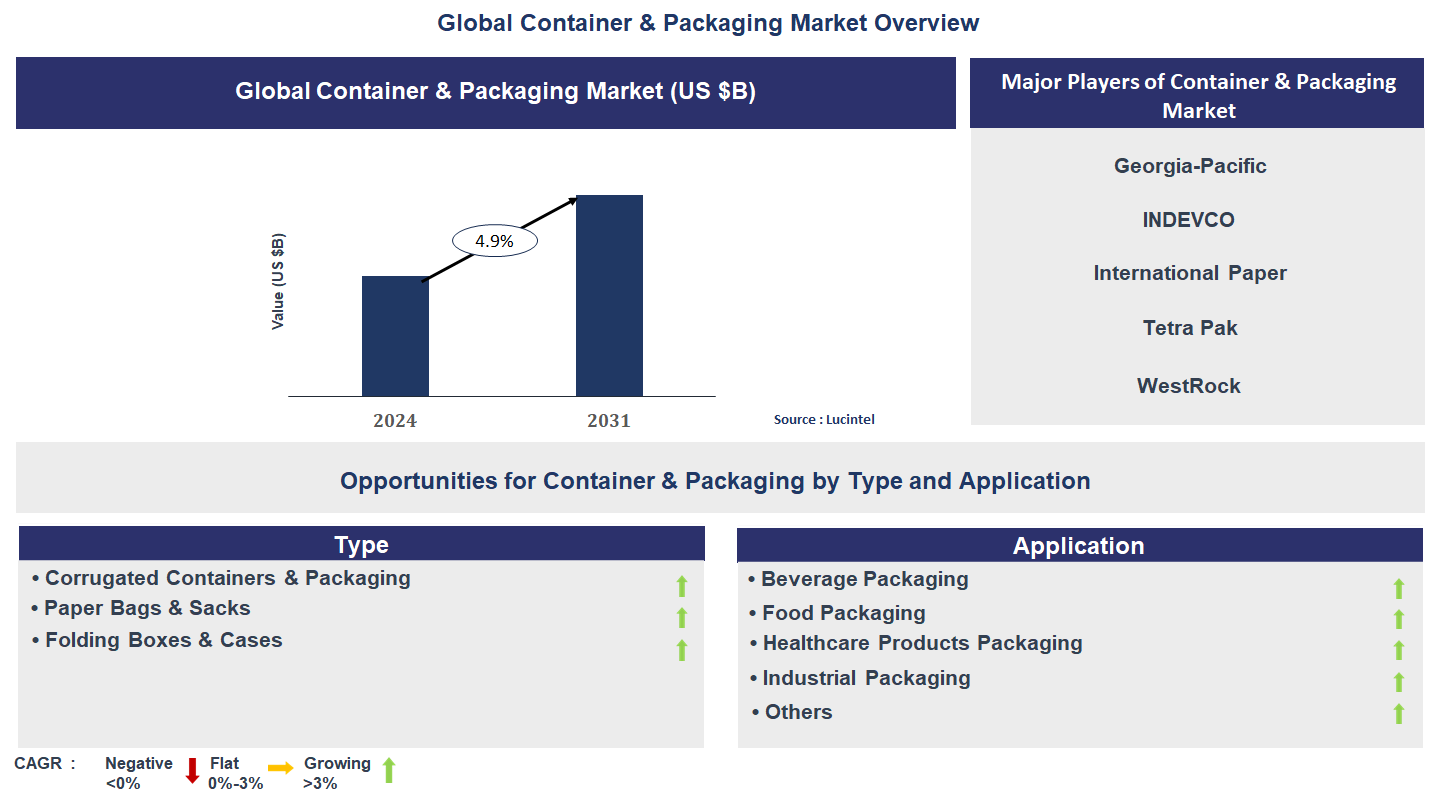
The future of the global container & packaging market looks promising with opportunities in the beverage packaging, food packaging, healthcare product packaging, and industrial packaging markets. The global container & packaging market is expected to grow with a CAGR of 4.9% from 2025 to 2031. The major drivers for this market are the increasing demand for sustainable packaging solutions, the rising adoption of E-commerce packaging needs, and the growing focus on product safety standards.• Lucintel forecasts that, within the type category, corrugated container & packaging is expected to witness the highest growth over the forecast period.
• Within the application category, beverage packaging is expected to witness the highest growth.
• In terms of region, APAC is expected to witness the highest growth over the forecast period. Gain valuable insights for your business decisions with our comprehensive 150+ page report. Sample figures with some insights are shown below.
Emerging Trends in the Container & Packaging Market
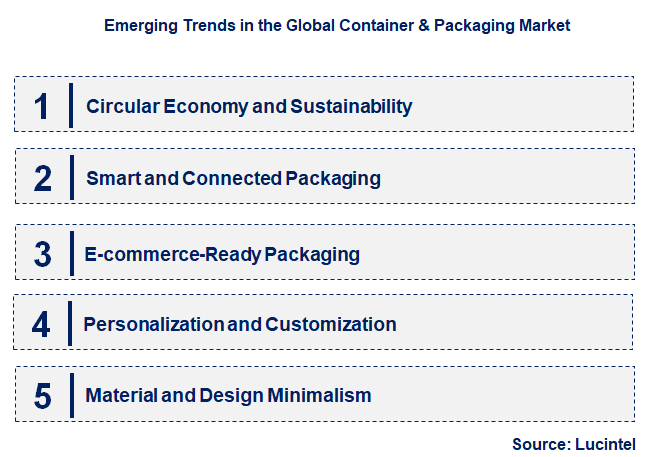
The container & packaging industry is being redefined by a number of dominant trends that are profoundly transforming how products are designed, manufactured, and consumed. Such trends are a reaction to a worldwide call for sustainability, the commercialization of the digital world, and a call for increased efficiency and transparency within the supply chain. The industry is shifting away from its historical function of solely being a container and into being part of a brand’s image and its environmental stewardship.• Circular Economy and Sustainability: Sustainability and green packaging solutions are a dominant trend. This involves the application of post-consumer recycled (PCR) material, bio-based plastics, and easy recycling or composability-enabled designs. The result is less environmental footprint and a transition to a circular economy. Brands are leveraging this as a major differentiator, and it’s pushing innovation in material science and recycling infrastructure, redefining the whole value chain.
• Smart and Connected Packaging: Smart packaging is a new trend that embeds technology into a container. This is done by utilizing QR codes, NFC tags, and IoT sensors to offer real-time information to consumers and supply chain stakeholders. The effect is an open and dynamic consumer experience. This technology allows for product traceability, authenticates products to deter counterfeiting, and gives brands insightful data about consumer behavior, building a stronger connection with their base.
• E-commerce-Ready Packaging: Expansion in e-commerce is leading to a shift towards e-commerce-specific packaging. This comprises lightweight, rigid, and correctly sized boxes and mailers that cushion the product en route and minimize waste. The effect is an efficient and cheaper logistics system. This is forcing the sector to design packaging that not only serves a use function but also looks attractive to the "unboxing" experience, which is a significant aspect of a brand’s social online presence.
• Personalization and Customization: The drive towards on-demand printing and digital manufacturing is making it possible for brands to provide customized and personalized packaging. This enables smaller batches, as well as distinct designs for various regions, campaigns, or even individual shoppers. The result is a more powerful brand image and greater customer loyalty. This trend is very much in vogue in the cosmetics, food, and drinks industries, where an exclusive and memorable unboxing will go a long way towards strengthening brand perception.
• Material and Design Minimalism: There is a trend towards "less is more" that is affecting packaging design and material application. This means less material used in packaging, removing excessive layers, and having a clean minimalist look. The effect is lower material cost and reduced environmental footprint. This appeals to cautious consumers concerned about too much packaging and is beneficial to brands that want to convey an image of efficiency and sustainability. These trends are collectively reshaping the market by making packaging a more critical part of the brand-consumer relationship and an important tool for achieving sustainability goals. The industry is becoming more innovative, responsive, and technologically advanced.
Recent Development in the Container & Packaging Market
The container & packaging industry is experiencing dynamic development, fueled by the convergence of consumer, technological, and regulatory trends. These trends are changing the industry from being a mere supplier of containers to a supply chain efficiency and brand management strategic partner. The emphasis has moved on from just functionality to a more integrated approach that includes sustainability, consumer interaction, and digital inclusion. These are turning packaging into an interactive part of the product’s life cycle from maker to user.• Emergence of Sustainable Materials: One of the biggest developments is the ubiquitous use of sustainable materials. This means more use of recycled materials, bio-based plastics, and innovative paper and paperboard options. Firms are ploughing money into research and development to produce materials that not only have a lower environmental impact but also retain the necessary barrier characteristics for food and other products. The effect is a massive decrease in the industry carbon footprint, which is an important aspiration for both companies and consumers.
• E-commerce Packaging Innovation: The quick rise of e-commerce has given rise to a dramatic evolution of packaging specifically for shipping purposes. They are lightweight corrugated boxes, flexible mailers, and smart packaging with embedded tracking functionality. Automated machinery is being employed by companies to right-size boxes, saving material waste and shipping expenses. The result is a more sustainable and efficient e-commerce supply chain.
• Smart Technology Integration: One of the most important developments is the integration of smart technology into packages. It entails employing QR codes, NFC tags, and other digital markers linking the product in the physical world to a digital world. The effect is improved consumer experience and product traceability. With this technology, consumers can access comprehensive product information, and brands have access to real-time information about their supply chain and consumer behavior.
• Regulatory Developments and EPR: New regulatory guidelines, including the imposition of Extended Producer Responsibility (EPR) schemes in most countries, are having an enormous effect. The legislation is making producers responsible for the entire life of their packaging. The effect is that it is compelling businesses to re-design packaging to make it recyclable and reusable. This is speeding up the transition away from hard-to-recycle materials and is leading to investments in new recycling facilities.
• Transition to Reusable and Refillable Models: One of the new developments is the transition to reusable and refillable packaging models. Companies are testing durable containers that are returned and refilled by consumers. This model is taking hold in the food, beverage, and personal care markets. The effect is a dramatic decrease in waste and a new business model for companies. These trends are collectively shaping the market by positioning packaging as a more strategic and integral component of the value chain of the product. The industry is shifting towards a sustainable, open, and technology-oriented future.
Strategic Growth Opportunities in the Container & Packaging Market
The container & packaging market offers a myriad of strategic growth opportunities on the back of key applications that are revolutionizing the industry. By targeting these opportunities, businesses can open up new sources of revenue and create a competitive edge. They are based on consumer demands for sustainability, convenience through e-commerce, and the requirement for more sophisticated functionality in areas such as healthcare. To succeed will be through innovating in materiality, technology, and business models to address these changing demands.• Last-Mile Delivery and E-commerce Logistics: The rocketing growth of e-commerce is a huge strategic growth potential. Firms can focus on light, strong, and appropriately sized corrugated and flexible packaging optimized for transport. The result is the potential to access a high-growth market by delivering cost-saving shipment solutions and material savings. The opportunity further encompasses creating packaging to optimize the "unboxing" experience.
• Sustainability and Food Safety: The food and beverage industry is one of the main growth areas, with an emphasis on sustainable, high-barrier packaging. Business can innovate by offering solutions to increase shelf life through the use of recyclable mono-materials and bio-based plastics. The effect is that this meets consumer demand for sustainable products while maintaining food safety and minimizing food waste, priorities that are paramount for both consumers and brands.
• Intelligent and Secure Packaging: There is a very important strategic imperative across the healthcare and pharmaceutical space, fueled by requirements for secure, sterile, and tamper-evident packaging. Firms can offer solutions with built-in smart labels, product-specific identifiers, and high-level barrier properties. The effect is that this guarantees patient safety and eliminates counterfeiting, which are absolute imperatives in healthcare, and this makes a high-margin market for dedicated packaging providers.
• Personalization and Customization: The consumer goods industry offers a strategic growth opportunity through personalization and customization. Businesses can use digital printing and on-demand production to develop distinct, limited, or personalized packaging for brands. The effect is that it allows brands to differentiate themselves and build a deeper bond with consumers. This is an especial opportunity for the luxury goods, personal care, and cosmetics markets, where the packaging is an essential component of the brand identity.
• Reusable and Circular Models: Industrial and bulk packaging presents a strategic opportunity for growth by building reusable and circular packaging solutions. Businesses can create robust, returnable containers, pallets, and intermediate bulk containers (IBCs) for business-to-business use. The effect is that this minimizes waste and enhances supply chain efficiency for large companies, which fits with their corporate sustainability objectives and offers a long-term, value-based service. These growth opportunities are driving the market by compelling companies to innovate and specialize in various applications. The market is shifting from a generalist approach to one of customized solutions for particular industries as the means of achieving worthwhile growth.
Container & Packaging Market Driver and Challenges
The container & packaging industry is impacted by a variety of drivers that promote its growth and challenges that pose serious obstacles. The drivers are chiefly in response to world trends like the growth of e-commerce and an increasing need for sustainable products. On the other hand, the challenges are based on the intricacy of regulation, the expense of innovation, and the fragmented recycling infrastructure. The future of the market will be contingent on its ability to ride its growth drivers while successfully overcoming its major challenges. The factors responsible for driving the container & packaging market include: 1. E-commerce Boom: Global e-commerce’s huge and consistent growth is a key driver. This has generated unprecedented volumes of demand for lightweight, strong, yet affordable packaging that can survive shipping and handling stresses. This is especially propelling the corrugated and flexible packaging categories. 2. Consumer Demand and Sustainability: One of the key drivers is growing consumer and business demand for sustainability. Consumers are looking for packaging that is bio-based, reusable, and recyclable, and this is forcing brands to alter their packaging. This is forcing the industry to invest in new packaging materials and recycling technologies and to innovate. 3. Urbanization and Changing Lifestyles: Urbanization and increasing numbers of smaller households and busy lifestyles are motivating demand for easy, single-serve, and ready-to-eat products. This trend directly affects demand for flexible pouches, single-use containers, and other convenient packaging forms. 4. Expansion in the Healthcare Industry: The growth of the global healthcare and pharmaceutical industries is one of the major drivers. This is leading to demand for high-quality, sterile, and tamper-evident packaging to maintain product integrity and patient safety. This is a high-value, high-growth area for packaging suppliers. 5. Technological Developments: Merging new technologies, including digital printing, intelligent labels, and automation, is a key driver. These technologies are enhancing packaging to be more efficient, traceable, and interactive, which is increasing brand-consumer interaction and enhancing supply chain management. Challenges in the container & packaging market are: 1. Bans and Regulatory Complexities: One of the main issues is a complicated and fragmented regulatory landscape, particularly in plastics bans and new recycling regulations. Divergent regulations in different countries and regions can present major compliance challenges for multinational companies and can hinder new material adoption. 2. High Price of Sustainable Alternatives: The price of sustainable material and cutting-edge recycling technology is a major barrier. Recycled and bio-based plastics tend to be more expensive than virgin plastics, which can act as a stumbling block for highly price-sensitive and thin-margin companies. 3. Lacking Recycling Infrastructure: Although there has been a drive towards sustainability, an inconsistent and strong recycling infrastructure in the world is one of the major challenges. It can be challenging to collect, sort, and recycle materials efficiently, which can jeopardize the efforts of a circular economy and hamper the development of new recycling innovations. In sum, the market for containers and packaging is fueled by strong worldwide trends toward convenience, sustainability, and technology integration. Yet it is confronted with major challenges in regulatory complexity, the expense of sustainable materials, and the limitations of current recycling infrastructure. The future growth of the industry will be based on its capacity to overcome those challenges through innovation and collaborative partnerships.List of Container & Packaging Companies
Companies in the market compete on the basis of product quality offered. Major players in this market focus on expanding their manufacturing facilities, R&D investments, infrastructural development, and leverage integration opportunities across the value chain. With these strategies container & packaging companies cater increasing demand, ensure competitive effectiveness, develop innovative products & technologies, reduce production costs, and expand their customer base. Some of the container & packaging companies profiled in this report include-• Georgia-Pacific
• INDEVCO
• International Paper
• Tetra Pak
• WestRock
• Smurfit Kappa
• Cascades
• Colbert Packaging
• Davpack
• Diamond Packaging
Container & Packaging Market by Segment
The study includes a forecast for the global container & packaging market by type, application, and region.Container & Packaging Market by Type [Value from 2019 to 2031]:
• Corrugated Containers & Packaging
• Paper Bags & Sacks
• Folding Boxes & Cases
Container & Packaging Market by Application [Value from 2019 to 2031]:
• Beverage Packaging
• Food Packaging
• Healthcare Products Packaging
• Industrial Packaging
• Others
Container & Packaging Market by Region [Value from 2019 to 2031]:
• North America
• Europe
• Asia Pacific
• The Rest of the World
Country Wise Outlook for the Container & Packaging Market
The container & packaging industry stands at a critical juncture, experiencing radical change stimulated by worldwide forces. Consumer pressure for sustainability, the phenomenal rise in e-commerce, and the necessity to improve efficiency in the supply chain are the main drivers. Recent trends are aimed at producing packaging that is not just protective and functional but also sustainable and smart. This encompasses a transition towards new materials, novel designs, and the integration of intelligent technologies. The sector is transforming from a linear "make, use, dispose" system to a circular and sustainable one.• United States: In the United States, recent trends are predominantly fueled by the e-commerce boom and a strong national initiative towards sustainability. There is considerable emphasis on light and robust corrugated packaging to address the last-mile delivery demands. There are also new regulations, including Extended Producer Responsibility (EPR) legislation in certain states, compelling brands to opt for reusable and recyclable packaging options. There is also a remarkable upsurge in the application of post-consumer resin (PCR) and other bio-based materials as substitutes for virgin plastics.
• China: As the world’s largest consumer market and a manufacturing powerhouse, China’s container & packaging market is a leader in volume and innovation. Recent developments are guided by a national strategy to reduce plastic waste and enhance recycling. There is a strong government push for flexible packaging that uses less material and is easier to recycle. One of the most important developments is broad adoption of smart packaging with QR codes and NFC tags to enhance product traceability and consumer interaction, particularly in the fast-growing e-commerce segment.
• Germany: Germany’s packaging and container industry is a world leader in circular economy and sustainability trends. Developments are strongly driven by rigorous European Union regulation. There is a high focus on paper, glass, and metal recycling rates. One of the most important developments is the trend toward easier-to-recycle mono-material plastics and the adoption of refillable and reusable packaging systems, well-backed by an advanced deposit-return system for bottles and containers.
• India: India’s container & packaging industry is growing at a fast pace, driven by urbanization, increased disposable incomes, and growth in organized retail and e-commerce. Latest trends are centered around offering affordable and efficient packaging solutions. Flexible packaging and sachets are on the increase to meet a huge, price-conscious consumer segment. Government efforts to reduce single-use plastics are also spurring innovation in sustainable, biodegradable materials.
• Japan: Japan’s packaging and container market is very innovative, focusing on quality, accuracy, and waste reduction. The developments are led by a demand for high-end functionality and sustainability. Food and healthcare product manufacturers are investing in lightweight, high-barrier plastics to provide longer shelf life and safety. There is ongoing demand for minimalist design and high-quality, recyclable materials, and the nation is a global leader in the evolution of advanced technologies for sterile and tamper-evident packaging.

Features of the Global Container & Packaging Market
Market Size Estimates: Container & packaging market size estimation in terms of value ($B). Trend and Forecast Analysis: Market trends (2019 to 2024) and forecast (2025 to 2031) by various segments and regions. Segmentation Analysis: Container & packaging market size by type, application, and region in terms of value ($B). Regional Analysis: Container & packaging market breakdown by North America, Europe, Asia Pacific, and Rest of the World. Growth Opportunities: Analysis of growth opportunities in different types, applications, and regions for the container & packaging market. Strategic Analysis: This includes M&A, new product development, and competitive landscape of the container & packaging market. Analysis of competitive intensity of the industry based on Porter’s Five Forces model.
FAQ
Q1. What is the growth forecast for container & packaging market? Answer: The global container & packaging market is expected to grow with a CAGR of 4.9% from 2025 to 2031. Q2. What are the major drivers influencing the growth of the container & packaging market? Answer: The major drivers for this market are the increasing demand for sustainable packaging solutions, the rising adoption of e-commerce packaging needs, and the growing focus on product safety standards. Q3. What are the major segments for container & packaging market? Answer: The future of the container & packaging market looks promising with opportunities in the beverage packaging, food packaging, healthcare product packaging, and industrial packaging markets. Q4. Who are the key container & packaging market companies? Answer: Some of the key container & packaging companies are as follows:• Georgia-Pacific
• INDEVCO
• International Paper
• Tetra Pak
• WestRock
• Smurfit Kappa
• Cascades
• Colbert Packaging
• Davpack
• Diamond Packaging Q5. Which container & packaging market segment will be the largest in future? Answer: Lucintel forecasts that, within the type category, corrugated container & packaging is expected to witness the highest growth over the forecast period. Q6. In container & packaging market, which region is expected to be the largest in next 5 years? Answer: In terms of region, APAC is expected to witness the highest growth over the forecast period. Q7. Do we receive customization in this report? Answer: Yes, Lucintel provides 10% customization without any additional cost.
Table of Contents
List of Figures
List of Tables
Methodology
- In-depth interviews of the major players in this market
- Detailed secondary research from competitors’ financial statements and published data
- Extensive searches of published works, market, and database information pertaining to industry news, company press releases, and customer intentions
- A compilation of the experiences, judgments, and insights of Lucintel’s professionals, who have analyzed and tracked this market over the years.


Buy Now
Choose a license that fits your team. Instant PDF delivery.
Prices exclude taxes. Instant delivery. Custom licensing available on request.
Key Questions
- • What are some of the most promising, high-growth opportunities for the container & packaging market by type (corrugated containers & packaging, paper bags & sacks, and folding boxes & cases), application (beverage packaging, food packaging, healthcare products packaging, industrial packaging, and others), and region (North America, Europe, Asia Pacific, and the Rest of the World)?
- • Which segments will grow at a faster pace and why?
- • Which region will grow at a faster pace and why?
- • What are the key factors affecting market dynamics? What are the key challenges and business risks in this market?
- • What are the business risks and competitive threats in this market?
- • What are the emerging trends in this market and the reasons behind them?
- • What are some of the changing demands of customers in the market?
- • What are the new developments in the market? Which companies are leading these developments?
- • Who are the major players in this market? What strategic initiatives are key players pursuing for business growth?
- • What are some of the competing products in this market and how big of a threat do they pose for loss of market share by material or product substitution?
- • What M&A activity has occurred in the last 5 years and what has its impact been on the industry? For any questions related to Container & Packaging Market, Container & Packaging Market Size, Container & Packaging Market Growth, Container & Packaging Market Analysis, Container & Packaging Market Report, Container & Packaging Market Share, Container & Packaging Market Trends, Container & Packaging Market Forecast, Container & Packaging Companies, write Lucintel analyst at email: helpdesk@lucintel.com. We will be glad to get back to you soon.


