
Market Report · July 31, 2026

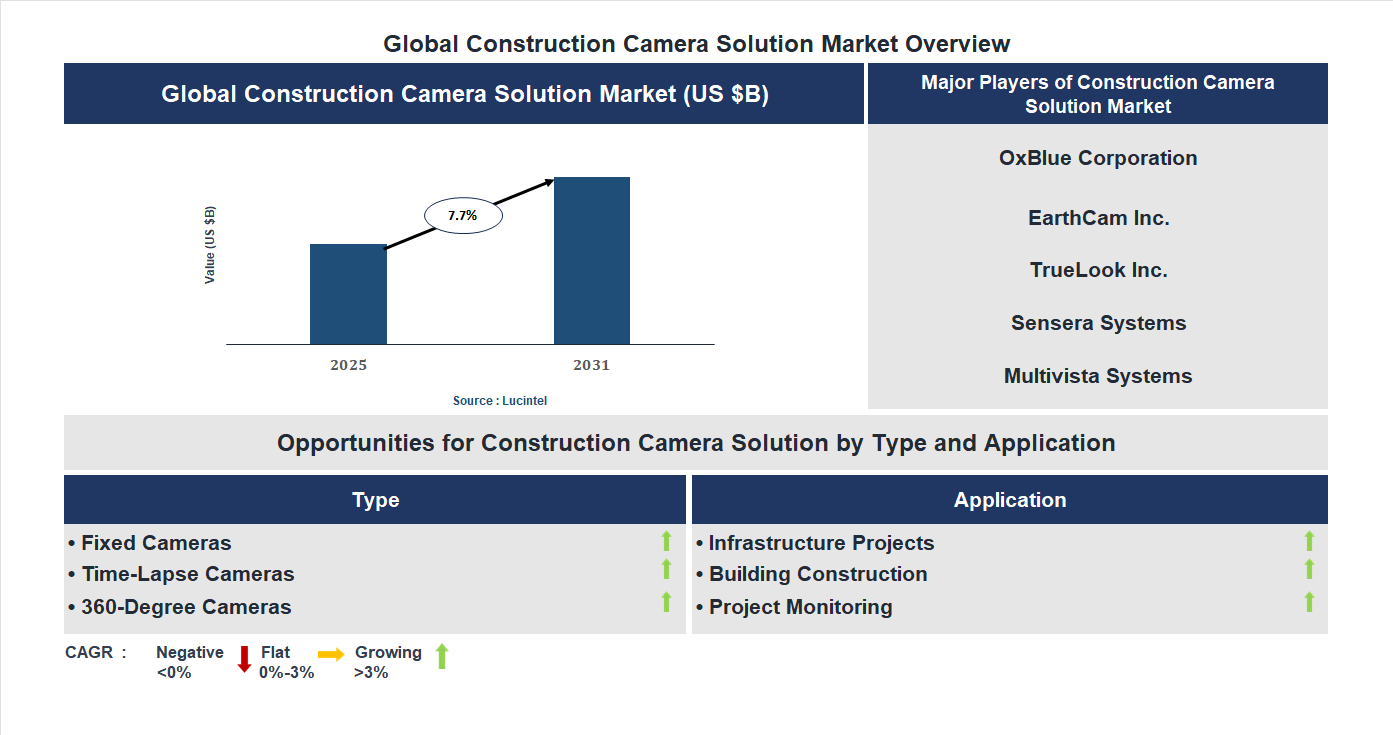
Key data points: The growth forecast = 7.7% annually for the next 7 years. Scroll below to get more insights. This market report covers trends, opportunities and forecasts in construction camera solution market to 2031 by type (fixed cameras, time-lapse cameras, and 360-degree cameras), application (infrastructure projects, building construction, and project monitoring), and region (North America, Europe, Asia Pacific, and the Rest of the World)
We'll send your sample report shortly.
• Lucintel forecasts that, within the type category, 360-degree camera is expected to witness the highest growth over the forecast period.
• Within the application category, project monitoring is expected to witness the highest growth.
• In terms of region, APAC is expected to witness the highest growth over the forecast period. Gain valuable insights for your business decisions with our comprehensive 150+ page report. Sample figures with some insights are shown below.
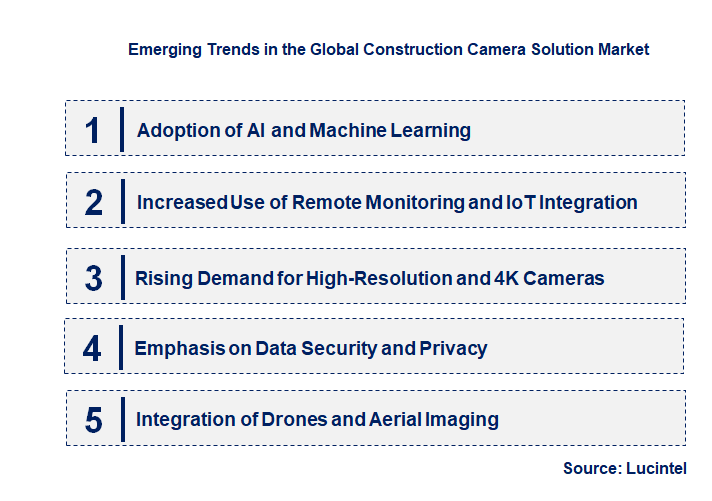
• Adoption of AI and Machine Learning: This trend involves integrating artificial intelligence and machine learning algorithms into construction cameras to enable real-time data analysis, predictive maintenance, and automated incident detection. AI-powered cameras can identify safety hazards, monitor worker behavior, and track equipment usage, significantly enhancing site safety and operational efficiency. These intelligent systems reduce human oversight needs, minimize errors, and facilitate proactive decision-making, leading to faster project completion and cost savings. As AI technology advances, its adoption is expected to become a key differentiator in the construction camera market.
• Increased Use of Remote Monitoring and IoT Integration: Remote monitoring allows stakeholders to oversee construction sites from anywhere, improving oversight and coordination. The integration of Internet of Things (IoT) devices with construction cameras enables continuous data collection on environmental conditions, equipment status, and site activity. This connectivity enhances real-time decision-making, reduces the need for on-site personnel, and improves safety by providing instant alerts for potential issues. IoT-enabled cameras also facilitate better resource management and project tracking, making construction processes more transparent and efficient, especially for large or inaccessible sites.
• Rising Demand for High-Resolution and 4K Cameras: As project complexity increases, so does the need for detailed visual documentation. High-resolution and 4K cameras provide crystal-clear images and videos, enabling precise inspections, quality control, and progress tracking. These advanced cameras help identify defects early, reduce rework, and ensure compliance with safety standards. The superior image quality also supports virtual walkthroughs and remote inspections, saving time and costs. The demand for such high-quality imaging solutions is driven by the need for accuracy and comprehensive documentation in modern construction projects.
• Emphasis on Data Security and Privacy: With the increasing deployment of connected cameras and data sharing, security concerns have become paramount. Construction companies are investing in secure data transmission protocols, encryption, and access controls to protect sensitive project information. Ensuring data privacy not only complies with regulations but also builds trust among stakeholders. As cyber threats evolve, the market is witnessing the development of more robust cybersecurity solutions tailored for construction camera systems. This trend underscores the importance of safeguarding project data against breaches and unauthorized access.
• Integration of Drones and Aerial Imaging: The use of drones equipped with construction cameras is expanding rapidly, providing aerial views of large sites for better planning, monitoring, and documentation. Drones can access hard-to-reach areas, capture high-resolution images, and generate 3D models for detailed analysis. This aerial imaging enhances site safety, improves progress tracking, and supports environmental monitoring. The integration of drone technology with construction cameras is transforming site surveillance, enabling faster assessments and more comprehensive data collection, which ultimately leads to more efficient project management and reduced costs. In summary, these emerging trends are fundamentally reshaping the construction camera solution market by enhancing safety, improving data accuracy, and enabling remote and real-time project management. The adoption of AI, IoT, high-resolution imaging, cybersecurity measures, and drone technology is driving increased efficiency, transparency, and safety standards across the industry. As these innovations continue to evolve, they will set new benchmarks for construction project execution and management worldwide.
• Integration of AI and Machine Learning: This development enables real-time analysis of construction site footage, improving safety monitoring, progress tracking, and anomaly detection. AI algorithms can identify safety hazards, unauthorized personnel, or equipment malfunctions, reducing risks and enhancing site management efficiency. The impact is a significant reduction in accidents and improved project timelines, making construction sites safer and more productive.
• Adoption of 5G Connectivity: The deployment of 5G technology enhances remote access and real-time data transmission from construction cameras. Faster, more reliable connectivity allows for seamless live streaming, instant alerts, and remote control of camera systems. This development supports real-time decision-making, especially for large or multi-site projects, leading to improved coordination and reduced delays.
• Development of Rugged and Weatherproof Cameras: Construction sites are often exposed to harsh environmental conditions. The introduction of durable, weatherproof cameras ensures continuous operation despite dust, rain, or extreme temperatures. This advancement minimizes downtime and maintenance costs, ensuring consistent site monitoring and documentation, which is crucial for project accountability and legal compliance.
• Integration with Building Information Modeling (BIM): Combining camera solutions with BIM systems allows for enhanced visualization and project management. Cameras provide real-time visual data that can be integrated into BIM models, facilitating better coordination among stakeholders, progress verification, and clash detection. This integration streamlines workflows and reduces rework, accelerating project completion.
• Use of Drones and Aerial Cameras: The incorporation of drones equipped with high-resolution cameras offers comprehensive site coverage, especially for large or inaccessible areas. Drones provide aerial perspectives, enabling better site planning, progress tracking, and safety inspections. Their use reduces the need for manual inspections, saving time and costs while improving overall site oversight. In summary, these recent developments are significantly transforming the construction camera solution market by enhancing safety, connectivity, durability, integration, and coverage. They are enabling construction companies to operate more efficiently, reduce risks, and improve project outcomes, thereby driving market growth and innovation.
• Site Surveillance: Enhanced security and theft prevention : Advanced camera solutions provide real-time monitoring, deterring theft and vandalism, and ensuring site safety. This reduces project delays and insurance costs, while improving overall site security.
• Progress Monitoring: Real-time project tracking : High-definition cameras enable continuous visual documentation of construction progress, facilitating better project management, timely decision-making, and stakeholder communication.
• Safety Management: Improved safety compliance : Cameras help monitor safety protocols, identify hazards, and ensure workers adhere to safety standards, reducing accidents and liability risks on-site.
• Remote Site Access: Enhanced remote monitoring capabilities : Wireless and cloud-enabled cameras allow managers to oversee multiple sites remotely, increasing oversight efficiency and reducing the need for physical presence.
• Drone Integration: Aerial site analysis and inspection : Drones equipped with cameras provide comprehensive aerial views, enabling detailed inspections, progress assessments, and site planning from above, saving time and resources. In summary, these growth opportunities are significantly impacting the construction camera solution market by increasing operational efficiency, enhancing safety, and enabling better project oversight. As technology continues to evolve, the market is poised for sustained expansion, driven by the need for smarter, safer, and more connected construction sites.
• Technological Advancements: The rapid evolution of camera technology, including high-resolution imaging, remote access, and AI-powered analytics, has significantly enhanced the capabilities of construction cameras. These innovations enable real-time monitoring, improved safety, and efficient project management. As technology becomes more affordable and accessible, construction companies are increasingly adopting these solutions to streamline operations, reduce delays, and improve safety compliance. The integration of IoT and cloud-based platforms further amplifies the utility of construction cameras, making them indispensable tools in modern construction projects.
• Increasing Infrastructure Development: Growing investments in infrastructure projects across regions such as Asia-Pacific, North America, and Europe are fueling demand for construction camera solutions. Governments and private sector players are prioritizing urbanization, transportation, and energy projects, which require extensive monitoring and management. Construction cameras provide transparency, progress tracking, and quality assurance, making them vital for large-scale developments. This surge in infrastructure initiatives directly correlates with increased adoption of construction camera solutions to ensure project efficiency and accountability.
• Safety and Security Regulations: Stringent safety standards and security regulations imposed by governments and industry bodies are driving the adoption of construction cameras. These solutions help monitor hazardous zones, ensure compliance with safety protocols, and provide evidence in case of accidents or disputes. Enhanced security measures, including surveillance against theft and vandalism, are also critical in safeguarding construction sites. As regulatory frameworks become more rigorous, construction firms are compelled to implement camera solutions to meet legal requirements and mitigate risks.
• Cost Optimization and Efficiency: Construction companies are increasingly seeking cost-effective solutions to manage projects efficiently. Construction cameras facilitate remote monitoring, reducing the need for on-site personnel and minimizing travel costs. They enable early detection of issues, reducing rework and delays, which ultimately lowers overall project costs. The ability to oversee multiple sites simultaneously from centralized locations enhances productivity and resource allocation, making construction cameras a strategic investment for optimizing project timelines and budgets.
• Growing Adoption of AI and Data Analytics: The integration of artificial intelligence and data analytics with construction camera solutions is transforming project management. AI-powered cameras can automatically detect safety violations, track progress, and analyze site conditions, providing actionable insights. This technological synergy enhances decision-making, improves safety compliance, and accelerates project completion. As AI adoption accelerates, construction firms gain a competitive edge through smarter, data-driven operations, further propelling market growth. The challenges facing this construction camera solution market include:
• High Initial Investment Costs: Despite the benefits, the high upfront costs of purchasing, installing, and maintaining advanced construction camera systems pose a significant barrier, especially for small and medium-sized enterprises. The expenses associated with hardware, software, and training can deter adoption, limiting market penetration. Additionally, ongoing maintenance and technological upgrades add to the financial burden, making it challenging for some firms to justify the investment without clear short-term returns.
• Data Security and Privacy Concerns: The widespread use of connected cameras and cloud-based platforms raises concerns over data security and privacy. Sensitive project information, site footage, and personal data are vulnerable to cyber threats and unauthorized access. Ensuring robust cybersecurity measures is essential but can be costly and complex. Data breaches could lead to legal liabilities, loss of competitive advantage, and damage to reputation, hindering the adoption of construction camera solutions.
• Technological Integration and Compatibility Issues: Integrating new camera systems with existing construction management platforms and legacy systems can be complex. Compatibility issues may lead to delays, increased costs, and operational disruptions. Additionally, varying standards and protocols across different vendors complicate seamless integration. Resistance to change within organizations and a lack of technical expertise further impede smooth adoption, limiting the full potential of advanced construction camera solutions. In summary, the construction camera solution market is driven by technological innovations, infrastructure development, regulatory requirements, cost efficiencies, and AI integration. However, high costs, data security issues, and integration challenges pose significant hurdles. These factors collectively influence market growth, requiring stakeholders to balance technological benefits with strategic investments and risk management. Overall, the markets future depends on overcoming these challenges through technological advancements, cost reductions, and robust security measures, ensuring sustainable growth and enhanced project management capabilities.
• OxBlue Corporation
• EarthCam Inc.
• TrueLook Inc.
• Sensera Systems
• Multivista Systems
• Brinno Inc.
• Evercam
• CamDo Solutions
• iBEAM Construction Cameras
• Jobsite Camera
• Fixed Cameras
• Time-Lapse Cameras
• 360-Degree Cameras
• Infrastructure Projects
• Building Construction
• Project Monitoring
• North America
• Europe
• Asia Pacific
• The Rest of the World
• United States: The US market has seen rapid adoption of AI-powered cameras and cloud-based monitoring systems, driven by large-scale infrastructure projects and safety regulations. Major players are investing in smart camera technologies that enable real-time site analysis and remote management. The government’s focus on smart city initiatives and sustainable construction practices further boosts market growth. Additionally, increased safety concerns post-pandemic have accelerated the deployment of construction cameras to ensure worker safety and project oversight. The US market is also witnessing a rise in rental and leasing models, making advanced solutions more accessible to small and medium-sized firms.
• China: China’s construction camera solution market is expanding swiftly due to massive infrastructure development and urbanization. The government’s emphasis on smart construction and digital transformation has led to widespread adoption of IoT-enabled cameras. Chinese companies are integrating AI for automated site monitoring, safety compliance, and progress tracking. The market benefits from a large manufacturing base and supportive policies promoting technological innovation. Additionally, the rise of 5G connectivity enhances real-time data transmission and remote site management. The focus on green construction and sustainable practices is also encouraging the deployment of advanced monitoring solutions to ensure environmental compliance.
• Germany: Germany’s market is characterized by a focus on high-quality, reliable construction camera solutions that comply with strict safety and environmental standards. The adoption of IoT and AI technologies is increasing, especially in large infrastructure projects and urban development. The country’s emphasis on energy efficiency and sustainability influences the deployment of innovative monitoring systems that optimize resource use and reduce waste. German firms are also investing in integrated solutions that combine construction cameras with BIM (Building Information Modeling) for enhanced project management. Regulatory frameworks and safety standards drive the demand for advanced, compliant monitoring solutions across the construction sector.
• India: The Indian construction camera solution market is witnessing rapid growth due to increasing infrastructure projects, urbanization, and government initiatives like Smart Cities and AMRUT. The adoption of affordable, rugged, and wireless camera systems is rising, catering to diverse project needs. The market is driven by a focus on safety, project monitoring, and progress tracking, with many companies integrating AI and IoT for automation. The expansion of digital infrastructure and the push for smart construction practices are further fueling growth. Local manufacturers are gaining prominence, offering cost-effective solutions tailored to India’s unique construction environment and regulatory landscape.
• Japan: Japan’s construction camera market is evolving with a focus on advanced, durable, and weather-resistant solutions suitable for its seismic and climatic conditions. The adoption of AI and IoT technologies is increasing to improve safety, efficiency, and project management. Japan emphasizes disaster resilience and environmental sustainability, influencing the deployment of innovative monitoring systems. The integration of construction cameras with smart city initiatives and robotics is also gaining traction. Japanese companies are investing in high-precision, high-resolution cameras that support detailed site analysis and remote monitoring, aligning with the country’s technological innovation and safety standards.


• OxBlue Corporation
• EarthCam Inc.
• TrueLook Inc.
• Sensera Systems
• Multivista Systems
• Brinno Inc.
• Evercam
• CamDo Solutions
• iBEAM Construction Cameras
• Jobsite Camera Q5. Which construction camera solution market segment will be the largest in future? Answer: Lucintel forecasts that, within the type category, 360-degree camera is expected to witness the highest growth over the forecast period. Q6. In construction camera solution market, which region is expected to be the largest in next 5 years? Answer: In terms of region, APAC is expected to witness the highest growth over the forecast period. Q7. Do we receive customization in this report? Answer: Yes, Lucintel provides 10% customization without any additional cost.


Choose a license that fits your team. Instant PDF delivery.
Prices exclude taxes. Instant delivery. Custom licensing available on request.
Market Report · July 31, 2026
Market Report · July 22, 2026
Market Report · July 20, 2026
Trusted partner for strategic intelligence and business growth


Receive a complimentary market analysis tailored to your industry. Our analysts will identify key growth opportunities and competitive dynamics specific to your business.

Market size, growth rate, and key trend analysis for your specific sector.

Top competitor positioning and market share analysis.

Strategic recommendations backed by data-driven insights.
Get curated market intelligence and competitive moves straight to your inbox.
By subscribing, you agree to receive our monthly insights. Unsubscribe anytime.
Receive a complimentary market analysis tailored to your industry. Our analysts will identify key growth opportunities and competitive dynamics specific to your business.
Market size, growth rate, and key trend analysis for your specific sector.
Top competitor positioning and market share analysis.
Strategic recommendations backed by data-driven insights.
Get curated market intelligence, emerging trends, and competitive moves straight to your inbox each month.
By subscribing, you agree to receive our monthly insights. Unsubscribe anytime.
We'll send your sample report shortly.