
Report Feature
Conservation Voltage Reduction Market Trends and Forecast
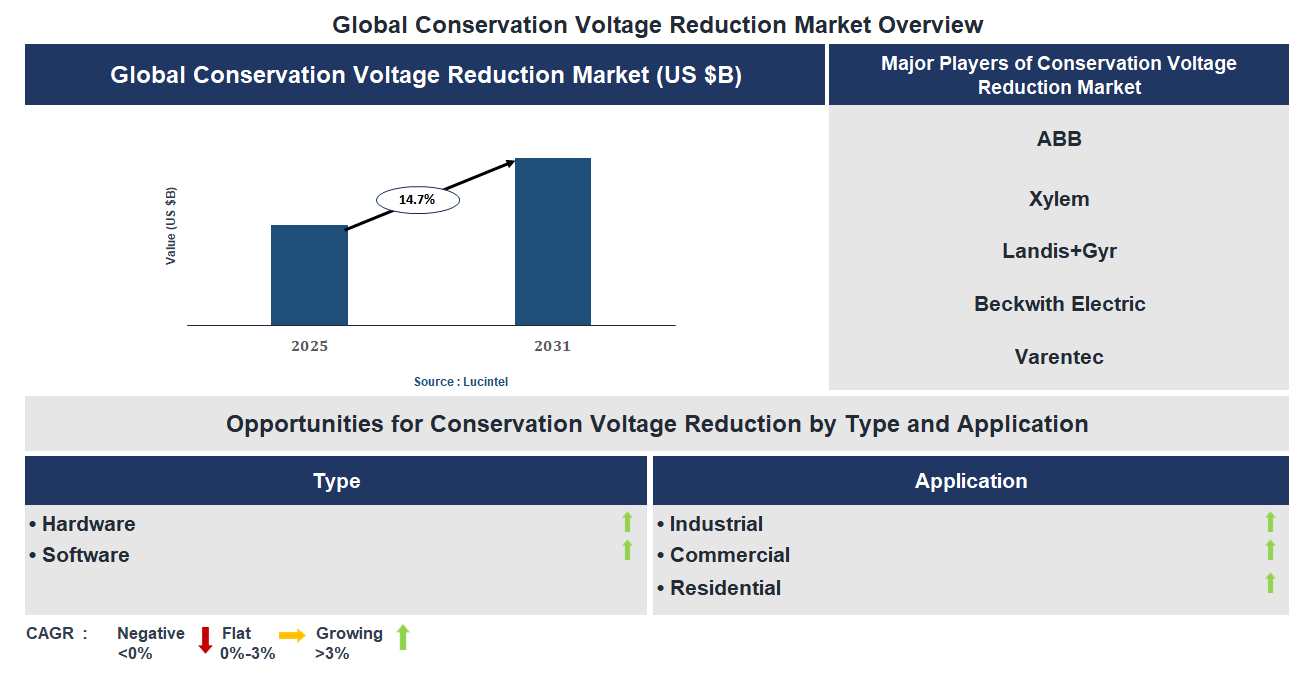
The future of the global conservation voltage reduction market looks promising with opportunities in the industrial, commercial, and residential markets. The global conservation voltage reduction market is expected to grow with a CAGR of 14.7% from 2025 to 2031. The major drivers for this market are the increasing focus on energy efficiency, the rising need for grid optimization, and the growing adoption of smart grid technologies.• Lucintel forecasts that, within the type category, software is expected to witness higher growth over the forecast period.
• Within the application category, industrial is expected to witness the highest growth.
• In terms of region, APAC is expected to witness the highest growth over the forecast period. Gain valuable insights for your business decisions with our comprehensive 150+ page report. Sample figures with some insights are shown below.
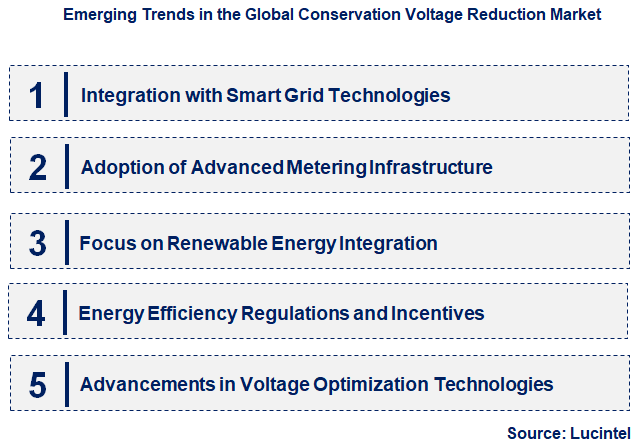
Emerging Trends in the Conservation Voltage Reduction Market
The conservation voltage reduction market is experiencing several emerging trends as utilities and governments focus on energy conservation, grid optimization, and sustainability. The growing adoption of smart grid technologies, advanced metering infrastructure, and renewable energy integration are shaping the future of CVR. These trends are not only improving energy efficiency but also enabling more flexible, resilient, and intelligent grid systems. CVR solutions are becoming increasingly important as utilities look for ways to optimize power delivery while reducing operational costs and minimizing environmental impact.• Integration with Smart Grid Technologies: The integration of CVR with smart grid technologies is one of the most prominent trends in the market. With the proliferation of advanced metering infrastructure (AMI), grid operators can now monitor and control voltage levels in real time, enabling more precise voltage regulation and energy savings. Smart grids also allow for better coordination between energy supply and demand, making CVR an effective strategy for balancing grid operations. This trend is expected to continue as more utilities implement smart grid solutions to enhance efficiency and sustainability.
• Adoption of Advanced Metering Infrastructure: The increasing deployment of AMI systems is driving the adoption of CVR across various regions. AMI enables real-time monitoring of voltage levels, providing utilities with the data needed to make adjustments that reduce energy consumption. This infrastructure also supports better decision-making, allowing for proactive voltage reduction and more accurate energy-saving predictions. The growing availability of AMI systems is expected to accelerate the implementation of CVR, leading to more widespread use of this technology across global electricity grids.
• Focus on Renewable Energy Integration: As the share of renewable energy in power grids increases, CVR plays a critical role in ensuring grid stability and efficient energy distribution. The intermittency of renewable energy sources like solar and wind requires dynamic voltage management to balance supply and demand. CVR is being integrated into grid management systems to support the integration of renewables, reduce power loss, and ensure reliable power delivery. This trend is expected to continue as more countries aim to meet their renewable energy targets and decarbonize their energy systems.
• Energy Efficiency Regulations and Incentives: Governments around the world are introducing energy efficiency regulations and incentives that promote the adoption of CVR technologies. For example, utilities in the U.S. and Europe are incentivized to implement CVR as part of their energy-saving and emissions-reduction goals. These regulatory frameworks are pushing utilities to adopt CVR solutions as a cost-effective method for reducing energy consumption and meeting energy efficiency targets. The growing regulatory pressure will likely lead to increased adoption of CVR solutions across both developed and developing countries.
• Advancements in Voltage Optimization Technologies: Ongoing advancements in voltage optimization technologies are enhancing the effectiveness of CVR systems. New algorithms and software platforms are enabling more precise voltage control, which leads to better energy savings and improved grid reliability. These technologies also allow utilities to better manage load fluctuations and respond more effectively to changes in energy demand. As the technology continues to evolve, CVR will become an even more integral part of energy efficiency strategies. The emerging trends in the conservation voltage reduction market, including smart grid integration, AMI adoption, renewable energy integration, regulatory incentives, and advancements in voltage optimization technologies, are reshaping the future of CVR. These trends are driving the widespread adoption of CVR solutions, enabling utilities to enhance grid efficiency, reduce energy consumption, and support sustainability efforts across the globe.
Recent Development in the Conservation Voltage Reduction Market
The conservation voltage reduction market has seen several key developments in recent years, as utilities and governments recognize the benefits of this technology in reducing energy consumption and improving grid reliability. CVR solutions have been increasingly adopted across regions, driven by the integration of smart grid technologies, the need for sustainable energy practices, and advancements in metering infrastructure. These developments are helping utilities meet their energy efficiency targets, optimize energy distribution, and manage growing electricity demand in a more sustainable manner.• Deployment of Smart Grids: One of the key developments in the CVR market is the ongoing deployment of smart grids, particularly in North America, Europe, and Asia. Smart grid technologies enable real-time monitoring and adjustment of voltage levels, making CVR implementation more effective. Utilities can now reduce voltage during non-peak times, resulting in substantial energy savings and lower operational costs. The widespread adoption of smart grids is significantly contributing to the growth of the CVR market by enabling more intelligent and flexible grid management.
• Government Incentives for CVR Implementation: In countries like the United States and Germany, government incentives have been a key factor in driving the adoption of CVR solutions. Utilities are receiving financial support to implement voltage reduction technologies as part of broader energy efficiency and emissions reduction goals. These incentives are making CVR a more attractive option for utilities, encouraging the integration of voltage control systems into grid infrastructure. This development is expected to continue as governments aim to achieve sustainability targets.
• Increased Use of Advanced Metering Infrastructure (AMI): The implementation of AMI systems is another significant development in the CVR market. AMI enables utilities to collect real-time data on voltage levels and adjust grid operations accordingly. This data-driven approach allows for more precise voltage regulation and helps utilities reduce energy consumption. The growing availability and affordability of AMI systems are accelerating CVR adoption, making it easier for utilities to implement these solutions on a larger scale.
• Integration of Renewable Energy Sources: The integration of renewable energy sources, such as wind and solar power, into existing grids is creating new opportunities for CVR. As renewable energy generation fluctuates throughout the day, voltage optimization through CVR helps balance supply and demand, ensuring grid stability. This integration is particularly important in countries with high renewable energy targets, such as Germany and China. As renewable energy continues to grow, CVR will play an increasingly vital role in maintaining grid reliability.
• Collaborations and Partnerships in CVR Solutions: There has been a rise in collaborations and partnerships between technology providers, utilities, and governments to advance CVR solutions. For example, companies are partnering with utilities to develop and deploy CVR technologies, integrating advanced software and hardware to enhance grid efficiency. These collaborations are accelerating the adoption of CVR by leveraging expertise across multiple sectors and ensuring the development of scalable, cost-effective solutions. Recent developments in the CVR market, such as the deployment of smart grids, government incentives, the use of AMI, renewable energy integration, and strategic collaborations, are driving the growth of CVR solutions worldwide. These developments are making CVR an integral part of energy efficiency and grid optimization strategies, helping utilities reduce energy consumption, lower operational costs, and enhance the stability of the electrical grid.
Strategic Growth Opportunities in the Conservation Voltage Reduction Market
The conservation voltage reduction market presents significant growth opportunities driven by the need for greater energy efficiency, grid stability, and sustainability. As utilities focus on optimizing power delivery, CVR technology is emerging as a key solution to reduce energy consumption and enhance grid performance. The increasing adoption of smart grid systems, advanced metering infrastructure (AMI), and renewable energy integration are unlocking new avenues for CVR implementation across various applications.• Smart Grids and Advanced Metering Infrastructure: Smart grid systems and AMI infrastructure are essential enablers of CVR technology. These advanced systems provide utilities with real-time data on voltage levels, enabling precise voltage control. By integrating CVR into smart grid networks, utilities can dynamically manage energy supply and demand, reducing overall energy consumption during peak periods. The growth in smart grid adoption, driven by regulatory incentives and the push for grid modernization, offers significant opportunities for CVR implementation.
• Renewable Energy Integration: The rise of renewable energy sources like wind and solar has increased the need for dynamic voltage control. CVR is particularly beneficial in this context as it allows utilities to stabilize voltage fluctuations caused by the intermittent nature of renewable energy generation. By incorporating CVR into grids with high renewable penetration, utilities can reduce energy losses and improve grid reliability. The transition to renewable energy is one of the key drivers of CVR adoption, especially in countries with ambitious clean energy goals.
• Industrial and Commercial Applications: Industries and commercial establishments are increasingly adopting CVR technology to reduce energy consumption and lower operational costs. In sectors with high energy demand, such as manufacturing and data centers, CVR can lead to significant energy savings by reducing voltage levels during off-peak hours. The impact of CVR in these applications is particularly noteworthy in large-scale facilities where energy costs are a major portion of the operating budget.
• Residential Energy Efficiency Programs: Residential energy efficiency programs, often implemented by utilities or governments, represent another growth opportunity for CVR solutions. As part of these programs, CVR can be used to reduce electricity consumption by managing voltage levels in residential areas, particularly during peak demand periods. By incorporating CVR into residential smart meter systems, utilities can provide households with the ability to participate in energy-saving initiatives without compromising their comfort.
• Grid Modernization and Infrastructure Upgrades: Ongoing grid modernization efforts in developed and emerging markets create a critical growth opportunity for CVR. As aging electrical infrastructure is replaced with more advanced, flexible systems, CVR can be integrated into the new infrastructure to optimize energy distribution. Utilities undertaking large-scale infrastructure upgrades are increasingly focusing on solutions that improve energy efficiency and reduce transmission losses. The growth opportunities in the conservation voltage reduction market are vast, spanning across smart grid implementation, renewable energy integration, industrial applications, residential programs, and grid modernization efforts. These opportunities are reshaping the market, driving increased adoption of CVR technologies and allowing utilities to meet sustainability and energy efficiency goals. As each application area continues to evolve, CVR will play an increasingly critical role in optimizing energy usage, reducing operational costs, and improving grid stability.
Conservation Voltage Reduction Market Driver and Challenges
The conservation voltage reduction market is influenced by various drivers and challenges, including technological advancements, regulatory changes, economic factors, and environmental concerns. CVR is increasingly seen as a cost-effective and sustainable solution for reducing energy consumption and improving grid efficiency. However, the market also faces several challenges, including the high initial cost of implementation, regulatory barriers, and the complexity of integrating CVR with existing infrastructure. Understanding these drivers and challenges is crucial for utilities and stakeholders looking to adopt CVR technologies and maximize their benefits. The factors responsible for driving the conservation voltage reduction market include: 1. Government Regulations and Energy Efficiency Targets: Governments worldwide are introducing stricter energy efficiency regulations and sustainability targets, which are driving the adoption of CVR technologies. Utilities are incentivized to implement CVR as part of their efforts to reduce energy consumption and meet emissions reduction goals. This regulatory push is a major driver of CVR adoption, as utilities seek to comply with energy efficiency mandates while lowering operational costs. 2. Integration of Smart Grid and AMI Technologies: The growing adoption of smart grids and advanced metering infrastructure (AMI) is making CVR more feasible and effective. Smart grids enable real-time monitoring of voltage levels and better coordination of energy supply and demand, which enhances the effectiveness of CVR strategies. As more utilities implement smart grid technologies, the demand for CVR solutions is expected to rise. 3. Renewable Energy Integration and Grid Stability: As renewable energy sources like wind and solar become more prevalent, CVR plays an essential role in managing voltage fluctuations and ensuring grid stability. The ability to reduce voltage dynamically allows utilities to accommodate renewable energy generation while maintaining a reliable power supply. This is a significant driver for CVR adoption, particularly in regions with high renewable energy penetration. 4. Cost Savings and Operational Efficiency: CVR provides utilities with an opportunity to reduce energy consumption, lower operational costs, and enhance overall grid efficiency. By lowering voltage during non-peak times, utilities can reduce losses in the distribution system, contributing to cost savings. As energy costs rise and grid efficiency becomes more critical, utilities are increasingly looking to CVR as a viable solution. 5. Technological Advancements in Voltage Optimization: Ongoing advancements in voltage optimization technologies, such as improved software algorithms and control systems, are enhancing the effectiveness of CVR. These innovations allow for more precise and efficient voltage reduction, contributing to greater energy savings and grid reliability. As these technologies evolve, they are expected to drive further adoption of CVR. Challenges in the conservation voltage reduction market are: 1. High Initial Implementation Costs: One of the key challenges for utilities adopting CVR is the high initial cost of installing the necessary infrastructure, such as smart meters, voltage control devices, and communication networks. These upfront costs can be a barrier to adoption, especially for smaller utilities or those operating with tight budgets. 2. Integration with Existing Grid Infrastructure: Integrating CVR with existing grid infrastructure can be complex and costly. Utilities must ensure that their current systems are compatible with CVR technologies, which may require significant upgrades or modifications. This challenge is particularly relevant for older grid systems that lack the necessary automation and control capabilities. 3. Regulatory Barriers and Policy Uncertainty: In some regions, regulatory barriers and policy uncertainty can slow the adoption of CVR technologies. Utilities may face difficulties in obtaining the necessary approvals or incentives to implement CVR, and inconsistent policies can create uncertainty around the long-term viability of these solutions. The major drivers of the conservation voltage reduction market include government regulations, the integration of smart grid technologies, renewable energy adoption, cost savings, and technological advancements. However, challenges such as high implementation costs, integration complexity, and regulatory barriers continue to pose obstacles. Overcoming these challenges will be critical for accelerating the widespread adoption of CVR technologies and maximizing their benefits in terms of energy efficiency and grid optimization.List of Conservation Voltage Reduction Companies
Companies in the market compete on the basis of product quality offered. Major players in this market focus on expanding their manufacturing facilities, R&D investments, infrastructural development, and leverage integration opportunities across the value chain. With these strategies conservation voltage reduction companies cater increasing demand, ensure competitive effectiveness, develop innovative products & technologies, reduce production costs, and expand their customer base. Some of the conservation voltage reduction companies profiled in this report include-• ABB
• Xylem
• Landis+Gyr
• Beckwith Electric
• Varentec
• Legend Power Systems
• Eaton
• TAKAOKA TOKO
• AMSC
• Dominion Voltage
Conservation Voltage Reduction Market by Segment
The study includes a forecast for the global conservation voltage reduction market by type, application, and region.Conservation Voltage Reduction Market by Type [Value from 2019 to 2031]:
• Hardware
• Software
Conservation Voltage Reduction Market by Application [Value from 2019 to 2031]:
• Industrial
• Commercial
• Residential
Conservation Voltage Reduction Market by Region [Value from 2019 to 2031]:
• North America
• Europe
• Asia Pacific
• The Rest of the World
Country Wise Outlook for the Conservation Voltage Reduction Market
The conservation voltage reduction market has seen significant developments in recent years, particularly in the United States, China, Germany, India, and Japan. These developments are driven by the need for energy conservation, grid efficiency, and the increasing adoption of smart grid technologies. CVR strategies aim to optimize voltage levels in the electricity distribution system, resulting in energy savings and improved grid stability. Governments and utilities in these countries are focusing on implementing CVR solutions as part of their broader efforts to enhance energy efficiency, reduce electricity consumption, and meet sustainability goals.• United States: In the U.S., CVR has gained traction as a key energy-saving strategy, particularly with the implementation of advanced metering infrastructure (AMI) and smart grid technologies. The Department of Energy (DOE) has supported various CVR initiatives, focusing on optimizing grid operations and reducing peak demand. Several utilities in regions such as California and Texas have reported substantial energy savings through CVR programs, enhancing grid reliability and reducing operating costs. Furthermore, U.S. regulators are incentivizing utilities to adopt CVR technologies as part of broader energy efficiency and sustainability targets.
• China: As the worlds largest energy consumer, China is prioritizing CVR solutions to optimize energy usage and reduce carbon emissions. Chinese utilities are increasingly investing in advanced grid technologies, including CVR, to improve grid efficiency and integrate renewable energy sources. The government’s 13th Five-Year Plan for energy development emphasized energy conservation, and CVR is seen as a key tool to meet these objectives. Moreover, China’s growing adoption of smart meters and grid automation is enabling real-time voltage adjustments, making CVR a more feasible and impactful strategy for reducing energy consumption.
• Germany: Germany, a leader in the adoption of renewable energy, is utilizing CVR as part of its broader strategy to reduce energy consumption and integrate renewable sources into the grid. With its Energiewende (energy transition) policy, Germany has focused on improving grid efficiency and reducing power loss. German utilities are implementing CVR alongside other smart grid technologies to better balance supply and demand, especially as renewable energy sources like wind and solar become a more prominent part of the energy mix. The shift toward decentralized energy generation is driving the need for innovative voltage control solutions like CVR.
• India: In India, CVR is increasingly seen as a key strategy for improving energy efficiency and reducing the strain on the electrical grid. With rising electricity demand and an expanding industrial base, India’s utilities are adopting CVR solutions to manage voltage levels and reduce transmission losses. Several state-owned utilities are implementing smart grid and AMI technologies to optimize energy usage, especially during peak demand periods. The Indian government is also encouraging the adoption of CVR as part of its broader push to modernize the country’s electrical infrastructure and meet growing energy needs sustainably.
• Japan: Japan is focusing on CVR as part of its efforts to rebuild and modernize its energy infrastructure post-Fukushima. The country’s energy policies emphasize the integration of renewable energy and improving the efficiency of electricity distribution. Japanese utilities are implementing CVR to optimize voltage levels, reduce electricity consumption, and enhance grid stability. With Japan’s growing reliance on solar and wind energy, CVR solutions are critical in managing the intermittency of renewable power generation and ensuring the stability of the grid.

Features of the Global Conservation Voltage Reduction Market
Market Size Estimates: Conservation voltage reduction market size estimation in terms of value ($B). Trend and Forecast Analysis: Market trends (2019 to 2024) and forecast (2025 to 2031) by various segments and regions. Segmentation Analysis: Conservation voltage reduction market size by type, application, and region in terms of value ($B). Regional Analysis: Conservation voltage reduction market breakdown by North America, Europe, Asia Pacific, and Rest of the World. Growth Opportunities: Analysis of growth opportunities in different types, applications, and regions for the conservation voltage reduction market. Strategic Analysis: This includes M&A, new product development, and competitive landscape of the conservation voltage reduction market. Analysis of competitive intensity of the industry based on Porter’s Five Forces model.
FAQ
Q1. What is the growth forecast for conservation voltage reduction market? Answer: The global conservation voltage reduction market is expected to grow with a CAGR of 14.7% from 2025 to 2031. Q2. What are the major drivers influencing the growth of the conservation voltage reduction market? Answer: The major drivers for this market are the increasing focus on energy efficiency, the rising need for grid optimization, and the growing adoption of smart grid technologies. Q3. What are the major segments for conservation voltage reduction market? Answer: The future of the conservation voltage reduction market looks promising with opportunities in the industrial, commercial, and residential markets. Q4. Who are the key conservation voltage reduction market companies? Answer: Some of the key conservation voltage reduction companies are as follows:• ABB
• Xylem
• Landis+Gyr
• Beckwith Electric
• Varentec
• Legend Power Systems
• Eaton
• TAKAOKA TOKO
• AMSC
• Dominion Voltage Q5. Which conservation voltage reduction market segment will be the largest in future? Answer: Lucintel forecasts that, within the type category, software is expected to witness higher growth over the forecast period. Q6. In conservation voltage reduction market, which region is expected to be the largest in next 5 years? Answer: In terms of region, APAC is expected to witness the highest growth over the forecast period. Q7. Do we receive customization in this report? Answer: Yes, Lucintel provides 10% customization without any additional cost.
Table of Contents
List of Figures
List of Tables
Methodology
- In-depth interviews of the major players in this market
- Detailed secondary research from competitors’ financial statements and published data
- Extensive searches of published works, market, and database information pertaining to industry news, company press releases, and customer intentions
- A compilation of the experiences, judgments, and insights of Lucintel’s professionals, who have analyzed and tracked this market over the years.


Buy Now
Choose a license that fits your team. Instant PDF delivery.
Prices exclude taxes. Instant delivery. Custom licensing available on request.
Key Questions
- • What are some of the most promising, high-growth opportunities for the conservation voltage reduction market by type (hardware and software), application (industrial, commercial, and residential), and region (North America, Europe, Asia Pacific, and the Rest of the World)?
- • Which segments will grow at a faster pace and why?
- • Which region will grow at a faster pace and why?
- • What are the key factors affecting market dynamics? What are the key challenges and business risks in this market?
- • What are the business risks and competitive threats in this market?
- • What are the emerging trends in this market and the reasons behind them?
- • What are some of the changing demands of customers in the market?
- • What are the new developments in the market? Which companies are leading these developments?
- • Who are the major players in this market? What strategic initiatives are key players pursuing for business growth?
- • What are some of the competing products in this market and how big of a threat do they pose for loss of market share by material or product substitution?
- • What M&A activity has occurred in the last 5 years and what has its impact been on the industry? For any questions related to Conservation Voltage Reduction Market, Conservation Voltage Reduction Market Size, Conservation Voltage Reduction Market Growth, Conservation Voltage Reduction Market Analysis, Conservation Voltage Reduction Market Report, Conservation Voltage Reduction Market Share, Conservation Voltage Reduction Market Trends, Conservation Voltage Reduction Market Forecast, Conservation Voltage Reduction Companies, write Lucintel analyst at email: helpdesk@lucintel.com. We will be glad to get back to you soon.


