
'
...

The Impact of COVID-19 is included in Connected Wearable Patch Market Report. Buy it today to get an advantage.

Request the impact of COVID-19 on your product or industry


Connected Wearable Patch Market Trends and Forecast

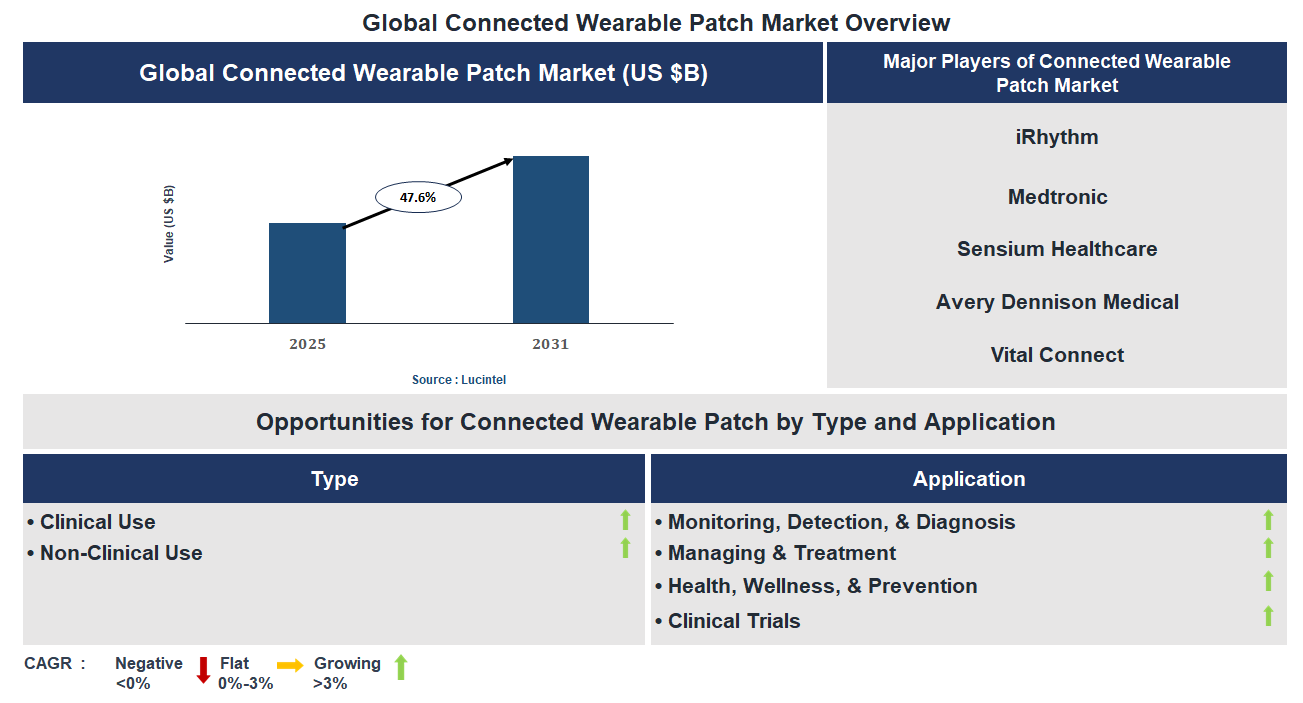
The future of the global connected wearable patch market looks promising with opportunities in the monitoring, detection, & diagnosis, managing & treatment, and health, wellness, & prevention markets. The global connected wearable patch market is expected to grow with a CAGR of 47.6% from 2025 to 2031. The major drivers for this market are the increasing demand for real-time health monitoring, the rising adoption of wearable health technologies, and the growing focus on personalized healthcare solutions.

• Lucintel forecasts that, within the type category, clinical use is expected to witness higher growth over the forecast period.
• Within the application category, monitoring, detection, & diagnosis is expected to witness the highest growth.
• In terms of region, APAC is expected to witness the highest growth over the forecast period.
Gain valuable insights for your business decisions with our comprehensive 150+ page report. Sample figures with some insights are shown below.
Connected Wearable Patch Market Trends and Forecast

Emerging Trends in the Connected Wearable Patch Market

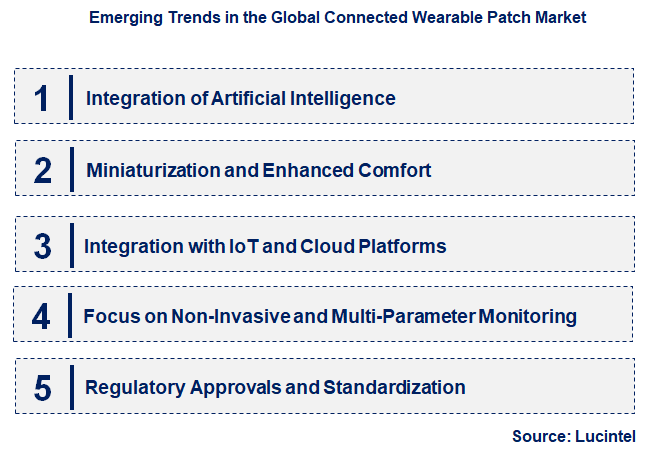
The connected wearable patch market is experiencing rapid growth driven by technological advancements, increasing health awareness, and the demand for personalized healthcare solutions. As consumers and healthcare providers seek more efficient, non-invasive, and real-time monitoring tools, the market is evolving with innovative products and integrated digital health ecosystems. These developments are transforming traditional healthcare delivery, enabling proactive management of health conditions, and fostering new business models. The following key trends highlight the major shifts shaping this dynamic market landscape, reflecting its trajectory toward more connected, intelligent, and user-centric health monitoring solutions.

• Integration of Artificial Intelligence: AI is increasingly embedded in wearable patches to enhance data analysis and predictive capabilities. These patches can now process large volumes of health data in real-time, providing personalized insights and early warning signals for conditions such as arrhythmias or glucose fluctuations. AI-driven analytics improve diagnostic accuracy, enable proactive interventions, and support remote patient monitoring, ultimately reducing healthcare costs and improving patient outcomes.
• Miniaturization and Enhanced Comfort: Advances in materials science and microfabrication are leading to smaller, more comfortable wearable patches. These devices are designed for extended wear without causing skin irritation or discomfort, encouraging consistent use. The trend toward discreet, lightweight patches increases user compliance and broadens application areas, including daily health monitoring, sports performance, and chronic disease management, making wearable technology more accessible and user-friendly.
• Integration with IoT and Cloud Platforms: Wearable patches are increasingly connected to Internet of Things (IoT) ecosystems and cloud-based health platforms. This connectivity allows seamless data transfer, remote monitoring, and centralized health record management. Healthcare providers can access real-time data remotely, enabling timely interventions. Consumers benefit from integrated health dashboards, fostering engagement and proactive health management. This trend enhances data interoperability and supports comprehensive, personalized healthcare solutions.
• Focus on Non-Invasive and Multi-Parameter Monitoring: The market is shifting toward patches capable of non-invasive, multi-parameter health monitoring, including vital signs, hydration levels, and biochemical markers. These patches eliminate the need for blood draws or invasive procedures, making health tracking more comfortable and accessible. Multi-parameter capabilities provide a holistic view of health, facilitating early detection of issues and better disease management, especially for chronic conditions like diabetes and cardiovascular diseases.
• Regulatory Approvals and Standardization: As wearable patches become more integral to healthcare, regulatory bodies are establishing standards and approval pathways to ensure safety, efficacy, and data security. Increased regulatory oversight fosters trust among consumers and healthcare providers, encouraging adoption. Standardization efforts also facilitate interoperability among devices and platforms, promoting a cohesive ecosystem. This trend is crucial for integrating wearable patches into mainstream healthcare and ensuring their long-term viability and acceptance.

In summary, these trends are collectively reshaping the connected wearable patch market by making devices smarter, more comfortable, interconnected, and reliable. They are driving innovation, expanding application areas, and fostering greater acceptance among users and healthcare providers. As a result, the market is poised for sustained growth, with wearable patches becoming essential tools in personalized, remote, and preventive healthcare strategies.
Emerging Trends in the Connected Wearable Patch Market

Recent Development in the Connected Wearable Patch Market

The connected wearable patch market has experienced rapid growth driven by technological advancements, increasing health awareness, and the demand for remote monitoring solutions. As consumers and healthcare providers seek more efficient, non-invasive, and real-time health tracking options, the market is evolving swiftly. Innovations in materials, connectivity, and data analytics are shaping the landscape, making wearable patches more versatile and accessible. Regulatory approvals and strategic collaborations are further accelerating adoption across various sectors, including healthcare, sports, and wellness. These developments are transforming how health data is collected, analyzed, and utilized, ultimately enhancing patient outcomes and user experience.

• Technological Advancements: Integration of AI and IoT in patches has improved data accuracy and real-time monitoring capabilities, leading to better health management and personalized treatment plans.
• Material Innovation: Development of flexible, biocompatible, and durable materials has increased comfort and wearability, encouraging longer usage and expanding application areas.
• Regulatory Approvals: Increased approvals from health authorities have boosted market confidence, facilitating wider adoption in clinical and consumer markets.
• Strategic Collaborations: Partnerships between tech firms, healthcare providers, and pharmaceutical companies have accelerated product development and market penetration.
• Market Expansion: Growing applications in chronic disease management, sports performance, and wellness have expanded the market scope, attracting new customer segments and investment.

These developments are significantly impacting the connected wearable patch market by enhancing product efficacy, safety, and user engagement. They are driving market growth, fostering innovation, and broadening application horizons, ultimately making health monitoring more accessible and effective for diverse populations.

Strategic Growth Opportunities in the Connected Wearable Patch Market

The connected wearable patch market is experiencing rapid expansion driven by technological advancements, increasing health awareness, and the demand for personalized healthcare solutions. As consumers and healthcare providers seek more efficient, non-invasive monitoring tools, the market is poised for significant growth across various applications. Key opportunities include innovations in medical diagnostics, fitness tracking, remote patient monitoring, drug delivery systems, and chronic disease management. These developments are transforming healthcare delivery, improving patient outcomes, and creating new revenue streams for manufacturers. Understanding these growth opportunities is essential for stakeholders aiming to capitalize on emerging trends and maintain a competitive advantage in this dynamic market.

• Medical Diagnostics: Enhanced early detection and continuous health monitoring are revolutionizing diagnostics. Wearable patches enable real-time data collection for conditions like arrhythmias, glucose levels, and infections, leading to faster diagnosis and intervention. This reduces hospital visits and improves patient outcomes, making diagnostics more accessible and efficient.
• Fitness and Wellness Tracking: Increasing consumer focus on health and fitness drives demand for wearable patches that monitor vital signs, activity levels, and sleep patterns. These devices motivate healthier lifestyles, provide personalized insights, and support preventive healthcare, expanding market reach beyond clinical settings.
• Remote Patient Monitoring: Telehealth adoption accelerates the need for remote monitoring solutions. Wearable patches facilitate continuous tracking of chronic conditions such as hypertension and heart disease, enabling healthcare providers to manage patients remotely, reduce hospital readmissions, and improve care quality.
• Drug Delivery Systems: Integration of wearable patches with drug delivery capabilities offers targeted, controlled medication administration. This innovation enhances treatment adherence, minimizes side effects, and supports personalized therapy, especially for chronic illnesses requiring regular medication.
• Chronic Disease Management: Wearable patches provide ongoing monitoring for chronic disease patients, enabling early intervention and better disease control. This reduces complications, hospitalizations, and healthcare costs, while empowering patients to manage their health proactively.

In summary, these growth opportunities are significantly impacting the connected wearable patch market by expanding its applications, improving healthcare outcomes, and fostering innovation. They are driving market growth, attracting investments, and shaping the future landscape of personalized, remote, and efficient healthcare solutions.

Connected Wearable Patch Market Driver and Challenges

The connected wearable patch market is influenced by a variety of technological, economic, and regulatory factors that shape its growth trajectory. Advances in sensor technology, data analytics, and wireless connectivity are driving innovation and expanding application areas. Economic factors such as increasing healthcare costs and the rising prevalence of chronic diseases are fueling demand for remote monitoring solutions. Regulatory frameworks around data privacy and medical device approval also impact market development, ensuring safety and efficacy. Additionally, consumer awareness and preference for personalized health management are further propelling market expansion. However, these drivers are counterbalanced by challenges related to technological limitations, regulatory hurdles, and data security concerns, which could impede growth if not addressed effectively.

The factors responsible for driving the connected wearable patch market include:-
• Technological Innovation: The rapid development of miniaturized sensors, wireless communication, and data processing technologies has enabled the creation of highly effective wearable patches. These innovations facilitate real-time health monitoring, improve user comfort, and expand application areas from fitness tracking to chronic disease management. As technology continues to evolve, the accuracy, battery life, and integration capabilities of wearable patches are expected to improve, making them more appealing to consumers and healthcare providers alike. This ongoing innovation is crucial for market growth, as it addresses current limitations and opens new opportunities for personalized healthcare solutions.
• Rising Healthcare Costs and Chronic Disease Prevalence: Increasing healthcare expenses worldwide are prompting both consumers and healthcare providers to seek cost-effective, remote monitoring solutions. Wearable patches offer continuous health data collection, enabling early detection and management of chronic conditions such as diabetes, cardiovascular diseases, and respiratory illnesses. This reduces hospital visits and associated costs, making wearable patches an attractive alternative to traditional healthcare methods. The growing burden of chronic diseases, especially in aging populations, further accelerates demand, positioning wearable patches as vital tools in preventive care and long-term health management.
• Regulatory Approvals and Standards: The development and commercialization of connected wearable patches depend heavily on regulatory approvals from authorities like the FDA and EMA. These approvals ensure safety, efficacy, and data security, which are critical for gaining consumer trust and healthcare provider acceptance. Evolving regulatory standards around medical devices and digital health data management influence product development, testing, and certification processes. Companies investing in compliance can gain competitive advantages, while delays or non-compliance can hinder market entry. Clear, supportive regulatory frameworks are essential for fostering innovation and ensuring market stability.
• Growing Adoption of Telehealth and Remote Monitoring: The COVID-19 pandemic accelerated the adoption of telehealth services, highlighting the importance of remote patient monitoring. Connected wearable patches are integral to this shift, providing continuous health data that can be transmitted to healthcare providers for timely intervention. This trend enhances patient engagement, improves health outcomes, and reduces the burden on healthcare facilities. As telehealth becomes more mainstream, the demand for reliable, easy-to-use wearable patches is expected to rise, further integrating these devices into standard healthcare practices and expanding market opportunities.
• Consumer Awareness and Preference for Personalized Healthcare: Increasing awareness about health and wellness, coupled with a desire for personalized health insights, drives consumer demand for wearable health devices. Wearable patches offer tailored monitoring and feedback, empowering users to manage their health proactively. The trend towards preventive care and wellness optimization encourages adoption across various demographics, including athletes, fitness enthusiasts, and patients with chronic conditions. Market growth is supported by the desire for convenience, real-time data access, and improved health outcomes, making connected wearable patches a key component of modern health management.

The challenges facing this connected wearable patch market include:-
• Technological Limitations and Device Accuracy: Despite rapid advancements, wearable patches still face issues related to sensor accuracy, battery life, and device durability. Inaccurate readings can lead to misdiagnosis or improper health management, undermining user trust and clinical utility. Technological constraints also limit the integration of multiple health parameters into a single device, restricting comprehensive health monitoring. Overcoming these limitations requires ongoing research and development, which can be costly and time-consuming. Failure to address these issues may hinder market adoption and slow innovation, especially in critical healthcare applications.
• Regulatory and Data Privacy Concerns: Navigating complex regulatory landscapes remains a significant challenge for wearable patch manufacturers. Ensuring compliance with medical device standards and data privacy laws, such as GDPR and HIPAA, is essential but often cumbersome. Data security breaches or mishandling can lead to legal repercussions and loss of consumer confidence. Additionally, evolving regulations may impose restrictions on data collection, storage, and sharing, complicating product development and deployment. Companies must invest heavily in secure data management systems and legal compliance, which can increase costs and delay time-to-market.
• Market Fragmentation and Competition: The wearable patch market is highly competitive, with numerous startups and established players vying for market share. Fragmentation can lead to inconsistent product quality, pricing pressures, and challenges in establishing brand loyalty. Differentiating products through innovation, regulatory approval, and user experience becomes critical but difficult amid intense competition. Additionally, the rapid pace of technological change requires continuous investment in R&D, which can strain resources. Market fragmentation may slow overall growth and complicate efforts to establish standardized protocols and interoperability across devices.

In summary, the connected wearable patch market is driven by technological advancements, economic pressures, regulatory support, and changing consumer preferences. However, technological limitations, regulatory complexities, and intense competition pose significant challenges. The interplay of these factors will shape the market’s evolution, requiring stakeholders to innovate responsibly, ensure compliance, and focus on user trust. Overall, the market holds substantial growth potential, provided these drivers are harnessed effectively and challenges are managed proactively.

List of Connected Wearable Patch Companies

Companies in the market compete on the basis of product quality offered. Major players in this market focus on expanding their manufacturing facilities, R&D investments, infrastructural development, and leverage integration opportunities across the value chain. With these strategies connected wearable patch companies cater increasing demand, ensure competitive effectiveness, develop innovative products & technologies, reduce production costs, and expand their customer base. Some of the connected wearable patch companies profiled in this report include-
• iRhythm
• Medtronic
• Sensium Healthcare
• Avery Dennison Medical
• Vital Connect
• Boston Scientific Cardiac Diagnostics
• Gentag Inc.
• Philips
• iLece
• LifeSignals

Connected Wearable Patch Market by Segment

The study includes a forecast for the global connected wearable patch market by type, application, and region.

Connected Wearable Patch Market by Type [Value from 2019 to 2031]:


• Clinical Use
• Non-Clinical Use

Connected Wearable Patch Market by Application [Value from 2019 to 2031]:


• Monitoring, Detection, & Diagnosis
• Managing & Treatment
• Health, Wellness, & Prevention
• Clinical Trials

Connected Wearable Patch Market by Region [Value from 2019 to 2031]:


• North America
• Europe
• Asia Pacific
• The Rest of the World

Country Wise Outlook for the Connected Wearable Patch Market

The connected wearable patch market has experienced rapid growth driven by technological advancements, increasing healthcare needs, and rising consumer demand for health monitoring solutions. As digital health becomes more integrated into daily life, countries are innovating to improve device functionality, data accuracy, and user comfort. Regulatory frameworks are evolving to accommodate these new devices, fostering innovation while ensuring safety. Market players are expanding their product portfolios and exploring new applications across the medical, fitness, and wellness sectors. The following summaries highlight recent developments in the United States, China, Germany, India, and Japan, reflecting their unique contributions and market dynamics.

• United States: The US market has seen significant innovation with the approval of advanced wearable patches for continuous glucose monitoring and cardiac health. Major tech companies are partnering with healthcare providers to develop integrated health platforms. Investment in R&D is high, focusing on miniaturization and enhanced data analytics. Regulatory agencies like the FDA are streamlining approval processes for new wearable devices, encouraging faster market entry. Consumer adoption is driven by increasing health awareness and telemedicine trends, making the US a leader in connected wearable patch technology.
• China: China has rapidly expanded its connected wearable patch market, driven by a large domestic consumer base and government support for digital health initiatives. Local companies are developing cost-effective, multifunctional patches for chronic disease management and fitness tracking. Innovations include integration with AI for personalized health insights. The government’s policies promote innovation and the export of wearable health devices. The market also benefits from widespread smartphone usage and a growing elderly population seeking accessible healthcare solutions. These factors position China as a key player in the global connected wearable patch industry.
• Germany: Germany’s market emphasizes high-quality, medically certified wearable patches, with a focus on chronic disease management such as cardiovascular and diabetes care. The country’s strict regulatory environment ensures device safety and efficacy, fostering trust among healthcare providers. German companies are investing in research collaborations with academic institutions to develop next-generation patches with improved comfort and data accuracy. The integration of wearable patches into hospital and outpatient care is increasing, supported by EU health policies promoting digital health solutions. Germany’s emphasis on innovation and quality makes it a significant contributor to the connected wearable patch market.
• India: India’s connected wearable patch market is growing rapidly, driven by increasing healthcare awareness and affordability. Local startups are developing low-cost patches for managing diabetes, hypertension, and fitness. The government’s Digital India initiative supports the adoption of digital health tools, including wearable devices. Innovations focus on battery life, ease of use, and integration with mobile apps. The expanding healthcare infrastructure and rising smartphone penetration facilitate widespread adoption. Additionally, the growing elderly population and rising prevalence of chronic diseases create a strong demand for remote health monitoring solutions, positioning India as a promising emerging market.
• Japan: Japan’s market is characterized by advanced technological integration and a focus on aging population. Japanese companies are developing highly sophisticated wearable patches for cardiac monitoring, wound care, and medication adherence. The country’s strong healthcare infrastructure and regulatory standards ensure high-quality device production. Innovations include seamless integration with electronic health records and AI-driven health insights. The aging demographic drives demand for non-invasive, comfortable, and reliable wearable patches. Government initiatives promote digital health adoption, and collaborations between industry and academia foster cutting-edge research. Japan remains a key player in the development of innovative connected wearable patch solutions.

Lucintel Analytics Dashboard

Features of the Global Connected Wearable Patch Market

Market Size Estimates: Connected wearable patch market size estimation in terms of value ($B).
Trend and Forecast Analysis: Market trends (2019 to 2024) and forecast (2025 to 2031) by various segments and regions.
Segmentation Analysis: Connected wearable patch market size by type, application, and region in terms of value ($B).
Regional Analysis: Connected wearable patch market breakdown by North America, Europe, Asia Pacific, and Rest of the World.
Growth Opportunities: Analysis of growth opportunities in different types, applications, and regions for the connected wearable patch market.
Strategic Analysis: This includes M&A, new product development, and competitive landscape of the connected wearable patch market.
Analysis of competitive intensity of the industry based on Porter’s Five Forces model.

Lucintel Consulting Services

FAQ

Q1. What is the growth forecast for connected wearable patch market?
Answer: The global connected wearable patch market is expected to grow with a CAGR of 47.6% from 2025 to 2031.
Q2. What are the major drivers influencing the growth of the connected wearable patch market?
Answer: The major drivers for this market are the increasing demand for real-time health monitoring, the rising adoption of wearable health technologies, and the growing focus on personalized healthcare solutions.
Q3. What are the major segments for connected wearable patch market?
Answer: The future of the connected wearable patch market looks promising with opportunities in the monitoring, detection, & diagnosis, managing & treatment, and health, wellness, & prevention markets.
Q4. Who are the key connected wearable patch market companies?
Answer: Some of the key connected wearable patch companies are as follows:
• iRhythm
• Medtronic
• Sensium Healthcare
• Avery Dennison Medical
• Vital Connect
• Boston Scientific Cardiac Diagnostics
• Gentag Inc.
• Philips
• iLece
• LifeSignals
Q5. Which connected wearable patch market segment will be the largest in future?
Answer: Lucintel forecasts that, within the type category, clinical use is expected to witness higher growth over the forecast period.
Q6. In connected wearable patch market, which region is expected to be the largest in next 5 years?
Answer: In terms of region, APAC is expected to witness the highest growth over the forecast period.
Q7. Do we receive customization in this report?
Answer: Yes, Lucintel provides 10% customization without any additional cost.

This report answers following 11 key questions:

Q.1. What are some of the most promising, high-growth opportunities for the connected wearable patch market by type (clinical use and non-clinical use), application (monitoring, detection, & diagnosis, managing & treatment, health, wellness, & prevention, and clinical trials), and region (North America, Europe, Asia Pacific, and the Rest of the World)?
Q.2. Which segments will grow at a faster pace and why?
Q.3. Which region will grow at a faster pace and why?
Q.4. What are the key factors affecting market dynamics? What are the key challenges and business risks in this market?
Q.5. What are the business risks and competitive threats in this market?
Q.6. What are the emerging trends in this market and the reasons behind them?
Q.7. What are some of the changing demands of customers in the market?
Q.8. What are the new developments in the market? Which companies are leading these developments?
Q.9. Who are the major players in this market? What strategic initiatives are key players pursuing for business growth?
Q.10. What are some of the competing products in this market and how big of a threat do they pose for loss of market share by material or product substitution?
Q.11. What M&A activity has occurred in the last 5 years and what has its impact been on the industry?

For any questions related to Connected Wearable Patch Market, Connected Wearable Patch Market Size, Connected Wearable Patch Market Growth, Connected Wearable Patch Market Analysis, Connected Wearable Patch Market Report, Connected Wearable Patch Market Share, Connected Wearable Patch Market Trends, Connected Wearable Patch Market Forecast, Connected Wearable Patch Companies, write Lucintel analyst at email: helpdesk@lucintel.com. We will be glad to get back to you soon.
                                           Table of Contents

            1. Executive Summary

            2. Market Overview

                        2.1 Background and Classifications
                        2.2 Supply Chain

            3. Market Trends & Forecast Analysis

                        3.1 Macroeconomic Trends and Forecasts
                        3.2 Industry Drivers and Challenges
                        3.3 PESTLE Analysis
                        3.4 Patent Analysis
                        3.5 Regulatory Environment
                        3.6 Global Connected Wearable Patch Market Trends and Forecast

            4. Global Connected Wearable Patch Market by Type

                        4.1 Overview
                        4.2 Attractiveness Analysis by Type
                        4.3 Clinical Use : Trends and Forecast 2019 to 2031
                        4.4 Non-Clinical Use : Trends and Forecast 2019 to 2031

            5. Global Connected Wearable Patch Market by Application

                        5.1 Overview
                        5.2 Attractiveness Analysis by Application
                        5.3 Monitoring, Detection, & Diagnosis : Trends and Forecast 2019 to 2031
                        5.4 Managing & Treatment : Trends and Forecast 2019 to 2031
                        5.5 Health, Wellness, & Prevention : Trends and Forecast 2019 to 2031
                        5.6 Clinical Trials : Trends and Forecast 2019 to 2031

            6. Regional Analysis

                        6.1 Overview
                        6.2 Global Connected Wearable Patch Market by Region

            7. North American Connected Wearable Patch Market

                        7.1 Overview
                        7.2 North American Connected Wearable Patch Market by Type
                        7.3 North American Connected Wearable Patch Market by Application
                        7.4 The United States Connected Wearable Patch Market
                        7.5 Canadian Connected Wearable Patch Market
                        7.6 Mexican Connected Wearable Patch Market

            8. European Connected Wearable Patch Market

                        8.1 Overview
                        8.2 European Connected Wearable Patch Market by Type
                        8.3 European Connected Wearable Patch Market by Application
                        8.4 German Connected Wearable Patch Market
                        8.5 French Connected Wearable Patch Market
                        8.6 Italian Connected Wearable Patch Market
                        8.7 Spanish Connected Wearable Patch Market
                        8.8 The United Kingdom Connected Wearable Patch Market

            9. APAC Connected Wearable Patch Market

                        9.1 Overview
                        9.2 APAC Connected Wearable Patch Market by Type
                        9.3 APAC Connected Wearable Patch Market by Application
                        9.4 Chinese Connected Wearable Patch Market
                        9.5 Indian Connected Wearable Patch Market
                        9.6 Japanese Connected Wearable Patch Market
                        9.7 South Korean Connected Wearable Patch Market
                        9.8 Indonesian Connected Wearable Patch Market

            10. ROW Connected Wearable Patch Market

                        10.1 Overview
                        10.2 ROW Connected Wearable Patch Market by Type
                        10.3 ROW Connected Wearable Patch Market by Application
                        10.4 Middle Eastern Connected Wearable Patch Market
                        10.5 South American Connected Wearable Patch Market
                        10.6 African Connected Wearable Patch Market

            11. Competitor Analysis

                        11.1 Product Portfolio Analysis
                        11.2 Operational Integration
                        11.3 Porter’s Five Forces Analysis
                                    • Competitive Rivalry
                                    • Bargaining Power of Buyers
                                    • Bargaining Power of Suppliers
                                    • Threat of Substitutes
                                    • Threat of New Entrants
                        11.4 Market Share Analysis

            12. Opportunities & Strategic Analysis

                        12.1 Value Chain Analysis
                        12.2 Growth Opportunity Analysis
                                    12.2.1 Growth Opportunity by Type
                                    12.2.2 Growth Opportunity by Application
                        12.3 Emerging Trends in the Global Connected Wearable Patch Market
                        12.4 Strategic Analysis
                                    12.4.1 New Product Development
                                    12.4.2 Certification and Licensing
                                    12.4.3 Mergers, Acquisitions, Agreements, Collaborations, and Joint Ventures

            13. Company Profiles of the Leading Players Across the Value Chain

                        13.1 Competitive Analysis Overview
                        13.2 iRhythm
                                    • Company Overview
                                    • Connected Wearable Patch Market Business Overview
                                    • New Product Development
                                    • Merger, Acquisition, and Collaboration
                                    • Certification and Licensing
                        13.3 Medtronic
                                    • Company Overview
                                    • Connected Wearable Patch Market Business Overview
                                    • New Product Development
                                    • Merger, Acquisition, and Collaboration
                                    • Certification and Licensing
                        13.4 Sensium Healthcare
                                    • Company Overview
                                    • Connected Wearable Patch Market Business Overview
                                    • New Product Development
                                    • Merger, Acquisition, and Collaboration
                                    • Certification and Licensing
                        13.5 Avery Dennison Medical
                                    • Company Overview
                                    • Connected Wearable Patch Market Business Overview
                                    • New Product Development
                                    • Merger, Acquisition, and Collaboration
                                    • Certification and Licensing
                        13.6 Vital Connect
                                    • Company Overview
                                    • Connected Wearable Patch Market Business Overview
                                    • New Product Development
                                    • Merger, Acquisition, and Collaboration
                                    • Certification and Licensing
                        13.7 Boston Scientific Cardiac Diagnostics
                                    • Company Overview
                                    • Connected Wearable Patch Market Business Overview
                                    • New Product Development
                                    • Merger, Acquisition, and Collaboration
                                    • Certification and Licensing
                        13.8 Gentag Inc.
                                    • Company Overview
                                    • Connected Wearable Patch Market Business Overview
                                    • New Product Development
                                    • Merger, Acquisition, and Collaboration
                                    • Certification and Licensing
                        13.9 Philips
                                    • Company Overview
                                    • Connected Wearable Patch Market Business Overview
                                    • New Product Development
                                    • Merger, Acquisition, and Collaboration
                                    • Certification and Licensing
                        13.10 iLece
                                    • Company Overview
                                    • Connected Wearable Patch Market Business Overview
                                    • New Product Development
                                    • Merger, Acquisition, and Collaboration
                                    • Certification and Licensing
                        13.11 LifeSignals
                                    • Company Overview
                                    • Connected Wearable Patch Market Business Overview
                                    • New Product Development
                                    • Merger, Acquisition, and Collaboration
                                    • Certification and Licensing

            14. Appendix

                        14.1 List of Figures
                        14.2 List of Tables
                        14.3 Research Methodology
                        14.4 Disclaimer
                        14.5 Copyright
                        14.6 Abbreviations and Technical Units
                        14.7 About Us
                        14.8 Contact Us

                                               List of Figures


            Chapter 1

                        Figure 1.1: Trends and Forecast for the Global Connected Wearable Patch Market

            Chapter 2

                        Figure 2.1: Usage of Connected Wearable Patch Market
                        Figure 2.2: Classification of the Global Connected Wearable Patch Market
                        Figure 2.3: Supply Chain of the Global Connected Wearable Patch Market

            Chapter 3

                        Figure 3.1: Trends of the Global GDP Growth Rate
                        Figure 3.2: Trends of the Global Population Growth Rate
                        Figure 3.3: Trends of the Global Inflation Rate
                        Figure 3.4: Trends of the Global Unemployment Rate
                        Figure 3.5: Trends of the Regional GDP Growth Rate
                        Figure 3.6: Trends of the Regional Population Growth Rate
                        Figure 3.7: Trends of the Regional Inflation Rate
                        Figure 3.8: Trends of the Regional Unemployment Rate
                        Figure 3.9: Trends of Regional Per Capita Income
                        Figure 3.10: Forecast for the Global GDP Growth Rate
                        Figure 3.11: Forecast for the Global Population Growth Rate
                        Figure 3.12: Forecast for the Global Inflation Rate
                        Figure 3.13: Forecast for the Global Unemployment Rate
                        Figure 3.14: Forecast for the Regional GDP Growth Rate
                        Figure 3.15: Forecast for the Regional Population Growth Rate
                        Figure 3.16: Forecast for the Regional Inflation Rate
                        Figure 3.17: Forecast for the Regional Unemployment Rate
                        Figure 3.18: Forecast for Regional Per Capita Income
                        Figure 3.19: Driver and Challenges of the Connected Wearable Patch Market

            Chapter 4

                        Figure 4.1: Global Connected Wearable Patch Market by Type in 2019, 2024, and 2031
                        Figure 4.2: Trends of the Global Connected Wearable Patch Market ($B) by Type
                        Figure 4.3: Forecast for the Global Connected Wearable Patch Market ($B) by Type
                        Figure 4.4: Trends and Forecast for Clinical Use in the Global Connected Wearable Patch Market (2019-2031)
                        Figure 4.5: Trends and Forecast for Non-Clinical Use in the Global Connected Wearable Patch Market (2019-2031)

            Chapter 5

                        Figure 5.1: Global Connected Wearable Patch Market by Application in 2019, 2024, and 2031
                        Figure 5.2: Trends of the Global Connected Wearable Patch Market ($B) by Application
                        Figure 5.3: Forecast for the Global Connected Wearable Patch Market ($B) by Application
                        Figure 5.4: Trends and Forecast for Monitoring, Detection, & Diagnosis in the Global Connected Wearable Patch Market (2019-2031)
                        Figure 5.5: Trends and Forecast for Managing & Treatment in the Global Connected Wearable Patch Market (2019-2031)
                        Figure 5.6: Trends and Forecast for Health, Wellness, & Prevention in the Global Connected Wearable Patch Market (2019-2031)
                        Figure 5.7: Trends and Forecast for Clinical Trials in the Global Connected Wearable Patch Market (2019-2031)

            Chapter 6

                        Figure 6.1: Trends of the Global Connected Wearable Patch Market ($B) by Region (2019-2024)
                        Figure 6.2: Forecast for the Global Connected Wearable Patch Market ($B) by Region (2025-2031)

            Chapter 7

                        Figure 7.1: Trends and Forecast for the North American Connected Wearable Patch Market (2019-2031)
                        Figure 7.2: North American Connected Wearable Patch Market by Type in 2019, 2024, and 2031
                        Figure 7.3: Trends of the North American Connected Wearable Patch Market ($B) by Type (2019-2024)
                        Figure 7.4: Forecast for the North American Connected Wearable Patch Market ($B) by Type (2025-2031)
                        Figure 7.5: North American Connected Wearable Patch Market by Application in 2019, 2024, and 2031
                        Figure 7.6: Trends of the North American Connected Wearable Patch Market ($B) by Application (2019-2024)
                        Figure 7.7: Forecast for the North American Connected Wearable Patch Market ($B) by Application (2025-2031)
                        Figure 7.8: Trends and Forecast for the United States Connected Wearable Patch Market ($B) (2019-2031)
                        Figure 7.9: Trends and Forecast for the Mexican Connected Wearable Patch Market ($B) (2019-2031)
                        Figure 7.10: Trends and Forecast for the Canadian Connected Wearable Patch Market ($B) (2019-2031)

            Chapter 8

                        Figure 8.1: Trends and Forecast for the European Connected Wearable Patch Market (2019-2031)
                        Figure 8.2: European Connected Wearable Patch Market by Type in 2019, 2024, and 2031
                        Figure 8.3: Trends of the European Connected Wearable Patch Market ($B) by Type (2019-2024)
                        Figure 8.4: Forecast for the European Connected Wearable Patch Market ($B) by Type (2025-2031)
                        Figure 8.5: European Connected Wearable Patch Market by Application in 2019, 2024, and 2031
                        Figure 8.6: Trends of the European Connected Wearable Patch Market ($B) by Application (2019-2024)
                        Figure 8.7: Forecast for the European Connected Wearable Patch Market ($B) by Application (2025-2031)
                        Figure 8.8: Trends and Forecast for the German Connected Wearable Patch Market ($B) (2019-2031)
                        Figure 8.9: Trends and Forecast for the French Connected Wearable Patch Market ($B) (2019-2031)
                        Figure 8.10: Trends and Forecast for the Spanish Connected Wearable Patch Market ($B) (2019-2031)
                        Figure 8.11: Trends and Forecast for the Italian Connected Wearable Patch Market ($B) (2019-2031)
                        Figure 8.12: Trends and Forecast for the United Kingdom Connected Wearable Patch Market ($B) (2019-2031)

            Chapter 9

                        Figure 9.1: Trends and Forecast for the APAC Connected Wearable Patch Market (2019-2031)
                        Figure 9.2: APAC Connected Wearable Patch Market by Type in 2019, 2024, and 2031
                        Figure 9.3: Trends of the APAC Connected Wearable Patch Market ($B) by Type (2019-2024)
                        Figure 9.4: Forecast for the APAC Connected Wearable Patch Market ($B) by Type (2025-2031)
                        Figure 9.5: APAC Connected Wearable Patch Market by Application in 2019, 2024, and 2031
                        Figure 9.6: Trends of the APAC Connected Wearable Patch Market ($B) by Application (2019-2024)
                        Figure 9.7: Forecast for the APAC Connected Wearable Patch Market ($B) by Application (2025-2031)
                        Figure 9.8: Trends and Forecast for the Japanese Connected Wearable Patch Market ($B) (2019-2031)
                        Figure 9.9: Trends and Forecast for the Indian Connected Wearable Patch Market ($B) (2019-2031)
                        Figure 9.10: Trends and Forecast for the Chinese Connected Wearable Patch Market ($B) (2019-2031)
                        Figure 9.11: Trends and Forecast for the South Korean Connected Wearable Patch Market ($B) (2019-2031)
                        Figure 9.12: Trends and Forecast for the Indonesian Connected Wearable Patch Market ($B) (2019-2031)

            Chapter 10

                        Figure 10.1: Trends and Forecast for the ROW Connected Wearable Patch Market (2019-2031)
                        Figure 10.2: ROW Connected Wearable Patch Market by Type in 2019, 2024, and 2031
                        Figure 10.3: Trends of the ROW Connected Wearable Patch Market ($B) by Type (2019-2024)
                        Figure 10.4: Forecast for the ROW Connected Wearable Patch Market ($B) by Type (2025-2031)
                        Figure 10.5: ROW Connected Wearable Patch Market by Application in 2019, 2024, and 2031
                        Figure 10.6: Trends of the ROW Connected Wearable Patch Market ($B) by Application (2019-2024)
                        Figure 10.7: Forecast for the ROW Connected Wearable Patch Market ($B) by Application (2025-2031)
                        Figure 10.8: Trends and Forecast for the Middle Eastern Connected Wearable Patch Market ($B) (2019-2031)
                        Figure 10.9: Trends and Forecast for the South American Connected Wearable Patch Market ($B) (2019-2031)
                        Figure 10.10: Trends and Forecast for the African Connected Wearable Patch Market ($B) (2019-2031)

            Chapter 11

                        Figure 11.1: Porter’s Five Forces Analysis of the Global Connected Wearable Patch Market
                        Figure 11.2: Market Share (%) of Top Players in the Global Connected Wearable Patch Market (2024)

            Chapter 12

                        Figure 12.1: Growth Opportunities for the Global Connected Wearable Patch Market by Type
                        Figure 12.2: Growth Opportunities for the Global Connected Wearable Patch Market by Application
                        Figure 12.3: Growth Opportunities for the Global Connected Wearable Patch Market by Region
                        Figure 12.4: Emerging Trends in the Global Connected Wearable Patch Market

                                               List of Tables


            Chapter 1

                        Table 1.1: Growth Rate (%, 2023-2024) and CAGR (%, 2025-2031) of the Connected Wearable Patch Market by Type and Application
                        Table 1.2: Attractiveness Analysis for the Connected Wearable Patch Market by Region
                        Table 1.3: Global Connected Wearable Patch Market Parameters and Attributes

            Chapter 3

                        Table 3.1: Trends of the Global Connected Wearable Patch Market (2019-2024)
                        Table 3.2: Forecast for the Global Connected Wearable Patch Market (2025-2031)

            Chapter 4

                        Table 4.1: Attractiveness Analysis for the Global Connected Wearable Patch Market by Type
                        Table 4.2: Market Size and CAGR of Various Type in the Global Connected Wearable Patch Market (2019-2024)
                        Table 4.3: Market Size and CAGR of Various Type in the Global Connected Wearable Patch Market (2025-2031)
                        Table 4.4: Trends of Clinical Use in the Global Connected Wearable Patch Market (2019-2024)
                        Table 4.5: Forecast for Clinical Use in the Global Connected Wearable Patch Market (2025-2031)
                        Table 4.6: Trends of Non-Clinical Use in the Global Connected Wearable Patch Market (2019-2024)
                        Table 4.7: Forecast for Non-Clinical Use in the Global Connected Wearable Patch Market (2025-2031)

            Chapter 5

                        Table 5.1: Attractiveness Analysis for the Global Connected Wearable Patch Market by Application
                        Table 5.2: Market Size and CAGR of Various Application in the Global Connected Wearable Patch Market (2019-2024)
                        Table 5.3: Market Size and CAGR of Various Application in the Global Connected Wearable Patch Market (2025-2031)
                        Table 5.4: Trends of Monitoring, Detection, & Diagnosis in the Global Connected Wearable Patch Market (2019-2024)
                        Table 5.5: Forecast for Monitoring, Detection, & Diagnosis in the Global Connected Wearable Patch Market (2025-2031)
                        Table 5.6: Trends of Managing & Treatment in the Global Connected Wearable Patch Market (2019-2024)
                        Table 5.7: Forecast for Managing & Treatment in the Global Connected Wearable Patch Market (2025-2031)
                        Table 5.8: Trends of Health, Wellness, & Prevention in the Global Connected Wearable Patch Market (2019-2024)
                        Table 5.9: Forecast for Health, Wellness, & Prevention in the Global Connected Wearable Patch Market (2025-2031)
                        Table 5.10: Trends of Clinical Trials in the Global Connected Wearable Patch Market (2019-2024)
                        Table 5.11: Forecast for Clinical Trials in the Global Connected Wearable Patch Market (2025-2031)

            Chapter 6

                        Table 6.1: Market Size and CAGR of Various Regions in the Global Connected Wearable Patch Market (2019-2024)
                        Table 6.2: Market Size and CAGR of Various Regions in the Global Connected Wearable Patch Market (2025-2031)

            Chapter 7

                        Table 7.1: Trends of the North American Connected Wearable Patch Market (2019-2024)
                        Table 7.2: Forecast for the North American Connected Wearable Patch Market (2025-2031)
                        Table 7.3: Market Size and CAGR of Various Type in the North American Connected Wearable Patch Market (2019-2024)
                        Table 7.4: Market Size and CAGR of Various Type in the North American Connected Wearable Patch Market (2025-2031)
                        Table 7.5: Market Size and CAGR of Various Application in the North American Connected Wearable Patch Market (2019-2024)
                        Table 7.6: Market Size and CAGR of Various Application in the North American Connected Wearable Patch Market (2025-2031)
                        Table 7.7: Trends and Forecast for the United States Connected Wearable Patch Market (2019-2031)
                        Table 7.8: Trends and Forecast for the Mexican Connected Wearable Patch Market (2019-2031)
                        Table 7.9: Trends and Forecast for the Canadian Connected Wearable Patch Market (2019-2031)

            Chapter 8

                        Table 8.1: Trends of the European Connected Wearable Patch Market (2019-2024)
                        Table 8.2: Forecast for the European Connected Wearable Patch Market (2025-2031)
                        Table 8.3: Market Size and CAGR of Various Type in the European Connected Wearable Patch Market (2019-2024)
                        Table 8.4: Market Size and CAGR of Various Type in the European Connected Wearable Patch Market (2025-2031)
                        Table 8.5: Market Size and CAGR of Various Application in the European Connected Wearable Patch Market (2019-2024)
                        Table 8.6: Market Size and CAGR of Various Application in the European Connected Wearable Patch Market (2025-2031)
                        Table 8.7: Trends and Forecast for the German Connected Wearable Patch Market (2019-2031)
                        Table 8.8: Trends and Forecast for the French Connected Wearable Patch Market (2019-2031)
                        Table 8.9: Trends and Forecast for the Spanish Connected Wearable Patch Market (2019-2031)
                        Table 8.10: Trends and Forecast for the Italian Connected Wearable Patch Market (2019-2031)
                        Table 8.11: Trends and Forecast for the United Kingdom Connected Wearable Patch Market (2019-2031)

            Chapter 9

                        Table 9.1: Trends of the APAC Connected Wearable Patch Market (2019-2024)
                        Table 9.2: Forecast for the APAC Connected Wearable Patch Market (2025-2031)
                        Table 9.3: Market Size and CAGR of Various Type in the APAC Connected Wearable Patch Market (2019-2024)
                        Table 9.4: Market Size and CAGR of Various Type in the APAC Connected Wearable Patch Market (2025-2031)
                        Table 9.5: Market Size and CAGR of Various Application in the APAC Connected Wearable Patch Market (2019-2024)
                        Table 9.6: Market Size and CAGR of Various Application in the APAC Connected Wearable Patch Market (2025-2031)
                        Table 9.7: Trends and Forecast for the Japanese Connected Wearable Patch Market (2019-2031)
                        Table 9.8: Trends and Forecast for the Indian Connected Wearable Patch Market (2019-2031)
                        Table 9.9: Trends and Forecast for the Chinese Connected Wearable Patch Market (2019-2031)
                        Table 9.10: Trends and Forecast for the South Korean Connected Wearable Patch Market (2019-2031)
                        Table 9.11: Trends and Forecast for the Indonesian Connected Wearable Patch Market (2019-2031)

            Chapter 10

                        Table 10.1: Trends of the ROW Connected Wearable Patch Market (2019-2024)
                        Table 10.2: Forecast for the ROW Connected Wearable Patch Market (2025-2031)
                        Table 10.3: Market Size and CAGR of Various Type in the ROW Connected Wearable Patch Market (2019-2024)
                        Table 10.4: Market Size and CAGR of Various Type in the ROW Connected Wearable Patch Market (2025-2031)
                        Table 10.5: Market Size and CAGR of Various Application in the ROW Connected Wearable Patch Market (2019-2024)
                        Table 10.6: Market Size and CAGR of Various Application in the ROW Connected Wearable Patch Market (2025-2031)
                        Table 10.7: Trends and Forecast for the Middle Eastern Connected Wearable Patch Market (2019-2031)
                        Table 10.8: Trends and Forecast for the South American Connected Wearable Patch Market (2019-2031)
                        Table 10.9: Trends and Forecast for the African Connected Wearable Patch Market (2019-2031)

            Chapter 11

                        Table 11.1: Product Mapping of Connected Wearable Patch Suppliers Based on Segments
                        Table 11.2: Operational Integration of Connected Wearable Patch Manufacturers
                        Table 11.3: Rankings of Suppliers Based on Connected Wearable Patch Revenue

            Chapter 12

                        Table 12.1: New Product Launches by Major Connected Wearable Patch Producers (2019-2024)
                        Table 12.2: Certification Acquired by Major Competitor in the Global Connected Wearable Patch Market

.

Buy full report or by chapter as follows

Limited Time Offer

Price by License Type:
[-] Hide Chapter Details
[Chapter Number] [Chapter Name] [Chapter Number Of Pages] [Chapter Price]
Title/Chapter Name Pages Price
Full Report: Connected Wearable Patch Market Report: Trends, Forecast and Competitive Analysis to 2031 Full Report $ 2,990
A 150 Page Report
Lucintel has been in the business of market research and management consulting since 2000 and has published over 1000 market intelligence reports in various markets / applications and served over 1,000 clients worldwide. This study is a culmination of four months of full-time effort performed by Lucintel's analyst team. The analysts used the following sources for the creation and completion of this valuable report:
  • In-depth interviews of the major players in this market
  • Detailed secondary research from competitors’ financial statements and published data 
  • Extensive searches of published works, market, and database information pertaining to industry news, company press releases, and customer intentions
  • A compilation of the experiences, judgments, and insights of Lucintel’s professionals, who have analyzed and tracked this market over the years.
Extensive research and interviews are conducted across the supply chain of this market to estimate market share, market size, trends, drivers, challenges, and forecasts. Below is a brief summary of the primary interviews that were conducted by job function for this report.
 
Thus, Lucintel compiles vast amounts of data from numerous sources, validates the integrity of that data, and performs a comprehensive analysis. Lucintel then organizes the data, its findings, and insights into a concise report designed to support the strategic decision-making process. The figure below is a graphical representation of Lucintel’s research process. 
 

Please sign in below to get report brochure - Connected Wearable Patch Market Report.

At Lucintel, we respect your privacy and maintain the confidentiality of information / data provided by you
(Please enter your corporate email. * These fields are mandatory )

Follow us on