
Market Report · July 22, 2026

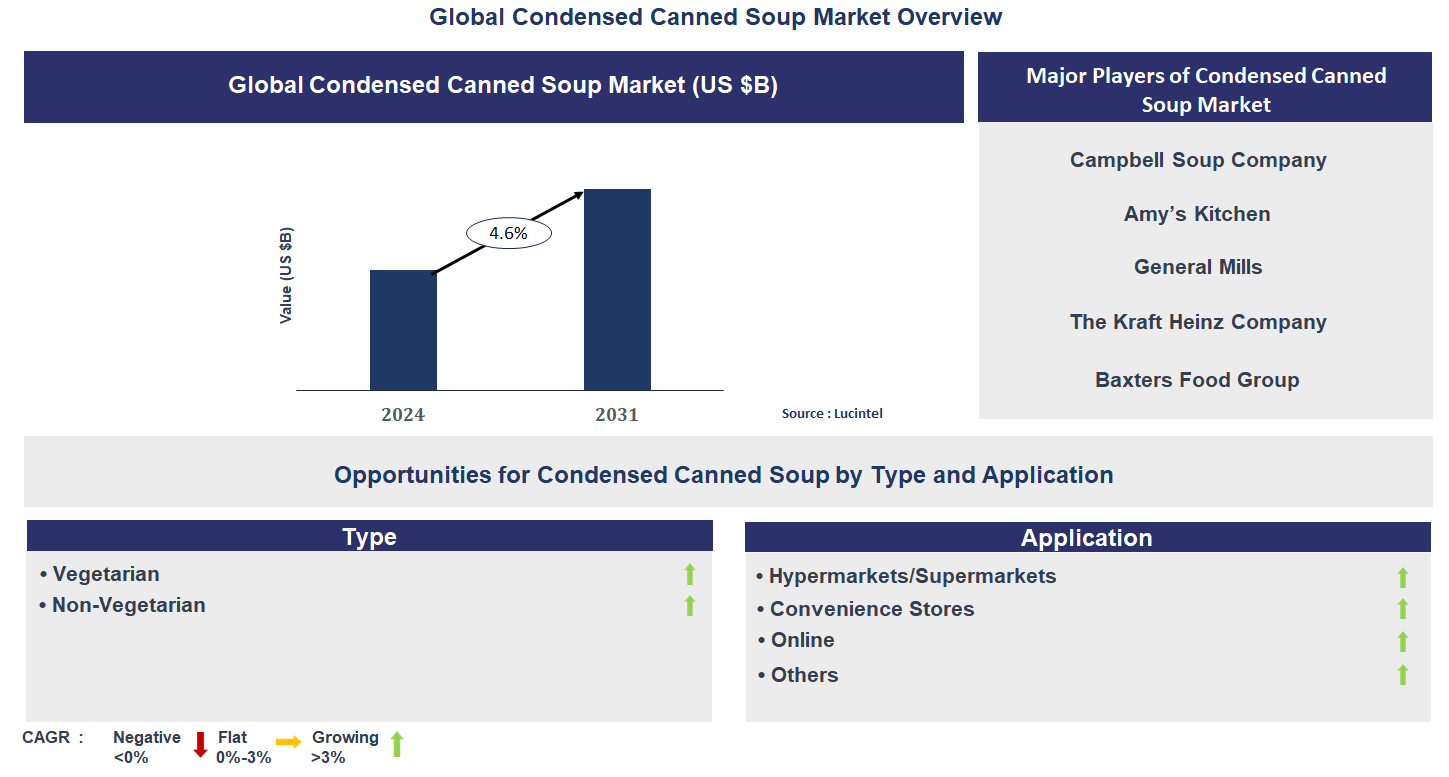
Key data points: The growth forecast = 4.6% annually for the next 7 years. Scroll below to get more insights. This market report covers trends, opportunities and forecasts in condensed canned soup market to 2031 by type (vegetarian and non-vegetarian), application (hypermarkets/supermarkets, convenience stores, online, and others), and region (North America, Europe, Asia Pacific, and the Rest of the World)
We'll send your sample report shortly.
• Lucintel forecasts that, within the type category, vegetarian is expected to witness higher growth over the forecast period.
• Within the application category, convenience store is expected to witness the highest growth.
• In terms of region, APAC is expected to witness the highest growth over the forecast period. Gain valuable insights for your business decisions with our comprehensive 150+ page report. Sample figures with some insights are shown below.
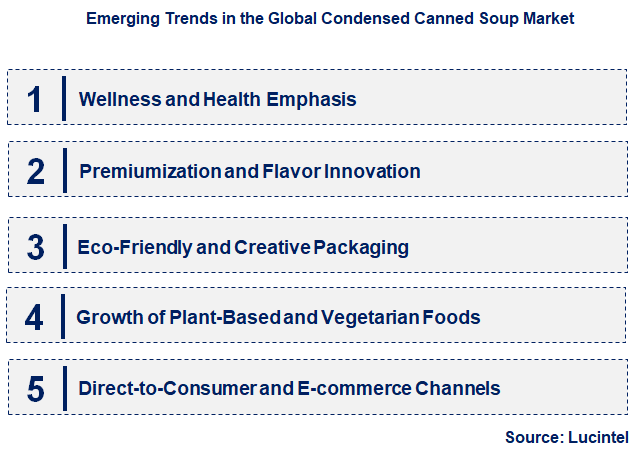
• Wellness and Health Emphasis: There has been a strong move toward health-forward formulations, with emphasis placed on lower sodium, clean label, and the inclusion of functional ingredients. Shoppers are carefully examining nutrition labels and seeking lower-sodium soups that contain no artificial preservatives. The effect is a market in which old-line products are being reformulated and new products are being launched containing added proteins, vegetables, and vitamins.
• Premiumization and Flavor Innovation: The market is trending towards premium and gourmet products, with companies launching a broader range of ethnic and sophisticated flavor profiles. People are looking for novel gastronomic experiences beyond the traditional chicken noodle or tomato soup. The result is a market that is no longer monolithic. Adding flavors such as Thai coconut curry, Mexican tortilla, and Japanese miso soup is pulling in new shoppers and warranting premium prices, elevating the product from a recession-friendly staple to a more aspirational food.
• Eco-Friendly and Creative Packaging: With an emerging movement toward more sustainable and convenient packaging, metal cans remain the norm, but consumers increasingly demand recyclable, BPA-free, and resealable packaging. The effect is a market in which packaging is a major point of differentiation. Businesses are spending money on new technology to produce more sustainable and convenient packaging. This not only will attract eco-aware consumers but also provides a practical advantage, for example, straightforward storage and mess-free preparation.
• Growth of Plant-Based and Vegetarian Foods: Plant-based eating and flexitarians are a dominant trend. Producers are creating innovative vegan and vegetarian condensed soups that taste and feel as good as their conventional counterparts. The effect is that it is creating a huge new market segment. By having many meat-free soups to offer, businesses can target an increasingly large group of consumers actively cutting back on their meat intake for health, environmental, and moral reasons.
• Direct-to-Consumer and E-commerce Channels: Online grocery shopping is a strong trend. Consumers are more and more purchasing their food items, such as condensed canned soups, from e-commerce websites and subscription boxes. The effect is altering the conventional distribution pattern. It offers manufacturers a direct-to-consumer channel where they can sense consumers’ likes and dislikes better and provide consumers with more products that do not sit on physical store shelves. These trends are cumulatively remaking the market by propelling it towards a more contemporary, diverse, and consumer-driven model. The sector is evolving to address the needs of a new shopping generation that cares about health, convenience, and ethical purchasing.
• Product Reformulation for Health: Among the most important developments is the widespread reformulation of traditional soup recipes to lower sodium and fat levels. In response to consumer pressure for healthier alternatives, large brands are launching "low-sodium" or "heart-healthy" versions of their top-selling soups. The effect is a more health-oriented product line, which is particularly important for keeping current customers and getting new ones who are actively controlling what they eat. This trend is also serving to shift the stigma against canned food as unhealthy.
• New and Ethnic Flavors: One of the most important trends is the release of a broad spectrum of new and exotic flavors. Companies are stretching beyond the traditional recipe and are introducing soups based on international cuisines. Some examples include the lentil dal, Thai curry, and roasted red pepper and tomato. The effect is a more diverse product line that appeals to a wider variety of consumers. This innovation is building buzz in a seasoned market and is propelling trial among consumers looking for bold food experiences.
• Consumer-Friendly and Sustainable Packaging: The market has witnessed an evolution in packaging innovation, balancing convenience and sustainability. While steel can is still there, new materials and designs are being experimented with, including easy-open lids and resealable packets. The result is a newer and more attractive product. These innovations solve environmental issues and enhance user experience, and thus the product becomes more desirable to consumers who are both environmentally friendly and time-constrained.
• Acquisitions and Strategic Alliances: The key development here is the rise of mergers, acquisitions, and strategic alliances within the industry. Big food manufacturers are buying smaller, innovative brands that have expertise in organic, plant-based, or gourmet soups. The effect is a concentration of the market and a faster entry into new markets. This enables big players to increase their product offerings and gain know-how in markets where they lacked before, speeding up innovation and market expansion.
• Digital Marketing and E-commerce Strategy: There is a significant shift in how condensed soup is marketed and retailed. Businesses are diverting attention towards digital marketing, social media campaigns, and e-commerce websites. The effect is a shift in the purchasing journey of consumers. By investing in online retail, brands are making their products more accessible and are able to directly engage with consumers, which allows for more personalized marketing and a better understanding of customer preferences. These trends collectively are affecting the market by redefining condensed canned soup from an everyday commodity into a more advanced, contemporary, and consumer-focused product. The sector is proactively responding to address the changing needs of a new generation of consumers.
• Institutional and Foodservice Use: There is a considerable growth potential in the institutional and foodservice area. Condensed soup is the perfect product for restaurants, schools, hospitals, and corporate cafeterias because it is inexpensive, has an extended shelf life, and is simple to prepare in bulk. The effect is big and steady revenue. These customers can be targeted by the companies in a strategic manner by emphasizing the cost-saving and flexibility of their soups, which can be used as a foundation for numerous varied recipes and meals.
• E-commerce and Subscription Services: The increased trend of online shopping for groceries offers a huge growth opportunity. The companies can strategically concentrate on optimizing their e-commerce platforms and creating subscription-based services. The effect is a direct relationship with the consumer and a new growth channel. This enables wider product offerings and offers a convenient, recurring purchase option that fosters customer loyalty and offers insightful information on consumer behavior.
• Health and Wellness Product Line Growth: Health and wellness is not only a trend driver but a growth strategy. Firms can invest in building out product lines to have organic, non-GMO, gluten-free, and plant-based options. The effect is a new market segment willing to pay more for healthier products. With certification and emphasis on nutritional value, brands can become the leaders in the health-oriented food category.
• Specialty and Niche Markets: There is also a strategic advantage to targeting specialty and niche markets. This involves creating ethnic-specific flavors, seasonal limited-time soups, or soups addressing special dietary requirements such as low-carb or high-protein diets. The result is a more loyal, engaged customer base. By producing a distinctive product for a specific target market, companies can set themselves apart from others and generate a buzz for their brand.
• Ingredient-Based Promotion and Value-Added Advantage: Businesses are able to discover an opportunity for growth by pointing out the unique ingredients and value-added advantage of their soups. This includes promoting soups that are highly concentrated in vitamins, have prebiotics, or are produced from innovative, sustainable materials. The effect is that this raises the products value proposition above mere convenience. By highlighting what’s in the can, brands can resonate with a more discerning consumer seeking out foods that benefit their overall health. These strategic growth opportunities are affecting the market by nudging companies away from a one-size-fits-all model. The market is segmenting and specializing as companies are now creating products and marketing tailored to individual consumer needs and uses.
• Campbell Soup Company
• Amy’s Kitchen
• General Mills
• The Kraft Heinz Company
• Baxters Food Group
• Unilever
• Struik Foods Europe
• Vanee Foods Company
• BCI Foods
• Hain Celestial
• Vegetarian
• Non-Vegetarian
• Hypermarkets/Supermarkets
• Convenience Stores
• Online
• Others
• North America
• Europe
• Asia Pacific
• The Rest of the World
• United States: In the United States, recent trends are led by health and premiumization. Customers are looking for reduced-sodium, organic, and plant-based options. Makers are retaliating by making traditional soups healthier and creating new lines of products that address specific dietary requirements such as vegetarian and gluten-free diets. Innovative packaging is also on the cards, with some players providing cans that can be sealed and new packaging formats that please younger, convenient consumers.
• China: China’s canned condensed soup market remains relatively small but has huge growth potential. The trends are focused on product adaptation to local palates and e-commerce. With growing urbanization and hectic lifestyles, demand for convenient, ready-to-consume meals is increasing. Companies are launching flavors and ingredients popular with Chinese, like regional vegetable and noodle-based soups. The growth of online food websites is also a major trend, widening the reach of such items.
• Germany: The condensed canned soup market in Germany is driven by high demand for quality, transparency, and traditional taste. Recent trends are centered around providing products with "clean labels" in the sense of fewer added preservatives and artificial additives. Consumers prefer old-fashioned, hearty recipes that are consistent with traditional German food. The manufacturers are enhancing packaging and marketing to draw attention to the natural ingredients of the product and the nutritional value, targeting a healthy consumer market.
• India: The Indian condensed canned soup market is in the nascent stage but is growing fast, spurred by demographic change and urbanization. Emerging trends are around product tailoring to the local taste and convenience. As more and more nuclear families and professionals are present, the demand for convenient-to-prepare food is high. Firms are launching flavors with traditional Indian spices and ingredients to entice consumers and also bringing to light the long shelf life of the products and how easy they are to use.
• Japan: Japan’s market for canned condensed soup is mature and intensely competitive, and there is heavy emphasis on innovation and niche markets. Current trends are fueled by a desire to appeal to a high-tech society with heavy emphasis on quality and convenience. Producers are creating special tastes and textures, usually based on the local diet, and also pushing the boundaries with packaging to provide a fresh, attractive product. With an emphasis on low-calorie, high-vitamin soups to satisfy the needs of a wellness-orientated consumer base, there is strong evidence of a trend in this direction as well.


• Campbell Soup Company
• Amy’s Kitchen
• General Mills
• The Kraft Heinz Company
• Baxters Food Group
• Unilever
• Struik Foods Europe
• Vanee Foods Company
• BCI Foods
• Hain Celestial Q5. Which condensed canned soup market segment will be the largest in future? Answer: Lucintel forecasts that, within the type category, vegetarian is expected to witness higher growth over the forecast period. Q6. In condensed canned soup market, which region is expected to be the largest in next 5 years? Answer: In terms of region, APAC is expected to witness the highest growth over the forecast period. Q7. Do we receive customization in this report? Answer: Yes, Lucintel provides 10% customization without any additional cost.


Choose a license that fits your team. Instant PDF delivery.
Prices exclude taxes. Instant delivery. Custom licensing available on request.
Market Report · July 22, 2026
Market Report · July 22, 2026
Market Report · July 22, 2026
Trusted partner for strategic intelligence and business growth


Receive a complimentary market analysis tailored to your industry. Our analysts will identify key growth opportunities and competitive dynamics specific to your business.

Market size, growth rate, and key trend analysis for your specific sector.

Top competitor positioning and market share analysis.

Strategic recommendations backed by data-driven insights.
Get curated market intelligence and competitive moves straight to your inbox.
By subscribing, you agree to receive our monthly insights. Unsubscribe anytime.
Receive a complimentary market analysis tailored to your industry. Our analysts will identify key growth opportunities and competitive dynamics specific to your business.
Market size, growth rate, and key trend analysis for your specific sector.
Top competitor positioning and market share analysis.
Strategic recommendations backed by data-driven insights.
Get curated market intelligence, emerging trends, and competitive moves straight to your inbox each month.
By subscribing, you agree to receive our monthly insights. Unsubscribe anytime.
We'll send your sample report shortly.