
Close Lucintel Chat
Didn't Find What You're Looking for?
Call us at +1972 636 5056 or write at helpdesk@Lucintel.com
Ask an Expert Provide Custom Requirements Download Sample Report Search Available Reports
  • helpdesk@Lucintel.com
  • |
  • Call Lucintel +1 972 636 5056
  • |
  • Login
  • |
  • Register
  • |
  • Search
  • |
'
...

The Impact of COVID-19 is included in Concrete Tool Market Report. Buy it today to get an advantage.

Request the impact of COVID-19 on your product or industry


Concrete Tool Market Trends and Forecast

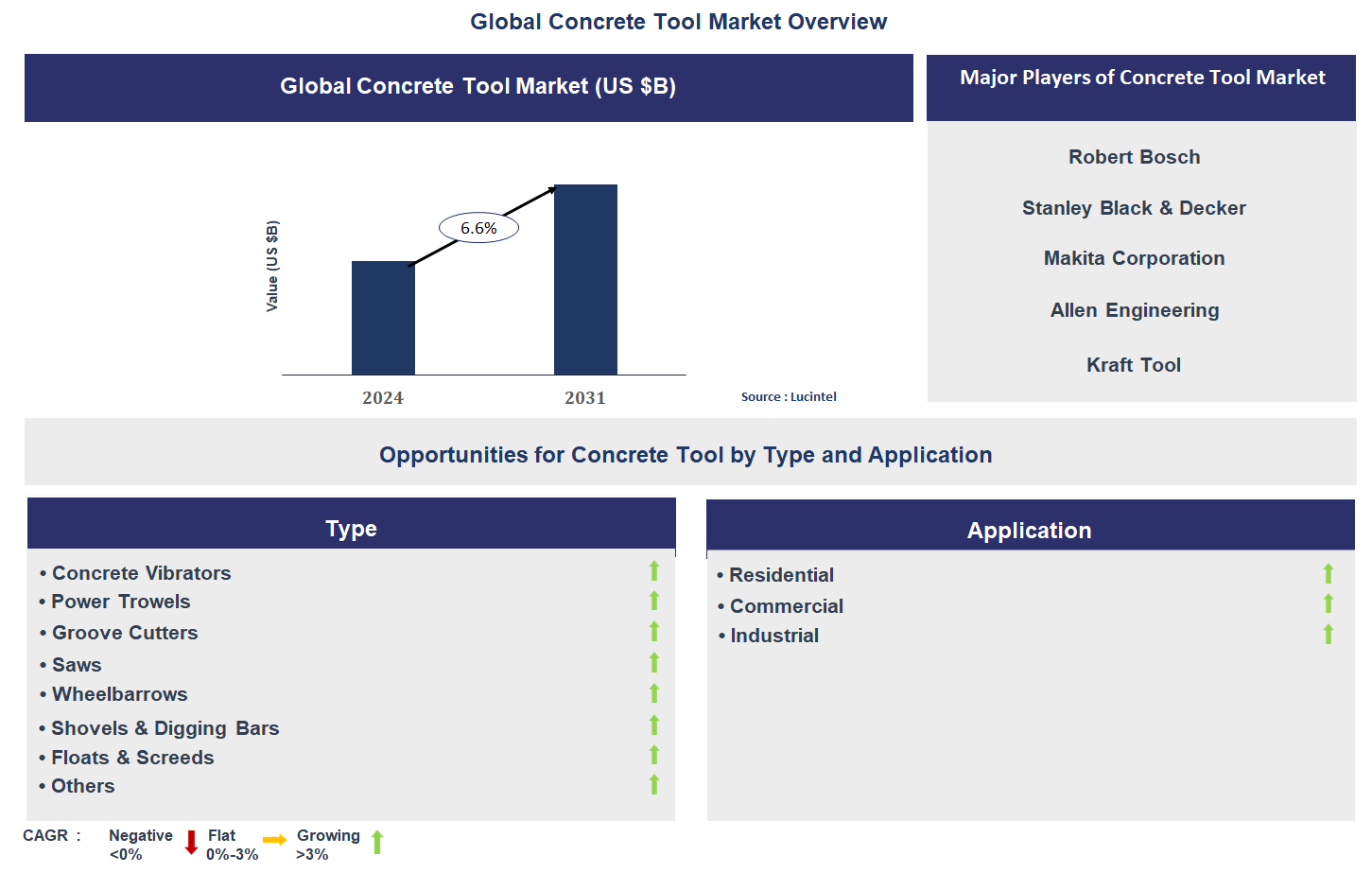
The future of the global concrete tool market looks promising with opportunities in the residential, commercial, and industrial markets. The global concrete tool market is expected to grow with a CAGR of 6.6% from 2025 to 2031. The major drivers for this market are the increasing demand for efficient concrete finishing, the rising adoption of advanced construction tools, and the growing focus on infrastructure development projects.

• Lucintel forecasts that, within the type category, concrete vibrator is expected to witness the highest growth over the forecast period.
• Within the application category, residential is expected to witness the highest growth.
• In terms of region, APAC is expected to witness the highest growth over the forecast period.
Gain valuable insights for your business decisions with our comprehensive 150+ page report. Sample figures with some insights are shown below.
Concrete Tool Market Trends and Forecast

Emerging Trends in the Concrete Tool Market

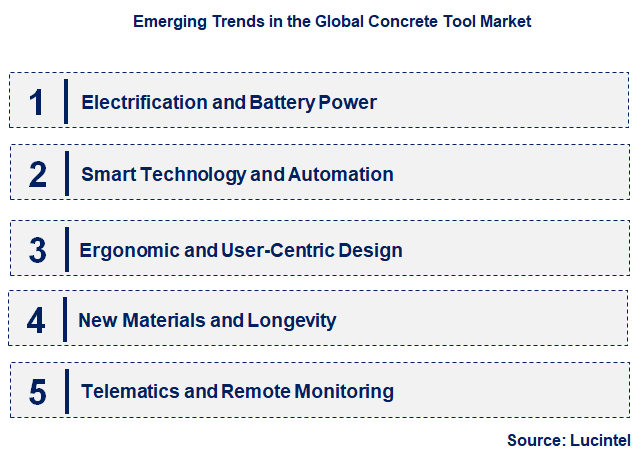
The concrete tool industry is experiencing a revolutionary shift, propelled by a combination of technological advancement, increased emphasis on ergonomics and safety, and changing needs of the international construction industry. These new trends are not just incremental technology; they are transforming the design, functionality, and even the purpose of these tools on a worksite. The trend toward smarter, more efficient, and sustainable equipment is creating a new industry standard, from large industrial projects to urban development.
• Electrification and Battery Power: One of the notable trends is going electric and battery-powered with concrete tools. This is in response to more stringent environmental regulations, especially for projects indoors and in the city where emissions and noise are of utmost concern. Improvements in battery technology are now offering the power and run time needed to make these machines a worthwhile alternative to conventional gasoline and corded models.
• Smart Technology and Automation: Automating equipment is a major developing trend. These integrated smart technologies consist of tools with GPS guidance that can operate independently, real-time diagnostics digital readouts, and sensors tracking performance and required maintenance. The aim is to enhance accuracy, consistency, and productivity, as well as to allow contractors to more effectively manage their equipment fleets. These technologies also work towards enhanced safety by minimizing the amount of direct human intervention in hazardous surroundings and simplifying complicated tasks.
• Ergonomic and User-Centric Design: Companies are focusing more and more on making the operators’ comfort and protection a priority. This movement is about creating tools with sophisticated ergonomic solutions, like adaptable handles, simple controls, and vibration-reduction systems. The goal is to minimize physical stress and repetitive motion injury risk, as these are prevalent in this kind of work. This user-centered design focus is also a solution to the skilled worker shortage, as it makes the work more attractive and sustainable to workers.
• New Materials and Longevity: One of the trends is the use of more advanced materials to develop tools. These consist of high-strength composites and alloys with a superior balance of weight, flexibility, and strength. The tools produced using these materials are lighter, yet stronger, minimizing operator fatigue while increasing the tools lifespan. This trend is a reaction to a demand for more reliable and durable tools that minimize downtime and replacement costs for contractors.
• Telematics and Remote Monitoring: Remote monitoring and telematics integration is an emerging feature in the industry. Some of the high-end models come with sensors that can monitor critical performance metrics like engine hours, usage patterns, and maintenance requirements. These can be sent to a central system, and fleet managers can track tool health and arrange for preventive maintenance. This is a trend about giving contractors data-driven insights to better manage workflow and more efficiently manage their equipment fleet.
Together, these trends are transforming the concrete tool industry by driving manufacturers to go beyond mere mechanical advancements. The emphasis now lies in developing holistic, high-tech solutions that advance all aspects of the concrete work process. The industry is heading towards a future with tools not only more powerful and efficient but also intelligent, safer, and more environmentally friendly, essentially revolutionizing the landscape of today’s construction and demolition.
Emerging Trends in the Concrete Tool Market

Recent Development in the Concrete Tool Market

The concrete tool industry has witnessed several major advancements, fueled by a desire for greater productivity, enhanced safety, and more precision during construction and finishing. These developments are revolutionizing how concrete is handled, making the process quicker, more efficient, and less labor-intensive. The emphasis lies in combining new technologies and design concepts to develop tools that are not only more capable but also more user-friendly and dependable, having a direct impact on the quality of the final product.
• Cordless Tool Systems: Another significant innovation is the widespread availability of cordless tool systems utilizing high-voltage batteries. Several manufacturers now provide extensive lines of cordless concrete equipment, such as power trowels, concrete vibrators, and rebar cutters. This new innovation gives contractors more mobility and removes the safety hazard of power cords. The tools are also quieter and produce no emissions, making them perfectly suited for indoor or poorly ventilated work sites.
• Ergonomic and Anti-Vibration Technology: To counteract operator health, one of the key breakthroughs has been the marriage of ergonomic design and anti-vibration technology. Products are being designed with handles that minimize physical stress and dampen vibrations, a primary source of hand and arm fatigue. This innovation is vital to retaining skilled workers in the sector and in complying with strict occupational safety standards, making the work more manageable and safer.
• Integrated Smart Features: One of the most significant developments is the integration of smart features into concrete tools. This involves the installation of sensors and embedded chips that can report real-time performance, battery life, and maintenance requirements. Some tools have the ability to link to a smartphone app, enabling the operator or project manager to monitor usage and follow tool location. This innovation is all about giving contractors data-based information to maximize workflow and better manage their equipment fleet.
• New Materials for Longevity: Producers are developing the materials of tool blades and other parts. Abrasion-resistant, high-grade alloys are utilized to prolong the longevity of cutting and finishing blades, minimizing replacement requirements. This translates into less maintenance expense and downtime for contractors. The new materials help achieve a quicker, more accurate finish and are specifically a reaction to contractor needs for more resistant and longer-lasting equipment.
• Specialized Tooling for Specific Applications: There is a growing development in creating specialized tools for specific concrete applications. For instance, tools are being developed with unique blade shapes for decorative concrete work or with specific features for polishing and grinding. This development reflects a greater emphasis on task-specific tools to optimize performance and craftsmanship. By offering a range of specialized tools, manufacturers can cater to the specific needs of professional contractors.
These new advances are all working together to change the concrete tool market. No longer is the emphasis on raw power and size, but on a greater picture that takes into account efficiency, safety, and technology. These new developments are not only enhancing the quality of the work being done with concrete, but also making the process safer and easier for operators, eventually resulting in greater productivity and improved results on projects for the entire construction and demolition industry.

Strategic Growth Opportunities in the Concrete Tool Market

There are a number of strategic opportunities for growth in the concrete tool market across significant applications due to a global rise in big construction, renovation, and infrastructure projects. Through focusing on specific end-user segments, manufacturers and suppliers can take advantage of these trends and deliver customized solutions addressing the distinctive requirements of various projects. It’s not merely about making a tool but also about comprehending and catering to the various needs of various projects, resulting in increased market share and profitability.
• Residential and Commercial Construction: Residential and commercial construction presents a significant growth opportunity. When new homes and commercial structures are built, there is a continuous demand for tools to mix, pour, finish, and cut concrete. The strategic potential is to offer a variety of handy, mid-sized tools that are convenient to use and move. By servicing the interests of a broad spectrum of contractors, ranging from large companies to small independent builders, firms can secure a large market share and establish a reputation for dependability.
• Public Works and Infrastructure: Major infrastructure development projects like the building of bridges, dams, and public structures generate a major opportunity for concrete equipment. All these applications demand heavy-duty, high-horsepower equipment with high-performance capabilities to meet large-scale, heavy-duty requirements. The strategic potential is to offer heavy-duty, high-horsepower equipment with high-tech features and to develop a robust sales and service network to address the requirements of major civil engineering and government contractors.
• Repair and Renovation: The increasing popularity of repair and renovation jobs on existing buildings presents a key growth potential for concrete equipment. The jobs involve sensitive and controlled operations in congested and small areas. The strategic potential is to offer compact, space-saving, and soundless electric or battery-operated equipment. These products are critical for noise and dust pollution reduction, positioning them as best suited for operations in cities with stringent regulations.
• Specialty and Decorative Concrete: Decorative and specialty concrete, such as polished floors, stamped patios, and architectural concrete, is an important growth opportunity. Those are applications that demand different, application-specific tools that can perform in intricate details and exacting work. The strategic play is to offer a variety of specialist, niche tools that are designed for this level of craftsmanship. This division provides an opportunity to market to the artistic and high-end consumer and establish a reputation for excellence and competence.
• Leasing and Equipment Rental: The rental market for equipment is a key growth opportunity. Numerous contractors, particularly small and medium ones, would rather lease costly machinery on a job-by-job basis than make a purchase. The strategic implication is to become involved with leasing companies to provide widespread access to concrete tools. This method maximizes brand visibility and market reach without necessitating the end-user to incur a large capital outlay, thus increasing the customer base.
These opportunities for growth are transforming the concrete tool industry by fostering a move away from a one-size-fits-all strategy toward a more segmented, application-specific strategy. Those firms that are able to identify and serve the specific needs of each application will be best positioned for future success and growth. The future of the market is in delivering custom solutions that provide optimal value, efficiency, and performance for all forms of concrete work.

Concrete Tool Market Driver and Challenges

The concrete tool market is a dynamic market influenced by a mix of key drivers and challenges. The drivers are mainly the outcome of a strong construction and infrastructure industry and ongoing pressure for technological advancement. On the other hand, the challenges are based on economic uncertainty and market competition. It is important for market participants to grasp this dynamic interaction in formulating effective strategies. The entire market is an intricate ecosystem where the need for effective tools is a direct reaction to challenges within the industry, resulting in a cycle of adaptation and innovation.
The factors responsible for driving the concrete tool market include:
1. Global Infrastructure Development: The major growth impetus for the concrete tool market comes from the global development of infrastructure projects. Governments and private players are allocating huge amounts of money to build new roads, bridges, airports, and other public infrastructure. Such extensive development provides a steady and high demand for strong and efficient tools, and thus concrete tools become a vital piece of equipment for civil engineering and construction companies across the globe.
2. Increasing Demand for Productivity: As labor costs rise and skilled labor becomes short in supply in most areas, there is a high motivation for contractors to adopt machinery that helps boost productivity. Concrete equipment tremendously saves time and effort for operations such as mixing, finishing, and cutting. This improved efficiency automatically translates into reduced project costs and faster turnaround, which is a strong motivation for contractors to invest in these sophisticated machines.
3. Technological Development: Continuous innovations form a major driver of the market. Evolution of sophisticated features such as remote operation, intelligent sensors, and onboard dust control systems is rendering concrete tools safer and more effective. Inclusion of electric and battery-powered variants is also fueling adoption through cleaner and quieter options that fit today’s environmental and noise standards, thus serving more types of projects.
4. Urbanization and Renovation: The process of urbanization and the necessity to keep and refurbish already built infrastructure are key market drivers. With expanding cities, controlled demolition, street repairs, and installation of utilities become necessary. Concrete tools are best adapted to these processes as they offer a neat and efficient way to work with concrete without generating too much damage to other structures, so they are crucial for urban development projects.
5. Focus on Safety and Environmental Compliance: An increasing focus on worker safety and environmental laws is a major driver. Manufacturers are designing concrete equipment with attributes that minimize operator fatigue, mitigate dust emissions, and decrease noise. These regulations are not only legally required but also a competitive edge, since contractors look for equipment that enables them to build a safer and environmentally more friendly work environment.
Challenges in the concrete tool market are:
1. High Initial Investment: One of the main issues in the market is a high initial investment in buying concrete tools, especially for big, complex machinery. The tools are a heavy capital expenditure, which becomes a hindrance for small and medium-sized contractors. The high expense can restrict the growth of the market and compel smaller entities to use less efficient manual processes or costly leases.
2. Fierce Competition: The market for concrete tools is very competitive, with numerous manufacturers competing for market share. This fierce competition can give rise to price wars, which create pressure on margins. Low-cost substitutes from the emerging economies create a major threat to established brands of high quality that have to continuously innovate in order to support their premium pricing and hold on to their market share.
3. Skilled Operators Needed: As much as the demand for productivity equipment is spurred by a shortage of labor, the same shortage also presents a challenge. Handling high-tech advanced concrete equipment necessitates some level of skill and training. Unavailability of trained personnel can delay the use of advanced, high-technology equipment since contractors can shy away from buying equipment they cannot use efficiently.
Overall, the concrete machinery market is witnessing strong growth driven by a healthy construction industry and demand for productive, technologically superior, and ergonomic equipment. But this growth is being moderated by factors like the high cost of procurement, high competition, and lack of skilled operators. The success of the sector in overcoming these challenges by concentrating on innovation, quality, and customer-centric design will be critical to its future growth and success.

List of Concrete Tool Companies

Companies in the market compete on the basis of product quality offered. Major players in this market focus on expanding their manufacturing facilities, R&D investments, infrastructural development, and leverage integration opportunities across the value chain. With these strategies concrete tool companies cater increasing demand, ensure competitive effectiveness, develop innovative products & technologies, reduce production costs, and expand their customer base. Some of the concrete tool companies profiled in this report include-
• Robert Bosch
• Stanley Black & Decker
• Makita Corporation
• Allen Engineering
• Kraft Tool
• Beton Tool Company
• Leading Tools Industrial

Concrete Tool Market by Segment

The study includes a forecast for the global concrete tool market by type, application, and region.

Concrete Tool Market by Type [Value from 2019 to 2031]:


• Concrete Vibrators
• Power Trowels
• Groove Cutters
• Saws
• Wheelbarrows
• Shovels & Digging Bars
• Floats & Screeds
• Others

Concrete Tool Market by Application [Value from 2019 to 2031]:


• Residential
• Commercial
• Industrial

Concrete Tool Market by Region [Value from 2019 to 2031]:


• North America
• Europe
• Asia Pacific
• The Rest of the World

Country Wise Outlook for the Concrete Tool Market

The concrete tool industry is in the midst of immense transformation, prompted by the world construction industry’s need for more efficient, robust, and ergonomically friendly equipment. Ranging from hand tools to heavy machinery, recent innovations are centered on maximizing performance, boosting safety, and minimizing operator’s physical burden. The market is also reacting to an increasing demand for environmentally friendly, battery-powered tools that comply with rigorous environmental standards. Every major global market is embracing these innovations in a manner that is responsive to its distinct economic environment, regulatory regime, and labor market.
• United States: In the United States, the concrete tool market is underpinned by an emphasis on productivity and employee safety. Recent advances involve the popularity of battery-operated and wireless tools, including wireless concrete vibrators and power screeds, that have increased mobility and less emission. There is also an increased interest in smart tools with onboard technology for data gathering and real-time monitoring. These are intended to overcome the shortage of skilled labor by making the tools simpler and more efficient to use.
• China: Chinas construction tooling market is growing strongly, driven by huge urbanization and mega-infrastructure projects. Although the market is still price-sensitive, there is a definite move towards higher-quality, professional-grade equipment. Local manufacturers are spending more on research and development to create more powerful and more accurate tools that can rival overseas brands. Automation and the use of semi-autonomous vehicles are also on the rise, felled by the demand for speed and consistency in high-volume building projects, assisting the country’s ambitious development objectives.
• Germany: Germanys concrete tool industry is defined by strong demand for accuracy, long life, and adherence to strict environmental and safety regulations. Current trends involve the manufacture of sturdy, long-lasting machines with low emissions and noise abatement technology. Operator health is emphasized in the market, including ergonomic controls and anti-vibration controls to minimize physical fatigue. German contractors are willing to pay for high-quality, professional-grade equipment that provides superior performance and complies with strict regulations.
• India: The Indian concrete tool market is in a robust growth phase, led by a thriving construction industry and government investment in infrastructure. The market is dominated by a demand for easy-maintenance, low-cost, and durable tools. Nevertheless, as the market becomes organized, there is a steady movement towards more technology-based models. The expansion of e-commerce websites and an increasingly evolved rental market are providing domestic and international brands with greater accessibility to a broader number of contractors, fueling overall market growth and evolution.
• Japan: The Japanese market for concrete tools is very advanced, with a strong inclination toward lightweight, compact, and high-performance equipment. New developments emphasize creating highly agile tools that are ideal for the country’s high-density urban areas and smaller job sites. Strong emphasis is placed on automation and incorporation of high-precision control systems to guarantee a perfect finish. The industry is also experiencing growth in the use of battery and electric models to suit stringent noise and environmental requirements, in line with a national emphasis on precision and sustainability.

Lucintel Analytics Dashboard

Features of the Global Concrete Tool Market

Market Size Estimates: Concrete tool market size estimation in terms of value ($B).
Trend and Forecast Analysis: Market trends (2019 to 2024) and forecast (2025 to 2031) by various segments and regions.
Segmentation Analysis: Concrete tool market size by type, application, and region in terms of value ($B).
Regional Analysis: Concrete tool market breakdown by North America, Europe, Asia Pacific, and Rest of the World.
Growth Opportunities: Analysis of growth opportunities in different types, applications, and regions for the concrete tool market.
Strategic Analysis: This includes M&A, new product development, and competitive landscape of the concrete tool market.
Analysis of competitive intensity of the industry based on Porter’s Five Forces model.

Lucintel Consulting Services

FAQ

Q1. What is the growth forecast for concrete tool market?
Answer: The global concrete tool market is expected to grow with a CAGR of 6.6% from 2025 to 2031.
Q2. What are the major drivers influencing the growth of the concrete tool market?
Answer: The major drivers for this market are the increasing demand for efficient concrete finishing, the rising adoption of advanced construction tools, and the growing focus on infrastructure development projects.
Q3. What are the major segments for concrete tool market?
Answer: The future of the concrete tool market looks promising with opportunities in the residential, commercial, and industrial markets.
Q4. Who are the key concrete tool market companies?
Answer: Some of the key concrete tool companies are as follows:
• Robert Bosch
• Stanley Black & Decker
• Makita Corporation
• Allen Engineering
• Kraft Tool
• Beton Tool Company
• Leading Tools Industrial
Q5. Which concrete tool market segment will be the largest in future?
Answer: Lucintel forecasts that, within the type category, concrete vibrator is expected to witness the highest growth over the forecast period.
Q6. In concrete tool market, which region is expected to be the largest in next 5 years?
Answer: In terms of region, APAC is expected to witness the highest growth over the forecast period.
Q7. Do we receive customization in this report?
Answer: Yes, Lucintel provides 10% customization without any additional cost.

This report answers following 11 key questions:

Q.1. What are some of the most promising, high-growth opportunities for the concrete tool market by type (concrete vibrators, power trowels, groove cutters, saws, wheelbarrows, shovels & digging bars, floats & screeds, and others), application (residential, commercial, and industrial), and region (North America, Europe, Asia Pacific, and the Rest of the World)?
Q.2. Which segments will grow at a faster pace and why?
Q.3. Which region will grow at a faster pace and why?
Q.4. What are the key factors affecting market dynamics? What are the key challenges and business risks in this market?
Q.5. What are the business risks and competitive threats in this market?
Q.6. What are the emerging trends in this market and the reasons behind them?
Q.7. What are some of the changing demands of customers in the market?
Q.8. What are the new developments in the market? Which companies are leading these developments?
Q.9. Who are the major players in this market? What strategic initiatives are key players pursuing for business growth?
Q.10. What are some of the competing products in this market and how big of a threat do they pose for loss of market share by material or product substitution?
Q.11. What M&A activity has occurred in the last 5 years and what has its impact been on the industry?

For any questions related to Concrete Tool Market, Concrete Tool Market Size, Concrete Tool Market Growth, Concrete Tool Market Analysis, Concrete Tool Market Report, Concrete Tool Market Share, Concrete Tool Market Trends, Concrete Tool Market Forecast, Concrete Tool Companies, write Lucintel analyst at email: helpdesk@lucintel.com. We will be glad to get back to you soon.
                                           Table of Contents

            1. Executive Summary

            2. Market Overview

                        2.1 Background and Classifications
                        2.2 Supply Chain

            3. Market Trends & Forecast Analysis

                        3.1 Macroeconomic Trends and Forecasts
                        3.2 Industry Drivers and Challenges
                        3.3 PESTLE Analysis
                        3.4 Patent Analysis
                        3.5 Regulatory Environment
                        3.6 Global Concrete Tool Market Trends and Forecast

            4. Global Concrete Tool Market by Type

                        4.1 Overview
                        4.2 Attractiveness Analysis by Type
                        4.3 Concrete Vibrators : Trends and Forecast 2025 to 2031
                        4.4 Power Trowels : Trends and Forecast 2025 to 2031
                        4.5 Groove Cutters : Trends and Forecast 2025 to 2031
                        4.6 Saws : Trends and Forecast 2025 to 2031
                        4.7 Wheelbarrows : Trends and Forecast 2025 to 2031
                        4.8 Shovels & Digging Bars : Trends and Forecast 2025 to 2031
                        4.9 Floats & Screeds : Trends and Forecast 2025 to 2031
                        4.10 Others : Trends and Forecast 2025 to 2031

            5. Global Concrete Tool Market by Application

                        5.1 Overview
                        5.2 Attractiveness Analysis by Application
                        5.3 Residential : Trends and Forecast 2025 to 2031
                        5.4 Commercial : Trends and Forecast 2025 to 2031
                        5.5 Industrial : Trends and Forecast 2025 to 2031

            6. Regional Analysis

                        6.1 Overview
                        6.2 Global Concrete Tool Market by Region

            7. North American Concrete Tool Market

                        7.1 Overview
                        7.2 North American Concrete Tool Market by Type
                        7.3 North American Concrete Tool Market by Application
                        7.4 The United States Concrete Tool Market
                        7.5 Canadian Concrete Tool Market
                        7.6 Mexican Concrete Tool Market

            8. European Concrete Tool Market

                        8.1 Overview
                        8.2 European Concrete Tool Market by Type
                        8.3 European Concrete Tool Market by Application
                        8.4 German Concrete Tool Market
                        8.5 French Concrete Tool Market
                        8.6 Italian Concrete Tool Market
                        8.7 Spanish Concrete Tool Market
                        8.8 The United Kingdom Concrete Tool Market

            9. APAC Concrete Tool Market

                        9.1 Overview
                        9.2 APAC Concrete Tool Market by Type
                        9.3 APAC Concrete Tool Market by Application
                        9.4 Chinese Concrete Tool Market
                        9.5 Indian Concrete Tool Market
                        9.6 Japanese Concrete Tool Market
                        9.7 South Korean Concrete Tool Market
                        9.8 Indonesian Concrete Tool Market

            10. ROW Concrete Tool Market

                        10.1 Overview
                        10.2 ROW Concrete Tool Market by Type
                        10.3 ROW Concrete Tool Market by Application
                        10.4 Middle Eastern Concrete Tool Market
                        10.5 South American Concrete Tool Market
                        10.6 African Concrete Tool Market

            11. Competitor Analysis

                        11.1 Product Portfolio Analysis
                        11.2 Operational Integration
                        11.3 Porter’s Five Forces Analysis
                                    • Competitive Rivalry
                                    • Bargaining Power of Buyers
                                    • Bargaining Power of Suppliers
                                    • Threat of Substitutes
                                    • Threat of New Entrants
                        11.4 Market Share Analysis

            12. Opportunities & Strategic Analysis

                        12.1 Value Chain Analysis
                        12.2 Growth Opportunity Analysis
                                    12.2.1 Growth Opportunity by Type
                                    12.2.2 Growth Opportunity by Application
                        12.3 Emerging Trends in the Global Concrete Tool Market
                        12.4 Strategic Analysis
                                    12.4.1 New Product Development
                                    12.4.2 Certification and Licensing
                                    12.4.3 Mergers, Acquisitions, Agreements, Collaborations, and Joint Ventures

            13. Company Profiles of the Leading Players Across the Value Chain

                        13.1 Competitive Analysis
                        13.2 Robert Bosch
                                    • Company Overview
                                    • Concrete Tool Market Business Overview
                                    • New Product Development
                                    • Merger, Acquisition, and Collaboration
                                    • Certification and Licensing
                        13.3 Stanley Black & Decker
                                    • Company Overview
                                    • Concrete Tool Market Business Overview
                                    • New Product Development
                                    • Merger, Acquisition, and Collaboration
                                    • Certification and Licensing
                        13.4 Makita Corporation
                                    • Company Overview
                                    • Concrete Tool Market Business Overview
                                    • New Product Development
                                    • Merger, Acquisition, and Collaboration
                                    • Certification and Licensing
                        13.5 Allen Engineering
                                    • Company Overview
                                    • Concrete Tool Market Business Overview
                                    • New Product Development
                                    • Merger, Acquisition, and Collaboration
                                    • Certification and Licensing
                        13.6 Kraft Tool
                                    • Company Overview
                                    • Concrete Tool Market Business Overview
                                    • New Product Development
                                    • Merger, Acquisition, and Collaboration
                                    • Certification and Licensing
                        13.7 Beton Tool Company
                                    • Company Overview
                                    • Concrete Tool Market Business Overview
                                    • New Product Development
                                    • Merger, Acquisition, and Collaboration
                                    • Certification and Licensing
                        13.8 Leading Tools Industrial
                                    • Company Overview
                                    • Concrete Tool Market Business Overview
                                    • New Product Development
                                    • Merger, Acquisition, and Collaboration
                                    • Certification and Licensing

            14. Appendix

                        14.1 List of Figures
                        14.2 List of Tables
                        14.3 Research Methodology
                        14.4 Disclaimer
                        14.5 Copyright
                        14.6 Abbreviations and Technical Units
                        14.7 About Us
                        14.8 Contact Us

                                               List of Figures


            Chapter 1

                        Figure 1.1: Trends and Forecast for the Global Concrete Tool Market

            Chapter 2

                        Figure 2.1: Usage of Concrete Tool Market
                        Figure 2.2: Classification of the Global Concrete Tool Market
                        Figure 2.3: Supply Chain of the Global Concrete Tool Market

            Chapter 3

                        Figure 3.1: Trends of the Global GDP Growth Rate
                        Figure 3.2: Trends of the Global Population Growth Rate
                        Figure 3.3: Trends of the Global Inflation Rate
                        Figure 3.4: Trends of the Global Unemployment Rate
                        Figure 3.5: Trends of the Regional GDP Growth Rate
                        Figure 3.6: Trends of the Regional Population Growth Rate
                        Figure 3.7: Trends of the Regional Inflation Rate
                        Figure 3.8: Trends of the Regional Unemployment Rate
                        Figure 3.9: Trends of Regional Per Capita Income
                        Figure 3.10: Forecast for the Global GDP Growth Rate
                        Figure 3.11: Forecast for the Global Population Growth Rate
                        Figure 3.12: Forecast for the Global Inflation Rate
                        Figure 3.13: Forecast for the Global Unemployment Rate
                        Figure 3.14: Forecast for the Regional GDP Growth Rate
                        Figure 3.15: Forecast for the Regional Population Growth Rate
                        Figure 3.16: Forecast for the Regional Inflation Rate
                        Figure 3.17: Forecast for the Regional Unemployment Rate
                        Figure 3.18: Forecast for Regional Per Capita Income
                        Figure 3.19: Driver and Challenges of the Concrete Tool Market

            Chapter 4

                        Figure 4.1: Global Concrete Tool Market by Type in 2019, 2024, and 2031
                        Figure 4.2: Trends of the Global Concrete Tool Market ($B) by Type
                        Figure 4.3: Forecast for the Global Concrete Tool Market ($B) by Type
                        Figure 4.4: Trends and Forecast for Concrete Vibrators in the Global Concrete Tool Market (2019-2031)
                        Figure 4.5: Trends and Forecast for Power Trowels in the Global Concrete Tool Market (2019-2031)
                        Figure 4.6: Trends and Forecast for Groove Cutters in the Global Concrete Tool Market (2019-2031)
                        Figure 4.7: Trends and Forecast for Saws in the Global Concrete Tool Market (2019-2031)
                        Figure 4.8: Trends and Forecast for Wheelbarrows in the Global Concrete Tool Market (2019-2031)
                        Figure 4.9: Trends and Forecast for Shovels & Digging Bars in the Global Concrete Tool Market (2019-2031)
                        Figure 4.10: Trends and Forecast for Floats & Screeds in the Global Concrete Tool Market (2019-2031)
                        Figure 4.11: Trends and Forecast for Others in the Global Concrete Tool Market (2019-2031)

            Chapter 5

                        Figure 5.1: Global Concrete Tool Market by Application in 2019, 2024, and 2031
                        Figure 5.2: Trends of the Global Concrete Tool Market ($B) by Application
                        Figure 5.3: Forecast for the Global Concrete Tool Market ($B) by Application
                        Figure 5.4: Trends and Forecast for Residential in the Global Concrete Tool Market (2019-2031)
                        Figure 5.5: Trends and Forecast for Commercial in the Global Concrete Tool Market (2019-2031)
                        Figure 5.6: Trends and Forecast for Industrial in the Global Concrete Tool Market (2019-2031)

            Chapter 6

                        Figure 6.1: Trends of the Global Concrete Tool Market ($B) by Region (2019-2024)
                        Figure 6.2: Forecast for the Global Concrete Tool Market ($B) by Region (2025-2031)

            Chapter 7

                        Figure 7.1: Trends and Forecast for the North American Concrete Tool Market (2019-2031)
                        Figure 7.2: North American Concrete Tool Market by Type in 2019, 2024, and 2031
                        Figure 7.3: Trends of the North American Concrete Tool Market ($B) by Type (2019-2024)
                        Figure 7.4: Forecast for the North American Concrete Tool Market ($B) by Type (2025-2031)
                        Figure 7.5: North American Concrete Tool Market by Application in 2019, 2024, and 2031
                        Figure 7.6: Trends of the North American Concrete Tool Market ($B) by Application (2019-2024)
                        Figure 7.7: Forecast for the North American Concrete Tool Market ($B) by Application (2025-2031)
                        Figure 7.8: Trends and Forecast for the United States Concrete Tool Market ($B) (2019-2031)
                        Figure 7.9: Trends and Forecast for the Mexican Concrete Tool Market ($B) (2019-2031)
                        Figure 7.10: Trends and Forecast for the Canadian Concrete Tool Market ($B) (2019-2031)

            Chapter 8

                        Figure 8.1: Trends and Forecast for the European Concrete Tool Market (2019-2031)
                        Figure 8.2: European Concrete Tool Market by Type in 2019, 2024, and 2031
                        Figure 8.3: Trends of the European Concrete Tool Market ($B) by Type (2019-2024)
                        Figure 8.4: Forecast for the European Concrete Tool Market ($B) by Type (2025-2031)
                        Figure 8.5: European Concrete Tool Market by Application in 2019, 2024, and 2031
                        Figure 8.6: Trends of the European Concrete Tool Market ($B) by Application (2019-2024)
                        Figure 8.7: Forecast for the European Concrete Tool Market ($B) by Application (2025-2031)
                        Figure 8.8: Trends and Forecast for the German Concrete Tool Market ($B) (2019-2031)
                        Figure 8.9: Trends and Forecast for the French Concrete Tool Market ($B) (2019-2031)
                        Figure 8.10: Trends and Forecast for the Spanish Concrete Tool Market ($B) (2019-2031)
                        Figure 8.11: Trends and Forecast for the Italian Concrete Tool Market ($B) (2019-2031)
                        Figure 8.12: Trends and Forecast for the United Kingdom Concrete Tool Market ($B) (2019-2031)

            Chapter 9

                        Figure 9.1: Trends and Forecast for the APAC Concrete Tool Market (2019-2031)
                        Figure 9.2: APAC Concrete Tool Market by Type in 2019, 2024, and 2031
                        Figure 9.3: Trends of the APAC Concrete Tool Market ($B) by Type (2019-2024)
                        Figure 9.4: Forecast for the APAC Concrete Tool Market ($B) by Type (2025-2031)
                        Figure 9.5: APAC Concrete Tool Market by Application in 2019, 2024, and 2031
                        Figure 9.6: Trends of the APAC Concrete Tool Market ($B) by Application (2019-2024)
                        Figure 9.7: Forecast for the APAC Concrete Tool Market ($B) by Application (2025-2031)
                        Figure 9.8: Trends and Forecast for the Japanese Concrete Tool Market ($B) (2019-2031)
                        Figure 9.9: Trends and Forecast for the Indian Concrete Tool Market ($B) (2019-2031)
                        Figure 9.10: Trends and Forecast for the Chinese Concrete Tool Market ($B) (2019-2031)
                        Figure 9.11: Trends and Forecast for the South Korean Concrete Tool Market ($B) (2019-2031)
                        Figure 9.12: Trends and Forecast for the Indonesian Concrete Tool Market ($B) (2019-2031)

            Chapter 10

                        Figure 10.1: Trends and Forecast for the ROW Concrete Tool Market (2019-2031)
                        Figure 10.2: ROW Concrete Tool Market by Type in 2019, 2024, and 2031
                        Figure 10.3: Trends of the ROW Concrete Tool Market ($B) by Type (2019-2024)
                        Figure 10.4: Forecast for the ROW Concrete Tool Market ($B) by Type (2025-2031)
                        Figure 10.5: ROW Concrete Tool Market by Application in 2019, 2024, and 2031
                        Figure 10.6: Trends of the ROW Concrete Tool Market ($B) by Application (2019-2024)
                        Figure 10.7: Forecast for the ROW Concrete Tool Market ($B) by Application (2025-2031)
                        Figure 10.8: Trends and Forecast for the Middle Eastern Concrete Tool Market ($B) (2019-2031)
                        Figure 10.9: Trends and Forecast for the South American Concrete Tool Market ($B) (2019-2031)
                        Figure 10.10: Trends and Forecast for the African Concrete Tool Market ($B) (2019-2031)

            Chapter 11

                        Figure 11.1: Porter’s Five Forces Analysis of the Global Concrete Tool Market
                        Figure 11.2: Market Share (%) of Top Players in the Global Concrete Tool Market (2024)

            Chapter 12

                        Figure 12.1: Growth Opportunities for the Global Concrete Tool Market by Type
                        Figure 12.2: Growth Opportunities for the Global Concrete Tool Market by Application
                        Figure 12.3: Growth Opportunities for the Global Concrete Tool Market by Region
                        Figure 12.4: Emerging Trends in the Global Concrete Tool Market

                                               List of Tables


            Chapter 1

                        Table 1.1: Growth Rate (%, 2023-2024) and CAGR (%, 2025-2031) of the Concrete Tool Market by Type and Application
                        Table 1.2: Attractiveness Analysis for the Concrete Tool Market by Region
                        Table 1.3: Global Concrete Tool Market Parameters and Attributes

            Chapter 3

                        Table 3.1: Trends of the Global Concrete Tool Market (2019-2024)
                        Table 3.2: Forecast for the Global Concrete Tool Market (2025-2031)

            Chapter 4

                        Table 4.1: Attractiveness Analysis for the Global Concrete Tool Market by Type
                        Table 4.2: Market Size and CAGR of Various Type in the Global Concrete Tool Market (2019-2024)
                        Table 4.3: Market Size and CAGR of Various Type in the Global Concrete Tool Market (2025-2031)
                        Table 4.4: Trends of Concrete Vibrators in the Global Concrete Tool Market (2019-2024)
                        Table 4.5: Forecast for Concrete Vibrators in the Global Concrete Tool Market (2025-2031)
                        Table 4.6: Trends of Power Trowels in the Global Concrete Tool Market (2019-2024)
                        Table 4.7: Forecast for Power Trowels in the Global Concrete Tool Market (2025-2031)
                        Table 4.8: Trends of Groove Cutters in the Global Concrete Tool Market (2019-2024)
                        Table 4.9: Forecast for Groove Cutters in the Global Concrete Tool Market (2025-2031)
                        Table 4.10: Trends of Saws in the Global Concrete Tool Market (2019-2024)
                        Table 4.11: Forecast for Saws in the Global Concrete Tool Market (2025-2031)
                        Table 4.12: Trends of Wheelbarrows in the Global Concrete Tool Market (2019-2024)
                        Table 4.13: Forecast for Wheelbarrows in the Global Concrete Tool Market (2025-2031)
                        Table 4.14: Trends of Shovels & Digging Bars in the Global Concrete Tool Market (2019-2024)
                        Table 4.15: Forecast for Shovels & Digging Bars in the Global Concrete Tool Market (2025-2031)
                        Table 4.16: Trends of Floats & Screeds in the Global Concrete Tool Market (2019-2024)
                        Table 4.17: Forecast for Floats & Screeds in the Global Concrete Tool Market (2025-2031)
                        Table 4.18: Trends of Others in the Global Concrete Tool Market (2019-2024)
                        Table 4.19: Forecast for Others in the Global Concrete Tool Market (2025-2031)

            Chapter 5

                        Table 5.1: Attractiveness Analysis for the Global Concrete Tool Market by Application
                        Table 5.2: Market Size and CAGR of Various Application in the Global Concrete Tool Market (2019-2024)
                        Table 5.3: Market Size and CAGR of Various Application in the Global Concrete Tool Market (2025-2031)
                        Table 5.4: Trends of Residential in the Global Concrete Tool Market (2019-2024)
                        Table 5.5: Forecast for Residential in the Global Concrete Tool Market (2025-2031)
                        Table 5.6: Trends of Commercial in the Global Concrete Tool Market (2019-2024)
                        Table 5.7: Forecast for Commercial in the Global Concrete Tool Market (2025-2031)
                        Table 5.8: Trends of Industrial in the Global Concrete Tool Market (2019-2024)
                        Table 5.9: Forecast for Industrial in the Global Concrete Tool Market (2025-2031)

            Chapter 6

                        Table 6.1: Market Size and CAGR of Various Regions in the Global Concrete Tool Market (2019-2024)
                        Table 6.2: Market Size and CAGR of Various Regions in the Global Concrete Tool Market (2025-2031)

            Chapter 7

                        Table 7.1: Trends of the North American Concrete Tool Market (2019-2024)
                        Table 7.2: Forecast for the North American Concrete Tool Market (2025-2031)
                        Table 7.3: Market Size and CAGR of Various Type in the North American Concrete Tool Market (2019-2024)
                        Table 7.4: Market Size and CAGR of Various Type in the North American Concrete Tool Market (2025-2031)
                        Table 7.5: Market Size and CAGR of Various Application in the North American Concrete Tool Market (2019-2024)
                        Table 7.6: Market Size and CAGR of Various Application in the North American Concrete Tool Market (2025-2031)
                        Table 7.7: Trends and Forecast for the United States Concrete Tool Market (2019-2031)
                        Table 7.8: Trends and Forecast for the Mexican Concrete Tool Market (2019-2031)
                        Table 7.9: Trends and Forecast for the Canadian Concrete Tool Market (2019-2031)

            Chapter 8

                        Table 8.1: Trends of the European Concrete Tool Market (2019-2024)
                        Table 8.2: Forecast for the European Concrete Tool Market (2025-2031)
                        Table 8.3: Market Size and CAGR of Various Type in the European Concrete Tool Market (2019-2024)
                        Table 8.4: Market Size and CAGR of Various Type in the European Concrete Tool Market (2025-2031)
                        Table 8.5: Market Size and CAGR of Various Application in the European Concrete Tool Market (2019-2024)
                        Table 8.6: Market Size and CAGR of Various Application in the European Concrete Tool Market (2025-2031)
                        Table 8.7: Trends and Forecast for the German Concrete Tool Market (2019-2031)
                        Table 8.8: Trends and Forecast for the French Concrete Tool Market (2019-2031)
                        Table 8.9: Trends and Forecast for the Spanish Concrete Tool Market (2019-2031)
                        Table 8.10: Trends and Forecast for the Italian Concrete Tool Market (2019-2031)
                        Table 8.11: Trends and Forecast for the United Kingdom Concrete Tool Market (2019-2031)

            Chapter 9

                        Table 9.1: Trends of the APAC Concrete Tool Market (2019-2024)
                        Table 9.2: Forecast for the APAC Concrete Tool Market (2025-2031)
                        Table 9.3: Market Size and CAGR of Various Type in the APAC Concrete Tool Market (2019-2024)
                        Table 9.4: Market Size and CAGR of Various Type in the APAC Concrete Tool Market (2025-2031)
                        Table 9.5: Market Size and CAGR of Various Application in the APAC Concrete Tool Market (2019-2024)
                        Table 9.6: Market Size and CAGR of Various Application in the APAC Concrete Tool Market (2025-2031)
                        Table 9.7: Trends and Forecast for the Japanese Concrete Tool Market (2019-2031)
                        Table 9.8: Trends and Forecast for the Indian Concrete Tool Market (2019-2031)
                        Table 9.9: Trends and Forecast for the Chinese Concrete Tool Market (2019-2031)
                        Table 9.10: Trends and Forecast for the South Korean Concrete Tool Market (2019-2031)
                        Table 9.11: Trends and Forecast for the Indonesian Concrete Tool Market (2019-2031)

            Chapter 10

                        Table 10.1: Trends of the ROW Concrete Tool Market (2019-2024)
                        Table 10.2: Forecast for the ROW Concrete Tool Market (2025-2031)
                        Table 10.3: Market Size and CAGR of Various Type in the ROW Concrete Tool Market (2019-2024)
                        Table 10.4: Market Size and CAGR of Various Type in the ROW Concrete Tool Market (2025-2031)
                        Table 10.5: Market Size and CAGR of Various Application in the ROW Concrete Tool Market (2019-2024)
                        Table 10.6: Market Size and CAGR of Various Application in the ROW Concrete Tool Market (2025-2031)
                        Table 10.7: Trends and Forecast for the Middle Eastern Concrete Tool Market (2019-2031)
                        Table 10.8: Trends and Forecast for the South American Concrete Tool Market (2019-2031)
                        Table 10.9: Trends and Forecast for the African Concrete Tool Market (2019-2031)

            Chapter 11

                        Table 11.1: Product Mapping of Concrete Tool Suppliers Based on Segments
                        Table 11.2: Operational Integration of Concrete Tool Manufacturers
                        Table 11.3: Rankings of Suppliers Based on Concrete Tool Revenue

            Chapter 12

                        Table 12.1: New Product Launches by Major Concrete Tool Producers (2019-2024)
                        Table 12.2: Certification Acquired by Major Competitor in the Global Concrete Tool Market

.

Buy full report or by chapter as follows

Limited Time Offer

Price by License Type:
[-] Hide Chapter Details
[Chapter Number] [Chapter Name] [Chapter Number Of Pages] [Chapter Price]
Title/Chapter Name Pages Price
Full Report: Concrete Tool Market Report: Trends, Forecast and Competitive Analysis to 2031 Full Report $ 2,990
A 150 Page Report
Lucintel has been in the business of market research and management consulting since 2000 and has published over 1000 market intelligence reports in various markets / applications and served over 1,000 clients worldwide. This study is a culmination of four months of full-time effort performed by Lucintel's analyst team. The analysts used the following sources for the creation and completion of this valuable report:
  • In-depth interviews of the major players in this market
  • Detailed secondary research from competitors’ financial statements and published data 
  • Extensive searches of published works, market, and database information pertaining to industry news, company press releases, and customer intentions
  • A compilation of the experiences, judgments, and insights of Lucintel’s professionals, who have analyzed and tracked this market over the years.
Extensive research and interviews are conducted across the supply chain of this market to estimate market share, market size, trends, drivers, challenges, and forecasts. Below is a brief summary of the primary interviews that were conducted by job function for this report.
 
Thus, Lucintel compiles vast amounts of data from numerous sources, validates the integrity of that data, and performs a comprehensive analysis. Lucintel then organizes the data, its findings, and insights into a concise report designed to support the strategic decision-making process. The figure below is a graphical representation of Lucintel’s research process. 
 

Please sign in below to get report brochure - Concrete Tool Market Report.

At Lucintel, we respect your privacy and maintain the confidentiality of information / data provided by you
(Please enter your corporate email. * These fields are mandatory )

Follow us on