
Close Lucintel Chat
Didn't Find What You're Looking for?
Call us at +1972 636 5056 or write at helpdesk@Lucintel.com
Ask an Expert Provide Custom Requirements Download Sample Report Search Available Reports
  • helpdesk@Lucintel.com
  • |
  • Call Lucintel +1 972 636 5056
  • |
  • Login
  • |
  • Register
  • |
  • Search
  • |
'
...

The Impact of COVID-19 is included in Concrete Mixing Machine and Tool Market Report. Buy it today to get an advantage.

Request the impact of COVID-19 on your product or industry


Concrete Mixing Machine and Tool Market Trends and Forecast

The future of the global concrete mixing machine and tool market looks promising with opportunities in the residential, commercial, and industrial markets. The global concrete mixing machine and tool market is expected to grow with a CAGR of 6.8% from 2025 to 2031. The major drivers for this market are the increasing demand for efficient mixing equipment, the rising adoption of automated construction tools, and the growing focus on time-saving construction solutions.

• Lucintel forecasts that, within the type category, mixing machine is expected to witness higher growth over the forecast period.
• Within the application category, residential is expected to witness the highest growth.
• In terms of region, APAC is expected to witness the highest growth over the forecast period.
Gain valuable insights for your business decisions with our comprehensive 150+ page report. Sample figures with some insights are shown below.
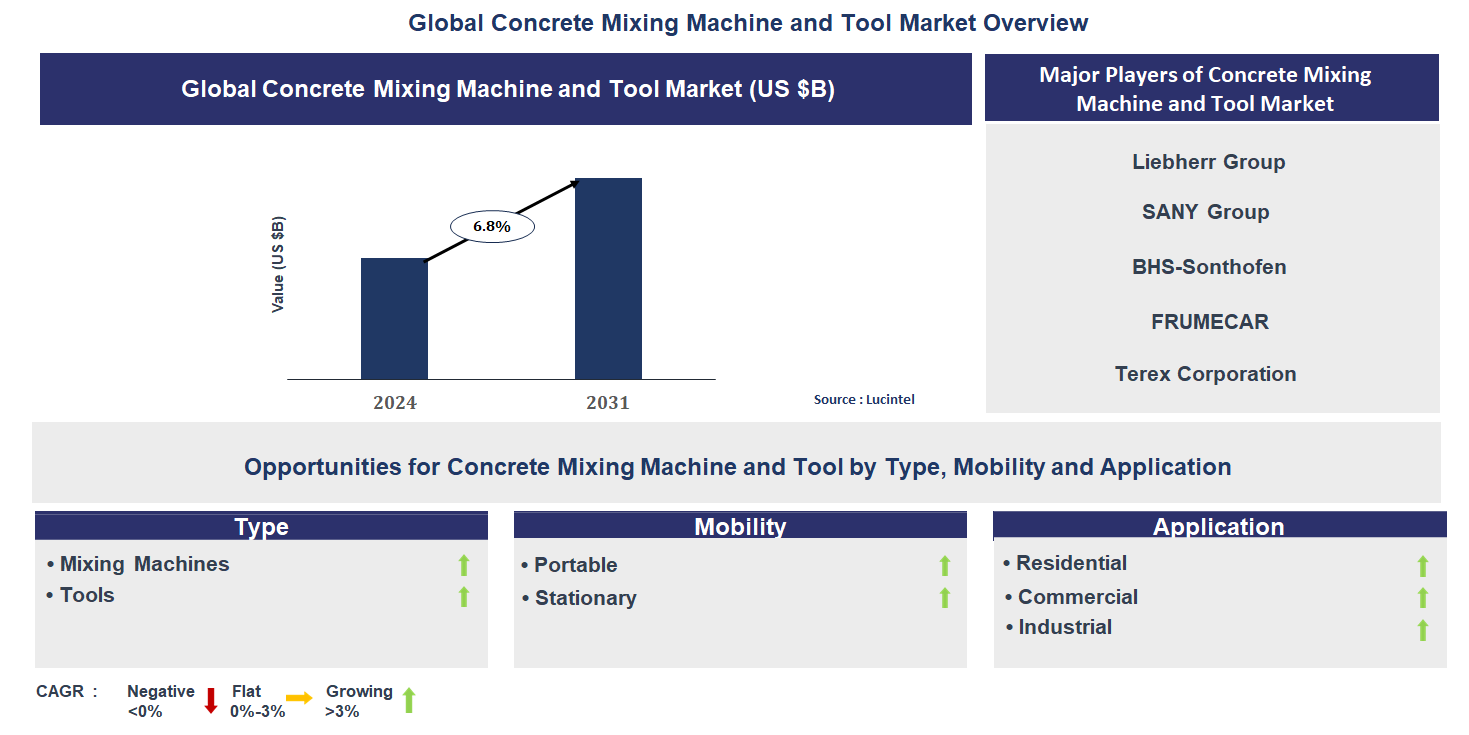
Concrete Mixing Machine and Tool Market Trends and Forecast

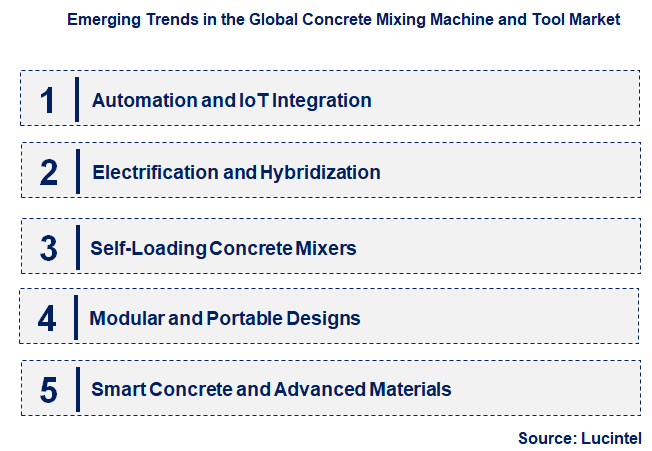
Emerging Trends in the Concrete Mixing Machine and Tool Market

The market for concrete mixing machine and tool is going through a dramatic shift, with major trends being spurred by pressure for increased efficiency, sustainability, and technological integration. These changes are essentially redesigning the way concrete is made and transported on a worldwide level. The industry is abandoning conventional, labor-based approaches in favor of intelligent, automated, and sustainable solutions. This revolution is not only redesigning equipment but also business models and operating practices, calling for new technical know-how and strategic vision from industry players.
• Automation and IoT Integration: Automation and IoT are leading the way in this market’s development. Advanced new concrete mixers feature automated batching and mixing controls to guarantee the right ingredient ratios for uniform, high-quality concrete and reduce human error. With IoT integration, machine performance, location, fuel usage, and maintenance requirements can be tracked in real time. This data-centric method improves operational effectiveness, facilitates predictive maintenance, and streamlines logistics through real-time tracking of delivery routes.
• Electrification and Hybridization: The shift to electric and hybrid concrete mixers is a dominant trend fueled by tighter emissions controls and a worldwide sustainability mandate. These machines have zero tailpipe emissions and much less noise pollution, making them well-suited for urban and residential job sites. Although they cost more upfront, the payoff in the long run is less fuel usage and less maintenance. This is a significant component of the overall push to decarbonize construction, which appeals to environmental companies and governments alike.
• Self-Loading Concrete Mixers: Self-loading concrete mixers are gaining popularity, especially for small-and-medium-scale applications and far-away construction sites. They are lightweight, mobile, and self-contained machines that have the ability to load aggregates, cement, and water by themselves, mix the concrete, and unload, with one operator. By doing so, they save the industry from the necessity of additional loading gear and batching plant, thus saving labor and transportation expenses considerably.
• Modular and Portable Designs: The need for portable and transportable equipment has created a move towards portable and modular designs. These batching plants and mixers are easily assembled, dismantled, and relocated from site to site. Portability is particularly useful for short-duration projects or areas where construction sites are temporary. The modularity also enables companies to scale their operations when required, minimizing capital outlay and offering more flexibility in an industry based on projects.
• Smart Concrete and Advanced Materials: The industry is experiencing increasing orders for mixing machinery that can process high-tech materials and create intelligent concrete. This involves concrete with features such as self-healing capacity, greater durability, and greater thermal performance. Such special concretes demand highly controlled mixing and handling, consequently requiring advancing mixing machines with more advanced control systems. This trend points towards a departure from primary mixing into the creation of high-performance, special building materials.
These trends are combined to reshape the market, making efficiency, sustainability, and technological integration the top priorities. The transition to automated and intelligent equipment is making the industry more data-oriented and accurate, while the emphasis on electrification and high-performance materials is driving the market towards a greener, more advanced future. The priority on mobility and autonomy is opening up contemporary concrete production to be more accessible and flexible to a variety of construction applications.
Emerging Trends in the Concrete Mixing Machine and Tool Market

Recent Development in the Concrete Mixing Machine and Tool Market

The concrete mixing machine and tool industry is witnessing major developments, driven by the world’s drive towards greater efficiency, sustainability, and mechanization of the construction sector. These developments are directly in response to increased labor costs, more stringent environmental regulations, and the requirement for high-quality, consistent concrete production. The sector is evolving from mere mechanical blending to incorporate advanced technology to enhance each phase of concrete manufacturing, from material handling to real-time monitoring of performance.
• Use of Telematics and IoT for Real-Time Monitoring: One of the prominent developments is the extensive adoption of telematics and the Internet of Things (IoT) in concrete mixers. This technology enables project managers and operators to track vital information in real-time, such as mixing conditions, truck position, fuel usage, and maintenance timelines. This has a significant impact, allowing companies to streamline logistics, minimize operational expenses, and conduct predictive maintenance to prevent unforeseen downtimes.
• Scaling of Self-Loading Mixer Technology: The market has witnessed an accelerated growth in the use and sophistication of self-loading concrete mixers. The machines are being used not only for small-sized jobs but also medium-sized projects, especially in developing areas and countryside. The growth has an important influence on efficiency as it integrates the tasks of a loader, a mixer, and a transporter in one machine. It minimizes labor needs, decreases on-site congestion, and offers an extremely mobile and versatile solution for numerous construction conditions.
• Emphasis on Eco-Friendly and Hybrid Models: There is an emerging trend of the creation and application of hybrid and green concrete mixers. Companies are launching battery-electric and hybrid-electric mixer trucks to lower carbon footprints and noise levels. This innovation is significant to address strict environmental laws in cities and to corporate sustainability strategies. The influence has a reduced environmental impact, lower operational expenses with less fuel usage, and enhanced public perception for construction firms focused on green technology.
• Designing Improved Batching Plant Control Systems: Among recent improvements is the development of more sophisticated, computerized concrete batching plant control systems. They utilize advanced software to accurately measure and mix material, producing high-strength, uniform concrete. The effect of this improvement is significantly better concrete quality and less material wastage. Automated controls result in increased production rates and reliability, as they reduce the possibility of human error and can be combined with project-specific mix designs.
• Smart and Specialized Concrete Mixing Tools Emergence: Aside from massive machinery, the tool industry is also transforming with the onset of intelligent and specialized tools. These range from tools with built-in sensors to measure the consistency of concrete, variable frequency vibrators, and finishing tools for specialized high-performance concretes. The tools ensure the final concrete product is exactly as it should be. This innovation allows contractors to produce higher-quality finishes and higher structural integrity, allowing construction to produce modern, complex structures.
These advancements are revolutionizing the concrete mixing industry by transforming the emphasis from basic mechanical operations to end-to-end, data-enabled, and eco-friendly solutions. The intersection of technology and machinery is driving efficiency, quality, and environmental performance improvements, making the industry more sophisticated and responsive to the needs of contemporary construction.

Strategic Growth Opportunities in the Concrete Mixing Machine and Tool Market

The concrete mixing machine and tool market presents significant strategic growth opportunities, driven by urbanization, infrastructure development, and a push for technological integration across key applications. The industry is moving towards more specialized and efficient solutions that can cater to diverse project needs, from high-rise buildings to road construction and residential development.
• Road Building and Infrastructure Development: The worldwide emphasis on updating and increasing infrastructure, such as roads, bridges, and tunnels, presents an excellent opportunity for growth. This application calls for high-volume, dependable delivery of concrete. Strategic expansion here is the creation and sale of specialty high-capacity transit mixers, concrete pumps, and mobile batching plants that can service large-scale, frequently isolated, building construction sites. The effect is a faster and more efficient completion of large public works undertakings, necessitating equipment to provide a consistent and uninterrupted supply of concrete, hence cutting down on project duration and expense.
• High-Rise and Urban Construction: As the pace of urbanization picks up, the building of skyscrapers and complex urban buildings demands equipment that can place concrete to high levels and within narrow spaces. This offers the possibility for companies to concentrate on high-pressure, cutting-edge concrete pumps and small-footprint specialized concrete mixing machines. The benefit of this emphasis is the capability to service projects in high-density areas where space is at a premium, allowing effective construction of contemporary urban centers and addressing the unique logistical demands of vertical construction.
• Precast and Prefabricated Concrete: The increasing trend of employing precast and prefabricated concrete elements within construction provides a special chance for market expansion. This project demands very accurate, uniform concrete mixes manufactured in a controlled factory setting. Strategic development is in the provision of advanced, mechanized batching plants and fixed mixers with the capability to produce huge quantities of uniform-quality concrete.
• Residential and Small-Scale Projects: The growing residential market, especially in developing economies, makes for a high demand for compact, mobile, and affordable mixing solutions. The opportunity here is to target this segment with portable, drum mixers, and self-loading mixers. These products are best suited for home developers and small construction companies that require flexibility and low capital costs. The effect is wider market penetration through offering affordable and effective tools to numerous smaller-scale undertakings, encouraging expansion in a previously neglected niche.
• Sustainable and Green Building: Growing importance for sustainable construction and green building codes presents a strategic chance to create and sell environmentally friendly concrete mixing machinery. These include more energy-efficient machines, water-conserving machines, and compatibility with new green concrete mixes that use recycled products. The effect is the convergence of business strategies with worldwide environmental objectives, gaining an increasing number of clients who value sustainability.
These strategic growth prospects are transforming the industry by promoting specialization and innovation. By concentrating on the distinct requirements of every application, ranging from massive infrastructure to green building, businesses can achieve new sources of income and position themselves as industry leaders in a fast-changing and more diversified market.

Concrete Mixing Machine and Tool Market Driver and Challenges

The market for concrete mixing machine and tool is influenced by a complex interplay of powerful drivers and key challenges, which involve a range of technological, economic, and regulatory factors. The market is driven by a worldwide growth in construction and an ongoing pressure for technological advancement while, at the same time, suffering from obstacles concerning capital investment, environmental policies, and a lack of skilled workers. Managing these forces is important for industry players to have a competitive advantage and achieve long-term growth.
The factors responsible for driving the concrete mixing machine and tool market include:
1. Increase in Urbanization and Infrastructure Development: One key driver is the increasing rate of urbanization, especially in the Asia-Pacific and other emerging economies. This is generating widespread construction of residential and commercial buildings, together with the construction of key infrastructure such as roads, bridges, and airports. The scope of such projects generates huge and long-term demand for high-capacity, efficient concrete mixers and equipment to satisfy bold project timelines and quality requirements.
2. Automation Technology Advancements: Integration of automation, IoT, and telematics is a key driver. They enhance efficiency in operations, accuracy, and safety. Computer-controlled automated batching plants provide uniform quality of concrete, and IoT-based mixers supply real-time information for logistics and maintenance improvement. The capacity to deliver a better quality product with greater reliability at less human effort is an impressive reason for construction firms to make an investment in advanced machinery.
3. Increasing Demand for Ready-Mix Concrete: Growing use of ready-mix concrete (RMC) as opposed to conventional on-site mixing is fueling the demand for transit mixers and stationary batching plants. RMC provides better quality control and saves labor and materials at the site. This switch in preference, particularly among large and medium-sized projects, is energizing the market for specialized RMC-related equipment.
4. Public Works Investments by Governments: Governments across the globe are undertaking massive investments in public works projects to spur economic activity and enhance country-level connectivity. These projects, ranging from road construction to city revitalization, generate a steady and volume-based demand for concrete mixing machinery. Such stable demand prevents the market from experiencing fluctuations and persuades manufacturers to invest in producing high-performance equipment.
5. Focus on Energy Efficiency and Sustainability: The increasing international emphasis on environmental conservation is a key driver. This is compelling producers to create cleaner and more energy-efficient machinery, including electric and hybrid mixers. The demand for equipment that is carbon-emission-reducing and noise-pollution-reducing is increasing, led by regulatory forces and customer pressure for greener building practices. This is remaking product development and marketing approaches.
Challenges in the concrete mixing machine and tool market are:
1. High Initial Capital Investment: The expense of the new, automated, and specialized concrete mixers is a major deterrent. The high up-front capital requirement can be too costly for smaller builders and building companies, particularly in poorer nations with few opportunities for financing. The up-front financial investment in a new fleet of equipment can act as a braking factor, hindering the introduction of newer machines and keeping the market dispersed with older, lower-efficiency equipment.
2. Tough Environmental Regulations: Though a spur to innovation, tough environmental regulations on emissions, noise, and dust can also prove challenging. Adherence to such rules necessarily involves huge investment in new technology that can raise the cost of production and the end product price of the equipment. In addition, applying for the requisite permits and clearances to operate the plant can prove to be time-consuming and complicated.
3. Lack of Skilled Labor: Advanced, technologically advanced concrete mixing equipment demands highly skilled personnel for operation and maintenance. There is a chronic lack of trained technicians and operators, and this represents a significant challenge. Such a manpower shortage may result in inefficiency in operation, higher maintenance expenses due to misuse, and also retard the adoption rate of new technologies because firms might not have enough manpower to take maximum advantage of the equipment’s capabilities.
The net effect of these drivers and challenges is a dynamic market. While technology innovation and robust demand from infrastructure demand are driving growth, the sector must also overcome issues of capital expense, regulatory barriers, and shortages of labor. Success will be achieved through firms capable of innovating to satisfy both economic and environmental imperatives, delivering solutions that are not only technologically advanced but also economically viable and simple to use.

List of Concrete Mixing Machine and Tool Companies

Companies in the market compete on the basis of product quality offered. Major players in this market focus on expanding their manufacturing facilities, R&D investments, infrastructural development, and leverage integration opportunities across the value chain. With these strategies concrete mixing machine and tool companies cater increasing demand, ensure competitive effectiveness, develop innovative products & technologies, reduce production costs, and expand their customer base. Some of the concrete mixing machine and tool companies profiled in this report include-
• Liebherr Group
• SANY Group 
• BHS-Sonthofen
• FRUMECAR
• Terex Corporation 
• SCHWING-Stetter 
• Shantui Construction Machinery
• CIFA
• KYC Machine Industry
• Meka Group 

Concrete Mixing Machine and Tool Market by Segment

The study includes a forecast for the global concrete mixing machine and tool market by type, mobility, application, and region.

Concrete Mixing Machine and Tool Market by Type [Value from 2019 to 2031]:


• Mixing Machines
• Tools

Concrete Mixing Machine and Tool Market by Mobility [Value from 2019 to 2031]:


• Portable
• Stationary

Concrete Mixing Machine and Tool Market by Application [Value from 2019 to 2031]:


• Residential
• Commercial
• Industrial

Concrete Mixing Machine and Tool Market by Region [Value from 2019 to 2031]:


• North America
• Europe
• Asia Pacific
• The Rest of the World

Country Wise Outlook for the Concrete Mixing Machine and Tool Market

The world market for concrete mixing machine and tool is undergoing a whirlwind of change due to a combination of factors such as technological breakthroughs, concern for the environment, and changes in regional construction patterns. Nations are embracing new technologies to make processes more efficient, save on labor, and increase the quality of concrete. This vibrant market is a global move towards greener, automated, and specialized construction methods. As urbanization and infrastructure development intensify, especially in emerging economies, the need for innovative, high-performance concrete equipment is transforming the sector.
• United States: The United States market is experiencing a significant increase in self-loading concrete mixers, appreciated for their double role of mixing and hauling concrete, proving them suitable for small to medium-sized projects, particularly in rural settings. The pressure is high to automate and integrate technology with a high rate of introduction of smart mixers and the use of digital dashboards for real-time monitoring and control. This is fueled by a need to enhance efficiency and precision, lower labor costs, and fulfill demand for cutting-edge, environmentally friendly building techniques.
• China: The Chinese market is defined by enormous scale and intricate blend of domestic and foreign rivalry. Although it has recently experienced a slowdown in domestic demand as a result of a slowdown in real estate, the market is expected to expand, driven by the 14th Five-Year Plan and major government spending on infrastructure. There’s a definite trend towards electrification and green technology, with Chinese makers such as XCMG introducing massive-tonnage LNG excavators, a sign of national determination towards carbon reduction.
• Germany: The market of Germany is a leader in high-technology sophistication and sustainability. Although there has been a recent weakening in construction activity, the market is still healthy with a significant order backlog and continued emphasis on high-technology, efficient equipment. German builders, for instance, Liebherr, are leaders in creating state-of-the-art truck mixers and batching plants that ensure ecologically friendly production and resource-conserving operation.
• India: India’s economy is witnessing strong growth fueled by high urbanization and large-scale infrastructure development initiatives. The use of mechanized and automated concrete mixing plant is taking the place of conventional manual means to ensure efficiency, quality, and speed. The demand for mobile batching plants and transit mixers is greatly increased to supply the remote and inaccessible areas with inadequate road conditions. The market is also seeing the trend towards ready-mix concrete (RMC) because of its quality control advantage, and this is driving the demand for advanced mixing and transportation equipment.
• Japan: The Japanese market is characterized by consistent demand for high-quality, niche equipment. Although the overall concrete mixer market has seen a minor decline, it is likely to grow modestly, fueled by a desire to refurbish old infrastructure and cater to events such as the Expo 2025 coming up. The market is embracing cutting-edge technologies, such as automated batch systems and IoT connectivity, to enhance operational efficiency.

Lucintel Analytics Dashboard

Features of the Global Concrete Mixing Machine and Tool Market

Market Size Estimates: Concrete mixing machine and tool market size estimation in terms of value ($B).
Trend and Forecast Analysis: Market trends (2019 to 2024) and forecast (2025 to 2031) by various segments and regions.
Segmentation Analysis: Concrete mixing machine and tool market size by type, mobility, application, and region in terms of value ($B).
Regional Analysis: Concrete mixing machine and tool market breakdown by North America, Europe, Asia Pacific, and Rest of the World.
Growth Opportunities: Analysis of growth opportunities in different types, mobility, applications, and regions for the concrete mixing machine and tool market.
Strategic Analysis: This includes M&A, new product development, and competitive landscape of the concrete mixing machine and tool market.
Analysis of competitive intensity of the industry based on Porter’s Five Forces model.

Lucintel Consulting Services

FAQ

Q1. What is the growth forecast for concrete mixing machine and tool market?
Answer: The global concrete mixing machine and tool market is expected to grow with a CAGR of 6.8% from 2025 to 2031.
Q2. What are the major drivers influencing the growth of the concrete mixing machine and tool market?
Answer: The major drivers for this market are the increasing demand for efficient mixing equipment, the rising adoption of automated construction tools, and the growing focus on time-saving construction solutions.
Q3. What are the major segments for concrete mixing machine and tool market?
Answer: The future of the concrete mixing machine and tool market looks promising with opportunities in the residential, commercial, and industrial markets.
Q4. Who are the key concrete mixing machine and tool market companies?
Answer: Some of the key concrete mixing machine and tool companies are as follows:
• Liebherr Group
• SANY Group 
• BHS-Sonthofen
• FRUMECAR
• Terex Corporation 
• SCHWING-Stetter 
• Shantui Construction Machinery
• CIFA
• KYC Machine Industry
• Meka Group 
Q5. Which concrete mixing machine and tool market segment will be the largest in future?
Answer: Lucintel forecasts that, within the type category, mixing machine is expected to witness higher growth over the forecast period.
Q6. In concrete mixing machine and tool market, which region is expected to be the largest in next 5 years?
Answer: In terms of region, APAC is expected to witness the highest growth over the forecast period.
Q7. Do we receive customization in this report?
Answer: Yes, Lucintel provides 10% customization without any additional cost.

This report answers following 11 key questions:

Q.1. What are some of the most promising, high-growth opportunities for the concrete mixing machine and tool market by type (mixing machines and tools), mobility (portable and stationary), application (residential, commercial, and industrial), and region (North America, Europe, Asia Pacific, and the Rest of the World)?
Q.2. Which segments will grow at a faster pace and why?
Q.3. Which region will grow at a faster pace and why?
Q.4. What are the key factors affecting market dynamics? What are the key challenges and business risks in this market?
Q.5. What are the business risks and competitive threats in this market?
Q.6. What are the emerging trends in this market and the reasons behind them?
Q.7. What are some of the changing demands of customers in the market?
Q.8. What are the new developments in the market? Which companies are leading these developments?
Q.9. Who are the major players in this market? What strategic initiatives are key players pursuing for business growth?
Q.10. What are some of the competing products in this market and how big of a threat do they pose for loss of market share by material or product substitution?
Q.11. What M&A activity has occurred in the last 5 years and what has its impact been on the industry?

For any questions related to Concrete Mixing Machine and Tool Market, Concrete Mixing Machine and Tool Market Size, Concrete Mixing Machine and Tool Market Growth, Concrete Mixing Machine and Tool Market Analysis, Concrete Mixing Machine and Tool Market Report, Concrete Mixing Machine and Tool Market Share, Concrete Mixing Machine and Tool Market Trends, Concrete Mixing Machine and Tool Market Forecast, Concrete Mixing Machine and Tool Companies, write Lucintel analyst at email: helpdesk@lucintel.com. We will be glad to get back to you soon.
                                           Table of Contents

            1. Executive Summary

            2. Market Overview

                        2.1 Background and Classifications
                        2.2 Supply Chain

            3. Market Trends & Forecast Analysis

                        3.1 Macroeconomic Trends and Forecasts
                        3.2 Industry Drivers and Challenges
                        3.3 PESTLE Analysis
                        3.4 Patent Analysis
                        3.5 Regulatory Environment
                        3.6 Global Concrete Mixing Machine and Tool Market Trends and Forecast

            4. Global Concrete Mixing Machine and Tool Market by Type

                        4.1 Overview
                        4.2 Attractiveness Analysis by Type
                        4.3 Mixing Machines : Trends and Forecast 2025 to 2031
                        4.4 Tools : Trends and Forecast 2025 to 2031

            5. Global Concrete Mixing Machine and Tool Market by Mobility

                        5.1 Overview
                        5.2 Attractiveness Analysis by Mobility
                        5.3 Portable : Trends and Forecast 2025 to 2031
                        5.4 Stationary : Trends and Forecast 2025 to 2031

            6. Global Concrete Mixing Machine and Tool Market by Application

                        6.1 Overview
                        6.2 Attractiveness Analysis by Application
                        6.3 Residential : Trends and Forecast 2025 to 2031
                        6.4 Commercial : Trends and Forecast 2025 to 2031
                        6.5 Industrial : Trends and Forecast 2025 to 2031

            7. Regional Analysis

                        7.1 Overview
                        7.2 Global Concrete Mixing Machine and Tool Market by Region

            8. North American Concrete Mixing Machine and Tool Market

                        8.1 Overview
                        8.2 North American Concrete Mixing Machine and Tool Market by Type
                        8.3 North American Concrete Mixing Machine and Tool Market by Application
                        8.4 The United States Concrete Mixing Machine and Tool Market
                        8.5 Canadian Concrete Mixing Machine and Tool Market
                        8.6 Mexican Concrete Mixing Machine and Tool Market

            9. European Concrete Mixing Machine and Tool Market

                        9.1 Overview
                        9.2 European Concrete Mixing Machine and Tool Market by Type
                        9.3 European Concrete Mixing Machine and Tool Market by Application
                        9.4 German Concrete Mixing Machine and Tool Market
                        9.5 French Concrete Mixing Machine and Tool Market
                        9.6 Italian Concrete Mixing Machine and Tool Market
                        9.7 Spanish Concrete Mixing Machine and Tool Market
                        9.8 The United Kingdom Concrete Mixing Machine and Tool Market

            10. APAC Concrete Mixing Machine and Tool Market

                        10.1 Overview
                        10.2 APAC Concrete Mixing Machine and Tool Market by Type
                        10.3 APAC Concrete Mixing Machine and Tool Market by Application
                        10.4 Chinese Concrete Mixing Machine and Tool Market
                        10.5 Indian Concrete Mixing Machine and Tool Market
                        10.6 Japanese Concrete Mixing Machine and Tool Market
                        10.7 South Korean Concrete Mixing Machine and Tool Market
                        10.8 Indonesian Concrete Mixing Machine and Tool Market

            11. ROW Concrete Mixing Machine and Tool Market

                        11.1 Overview
                        11.2 ROW Concrete Mixing Machine and Tool Market by Type
                        11.3 ROW Concrete Mixing Machine and Tool Market by Application
                        11.4 Middle Eastern Concrete Mixing Machine and Tool Market
                        11.5 South American Concrete Mixing Machine and Tool Market
                        11.6 African Concrete Mixing Machine and Tool Market

            12. Competitor Analysis

                        12.1 Product Portfolio Analysis
                        12.2 Operational Integration
                        12.3 Porter’s Five Forces Analysis
                                    • Competitive Rivalry
                                    • Bargaining Power of Buyers
                                    • Bargaining Power of Suppliers
                                    • Threat of Substitutes
                                    • Threat of New Entrants
                        12.4 Market Share Analysis

            13. Opportunities & Strategic Analysis

                        13.1 Value Chain Analysis
                        13.2 Growth Opportunity Analysis
                                    13.2.1 Growth Opportunity by Type
                                    13.2.2 Growth Opportunity by Mobility
                                    13.2.3 Growth Opportunity by Application
                        13.3 Emerging Trends in the Global Concrete Mixing Machine and Tool Market
                        13.4 Strategic Analysis
                                    13.4.1 New Product Development
                                    13.4.2 Certification and Licensing
                                    13.4.3 Mergers, Acquisitions, Agreements, Collaborations, and Joint Ventures

            14. Company Profiles of the Leading Players Across the Value Chain

                        14.1 Competitive Analysis
                        14.2 Liebherr Group
                                    • Company Overview
                                    • Concrete Mixing Machine and Tool Market Business Overview
                                    • New Product Development
                                    • Merger, Acquisition, and Collaboration
                                    • Certification and Licensing
                        14.3 SANY Group Overview
                                    • Company Overview
                                    • Concrete Mixing Machine and Tool Market Business Overview
                                    • New Product Development
                                    • Merger, Acquisition, and Collaboration
                                    • Certification and Licensing
                        14.4 BHS-Sonthofen
                                    • Company Overview
                                    • Concrete Mixing Machine and Tool Market Business Overview
                                    • New Product Development
                                    • Merger, Acquisition, and Collaboration
                                    • Certification and Licensing
                        14.5 FRUMECAR
                                    • Company Overview
                                    • Concrete Mixing Machine and Tool Market Business Overview
                                    • New Product Development
                                    • Merger, Acquisition, and Collaboration
                                    • Certification and Licensing
                        14.6 Terex Corporation Overview
                                    • Company Overview
                                    • Concrete Mixing Machine and Tool Market Business Overview
                                    • New Product Development
                                    • Merger, Acquisition, and Collaboration
                                    • Certification and Licensing
                        14.7 SCHWING-Stetter Overview
                                    • Company Overview
                                    • Concrete Mixing Machine and Tool Market Business Overview
                                    • New Product Development
                                    • Merger, Acquisition, and Collaboration
                                    • Certification and Licensing
                        14.8 Shantui Construction Machinery
                                    • Company Overview
                                    • Concrete Mixing Machine and Tool Market Business Overview
                                    • New Product Development
                                    • Merger, Acquisition, and Collaboration
                                    • Certification and Licensing
                        14.9 CIFA
                                    • Company Overview
                                    • Concrete Mixing Machine and Tool Market Business Overview
                                    • New Product Development
                                    • Merger, Acquisition, and Collaboration
                                    • Certification and Licensing
                        14.10 KYC Machine Industry
                                    • Company Overview
                                    • Concrete Mixing Machine and Tool Market Business Overview
                                    • New Product Development
                                    • Merger, Acquisition, and Collaboration
                                    • Certification and Licensing
                        14.11 Meka Group Overview
                                    • Company Overview
                                    • Concrete Mixing Machine and Tool Market Business Overview
                                    • New Product Development
                                    • Merger, Acquisition, and Collaboration
                                    • Certification and Licensing

            15. Appendix

                        15.1 List of Figures
                        15.2 List of Tables
                        15.3 Research Methodology
                        15.4 Disclaimer
                        15.5 Copyright
                        15.6 Abbreviations and Technical Units
                        15.7 About Us
                        15.8 Contact Us

                                               List of Figures


            Chapter 1

                        Figure 1.1: Trends and Forecast for the Global Concrete Mixing Machine and Tool Market

            Chapter 2

                        Figure 2.1: Usage of Concrete Mixing Machine and Tool Market
                        Figure 2.2: Classification of the Global Concrete Mixing Machine and Tool Market
                        Figure 2.3: Supply Chain of the Global Concrete Mixing Machine and Tool Market

            Chapter 3

                        Figure 3.1: Trends of the Global GDP Growth Rate
                        Figure 3.2: Trends of the Global Population Growth Rate
                        Figure 3.3: Trends of the Global Inflation Rate
                        Figure 3.4: Trends of the Global Unemployment Rate
                        Figure 3.5: Trends of the Regional GDP Growth Rate
                        Figure 3.6: Trends of the Regional Population Growth Rate
                        Figure 3.7: Trends of the Regional Inflation Rate
                        Figure 3.8: Trends of the Regional Unemployment Rate
                        Figure 3.9: Trends of Regional Per Capita Income
                        Figure 3.10: Forecast for the Global GDP Growth Rate
                        Figure 3.11: Forecast for the Global Population Growth Rate
                        Figure 3.12: Forecast for the Global Inflation Rate
                        Figure 3.13: Forecast for the Global Unemployment Rate
                        Figure 3.14: Forecast for the Regional GDP Growth Rate
                        Figure 3.15: Forecast for the Regional Population Growth Rate
                        Figure 3.16: Forecast for the Regional Inflation Rate
                        Figure 3.17: Forecast for the Regional Unemployment Rate
                        Figure 3.18: Forecast for Regional Per Capita Income
                        Figure 3.19: Driver and Challenges of the Concrete Mixing Machine and Tool Market

            Chapter 4

                        Figure 4.1: Global Concrete Mixing Machine and Tool Market by Type in 2019, 2024, and 2031
                        Figure 4.2: Trends of the Global Concrete Mixing Machine and Tool Market ($B) by Type
                        Figure 4.3: Forecast for the Global Concrete Mixing Machine and Tool Market ($B) by Type
                        Figure 4.4: Trends and Forecast for Mixing Machines in the Global Concrete Mixing Machine and Tool Market (2019-2031)
                        Figure 4.5: Trends and Forecast for Tools in the Global Concrete Mixing Machine and Tool Market (2019-2031)

            Chapter 5

                        Figure 5.1: Global Concrete Mixing Machine and Tool Market by Mobility in 2019, 2024, and 2031
                        Figure 5.2: Trends of the Global Concrete Mixing Machine and Tool Market ($B) by Mobility
                        Figure 5.3: Forecast for the Global Concrete Mixing Machine and Tool Market ($B) by Mobility
                        Figure 5.4: Trends and Forecast for Portable in the Global Concrete Mixing Machine and Tool Market (2019-2031)
                        Figure 5.5: Trends and Forecast for Stationary in the Global Concrete Mixing Machine and Tool Market (2019-2031)

            Chapter 6

                        Figure 6.1: Global Concrete Mixing Machine and Tool Market by Application in 2019, 2024, and 2031
                        Figure 6.2: Trends of the Global Concrete Mixing Machine and Tool Market ($B) by Application
                        Figure 6.3: Forecast for the Global Concrete Mixing Machine and Tool Market ($B) by Application
                        Figure 6.4: Trends and Forecast for Residential in the Global Concrete Mixing Machine and Tool Market (2019-2031)
                        Figure 6.5: Trends and Forecast for Commercial in the Global Concrete Mixing Machine and Tool Market (2019-2031)
                        Figure 6.6: Trends and Forecast for Industrial in the Global Concrete Mixing Machine and Tool Market (2019-2031)

            Chapter 7

                        Figure 7.1: Trends of the Global Concrete Mixing Machine and Tool Market ($B) by Region (2019-2024)
                        Figure 7.2: Forecast for the Global Concrete Mixing Machine and Tool Market ($B) by Region (2025-2031)

            Chapter 8

                        Figure 8.1: Trends and Forecast for the North American Concrete Mixing Machine and Tool Market (2019-2031)
                        Figure 8.2: North American Concrete Mixing Machine and Tool Market by Type in 2019, 2024, and 2031
                        Figure 8.3: Trends of the North American Concrete Mixing Machine and Tool Market ($B) by Type (2019-2024)
                        Figure 8.4: Forecast for the North American Concrete Mixing Machine and Tool Market ($B) by Type (2025-2031)
                        Figure 8.5: North American Concrete Mixing Machine and Tool Market by Mobility in 2019, 2024, and 2031
                        Figure 8.6: Trends of the North American Concrete Mixing Machine and Tool Market ($B) by Mobility (2019-2024)
                        Figure 8.7: Forecast for the North American Concrete Mixing Machine and Tool Market ($B) by Mobility (2025-2031)
                        Figure 8.8: North American Concrete Mixing Machine and Tool Market by Application in 2019, 2024, and 2031
                        Figure 8.9: Trends of the North American Concrete Mixing Machine and Tool Market ($B) by Application (2019-2024)
                        Figure 8.10: Forecast for the North American Concrete Mixing Machine and Tool Market ($B) by Application (2025-2031)
                        Figure 8.11: Trends and Forecast for the United States Concrete Mixing Machine and Tool Market ($B) (2019-2031)
                        Figure 8.12: Trends and Forecast for the Mexican Concrete Mixing Machine and Tool Market ($B) (2019-2031)
                        Figure 8.13: Trends and Forecast for the Canadian Concrete Mixing Machine and Tool Market ($B) (2019-2031)

            Chapter 9

                        Figure 9.1: Trends and Forecast for the European Concrete Mixing Machine and Tool Market (2019-2031)
                        Figure 9.2: European Concrete Mixing Machine and Tool Market by Type in 2019, 2024, and 2031
                        Figure 9.3: Trends of the European Concrete Mixing Machine and Tool Market ($B) by Type (2019-2024)
                        Figure 9.4: Forecast for the European Concrete Mixing Machine and Tool Market ($B) by Type (2025-2031)
                        Figure 9.5: European Concrete Mixing Machine and Tool Market by Mobility in 2019, 2024, and 2031
                        Figure 9.6: Trends of the European Concrete Mixing Machine and Tool Market ($B) by Mobility (2019-2024)
                        Figure 9.7: Forecast for the European Concrete Mixing Machine and Tool Market ($B) by Mobility (2025-2031)
                        Figure 9.8: European Concrete Mixing Machine and Tool Market by Application in 2019, 2024, and 2031
                        Figure 9.9: Trends of the European Concrete Mixing Machine and Tool Market ($B) by Application (2019-2024)
                        Figure 9.10: Forecast for the European Concrete Mixing Machine and Tool Market ($B) by Application (2025-2031)
                        Figure 9.11: Trends and Forecast for the German Concrete Mixing Machine and Tool Market ($B) (2019-2031)
                        Figure 9.12: Trends and Forecast for the French Concrete Mixing Machine and Tool Market ($B) (2019-2031)
                        Figure 9.13: Trends and Forecast for the Spanish Concrete Mixing Machine and Tool Market ($B) (2019-2031)
                        Figure 9.14: Trends and Forecast for the Italian Concrete Mixing Machine and Tool Market ($B) (2019-2031)
                        Figure 9.15: Trends and Forecast for the United Kingdom Concrete Mixing Machine and Tool Market ($B) (2019-2031)

            Chapter 10

                        Figure 10.1: Trends and Forecast for the APAC Concrete Mixing Machine and Tool Market (2019-2031)
                        Figure 10.2: APAC Concrete Mixing Machine and Tool Market by Type in 2019, 2024, and 2031
                        Figure 10.3: Trends of the APAC Concrete Mixing Machine and Tool Market ($B) by Type (2019-2024)
                        Figure 10.4: Forecast for the APAC Concrete Mixing Machine and Tool Market ($B) by Type (2025-2031)
                        Figure 10.5: APAC Concrete Mixing Machine and Tool Market by Mobility in 2019, 2024, and 2031
                        Figure 10.6: Trends of the APAC Concrete Mixing Machine and Tool Market ($B) by Mobility (2019-2024)
                        Figure 10.7: Forecast for the APAC Concrete Mixing Machine and Tool Market ($B) by Mobility (2025-2031)
                        Figure 10.8: APAC Concrete Mixing Machine and Tool Market by Application in 2019, 2024, and 2031
                        Figure 10.9: Trends of the APAC Concrete Mixing Machine and Tool Market ($B) by Application (2019-2024)
                        Figure 10.10: Forecast for the APAC Concrete Mixing Machine and Tool Market ($B) by Application (2025-2031)
                        Figure 10.11: Trends and Forecast for the Japanese Concrete Mixing Machine and Tool Market ($B) (2019-2031)
                        Figure 10.12: Trends and Forecast for the Indian Concrete Mixing Machine and Tool Market ($B) (2019-2031)
                        Figure 10.13: Trends and Forecast for the Chinese Concrete Mixing Machine and Tool Market ($B) (2019-2031)
                        Figure 10.14: Trends and Forecast for the South Korean Concrete Mixing Machine and Tool Market ($B) (2019-2031)
                        Figure 10.15: Trends and Forecast for the Indonesian Concrete Mixing Machine and Tool Market ($B) (2019-2031)

            Chapter 11

                        Figure 11.1: Trends and Forecast for the ROW Concrete Mixing Machine and Tool Market (2019-2031)
                        Figure 11.2: ROW Concrete Mixing Machine and Tool Market by Type in 2019, 2024, and 2031
                        Figure 11.3: Trends of the ROW Concrete Mixing Machine and Tool Market ($B) by Type (2019-2024)
                        Figure 11.4: Forecast for the ROW Concrete Mixing Machine and Tool Market ($B) by Type (2025-2031)
                        Figure 11.5: ROW Concrete Mixing Machine and Tool Market by Mobility in 2019, 2024, and 2031
                        Figure 11.6: Trends of the ROW Concrete Mixing Machine and Tool Market ($B) by Mobility (2019-2024)
                        Figure 11.7: Forecast for the ROW Concrete Mixing Machine and Tool Market ($B) by Mobility (2025-2031)
                        Figure 11.8: ROW Concrete Mixing Machine and Tool Market by Application in 2019, 2024, and 2031
                        Figure 11.9: Trends of the ROW Concrete Mixing Machine and Tool Market ($B) by Application (2019-2024)
                        Figure 11.10: Forecast for the ROW Concrete Mixing Machine and Tool Market ($B) by Application (2025-2031)
                        Figure 11.11: Trends and Forecast for the Middle Eastern Concrete Mixing Machine and Tool Market ($B) (2019-2031)
                        Figure 11.12: Trends and Forecast for the South American Concrete Mixing Machine and Tool Market ($B) (2019-2031)
                        Figure 11.13: Trends and Forecast for the African Concrete Mixing Machine and Tool Market ($B) (2019-2031)

            Chapter 12

                        Figure 12.1: Porter’s Five Forces Analysis of the Global Concrete Mixing Machine and Tool Market
                        Figure 12.2: Market Share (%) of Top Players in the Global Concrete Mixing Machine and Tool Market (2024)

            Chapter 13

                        Figure 13.1: Growth Opportunities for the Global Concrete Mixing Machine and Tool Market by Type
                        Figure 13.2: Growth Opportunities for the Global Concrete Mixing Machine and Tool Market by Mobility
                        Figure 13.3: Growth Opportunities for the Global Concrete Mixing Machine and Tool Market by Application
                        Figure 13.4: Growth Opportunities for the Global Concrete Mixing Machine and Tool Market by Region
                        Figure 13.5: Emerging Trends in the Global Concrete Mixing Machine and Tool Market

                                               List of Tables


            Chapter 1

                        Table 1.1: Growth Rate (%, 2023-2024) and CAGR (%, 2025-2031) of the Concrete Mixing Machine and Tool Market by Type, Mobility, and Application
                        Table 1.2: Attractiveness Analysis for the Concrete Mixing Machine and Tool Market by Region
                        Table 1.3: Global Concrete Mixing Machine and Tool Market Parameters and Attributes

            Chapter 3

                        Table 3.1: Trends of the Global Concrete Mixing Machine and Tool Market (2019-2024)
                        Table 3.2: Forecast for the Global Concrete Mixing Machine and Tool Market (2025-2031)

            Chapter 4

                        Table 4.1: Attractiveness Analysis for the Global Concrete Mixing Machine and Tool Market by Type
                        Table 4.2: Market Size and CAGR of Various Type in the Global Concrete Mixing Machine and Tool Market (2019-2024)
                        Table 4.3: Market Size and CAGR of Various Type in the Global Concrete Mixing Machine and Tool Market (2025-2031)
                        Table 4.4: Trends of Mixing Machines in the Global Concrete Mixing Machine and Tool Market (2019-2024)
                        Table 4.5: Forecast for Mixing Machines in the Global Concrete Mixing Machine and Tool Market (2025-2031)
                        Table 4.6: Trends of Tools in the Global Concrete Mixing Machine and Tool Market (2019-2024)
                        Table 4.7: Forecast for Tools in the Global Concrete Mixing Machine and Tool Market (2025-2031)

            Chapter 5

                        Table 5.1: Attractiveness Analysis for the Global Concrete Mixing Machine and Tool Market by Mobility
                        Table 5.2: Market Size and CAGR of Various Mobility in the Global Concrete Mixing Machine and Tool Market (2019-2024)
                        Table 5.3: Market Size and CAGR of Various Mobility in the Global Concrete Mixing Machine and Tool Market (2025-2031)
                        Table 5.4: Trends of Portable in the Global Concrete Mixing Machine and Tool Market (2019-2024)
                        Table 5.5: Forecast for Portable in the Global Concrete Mixing Machine and Tool Market (2025-2031)
                        Table 5.6: Trends of Stationary in the Global Concrete Mixing Machine and Tool Market (2019-2024)
                        Table 5.7: Forecast for Stationary in the Global Concrete Mixing Machine and Tool Market (2025-2031)

            Chapter 6

                        Table 6.1: Attractiveness Analysis for the Global Concrete Mixing Machine and Tool Market by Application
                        Table 6.2: Market Size and CAGR of Various Application in the Global Concrete Mixing Machine and Tool Market (2019-2024)
                        Table 6.3: Market Size and CAGR of Various Application in the Global Concrete Mixing Machine and Tool Market (2025-2031)
                        Table 6.4: Trends of Residential in the Global Concrete Mixing Machine and Tool Market (2019-2024)
                        Table 6.5: Forecast for Residential in the Global Concrete Mixing Machine and Tool Market (2025-2031)
                        Table 6.6: Trends of Commercial in the Global Concrete Mixing Machine and Tool Market (2019-2024)
                        Table 6.7: Forecast for Commercial in the Global Concrete Mixing Machine and Tool Market (2025-2031)
                        Table 6.8: Trends of Industrial in the Global Concrete Mixing Machine and Tool Market (2019-2024)
                        Table 6.9: Forecast for Industrial in the Global Concrete Mixing Machine and Tool Market (2025-2031)

            Chapter 7

                        Table 7.1: Market Size and CAGR of Various Regions in the Global Concrete Mixing Machine and Tool Market (2019-2024)
                        Table 7.2: Market Size and CAGR of Various Regions in the Global Concrete Mixing Machine and Tool Market (2025-2031)

            Chapter 8

                        Table 8.1: Trends of the North American Concrete Mixing Machine and Tool Market (2019-2024)
                        Table 8.2: Forecast for the North American Concrete Mixing Machine and Tool Market (2025-2031)
                        Table 8.3: Market Size and CAGR of Various Type in the North American Concrete Mixing Machine and Tool Market (2019-2024)
                        Table 8.4: Market Size and CAGR of Various Type in the North American Concrete Mixing Machine and Tool Market (2025-2031)
                        Table 8.5: Market Size and CAGR of Various Mobility in the North American Concrete Mixing Machine and Tool Market (2019-2024)
                        Table 8.6: Market Size and CAGR of Various Mobility in the North American Concrete Mixing Machine and Tool Market (2025-2031)
                        Table 8.7: Market Size and CAGR of Various Application in the North American Concrete Mixing Machine and Tool Market (2019-2024)
                        Table 8.8: Market Size and CAGR of Various Application in the North American Concrete Mixing Machine and Tool Market (2025-2031)
                        Table 8.9: Trends and Forecast for the United States Concrete Mixing Machine and Tool Market (2019-2031)
                        Table 8.10: Trends and Forecast for the Mexican Concrete Mixing Machine and Tool Market (2019-2031)
                        Table 8.11: Trends and Forecast for the Canadian Concrete Mixing Machine and Tool Market (2019-2031)

            Chapter 9

                        Table 9.1: Trends of the European Concrete Mixing Machine and Tool Market (2019-2024)
                        Table 9.2: Forecast for the European Concrete Mixing Machine and Tool Market (2025-2031)
                        Table 9.3: Market Size and CAGR of Various Type in the European Concrete Mixing Machine and Tool Market (2019-2024)
                        Table 9.4: Market Size and CAGR of Various Type in the European Concrete Mixing Machine and Tool Market (2025-2031)
                        Table 9.5: Market Size and CAGR of Various Mobility in the European Concrete Mixing Machine and Tool Market (2019-2024)
                        Table 9.6: Market Size and CAGR of Various Mobility in the European Concrete Mixing Machine and Tool Market (2025-2031)
                        Table 9.7: Market Size and CAGR of Various Application in the European Concrete Mixing Machine and Tool Market (2019-2024)
                        Table 9.8: Market Size and CAGR of Various Application in the European Concrete Mixing Machine and Tool Market (2025-2031)
                        Table 9.9: Trends and Forecast for the German Concrete Mixing Machine and Tool Market (2019-2031)
                        Table 9.10: Trends and Forecast for the French Concrete Mixing Machine and Tool Market (2019-2031)
                        Table 9.11: Trends and Forecast for the Spanish Concrete Mixing Machine and Tool Market (2019-2031)
                        Table 9.12: Trends and Forecast for the Italian Concrete Mixing Machine and Tool Market (2019-2031)
                        Table 9.13: Trends and Forecast for the United Kingdom Concrete Mixing Machine and Tool Market (2019-2031)

            Chapter 10

                        Table 10.1: Trends of the APAC Concrete Mixing Machine and Tool Market (2019-2024)
                        Table 10.2: Forecast for the APAC Concrete Mixing Machine and Tool Market (2025-2031)
                        Table 10.3: Market Size and CAGR of Various Type in the APAC Concrete Mixing Machine and Tool Market (2019-2024)
                        Table 10.4: Market Size and CAGR of Various Type in the APAC Concrete Mixing Machine and Tool Market (2025-2031)
                        Table 10.5: Market Size and CAGR of Various Mobility in the APAC Concrete Mixing Machine and Tool Market (2019-2024)
                        Table 10.6: Market Size and CAGR of Various Mobility in the APAC Concrete Mixing Machine and Tool Market (2025-2031)
                        Table 10.7: Market Size and CAGR of Various Application in the APAC Concrete Mixing Machine and Tool Market (2019-2024)
                        Table 10.8: Market Size and CAGR of Various Application in the APAC Concrete Mixing Machine and Tool Market (2025-2031)
                        Table 10.9: Trends and Forecast for the Japanese Concrete Mixing Machine and Tool Market (2019-2031)
                        Table 10.10: Trends and Forecast for the Indian Concrete Mixing Machine and Tool Market (2019-2031)
                        Table 10.11: Trends and Forecast for the Chinese Concrete Mixing Machine and Tool Market (2019-2031)
                        Table 10.12: Trends and Forecast for the South Korean Concrete Mixing Machine and Tool Market (2019-2031)
                        Table 10.13: Trends and Forecast for the Indonesian Concrete Mixing Machine and Tool Market (2019-2031)

            Chapter 11

                        Table 11.1: Trends of the ROW Concrete Mixing Machine and Tool Market (2019-2024)
                        Table 11.2: Forecast for the ROW Concrete Mixing Machine and Tool Market (2025-2031)
                        Table 11.3: Market Size and CAGR of Various Type in the ROW Concrete Mixing Machine and Tool Market (2019-2024)
                        Table 11.4: Market Size and CAGR of Various Type in the ROW Concrete Mixing Machine and Tool Market (2025-2031)
                        Table 11.5: Market Size and CAGR of Various Mobility in the ROW Concrete Mixing Machine and Tool Market (2019-2024)
                        Table 11.6: Market Size and CAGR of Various Mobility in the ROW Concrete Mixing Machine and Tool Market (2025-2031)
                        Table 11.7: Market Size and CAGR of Various Application in the ROW Concrete Mixing Machine and Tool Market (2019-2024)
                        Table 11.8: Market Size and CAGR of Various Application in the ROW Concrete Mixing Machine and Tool Market (2025-2031)
                        Table 11.9: Trends and Forecast for the Middle Eastern Concrete Mixing Machine and Tool Market (2019-2031)
                        Table 11.10: Trends and Forecast for the South American Concrete Mixing Machine and Tool Market (2019-2031)
                        Table 11.11: Trends and Forecast for the African Concrete Mixing Machine and Tool Market (2019-2031)

            Chapter 12

                        Table 12.1: Product Mapping of Concrete Mixing Machine and Tool Suppliers Based on Segments
                        Table 12.2: Operational Integration of Concrete Mixing Machine and Tool Manufacturers
                        Table 12.3: Rankings of Suppliers Based on Concrete Mixing Machine and Tool Revenue

            Chapter 13

                        Table 13.1: New Product Launches by Major Concrete Mixing Machine and Tool Producers (2019-2024)
                        Table 13.2: Certification Acquired by Major Competitor in the Global Concrete Mixing Machine and Tool Market

.

Buy full report or by chapter as follows

Limited Time Offer

Price by License Type:
[-] Hide Chapter Details
[Chapter Number] [Chapter Name] [Chapter Number Of Pages] [Chapter Price]
Title/Chapter Name Pages Price
Full Report: Concrete Mixing Machine and Tool Market Report: Trends, Forecast and Competitive Analysis to 2031 Full Report $ 2,990
A 150 Page Report
Lucintel has been in the business of market research and management consulting since 2000 and has published over 1000 market intelligence reports in various markets / applications and served over 1,000 clients worldwide. This study is a culmination of four months of full-time effort performed by Lucintel's analyst team. The analysts used the following sources for the creation and completion of this valuable report:
  • In-depth interviews of the major players in this market
  • Detailed secondary research from competitors’ financial statements and published data 
  • Extensive searches of published works, market, and database information pertaining to industry news, company press releases, and customer intentions
  • A compilation of the experiences, judgments, and insights of Lucintel’s professionals, who have analyzed and tracked this market over the years.
Extensive research and interviews are conducted across the supply chain of this market to estimate market share, market size, trends, drivers, challenges, and forecasts. Below is a brief summary of the primary interviews that were conducted by job function for this report.
 
Thus, Lucintel compiles vast amounts of data from numerous sources, validates the integrity of that data, and performs a comprehensive analysis. Lucintel then organizes the data, its findings, and insights into a concise report designed to support the strategic decision-making process. The figure below is a graphical representation of Lucintel’s research process. 
 

Please sign in below to get report brochure - Concrete Mixing Machine and Tool Market Report.

At Lucintel, we respect your privacy and maintain the confidentiality of information / data provided by you
(Please enter your corporate email. * These fields are mandatory )

Follow us on