
Report Feature
Computed Tomography Market Trends and Forecast
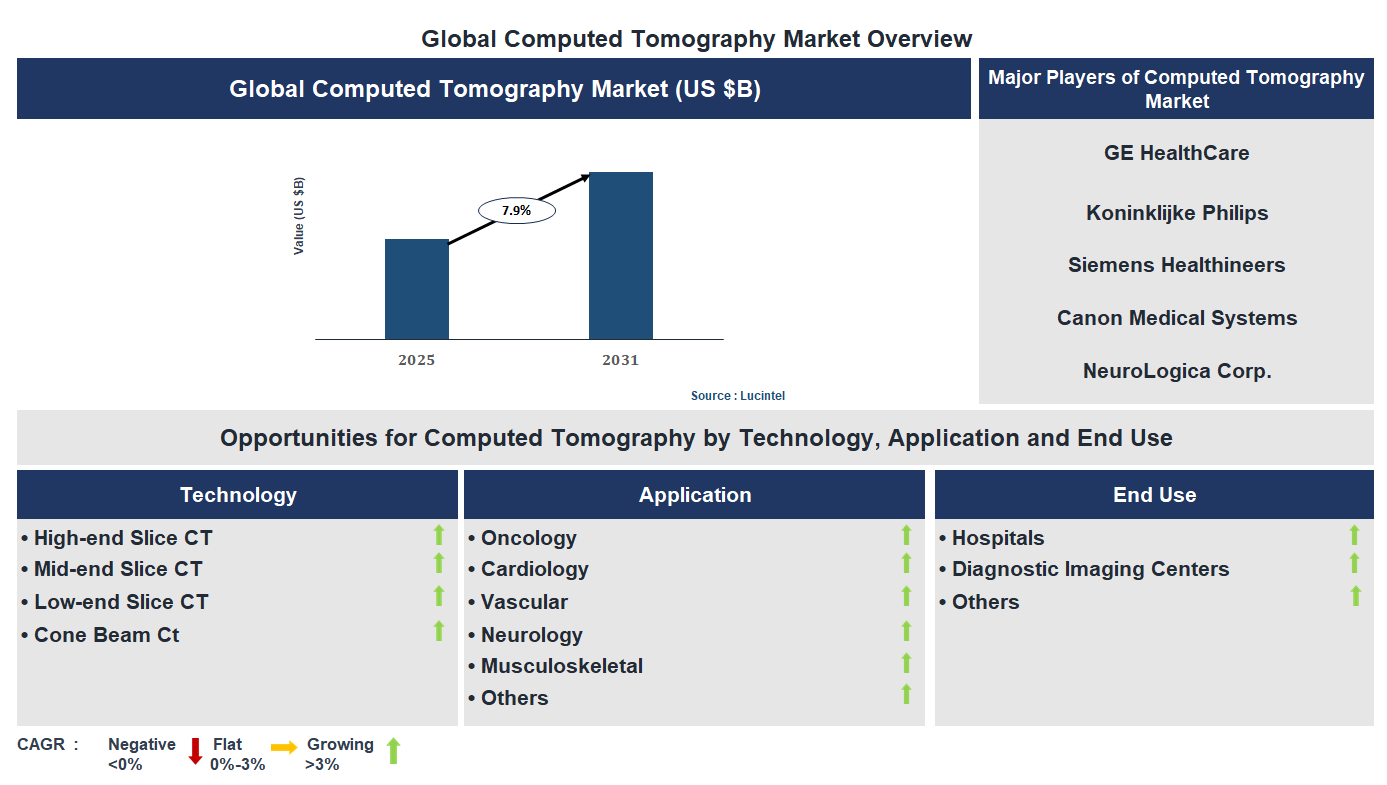
The future of the global computed tomography market looks promising with opportunities in the hospital and diagnostic imaging center markets. The global computed tomography market is expected to grow with a CAGR of 7.9% from 2025 to 2031. The major drivers for this market are the increasing prevalence of chronic diseases, the rising demand for advanced imaging techniques, and the growing adoption of early diagnosis practices.• Lucintel forecasts that, within the technology category, high-end slice CT will remain the largest segment over the forecast period.
• Within the end use category, hospital will remain a larger segment.
• In terms of region, North America will remain the largest region over the forecast period. Gain valuable insights for your business decisions with our comprehensive 150+ page report. Sample figures with some insights are shown below.
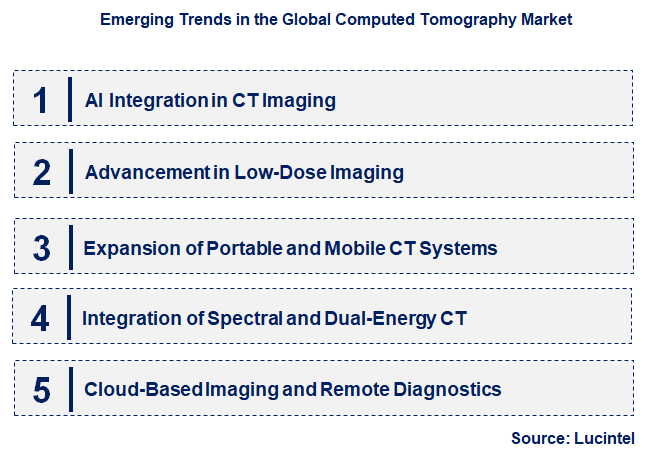
Emerging Trends in the Computed Tomography Market
The computed tomography market is undergoing a major transformation with innovations in imaging technology, automation, and data analytics. Rising focus on AI-driven image interpretation, portable CT scanners, and low-dose imaging techniques is reshaping diagnostic workflows. Healthcare providers are prioritizing faster scan times, improved image clarity, and patient safety. These trends reflect the industry’s evolution toward personalized, data-driven, and cost-efficient imaging systems that improve diagnostic outcomes while optimizing resource utilization.• AI Integration in CT Imaging: Artificial intelligence integration in CT systems is transforming diagnostic workflows through automated image reconstruction, lesion detection, and interpretation. AI reduces radiologist workload, improves accuracy, and supports faster reporting. The use of machine learning in image enhancement helps identify subtle abnormalities and improves diagnostic confidence.
• Advancement in Low-Dose Imaging: Manufacturers are developing advanced dose-reduction technologies to enhance patient safety without compromising image quality. Iterative reconstruction algorithms and photon-counting detectors minimize radiation exposure, enabling safer and more sustainable imaging practices. This trend addresses growing regulatory and patient safety concerns.
• Expansion of Portable and Mobile CT Systems: The demand for portable CT scanners is rising due to their ability to deliver high-quality imaging in emergency rooms, ICUs, and remote healthcare facilities. Compact design and ease of transport enhance accessibility and support point-of-care diagnostics. This trend improves emergency care and diagnostic reach.
• Integration of Spectral and Dual-Energy CT: The growing adoption of spectral and dual-energy CT technology enables better tissue characterization and improved visualization of lesions. These systems offer enhanced diagnostic accuracy for oncology, cardiology, and vascular imaging, supporting personalized treatment planning and research.
• Cloud-Based Imaging and Remote Diagnostics: Cloud integration in CT imaging supports remote access, data sharing, and collaboration between radiologists and clinicians. This trend enables faster diagnosis, centralized storage, and improved workflow efficiency across multi-site hospital networks. It promotes connectivity and tele-radiology adoption worldwide. These emerging trends are redefining the computed tomography market through enhanced accuracy, mobility, and patient safety. AI integration, low-dose imaging, and cloud-based systems are enabling faster and more precise diagnostics. As innovation continues, CT imaging is becoming more intelligent, accessible, and efficient across global healthcare systems.
Recent Development in the Computed Tomography Market
The computed tomography market is experiencing rapid technological progress supported by increasing demand for early diagnosis, precision medicine, and AI-assisted imaging. Manufacturers are launching advanced systems with improved image resolution, faster scan times, and reduced radiation exposure. Collaborations, product launches, and regulatory approvals are strengthening market competitiveness and enhancing clinical applications across cardiology, oncology, and neurology.• AI-Driven Image Reconstruction: Leading CT manufacturers are introducing AI-based reconstruction algorithms that improve image clarity, reduce noise, and enhance workflow efficiency. These systems provide faster diagnosis and greater accuracy for complex medical conditions.
• Photon-Counting CT Technology: New photon-counting CT scanners are offering higher spatial resolution and better tissue differentiation. This innovation provides improved diagnostic detail for cardiovascular and oncological imaging, marking a major step forward in CT technology.
• Compact and Mobile CT Solutions: The development of lightweight, portable CT scanners enables imaging in emergency and intensive care settings. These systems improve access to diagnostics in rural hospitals and during medical emergencies.
• Strategic Partnerships in Healthcare AI: Collaborations between CT manufacturers and AI companies are driving innovation in automated image interpretation and workflow optimization. These partnerships accelerate regulatory approval and market adoption of intelligent imaging systems.
• Sustainability-Focused CT Systems: Manufacturers are emphasizing eco-friendly designs that consume less power and require minimal maintenance. The use of recyclable materials and energy-efficient components reflects growing awareness of environmental sustainability. These developments are improving diagnostic precision, accessibility, and sustainability in the computed tomography market. AI-driven and photon-counting systems are setting new benchmarks in imaging quality, while portable solutions and green technologies enhance the global healthcare ecosystem.
Strategic Growth Opportunities in the Computed Tomography Market
The computed tomography market is expanding across multiple clinical applications due to technological innovation and growing patient demand for non-invasive imaging. Opportunities exist in cardiology, oncology, neurology, orthopedics, and emergency medicine. These applications leverage advanced CT systems for improved diagnostic precision, early disease detection, and patient monitoring, supporting better clinical outcomes and healthcare efficiency.• Cardiology Imaging: Rising prevalence of heart disease is driving demand for advanced cardiac CT imaging. High-speed scanners and AI-assisted reconstruction enhance visualization of coronary arteries and plaque characterization, supporting early diagnosis and prevention.
• Oncology Detection and Monitoring: CT imaging plays a key role in tumor detection, staging, and treatment planning. New spectral and photon-counting technologies provide greater contrast differentiation, improving cancer diagnosis and therapy management.
• Neurological Imaging: Advanced CT scanners offer rapid brain imaging for stroke, trauma, and neurodegenerative conditions. AI-driven image processing supports accurate diagnosis and timely intervention, enhancing patient survival rates.
• Orthopedic and Musculoskeletal Applications: The use of CT imaging in orthopedic diagnostics is expanding, providing detailed 3D visualization of bone structures. These systems assist in pre-surgical planning and post-operative assessments.
• Emergency and Trauma Care: Portable and fast-scanning CT systems enable immediate diagnosis in emergency settings. Their mobility and quick imaging capabilities support faster clinical decision-making and improve patient outcomes. Strategic growth opportunities in the CT market are centered on improving diagnostic speed, accuracy, and accessibility across key clinical segments. Cardiology, oncology, and neurology applications are driving future market growth through innovation and expanded use cases.
Computed Tomography Market Driver and Challenges
The computed tomography market is shaped by technological, economic, and regulatory factors. Continuous innovation, rising disease burden, and growing healthcare investments are key drivers. However, high equipment costs, radiation concerns, and regulatory challenges influence market adoption and long-term sustainability. The factors responsible for driving the computed tomography market include: 1. Rising Chronic Disease Burden: Increasing cases of cancer, cardiovascular, and neurological diseases drive demand for accurate diagnostic imaging, expanding the market globally. 2. Advancements in Imaging Technology: Technological innovations such as AI, dual-energy scanning, and photon-counting detectors enhance image quality, reduce dose levels, and improve workflow efficiency. 3. Growing Demand for Early Diagnosis: The shift toward preventive healthcare and early detection of critical diseases fuels CT adoption across hospitals and diagnostic centers. 4. Expansion of Healthcare Infrastructure: Investments in healthcare infrastructure, especially in emerging economies, are increasing CT system installations in hospitals and imaging centers. 5. Integration of AI and Automation: AI-driven automation reduces radiologist workload, improves accuracy, and accelerates reporting times, strengthening clinical efficiency. Challenges in the computed tomography market are: 1. High Equipment and Maintenance Costs: The high cost of CT scanners and service maintenance limits adoption in low-resource regions, particularly in developing markets. 2. Radiation Exposure Concerns: Despite advancements, radiation safety remains a challenge, requiring ongoing research and awareness to ensure patient protection. 3. Regulatory Compliance and Approval Delays: Stringent regulatory frameworks and slow approval processes can hinder product launches and innovation timelines. Overall, the computed tomography market is expanding due to strong technological innovation and healthcare investment. While cost and safety challenges persist, ongoing research, AI integration, and infrastructure development are expected to sustain long-term growth and adoption across the global healthcare landscape.List of Computed Tomography Companies
Companies in the market compete on the basis of product quality offered. Major players in this market focus on expanding their manufacturing facilities, R&D investments, infrastructural development, and leverage integration opportunities across the value chain. With these strategies computed tomography companies cater increasing demand, ensure competitive effectiveness, develop innovative products & technologies, reduce production costs, and expand their customer base. Some of the computed tomography companies profiled in this report include-• GE HealthCare
• Koninklijke Philips
• Siemens Healthineers
• Canon Medical Systems
• NeuroLogica Corp.
• Shanghai United Imaging Healthcare
• Fujifilm Holdings Corporation
• Shenzhen Anke High-tech
• Koning Health
• Carestream Dental
Computed Tomography Market by Segment
The study includes a forecast for the global computed tomography market by technology, application, end use, and region.Computed Tomography Market by Technology [Value from 2019 to 2031]:
• High-end Slice CT
• Mid-end Slice CT
• Low-end Slice CT
• Cone Beam Ct
Computed Tomography Market by Application [Value from 2019 to 2031]:
• Oncology
• Cardiology
• Vascular
• Neurology
• Musculoskeletal
• Others
Computed Tomography Market by End Use [Value from 2019 to 2031]:
• Hospitals
• Diagnostic Imaging Centers
• Others
Computed Tomography Market by Region [Value from 2019 to 2031]:
• North America
• Europe
• Asia Pacific
• The Rest of the World
Country Wise Outlook for the Computed Tomography Market
The global computed tomography market is advancing rapidly due to technological innovations, rising chronic disease prevalence, and growing demand for early diagnosis. Key regions such as the United States, China, Germany, India, and Japan are leading this transformation through investments in imaging infrastructure, artificial intelligence integration, and low-dose scanning solutions. Continuous R&D efforts and collaborations among healthcare providers, equipment manufacturers, and software developers are enhancing diagnostic accuracy and patient safety. These advancements reflect a global shift toward faster, more efficient, and patient-friendly CT imaging solutions.• United States: The United States computed tomography market continues to expand due to the adoption of AI-driven imaging systems and advanced dose-reduction technologies. Major healthcare institutions are integrating dual-energy and spectral CT scanners to improve image precision while minimizing radiation exposure. Strong government support for diagnostic imaging and rising demand for early cancer and cardiovascular screening are also fueling growth. The market is benefiting from robust research initiatives and collaborations between medical device companies and hospitals aimed at enhancing diagnostic performance and clinical efficiency.
• China: China is experiencing rapid growth in the computed tomography market driven by healthcare infrastructure expansion, rising healthcare spending, and increased access to advanced diagnostic technologies. Local manufacturers are investing in AI-enabled CT systems to meet domestic demand and compete globally. The government’s Healthy China initiative is promoting the adoption of modern imaging technologies in public hospitals. Continuous improvements in system design and affordability have made CT imaging accessible to a wider population, strengthening China’s position as a growing hub for medical imaging innovation.
• Germany: Germany remains a leader in the computed tomography market supported by its strong medical technology base and focus on precision imaging. The country is witnessing increased adoption of low-dose, high-speed CT systems to improve diagnostic outcomes and patient safety. Research centers and manufacturers are collaborating to develop AI-based image reconstruction algorithms and cardiac-specific imaging solutions. Continuous investment in hospital digitization and radiology network integration is enhancing workflow efficiency and clinical accuracy, reinforcing Germany’s reputation for excellence in medical imaging innovation.
• India: India’s computed tomography market is growing steadily due to improving healthcare infrastructure, increasing awareness of early disease diagnosis, and expanding private hospital networks. The introduction of affordable, compact CT scanners suitable for rural and semi-urban healthcare centers is widening accessibility. Government initiatives under programs such as Ayushman Bharat are driving public sector adoption. Global and local companies are also investing in manufacturing units within India to serve domestic demand efficiently. The focus on cost-effective, high-quality diagnostic solutions is accelerating market expansion.
• Japan: Japan’s computed tomography market is characterized by advanced imaging technologies and strong R&D capabilities. Leading companies are developing high-speed, ultra-low-dose CT systems to enhance image quality and minimize radiation risks. Integration of AI and machine learning algorithms supports automated image analysis and improved diagnostic accuracy. Japan’s aging population continues to drive demand for early detection of cardiovascular and oncological conditions. Continuous innovation and precision-driven healthcare practices make Japan a global benchmark for CT imaging excellence.

Features of the Global Computed Tomography Market
Market Size Estimates: Computed tomography market size estimation in terms of value ($B). Trend and Forecast Analysis: Market trends (2019 to 2024) and forecast (2025 to 2031) by various segments and regions. Segmentation Analysis: Computed tomography market size by technology, application, end use, and region in terms of value ($B). Regional Analysis: Computed tomography market breakdown by North America, Europe, Asia Pacific, and Rest of the World. Growth Opportunities: Analysis of growth opportunities in different technologies, applications, end uses, and regions for the computed tomography market. Strategic Analysis: This includes M&A, new product development, and competitive landscape of the computed tomography market. Analysis of competitive intensity of the industry based on Porter’s Five Forces model.
FAQ
Q1. What is the growth forecast for computed tomography market? Answer: The global computed tomography market is expected to grow with a CAGR of 7.9% from 2025 to 2031. Q2. What are the major drivers influencing the growth of the computed tomography market? Answer: The major drivers for this market are the increasing prevalence of chronic diseases, the rising demand for advanced imaging techniques, and the growing adoption of early diagnosis practices. Q3. What are the major segments for computed tomography market? Answer: The future of the computed tomography market looks promising with opportunities in the hospital and diagnostic imaging center markets. Q4. Who are the key computed tomography market companies? Answer: Some of the key computed tomography companies are as follows:• GE HealthCare
• Koninklijke Philips
• Siemens Healthineers
• Canon Medical Systems
• NeuroLogica Corp.
• Shanghai United Imaging Healthcare
• Fujifilm Holdings Corporation
• Shenzhen Anke High-tech
• Koning Health
• Carestream Dental Q5. Which computed tomography market segment will be the largest in future? Answer: Lucintel forecasts that, within the technology category, high-end slice CT will remain the largest segment over the forecast period. Q6. In computed tomography market, which region is expected to be the largest in next 5 years? Answer: In terms of region, North America will remain the largest region over the forecast period. Q7. Do we receive customization in this report? Answer: Yes, Lucintel provides 10% customization without any additional cost.
Table of Contents
List of Figures
List of Tables
Methodology
- In-depth interviews of the major players in this market
- Detailed secondary research from competitors’ financial statements and published data
- Extensive searches of published works, market, and database information pertaining to industry news, company press releases, and customer intentions
- A compilation of the experiences, judgments, and insights of Lucintel’s professionals, who have analyzed and tracked this market over the years.


Buy Now
Choose a license that fits your team. Instant PDF delivery.
Prices exclude taxes. Instant delivery. Custom licensing available on request.
Key Questions
- • What are some of the most promising, high-growth opportunities for the computed tomography market by technology (high-end slice CT, mid-end slice CT, low-end slice CT, and cone beam CT), application (oncology, cardiology, vascular, neurology, musculoskeletal, and others), end use (hospitals, diagnostic imaging centers, and others), and region (North America, Europe, Asia Pacific, and the Rest of the World)?
- • Which segments will grow at a faster pace and why?
- • Which region will grow at a faster pace and why?
- • What are the key factors affecting market dynamics? What are the key challenges and business risks in this market?
- • What are the business risks and competitive threats in this market?
- • What are the emerging trends in this market and the reasons behind them?
- • What are some of the changing demands of customers in the market?
- • What are the new developments in the market? Which companies are leading these developments?
- • Who are the major players in this market? What strategic initiatives are key players pursuing for business growth?
- • What are some of the competing products in this market and how big of a threat do they pose for loss of market share by material or product substitution?
- • What M&A activity has occurred in the last 5 years and what has its impact been on the industry? For any questions related to Computed Tomography Market, Computed Tomography Market Size, Computed Tomography Market Growth, Computed Tomography Market Analysis, Computed Tomography Market Report, Computed Tomography Market Share, Computed Tomography Market Trends, Computed Tomography Market Forecast, Computed Tomography Companies, write Lucintel analyst at email: helpdesk@lucintel.com. We will be glad to get back to you soon.


