
Report Feature
Compute Express Link Component Market Trends and Forecast
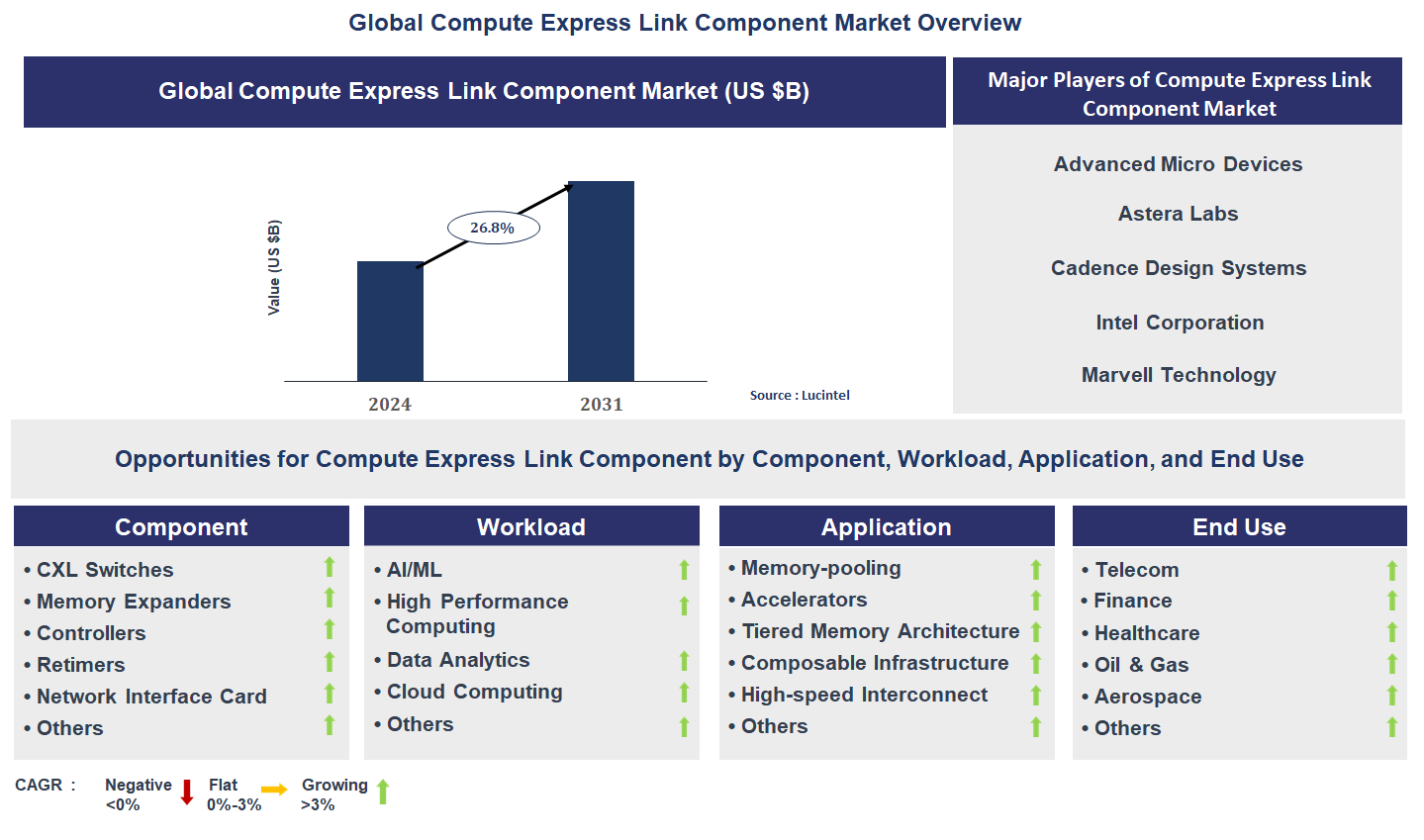
The future of the global compute express link component market looks promising with opportunities in the telecom, finance, healthcare, oil & gas, and aerospace markets. The global compute express link component market is expected to grow with a CAGR of 26.8% from 2025 to 2031. The major drivers for this market are the increasing demand for high-speed data transfer, the rising adoption of advanced computing technologies, and the growing need for faster connectivity solutions.• Lucintel forecasts that, within the component category, CXLl switch is expected to witness the highest growth over the forecast period.
• Within the end use category, healthcare is expected to witness the highest growth.
• In terms of region, North America is expected to witness the highest growth over the forecast period. Gain valuable insights for your business decisions with our comprehensive 150+ page report. Sample figures with some insights are shown below.
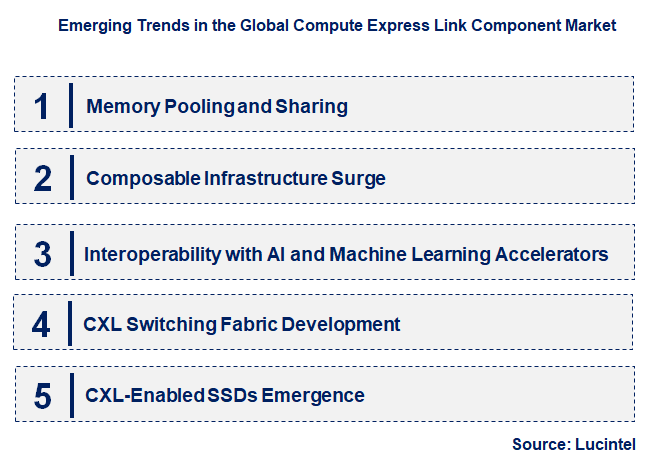
Emerging Trends in the Compute Express Link Component Market
The compute express link component market is being influenced by a number of influential trends, each one of which is a direct function of the growing needs of contemporary data-intensive workloads. The demand for more rapid, more versatile, and more efficient computer architectures has driven CXL from theory to an essential part of future-generation data centers. These trends are not independent but are interlinked, leading to a collective momentum for a future in which memory is being managed as a common, shared, dynamic resource, radically reshaping the economics and performance of high-performance computing and cloud services.• Memory Pooling and Sharing: This is one of the most disruptive trends. Memory pooling enables several CPUs to share a common pool of CXL-attached memory. This provides dynamic memory resource allocation to avoid memory overprovisioning and enhance overall server utilization. The effect is substantial, as it enables memory to be deployed more efficiently by data center operators with associated reductions in both capital and operational costs. It also offers the ability to change memory resources on the fly in response to varying workloads.
• Composable Infrastructure Surge: CXL is a strong enabler for composable infrastructure, in which computing resources (CPUs, GPUs, memory, and storage) can be broken out and dynamically assembled into unique systems. This reduces the inefficiencies of legacy fixed-server setups. The effect is a more agile and cost-efficient data center design that can adjust to shifting demands in real-time, significantly improving resource utilization and scalability.
• Interoperability with AI and Machine Learning Accelerators: The huge memory needs of AI and machine learning models are one of the key drivers of CXL adoption. CXL offers a high-bandwidth, low-latency communication channel for accelerators to access and share with the CPU memory. This is a trend that enables more efficient processing and data movement, dispelling the conventional "memory wall" bottleneck. The effect is reduced training and inference times for AI models, and thus CXL is an essential building block for future AI platforms.
• CXL Switching Fabric Development: As the CXL ecosystem develops, there is a strong tendency towards the development of domain-specific CXL switches. These switches will enable the design of large-scale, coherent memory fabrics that can span several server racks. This advancement is vital for allowing disaggregated memory and memory-as-a-service models. The effect is a paradigm shift in data center design, and it is now possible to have levels of sharing and optimization of resources at a scale never seen in a data center before.
• CXL-Enabled SSDs Emergence: Although CXL is best associated with memory, a new trend is emerging to develop CXL-enabled Solid-State Drives (SSDs). These SSDs are able to act both as memory and storage, removing the distinctness between the two. This is all propelled by demand for high-capacity, low-latency storage for in-memory databases and big data. The effect is a more efficient and flexible storage hierarchy that can be dynamically managed and thereby enhances application performance while lessening the complexity of managing data. These trends are essentially transforming the CXL component market by taking it past being a mere interconnect and making it a corner-stone technology for the next generation of data center design. The market is becoming specialized with increased focus on delivering solutions that provide the ability to support higher flexibility, efficiency, and performance for workloads that are high in data.
Recent Development in the Compute Express Link Component Market
The compute express link component market is witnessing a phase of fast-paced and significant development as the industry craves a new architecture that will help break free from the constraints of existing server designs. The developments are not merely about the components but about building a complete ecosystem that facilitates memory disaggregation, pooling, and sharing. The evolution of the market is gathering pace with major industry players from the semiconductor, server, and software space coming together to drive CXL technology into broad applications, ranging from cloud computing to high-performance computing.• CXL 3.0 and 3.1 Specification Releases: One of the latest and most important developments is the availability of the CXL 3.0 and 3.1 specifications. CXL 3.0 added fabric capabilities, memory sharing, and improved peer-to-peer communication among devices, and CXL 3.1 further developed these features. This advancement is important as it transitions CXL from a point-to-point connection to a fabric-based architecture. The result is a significant advancement toward enabling fully composable systems and memory-as-a-service models, enabling greater scalability and efficiency in using resources.
• Mass Availability of CXL-Supported CPUs: The industry has experienced a significant breakthrough with the mass availability of Intel and AMD server CPUs that natively support CXL. Introduction of these processors has brought the basic host-side support for the CXL ecosystem. The effect of this breakthrough is that it has helped to speed up CXL component adoption through a platform base for system builders. It has also fueled the innovation of CXL-capable memory, accelerators, and switches, generating a cycle of innovation.
• CXL Memory Expander Module Commercialization: One major development has been the commercialization of CXL memory expander modules by big memory vendors such as Samsung, SK Hynix, and Micron. These modules enable server memory to be extended past the physical boundaries of the CPU, offering terabytes of extra capacity. The effect is that it allows more memory-dense workloads to be supported on a single server, which is essential for AI and big data analytics. It also offers a lower-cost method of scaling memory capacity than the traditional approach.
• Release of CXL Switches and Retimes: The release of CXL switches and retimes specifically designed for CXL purposes is a significant milestone that is making it possible to design multi-host, multi-device CXL fabrics. Switches enable several CPUs to share a pool of memory using CXL, and retimes increase the distance of the CXL signal. The result is that these devices are enabling memory pooling and disaggregation at rack-scale. This is an important step toward developing more agile and resource-consumption-efficient data centers that can dynamically provision resources based on demand.
• Software Ecosystem Creation for CXL: One very important and yet underappreciated development is the creation of a strong software ecosystem to deal with CXL-capable hardware. It encompasses the creation of firmware, operating system drivers, and management software that can discover, configure, and manage CXL devices. The effect is that this software is rendering CXL technology deployable in actual applications. It is making dynamic resource allocation and seamless integration of CXL components into current data center infrastructure possible. They are greatly influencing the CXL component market by taking the technology away from the laboratory and into the commercial space. They are cumulatively creating a comprehensive ecosystem that is needed for a new generation of high-performance computing, where memory is dynamic and composable.
Strategic Growth Opportunities in the Compute Express Link Component Market
The compute express link component market has tremendous strategic growth opportunities in its key applications, led by demand for more scalable and efficient computing architectures. These opportunities can be leveraged by manufacturers and service providers through creating targeted solutions that cater to each market segment’s distinct needs. The secret to success is a profound understanding of the end-user’s needs, from the huge size of hyperscale data centers to the unique requirements of high-performance computing, and delivering customized, value-added products and solutions.• High-Performance Computing: HPC is one of the leading growth opportunities because it has an unparalleled need for memory bandwidth and capacity. CXL can also be utilized to build memory pools shared by multiple compute nodes, a requirement for large-scale scientific simulations and sophisticated data analysis. Strategic opportunities include building optimized CXL memory expanders and switches that are tailored for HPC workloads to support low latency and high bandwidth to achieve the stringent performance demands of this application.
• Cloud and Hyperscale Computing: Cloud service providers and hyperscale data centers are key market drivers for CXL. Their large scale and elastic workloads necessitate memory disaggregation and pooling as the best means to maximize resource use and minimize cost. Strategic opportunities include offering rack-scale deployable CXL switches and CXL-enabled server platforms. Here, emphasis is given to creating solutions that are extremely scalable, simple to administer, and deliver a definite return on investment in the form of greater efficiency.
• Artificial Intelligence and Machine Learning: The outrageous memory hunger of AI/ML models creates an enormous growth opportunity. CXL enables AI accelerators to use vast amounts of host memory at low latency, breaking through the "memory wall" bottleneck. Strategic areas include the creation of specialty CXL-enabled memory expanders and CXL-to-GPU integrated interconnects. The market will compensate those who can provide solutions that enable the training of larger, more intricate models at higher speeds and at lower costs, and that is a leading competitive edge in the AI area.
• Enterprise and Edge Computing: Although CXL has been a data center technology, the opportunity is growing in enterprise and edge computing. As these environments become increasingly data-intensive, CXL can be applied to minimize server configurations and lower hardware costs. Strategic opportunities involve creating a less expensive CXL solution that can be implemented within typical enterprise servers. The emphasis lies in making the advantages of memory expansion and pooling available to a broader base of businesses experiencing rising data loads.
• Aftermarket and Software Services: As the CXL ecosystem matures, aftermarket and software services demand will grow. This ranges from CXL-enabled firmware and drivers to fabric management software and consultancy services. Strategic opportunities in offering a full software stack that enables customers to manage their CXL infrastructure so that it achieves high performance and reliability. The emphasis here is on delivering the expertise and resources that ensure the implementation of CXL technology is an easy and successful experience for end users. These strategic growth avenues are transforming the CXL component market by incentivizing attention toward specific, high-value applications. The market is trending toward a future when CXL is more than a component but rather a foundational technology that provides a more efficient, flexible, and powerful computing architecture for a broad set of industries.
Compute Express Link Component Market Driver and Challenges
Compute express link component industry is a dynamic one, impacted by a mix of key drivers and compelling challenges. The drivers are primarily due to global economic and technological trends that are driving the advance in data-intensive computing. The challenges, however, are due to the expensive nature of innovation, complexity of implementation, and requirements of an established ecosystem. The market’s future will be determined by how effectively businesses can capitalize on these drivers while overcoming the inherent complexities of introducing a new standard. The factors responsible for driving the compute express link component market include: 1. Data Exponential Growth: The exponential, ongoing data growth from sources such as AI, big data analytics, and IoT is the key influencer. This explosion in data generates a need for enormous memory capacity that conventional architectures are unable to support with efficiency, and CXL’s memory expansion and pooling are thus critical. 2. High-Performance Computing Demand: The demand for faster and more powerful computing for scientific computation, financial modeling, and cloud services is a key driver. CXL’s low-latency, cache-coherent interconnect is essential to burst the "memory wall" and allow more efficient communication between accelerators and CPUs. 3. Move to Composable and Disaggregated Architectures: Data centers are transitioning away from static, monolithic servers to more agile, composable architectures. CXL is the underlying technology for this transition, which enables resources such as memory and storage to be pooled and dynamically shared, and this is the primary market driver. 4. Workloads of Machine Learning and AI: The high memory requirement of machine learning and AI workloads is a strong influencer. CXL allows accelerators to access much more shared memory, supporting the training and inference of larger and more complex models with higher speed and efficiency. 5. Data Center Cost Optimization: CXL solves the expense of memory and the issue of memory overprovisioning in data centers. By facilitating memory pooling, CXL enables data center operators to efficiently use their memory, which saves on hardware expenses as well as power usage, which is a major economic incentive. Challenges in the compute express link component market are: 1. High Upfront Cost: Perhaps the greatest challenge is the high upfront cost of CXL-equipped hardware. The cost of CXL controllers, switches, and memory modules is prohibitive for most small and medium-sized businesses, constraining the market’s adoption to large data centers and hyperscale’s. 2. Ecosystem and Software Readiness: The CXL ecosystem is not yet fully mature. A more expansive and solid software stack, such as operating system drivers, management software, and application-level support, is required. Incomplete ecosystem maturity may impede mass adoption and make implementation more complex. 3. Interoperability and Complexity: CXL adds a level of added complexity to the system design. Making each component—CPUs, memory, accelerators, and switches—fully interoperable and cooperate seamlessly with each other is a significant technical challenge. This complexity can result in integration problems and potential performance bottlenecks if not properly handled. In summary, the CXL component market is being fueled by the underlying requirements of contemporary, data-hungry computing to bridge performance constraints and maximize resource utilization. But at the same time, it is also suffering from serious issues pertaining to the high expense of innovation, the immaturity of its ecosystem, and the challenge of achieving complete interoperability. The success of the market hinges on how it can overcome these hurdles by offering low-cost, simple-to-deploy, and thoroughly supported solutions that are scalable to address the needs of a data-centric world.List of Compute Express Link Component Companies
Companies in the market compete on the basis of product quality offered. Major players in this market focus on expanding their manufacturing facilities, R&D investments, infrastructural development, and leverage integration opportunities across the value chain. With these strategies compute express link component companies cater increasing demand, ensure competitive effectiveness, develop innovative products & technologies, reduce production costs, and expand their customer base. Some of the compute express link component companies profiled in this report include-• Advanced Micro Devices
• Astera Labs
• Cadence Design Systems
• Intel Corporation
• Marvell Technology
• Micron Technology
• Mobiveil
• Montage Technology
• Rambus
• Samsung Electronics
Compute Express Link Component Market by Segment
The study includes a forecast for the global compute express link component market by component, workload, application, end use, and region.Compute Express Link Component Market by Component [Value from 2019 to 2031]:
• CXL Switches
• Memory Expanders
• Controllers
• Retimers
• Network Interface Card
• Others
Compute Express Link Component Market by Workload [Value from 2019 to 2031]:
• AI/ML
• High Performance Computing
• Data Analytics
• Cloud Computing
• Others
Compute Express Link Component Market by Application [Value from 2019 to 2031]:
• Memory-pooling
• Accelerators
• Tiered Memory Architecture
• Composable Infrastructure
• High-speed Interconnect
• Others
Compute Express Link Component Market by End Use [Value from 2019 to 2031]:
• Telecom
• Finance
• Healthcare
• Oil & Gas
• Aerospace
• Others
Compute Express Link Component Market by Region [Value from 2019 to 2031]:
• North America
• Europe
• Asia Pacific
• The Rest of the World
Country Wise Outlook for the Compute Express Link Component Market
The compute express link component market is witnessing speedy development as a result of the growing need for high-performance computing, artificial intelligence, and big data analytics. CXL is a low-latency, high-speed interconnect that facilitates cache-coherent communication between the CPU and peripherals such as memory, accelerators, and I/O. Its main purpose is to shatter the "memory wall" by enabling memory to be pooled, shared, and scaled, thus optimizing resource use and lowering system costs in data centers.• United States: In the US, CXL advancements are driven primarily by giant tech firms such as Intel and AMD, which have included CXL support on their new server CPUs. The industry is witnessing a proliferation of CXL-capable memory expander modules from firms such as Micron and Rambus, which are essential for memory pooling and tiering in hyperscale data centers. The emphasis is on supporting composable infrastructure and performance optimization for AI and machine learning workloads. The U.S. leads in this market because of the high density of cloud service providers and data centers.
• China: China is quickly building out its CXL ecosystem to underpin its enormous cloud computing and AI plans. Efforts are aimed at establishing a local supply chain for CXL parts, such as controllers and memory devices. Chinese technology companies and research organizations are actively engaging in the CXL Consortium, and the government is investing heavily in developing indigenous technology. The initiative is intended to gain self-reliance in high-performance computing and decrease dependence on overseas technology.
• Germany: Germany’s CXL market is powered by its intense emphasis on high-end engineering and industrial use. New developments have their base in bringing CXL technology to the high-performance computing (HPC) space for scientific computing and advanced simulations. The market is experiencing a thrust to create reliable CXL switches and fabric management software that facilitate memory pooling and sharing across large computing clusters. German firms are tapping their experience to provide high reliability and security for their CXL solutions.
• India: India’s CXL component market is still in its infancy stage but is growing at a very fast pace due to the government’s emphasis on digitalization and the growth of the nation’s data center infrastructure. CXL controller intellectual property (IP) and system-level solutions are the current trends in recent developments. Indian firms are also drawing foreign investments and partnering with international companies to ensure the rapid adoption of CXL technology, especially in cloud computing and business applications.
• Japan: Japan’s CXL market is defined by an emphasis on innovation and cooperation. Current advancements are fueled by the requirement for more efficient computer architecture to enable high-performance computing and artificial intelligence research. Japanese firms are leading the charge in creating specialized CXL memory expander modules and controllers that are power-efficient and low-latency optimized. The market is also experiencing a thrust toward leveraging CXL to drive new computing architectures for big data analytics.

Features of the Global Compute Express Link Component Market
Market Size Estimates: Compute express link component market size estimation in terms of value ($B). Trend and Forecast Analysis: Market trends (2019 to 2024) and forecast (2025 to 2031) by various segments and regions. Segmentation Analysis: Compute express link component market size by various segments, such as by component, workload, application, end use, and region in terms of value ($B). Regional Analysis: Compute express link component market breakdown by North America, Europe, Asia Pacific, and Rest of the World. Growth Opportunities: Analysis of growth opportunities in different component, workload, application, end use, and regions for the compute express link component market. Strategic Analysis: This includes M&A, new product development, and competitive landscape of the compute express link component market. Analysis of competitive intensity of the industry based on Porter’s Five Forces model.
FAQ
Q1. What is the growth forecast for compute express link component market? Answer: The global compute express link component market is expected to grow with a CAGR of 26.8% from 2025 to 2031. Q2. What are the major drivers influencing the growth of the compute express link component market? Answer: The major drivers for this market are the increasing demand for high-speed data transfer, the rising adoption of advanced computing technologies, and the growing need for faster connectivity solutions. Q3. What are the major segments for compute express link component market? Answer: The future of the compute express link component market looks promising with opportunities in the telecom, finance, healthcare, oil & gas, and aerospace markets. Q4. Who are the key compute express link component market companies? Answer: Some of the key compute express link component companies are as follows:• Advanced Micro Devices
• Astera Labs
• Cadence Design Systems
• Intel Corporation
• Marvell Technology
• Micron Technology
• Mobiveil
• Montage Technology
• Rambus
• Samsung Electronics Q5. Which compute express link component market segment will be the largest in future? Answer: Lucintel forecasts that, within the component category, CXLl switch is expected to witness the highest growth over the forecast period. Q6. In compute express link component market, which region is expected to be the largest in next 5 years? Answer: In terms of region, North America is expected to witness the highest growth over the forecast period. Q7. Do we receive customization in this report? Answer: Yes, Lucintel provides 10% customization without any additional cost.
Table of Contents
List of Figures
List of Tables
Methodology
- In-depth interviews of the major players in this market
- Detailed secondary research from competitors’ financial statements and published data
- Extensive searches of published works, market, and database information pertaining to industry news, company press releases, and customer intentions
- A compilation of the experiences, judgments, and insights of Lucintel’s professionals, who have analyzed and tracked this market over the years.


Buy Now
Choose a license that fits your team. Instant PDF delivery.
Prices exclude taxes. Instant delivery. Custom licensing available on request.
Key Questions
- • What are some of the most promising, high-growth opportunities for the compute express link component market by component (CXL switches, memory expanders, controllers, retimers, network interface card, and others), workload (AI/ML, high performance computing, data analytics, cloud computing, and others), application (memory-pooling, accelerators, tiered memory architecture, composable infrastructure, high-speed interconnect, and others), end use (telecom, finance, healthcare, oil & gas, aerospace, and others), and region (North America, Europe, Asia Pacific, and the Rest of the World)?
- • Which segments will grow at a faster pace and why?
- • Which region will grow at a faster pace and why?
- • What are the key factors affecting market dynamics? What are the key challenges and business risks in this market?
- • What are the business risks and competitive threats in this market?
- • What are the emerging trends in this market and the reasons behind them?
- • What are some of the changing demands of customers in the market?
- • What are the new developments in the market? Which companies are leading these developments?
- • Who are the major players in this market? What strategic initiatives are key players pursuing for business growth?
- • What are some of the competing products in this market and how big of a threat do they pose for loss of market share by material or product substitution?
- • What M&A activity has occurred in the last 5 years and what has its impact been on the industry? For any questions related to Compute Express Link Component Market, Compute Express Link Component Market Size, Compute Express Link Component Market Growth, Compute Express Link Component Market Analysis, Compute Express Link Component Market Report, Compute Express Link Component Market Share, Compute Express Link Component Market Trends, Compute Express Link Component Market Forecast, Compute Express Link Component Companies, write Lucintel analyst at email: helpdesk@lucintel.com. We will be glad to get back to you soon.


