
Report Feature
Compressed Air Monitoring Market Trends and Forecast
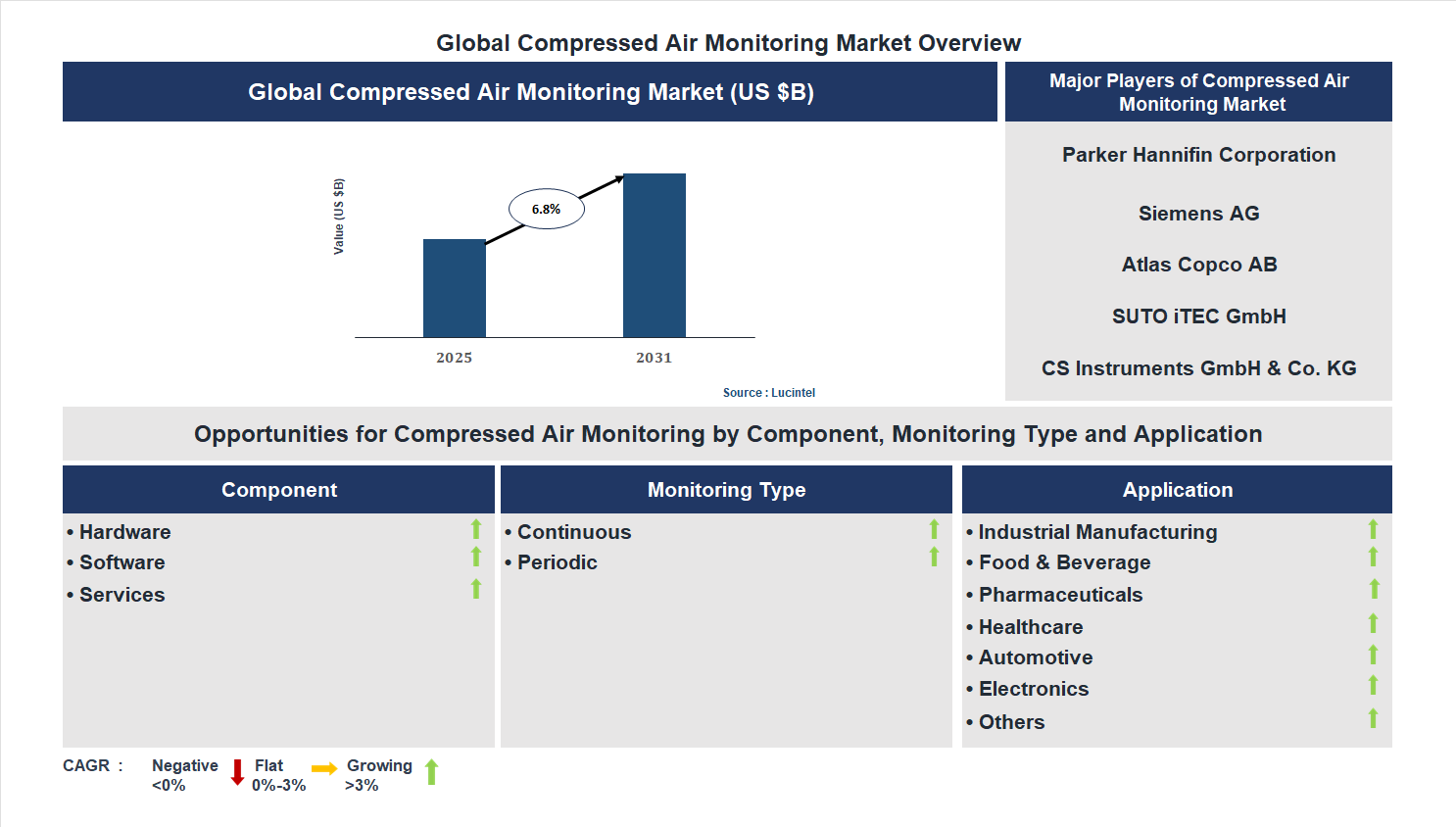
The future of the global compressed air monitoring market looks promising with opportunities in the industrial manufacturing, food & beverage, pharmaceutical, healthcare, automotive, and electronics markets. The global compressed air monitoring market is expected to grow with a CAGR of 6.8% from 2025 to 2031. The major drivers for this market are the increasing demand for compressed air efficiency, the rising focus on reducing energy losses, and the growing adoption of industrial monitoring systems.• Lucintel forecasts that, within the component category, hardware is expected to witness the highest growth over the forecast period.
• Within the application category, industrial manufacturing is expected to witness the highest growth.
• In terms of region, APAC is expected to witness the highest growth over the forecast period. Gain valuable insights for your business decisions with our comprehensive 150+ page report. Sample figures with some insights are shown below.
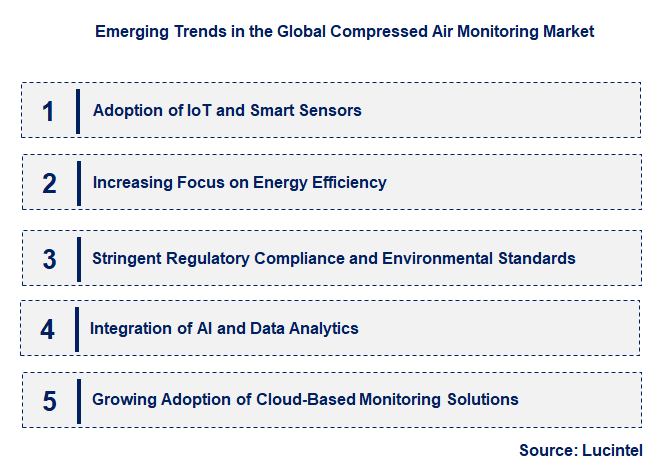
Emerging Trends in the Compressed Air Monitoring Market
The compressed air monitoring market is experiencing rapid growth driven by increasing industrial automation, stringent environmental regulations, and the need for energy efficiency. As industries seek to optimize operations and reduce costs, advanced monitoring solutions are becoming essential. Technological innovations, such as IoT integration and real-time data analytics, are transforming how companies manage compressed air systems. Additionally, the focus on sustainability and reducing carbon footprints is pushing the adoption of smarter, more efficient monitoring tools. These developments are not only improving operational efficiency but also helping companies comply with regulatory standards, ultimately reshaping the landscape of the compressed air monitoring industry.• Adoption of IoT and Smart Sensors: The integration of IoT technology and smart sensors is revolutionizing compressed air monitoring by enabling real-time data collection and remote management. These sensors provide continuous insights into system performance, leak detection, and energy consumption, allowing for proactive maintenance and reduced downtime. The connectivity facilitates predictive analytics, which helps prevent costly failures and optimize system efficiency. As IoT adoption grows, companies benefit from enhanced operational transparency and improved decision-making, leading to significant cost savings and sustainability gains.
• Increasing Focus on Energy Efficiency: Energy consumption in compressed air systems accounts for a substantial portion of industrial energy use. Market players are emphasizing energy-efficient monitoring solutions to minimize wastage and reduce operational costs. Advanced monitoring tools help identify leaks, pressure drops, and inefficiencies, enabling targeted interventions. Governments and regulatory bodies are also promoting energy conservation, encouraging industries to adopt these technologies. This trend is driving innovation in sensor accuracy and data analytics, ultimately leading to more sustainable and cost-effective compressed air systems.
• Stringent Regulatory Compliance and Environmental Standards: Growing environmental concerns and stricter regulations are compelling industries to adopt comprehensive monitoring solutions. These standards require detailed reporting on emissions, leaks, and energy use, making advanced monitoring systems essential. Companies are investing in compliance-focused technologies that facilitate accurate data collection and reporting. This trend ensures that industries not only meet legal requirements but also improve their environmental footprint, fostering a culture of sustainability and accountability within the market.
• Integration of AI and Data Analytics: The incorporation of artificial intelligence (AI) and advanced data analytics is enhancing the capabilities of compressed air monitoring systems. AI algorithms analyze vast amounts of data to identify patterns, predict failures, and optimize system performance. This proactive approach reduces maintenance costs and prevents unexpected breakdowns. The use of predictive analytics also supports strategic planning and resource allocation. As AI becomes more sophisticated, it is transforming the market by enabling smarter, more autonomous systems that improve efficiency and reliability.
• Growing Adoption of Cloud-Based Monitoring Solutions: Cloud technology is enabling scalable, flexible, and cost-effective monitoring solutions. Cloud-based platforms facilitate centralized data management, remote access, and seamless integration with other enterprise systems. This trend allows companies to monitor multiple sites from a single interface, improving oversight and operational coordination. Additionally, cloud solutions support real-time alerts and data sharing, enhancing responsiveness. As cloud adoption accelerates, it is reshaping the market by making advanced monitoring accessible to a broader range of industries, including small and medium enterprises. In summary, these emerging trends are significantly transforming the compressed air monitoring market by promoting smarter, more efficient, and sustainable systems. The integration of IoT, AI, and cloud technologies is enabling real-time, predictive, and centralized management, which enhances operational efficiency and regulatory compliance. Focusing on energy efficiency and environmental standards is driving innovation and adoption of advanced solutions. Collectively, these developments are reshaping the industry landscape, fostering a more connected, sustainable, and technologically advanced market environment.
Recent Development in the Compressed Air Monitoring Market
The compressed air monitoring market has experienced significant growth driven by increasing industrial automation, stringent environmental regulations, and the need for energy efficiency. As industries seek to optimize operations and reduce costs, advanced monitoring solutions have become essential. Technological innovations, regulatory pressures, and rising awareness of sustainable practices are shaping the market landscape. Companies are investing in smarter, more accurate monitoring systems to ensure compliance and improve operational efficiency. This evolving environment presents new opportunities and challenges, prompting stakeholders to adopt innovative strategies. The following developments highlight the key trends influencing this dynamic market.• Adoption of IoT-enabled Monitoring Systems: The integration of Internet of Things (IoT) technology has revolutionized compressed air monitoring by enabling real-time data collection and remote management. These systems provide precise insights into air quality, pressure, and energy consumption, allowing for proactive maintenance and reduced downtime. The impact is increased operational efficiency, lower maintenance costs, and enhanced compliance with environmental standards. IoT-enabled solutions also facilitate predictive analytics, helping companies anticipate issues before they escalate, thus optimizing overall system performance.
• Stringent Regulatory Standards: Governments and environmental agencies worldwide are implementing stricter regulations concerning air quality and emissions. These regulations compel industries to adopt advanced monitoring solutions to ensure compliance. The impact includes increased demand for sophisticated sensors and monitoring devices that can accurately measure pollutants and other parameters. Companies investing in compliant systems benefit from avoiding penalties and improving their environmental footprint, which enhances their corporate reputation and market competitiveness.
• Technological Advancements in Sensor Technology: Innovations in sensor technology have led to more accurate, durable, and cost-effective monitoring devices. These advancements enable detailed analysis of compressed air systems, detecting leaks, contamination, and inefficiencies more effectively. The impact is improved system reliability, energy savings, and reduced operational costs. Enhanced sensors also support predictive maintenance strategies, minimizing unexpected failures and extending equipment lifespan, thereby benefiting end-users across various industries.
• Growing Focus on Energy Efficiency and Sustainability: Increasing awareness of energy consumption and environmental impact is driving industries to optimize compressed air systems. Monitoring solutions now emphasize energy efficiency, helping companies identify wastage and implement corrective measures. The impact includes significant reductions in energy costs and carbon emissions, aligning with sustainability goals. This focus encourages innovation in monitoring technologies and promotes the adoption of eco-friendly practices, ultimately contributing to a greener industrial landscape.
• Expansion in Emerging Markets: Rapid industrialization in emerging economies such as India, China, and Southeast Asia is fueling market growth. The demand for reliable compressed air monitoring solutions is rising as industries expand and modernize. The impact involves increased market penetration, new business opportunities, and the development of localized solutions tailored to regional needs. This expansion also fosters competitive pricing and innovation, making advanced monitoring systems more accessible to a broader customer base. In summary, these developments are significantly transforming the compressed air monitoring market by enhancing technological capabilities, ensuring regulatory compliance, promoting energy efficiency, and expanding global reach. The market is becoming more sophisticated, sustainable, and accessible, positioning it for continued growth and innovation in the coming years.
Strategic Growth Opportunities in the Compressed Air Monitoring Market
The compressed air monitoring market is experiencing rapid growth driven by increasing industrial automation, stringent environmental regulations, and the need for energy efficiency. As industries seek to optimize operations and reduce costs, the demand for advanced monitoring solutions has surged. Key applications such as manufacturing, oil and gas, healthcare, food and beverage, and automotive are pivotal in shaping market dynamics. These sectors are adopting innovative technologies to ensure compliance, improve safety, and enhance operational efficiency. The following five growth opportunities highlight the most promising avenues for expansion across these applications, reflecting the evolving landscape of compressed air monitoring.• Manufacturing: Enhanced Process Optimization: Implementation of real-time monitoring systems allows manufacturers to detect leaks, reduce energy consumption, and improve overall process efficiency, leading to cost savings and increased productivity.
• Regulatory Compliance and Safety: Advanced monitoring solutions help oil and gas companies adhere to environmental standards and safety protocols, minimizing risks and avoiding penalties while ensuring sustainable operations.
• Ensuring Air Quality and Safety: In healthcare facilities, precise air quality monitoring ensures compliance with health standards, prevents contamination, and safeguards patient and staff safety, boosting trust and operational reliability.
• Quality Control and Energy Efficiency: Monitoring compressed air quality and consumption helps maintain product quality, reduce waste, and optimize energy use, supporting sustainable practices and regulatory adherence.
• Manufacturing Efficiency and Equipment Maintenance: In automotive production, monitoring systems improve equipment performance, reduce downtime, and enhance quality control, leading to streamlined operations and cost reductions. These growth opportunities are significantly impacting the market by driving technological innovation, improving operational efficiencies, and ensuring compliance across key industries. As companies increasingly adopt advanced monitoring solutions, the market is poised for substantial expansion, fostering sustainable industrial growth and environmental responsibility.
Compressed Air Monitoring Market Driver and Challenges
The compressed air monitoring market is influenced by a variety of technological, economic, and regulatory factors that shape its growth and development. Advances in sensor technology and data analytics are enabling more precise and real-time monitoring solutions, which improve efficiency and reduce operational costs. Economic factors such as industrial expansion and the need for energy optimization drive demand, while stringent regulations on emissions and safety standards compel industries to adopt advanced monitoring systems. Additionally, increasing awareness of environmental sustainability and the importance of maintaining air quality further propel market growth. However, these opportunities are balanced by challenges related to high implementation costs, technological complexities, and evolving regulatory landscapes that require continuous adaptation. The factors responsible for driving the compressed air monitoring market include:• Technological Advancements: The development of sophisticated sensors, IoT integration, and real-time data analytics enhances monitoring accuracy and operational efficiency. These innovations enable industries to detect leaks, optimize compressor performance, and reduce energy consumption, leading to cost savings and environmental benefits. As technology continues to evolve, the market benefits from increased adoption of smart monitoring systems, which provide predictive maintenance and improve overall system reliability. The integration of AI and machine learning further enhances predictive capabilities, making monitoring more proactive and efficient.
• Industrial Expansion: Rapid growth in manufacturing, automotive, and energy sectors increases the demand for compressed air systems, which require effective monitoring to ensure optimal performance. As industries expand their operations, the need for reliable air quality and system efficiency becomes critical to meet production targets and safety standards. This expansion drives investments in advanced monitoring solutions to prevent downtime, reduce maintenance costs, and ensure compliance with environmental regulations. The rising adoption of automation and Industry 4.0 practices further amplifies the need for comprehensive air monitoring systems.
• Regulatory Compliance: Governments and environmental agencies impose strict regulations on emissions, air quality, and safety standards, compelling industries to adopt advanced monitoring solutions. Compliance not only avoids penalties but also enhances corporate reputation and sustainability efforts. The increasing stringency of regulations worldwide encourages industries to invest in monitoring systems that can provide accurate data for reporting and compliance purposes. This regulatory landscape acts as a catalyst for market growth, especially in regions with aggressive environmental policies.
• Cost Optimization and Energy Efficiency: The rising focus on reducing operational costs and energy consumption motivates industries to implement efficient compressed air systems with integrated monitoring. Monitoring solutions help identify leaks, inefficiencies, and maintenance needs, leading to significant energy savings and reduced operational expenses. As energy prices fluctuate and sustainability becomes a priority, companies are increasingly adopting advanced monitoring to optimize their processes, thereby driving market demand for innovative solutions that support cost-effective operations.
• Growing Awareness of Environmental Sustainability: Increasing concern over environmental impact and the push for sustainable practices encourage industries to monitor and control their emissions and resource usage. Compressed air systems are significant energy consumers, and effective monitoring helps minimize wastage and environmental footprint. This awareness fosters the adoption of eco-friendly technologies and practices, boosting demand for advanced monitoring solutions that support sustainability goals. The trend aligns with global efforts to reduce carbon emissions and promote green manufacturing, further expanding the market. The challenges in the compressed air monitoring market are:
• High Implementation Costs: The initial investment required for advanced monitoring systems, including sensors, data analytics platforms, and integration with existing infrastructure, can be substantial. Small and medium-sized enterprises may find these costs prohibitive, limiting adoption. Additionally, ongoing maintenance and upgrades add to the financial burden, which can hinder widespread implementation, especially in regions with limited budgets. This cost barrier slows down market growth and necessitates the development of more affordable solutions to encourage broader adoption.
• Technological Complexities: Integrating various sensors, IoT devices, and data management platforms presents technical challenges. Ensuring compatibility, data security, and system reliability requires sophisticated expertise and infrastructure. The complexity of deploying and maintaining these systems can lead to operational disruptions and increased training requirements. Moreover, rapid technological changes demand continuous updates and upgrades, which can be resource-intensive and pose risks to system stability, thereby impeding market expansion.
• Evolving Regulatory Landscape: While regulations drive market growth, they also pose challenges due to their complexity and frequent updates. Companies must stay compliant with diverse regional standards, which can vary significantly and require tailored solutions. Navigating these regulatory requirements demands significant resources and expertise, and non-compliance can result in penalties and operational setbacks. The dynamic regulatory environment necessitates ongoing adjustments to monitoring systems, increasing costs and operational complexity for industry players. In summary, the compressed air monitoring market is propelled by technological innovations, industrial growth, regulatory pressures, cost-saving initiatives, and environmental consciousness. However, high costs, technological challenges, and regulatory complexities present significant hurdles. These drivers and challenges collectively influence the market’s trajectory, requiring stakeholders to innovate and adapt continuously. The overall impact is a dynamic landscape where growth opportunities are balanced by operational and financial challenges, shaping the future development of the market.
List of Compressed Air Monitoring Companies
Companies in the market compete on the basis of product quality offered. Major players in this market focus on expanding their manufacturing facilities, R&D investments, infrastructural development, and leverage integration opportunities across the value chain. With these strategies compressed air monitoring companies cater increasing demand, ensure competitive effectiveness, develop innovative products & technologies, reduce production costs, and expand their customer base. Some of the compressed air monitoring companies profiled in this report include-• Parker Hannifin Corporation
• Siemens AG
• Atlas Copco AB
• SUTO iTEC GmbH
• CS Instruments GmbH & Co. KG
• Emerson Electric Co.
• Pentair plc
• Kaeser Kompressoren SE
• Beko Technologies GmbH
• Schneider Electric SE
Compressed Air Monitoring Market by Segment
The study includes a forecast for the global compressed air monitoring market by component, monitoring type, application, and region.Compressed Air Monitoring Market by Component [Value from 2019 to 2031]:
• Hardware
• Software
• Services
Compressed Air Monitoring Market by Monitoring Type [Value from 2019 to 2031]:
• Continuous
• Periodic
Compressed Air Monitoring Market by Application [Value from 2019 to 2031]:
• Industrial Manufacturing
• Food & Beverage
• Pharmaceuticals
• Healthcare
• Automotive
• Electronics
• Others
Compressed Air Monitoring Market by Region [Value from 2019 to 2031]:
• North America
• Europe
• Asia Pacific
• The Rest of the World
Country Wise Outlook for the Compressed Air Monitoring Market
The compressed air monitoring market has experienced significant growth driven by increasing industrial automation, stringent environmental regulations, and the need for energy efficiency. Countries are adopting advanced monitoring solutions to optimize operations, reduce costs, and ensure compliance with safety standards. Technological innovations such as IoT integration, real-time data analytics, and predictive maintenance are transforming the landscape. The markets expansion reflects a global shift towards smarter, more sustainable industrial practices. Each country’s developments are shaped by its unique industrial priorities, regulatory frameworks, and technological adoption rates, contributing to a dynamic and competitive global market.• United States: The U.S. market has seen rapid adoption of IoT-enabled compressed air monitoring systems, driven by the manufacturing and energy sectors focus on energy efficiency and regulatory compliance. Major players are investing in advanced analytics and cloud-based solutions to enhance real-time monitoring and predictive maintenance. The government’s emphasis on reducing industrial emissions and improving operational efficiency has further accelerated market growth. Additionally, the integration of AI technologies is enabling more accurate fault detection and system optimization, making the U.S. a leader in innovative compressed air monitoring solutions.
• China: China’s market is expanding due to its booming manufacturing industry and government initiatives promoting industrial modernization. The adoption of smart monitoring systems is increasing to meet environmental standards and reduce energy consumption. Chinese companies are investing heavily in IoT and big data analytics to improve system reliability and efficiency. The government’s focus on sustainable development and pollution control has also driven demand for advanced monitoring solutions. Local manufacturers are collaborating with international firms to develop cost-effective, scalable systems, positioning China as a key player in the global market.
• Germany: Germany’s market is characterized by high technological adoption and stringent regulatory standards, especially within the automotive and manufacturing sectors. The country emphasizes energy efficiency and emissions reduction, leading to widespread use of sophisticated monitoring systems. German companies are pioneering innovations in sensor technology and data analytics to optimize compressed air systems. The focus on Industry 4.0 integration has facilitated real-time monitoring and automation, enhancing operational efficiency. Additionally, Germany’s strong emphasis on sustainability and environmental compliance continues to propel market growth and technological advancements.
• India: India’s market is witnessing rapid growth due to expanding industrialization, urbanization, and government initiatives like Make in India. The demand for reliable and efficient compressed air systems is increasing across sectors such as manufacturing, pharmaceuticals, and food processing. Indian companies are adopting IoT-enabled monitoring solutions to improve system performance and reduce downtime. The government’s focus on sustainable industrial practices and energy conservation is encouraging investments in advanced monitoring technologies. Local startups and global players are collaborating to develop affordable, scalable solutions tailored to India’s diverse industrial landscape.
• Japan: Japan’s market is driven by its advanced manufacturing sector and focus on automation and energy efficiency. The adoption of smart monitoring systems is widespread, supported by technological innovation and strict environmental regulations. Japanese firms are integrating AI and IoT technologies to enhance system reliability and predictive maintenance capabilities. The emphasis on reducing carbon footprint and optimizing energy use aligns with national sustainability goals. The market also benefits from Japan’s strong R&D infrastructure, fostering continuous innovation in compressed air monitoring solutions, which are crucial for maintaining high standards of industrial performance and environmental responsibility.

Features of the Global Compressed Air Monitoring Market
Market Size Estimates: Compressed air monitoring market size estimation in terms of value ($B). Trend and Forecast Analysis: Market trends (2019 to 2024) and forecast (2025 to 2031) by various segments and regions. Segmentation Analysis: Compressed air monitoring market size by component, monitoring type, application, and region in terms of value ($B). Regional Analysis: Compressed air monitoring market breakdown by North America, Europe, Asia Pacific, and Rest of the World. Growth Opportunities: Analysis of growth opportunities in different components, monitoring types, applications, and regions for the compressed air monitoring market. Strategic Analysis: This includes M&A, new product development, and competitive landscape of the compressed air monitoring market. Analysis of competitive intensity of the industry based on Porter’s Five Forces model.
FAQ
Q1. What is the growth forecast for compressed air monitoring market? Answer: The global compressed air monitoring market is expected to grow with a CAGR of 6.8% from 2025 to 2031. Q2. What are the major drivers influencing the growth of the compressed air monitoring market? Answer: The major drivers for this market are the increasing demand for compressed air efficiency, the rising focus on reducing energy losses, and the growing adoption of industrial monitoring systems. Q3. What are the major segments for compressed air monitoring market? Answer: The future of the compressed air monitoring market looks promising with opportunities in the industrial manufacturing, food & beverage, pharmaceutical, healthcare, automotive, and electronics markets. Q4. Who are the key compressed air monitoring market companies? Answer: Some of the key compressed air monitoring companies are as follows:• Parker Hannifin Corporation
• Siemens AG
• Atlas Copco AB
• SUTO iTEC GmbH
• CS Instruments GmbH & Co. KG
• Emerson Electric Co.
• Pentair plc
• Kaeser Kompressoren SE
• Beko Technologies GmbH
• Schneider Electric SE Q5. Which compressed air monitoring market segment will be the largest in future? Answer: Lucintel forecasts that, within the component category, hardware is expected to witness the highest growth over the forecast period. Q6. In compressed air monitoring market, which region is expected to be the largest in next 5 years? Answer: In terms of region, APAC is expected to witness the highest growth over the forecast period. Q7. Do we receive customization in this report? Answer: Yes, Lucintel provides 10% customization without any additional cost.
Table of Contents
List of Figures
List of Tables
Methodology
- In-depth interviews of the major players in this market
- Detailed secondary research from competitors’ financial statements and published data
- Extensive searches of published works, market, and database information pertaining to industry news, company press releases, and customer intentions
- A compilation of the experiences, judgments, and insights of Lucintel’s professionals, who have analyzed and tracked this market over the years.


Buy Now
Choose a license that fits your team. Instant PDF delivery.
Prices exclude taxes. Instant delivery. Custom licensing available on request.
Key Questions
- • What are some of the most promising, high-growth opportunities for the compressed air monitoring market by component (hardware, software, and services), monitoring type (continuous and periodic), application (industrial manufacturing, food & beverage, pharmaceuticals, healthcare, automotive, electronics, and others), and region (North America, Europe, Asia Pacific, and the Rest of the World)?
- • Which segments will grow at a faster pace and why?
- • Which region will grow at a faster pace and why?
- • What are the key factors affecting market dynamics? What are the key challenges and business risks in this market?
- • What are the business risks and competitive threats in this market?
- • What are the emerging trends in this market and the reasons behind them?
- • What are some of the changing demands of customers in the market?
- • What are the new developments in the market? Which companies are leading these developments?
- • Who are the major players in this market? What strategic initiatives are key players pursuing for business growth?
- • What are some of the competing products in this market and how big of a threat do they pose for loss of market share by material or product substitution?
- • What M&A activity has occurred in the last 5 years and what has its impact been on the industry? For any questions related to Compressed Air Monitoring Market, Compressed Air Monitoring Market Size, Compressed Air Monitoring Market Growth, Compressed Air Monitoring Market Analysis, Compressed Air Monitoring Market Report, Compressed Air Monitoring Market Share, Compressed Air Monitoring Market Trends, Compressed Air Monitoring Market Forecast, Compressed Air Monitoring Companies, write Lucintel analyst at email: helpdesk@lucintel.com. We will be glad to get back to you soon.


