
Market Report · July 29, 2026

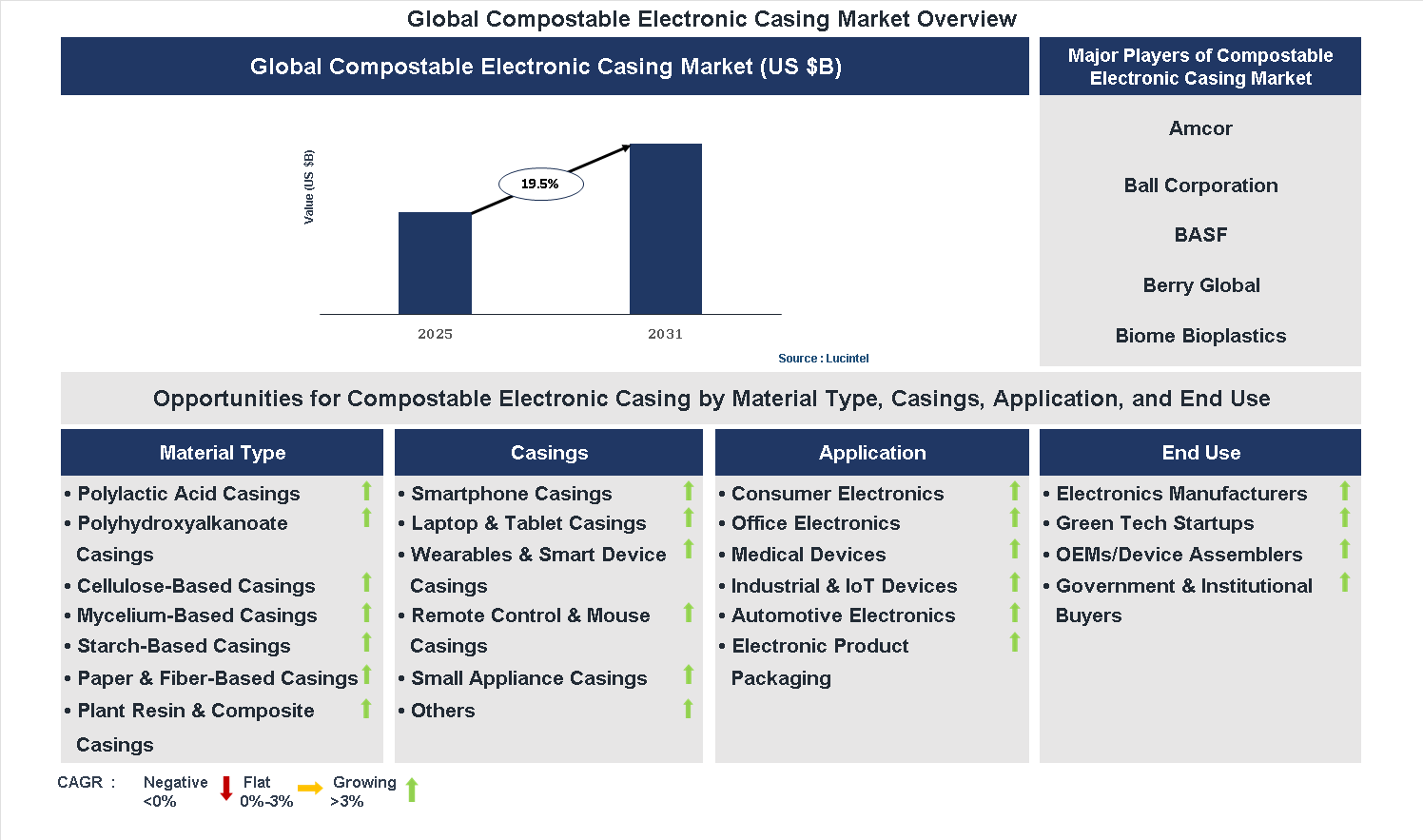
Key data points: The growth forecast = 19.5% annually for the next 7 years. Scroll below to get more insights. This market report covers trends, opportunities and forecasts in compostable electronic casing market to 2031 by material type (polylactic acid casings, polyhydroxyalkanoate casings, cellulose-based casings, mycelium-based casings, starch-based casings, paper & fiber-based casings, and plant resin & composite casings), casings (smartphone casings, laptop & tablet casings, wearables & smart device casings, remote control & mouse casings, small appliance casings, and others), application (consumer electronics, office electronics, medical devices, industrial & IoT devices, automotive electronics, and electronic product packaging), end use (electronics manufacturers, green tech startups, OEMs/device assemblers, and government & institutional buyers), and region (North America, Europe, Asia Pacific, and the Rest of the World)
We'll send your sample report shortly.
• Lucintel forecasts that, within the material type category, polylactic acid casing is expected to witness the highest growth over the forecast period.
• Within the application category, consumer electronics is expected to witness the highest growth.
• In terms of region, APAC is expected to witness the highest growth over the forecast period. Gain valuable insights for your business decisions with our comprehensive 150+ page report. Sample figures with some insights are shown below.
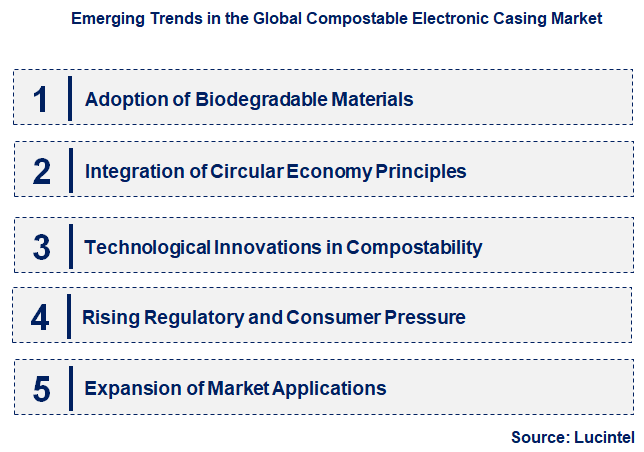
• Adoption of Biodegradable Materials: The market is increasingly utilizing biodegradable plastics and natural fibers for electronic casings. These materials decompose naturally, reducing landfill waste and environmental impact. Advances in material science have enabled the development of durable, lightweight, and cost-effective options that meet electronic performance standards. This trend is driven by consumer demand for eco-friendly products and stricter environmental regulations, encouraging manufacturers to innovate and adopt sustainable materials in their product lines.
• Integration of Circular Economy Principles: Companies are shifting towards designing electronic casings that are easily recyclable or compostable, promoting a circular economy. This involves creating modular designs for easy disassembly and reuse of components, minimizing waste. Such practices not only reduce environmental footprint but also offer economic benefits by conserving resources and reducing disposal costs. The trend is supported by policy initiatives and consumer preferences for sustainable products, fostering a more responsible approach to electronic product lifecycle management.
• Technological Innovations in Compostability: Advances in compostable materials now enable electronic casings to meet durability, heat resistance, and electrical insulation requirements. Researchers are developing new bioplastics and composite materials that can withstand the operational stresses of electronic devices while remaining environmentally friendly. These innovations are expanding the application scope of compostable casings across various electronic devices, from smartphones to wearables, thus broadening market opportunities and encouraging industry adoption.
• Rising Regulatory and Consumer Pressure: Governments worldwide are implementing stricter regulations on electronic waste disposal and promoting sustainable manufacturing practices. Simultaneously, consumers are increasingly prioritizing eco-friendly products, influencing brands to adopt compostable casings. This dual pressure accelerates market growth, as companies seek to comply with legal standards and meet consumer expectations. The trend fosters transparency and accountability in the supply chain, encouraging innovation and investment in sustainable packaging solutions.
• Expansion of Market Applications: The use of compostable casings is expanding beyond consumer electronics to include medical devices, packaging, and industrial equipment. This diversification is driven by the need for sustainable solutions across various sectors, creating new revenue streams and market segments. As industries recognize the environmental benefits and cost savings, demand for compostable casings is expected to grow significantly, further integrating sustainability into mainstream electronic manufacturing practices. In summary, these trends are fundamentally reshaping the compostable electronic casing market by fostering innovation, promoting sustainability, and responding to regulatory and consumer demands. The industry is moving towards a more environmentally responsible future, with eco-friendly materials and circular economy principles at its core, ultimately leading to a greener, more sustainable electronics ecosystem.
• Development of biodegradable polymers and plant-based composites : New materials such as polylactic acid (PLA) and mushroom-based mycelium are being used to create casings that decompose naturally, reducing landfill waste and environmental impact. These materials offer durability comparable to traditional plastics while maintaining eco-friendliness, encouraging manufacturers to adopt sustainable options without compromising product quality.
• Governments worldwide are implementing policies and incentives : Several countries are introducing regulations that favor biodegradable materials and impose restrictions on traditional plastics, encouraging manufacturers to switch to compostable casings. These policies accelerate market adoption and foster innovation, making eco-friendly options more accessible and cost-effective for producers.
• Automation and precision engineering techniques : Advances in manufacturing processes, such as 3D printing and injection molding with biodegradable materials, have improved production efficiency and scalability. These innovations reduce costs and lead times, enabling mass production of compostable casings and making them more commercially viable.
• Growing environmental consciousness among consumers : Consumers are increasingly prioritizing eco-friendly products, influencing brands to adopt sustainable packaging solutions. This demand drives companies to innovate and incorporate compostable casings, enhancing brand reputation and customer loyalty while reducing environmental footprints.
• Partnerships between tech firms, material scientists, and environmental organizations : Collaborative efforts are fostering research, standardization, and certification of compostable electronic casings. These initiatives promote industry-wide adoption, ensure product reliability, and build consumer trust in sustainable electronics. In summary, these developments are significantly transforming the compostable electronic casing market by fostering innovation, supporting regulatory frameworks, and responding to consumer demand. The market is moving toward more sustainable, scalable, and cost-effective solutions, which will likely lead to widespread adoption and a substantial reduction in electronic waste. This evolution not only benefits the environment but also offers new competitive advantages for forward-thinking companies.
• Growing demand for eco-friendly smartphones and gadgets : The adoption of compostable casings in consumer electronics reduces electronic waste and appeals to environmentally conscious consumers, boosting sales and brand loyalty.
• Sustainability in health and fitness wearables : Incorporating compostable casings in wearable devices enhances sustainability credentials, attracting health-conscious and eco-aware users, and opening new market segments.
• Eco-friendly disposables and single-use devices : Using compostable materials in medical device casings minimizes medical waste and aligns with regulatory trends toward greener healthcare solutions.
• Sustainable components for vehicle interiors : Implementing compostable casings in automotive electronics supports automakers sustainability commitments and appeals to eco-conscious consumers.
• Eco-friendly packaging solutions for electronics : Developing compostable enclosures for packaging reduces plastic waste and enhances brand image, meeting consumer demand for sustainable packaging options. In summary, these growth opportunities are significantly impacting the compostable electronic casing market by fostering innovation, reducing environmental footprints, and aligning with global sustainability initiatives. As applications expand across various sectors, market growth is expected to accelerate, driven by consumer preferences and regulatory support for eco-friendly products.
• Growing Environmental Awareness: The increasing global focus on reducing electronic waste and plastic pollution has led consumers and manufacturers to seek sustainable alternatives. Governments are implementing stricter regulations on e-waste disposal, encouraging companies to adopt compostable materials. This shift not only aligns with corporate social responsibility goals but also appeals to eco-conscious consumers, thereby expanding market demand. As awareness continues to rise, the adoption of compostable electronic casings is expected to accelerate, fostering innovation and investment in biodegradable materials.
• Technological Advancements in Biodegradable Materials: Innovations in biodegradable polymers and eco-friendly composites have significantly improved the performance and durability of compostable electronic casings. Researchers are developing materials that meet industry standards for strength, heat resistance, and longevity while remaining environmentally friendly. These technological breakthroughs enable manufacturers to produce high-quality, sustainable products that can replace traditional plastics without compromising functionality, thus expanding the market scope and application range.
• Increasing Regulatory Support and Policies: Governments worldwide are enacting policies and regulations aimed at reducing electronic waste and promoting sustainable packaging solutions. Initiatives such as bans on single-use plastics, incentives for eco-friendly product development, and standards for biodegradable materials are creating a favorable environment for market growth. Regulatory support not only encourages manufacturers to innovate but also provides a framework for market expansion, ensuring that compostable electronic casings meet safety and environmental standards.
• Rising Consumer Demand for Eco-Friendly Products: Consumers are becoming more environmentally conscious and prefer products that minimize ecological impact. This shift in consumer preferences is compelling electronics manufacturers to incorporate sustainable materials into their products, including compostable casings. The demand for eco-friendly electronics is particularly strong among younger demographics, which influences brand reputation and sales. As consumer awareness and demand grow, companies are incentivized to invest in sustainable packaging solutions, further driving market expansion.
• Strategic Collaborations and Investments: Partnerships between material suppliers, electronics manufacturers, and environmental organizations are fostering innovation and scaling production capabilities. Investments in research and development are leading to the creation of more efficient, cost-effective compostable materials. Strategic collaborations also facilitate knowledge sharing and standardization, which are crucial for market growth. These initiatives help overcome technical and economic barriers, enabling the industry to meet increasing demand for sustainable electronic casings. The challenges facing compostable electronic casing market include:
• High Production Costs: Developing and manufacturing compostable electronic casings often involve expensive biodegradable materials and specialized processing techniques. These costs can be significantly higher than traditional plastic manufacturing, making products less competitive in price. Small and medium-sized enterprises may find it difficult to absorb these costs, limiting market penetration. Overcoming this challenge requires technological innovations to reduce costs and economies of scale to make sustainable options more affordable for mass production.
• Technological Limitations: Despite advancements, biodegradable materials still face issues related to durability, heat resistance, and long-term stability. These limitations can restrict the use of compostable casings in high-performance electronic devices that require robust protection. Additionally, compatibility with existing manufacturing processes can pose challenges, necessitating further research and development. Addressing these technological hurdles is essential to ensure that compostable casings can meet industry standards and consumer expectations.
• Regulatory and Standardization Barriers: While regulations support eco-friendly initiatives, the lack of comprehensive standards and certification processes for compostable electronic casings can hinder market growth. Unclear or inconsistent standards may lead to consumer mistrust and legal complications. Manufacturers may face difficulties in ensuring compliance across different regions, slowing down product development and adoption. Establishing clear, globally recognized standards is crucial to facilitate market expansion and build consumer confidence. In summary, the compostable electronic casing market is driven by increasing environmental awareness, technological innovations, supportive policies, consumer demand, and strategic collaborations. However, high costs, technological constraints, and regulatory challenges pose significant hurdles. These factors collectively influence the markets growth trajectory, requiring concerted efforts from stakeholders to overcome obstacles and harness opportunities. The markets future depends on balancing sustainability goals with technological and economic feasibility, ultimately fostering a more eco-friendly electronics industry.
• Amcor
• Ball Corporation
• BASF
• Berry Global
• Biome Bioplastics
• BioBag, Braskem
• Corbion
• EcoEnclose
• International Paper
• Mondi
• Polylactic Acid Casings
• Polyhydroxyalkanoate Casings
• Cellulose-Based Casings
• Mycelium-Based Casings
• Starch-Based Casings
• Paper & Fiber-Based Casings
• Plant Resin & Composite Casings
• Smartphone Casings
• Laptop & Tablet Casings
• Wearables & Smart Device Casings
• Remote Control & Mouse Casings
• Small Appliance Casings
• Others
• Consumer Electronics
• Office Electronics
• Medical Devices
• Industrial & IoT Devices
• Automotive Electronics
• Electronic Product Packaging
• Electronics Manufacturers
• Green Tech Startups
• OEMs/Device Assemblers
• Government & Institutional Buyers
• North America
• Europe
• Asia Pacific
• The Rest of the World
• United States: The U.S. market has seen significant advancements with increased investments in biodegradable materials and eco-design initiatives. Major tech companies are adopting compostable casings to meet sustainability goals, supported by government incentives for green innovation. Research institutions are developing new bioplastics with enhanced durability and compostability, fostering industry adoption. Regulatory frameworks are gradually encouraging eco-friendly packaging, influencing manufacturers to shift toward sustainable electronic casings. Consumer demand for environmentally responsible products is also driving market growth, prompting startups and established firms to explore compostable solutions for electronic devices.
• China: China is rapidly expanding its compostable electronic casing market, driven by government policies promoting green manufacturing and environmental protection. The country is investing heavily in research and development of biodegradable materials suitable for electronics, with several local firms launching innovative products. The adoption of compostable casings is also supported by Chinas push for sustainable supply chains and eco-friendly packaging standards. Additionally, the growing domestic electronics market and export demands are encouraging manufacturers to incorporate eco-conscious materials. Collaborations between research institutes and industry players are accelerating the commercialization of compostable electronic components.
• Germany: Germany leads in integrating sustainability into its electronics industry, with a focus on eco-design and circular economy principles. The country has developed advanced biodegradable plastics that meet stringent quality standards for electronic casings. German companies are pioneering in the development of compostable materials that combine durability with environmental benefits. Regulatory measures, such as stricter waste management policies and eco-labeling requirements, are incentivizing manufacturers to adopt compostable solutions. The country’s emphasis on innovation and sustainability is fostering collaborations between academia and industry to enhance material performance and scalability.
• India: Indias compostable electronic casing market is emerging, driven by increasing environmental awareness and government initiatives promoting sustainable manufacturing. The country is exploring biodegradable materials suitable for low-cost electronic devices, aiming to reduce e-waste and plastic pollution. Several startups are developing eco-friendly casings, supported by funding from government schemes and international organizations. The expanding electronics market and rising consumer consciousness are creating demand for sustainable products. Challenges remain in scaling production and ensuring material performance, but ongoing research and policy support are expected to accelerate market growth in the coming years.
• Japan: Japan is focusing on integrating compostable materials into its electronics manufacturing sector, emphasizing innovation and environmental responsibility. The country has developed advanced bioplastics that meet the high standards required for electronic casings, with several companies conducting pilot projects. Japan’s strict environmental regulations and consumer preferences for sustainable products are driving adoption. The government is supporting research into biodegradable materials and promoting eco-friendly product design. Collaborations between industry and academia are fostering technological advancements, aiming to establish Japan as a leader in compostable electronic casing solutions with a focus on quality and environmental impact.


• Amcor
• Ball Corporation
• BASF
• Berry Global
• Biome Bioplastics
• BioBag, Braskem
• Corbion
• EcoEnclose
• International Paper
• Mondi Q5. Which compostable electronic casing market segment will be the largest in future? Answer: Lucintel forecasts that, within the material type category, polylactic acid casing is expected to witness the highest growth over the forecast period. Q6. In compostable electronic casing market, which region is expected to be the largest in next 5 years? Answer: In terms of region, APAC is expected to witness the highest growth over the forecast period. Q7. Do we receive customization in this report? Answer: Yes, Lucintel provides 10% customization without any additional cost.


Choose a license that fits your team. Instant PDF delivery.
Prices exclude taxes. Instant delivery. Custom licensing available on request.
Market Report · July 29, 2026
Market Report · July 15, 2026
Market Report · July 13, 2026
Trusted partner for strategic intelligence and business growth


Receive a complimentary market analysis tailored to your industry. Our analysts will identify key growth opportunities and competitive dynamics specific to your business.

Market size, growth rate, and key trend analysis for your specific sector.

Top competitor positioning and market share analysis.

Strategic recommendations backed by data-driven insights.
Get curated market intelligence and competitive moves straight to your inbox.
By subscribing, you agree to receive our monthly insights. Unsubscribe anytime.
Receive a complimentary market analysis tailored to your industry. Our analysts will identify key growth opportunities and competitive dynamics specific to your business.
Market size, growth rate, and key trend analysis for your specific sector.
Top competitor positioning and market share analysis.
Strategic recommendations backed by data-driven insights.
Get curated market intelligence, emerging trends, and competitive moves straight to your inbox each month.
By subscribing, you agree to receive our monthly insights. Unsubscribe anytime.
We'll send your sample report shortly.