
Report Feature
Competent Cell Market Trends and Forecast
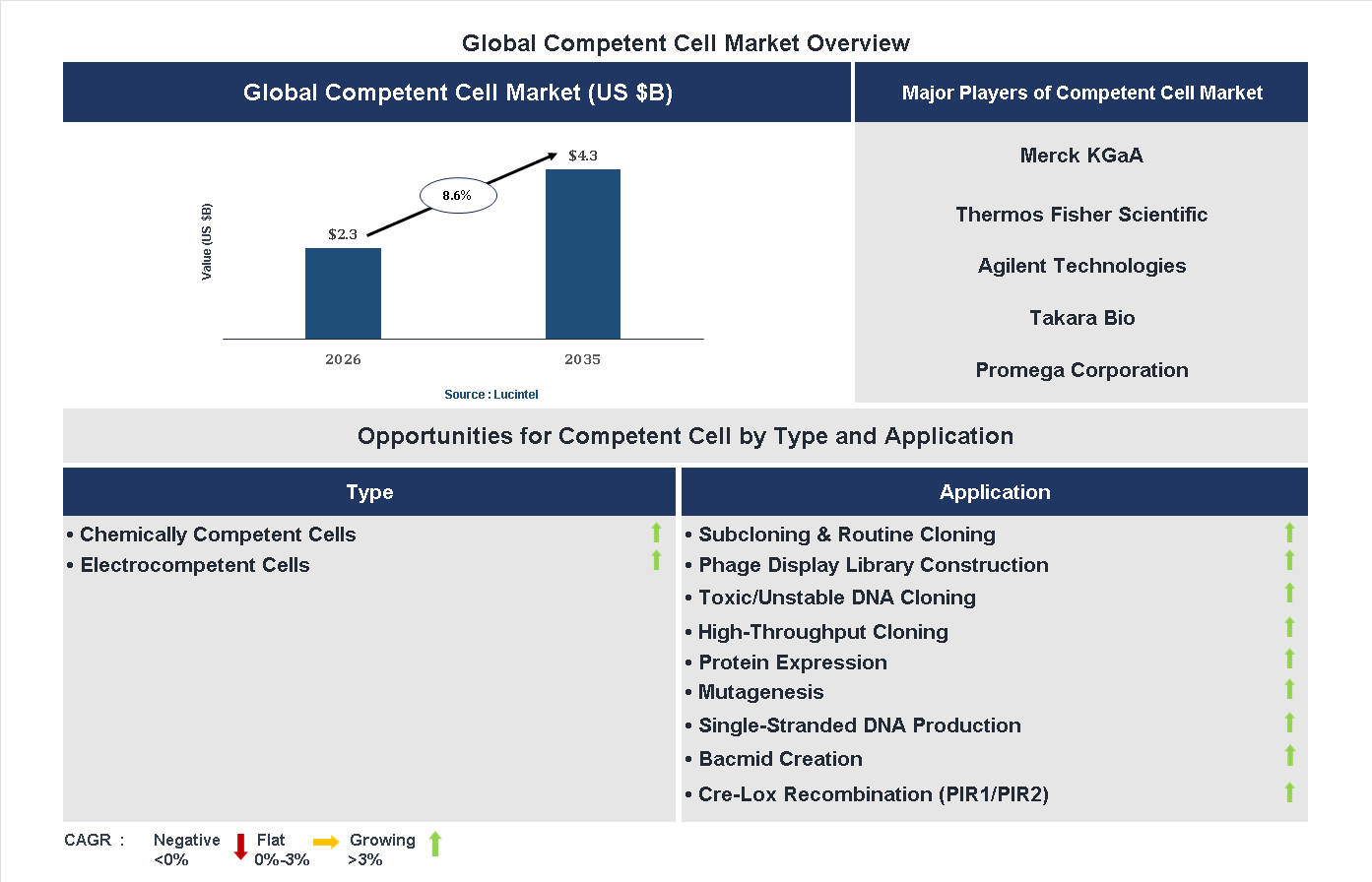
The future of the global competent cell market looks promising with opportunities in the subcloning & routine cloning, phage display library construction, toxic/unstable DNA cloning, high-throughput cloning, protein expression, mutagenesis, single-stranded DNA production, bacmid creation, and cre-lox recombination (PIR1/PIR2) markets. The global competent cell market is expected to reach an estimated $4.3 billion by 2035 with a CAGR of 8.6% from 2026 to 2035. The major drivers for this market are the growing use in genetic engineering research, the increasing microbial and protein expression studies, and the rising production of genetically modified organisms.• Lucintel forecasts that, within the type category, chemically competent cell is expected to witness higher growth over the forecast period.
• Within the application category, subcloning & routine cloning is expected to witness the highest growth.
• In terms of region, APAC is expected to witness the highest growth over the forecast period. Gain valuable insights for your business decisions with our comprehensive 150+ page report. Sample figures with some insights are shown below.
Emerging Trends in the Competent Cell Market
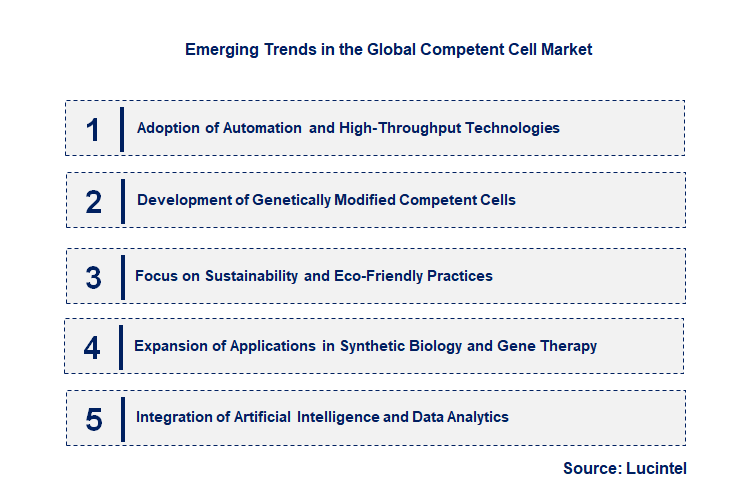
The competent cell market is experiencing rapid evolution driven by technological advancements, increasing demand for genetic engineering, and the need for efficient molecular biology tools. As research institutions, biotech companies, and pharmaceutical firms seek faster, more reliable methods for DNA cloning and genetic modification, the market is adapting to meet these needs. Emerging trends are shaping the landscape by introducing innovative technologies, expanding applications, and emphasizing sustainability. These developments are not only enhancing productivity but also reducing costs and environmental impact, ultimately transforming how genetic research and biotechnological processes are conducted worldwide.• Adoption of Automation and High-Throughput Technologies: The integration of automation in competent cell production and transformation processes is streamlining workflows, reducing human error, and increasing throughput. Automated systems enable large-scale experiments with minimal manual intervention, accelerating research timelines. This trend is particularly impactful for pharmaceutical and biotech companies aiming for rapid development cycles. As automation becomes more accessible, smaller labs can also benefit, democratizing advanced genetic techniques and fostering innovation across the industry.
• Development of Genetically Modified Competent Cells: Researchers are engineering competent cells with enhanced transformation efficiency, stability, and specificity. These genetically modified cells improve the success rate of cloning and gene editing, especially for difficult-to-transform strains. The impact is significant, as it allows for more complex genetic manipulations, broadening research possibilities. This trend supports personalized medicine, synthetic biology, and advanced therapeutics, making genetic modifications more precise and reliable, thus expanding the market’s scope.
• Focus on Sustainability and Eco-Friendly Practices: The market is shifting towards environmentally sustainable production methods, including biodegradable packaging and reduced chemical usage. Companies are investing in greener processes to minimize waste and energy consumption. This trend appeals to eco-conscious consumers and regulatory bodies, fostering a positive brand image. Sustainable practices also lower operational costs in the long term, encouraging industry-wide adoption. As environmental concerns grow, eco-friendly, competent cell products are becoming a key differentiator in the market.
• Expansion of Applications in Synthetic Biology and Gene Therapy: Competent cells are increasingly used beyond traditional cloning, notably in synthetic biology, gene therapy, and personalized medicine. These applications demand highly efficient and safe transformation methods, driving innovation in competent cell technology. The impact includes accelerated development of gene-based treatments and bioengineered products, opening new revenue streams. This trend is transforming the market from a niche research tool to a critical component in advanced therapeutic solutions, significantly broadening its scope and market size.
• Integration of Artificial Intelligence and Data Analytics: AI-driven algorithms are optimizing competent cell design, transformation protocols, and process efficiencies. Data analytics help predict outcomes, troubleshoot issues, and customize solutions for specific applications. This integration enhances accuracy, reduces development time, and lowers costs. The impact is profound, enabling personalized approaches and rapid innovation cycles. As AI becomes more embedded in biotech workflows, the competent cell market is poised for smarter, more efficient, and highly tailored solutions, fostering a competitive edge for early adopters. These emerging trends are collectively reshaping the competent cell market by increasing efficiency, expanding application areas, promoting sustainability, and integrating cutting-edge technologies. This evolution is driving faster innovation, reducing costs, and opening new avenues for research and therapeutic development, ultimately positioning the market for sustained growth and technological leadership.
Recent Development in the Competent Cell Market
The competent cell market is experiencing rapid growth driven by advancements in genetic research, biotechnology, and pharmaceutical development. Increasing demand for efficient cloning and gene editing techniques is fueling innovation. Market players are investing in new technologies to improve cell competency and transformation efficiency. The expanding application scope across research, diagnostics, and therapeutics is further propelling market expansion. This dynamic environment offers significant opportunities for stakeholders to develop innovative solutions, meet rising industry needs, and capture new market segments.• Growing Demand for Genetic Engineering: The rise in genetic research and biotechnology applications is boosting the need for competent cells, essential for gene cloning and transformation. This demand is driven by advancements in CRISPR and other gene editing technologies, which require highly efficient competent cells. As research accelerates, the market for competent cells expands, offering opportunities for manufacturers to develop specialized products tailored to specific research needs. The increasing adoption across academic, clinical, and industrial sectors is a key growth driver.
• Technological Innovations in Cell Preparation: Innovations in cell preparation techniques, such as electroporation and chemical transformation, are enhancing transformation efficiency. These advancements reduce time and improve success rates, making procedures more reliable and accessible. Companies investing in novel methods are gaining competitive advantages, leading to a broader application scope. Improved protocols also enable the use of a wider variety of cell types, expanding market reach. These technological improvements are crucial for meeting the evolving demands of research and clinical applications.
• Rising Adoption in Pharmaceutical and Biotech Industries: The pharmaceutical and biotech sectors are increasingly utilizing competent cells for drug development, gene therapy, and vaccine production. The need for high-efficiency transformation systems accelerates research and reduces development timelines. This trend is supported by increased R&D investments and collaborations. As these industries grow, so does the demand for specialized competent cells capable of supporting complex genetic manipulations, thereby expanding market opportunities and encouraging innovation in cell technology.
• Expansion of Research and Diagnostic Applications: Competent cells are vital for various research and diagnostic procedures, including gene expression analysis and mutation detection. The expanding scope of molecular diagnostics and personalized medicine is driving demand. Increased funding for biomedical research and the rise of academic and clinical laboratories contribute to market growth. The development of tailored competent cell products for specific applications enhances efficiency and accuracy, further fueling market expansion and encouraging product innovation.
• Increasing Focus on Quality and Regulatory Standards: Stringent quality control and regulatory standards are prompting manufacturers to improve product consistency and safety. This focus ensures reliable results in research and clinical settings, boosting user confidence. Compliance with international standards like ISO and GMP is becoming essential, leading to product innovation and higher manufacturing costs. Companies investing in quality assurance are gaining a competitive edge, fostering trust and expanding their market share. This emphasis on standards is shaping the future landscape of the competent cell market. These recent developments are significantly transforming the competent cell market by enhancing product efficiency, expanding application areas, and fostering innovation. Technological advancements, increased industry adoption, and stringent quality standards are driving growth and competitiveness. As research and clinical demands continue to rise, the market is poised for sustained expansion, offering lucrative opportunities for existing players and new entrants. Overall, these developments are creating a more dynamic, reliable, and versatile market landscape.
Strategic Growth Opportunities in the Competent Cell Market
The competent cell market is experiencing rapid expansion driven by advancements in genetic engineering, molecular biology, and biotechnological research. Increasing demand for efficient cloning, protein expression, and gene editing techniques is fueling growth. Innovations in vector development and automation are enhancing productivity and accuracy. The markets growth is also supported by rising investments in the pharmaceutical and agricultural biotech sectors. As research accelerates, opportunities for new product development and application expansion are creating a dynamic landscape for stakeholders.• Expansion of Recombinant DNA Technology and Cloning Applications: The growing need for efficient cloning vectors and competent cells to facilitate gene insertion and expression is a key driver. Advances in vector design and cell preparation techniques improve transformation efficiency, enabling faster research and development. This expansion supports pharmaceutical, agricultural, and industrial biotech sectors, creating opportunities for companies to develop specialized competent cells tailored for specific applications, thus broadening market reach and innovation.
• Increasing Adoption of Automation and High-Throughput Screening Methods: Automation in competent cell preparation and transformation processes enhances reproducibility, reduces manual errors, and accelerates research timelines. High-throughput screening capabilities allow rapid testing of multiple constructs, increasing productivity. This trend attracts biotech firms seeking scalable solutions, fostering market growth. Investment in automated systems and compatible competent cells is expected to rise, further expanding the market and enabling more complex genetic engineering projects.
• Rising Demand for Gene Editing and CRISPR Technologies: The advent of CRISPR and other gene editing tools has heightened the need for highly competent cells that support precise genetic modifications. Specialized competent cells optimized for gene editing improve efficiency and accuracy, reducing off-target effects. This demand is particularly strong in therapeutic research and crop improvement. Companies developing tailored competent cells for gene editing are poised to capitalize on this trend, driving innovation and market expansion.
• Growing Applications in Personalized Medicine and Vaccine Development: Competent cells are essential for producing recombinant proteins, monoclonal antibodies, and vaccines. The shift toward personalized medicine requires rapid, efficient protein expression systems, boosting demand for advanced competent cells. Additionally, the COVID-19 pandemic underscored the importance of competent cells in vaccine development. This expanding application base encourages investment in novel cell lines and production platforms, fostering market growth and diversification.
• Increasing Focus on Sustainable and Cost-Effective Solutions: The market is moving toward developing affordable, environmentally friendly, and competent cells that reduce resource consumption and waste. Innovations in cell preparation and preservation techniques aim to lower costs and improve stability. This focus appeals to academic institutions and small biotech firms, broadening market accessibility. Sustainable solutions also align with regulatory and societal expectations, positioning companies to meet future demands and expand their market share. The overall landscape of the competent cell market is shaped by technological advancements and expanding application areas, promising significant growth opportunities. These developments will likely lead to more efficient, versatile, and sustainable solutions, fostering innovation across biotech, pharmaceutical, and agricultural sectors. As companies capitalize on these opportunities, the market is expected to experience sustained expansion and diversification.
Competent Cell Market Driver and Challenges
The competent cell market is influenced by a variety of technological, economic, and regulatory factors that shape its growth and development. Advances in biotechnology and molecular biology have driven demand for specialized competent cells used in genetic engineering, cloning, and research applications. Economic factors such as increasing funding for life sciences and pharmaceutical research further propel market expansion. Regulatory frameworks ensure safety and standardization, impacting product development and commercialization. However, challenges such as high R&D costs, regulatory hurdles, and technological complexities also pose significant barriers. Understanding these drivers and challenges is essential for stakeholders aiming to capitalize on market opportunities and navigate potential risks effectively. The factors responsible for driving the competent cell market include:• Technological Innovation: The continuous development of advanced transformation techniques and genetic engineering tools has significantly increased the efficiency and reliability of competent cells. Innovations like electroporation and chemical transformation methods have improved success rates, enabling researchers to perform complex genetic modifications. This technological progress has expanded the application scope, from basic research to industrial biotech, fostering market growth. Companies investing in R&D are introducing more efficient, cost-effective, competent cells, which further accelerate adoption across various sectors. The demand for high-performance cells that can handle complex genetic manipulations remains a key growth driver.
• Rising Research and Development Activities: The surge in R&D activities across pharmaceuticals, biotechnology, and academic institutions is a major driver. Governments and private organizations are increasing funding for genetic research, drug discovery, and personalized medicine, all of which require competent cells. This increased investment leads to higher demand for specialized cells tailored for specific applications, such as CRISPR gene editing or plasmid propagation. The expanding pipeline of biotech innovations and the need for reliable tools to facilitate genetic modifications are fueling market expansion. As research intensifies, the demand for high-quality competent cells continues to grow, supporting market growth.
• Growing Adoption in Pharmaceutical and Biotech Industries: The pharmaceutical and biotech sectors are increasingly adopting competent cells for drug development, gene therapy, and vaccine production. The ability to efficiently introduce genetic material into host cells accelerates the development of biopharmaceuticals and personalized medicines. The rising prevalence of genetic disorders and infectious diseases further boosts demand for advanced genetic engineering tools. Additionally, the shift towards biologics over traditional small-molecule drugs enhances the need for competent cells in manufacturing processes. This sector-specific adoption is a significant driver, contributing to the overall expansion of the competent cell market.
• Increasing Focus on Personalized Medicine: The trend toward personalized medicine is driving demand for genetically engineered cells tailored to individual patient profiles. Competent cells are essential for developing gene therapies and customized treatments, which require precise genetic modifications. The growing understanding of genomics and molecular diagnostics enables targeted therapies, necessitating specialized competent cells. This focus on personalized approaches is expanding the market, especially in regions with advanced healthcare infrastructure. The ability to produce patient-specific cells and therapies is a key factor propelling market growth, aligning with the broader shift toward precision medicine.
• Expansion of Biotechnological Applications: The broadening scope of biotechnological applications, including agriculture, industrial enzymes, and environmental management, is a major driver. Competent cells are used in developing genetically modified crops, biofuels, and bioremediation agents. The increasing demand for sustainable and eco-friendly solutions encourages innovation in competent cell technology. Additionally, the rise of synthetic biology and metabolic engineering relies heavily on competent cells for constructing complex genetic circuits. This diversification of applications enhances market opportunities and stimulates investment in new competent cell products, fostering overall market growth. The challenges facing this Market include:
• High R&D and Production Costs: Developing and manufacturing competent cells involves significant investment in research, specialized equipment, and quality control. The high costs associated with R&D, validation, and scaling up production can limit market entry for smaller players and increase prices for end-users. These expenses may hinder rapid innovation and restrict accessibility, especially in emerging markets. Additionally, maintaining consistency and quality across batches is challenging, impacting product reliability. The financial burden associated with these costs poses a substantial barrier to market expansion and competitiveness.
• Regulatory and Safety Concerns: Stringent regulatory frameworks govern the development, testing, and commercialization of genetically modified organisms and related products. Navigating complex approval processes can delay product launches and increase compliance costs. Safety concerns related to gene editing and potential environmental impacts also influence regulatory policies, requiring extensive testing and documentation. Variability in regulations across regions adds complexity for global market players. These regulatory hurdles can impede innovation, restrict market entry, and increase time-to-market, thereby affecting overall growth prospects.
• Technological Complexities and Standardization Issues: The diverse range of competent cell types and transformation methods presents challenges in standardization and quality assurance. Variability in cell performance and transformation efficiency can impact research outcomes and industrial applications. Rapid technological advancements require continuous updates and validation, which can be resource-intensive. Moreover, the lack of universally accepted standards hampers interoperability and comparability across products and laboratories. These complexities can slow adoption, increase costs, and create barriers for new entrants, ultimately affecting market stability and growth. The competent cell market is driven by technological innovations, increased research activities, and expanding applications in pharmaceuticals and biotechnology. However, high development costs, regulatory challenges, and technological complexities pose significant hurdles. The interplay of these factors influences market dynamics, with growth opportunities driven by emerging applications and personalized medicine. Addressing challenges through regulatory harmonization, cost reduction, and technological standardization will be crucial for sustained growth. Overall, the markets future depends on balancing innovation with regulatory and operational efficiencies to meet the evolving needs of the biotech and pharmaceutical industries.
List of Competent Cell Companies
Companies in the market compete on the basis of product quality offered. Major players in this market focus on expanding their manufacturing facilities, R&D investments, infrastructural development, and leverage integration opportunities across the value chain. With these strategies competent cell companies cater increasing demand, ensure competitive effectiveness, develop innovative products & technologies, reduce production costs, and expand their customer base. Some of the competent cell companies profiled in this report include-• Merck KGaA
• Thermos Fisher Scientific
• Agilent Technologies
• Takara Bio
• Promega Corporation
• Beijing TransGen Biotech
• GeneScript Corporation
• Yeastern Biotech
• New England Biolabs
• QIAGEN N.V.
Competent Cell Market by Segment
The study includes a forecast for the global competent cell market by type, application, and region.Competent Cell Market by Type [Value from 2019 to 2035]:
• Chemically Competent Cells
• Electrocompetent Cells
Competent Cell Market by Application [Value from 2019 to 2035]:
• Subcloning & Routine Cloning
• Phage Display Library Construction
• Toxic/Unstable DNA Cloning
• High-Throughput Cloning
• Protein Expression
• Mutagenesis
• Single-Stranded DNA Production
• Bacmid Creation
• Cre-Lox Recombination (PIR1/PIR2)
Competent Cell Market by Region [Value from 2019 to 2035]:
• North America
• Europe
• Asia Pacific
• The Rest of the World
Country Wise Outlook for the Competent Cell Market
The competent cell market has experienced significant growth driven by advancements in biotechnology, genetic research, and pharmaceutical development. As demand for efficient gene editing, cloning, and molecular biology techniques increases, countries are investing heavily in research and infrastructure. Innovations in cell engineering, automation, and regulatory support are shaping the landscape, making competent cells more accessible and versatile. The markets evolution reflects broader trends in personalized medicine, agricultural biotech, and industrial applications. Each countrys unique research priorities and technological capabilities influence its market dynamics, leading to diverse growth patterns and strategic investments across the globe.• United States: The United States leads the competent cell market with extensive research institutions and biotech companies investing in innovative cell engineering techniques. Recent developments include the launch of automated high-throughput competent cell production systems and enhanced transformation efficiencies. Regulatory support and funding from government agencies like NIH foster rapid advancements. The market also benefits from collaborations between academia and industry, accelerating product commercialization and application in personalized medicine and gene therapy.
• China: China has rapidly expanded its competent cell market through substantial government funding and a focus on biotech innovation. Recent developments include the establishment of state-of-the-art research facilities and the commercialization of cost-effective competent cell products. Chinese companies are increasingly adopting automation and high-throughput technologies to meet domestic and international demand. The country’s emphasis on agricultural biotech and synthetic biology further drives market growth, with a focus on developing specialized competent cells for diverse applications.
• Germany: Germanys competent cell market is characterized by a strong emphasis on quality, regulatory compliance, and innovative research. Recent advancements include the development of highly efficient competent cells tailored for industrial and clinical applications. German biotech firms are investing in sustainable and eco-friendly production methods, aligning with EU regulations. Collaborations between research institutes and industry are fostering the development of next-generation competent cells, especially for gene editing and therapeutic uses, reinforcing Germany’s position as a leader in European biotech innovation.
• India: India is witnessing rapid growth in the competent cell market driven by increasing research activities and a burgeoning biotech industry. Recent developments include the introduction of affordable, competent cell products and the expansion of R&D infrastructure. Indian companies are focusing on developing specialized competent cells for agricultural biotech, pharmaceuticals, and academic research. Government initiatives supporting biotech startups and innovation hubs are further propelling market growth, making India a key player in affordable and scalable competent cell solutions.
• Japan: Japans competent cell market is marked by technological innovation and a focus on precision medicine. Recent advancements include the development of highly efficient, stable, competent cells for gene editing and therapeutic applications. Japanese firms are investing in automation and integration with other biotechnologies to enhance productivity. The country’s strong regulatory framework and emphasis on quality control support the development of safe and effective competent cell products, positioning Japan as a significant contributor to global biotech advancements and personalized medicine initiatives.

Features of the Global Competent Cell Market
Market Size Estimates: Competent cell market size estimation in terms of value ($B). Trend and Forecast Analysis: Market trends (2019 to 2025) and forecast (2026 to 2035) by various segments and regions. Segmentation Analysis: Competent cell market size by type, application, and region in terms of value ($B). Regional Analysis: Competent cell market breakdown by North America, Europe, Asia Pacific, and Rest of the World. Growth Opportunities: Analysis of growth opportunities in different types, applications, and regions for the competent cell market. Strategic Analysis: This includes M&A, new product development, and competitive landscape of the competent cell market. Analysis of competitive intensity of the industry based on Porter’s Five Forces model.
FAQ
Q1. What is the competent cell market size? Answer: The global competent cell market is expected to reach an estimated $4.3 billion by 2035. Q2. What is the growth forecast for competent cell market? Answer: The global competent cell market is expected to grow with a CAGR of 8.6% from 2026 to 2035. Q3. What are the major drivers influencing the growth of the competent cell market? Answer: The major drivers for this market are the growing use in genetic engineering research, the increasing microbial and protein expression studies, and the rising production of genetically modified organisms. Q4. What are the major segments for competent cell market? Answer: The future of the competent cell market looks promising with opportunities in the subcloning & routine cloning, phage display library construction, toxic/unstable DNA cloning, high-throughput cloning, protein expression, mutagenesis, single-stranded DNA production, bacmid creation, and cre-lox recombination (PIR1/PIR2) markets. Q5. Who are the key competent cell market companies? Answer: Some of the key competent cell companies are as follows:• Merck KGaA
• Thermos Fisher Scientific
• Agilent Technologies
• Takara Bio
• Promega Corporation
• Beijing TransGen Biotech
• GeneScript Corporation
• Yeastern Biotech
• New England Biolabs
• QIAGEN N.V. Q6. Which competent cell market segment will be the largest in future? Answer: Lucintel forecasts that, within the type category, chemically competent cell is expected to witness higher growth over the forecast period. Q7. In competent cell market, which region is expected to be the largest in next 5 years? Answer: In terms of region, APAC is expected to witness the highest growth over the forecast period. Q8. Do we receive customization in this report? Answer: Yes, Lucintel provides 10% customization without any additional cost.
Table of Contents
List of Figures
List of Tables
Methodology
- In-depth interviews of the major players in this market
- Detailed secondary research from competitors’ financial statements and published data
- Extensive searches of published works, market, and database information pertaining to industry news, company press releases, and customer intentions
- A compilation of the experiences, judgments, and insights of Lucintel’s professionals, who have analyzed and tracked this market over the years.


Buy Now
Choose a license that fits your team. Instant PDF delivery.
Prices exclude taxes. Instant delivery. Custom licensing available on request.
Key Questions
- • What are some of the most promising, high-growth opportunities for the competent cell market by type (chemically competent cells and electrocompetent cells), application (subcloning & routine cloning, phage display library construction, toxic/unstable DNA cloning, high-throughput cloning, protein expression, mutagenesis, single-stranded DNA production, bacmid creation, and cre-lox recombination (PIR1/PIR2)), and region (North America, Europe, Asia Pacific, and the Rest of the World)?
- • Which segments will grow at a faster pace and why?
- • Which region will grow at a faster pace and why?
- • What are the key factors affecting market dynamics? What are the key challenges and business risks in this market?
- • What are the business risks and competitive threats in this market?
- • What are the emerging trends in this market and the reasons behind them?
- • What are some of the changing demands of customers in the market?
- • What are the new developments in the market? Which companies are leading these developments?
- • Who are the major players in this market? What strategic initiatives are key players pursuing for business growth?
- • What are some of the competing products in this market and how big of a threat do they pose for loss of market share by material or product substitution?
- • What M&A activity has occurred in the last 7 years and what has its impact been on the industry? For any questions related to Competent Cell Market, Competent Cell Market Size, Competent Cell Market Growth, Competent Cell Market Analysis, Competent Cell Market Report, Competent Cell Market Share, Competent Cell Market Trends, Competent Cell Market Forecast, Competent Cell Companies, write Lucintel analyst at email: helpdesk@lucintel.com. We will be glad to get back to you soon.


