
Report Feature
Compaction Equipment Market Trends and Forecast
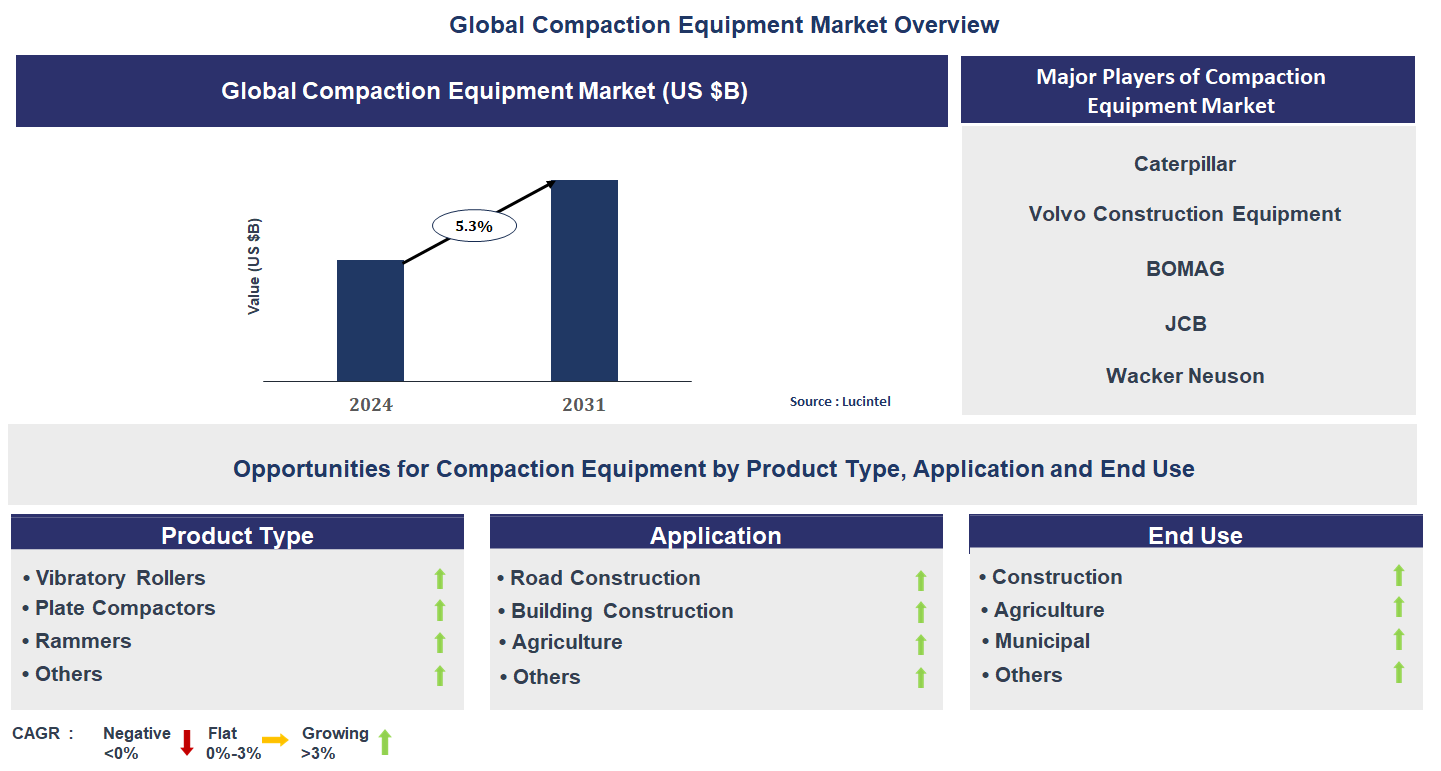
The future of the global compaction equipment market looks promising with opportunities in the construction, agriculture, and municipal markets. The global compaction equipment market is expected to grow with a CAGR of 5.3% from 2025 to 2031. The major drivers for this market are the increasing demand for soil compaction in construction, the rising focus on efficient construction processes, and the growing adoption of advanced compaction technologies.• Lucintel forecasts that, within the product type category, vibratory roller will remain the largest segment over the forecast period.
• Within the end use category, construction will remain the largest segment.
• In terms of region, APAC will remain the largest region over the forecast period. Gain valuable insights for your business decisions with our comprehensive 150+ page report. Sample figures with some insights are shown below.
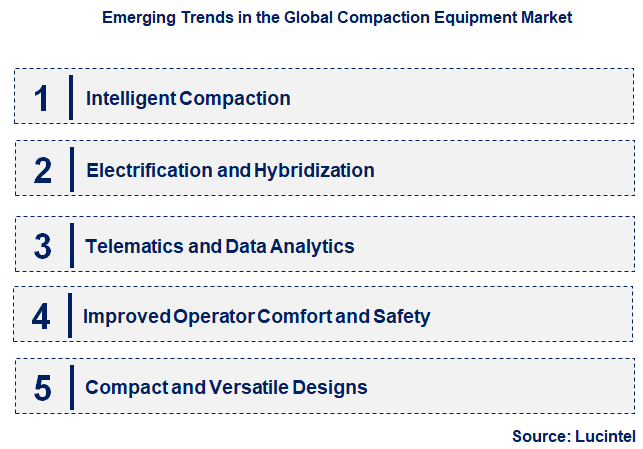
Emerging Trends in the Compaction Equipment Market
The compaction equipment industry is making a dramatic shift, with major trends fueled by an international drive towards higher efficiency, sustainability, and integration of technology. These trends are profoundly changing how earthwork and road building are performed. The sector is shifting from outdated, labor-based processes to intelligent, automatic, and eco-friendly options.• Intelligent Compaction: Intelligent compaction is the leading edge of this market’s transformation. This technology utilizes machines that are fitted with sophisticated sensors, GPS, and real-time feedback systems to closely measure and control the compaction process. The equipment can feel the stiffness of the soil and vibration response, and the operator can sense when optimal compaction is reached, avoiding over-compaction and minimizing the number of passes.
• Electrification and Hybridization: The shift towards electric and hybrid compaction machines is a significant trend fueled by tighter emissions controls and worldwide efforts toward sustainability. These vehicles produce zero tailpipe emissions and greatly less noise pollution, placing them on highly suitable urban and residential construction projects. Although investment costs at the outset are higher, benefits in the longer term are the lower fuel usage and reduced maintenance.
• Telematics and Data Analytics: The increasing adoption of telematics and data analytics is making it possible for companies to track their equipment remotely. Compaction machines can transmit real-time information about their location, operating condition, fuel usage, and maintenance requirements to a central console via embedded sensors. This data-based system improves operating efficiency, facilitates predictive maintenance, and optimizes fleet management.
• Improved Operator Comfort and Safety: Manufacturers are placing a greater emphasis on operator comfort and safety. This encompasses the creation of ergonomic cabs with climate control, intuitive control configurations, and enhanced visibility. Sophisticated features such as anti-vibration systems and automatic steering assist minimize operator fatigue and the likelihood of accidents. For walk-behind machines, consideration of the reduction of hand-arm vibration takes top priority. It not only makes the equipment more operator-friendly but also aids companies in attracting and retaining skilled labor in today’s competitive market.
• Compact and Versatile Designs: There is increasing demand for flexibility and mobility of equipment, driving a trend towards more compact and versatile designs. Such smaller, more maneuverable machines are best suited for construction in the city, landscaping, and residential work with confined space. Increasingly, compact machines are being multi-functional, featuring interchangeable attachments that enable them to carry out a range of tasks other than basic compaction, such as tamping and cutting. These trends are all together redefining the compaction equipment industry by focusing on efficiency, sustainability, and technologically integrated solutions. The move towards autonomous and intelligent equipment is creating a more data-intensive and accurate industry, while electrification focus is driving the industry towards a greener and more innovative future. The focus on operator wellness and cross-functional design is making new-generation compaction equipment more desirable and versatile to meet various construction requirements.
Recent Development in the Compaction Equipment Market
The compaction equipment market is witnessing considerable developments, driven by the global drive for greater efficiency, sustainability, and automation for the construction sector. These developments are in direct response to increasing labor expense, environmentally stringent regulations, and demands for high-quality, repeatable results. The field is shifting away from basic mechanical compaction to incorporate advanced technology that enhances each phase of the process, from material handling to real-time performance monitoring.• Expansion of Intelligent Compaction Systems: One significant development is the mass adoption of intelligent compaction (IC) systems. They utilize sensors to real-time measure soil density and stiffness, giving instantaneous feedback to the operator through in-cab indicators. GPS is commonly used to create a map of the compacted surface, indicating where additional work is required and where the job is finished. The effect is dramatic: it ensures consistent compaction, avoids over-compaction, conserves time and fuel, and enhances the general quality and life of infrastructure projects.
• Electrification and Hybrid Technology: Eco-friendly and hybrid compaction equipment is increasingly being developed and utilized. Companies are launching battery-electric and hybrid-electric rollers and plate compactors to minimize carbon emissions and noise pollution. This is essential to comply with strict environmental laws in cities and to drive corporate sustainability programs.
• Advanced Telematics and Remote Monitoring: Some of the recent advances include the addition of advanced telematics and remote monitoring features. The equipment is now fitted with sensors that send information on performance, location, fuel level, and maintenance requirements to a central cloud platform. This enables fleet managers to track their equipment remotely. The effect of this innovation is a dramatic increase in efficiency of operations and downtime reduction.
• Operator Safety and Ergonomics: Companies are focusing more on enhancing operator safety and ergonomics. This involves creating more ergonomic ride-on roller cabins with improved visibility, user-friendly controls, and vibration and noise reduction features. For walk-behind machines, the emphasis is placed on creating anti-vibration handles and lighter weight for minimizing operator fatigue and guarding against work-related injuries. This development not only increases safety but also assists in alleviating the skilled labor shortage by making equipment more comfortable and simpler to operate.
• Expansion of Rental and Leasing Models: The industry has experienced a quick growth in the adoption of rental and leasing formats for compaction equipment. This trend enables construction firms to get ready access to a variety of updated, high-tech equipment at much lower initial capital costs. The effect is a more fluid and competitive market, especially for small- and medium-sized firms. It also makes it possible for firms to employ the most recent equipment for particular jobs, keeping them competitive without an ongoing capital outlay. These innovations are revolutionizing the compaction business by transforming the focus from mere mechanical procedures to integrated, data-driven, and sustainable solutions. The integration of technology and equipment is driving efficiency, quality, and environmental performance much higher, making the sector more advanced and poised to achieve demands of new-age construction.
Strategic Growth Opportunities in the Compaction Equipment Market
The compaction equipment market represents a huge strategic growth opportunity, fueled by urbanization, infrastructure spending, and a drive toward technological integration in major applications. The market is evolving toward more specialized and effective solutions that can address various project requirements, from highway building to residential construction. Harvesting these opportunities entails thorough knowledge of market requirements and the ability to provide innovative, application-focused solutions that provide added value beyond normal compaction functionality.• Large-Scale Road Construction and Infrastructure Projects: The international emphasis on upgrading and expanding infrastructure, such as roads, highways, and airports, is an excellent opportunity for growth. This use requires large-volume, consistent compaction equipment. Growth strategy here is to create and sell specialized, high-capacity tandem rollers, single-drum rollers, and asphalt compactors that can handle efficiently the large-scale, frequently remote, road construction sites.
• Urban and Residential Development: As urbanization increases, the building of residential complexes, commercial complexes, and cityscapes demands equipment able to operate within limited spaces. This is an opportunity to highlight the focus on compact, mobile equipment, like vibratory plate compactors and walk-behind rollers. The effect of this emphasis is the capacity to service projects in high-density areas where space is limited, making it possible to construct modern urban areas efficiently and address the unique logistical demands of city growth.
• Landscaping and Utility Trenching: The utility and landscaping industries are a second major area of growth. These industries need small, compact compaction equipment for uses such as trench backfill, soil stabilization near pipelines, and ground preparation for walkways. Strategic expansion is providing light-weight, portable rammers and vibratory plate compactors with specialty attachments. The effect is expanded market reach through offering affordable, productive equipment to a large number of smaller-scale contractors and utilities, creating expansion in a previously under-served market.
• Demand for Eco-Friendly and Sustainable Equipment: The growing focus on green building and sustainable construction standards provides a strategic chance for creating and marketing eco-friendly compaction equipment. These are equipment that is more energy-efficient, emits fewer emissions, and is compatible with cutting-edge green building practices. The effect is the harmonizing of business strategy with worldwide environmental objectives, appealing to an expanding client base committed to sustainability.
• After-Sales Service and Rental Services: With increasing new equipment prices, there is a huge opportunity in offering sound after-sales service and increasing rental and leasing services. Providing maintenance plans, speedy delivery of spares, and technical assistance can create customer loyalty. In addition, expansion in the rental market enables businesses to tap into the newest technology without investing considerable capital. The result is a more robust business model that serves more diverse clients, ranging from large construction companies to small builders. These strategic opportunities for growth are restructuring the market by fueling specialization and innovation. By concentrating on the specific requirements of each application, from mass infrastructure to green building, businesses can open up new revenue streams and become an integral part of a fast-changing and ever more diversified industry.
Compaction Equipment Market Driver and Challenges
The market for compaction equipment is influenced by a complex interaction of key drivers and important challenges that consist of different technological, economic, and policy factors. The market is driven by a worldwide growth in construction activity and an ongoing need for technological advancement, while at the same time experiencing obstacles in terms of research and development costs, tight environmental regulations, and lack of skilled labor. Navigating these forces is crucial for industry players to maintain a competitive edge and ensure sustained growth. The factors responsible for driving the compaction equipment market include: 1. Rapid Urbanization and Infrastructure Development: The major impetus is the frenetic rate of urbanization in the emerging world. This is resulting in widespread development of residential and commercial complexes, plus the construction of core infrastructure such as roads, bridges, and airports. The sheer size of these developments generates an enormous and long-term requirement for high-capacity, effective compaction machinery in support of aggressive project schedules and specifications. 2. Technological Innovation in Automation and Telematics: The comingling of intelligent compaction, telematics, and automation is a key driver. Such technologies enhance operational efficiency, accuracy, and safety. Intelligent compaction equipment guarantees even density, and telematics enables real-time machine performance monitoring and maintenance requirements. The ability to deliver a better product with greater reliability and with less manual labor is a strong motivation for construction firms to adopt new equipment. 3. Increase in Road Repair and Construction: The ever-present requirement for constructing and maintaining roads, highways, and expressways across the globe is one of the major drivers for the compaction equipment market. Governments and private sectors are heavily investing in these initiatives to enhance connectivity and promote economic growth. This regular demand for high-performance compactors and rollers guarantees a stable market for manufacturers. Additionally, increasing demand for road repair and reconstruction in developed countries also drives the market. 4. Growing Emphasis on Rental and Leasing Services: The growing penetration of rental and leasing services is a strong market driver. These services enable small and medium-sized contractors to utilize a variety of latest equipment with the ease of not having to lay out a large sum of capital upfront. This makes it easier for companies to utilize specialized equipment for particular projects, which in turn enhances the overall market. 5. Energy Efficiency and Sustainability Focus: The increased international concern over the protection of the environment is a key driver. This is compelling makers to come up with more energy-efficient and environmentally friendly equipment, like electric and hybrid mixers. Demand for equipment that helps cut carbon emissions and noise pollution is growing, fueled by regulatory forces and customer pressure for green construction practices. This is revolutionizing product innovation and marketing strategy. Challenges in the compaction equipment market are: 1. Large Initial Capital Investment: The expense of sophisticated, automated, and specialized compaction machines is a major issue. The high upfront investment can prove to be a stumbling block for smaller construction companies and contractors, particularly in emerging nations where capital availability is limited. The capital expenditure on a state-of-the-art fleet of machinery can be a dissuader, hindering the uptake of newer technologies and keeping the market atomized with old, inefficient machines. 2. Restrictive Environmental Regulations: Although a stimulus to innovation, stringent environmental regulations regarding emissions, noise, and dust can be a hindrance as well. Adhering to these regulations frequently means major investment in new technology, thus raising the cost of production and the ultimate price of the equipment. Additionally, the process of securing permits and clearances necessary for the operation of the plant can be lengthy and bureaucratic. 3. Shortage of Skilled Labor: Advanced, technologically advanced compaction equipment demands a very skilled operating and maintenance force. One of the biggest challenges is a chronic shortage of trained operators and technicians. This skill gap can result in efficiency losses in operation, high maintenance charges due to misapplication, and reduced adoption rates for new technology, as firms do not have the staff to maximize the potential of the equipment. The aggregate effect of these drivers and challenges is a changing market. While technological innovation and robust demand from infrastructure investments are driving growth, the sector also has to contend with issues of capital expense, regulatory hurdles, and the shortage of labor. Success will hinge on firms that innovate to balance economic and environmental requirements with solutions that are not only technologically advanced but also affordable financially and easy to manage.List of Compaction Equipment Companies
Companies in the market compete on the basis of product quality offered. Major players in this market focus on expanding their manufacturing facilities, R&D investments, infrastructural development, and leverage integration opportunities across the value chain. With these strategies compaction equipment companies cater increasing demand, ensure competitive effectiveness, develop innovative products & technologies, reduce production costs, and expand their customer base. Some of the compaction equipment companies profiled in this report include-• Caterpillar
• Volvo Construction Equipment
• BOMAG
• JCB
• Wacker Neuson
• Hitachi Construction Machinery
• Sakai Heavy Industries
• Dynapac
• Ammann Group
• XCMG Group
Compaction Equipment Market by Segment
The study includes a forecast for the global compaction equipment market by product type, application, end use, and region.Compaction Equipment Market by Product Type [Value from 2019 to 2031]:
• Vibratory Rollers
• Plate Compactors
• Rammers
• Others
Compaction Equipment Market by Application [Value from 2019 to 2031]:
• Road Construction
• Building Construction
• Agriculture
• Others
Compaction Equipment Market by End Use [Value from 2019 to 2031]:
• Construction
• Agriculture
• Municipal
• Others
Compaction Equipment Market by Region [Value from 2019 to 2031]:
• North America
• Europe
• Asia Pacific
• The Rest of the World
Country Wise Outlook for the Compaction Equipment Market
The compaction equipment market is undergoing a worldwide revolution fueled by a combination of drivers such as growing urbanization, emphasis on infrastructure upgradation, and a need for more eco-friendly and smart construction technologies. Worldwide, vendors are adopting innovative technologies such as telematics and automated solutions to enhance efficiency, accuracy, and operator safety. At the same time, there is intense industry pressure to create electric and hybrid equipment to address stringent environmental requirements and lower carbon signatures.• United States: The US compaction equipment market is driven by huge investments in infrastructure, including roads and bridges. A primary trend is the increasing use of intelligent compaction (IC) systems, using real-time information and GPS to provide even compaction and minimize passes. The emphasis is on increasing efficiency and lowering fuel use. There is also increasing demand for lighter, more agile machines, such as vibratory plate compactors, particularly for urban and residential construction.
• China: China is still the biggest market for compaction equipment, with demand driven by enormous infrastructure projects and a nationwide drive for modernization. The market is also shifting towards hybrid and electric machines, consistent with government policies to minimize emissions and pollution. Chinese equipment manufacturers are also investing heavily in automation and AI solutions to optimize machine performance and reduce operating costs.
• Germany: Germany’s market is marked with a high focus on technological advancement and sustainability. German industry leaders, like Hamm and Ammann, are already at the forefront of innovating high-frequency compaction rollers that achieve higher compaction quality in addition to fuel efficiency. The market is also experiencing increased electrification to comply with tight European environmental regulations. The demand is for producing quiet, low-emission machines best for use in urban environments with tight noise regulations.
• India: India’s compaction equipment market is growing at a rapid pace, fueled by the government’s aggressive road and highway construction projects. India is shifting away from manual compaction to embracing mechanized and automated equipment for improved speed and quality. A variety of machines, ranging from walk-behind rollers to heavy-duty tandem rollers, are in increasing demand to serve different project requirements. The industry is also witnessing a move towards more sophisticated technology as contractors look to enhance efficiency as well as project delivery times.
• Japan: Japan’s market is centered around quality, long-lasting equipment with a prime area of development being combining IoT and telematics to enhance machine performance and maintenance. The market is spurred by the necessity for upgrading and repairing aged infrastructure and also by emerging projects in urban development and disaster reconstruction. Japanese companies are further developing hybrid and compact designs to overcome the nation’s space limitations and to match its long-term environmental aspirations.

Features of the Global Compaction Equipment Market
Market Size Estimates: Compaction equipment market size estimation in terms of value ($B). Trend and Forecast Analysis: Market trends (2019 to 2024) and forecast (2025 to 2031) by various segments and regions. Segmentation Analysis: Compaction equipment market size by product type, application, end use, and region in terms of value ($B). Regional Analysis: Compaction equipment market breakdown by North America, Europe, Asia Pacific, and Rest of the World. Growth Opportunities: Analysis of growth opportunities in different product type, application, end use, and regions for the compaction equipment market. Strategic Analysis: This includes M&A, new product development, and competitive landscape of the compaction equipment market. Analysis of competitive intensity of the industry based on Porter’s Five Forces model.
FAQ
Q1. What is the growth forecast for compaction equipment market? Answer: The global compaction equipment market is expected to grow with a CAGR of 5.3% from 2025 to 2031. Q2. What are the major drivers influencing the growth of the compaction equipment market? Answer: The major drivers for this market are the increasing demand for soil compaction in construction, the rising focus on efficient construction processes, and the growing adoption of advanced compaction technologies. Q3. What are the major segments for compaction equipment market? Answer: The future of the compaction equipment market looks promising with opportunities in the construction, agriculture, and municipal markets. Q4. Who are the key compaction equipment market companies? Answer: Some of the key compaction equipment companies are as follows:• Caterpillar
• Volvo Construction Equipment
• BOMAG
• JCB
• Wacker Neuson
• Hitachi Construction Machinery
• Sakai Heavy Industries
• Dynapac
• Ammann Group
• XCMG Group Q5. Which compaction equipment market segment will be the largest in future? Answer: Lucintel forecasts that, within the product type category, vibratory roller will remain the largest segment over the forecast period. Q6. In compaction equipment market, which region is expected to be the largest in next 5 years? Answer: In terms of region, APAC will remain the largest region over the forecast period. Q7. Do we receive customization in this report? Answer: Yes, Lucintel provides 10% customization without any additional cost.
Table of Contents
List of Figures
List of Tables
Methodology
- In-depth interviews of the major players in this market
- Detailed secondary research from competitors’ financial statements and published data
- Extensive searches of published works, market, and database information pertaining to industry news, company press releases, and customer intentions
- A compilation of the experiences, judgments, and insights of Lucintel’s professionals, who have analyzed and tracked this market over the years.


Buy Now
Choose a license that fits your team. Instant PDF delivery.
Prices exclude taxes. Instant delivery. Custom licensing available on request.
Key Questions
- • What are some of the most promising, high-growth opportunities for the compaction equipment market by product type (vibratory rollers, plate compactors, rammers, and others), application (road construction, building construction, agriculture, and others), end use (construction, agriculture, municipal, and others), and region (North America, Europe, Asia Pacific, and the Rest of the World)?
- • Which segments will grow at a faster pace and why?
- • Which region will grow at a faster pace and why?
- • What are the key factors affecting market dynamics? What are the key challenges and business risks in this market?
- • What are the business risks and competitive threats in this market?
- • What are the emerging trends in this market and the reasons behind them?
- • What are some of the changing demands of customers in the market?
- • What are the new developments in the market? Which companies are leading these developments?
- • Who are the major players in this market? What strategic initiatives are key players pursuing for business growth?
- • What are some of the competing products in this market and how big of a threat do they pose for loss of market share by material or product substitution?
- • What M&A activity has occurred in the last 5 years and what has its impact been on the industry? For any questions related to Compaction Equipment Market, Compaction Equipment Market Size, Compaction Equipment Market Growth, Compaction Equipment Market Analysis, Compaction Equipment Market Report, Compaction Equipment Market Share, Compaction Equipment Market Trends, Compaction Equipment Market Forecast, Compaction Equipment Companies, write Lucintel analyst at email: helpdesk@lucintel.com. We will be glad to get back to you soon.


