
Report Feature
Commercial Vehicle Clutch Market Trends and Forecast
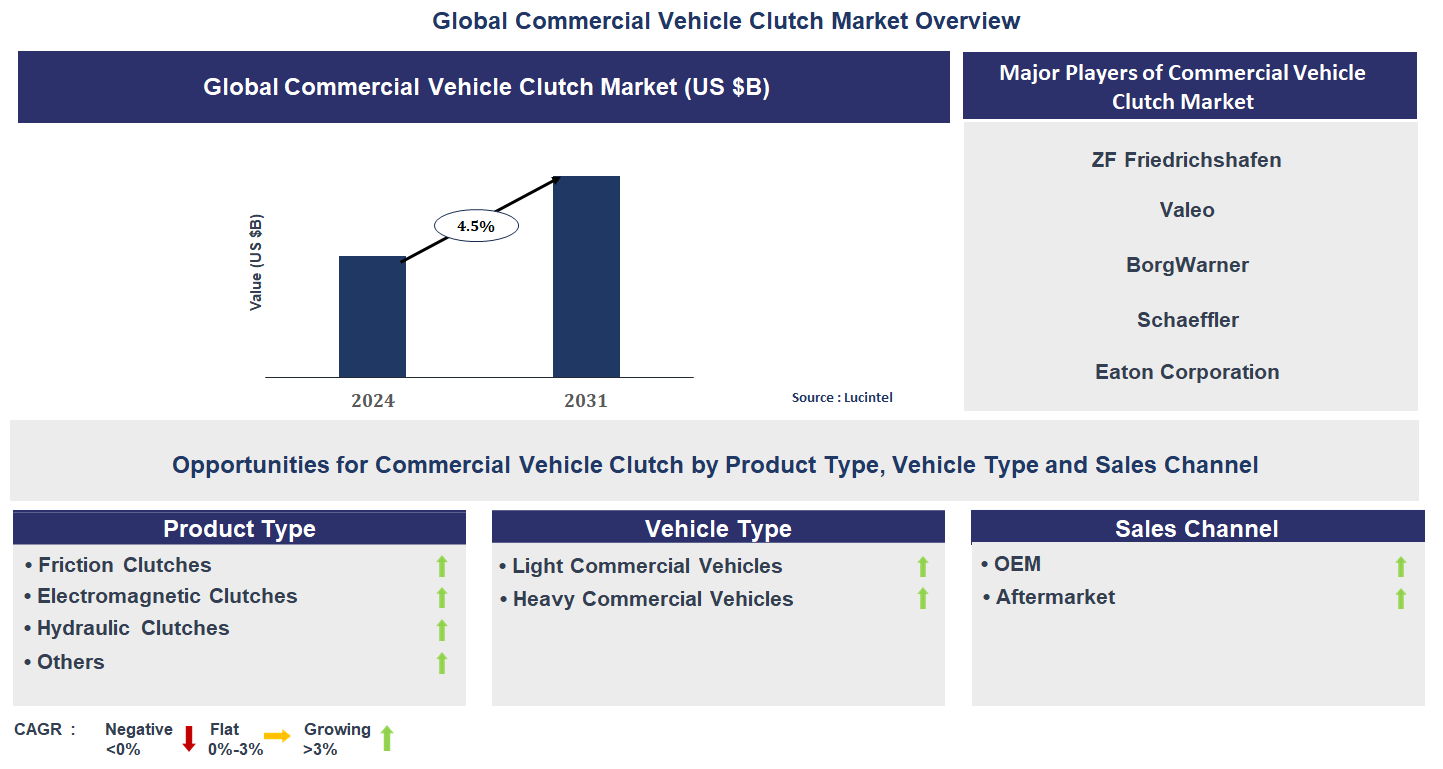
The future of the global commercial vehicle clutch market looks promising with opportunities in the light commercial vehicle and heavy commercial vehicle markets. The global commercial vehicle clutch market is expected to grow with a CAGR of 4.5% from 2025 to 2031. The major drivers for this market are the increasing demand for efficient transmission systems, the rising adoption of electric commercial vehicles, and the growing need for enhanced vehicle performance.• Lucintel forecasts that, within the product type category, friction clutch is expected to witness the highest growth over the forecast period.
• Within the vehicle type category, light commercial vehicle is expected to witness higher growth.
• In terms of region, APAC will remain the largest region over the forecast period. Gain valuable insights for your business decisions with our comprehensive 150+ page report. Sample figures with some insights are shown below.
Emerging Trends in the Commercial Vehicle Clutch Market
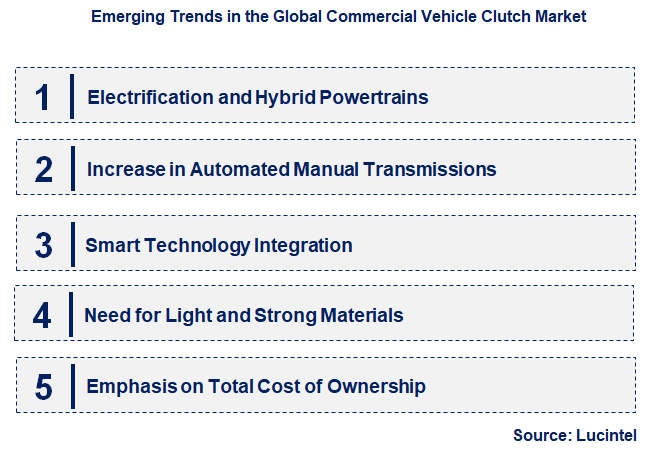
The market for commercial vehicle clutch is being transformed by some key trends, each underpinned by a coalescing industry drive for increased efficiency, sustainability, and technology adoption. These trends are interrelated rather than in isolation and represent a global transformation in the way commercial vehicles are designed, produced, and used. From materials deployed in clutch components to how they interact with a vehicle’s overall electronic systems, these advancements are creating a new standard of performance and reliability.• Electrification and Hybrid Powertrains: The move toward electric and hybrid commercial vehicles is revolutionizing clutch technology at its core. In contrast to classical internal combustion engines, electric motors need not always have a clutch to transfer power. Nevertheless, in hybrid vehicles, dedicated clutches play a significant role in terms of facilitating smooth power management between the hybrid system’s electric motor and combustion engine. This trend is developing a requirement for new clutches that are lighter, more compact, and effective at handling the peculiar torque profiles of hybrid systems, as well as providing improved regenerative braking capabilities.
• Increase in Automated Manual Transmissions: AMTs are increasing in popularity in commercial vehicles as they provide the fuel economy of a manual transmission combined with the ease of an automatic. These systems depend on sophisticated clutch technologies that allow accurate, quick, and smooth gear shifting. This trend is propelling the creation of electronically controlled clutches that can be interfaced with the vehicles’ engine management system and delivering better performance, decreased driver fatigue, and better fuel efficiency.
• Smart Technology Integration: Industry 4.0 and the Internet of Things are introducing smart technology into the clutch sector. Sensors are being integrated into clutch systems by manufacturers to track performance in real time. Sensors can identify wear and tear, temperature variations, and other operating data to facilitate predictive maintenance. This not only minimizes vehicle downtime and maintenance expense but also enhances overall security and operating efficiency for fleet owners.
• Need for Light and Strong Materials: With the world’s emphasis on lowering fuel efficiency and emissions, there is a serious effort to produce all vehicle parts, including clutches, utilizing lighter but stronger materials. Organizations are putting money into research and development of composite materials and advanced alloys that can tolerate high torque and temperature but keep overall vehicle weight low. This is directly responsible for better fuel efficiency and an extended service life for the clutch.
• Emphasis on Total Cost of Ownership: Fleet operators are increasingly focused on the TCO of their vehicles. This encompasses not just the upfront purchase price but also fuel efficiency, maintenance, and vehicle downtime. In this regard, clutch manufacturers are designing products that provide increased durability and longer service life. This trend is driving innovation in clutches that are more durable, need less frequent maintenance, and work towards overall operational cost savings by commercial fleets. These trends are universally transforming the commercial vehicle clutch industry by driving it towards higher levels of technological advancement, sustainability, and efficiency. They are forcing manufacturers to go beyond conventional mechanical clutches and spend on intelligent, lightweight, and resilient systems capable of responding to the changing needs of contemporary commercial transport. The marketplace is becoming increasingly competitive, with a high degree of focus on innovation that unambiguously addresses the economic and environmental imperatives of fleet operators globally.
Recent Development in the Commercial Vehicle Clutch Market
The commercial vehicle clutch market itself is undergoing a very fast-changing trend at the moment, with emerging technologies and market conditions shaping product development and business strategies. The change is driven by a global push for better efficiency, reduced emissions, and overall vehicle performance. The most important developments are a direct reaction to the evolving demands of commercial transport, where operational uptime, lower TCO, and adherence to increasingly tighter environmental controls become the top priority.• Dual-Clutch Transmission Trend: The shift to commercial vehicles using DCTs is a significant development. They employ two independent clutches with the ability to pre-select the next gear as the current one is still engaged. This yields very fast and smooth gear changes that not only enhance driving comfort but also improve fuel efficiency by limiting power interruption. Integration of DCTs is a fundamental innovation, especially for medium and light commercial vehicles where fuel efficiency and driver comfort are a priority.
• Advanced Friction Materials Development: In order to provide higher durability and thermal stability, clutch makers are designing newer friction materials. The advanced materials, i.e., carbon-fiber and ceramic-based composites, have the capability to handle higher temperatures and torque loads, which results in increased clutch life and lower wear. This addresses the TCO issues of fleet operators directly through longer maintenance intervals and lower vehicle downtime.
• Expansion of the Aftermarket Segment: The commercial vehicle clutch aftermarket is rapidly growing. This is because clutches are wear-and-tear items that need to be replaced every now and then during the course of a vehicles life. The growth of this segment is the largest opportunity for suppliers and manufacturers, especially in emerging markets where manual transmissions are dominant. The emphasis is on supplying high-quality, long-lasting, and widely accessible replacement parts to suit a wide and varied vehicle fleet.
• Integration of Electronic Controls: The modern clutch is no longer strictly mechanical. There is increasing movement toward the integration of electronic control units and sensors within clutch systems. The electronic controls provide for more accurate engagement and disengagement, which maximizes shifting and helps reduce fuel consumption. The electronic controls also support advanced features such as predictive maintenance and real-time diagnostics, which can warn operators of impending problems before they lead to a breakdown.
• Emphasis on Lighter and Smaller-Sized Designs: With an attempt to minimize overall vehicle weight to enhance fuel economy, the market for lighter and smaller-sized clutch designs is on the rise. The progress here entails the application of lighter materials, as well as novel design approaches that minimize the dimensions and intricacy of the clutch assembly without losing its performance or durability. This trend is extremely important for both conventional and new-energy commercial vehicles. These advances are imposing a deep influence on the commercial vehicle clutch industry, driving the sector to a new generation of high-performance, intelligent, and sustainable products. The emphasis is on delivering value not just through a better product but also through lower operating costs and improved reliability. The industry is moving from a component business to one that offers integrated, technologically innovative solutions for contemporary commercial transportation.
Strategic Growth Opportunities in the Commercial Vehicle Clutch Market
There are several strategic growth opportunities in the commercial vehicle clutch market that are being driven by changing applications and global focus on efficiency, sustainability, and technology. These opportunities are not one-size-fits-all but are segment-specific for various segments of the market, including heavy-duty trucking, last-mile logistics, and off-highway vehicles. By concentrating on these top application areas, companies can align their market and product strategies to take advantage of high-growth markets.• Heavy-Duty Trucking: The heavy-duty trucking market is a big growth opportunity. This is being propelled by worldwide demand for freight haulage and demand for clutches that are capable of taking excessive torque loads and having long service life. Companies can concentrate on making advanced clutches with better durability, lower maintenance needs, and light weight. There are also opportunities for offering integrated clutch systems for automated manual transmissions that are being increasingly used in this segment for enhanced fuel efficiency and driving comfort.
• Light Commercial Vehicles for Last-Mile Delivery: The rapid expansion of e-commerce and urbanization has created a surge in demand for LCVs for last-mile delivery. This application requires clutches that can withstand frequent start-stop cycles and provide smooth, effortless engagement to reduce driver fatigue. Growth opportunities include developing specialized clutches for small and medium-sized trucks and vans, particularly those with automated or semi-automated transmissions.
• Buses and Coaches: The public transportation market, buses, and coaches are a growth area of major importance. This market is moving toward new-energy models and automated transmissions, generating demand for new clutch technologies. The business opportunity is to create and provide specialized clutches for hybrid buses and electric buses that need systems capable of handling power from the electric motor as well as the combustion engine. There is a continuous requirement for clutches in standard diesel buses that provide longer life and better performance.
• Off-Highway and Construction Vehicles: This end-use market, which comprises vehicles for mining, construction, and agriculture, necessitates clutches that are very robust and durable. They should be capable of withstanding harsh operating conditions, heavy loads, and irregular patterns of use. Opportunities exist for developing heavy-duty, multi-plate clutches and specialty hydraulic clutch systems that can offer superior reliability and torque capacity. The emphasis is on offering products that are capable of reducing downtime in mission-critical applications.
• Replacement Services and Aftermarket: The commercial vehicle clutch aftermarket is a sustained and high-value growth market. Clutches are replaceable parts that need to be replaced periodically, with a consistent revenue source. Suppliers can concentrate on building strong distribution networks and offering extensive ranges of quality replacement components. This means creating easy-to-use clutch kits and providing full technical support and training to the service providers, thus gaining a leadership position in the replacement business. These growth opportunities are transforming the commercial vehicle clutch market by promoting specialization and innovation. The market’s future rests in offering customized solutions to particular applications, rather than taking a one-size-fits-all approach. By focusing on these high-growth segments, manufacturers can not only increase their market share, but also play a key role in facilitating the evolution of contemporary commercial transportation.
Commercial Vehicle Clutch Market Driver and Challenges
The commercial vehicle clutch industry is a dynamic sector influenced by several technological, economic, and regulatory factors. The relationship between these drivers and challenges is dictating product development and market growth directions. The drivers have mainly been brought about by industry-wide measures to enhance vehicle efficiency and performance, and the challenges arise from emerging technologies and changing industry paradigms. Knowledge of this delicate interplay is crucial for any player to successfully navigate the market. The factors responsible for driving the commercial vehicle clutch market include: 1. Surging Freight and Logistics Activity: The rise of the global economy and growth of e-commerce have created an unprecedented level of freight and logistics activity. This has straightaway driven demand for commercial vehicles, ranging from heavy-duty trucks to last-mile delivery vans. As more commercial vehicles are in operation, the demand for clutches—both original equipment and aftermarket replacement—is higher. This trend is a key contributor to market growth, especially in developing markets with growing infrastructure. 2. Fuel Efficiency and Emissions: Environmentally strict regulations and a strong worldwide impetus for sustainability are driving the need for more fuel-efficient vehicles. Clutches are an important part of this by allowing smoother gear transitions and improving power transfer efficiency. Automakers are meeting this challenge by creating lightweight materials and innovative clutches, both of which help to decrease fuel consumption and reduce carbon emissions. 3. Transmissions Technology Advances: The shift towards next-generation transmission systems such as AMTs and DCTs is a key market force. These systems necessitate advanced clutches with electronic controls for fast and accurate shifting. This technology transition is getting the market away from basic mechanical clutches towards technologically advanced, high-performance, and sophisticated products, offering opportunities for players who can innovate in this direction. 4. Growth of the Aftermarket: Commercial vehicles are subject to heavy and frequent use, making clutches consumables that must be replaced on a periodic basis. This generates a high-volume and stable aftermarket segment that represents a recurring source of income for manufacturers. Increased total volume of commercial vehicles on the road coupled with the demand for assured replacement parts ensures that the aftermarket continues to be a driving force in market expansion. 5. Driver Comfort and Safety: Driver well-being is a growing concern in the commercial vehicle sector. Clutches that offer lower pedal force and smoother engagement are sought after because they minimize driver fatigue during long-distance drives. Furthermore, the incorporation of electronic control and diagnosis within clutch systems can enhance safety through the avoidance of surprise failures and real-time notifications. Challenges in the commercial vehicle clutch market are: 1. Transition to Electric Vehicles: The biggest threat to the conventional clutch market is the quick transition to EVs. Complete electric commercial vehicles do not have a traditional clutch system, which is a long-term threat to the market. When governments and organizations are investing in electric fleets, the need for conventional clutches will wane, compelling manufacturers to broaden their product lines or concentrate on niche clutches for hybrids and hydrogen fuel cell vehicles. 2. Excessive Production Cost of Advanced Technologies: Advanced technologies like DCTs and smart clutches do have great advantages, but these are also produced at a greater expense. This could prove to be a problem for a price-conscious market, particularly in emerging nations where fleet operators might hesitate to fit costly parts. Finding the middle ground between innovation and price is one of the major concerns for manufacturers. 3. Supply Chain and Material Price Volatility: The business vehicle clutch industry is extremely reliant on an international supply chain for raw materials like steel and friction materials. Volatility in the price of these materials could affect the cost of production and margins. Furthermore, geopolitical tensions and supply chain disruptions could result in delays in production, representing a major operational challenge. In summary, the market for commercial vehicle clutches is driven by underlying drivers such as economic growth and efficiency needs, but simultaneously confronted with monumental hurdles from new-energy vehicle technologies as well as cost. The market stands at a crossroads, where conventional drivers are counterpoised by the revolutionary power of electrification. Success here will hinge on a firm’s capacity to innovate, incorporate new technology, and offer solutions that meet the short-term economic requirements as well as the longer-term sustainability objectives of the commercial transportation sector.List of Commercial Vehicle Clutch Companies
Companies in the market compete on the basis of product quality offered. Major players in this market focus on expanding their manufacturing facilities, R&D investments, infrastructural development, and leverage integration opportunities across the value chain. With these strategies commercial vehicle clutch companies cater increasing demand, ensure competitive effectiveness, develop innovative products & technologies, reduce production costs, and expand their customer base. Some of the commercial vehicle clutch companies profiled in this report include-• ZF Friedrichshafen
• Valeo
• BorgWarner
• Schaeffler
• Eaton Corporation
• Aisin Seiki
• Exedy Corporation
• F.C.C.
• Clutch Auto Limited
• Setco Automotive Limited
Commercial Vehicle Clutch Market by Segment
The study includes a forecast for the global commercial vehicle clutch market by product type, vehicle type, sales channel, and region.Commercial Vehicle Clutch Market by Product Type [Value from 2019 to 2031]:
• Friction Clutches
• Electromagnetic Clutches
• Hydraulic Clutches
• Others
Commercial Vehicle Clutch Market by Vehicle Type [Value from 2019 to 2031]:
• Light Commercial Vehicles
• Heavy Commercial Vehicles
Commercial Vehicle Clutch Market by Sales Channel [Value from 2019 to 2031]:
• OEM
• Aftermarket
Commercial Vehicle Clutch Market by Region [Value from 2019 to 2031]:
• North America
• Europe
• Asia Pacific
• The Rest of the World
Country Wise Outlook for the Commercial Vehicle Clutch Market
The commercial vehicle clutch market is going through a dramatic change, fueled by an intersection of drivers such as tighter emissions standards, the pressure to make vehicles more fuel-efficient, and the quick acceleration of vehicle electrification. All these global trends are forcing manufacturers to change, moving away from conventional mechanical systems towards more advanced, electronically controlled, and light-weight clutch technologies. The industry is currently engaged in creating components that can support greater torque, offer smoother shifts for better driver comfort, and easily integrate with sophisticated transmission systems.• United States: In the United States, recent trends are all about fuel economy and driver comfort in heavy-duty commercial vehicles. The market is witnessing higher usage of automated manual transmissions, which use sophisticated clutch systems to provide smooth and quick gear changes. There is a greater emphasis on designing clutches that are capable of withstanding the high torque and stress associated with long-haul trucking, and using lighter materials to enable vehicles to carry less weight overall.
• China: China’s market for commercial vehicle clutches is driven by its aggressive focus on electrification and smart manufacturing. China is a world leader in electric vehicle adoption, and this has created demand for new clutch systems optimized for electric and hybrid powertrains. Manufacturers are also incorporating Industry 4.0 technologies, including IoT sensors and real-time monitoring, into their clutches to support predictive maintenance and efficiency enhancement.
• Germany: Being a world center for automotive engineering, Germany’s commercial vehicle clutch market is marked by aggressive emphasis on precision engineering and high-performance. German auto producers are leading the way to design advanced clutch systems, such as dual-clutch transmissions, that are superior in terms of efficiency and have a smoother driving experience. The market is also dominated by stringent European Union emissions requirements, which compel the companies to design clutches that ensure reduced carbon footprints and fuel consumption.
• India: India’s market for commercial vehicle clutches is witnessing growth due to speedy infrastructure growth, growing freight movement, and growth in the e-commerce segment. There is specific demand for medium and heavy commercial vehicle clutches. Clutch makers are focusing on producing durable and strong clutches that can sustain bad road conditions and heavy loads. There is increasing movement towards automated and semi-automated transmissions, and manufacturers are developing joint ventures and technology collaborations to introduce sophisticated solutions into the market.
• Japan: Commercial vehicle clutching in Japan is influenced by a robust emphasis on innovation and sustainability. The automotive sector in Japan is at the forefront of hybrid vehicle technology, and this is spurring the development of niche clutches for hybrid powertrains. Japanese automakers are also leading the charge for brake-by-wire and AI-based braking systems. The market is witnessing a thrust towards clutches that last longer, need minimal maintenance, and lead to overall efficiency in the vehicle, keeping with the nation’s vision for future mobility solutions.

Features of the Global Commercial Vehicle Clutch Market
Market Size Estimates: Commercial vehicle clutch market size estimation in terms of value ($B). Trend and Forecast Analysis: Market trends (2019 to 2024) and forecast (2025 to 2031) by various segments and regions. Segmentation Analysis: Commercial vehicle clutch market size by product type, vehicle type, sales channel, and region in terms of value ($B). Regional Analysis: Commercial vehicle clutch market breakdown by North America, Europe, Asia Pacific, and Rest of the World. Growth Opportunities: Analysis of growth opportunities in different product types, vehicle types, sales channels, and regions for the commercial vehicle clutch market. Strategic Analysis: This includes M&A, new product development, and competitive landscape of the commercial vehicle clutch market. Analysis of competitive intensity of the industry based on Porter’s Five Forces model.
FAQ
Q1. What is the growth forecast for commercial vehicle clutch market? Answer: The global commercial vehicle clutch market is expected to grow with a CAGR of 4.5% from 2025 to 2031. Q2. What are the major drivers influencing the growth of the commercial vehicle clutch market? Answer: The major drivers for this market are the increasing demand for efficient transmission systems, the rising adoption of electric commercial vehicles, and the growing need for enhanced vehicle performance. Q3. What are the major segments for commercial vehicle clutch market? Answer: The future of the commercial vehicle clutch market looks promising with opportunities in the light commercial vehicle and heavy commercial vehicle markets. Q4. Who are the key commercial vehicle clutch market companies? Answer: Some of the key commercial vehicle clutch companies are as follows:• ZF Friedrichshafen
• Valeo
• BorgWarner
• Schaeffler
• Eaton Corporation
• Aisin Seiki
• Exedy Corporation
• F.C.C.
• Clutch Auto Limited
• Setco Automotive Limited Q5. Which commercial vehicle clutch market segment will be the largest in future? Answer: Lucintel forecasts that, within the product type category, friction clutch is expected to witness the highest growth over the forecast period. Q6. In commercial vehicle clutch market, which region is expected to be the largest in next 5 years? Answer: In terms of region, APAC will remain the largest region over the forecast period. Q7. Do we receive customization in this report? Answer: Yes, Lucintel provides 10% customization without any additional cost.
Table of Contents
List of Figures
List of Tables
Methodology
- In-depth interviews of the major players in this market
- Detailed secondary research from competitors’ financial statements and published data
- Extensive searches of published works, market, and database information pertaining to industry news, company press releases, and customer intentions
- A compilation of the experiences, judgments, and insights of Lucintel’s professionals, who have analyzed and tracked this market over the years.


Buy Now
Choose a license that fits your team. Instant PDF delivery.
Prices exclude taxes. Instant delivery. Custom licensing available on request.
Key Questions
- • What are some of the most promising, high-growth opportunities for the commercial vehicle clutch market by product type (friction clutches, electromagnetic clutches, hydraulic clutches, and others), vehicle type (light commercial vehicles and heavy commercial vehicles), sales channel (OEM and aftermarket), and region (North America, Europe, Asia Pacific, and the Rest of the World)?
- • Which segments will grow at a faster pace and why?
- • Which region will grow at a faster pace and why?
- • What are the key factors affecting market dynamics? What are the key challenges and business risks in this market?
- • What are the business risks and competitive threats in this market?
- • What are the emerging trends in this market and the reasons behind them?
- • What are some of the changing demands of customers in the market?
- • What are the new developments in the market? Which companies are leading these developments?
- • Who are the major players in this market? What strategic initiatives are key players pursuing for business growth?
- • What are some of the competing products in this market and how big of a threat do they pose for loss of market share by material or product substitution?
- • What M&A activity has occurred in the last 5 years and what has its impact been on the industry? For any questions related to Commercial Vehicle Clutch Market, Commercial Vehicle Clutch Market Size, Commercial Vehicle Clutch Market Growth, Commercial Vehicle Clutch Market Analysis, Commercial Vehicle Clutch Market Report, Commercial Vehicle Clutch Market Share, Commercial Vehicle Clutch Market Trends, Commercial Vehicle Clutch Market Forecast, Commercial Vehicle Clutch Companies, write Lucintel analyst at email: helpdesk@lucintel.com. We will be glad to get back to you soon.


