
Market Report · July 31, 2026

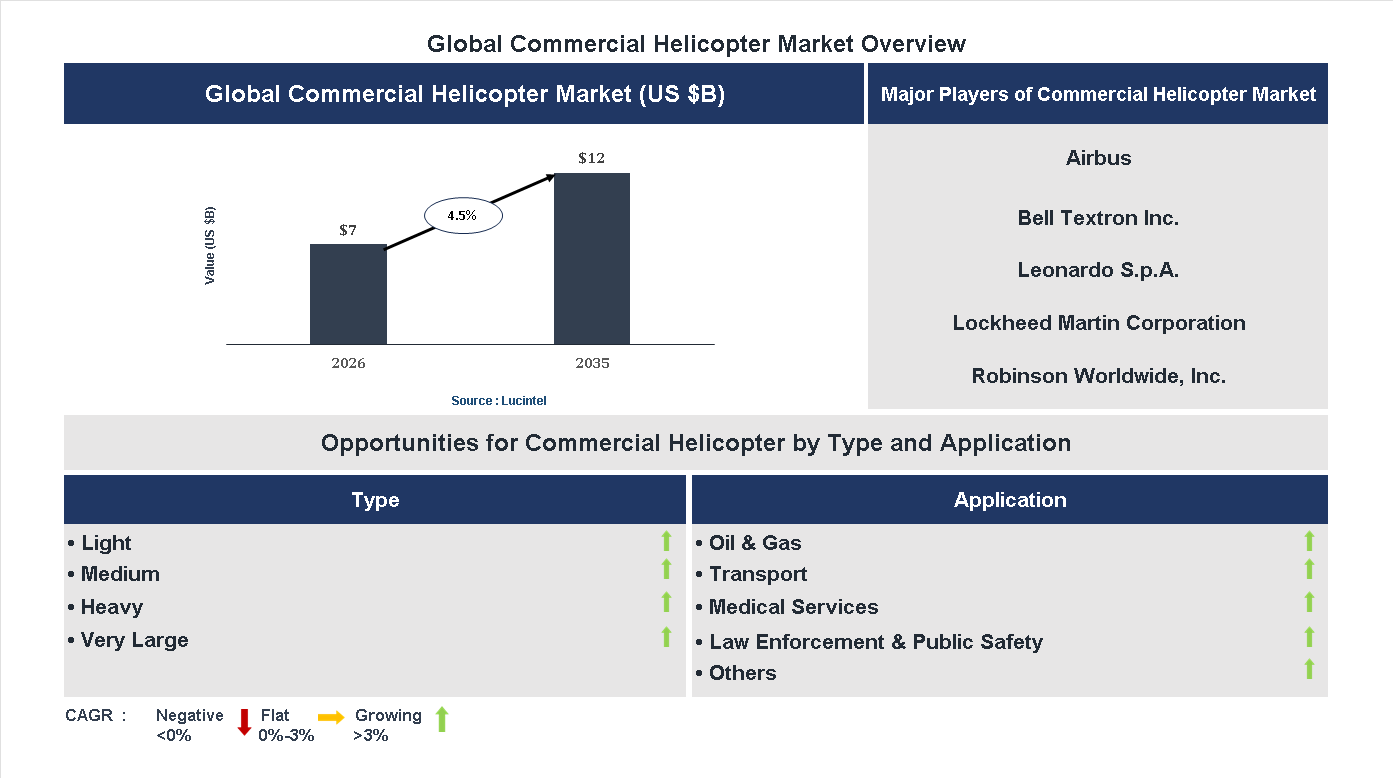
Key data points: The market size in 2035 = $12 billion, growth forecast = 4.5% annually for the next 8 years. Scroll below to get more insights. This market report covers trends, opportunities and forecasts in commercial helicopter market to 2035 by type (light, medium, heavy, and very large), application (oil & gas, transport, medical services, law enforcement & public safety, and others), and region (North America, Europe, Asia Pacific, and the Rest of the World)
We'll send your sample report shortly.
• Lucintel forecasts that, within the type category, medium is expected to witness the highest growth over the forecast period.
• Within the application category, law enforcement & public safety is expected to witness the highest growth.
• In terms of region, APAC is expected to witness the highest growth over the forecast period. Gain valuable insights for your business decisions with our comprehensive 150+ page report. Sample figures with some insights are shown below.
• Digital Transformation and Connectivity: The integration of digital technologies is revolutionizing helicopter operations. Advanced avionics, real-time data analytics, and connectivity solutions enhance safety, efficiency, and maintenance. Operators can monitor aircraft health remotely, optimize flight paths, and improve customer experience through seamless communication systems. This trend reduces operational costs and downtime while increasing reliability. As digital tools become more sophisticated, they enable predictive maintenance and better resource management, making helicopter services more competitive and responsive to market needs.
• Electric and Hybrid Propulsion Systems: The shift toward sustainable aviation is gaining momentum with the development of electric and hybrid propulsion technologies. These systems promise reduced emissions, lower operating costs, and quieter operations, which are crucial for urban air mobility and environmentally sensitive areas. Early adoption in smaller helicopters and drone applications demonstrates potential for broader market integration. This trend aligns with global environmental regulations and consumer preferences for greener transportation options, paving the way for innovative business models and new market segments such as urban air taxis.
• Urban Air Mobility (UAM) Expansion: Urban air mobility is transforming helicopter usage in congested cities. Vertical takeoff and landing (VTOL) aircraft are being designed for short-distance travel, reducing ground traffic congestion. Infrastructure development, regulatory support, and technological advancements are accelerating UAM deployment. This trend opens new revenue streams for helicopter operators, including on-demand urban transport, emergency response, and logistics. The integration of UAM into existing transportation networks is expected to reshape urban mobility, making helicopter services more accessible and efficient in densely populated areas.
• Customization and Specialized Services: Increasing demand for tailored helicopter solutions is driving market growth. Customers seek specialized services such as aerial surveying, medical evacuation, offshore support, and luxury tourism. Manufacturers are offering customizable aircraft configurations to meet specific operational needs. This trend enhances market segmentation, allowing operators to target niche markets and diversify revenue sources. The ability to adapt helicopter features and services to client requirements fosters innovation and strengthens customer loyalty, ultimately expanding the market’s scope and profitability.
• Regulatory Developments and Safety Standards: Evolving regulations and safety standards are shaping market dynamics. Governments and aviation authorities are implementing stricter certification processes, noise regulations, and operational guidelines to ensure safety and environmental compliance. These changes influence aircraft design, operational procedures, and market entry strategies. While regulatory hurdles may pose challenges, they also promote industry innovation and safety improvements. Harmonized international standards facilitate cross-border operations and market expansion, fostering confidence among investors and customers alike. These emerging trends are collectively reshaping the commercial helicopter market by fostering technological innovation, promoting sustainability, expanding urban mobility solutions, enabling market segmentation, and enhancing safety standards. As these developments continue to evolve, they will unlock new opportunities, redefine operational paradigms, and ensure the market remains dynamic and competitive in the coming years.

• Technological Innovations in Helicopter Design: Advancements in lightweight materials, fuel efficiency, and avionics are significantly improving helicopter performance. These innovations reduce operational costs, enhance safety, and enable longer flight ranges, making helicopters more attractive for commercial use. The integration of electric propulsion systems is also emerging, promising eco-friendly alternatives. Such technological progress is expanding market reach into new sectors like urban air mobility and drone-based services, ultimately boosting industry growth and competitiveness.
• Rising Demand for Emergency Medical Services (EMS): The increasing need for rapid medical response in urban and remote areas is driving the adoption of specialized medical helicopters. These aircraft are equipped with advanced life-support systems, enabling critical care during transit. Governments and private organizations are investing in EMS fleets to improve healthcare access, especially in underserved regions. This trend enhances market revenue streams and encourages innovation in helicopter design tailored for medical applications, fostering a more resilient emergency response infrastructure.
• Expansion of Urban Air Mobility (UAM): Urbanization and traffic congestion are prompting the development of urban air mobility solutions, including helicopter-based transportation. Companies are exploring vertical takeoff and landing (VTOL) aircraft to provide quick, efficient city-to-city transit. Regulatory frameworks are evolving to accommodate these innovations, opening new commercial opportunities. UAM is expected to revolutionize urban transportation, reduce congestion, and create a new segment within the commercial helicopter market, attracting investments and fostering technological breakthroughs.
• Growth in Tourism and Leisure Flights: The tourism industry is increasingly utilizing helicopters for sightseeing, luxury travel, and adventure tourism. This segment benefits from rising disposable incomes and a desire for unique experiences. Operators are expanding fleets and routes to popular destinations, boosting revenue. The development of eco-tourism and customized tour packages further enhances this market segment. As a result, tourism-related helicopter services are becoming a significant revenue contributor, encouraging market diversification and innovation in passenger comfort and safety features.
• Increasing Investment in Infrastructure and Defense: Governments worldwide are investing in infrastructure projects that require aerial support, such as construction, power line maintenance, and pipeline inspections. Additionally, defense budgets are fueling demand for military and surveillance helicopters. These investments stimulate the commercial helicopter market by creating steady demand for specialized aircraft. The focus on modernization and fleet expansion supports technological advancements and industry competitiveness, ultimately broadening the market scope and encouraging cross-sector collaborations. These developments are significantly transforming the commercial helicopter market by enhancing technological capabilities, expanding application areas, and attracting new investments. The integration of innovative designs, urban mobility solutions, and emergency services is creating diverse revenue streams and market opportunities. As infrastructure and tourism sectors grow, the industry is poised for sustained expansion. Overall, these trends are fostering a more dynamic, resilient, and competitive market landscape, promising long-term growth and innovation.
• Increasing Demand for Urban Air Mobility Solutions: Urban air mobility (UAM) is transforming transportation in congested cities by providing quick, efficient helicopter services for passenger and cargo transport. The development of electric and hybrid helicopters enhances sustainability and reduces operational costs. Governments and private companies are investing heavily in infrastructure, such as vertiports, to support UAM. This segment is expected to grow rapidly, driven by urbanization, traffic congestion, and technological innovations, opening new revenue streams for helicopter manufacturers and service providers.
• Expansion of Emergency Medical Services and Disaster Response: The need for rapid medical evacuation and disaster response is fueling growth in the emergency services segment. Advanced helicopters equipped with medical equipment, communication systems, and specialized interiors are increasingly deployed in remote and urban areas. Governments and healthcare providers are investing in dedicated fleets to improve response times and patient outcomes. The integration of telemedicine and real-time data sharing further enhances operational efficiency, making this a vital growth area within the commercial helicopter market.
• Growth in Offshore Oil & Gas and Wind Farm Support: The offshore energy sector relies heavily on helicopters for transportation of personnel, equipment, and supplies to and from oil rigs and wind farms. The demand for specialized, high-capacity, and weather-resistant helicopters is rising. Innovations in safety features, fuel efficiency, and maintenance are critical to meet the sector’s stringent requirements. As offshore projects expand globally, especially in renewable energy, this segment offers substantial growth opportunities for helicopter manufacturers and service providers.
• Rising Tourism and Luxury Travel Market: Helicopter tourism is gaining popularity among affluent travelers seeking exclusive, scenic, and quick transportation options. Destinations such as remote islands, mountain resorts, and urban landmarks benefit from helicopter services. The development of luxury helicopter charters and sightseeing tours is expanding, supported by increasing disposable incomes and a desire for unique experiences. This segment is expected to grow significantly, driven by marketing efforts, fleet modernization, and the emergence of personalized travel packages.
• Technological Innovations and Sustainability Initiatives: Advances in electric propulsion, lightweight materials, and autonomous flight are revolutionizing the commercial helicopter industry. These innovations improve fuel efficiency, reduce emissions, and lower operational costs. Governments and industry players are investing in sustainable solutions to meet environmental regulations and societal expectations. The adoption of digital cockpit systems, predictive maintenance, and automation enhances safety and efficiency, creating new opportunities for market expansion and competitive differentiation in the evolving landscape. These strategic growth opportunities are poised to significantly influence the commercial helicopter market by fostering innovation, expanding applications, and improving operational efficiencies. The integration of new technologies, infrastructure development, and evolving customer demands will drive market expansion across diverse segments. Companies that capitalize on these opportunities through strategic investments and technological advancements will be well-positioned to lead in this dynamic and competitive industry landscape.
• Technological Innovation: The continuous development of advanced rotorcraft, lightweight materials, and sophisticated navigation and communication systems enhances safety, efficiency, and operational capabilities. These innovations enable operators to serve diverse sectors such as emergency services, corporate transport, and tourism more effectively, expanding market reach. As technology evolves, costs decrease and performance improves, encouraging wider adoption and opening new revenue streams.
• Increasing Infrastructure Development: Governments and private entities are investing heavily in infrastructure projects, including urban transit systems, airports, and remote area connectivity. Helicopters provide vital transportation links where ground infrastructure is limited or unavailable. This demand for quick, flexible transportation solutions in urban and rural areas fuels market growth, especially in developing regions with expanding infrastructure needs.
• Rising Tourism and Leisure Activities: The global tourism industry is experiencing significant growth, with tourists seeking unique and convenient travel options. Helicopter tours and charter services offer premium experiences, attracting high-net-worth individuals and adventure travelers. This surge in leisure travel directly boosts demand for commercial helicopter services, especially in scenic and remote destinations, contributing substantially to market expansion.
• Economic Growth and Investment: Robust economic conditions in key markets lead to increased corporate and government spending on helicopter services. Business executives utilize helicopters for quick travel between locations, while governments invest in fleet upgrades for emergency and defense purposes. Economic stability and growth foster a favorable environment for market players to expand their fleets and service offerings, further propelling market development. The challenges facing the commercial helicopter market include:
• High Operational and Maintenance Costs: Operating helicopters involves significant expenses, including fuel, maintenance, and skilled personnel. These costs can limit profitability and restrict market entry for smaller operators. Fluctuations in fuel prices and maintenance requirements add unpredictability, impacting pricing strategies and service availability, thereby hindering overall market growth.
• Stringent Regulatory Environment: Safety standards, airspace regulations, and licensing requirements are increasingly strict, often varying across regions. Compliance demands substantial investments in training, certification, and safety protocols, which can delay deployment and increase costs. Navigating complex regulatory landscapes poses a barrier for new entrants and can restrict operational flexibility for existing operators.
• Safety and Security Concerns: Despite technological advancements, helicopter operations inherently carry risks, including accidents and security threats. High-profile incidents can damage industry reputation and lead to tighter regulations. Ensuring passenger safety and security remains a critical challenge, requiring continuous investment in safety measures, training, and technology, which can elevate operational costs and impact market confidence. The commercial helicopter market is shaped by technological progress, infrastructure development, tourism growth, and economic factors that promote expansion. Conversely, high costs, regulatory hurdles, and safety concerns present significant challenges that could restrain growth. The interplay of these drivers and challenges determines the market’s future trajectory, influencing investment, innovation, and operational strategies. Overall, while promising opportunities exist, addressing these challenges is essential for sustainable growth and industry stability.
• Airbus
• Bell Textron Inc.
• Leonardo S.p.A.
• Lockheed Martin Corporation
• Robinson Worldwide, Inc.
• Russian Helicopters
• Enstrom Helicopter Corporation
• MD Helicopters, Inc.
• Kaman Corporation
• Hindustan Aeronautics Limited
• Light
• Medium
• Heavy
• Very Large
• Oil & Gas
• Transport
• Medical Services
• Law Enforcement & Public Safety
• Others
• North America
• Europe
• Asia Pacific
• The Rest of the World
• United States: The US market has seen increased adoption of electric and hybrid helicopters, driven by environmental regulations and technological innovation. Major players are investing in autonomous flight systems and advanced safety features. The Federal Aviation Administration (FAA) has streamlined certification processes, encouraging new entrants. The demand for helicopters in emergency medical services and corporate transport remains high, with regional airports expanding infrastructure to support growth. Additionally, US companies are exploring urban air mobility solutions, aiming to reduce congestion in major cities.
• China: China’s commercial helicopter market is rapidly expanding, fueled by government initiatives to develop regional connectivity and infrastructure. The country is investing heavily in indigenous helicopter manufacturing, such as the AVIC platform, to reduce reliance on imports. The demand from the oil and gas sector, tourism, and emergency services is increasing steadily. China’s focus on technological innovation includes the integration of digital systems and improved safety standards. The government’s support for urban air mobility projects is also propelling market growth, with several pilot programs underway in major cities.
• Germany: Germany is emphasizing sustainable aviation solutions, with a focus on electric and hybrid helicopters. The country’s strong aerospace industry, led by companies like Airbus Helicopters, is advancing in autonomous and remotely operated helicopter technologies. Regulatory frameworks are evolving to accommodate new aircraft types, and there is a growing demand for helicopters in search and rescue, law enforcement, and corporate sectors. Germany’s commitment to environmental sustainability is driving investments in quieter, more efficient helicopter models, alongside expanding infrastructure for urban air mobility trials.
• India: The Indian commercial helicopter market is witnessing rapid growth due to increased demand for connectivity in remote regions, tourism, and disaster management. The government’s focus on infrastructure development and regional connectivity projects is boosting helicopter operations. Domestic manufacturers are emerging, and international players are expanding their presence. The adoption of advanced avionics and safety systems is improving operational efficiency. Additionally, India is exploring urban air mobility solutions to address congestion issues in major cities, supported by favorable policies and investments in infrastructure.
• Japan: Japan’s market is characterized by technological innovation and a focus on safety and efficiency. The country is investing in electric and hybrid helicopter technologies to meet environmental standards. The aging population and disaster preparedness needs are driving demand for emergency and rescue services. Japan’s aerospace industry is collaborating with global firms to develop autonomous and remotely piloted helicopters. Regulatory reforms are facilitating the integration of new aircraft types, and urban air mobility projects are gaining momentum, especially in densely populated areas, aiming to revolutionize transportation and emergency response systems.


• Airbus
• Bell Textron Inc.
• Leonardo S.p.A.
• Lockheed Martin Corporation
• Robinson Worldwide, Inc.
• Russian Helicopters
• Enstrom Helicopter Corporation
• MD Helicopters, Inc.
• Kaman Corporation
• Hindustan Aeronautics Limited Q6. Which commercial helicopter market segment will be the largest in future? Answer: Lucintel forecasts that, within the type category, medium is expected to witness the highest growth over the forecast period. Q7. In commercial helicopter market, which region is expected to be the largest in next 8 years? Answer: In terms of region, APAC is expected to witness the highest growth over the forecast period. Q8. Do we receive customization in this report? Answer: Yes, Lucintel provides 10% customization without any additional cost.


Choose a license that fits your team. Instant PDF delivery.
Prices exclude taxes. Instant delivery. Custom licensing available on request.
Market Report · July 31, 2026
Market Report · July 31, 2026
Market Report · July 31, 2026
Trusted partner for strategic intelligence and business growth


Receive a complimentary market analysis tailored to your industry. Our analysts will identify key growth opportunities and competitive dynamics specific to your business.

Market size, growth rate, and key trend analysis for your specific sector.

Top competitor positioning and market share analysis.

Strategic recommendations backed by data-driven insights.
Get curated market intelligence and competitive moves straight to your inbox.
By subscribing, you agree to receive our monthly insights. Unsubscribe anytime.
Receive a complimentary market analysis tailored to your industry. Our analysts will identify key growth opportunities and competitive dynamics specific to your business.
Market size, growth rate, and key trend analysis for your specific sector.
Top competitor positioning and market share analysis.
Strategic recommendations backed by data-driven insights.
Get curated market intelligence, emerging trends, and competitive moves straight to your inbox each month.
By subscribing, you agree to receive our monthly insights. Unsubscribe anytime.
We'll send your sample report shortly.