
Market Report · July 31, 2026

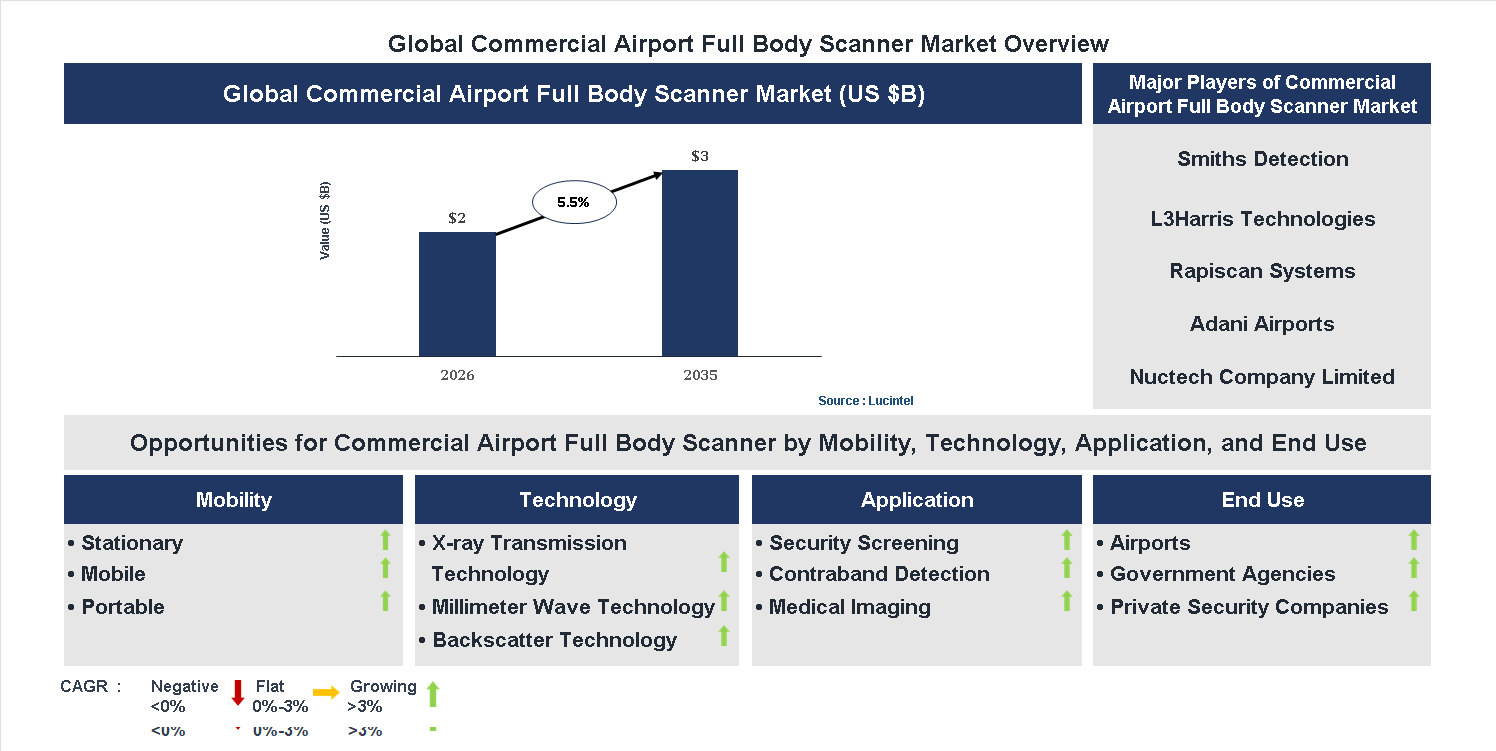
Key data points: The market size in 2035 = $3 billion, growth forecast = 5.5% annually for the next 8 years. Scroll below to get more insights. This market report covers trends, opportunities and forecasts in commercial airport full body scanner market to 2035 by mobility (stationary, mobile, and portable), technology (x-ray transmission technology, millimeter wave technology, and backscatter technology), application (security screening, contraband detection, and medical imaging), end use (airports, government agencies, and private security companies), and region (North America, Europe, Asia Pacific, and the Rest of the World)
We'll send your sample report shortly.
• Lucintel forecasts that, within the mobility category, stationary is expected to witness the highest growth over the forecast period.
• Within the end use category, airport is expected to witness the highest growth.
• In terms of region, APAC is expected to witness the highest growth over the forecast period. Gain valuable insights for your business decisions with our comprehensive 150+ page report. Sample figures with some insights are shown below.
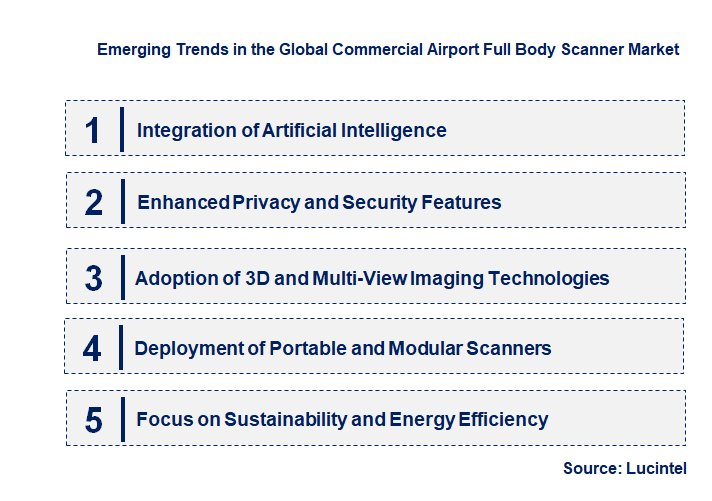
• Integration of Artificial Intelligence (AI): AI-powered full body scanners are increasingly being adopted to improve threat detection accuracy. These systems utilize machine learning algorithms to analyze imaging data, reducing false positives and enhancing passenger throughput. AI integration also enables real-time threat assessment and adaptive learning, making security checks more efficient and less intrusive. This trend is transforming traditional screening methods, providing a smarter, faster, and more reliable security process that aligns with evolving threat landscapes.
• Enhanced Privacy and Security Features: Privacy concerns are prompting manufacturers to develop scanners with advanced privacy-preserving technologies. These include automated image anonymization, where detailed images are replaced with generic outlines, and the use of 3D imaging to minimize intrusive examinations. Additionally, compliance with strict data protection regulations is driving innovations in secure data handling and storage. These features help balance security needs with passenger privacy, fostering greater acceptance and smoother screening experiences at airports.
• Adoption of 3D and Multi-View Imaging Technologies: The shift towards 3D imaging provides more detailed and accurate body scans, improving threat detection capabilities. Multi-view imaging allows for comprehensive analysis from different angles, reducing blind spots and increasing detection reliability. These technologies enable security personnel to identify concealed items more effectively without physical searches, streamlining the screening process. As a result, airports can enhance security while minimizing passenger inconvenience, making 3D and multi-view systems a key trend in the market.
• Deployment of Portable and Modular Scanners: The demand for portable, easy-to-install full body scanners is rising, especially for temporary or mobile security checkpoints. Modular designs allow for quick deployment and scalability across various airport zones or during special events. These systems offer flexibility, cost-effectiveness, and rapid response capabilities, making them suitable for airports with fluctuating security needs. The trend supports a more adaptable security infrastructure, enabling airports to respond swiftly to emerging threats or operational changes.
• Focus on Sustainability and Energy Efficiency: Environmental considerations are influencing the development of eco-friendly full body scanners. Manufacturers are incorporating energy-efficient components, reducing power consumption, and utilizing sustainable materials. These efforts align with broader airport sustainability initiatives and regulatory requirements. Energy-efficient scanners not only lower operational costs but also contribute to the airports environmental goals, reflecting a growing market emphasis on sustainable security solutions that do not compromise performance. These emerging trends—AI integration, enhanced privacy features, advanced imaging technologies, portable solutions, and sustainability efforts—are collectively transforming the commercial airport full body scanner market. They are driving improvements in security effectiveness, passenger experience, operational flexibility, and environmental responsibility, ultimately reshaping how airports approach security screening in a rapidly evolving global landscape.
• Growing Security Concerns: Enhanced security measures and terrorism threats are prompting airports globally to adopt full body scanners, ensuring safer travel environments. This demand drives market growth as airports seek reliable, high-throughput screening solutions that can detect concealed threats effectively. The need for improved security protocols is particularly prominent in major international hubs, leading to increased procurement of advanced scanners. As security standards tighten, the market is expected to expand further, with innovations focusing on accuracy and passenger comfort.
• Technological Innovations in Imaging: Advances in imaging technology, such as 3D imaging and millimeter-wave scanners, are significantly improving detection capabilities. These innovations offer clearer, more detailed images while reducing false positives, enhancing security efficiency. The integration of AI and machine learning further refines threat detection, minimizing human error. These developments attract airport operators seeking state-of-the-art solutions that balance security with passenger privacy, thereby expanding market opportunities for manufacturers investing in R&D.
• Regulatory and Privacy Standards: Stricter government regulations and privacy concerns are shaping the development and deployment of full body scanners. Compliance with standards like GDPR and local privacy laws influences product design, emphasizing data security and anonymization features. Market players are innovating to meet these requirements, offering solutions that protect passenger identities while maintaining high security levels. This regulatory landscape encourages the adoption of more sophisticated, privacy-conscious scanning systems, fostering market growth through increased demand.
• Increasing Adoption in Emerging Markets: Developing countries are rapidly adopting full body scanners to modernize their security infrastructure. Investments from governments and private sectors are driven by rising air travel and security threats. These markets present significant growth opportunities due to lower existing penetration and increasing airport expansions. Local manufacturers are entering the market, often offering cost-effective solutions tailored to regional needs. This trend broadens the global market scope, contributing to overall industry expansion and diversification.
• Integration with Airport Security Ecosystems: Full body scanners are increasingly integrated with other security systems like biometric verification and baggage screening. This convergence enhances overall airport security efficiency and passenger throughput. The development of unified security platforms reduces bottlenecks and improves passenger experience. Market players are focusing on interoperability and seamless data sharing, which boosts demand for integrated solutions. Such developments are transforming airport security into a more cohesive, technologically advanced ecosystem, driving sustained market growth. These developments collectively are transforming the commercial airport full body scanner market by enhancing security, efficiency, and privacy. Technological innovations, regulatory compliance, and expanding markets are fueling growth, while integration with broader security systems is creating more comprehensive solutions. As airports worldwide prioritize safety and passenger experience, the market is poised for continued expansion, driven by ongoing investments and technological advancements. This evolution promises a more secure, efficient, and privacy-conscious future for airport security infrastructure.
• Enhanced Security Screening Capabilities: Full body scanners provide detailed imaging that detects concealed threats, weapons, and contraband more effectively than traditional methods. This technology reduces false positives and speeds up passenger processing, making security checks more efficient. The integration of advanced imaging algorithms and AI-driven analysis further improves threat detection accuracy, supporting airports in complying with international security standards and enhancing traveler safety.
• Adoption of Advanced Imaging Technology (AIT): The shift from traditional metal detectors to AIT-based full body scanners offers improved threat detection and passenger experience. These systems utilize millimeter-wave or backscatter technology to produce detailed images without physical contact. The growing demand for non-invasive screening methods, coupled with regulatory mandates, drives the adoption of AIT solutions, especially in high-traffic airports seeking to streamline security procedures while maintaining safety.
• Growing Demand in Emerging Markets: Rapid airport infrastructure development in Asia-Pacific, Middle East, and Africa presents significant opportunities for full body scanner deployment. Governments and airport authorities in these regions prioritize security upgrades to accommodate increasing passenger volumes and international travel. Local manufacturers and global players are expanding their presence, offering cost-effective, scalable solutions tailored to regional needs, thus fueling market growth in these emerging markets.
• Integration with Biometric and Data Analytics Systems: Combining full body scanners with biometric identification and data analytics enhances security and operational efficiency. Real-time data processing enables quicker threat assessment and passenger verification, reducing wait times. This integration supports contactless screening, improves passenger flow management, and facilitates compliance with data privacy regulations. The development of intelligent security ecosystems positions the market for future growth, driven by technological convergence and increasing security complexity.
• Focus on Privacy and User Experience Improvements: Addressing privacy concerns associated with full body scanners is critical for market expansion. Innovations such as automated threat detection, image anonymization, and improved user interfaces enhance passenger comfort and acceptance. Manufacturers are investing in developing less intrusive, faster, and more privacy-conscious systems. These improvements are essential for broader adoption, especially in regions with heightened privacy regulations, and contribute to a positive passenger experience while maintaining high security standards. The overall market outlook indicates that these growth opportunities will significantly influence the evolution of airport security infrastructure, fostering innovation, expanding regional reach, and improving safety protocols worldwide.
• Technological Advancements: The development of high-resolution imaging and millimeter-wave technology has significantly improved the accuracy and safety of full body scanners. These innovations enable better threat detection while minimizing privacy concerns, encouraging airport authorities to upgrade their security infrastructure. As technology continues to evolve, scanners become more efficient, faster, and less intrusive, which boosts market demand. The integration of artificial intelligence and machine learning further enhances threat recognition capabilities, making these systems indispensable for modern airports. This ongoing innovation sustains a competitive edge and propels market growth.
• Increasing Security Concerns: Rising global terrorism threats and security breaches have heightened the need for advanced screening solutions at airports. Governments and security agencies are prioritizing passenger safety, leading to mandatory deployment of full body scanners. The growing volume of air travelers, especially in emerging economies, amplifies the demand for efficient security measures. Enhanced security protocols not only prevent potential threats but also improve passenger confidence, which is crucial for the aviation industry’s stability. Consequently, the emphasis on security drives continuous investment in full body scanning technology, expanding market opportunities.
• Regulatory Frameworks and Standards: Stringent regulations and standards imposed by international organizations such as the TSA, ICAO, and local government agencies influence the adoption of full body scanners. These regulations mandate specific security procedures, including the use of advanced screening equipment, to ensure passenger safety. Compliance requirements often lead airports to upgrade or replace outdated systems with newer, more compliant scanners. Regulatory support for privacy and safety standards also fosters market growth by encouraging manufacturers to develop compliant solutions. As regulations evolve, they shape product development and deployment strategies within the market.
• Growing Air Travel and Airport Infrastructure: The rapid expansion of air travel, especially in Asia-Pacific and the Middle East, necessitates the deployment of advanced security systems. New airports and terminal expansions require state-of-the-art screening solutions to handle increased passenger throughput efficiently. The modernization of existing airports also contributes to market growth, as authorities seek to enhance security without compromising passenger experience. Investment in airport infrastructure, driven by economic development and tourism growth, directly correlates with increased demand for full body scanners, making this a key driver for market expansion.
• Rising Awareness of Passenger Safety and Privacy: While security is paramount, passenger privacy concerns are increasingly influencing scanner design and deployment. Manufacturers are developing privacy-enhancing features such as automated threat detection and anonymized imaging to address these issues. Public awareness campaigns and media coverage about security threats have heightened passenger expectations for safety, prompting airports to adopt more sophisticated and less intrusive scanners. Balancing security effectiveness with privacy considerations is vital for market acceptance and growth, encouraging innovation and wider adoption of full body scanning solutions. The challenges facing the commercial airport full body scanner market include:
• Privacy and Data Security Concerns: The deployment of full body scanners raises significant privacy issues, as images can be intrusive and sensitive. Passengers often express discomfort and resistance, which can delay or hinder adoption. Additionally, concerns over data security and potential misuse of biometric information pose risks for airports and manufacturers. Strict data protection regulations require robust security measures, increasing compliance costs. Failure to address these concerns can lead to public backlash, legal challenges, and reduced market penetration, making privacy a critical challenge for sustained growth.
• Health and Safety Concerns: There are ongoing debates about the potential health risks associated with millimeter-wave and backscatter X-ray scanners. Although regulatory agencies deem these devices safe, public apprehension persists, especially among frequent travelers and health-conscious individuals. Negative perceptions can lead to resistance against scanner deployment, affecting market expansion. Manufacturers must invest in research and communication to dispel myths and demonstrate safety, but regulatory scrutiny and public skepticism remain significant hurdles that could slow adoption rates.
• Regulatory and Legal Barriers: Variations in regulations across countries and regions create complexities for market players. Some jurisdictions impose strict restrictions or bans on certain types of scanners due to privacy or health concerns, limiting market opportunities. Additionally, lengthy approval processes and compliance requirements increase costs and deployment delays. Legal challenges related to privacy rights and data handling further complicate market expansion. Navigating these regulatory landscapes requires significant resources and strategic planning, posing a substantial challenge for manufacturers and airport authorities aiming for global market penetration. The commercial airport full body scanner market is shaped by rapid technological innovations, increasing security needs, and evolving regulatory standards. While rising air travel and infrastructure investments fuel growth, privacy, health, and regulatory challenges pose significant hurdles. Addressing these issues through technological improvements, regulatory compliance, and public engagement is essential for sustainable market development. Overall, the markets future depends on balancing security effectiveness with privacy and safety concerns, fostering innovation, and navigating complex regulatory environments to meet the demands of modern air travel security.
• Smiths Detection
• L3Harris Technologies
• Rapiscan Systems
• Adani Airports
• Nuctech Company Limited
• Scanna
• Cobalt Light Systems
• Stationary
• Mobile
• Portable
• X-ray Transmission Technology
• Millimeter Wave Technology
• Backscatter Technology
• Security Screening
• Contraband Detection
• Medical Imaging
• Airports
• Government Agencies
• Private Security Companies
• North America
• Europe
• Asia Pacific
• The Rest of the World
• United States: The US market has seen rapid adoption of advanced full body scanners, with major airports upgrading to 3D imaging technology for better accuracy. Regulatory agencies like TSA have implemented stricter security protocols, encouraging innovation. There is also a focus on privacy-enhancing features, such as automated target recognition, to address public concerns. The government is investing in research to develop more efficient and less intrusive screening solutions, and private vendors are competing to supply cutting-edge systems to major airports.
• China: China has rapidly expanded its airport security infrastructure, integrating high-tech full body scanners to accommodate increasing passenger traffic. The government emphasizes automation and AI-driven imaging systems to improve throughput and accuracy. Recent developments include the deployment of multi-view scanners that reduce false positives and enhance privacy. China’s focus on technological self-reliance has led to domestic manufacturers gaining prominence, and the government is promoting the adoption of these advanced systems across its expanding network of airports.
• Germany: Germany’s market is characterized by the integration of high-resolution scanners with enhanced privacy features, aligning with strict EU data protection regulations. Airports are adopting multi-modal screening solutions that combine full body scanners with other security measures. There is a growing emphasis on sustainability and energy-efficient systems. German manufacturers are innovating in scanner design to improve image clarity while minimizing privacy concerns, and collaborations with European security agencies are fostering the development of standardized, secure screening technologies.
• India: India’s airport security sector is witnessing rapid modernization, with a focus on deploying full body scanners at major international airports. The government’s push for digital transformation and increased security measures has accelerated adoption. Recent developments include the integration of AI and machine learning to improve threat detection and reduce false alarms. The expansion of airport infrastructure and the rise in passenger volume are driving demand for faster, more reliable screening systems, with local manufacturers increasingly participating in the market.
• Japan: Japan has advanced its airport security technology by adopting high-resolution, privacy-preserving full body scanners. The focus is on seamless passenger experience and efficient throughput, especially in busy hubs like Tokyo and Osaka. Innovations include the use of AI for threat recognition and contactless screening methods. Japan’s emphasis on privacy and security has led to the development of systems that balance safety with minimal intrusion. The country is also investing in research to incorporate biometric verification with full body scanning, aiming for a highly integrated security approach.


• Smiths Detection
• L3Harris Technologies
• Rapiscan Systems
• Adani Airports
• Nuctech Company Limited
• Scanna
• Cobalt Light Systems Q6. Which commercial airport full body scanner market segment will be the largest in future? Answer: Lucintel forecasts that, within the mobility category, stationary is expected to witness the highest growth over the forecast period. Q7. In commercial airport full body scanner market, which region is expected to be the largest in next 8 years? Answer: In terms of region, APAC is expected to witness the highest growth over the forecast period. Q8. Do we receive customization in this report? Answer: Yes, Lucintel provides 10% customization without any additional cost.


Choose a license that fits your team. Instant PDF delivery.
Prices exclude taxes. Instant delivery. Custom licensing available on request.
Market Report · July 31, 2026
Market Report · July 31, 2026
Market Report · July 22, 2026
Trusted partner for strategic intelligence and business growth


Receive a complimentary market analysis tailored to your industry. Our analysts will identify key growth opportunities and competitive dynamics specific to your business.

Market size, growth rate, and key trend analysis for your specific sector.

Top competitor positioning and market share analysis.

Strategic recommendations backed by data-driven insights.
Get curated market intelligence and competitive moves straight to your inbox.
By subscribing, you agree to receive our monthly insights. Unsubscribe anytime.
Receive a complimentary market analysis tailored to your industry. Our analysts will identify key growth opportunities and competitive dynamics specific to your business.
Market size, growth rate, and key trend analysis for your specific sector.
Top competitor positioning and market share analysis.
Strategic recommendations backed by data-driven insights.
Get curated market intelligence, emerging trends, and competitive moves straight to your inbox each month.
By subscribing, you agree to receive our monthly insights. Unsubscribe anytime.
We'll send your sample report shortly.