
Market Report · July 31, 2026

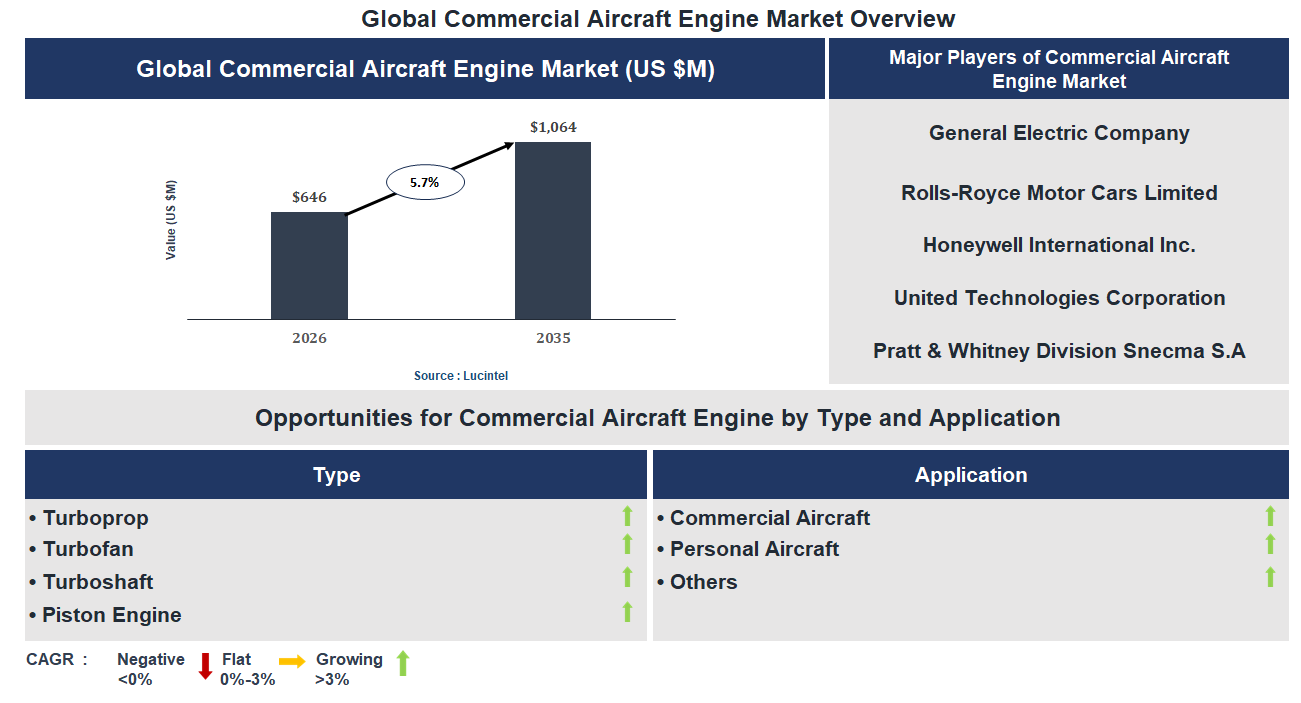
Key data points: The market size in 2035 = $1,064 million, growth forecast = 5.7% annually for the next 8 years. Scroll below to get more insights. This market report covers trends, opportunities and forecasts in commercial aircraft engine market to 2035 by type (turboprop, turbofan, turboshaft, and piston engine), application (commercial aircraft, personal aircraft, and others), and region (North America, Europe, Asia Pacific, and the Rest of the World)
We'll send your sample report shortly.
• Lucintel forecasts that, within the type category, turbofan is expected to witness the highest growth over the forecast period.
• Within the application category, commercial aircraft is expected to witness higher growth.
• In terms of region, APAC is expected to witness the highest growth over the forecast period. Gain valuable insights for your business decisions with our comprehensive 150+ page report. Sample figures with some insights are shown below.
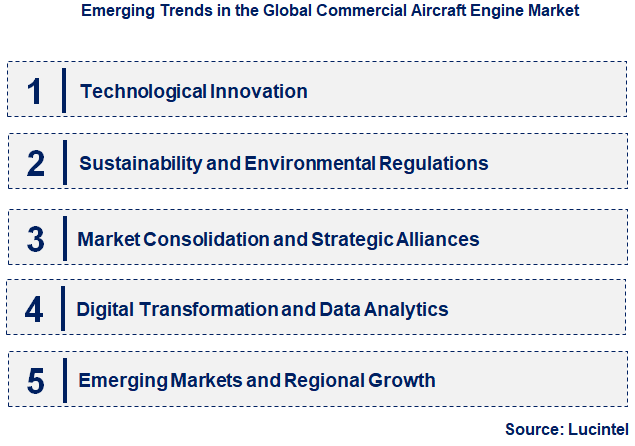
• Technological Innovation: The market is witnessing significant advancements in engine design, materials, and manufacturing processes. Next-generation engines, such as geared turbofans and open-rotor designs, offer improved fuel efficiency, reduced emissions, and lower operating costs. Digital technologies like predictive maintenance and AI-driven analytics are enhancing engine performance and reliability. These innovations are enabling manufacturers to deliver more sustainable and cost-effective engines, thereby meeting airline demands for efficiency and environmental compliance.
• Sustainability and Environmental Regulations: Increasing global emphasis on reducing carbon footprints is driving the adoption of eco-friendly engines. Regulatory bodies are imposing stricter emission standards, prompting manufacturers to develop engines with lower NOx emissions and higher fuel efficiency. The push for sustainable aviation fuels (SAFs) and hybrid-electric propulsion systems is also gaining momentum. These trends are compelling industry players to innovate rapidly, aligning product development with environmental policies and consumer expectations for greener travel options.
• Market Consolidation and Strategic Alliances: The competitive landscape is consolidating through mergers, acquisitions, and strategic partnerships. Major players are forming alliances to share technological expertise, expand market reach, and reduce R&D costs. This consolidation enhances their ability to develop advanced engine technologies and respond swiftly to market demands. It also results in a more concentrated market structure, influencing pricing strategies and competitive dynamics, ultimately benefiting consumers through improved product offerings.
• Digital Transformation and Data Analytics: The integration of digital technologies is revolutionizing engine design, manufacturing, and maintenance. Data analytics, IoT sensors, and AI enable real-time monitoring of engine performance, predictive maintenance, and optimized operations. This digital shift reduces downtime, enhances safety, and lowers operational costs. Additionally, digital twin technology allows for virtual testing and simulation, accelerating development cycles. These advancements are transforming traditional manufacturing and maintenance paradigms, making the market more efficient and responsive to customer needs.
• Emerging Markets and Regional Growth: Rapid economic growth in regions such as Asia-Pacific and the Middle East is fueling demand for commercial aircraft and, consequently, aircraft engines. These markets are characterized by expanding airline fleets, increased air travel, and infrastructure development. Local manufacturers are also emerging, supported by government initiatives and strategic investments. This regional growth diversifies the market, creates new opportunities for engine suppliers, and encourages innovation tailored to specific regional requirements, thereby reshaping the global competitive landscape. These trends are collectively transforming the commercial aircraft engine market by fostering innovation, emphasizing sustainability, encouraging strategic collaborations, leveraging digital technologies, and expanding regional markets. These developments are driving efficiency, reducing environmental impact, and opening new avenues for growth, ultimately shaping a more dynamic and competitive industry landscape.
• Technological Innovations in Engine Design: Advancements in materials and aerodynamics are leading to more fuel-efficient engines, reducing operational costs and emissions. These innovations enable airlines to meet stricter environmental standards while improving performance. The integration of digital monitoring systems enhances maintenance and reliability, further lowering lifecycle costs. Such developments are attracting investments and fostering competitive advantages for engine manufacturers, ultimately transforming the market landscape and encouraging sustainable growth.
• Shift Toward Sustainable and Eco-Friendly Engines: Increasing environmental concerns and regulations are pushing manufacturers to develop greener engines, including hybrid and electric propulsion systems. These eco-friendly engines aim to reduce carbon footprints and comply with international standards. The adoption of sustainable technologies is opening new market segments and encouraging airline operators to prioritize environmentally responsible options. This shift is expected to accelerate innovation, influence procurement decisions, and reshape industry standards, fostering a more sustainable future for commercial aviation.
• Rising Demand for Narrow-Body Aircraft Engines: The global expansion of low-cost carriers and regional travel is driving demand for narrow-body aircraft engines. These engines are favored for their efficiency, lower costs, and suitability for short to medium-haul routes. Manufacturers are focusing on producing lightweight, high-performance engines to meet this demand. The growth in this segment is expected to boost market revenues, stimulate competition, and lead to technological breakthroughs tailored to regional and budget-conscious markets.
• Strategic Collaborations and Mergers: Industry players are increasingly forming alliances, joint ventures, and mergers to enhance technological capabilities and expand market reach. These collaborations facilitate shared research, development, and production, reducing costs and accelerating innovation. Such strategic moves are enabling companies to better address evolving customer needs and environmental standards. The consolidation trend is expected to strengthen market positioning, foster innovation, and create a more resilient industry landscape, ultimately benefiting consumers and stakeholders.
• Impact of Digitalization and Data Analytics: The integration of digital technologies and data analytics is revolutionizing engine maintenance, performance monitoring, and design optimization. Predictive analytics enable proactive maintenance, reducing downtime and costs. Digital twin technology allows virtual testing and simulation, speeding up development cycles. These advancements improve reliability, efficiency, and customer satisfaction. As digitalization becomes more prevalent, it is transforming operational practices, creating new revenue streams, and setting new standards for innovation within the commercial aircraft engine market. These developments are collectively transforming the commercial aircraft engine market by fostering innovation, sustainability, and strategic growth. They are driving increased efficiency, reducing environmental impact, and enabling manufacturers to meet evolving customer demands. As a result, the market is poised for robust expansion, with technological and strategic advancements shaping a more competitive and sustainable future.
• Growing Demand for Fuel-Efficient Engines: The push for reducing operational costs and environmental impact is driving the development of more fuel-efficient engines. Airlines seek engines that offer better fuel economy, lower emissions, and compliance with stringent regulations. Manufacturers are investing in advanced materials, aerodynamics, and hybrid technologies to meet these needs, creating substantial growth opportunities in engine design, manufacturing, and aftermarket services.
• Expansion of Emerging Markets Presents New Opportunities: Rapid economic growth in regions like Asia-Pacific and the Middle East is fueling increased air travel and fleet expansion. Airlines in these markets are upgrading and expanding their fleets, creating demand for new engines. Local partnerships, tailored solutions, and understanding regional regulatory requirements are crucial for capturing market share and establishing a strong presence in these high-growth areas.
• Technological Innovations Drive Competitive Advantage: Advances in materials, additive manufacturing, and digitalization are transforming engine design and maintenance. Incorporating artificial intelligence, predictive analytics, and automation enhances performance, reliability, and maintenance efficiency. Companies investing in these innovations can differentiate themselves, reduce costs, and improve customer satisfaction, positioning themselves as leaders in a highly competitive market.
• Sustainability Initiatives Promote Development of Alternative Propulsion Systems: The push for greener aviation solutions is accelerating the development of alternative propulsion technologies such as hybrid-electric and fully electric engines. These innovations aim to reduce carbon emissions and dependence on fossil fuels. Investment in research and collaboration with technology providers are vital to bring these sustainable engines to market, opening new avenues for growth aligned with global environmental goals.
• Aftermarket Services and Maintenance Opportunities Expand Revenue Streams: As fleets grow and engines age, demand for maintenance, repair, and overhaul (MRO) services increases. Digital monitoring and predictive maintenance tools enable proactive servicing, reducing downtime and costs. Companies offering comprehensive aftermarket solutions can generate steady revenue streams, strengthen customer relationships, and gain a competitive edge by providing value-added services that extend engine life and optimize performance. The overall market growth is significantly influenced by these opportunities, fostering innovation, regional expansion, and sustainability. Companies that strategically leverage these trends will enhance their market position, meet evolving customer demands, and contribute to the sustainable development of the commercial aircraft engine industry.
• Technological Innovation: Advancements in engine design, such as the development of more fuel-efficient and environmentally friendly engines, are crucial. These innovations reduce operational costs for airlines and meet stringent emission standards, making newer engines more attractive. The integration of digital technologies like predictive maintenance and aerodynamics optimization enhances performance and reliability. As airlines seek to lower carbon footprints, manufacturers are investing heavily in next-generation engines, which accelerates market growth and competitiveness.
• Rising Air Travel Demand: The global increase in air travel, driven by economic growth, urbanization, and expanding middle classes, significantly boosts demand for commercial aircraft engines. Emerging markets, especially in Asia-Pacific, are experiencing rapid growth in passenger traffic, leading to higher aircraft orders. This surge necessitates a steady supply of new engines and engine upgrades, creating a robust market environment. The ongoing recovery from pandemic-related disruptions further amplifies this demand, supporting long-term industry expansion.
• Environmental Regulations and Sustainability Goals: Stricter emission standards and international agreements like the Carbon Offsetting and Reduction Scheme for International Aviation (CORSIA) compel manufacturers to develop cleaner engines. These regulations push innovation toward more sustainable solutions, such as geared turbofan engines and alternative fuel compatibility. Compliance not only ensures market access but also aligns with airlines corporate social responsibility goals, fostering a shift toward greener propulsion systems and influencing engine design and manufacturing strategies.
• Strategic Partnerships and Mergers: Collaborations between engine manufacturers, aircraft OEMs, and technology firms foster innovation and streamline development processes. Strategic alliances enable sharing of expertise, reduce R&D costs, and accelerate the commercialization of advanced engine technologies. Mergers and acquisitions also consolidate market power, enhance supply chain efficiencies, and expand product portfolios, positioning companies to better meet evolving customer demands and regulatory requirements.
• Increasing Focus on Fuel Efficiency: Rising fuel costs and environmental concerns drive the demand for more fuel-efficient engines. Innovations such as high bypass ratios, lightweight materials, and advanced aerodynamics contribute to significant fuel savings. Airlines prioritize these engines to reduce operating expenses and meet sustainability targets. Manufacturers are investing in research to develop engines that deliver superior efficiency, which is critical for maintaining competitiveness in a cost-sensitive industry. The challenges in the commercial aircraft engine market are:-
• High R&D and Manufacturing Costs: Developing next-generation engines involves substantial investment in research, testing, and certification processes. These costs can be prohibitive, especially for smaller players, and may lead to increased product prices. The lengthy development cycles and stringent regulatory approvals add to financial risks, potentially delaying market entry and affecting profitability. Managing these costs while maintaining technological innovation remains a key challenge for industry stakeholders.
• Supply Chain Disruptions: The complex global supply chains for engine components are vulnerable to disruptions caused by geopolitical tensions, pandemics, and natural disasters. Shortages of critical materials and delays in manufacturing can hinder production schedules, increase costs, and impact delivery timelines. Ensuring supply chain resilience is vital for meeting customer demands and maintaining competitive advantage, but ongoing vulnerabilities pose significant risks to market stability.
• Regulatory and Certification Hurdles: Stringent safety and environmental standards require extensive testing and certification, which can be time-consuming and costly. Navigating diverse regulatory environments across different regions complicates market entry and expansion. Delays in certification processes can hinder product launches and affect revenue streams. Staying compliant while innovating rapidly is a delicate balance that companies must manage to sustain growth in a highly regulated industry. The commercial aircraft engine market is shaped by technological progress, rising demand, and sustainability initiatives, which collectively foster growth and innovation. However, high development costs, supply chain vulnerabilities, and regulatory complexities pose significant hurdles. These drivers and challenges influence market dynamics, requiring stakeholders to adapt strategically. Successful navigation of this landscape will depend on technological agility, supply chain resilience, and regulatory compliance, ultimately determining the pace and direction of market evolution. The interplay of these factors will continue to define opportunities and risks, shaping the future trajectory of the industry.
• General Electric Company
• Rolls-Royce Motor Cars Limited
• Honeywell International Inc.
• United Technologies Corporation
• Pratt & Whitney Division Snecma S.A
• Hindustan Aeronautics Limited
• United Technologies Corporation
• Safran
• The Boeing Company
• International Aero Engines AG
• Turboprop
• Turbofan
• Turboshaft
• Piston Engine
• Commercial Aircraft
• Personal Aircraft
• Others
• North America
• Europe
• Asia Pacific
• The Rest of the World
• United States: The US market has seen major investments from Boeing and General Electric, focusing on next-generation engines like the GE9X. Innovations in fuel efficiency and noise reduction are prominent, with a strong emphasis on sustainable aviation fuels. The US also leads in research on hybrid-electric propulsion systems, aiming to reduce carbon emissions and improve performance. Additionally, startups and established firms are collaborating on advanced materials and digital engine health monitoring, enhancing reliability and maintenance efficiency.
• China: China’s commercial aircraft engine sector is rapidly expanding, driven by government initiatives to reduce reliance on foreign technology. The Commercial Aircraft Corporation of China (COMAC) is developing indigenous engines, such as the CJ-1000A, to power its upcoming aircraft. The country is investing heavily in research and development, focusing on high-bypass turbofan engines with improved fuel efficiency. Partnerships with international firms are also increasing, facilitating technology transfer and innovation. China aims to become a significant player in the global engine market by 2030, emphasizing domestic production and technological self-sufficiency.
• Germany: Germany remains a key hub for aerospace innovation, with companies like MTU Aero Engines leading engine development. The focus is on enhancing engine performance, reducing emissions, and integrating digital technologies for predictive maintenance. Germany is also involved in European collaborations, such as Airbus and the European Union’s Clean Sky initiative, to develop environmentally friendly propulsion systems. The country is investing in research on hybrid-electric engines and sustainable materials, aiming to meet stringent EU environmental standards while maintaining technological leadership.
• India: India’s aerospace sector is experiencing rapid growth, with the government promoting indigenous engine development through organizations like HAL and DRDO. The focus is on developing small to medium turbofan engines suitable for regional aircraft and military applications. India is also exploring sustainable aviation fuels and eco-friendly engine technologies to align with global environmental goals. Collaborations with international aerospace firms are increasing, facilitating technology transfer and capacity building. The country aims to establish itself as a significant player in regional aircraft engine manufacturing and innovation.
• Japan: Japan’s aerospace industry is characterized by its emphasis on high-precision engineering and advanced materials. Companies like IHI Corporation are working on next-generation engines with improved fuel efficiency and reduced emissions. Japan is also investing in hybrid and electric propulsion systems, aligning with global trends toward sustainability. The country’s focus on research and development is supported by government initiatives aimed at reducing environmental impact and enhancing technological competitiveness. Japan’s strategic partnerships with international aerospace firms further bolster its position in the evolving commercial aircraft engine market.


• General Electric Company
• Rolls-Royce Motor Cars Limited
• Honeywell International Inc.
• United Technologies Corporation
• Pratt & Whitney Division Snecma S.A
• Hindustan Aeronautics Limited
• United Technologies Corporation
• Safran
• The Boeing Company
• International Aero Engines AG Q6. Which commercial aircraft engine market segment will be the largest in future? Answer: Lucintel forecasts that, within the type category, turbofan is expected to witness the highest growth over the forecast period. Q7. In commercial aircraft engine market, which region is expected to be the largest in next 8 years? Answer: In terms of region, APAC is expected to witness the highest growth over the forecast period. Q8. Do we receive customization in this report? Answer: Yes, Lucintel provides 10% customization without any additional cost.


Choose a license that fits your team. Instant PDF delivery.
Prices exclude taxes. Instant delivery. Custom licensing available on request.
Market Report · July 31, 2026
Market Report · July 31, 2026
Market Report · July 22, 2026
Trusted partner for strategic intelligence and business growth


Receive a complimentary market analysis tailored to your industry. Our analysts will identify key growth opportunities and competitive dynamics specific to your business.

Market size, growth rate, and key trend analysis for your specific sector.

Top competitor positioning and market share analysis.

Strategic recommendations backed by data-driven insights.
Get curated market intelligence and competitive moves straight to your inbox.
By subscribing, you agree to receive our monthly insights. Unsubscribe anytime.
Receive a complimentary market analysis tailored to your industry. Our analysts will identify key growth opportunities and competitive dynamics specific to your business.
Market size, growth rate, and key trend analysis for your specific sector.
Top competitor positioning and market share analysis.
Strategic recommendations backed by data-driven insights.
Get curated market intelligence, emerging trends, and competitive moves straight to your inbox each month.
By subscribing, you agree to receive our monthly insights. Unsubscribe anytime.
We'll send your sample report shortly.