
Close Lucintel Chat
Didn't Find What You're Looking for?
Call us at +1972 636 5056 or write at helpdesk@Lucintel.com
Ask an Expert Provide Custom Requirements Download Sample Report Search Available Reports
  • helpdesk@Lucintel.com
  • |
  • Call Lucintel +1 972 636 5056
  • |
  • Login
  • |
  • Register
  • |
  • Search
  • |
'
...

The Impact of COVID-19 is included in Colour Cosmetic Market Report. Buy it today to get an advantage.

Request the impact of COVID-19 on your product or industry


Colour Cosmetic Market Trends and Forecast

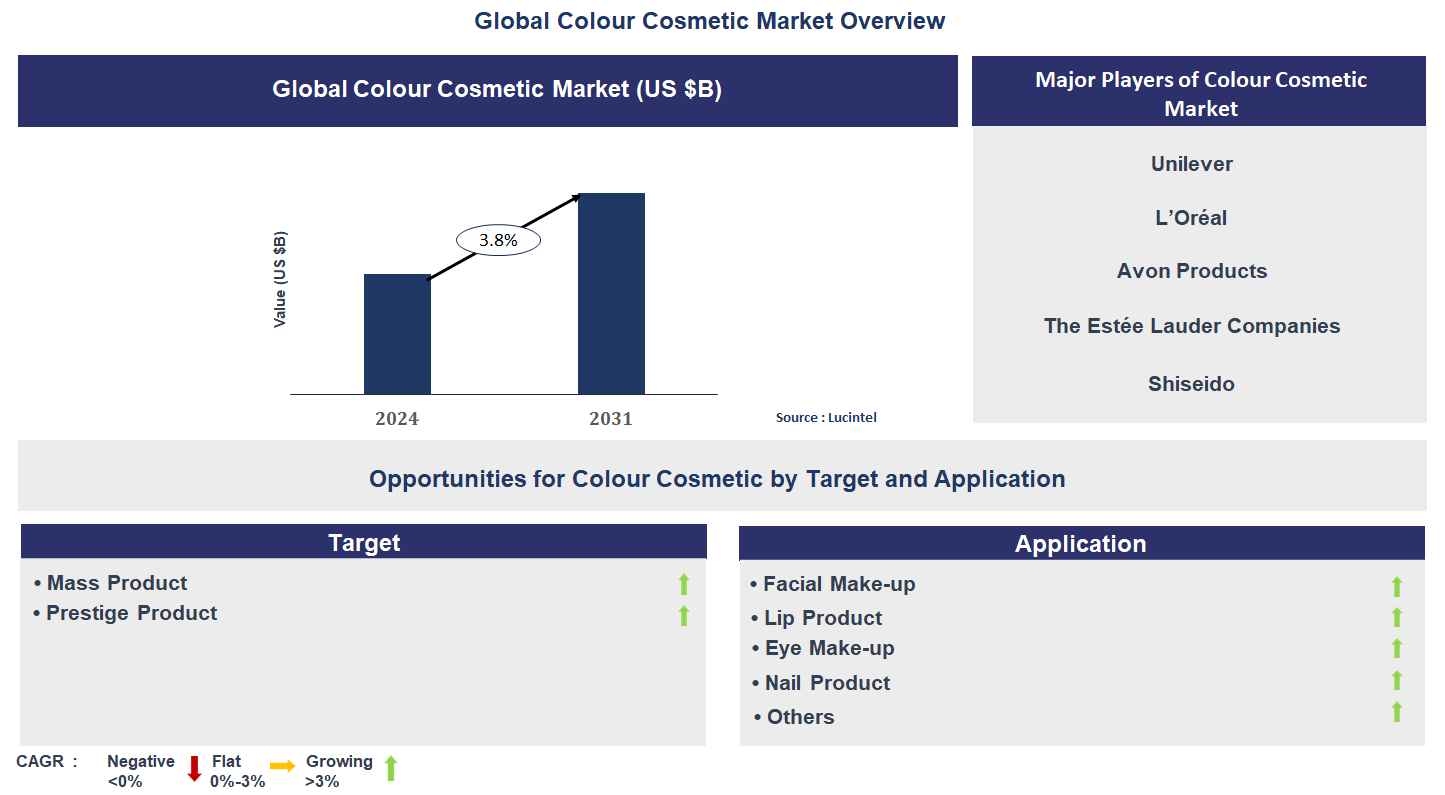
The future of the global colour cosmetic market looks promising with opportunities in the facial make-up, lip product, eye make-up, and nail product markets. The global colour cosmetic market is expected to grow with a CAGR of 3.8% from 2025 to 2031. The major drivers for this market are the increasing adoption of beauty products, the rising influence of social media trends, and the growing demand for cruelty-free cosmetics.

• Lucintel forecasts that, within the target category, prestige product is expected to witness higher growth over the forecast period.
• Within the application category, facial make-up is expected to witness the highest growth.
• In terms of region, APAC is expected to witness the highest growth over the forecast period.
Gain valuable insights for your business decisions with our comprehensive 150+ page report. Sample figures with some insights are shown below.
Colour Cosmetic Market Trends and Forecast

Emerging Trends in the Colour Cosmetic Market

The colour cosmetic market is experiencing a paradigm shift, fueled by new trends that represent a greater association between beauty, technology, and personal beliefs. These trends are shifting the industry away from conventional aesthetics to emphasis on a more comprehensive perspective of well-being and self-expression. From the incorporation of skincare benefits to leveraging digital tools to deliver personalized experiences, these innovations are not only altering what consumers purchase, but also how they find and engage with brands.
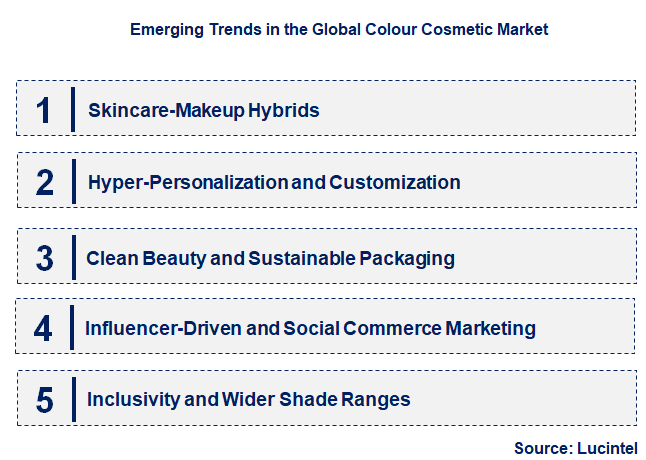
• Skincare-Makeup Hybrids: A prime trend is where lines are blurring between makeup and skincare. Today, consumers want their colour cosmetics to not only impart color, but also to moisturize, give sun protection, and provide anti-aging benefits. This has fueled growth in foundations with serums incorporated within, lipsticks with moisturizing ingredients, and concealers that have anti-inflammatory ingredients.
• Hyper-Personalization and Customization: Technology is making it possible to enter a new age of personalized beauty. Brands are employing artificial intelligence and augmented reality to assist consumers in discovering the ideal shade and product for their individual requirements. Virtual try-on tools and online questionnaires recommending personalized product regimens are part of this trend.
• Clean Beauty and Sustainable Packaging: The clean beauty trend continues to build steam. Consumers are becoming more and more critical of ingredient labels, wanting products that contain no parabens, sulfates, and other chemicals that could be negative. This is coupled with a fierce demand for sustainability in package materials. Brands are shifting away from plastic, toward refillable, recyclable, or biodegradable packaging.
• Influencer-Driven and Social Commerce Marketing: Social media has emerged as a top discovery, education, and purchasing channel. The social commerce trend, specifically through in-app shopping capabilities and live streaming, has turned colour cosmetic sales on its head. Influencers are central to the action, establishing credibility and selling products through real product reviews and tutorials.
• Inclusivity and Wider Shade Ranges: Brands are finally answering long-pending consumer requests for increased inclusivity. This is more than a marketing message; it is about formulating and selling products that truly accommodate all skin types, tones, and genders. Brands are increasing their foundation and concealer shade ranges and launching campaigns embracing diverse beauty.
These new trends are ultimately transforming the colour cosmetic industry. They are changing it from a stagnant industry concerned with long-standing products to a vibrant, consumer-driven system. The overlap between makeup and skincare, the strength of digital personalization, and the need for ethical and inclusive products are compelling brands to re-imagine their entire business model. The future of the market will be determined by its capacity to innovate, establish trust, and authentically engage with a widely diverse and highly educated base of consumers.
Emerging Trends in the Colour Cosmetic Market

Recent Development in the Colour Cosmetic Market

The colour cosmetic market is undergoing a variety of recent trends that are transforming the industry at a fast pace. These trends are influenced by consumer changes, advancements in technology, and a shift towards greener and more inclusive operations. All these trends are interrelated and are in turn collectively influencing product innovation, marketing and advertising methods, and consumer behavior.
• Use of Artificial Intelligence and Augmented Reality: Perhaps the most dramatic change is the marriage of AI and AR to bring it to the consumer experience. Brands are employing virtual try-on technology so that the customer can test out makeup digitally on their phone or computer before they buy. It decreases return rates and optimizes the online shopping experience. AI-based tools also examine skin tone and type to suggest customized product regimens, rendering the experience of choosing the correct makeup more efficient and targeted.
• Growth of the Multifunctional and Hybrid Product Category: One of the significant developments is the expansion of hybrid products that offer color along with the benefit of skincare. This ranges from foundations with anti-aging and SPF properties, lipsticks containing moisturizing ingredients, to primers that serve as a facial serum, too. This trend mirrors a consumer aspiration for streamlined rituals and prioritized long-term skin care.
• Increase in the Male Grooming and Cosmetic Segment: The other area of significant development is the expansion of the male grooming and cosmetic segment. As social culture regarding gender and personal expression changes, a greater number of men are integrating colour cosmetics as part of their everyday lives. This has spurred the creation of new product categories, including tinted moisturizers and men’s concealers. Manufacturers are launching new advertising campaigns aimed at this segment, illustrating a significant growth in the consumer universe.
• Sustainable and Refillable Packaging Strategy: The sector is witnessing a significant change towards sustainable packaging solutions. The companies are shifting from using single-use plastic to offering refillable compacts, returnable glass bottles, and other green materials. This is an immediate response to the demand for more sustainable products from the consumers as well as a corporate focus on sustainability.
• Higher Market Penetration of Clean Beauty Brands: The clean beauty trend, which emphasizes products that contain no potentially toxic ingredients, has transitioned from a niche market to the mass market. A notable growth is the higher market penetration of brands that invest in clean formulations. This is altering the norm for what shoppers want from their beauty products. Large retailers are establishing special sections for clean beauty, and even traditional companies are reformulating their items to satisfy these changing requirements of openness and safety.
These are all having a combined powerful effect on the colour cosmetics market. They are driving the business towards an age that is more high-tech, more inclusive, and greener. The use of AI and AR is changing the way that people shop, and the emphasis on hybrid products and clean formulations is evolving the products themselves. The diversification into new markets and the adherence to green practices demonstrate an industry that is looking to the future and aligning its business with the values of its customers.

Strategic Growth Opportunities in the Colour Cosmetic Market

The colour cosmetic market presents a range of strategic growth prospects in key applications based on changing consumer requirements and technological improvements. To take advantage of these opportunities, one needs to have a thorough understanding of market dynamics and a readiness to innovate outside the usual product categories. Businesses that are able to position themselves strategically to address these emerging needs are set to achieve dramatic expansion.
• Growing Men’s and Gender-Neutral Cosmetic Segment: One of the biggest opportunities for growth is in the male grooming and gender-neutral cosmetic categories. With changing social attitudes, more men are trying makeup. It is possible for brands to build specific product lines like tinted moisturizers, brow gels, and concealer sticks targeted towards this group. In addition, gender-neutral packaging and branding can resonate with a wider audience, reaching a market concerned with authenticity and self-expression rather than traditional notions of gender.
• Targeting the Mature and Senior Consumer Market: The world’s aging population represents a strong growth potential. This segment is typically neglected, but they possess high disposable income and particular beauty concerns. Brands are able to create colour cosmetics with anti-aging benefits, like foundations that fill in fine lines or lipsticks that moisturize and reduce the appearance of wrinkles.
• Creating Hyper-Personalized and Custom-Made Products: The craving for personalized products provides a special growth chance. By using technology such as AI-based quizzes and virtual try-on, companies can provide bespoke-blended foundations, concealers, or lip colors. Not only does this give a precise match to the consumer, but it also establishes a high-end, made-to-order experience that is worth a premium price.
• Targeting the Clean and Ethical Beauty Segment: Although clean beauty is a general trend, there is a particular opportunity to expand within this segment by emphasizing ethical sourcing and open supply chains. Companies can stand out by acquiring cruelty-free, vegan, and eco-friendly certifications. By presenting a clear breakdown of ingredients and sources, manufacturers can establish a trust base among consumers who are most interested in the social and environmental footprint of their products.
• Penetrating Tier-2 and Tier-3 Cities in Emerging Markets: With immense growth potential comes the opportunity to penetrate Tier-2 and Tier-3 cities in emerging markets such as India and China. While primary metropolitan areas are penetrated, there is an emerging middle class in these secondary markets that is gaining exposure to products through e-commerce. Strategic growth can be realized by rolling out products customized to local tastes and price points, and leveraging digital marketing to create brand awareness for these new and promising markets.
These strategic growth strategies are making a big difference in the colour cosmetic industry by compelling companies to innovate and stretch their imagination outside their conventional consumer base. Through an emphasis on niche consumers such as men and older people, the use of technology for personalization, and adherence to ethical and sustainable business practices, brands are generating new streams of revenue and developing a stronger business model.

Colour Cosmetic Market Driver and Challenges

The colour cosmetic industry is a complex and diverse industry driven by numerous technological, economic, and regulatory forces. The industry growth is driven by strong forces that are transforming consumer behavior and industry practices. Nonetheless, this growth does not come without tremendous challenges that need to be dealt with in order to ensure long-term growth.
The factors responsible for driving the colour cosmetic market include:
1. Social Media and Digital Platforms’ Impact: Social media has emerged as a key propeller of the colour cosmetic industry. Media platforms such as Instagram, TikTok, and YouTube have revolutionized the way consumers become aware of new products and learn application methods. Beauty influencers and bloggers serve as influential tastemakers, driving trends and taking product launches viral.
2. Increased Demand for Clean and Natural Products: Consumers increasingly have a desire for colour cosmetics with natural, clean, and non-toxic ingredients. Consumers are getting increasingly savvy about what they put on their skin and are increasingly concerned about the health implications of synthetic chemicals. This is driving brands to reformulate products, get certified, and use transparent labeling.
3. Technological Innovation and Advances: Ongoing technological innovation is a key driver of business expansion. This encompasses creation of new formulations with improved performance, for example, long-lasting, smudge-proof, and transfer-resistant products. Incorporation of technology such as AI and AR, making it possible to try on virtually and receive customized product suggestions, is also transforming the consumer’s experience and propelling online transactions.
4. Urbanization and Growing Disposable Income: Growing disposable income, especially in emerging economies, is a key economic driver. With higher amounts of money at their disposal, people are more inclined to spend on luxury and premium colour cosmetics. This trend is pronounced in fast-growing urban areas, where there is greater exposure to international beauty trends and personal grooming awareness is on the rise.
5. Inclusivity and Self-Expression Trend: The market is propelled by increasing emphasis on self-expression and individuality. Consumers are employing colour cosmetics as a means of expressing their identity, not just to fit in according to beauty ideals. This has resulted in an increasing demand for a broader palette of shades, from foundations to lipsticks, that match a variety of skin tones. Brands that adopt inclusivity as a part of their product portfolio and marketing initiatives are creating trust and loyalty with a diverse consumer audience.
Challenges in the colour cosmetic market are:
1. Ferocious Competition and Market Saturation: The colour cosmetics industry is extremely fragmented with numerous brands, ranging from global giants to small start-ups, vying for consumer attention. This competition results in cutthroat pricing and high advertising expenses, which can whittle down profit margins. Market saturation renders it challenging for new entrants to penetrate and for incumbent brands to differentiate themselves.
2. Regulatory Barriers and Compliance: The sector is subject to a maze of regulations that cover product formulation, labeling, and claims. Each country has its own ingredient standards, which create difficulties in global operations for brands. The threat of product recall and litigation owing to non-compliance is a major challenge. Keeping abreast of changing regulations takes constant vigilance and investment in research and development.
3. Counterfeit Products and Intellectual Property Theft: Popularity of colour cosmetics has resulted in massive issues with counterfeit products. Not only do these counterfeit products damage a brand’s reputation and sales, but also cause health problems to customers. These counterfeit products are usually manufactured using inexpensive, unregulated ingredients. Ensuring intellectual property and preventing the spread of counterfeit products is an ongoing struggle for brands.
The dynamics among these drivers and challenges are molding a highly promising and highly competitive market. The drivers, spearheaded by social media and a need for cleaner, more innovative solutions, are creating huge growth opportunities. They are encouraging the market to become more inclusive and technologically oriented. Yet. challenges such as market saturation and regulatory hurdles serve as a reminder of reality, making brands think before they act.

List of Colour Cosmetic Companies

Companies in the market compete on the basis of product quality offered. Major players in this market focus on expanding their manufacturing facilities, R&D investments, infrastructural development, and leverage integration opportunities across the value chain. With these strategies colour cosmetic companies cater increasing demand, ensure competitive effectiveness, develop innovative products & technologies, reduce production costs, and expand their customer base. Some of the colour cosmetic companies profiled in this report include-
• Unilever
• L’Oréal
• Avon Products
• The Estée Lauder Companies
• Shiseido
• Chantecaille Beauté
• Revlon
• Coty
• NARS Cosmetics
• Giorgio Armani

Colour Cosmetic Market by Segment

The study includes a forecast for the global colour cosmetic market by target, application, and region.

Colour Cosmetic Market by Target [Value from 2019 to 2031]:


• Mass Product
• Prestige Product

Colour Cosmetic Market by Application [Value from 2019 to 2031]:


• Facial Make-up
• Lip Product
• Eye Make-up
• Nail Product
• Others

Colour Cosmetic Market by Region [Value from 2019 to 2031]:


• North America
• Europe
• Asia Pacific
• The Rest of the World

Country Wise Outlook for the Colour Cosmetic Market

The world colour cosmetic market is in a process of ongoing development, influenced by a combination of factors such as digital evolution, changing consumer values, and post-pandemic revival of social activity. Consumers are looking increasingly for products that not just improve their looks but also confer skincare benefits, are compatible with their ethical standards, and are conveniently available through a range of channels. These trends are not consistent worldwide, and each of the large markets—the United States, China, Germany, India, and Japan—have distinct characteristics and drivers of growth.
• United States: The US colour cosmetics market is undergoing a dramatic shift toward digital-first companies and celebrity-focused product lines. Influencers and direct-to-consumer start-ups are taking a big bite out of the market through hyper-personalization, clean beauty, and transparent ingredient sourcing. As established brands shift by growing their e-commerce channels and introducing eco-friendly lines, upstart players are getting ahead of the curve by using social media to create robust brand communities and providing cutting-edge, high-performance products tailored to a sophisticated, health-oriented consumer base.
• China: The Chinese market features fast post-pandemic rebound and aggressive adoption of e-commerce and social commerce. Product launches and sales are made increasingly crucial by live streaming and key opinion leader marketing. Local brands are gaining strong momentum, competing with international brands by providing products suited to local skin tones and preferences. There is also a high trend towards multifunctional and hybrid cosmetics-skincare products, as natural radiance and skin health are the priorities among Chinese consumers.
• Germany: A strong consumer demand for natural, organic, and certified products drives the colour cosmetic market in Germany. The market is demanding understated, long-wear makeup with skincare benefits. German consumers are extremely critical of ingredient and environmental claims, and this compels the brands to invest in ethical sourcing and transparent labeling. Though social media dictates trends, the center market emphasizes efficacy, minimalism, and a concentration on core beauty products that provide performance and a clear health benefit.
• India: The Indian colour cosmetics industry is growing rapidly with a young population, improving disposable incomes, and the far-reaching impact of social media. Online channels such as Nykaa have made it easier for people to access a variety of international and domestic brands, with products now accessible outside large urban centers. Increased demand for products that cater to the varying Indian skin tones and climatic conditions is being witnessed.
• Japan: Japan’s economy is a developed one with a reputation for quality, accuracy, and technological advance. While the traditional ideals of beauty remain dominant, increasingly there is interest in colour cosmetics that deliver a natural, radiant appearance. Anti-aging and skincare benefits are becoming more and more appealing to Japanese consumers. The market also involves diversification of products to meet the needs of an aging population and an increasing male grooming market.

Lucintel Analytics Dashboard

Features of the Global Colour Cosmetic Market

Market Size Estimates: Colour cosmetic market size estimation in terms of value ($B).
Trend and Forecast Analysis: Market trends (2019 to 2024) and forecast (2025 to 2031) by various segments and regions.
Segmentation Analysis: Colour cosmetic market size by target, application, and region in terms of value ($B).
Regional Analysis: Colour cosmetic market breakdown by North America, Europe, Asia Pacific, and Rest of the World.
Growth Opportunities: Analysis of growth opportunities in different target, applications, and regions for the colour cosmetic market.
Strategic Analysis: This includes M&A, new product development, and competitive landscape of the colour cosmetic market.
Analysis of competitive intensity of the industry based on Porter’s Five Forces model.

Lucintel Consulting Services

FAQ

Q1. What is the growth forecast for colour cosmetic market?
Answer: The global colour cosmetic market is expected to grow with a CAGR of 3.8% from 2025 to 2031.
Q2. What are the major drivers influencing the growth of the colour cosmetic market?
Answer: The major drivers for this market are the increasing adoption of beauty products, the rising influence of social media trends, and the growing demand for cruelty-free cosmetics.
Q3. What are the major segments for colour cosmetic market?
Answer: The future of the colour cosmetic market looks promising with opportunities in the facial make-up, lip product, eye make-up, and nail product markets.
Q4. Who are the key colour cosmetic market companies?
Answer: Some of the key colour cosmetic companies are as follows:
• Unilever
• L’Oréal
• Avon Products
• The Estée Lauder Companies
• Shiseido
• Chantecaille Beauté
• Revlon
• Coty
• NARS Cosmetics
• Giorgio Armani
Q5. Which colour cosmetic market segment will be the largest in future?
Answer: Lucintel forecasts that, within the target category, prestige product is expected to witness higher growth over the forecast period.
Q6. In colour cosmetic market, which region is expected to be the largest in next 5 years?
Answer: In terms of region, APAC is expected to witness the highest growth over the forecast period.
Q7. Do we receive customization in this report?
Answer: Yes, Lucintel provides 10% customization without any additional cost.

This report answers following 11 key questions:

Q.1. What are some of the most promising, high-growth opportunities for the colour cosmetic market by target (mass product and prestige product), application (facial make-up, lip product, eye make-up, nail product, and others), and region (North America, Europe, Asia Pacific, and the Rest of the World)?
Q.2. Which segments will grow at a faster pace and why?
Q.3. Which region will grow at a faster pace and why?
Q.4. What are the key factors affecting market dynamics? What are the key challenges and business risks in this market?
Q.5. What are the business risks and competitive threats in this market?
Q.6. What are the emerging trends in this market and the reasons behind them?
Q.7. What are some of the changing demands of customers in the market?
Q.8. What are the new developments in the market? Which companies are leading these developments?
Q.9. Who are the major players in this market? What strategic initiatives are key players pursuing for business growth?
Q.10. What are some of the competing products in this market and how big of a threat do they pose for loss of market share by material or product substitution?
Q.11. What M&A activity has occurred in the last 5 years and what has its impact been on the industry?

For any questions related to Colour Cosmetic Market, Colour Cosmetic Market Size, Colour Cosmetic Market Growth, Colour Cosmetic Market Analysis, Colour Cosmetic Market Report, Colour Cosmetic Market Share, Colour Cosmetic Market Trends, Colour Cosmetic Market Forecast, Colour Cosmetic Companies, write Lucintel analyst at email: helpdesk@lucintel.com. We will be glad to get back to you soon.
                                           Table of Contents

            1. Executive Summary

            2. Market Overview

                        2.1 Background and Classifications
                        2.2 Supply Chain

            3. Market Trends & Forecast Analysis

                        3.1 Macroeconomic Trends and Forecasts
                        3.2 Industry Drivers and Challenges
                        3.3 PESTLE Analysis
                        3.4 Patent Analysis
                        3.5 Regulatory Environment
                        3.6 Global Colour Cosmetic Market Trends and Forecast

            4. Global Colour Cosmetic Market by Target

                        4.1 Overview
                        4.2 Attractiveness Analysis by Target
                        4.3 Mass Product : Trends and Forecast 2025 to 2031
                        4.4 Prestige Product : Trends and Forecast 2025 to 2031

            5. Global Colour Cosmetic Market by Application

                        5.1 Overview
                        5.2 Attractiveness Analysis by Application
                        5.3 Facial Make-up : Trends and Forecast 2025 to 2031
                        5.4 Lip Product : Trends and Forecast 2025 to 2031
                        5.5 Eye Make-up : Trends and Forecast 2025 to 2031
                        5.6 Nail Product : Trends and Forecast 2025 to 2031
                        5.7 Others : Trends and Forecast 2025 to 2031

            6. Regional Analysis

                        6.1 Overview
                        6.2 Global Colour Cosmetic Market by Region

            7. North American Colour Cosmetic Market

                        7.1 Overview
                        7.2 North American Colour Cosmetic Market by Target
                        7.3 North American Colour Cosmetic Market by Application
                        7.4 The United States Colour Cosmetic Market
                        7.5 Canadian Colour Cosmetic Market
                        7.6 Mexican Colour Cosmetic Market

            8. European Colour Cosmetic Market

                        8.1 Overview
                        8.2 European Colour Cosmetic Market by Target
                        8.3 European Colour Cosmetic Market by Application
                        8.4 German Colour Cosmetic Market
                        8.5 French Colour Cosmetic Market
                        8.6 Italian Colour Cosmetic Market
                        8.7 Spanish Colour Cosmetic Market
                        8.8 The United Kingdom Colour Cosmetic Market

            9. APAC Colour Cosmetic Market

                        9.1 Overview
                        9.2 APAC Colour Cosmetic Market by Target
                        9.3 APAC Colour Cosmetic Market by Application
                        9.4 Chinese Colour Cosmetic Market
                        9.5 Indian Colour Cosmetic Market
                        9.6 Japanese Colour Cosmetic Market
                        9.7 South Korean Colour Cosmetic Market
                        9.8 Indonesian Colour Cosmetic Market

            10. ROW Colour Cosmetic Market

                        10.1 Overview
                        10.2 ROW Colour Cosmetic Market by Target
                        10.3 ROW Colour Cosmetic Market by Application
                        10.4 Middle Eastern Colour Cosmetic Market
                        10.5 South American Colour Cosmetic Market
                        10.6 African Colour Cosmetic Market

            11. Competitor Analysis

                        11.1 Product Portfolio Analysis
                        11.2 Operational Integration
                        11.3 Porter’s Five Forces Analysis
                                    • Competitive Rivalry
                                    • Bargaining Power of Buyers
                                    • Bargaining Power of Suppliers
                                    • Threat of Substitutes
                                    • Threat of New Entrants
                        11.4 Market Share Analysis

            12. Opportunities & Strategic Analysis

                        12.1 Value Chain Analysis
                        12.2 Growth Opportunity Analysis
                                    12.2.1 Growth Opportunity by Target
                                    12.2.2 Growth Opportunity by Application
                        12.3 Emerging Trends in the Global Colour Cosmetic Market
                        12.4 Strategic Analysis
                                    12.4.1 New Product Development
                                    12.4.2 Certification and Licensing
                                    12.4.3 Mergers, Acquisitions, Agreements, Collaborations, and Joint Ventures

            13. Company Profiles of the Leading Players Across the Value Chain

                        13.1 Competitive Analysis
                        13.2 Unilever
                                    • Company Overview
                                    • Colour Cosmetic Market Business Overview
                                    • New Product Development
                                    • Merger, Acquisition, and Collaboration
                                    • Certification and Licensing
                        13.3 L’Oréal
                                    • Company Overview
                                    • Colour Cosmetic Market Business Overview
                                    • New Product Development
                                    • Merger, Acquisition, and Collaboration
                                    • Certification and Licensing
                        13.4 Avon Products
                                    • Company Overview
                                    • Colour Cosmetic Market Business Overview
                                    • New Product Development
                                    • Merger, Acquisition, and Collaboration
                                    • Certification and Licensing
                        13.5 The Estée Lauder Companies
                                    • Company Overview
                                    • Colour Cosmetic Market Business Overview
                                    • New Product Development
                                    • Merger, Acquisition, and Collaboration
                                    • Certification and Licensing
                        13.6 Shiseido
                                    • Company Overview
                                    • Colour Cosmetic Market Business Overview
                                    • New Product Development
                                    • Merger, Acquisition, and Collaboration
                                    • Certification and Licensing
                        13.7 Chantecaille Beauté
                                    • Company Overview
                                    • Colour Cosmetic Market Business Overview
                                    • New Product Development
                                    • Merger, Acquisition, and Collaboration
                                    • Certification and Licensing
                        13.8 Revlon
                                    • Company Overview
                                    • Colour Cosmetic Market Business Overview
                                    • New Product Development
                                    • Merger, Acquisition, and Collaboration
                                    • Certification and Licensing
                        13.9 Coty
                                    • Company Overview
                                    • Colour Cosmetic Market Business Overview
                                    • New Product Development
                                    • Merger, Acquisition, and Collaboration
                                    • Certification and Licensing
                        13.10 NARS Cosmetics
                                    • Company Overview
                                    • Colour Cosmetic Market Business Overview
                                    • New Product Development
                                    • Merger, Acquisition, and Collaboration
                                    • Certification and Licensing
                        13.11 Giorgio Armani
                                    • Company Overview
                                    • Colour Cosmetic Market Business Overview
                                    • New Product Development
                                    • Merger, Acquisition, and Collaboration
                                    • Certification and Licensing

            14. Appendix

                        14.1 List of Figures
                        14.2 List of Tables
                        14.3 Research Methodology
                        14.4 Disclaimer
                        14.5 Copyright
                        14.6 Abbreviations and Technical Units
                        14.7 About Us
                        14.8 Contact Us

                                               List of Figures


            Chapter 1

                        Figure 1.1: Trends and Forecast for the Global Colour Cosmetic Market

            Chapter 2

                        Figure 2.1: Usage of Colour Cosmetic Market
                        Figure 2.2: Classification of the Global Colour Cosmetic Market
                        Figure 2.3: Supply Chain of the Global Colour Cosmetic Market

            Chapter 3

                        Figure 3.1: Trends of the Global GDP Growth Rate
                        Figure 3.2: Trends of the Global Population Growth Rate
                        Figure 3.3: Trends of the Global Inflation Rate
                        Figure 3.4: Trends of the Global Unemployment Rate
                        Figure 3.5: Trends of the Regional GDP Growth Rate
                        Figure 3.6: Trends of the Regional Population Growth Rate
                        Figure 3.7: Trends of the Regional Inflation Rate
                        Figure 3.8: Trends of the Regional Unemployment Rate
                        Figure 3.9: Trends of Regional Per Capita Income
                        Figure 3.10: Forecast for the Global GDP Growth Rate
                        Figure 3.11: Forecast for the Global Population Growth Rate
                        Figure 3.12: Forecast for the Global Inflation Rate
                        Figure 3.13: Forecast for the Global Unemployment Rate
                        Figure 3.14: Forecast for the Regional GDP Growth Rate
                        Figure 3.15: Forecast for the Regional Population Growth Rate
                        Figure 3.16: Forecast for the Regional Inflation Rate
                        Figure 3.17: Forecast for the Regional Unemployment Rate
                        Figure 3.18: Forecast for Regional Per Capita Income
                        Figure 3.19: Driver and Challenges of the Colour Cosmetic Market

            Chapter 4

                        Figure 4.1: Global Colour Cosmetic Market by Target in 2019, 2024, and 2031
                        Figure 4.2: Trends of the Global Colour Cosmetic Market ($B) by Target
                        Figure 4.3: Forecast for the Global Colour Cosmetic Market ($B) by Target
                        Figure 4.4: Trends and Forecast for Mass Product in the Global Colour Cosmetic Market (2019-2031)
                        Figure 4.5: Trends and Forecast for Prestige Product in the Global Colour Cosmetic Market (2019-2031)

            Chapter 5

                        Figure 5.1: Global Colour Cosmetic Market by Application in 2019, 2024, and 2031
                        Figure 5.2: Trends of the Global Colour Cosmetic Market ($B) by Application
                        Figure 5.3: Forecast for the Global Colour Cosmetic Market ($B) by Application
                        Figure 5.4: Trends and Forecast for Facial Make-up in the Global Colour Cosmetic Market (2019-2031)
                        Figure 5.5: Trends and Forecast for Lip Product in the Global Colour Cosmetic Market (2019-2031)
                        Figure 5.6: Trends and Forecast for Eye Make-up in the Global Colour Cosmetic Market (2019-2031)
                        Figure 5.7: Trends and Forecast for Nail Product in the Global Colour Cosmetic Market (2019-2031)
                        Figure 5.8: Trends and Forecast for Others in the Global Colour Cosmetic Market (2019-2031)

            Chapter 6

                        Figure 6.1: Trends of the Global Colour Cosmetic Market ($B) by Region (2019-2024)
                        Figure 6.2: Forecast for the Global Colour Cosmetic Market ($B) by Region (2025-2031)

            Chapter 7

                        Figure 7.1: Trends and Forecast for the North American Colour Cosmetic Market (2019-2031)
                        Figure 7.2: North American Colour Cosmetic Market by Target in 2019, 2024, and 2031
                        Figure 7.3: Trends of the North American Colour Cosmetic Market ($B) by Target (2019-2024)
                        Figure 7.4: Forecast for the North American Colour Cosmetic Market ($B) by Target (2025-2031)
                        Figure 7.5: North American Colour Cosmetic Market by Application in 2019, 2024, and 2031
                        Figure 7.6: Trends of the North American Colour Cosmetic Market ($B) by Application (2019-2024)
                        Figure 7.7: Forecast for the North American Colour Cosmetic Market ($B) by Application (2025-2031)
                        Figure 7.8: Trends and Forecast for the United States Colour Cosmetic Market ($B) (2019-2031)
                        Figure 7.9: Trends and Forecast for the Mexican Colour Cosmetic Market ($B) (2019-2031)
                        Figure 7.10: Trends and Forecast for the Canadian Colour Cosmetic Market ($B) (2019-2031)

            Chapter 8

                        Figure 8.1: Trends and Forecast for the European Colour Cosmetic Market (2019-2031)
                        Figure 8.2: European Colour Cosmetic Market by Target in 2019, 2024, and 2031
                        Figure 8.3: Trends of the European Colour Cosmetic Market ($B) by Target (2019-2024)
                        Figure 8.4: Forecast for the European Colour Cosmetic Market ($B) by Target (2025-2031)
                        Figure 8.5: European Colour Cosmetic Market by Application in 2019, 2024, and 2031
                        Figure 8.6: Trends of the European Colour Cosmetic Market ($B) by Application (2019-2024)
                        Figure 8.7: Forecast for the European Colour Cosmetic Market ($B) by Application (2025-2031)
                        Figure 8.8: Trends and Forecast for the German Colour Cosmetic Market ($B) (2019-2031)
                        Figure 8.9: Trends and Forecast for the French Colour Cosmetic Market ($B) (2019-2031)
                        Figure 8.10: Trends and Forecast for the Spanish Colour Cosmetic Market ($B) (2019-2031)
                        Figure 8.11: Trends and Forecast for the Italian Colour Cosmetic Market ($B) (2019-2031)
                        Figure 8.12: Trends and Forecast for the United Kingdom Colour Cosmetic Market ($B) (2019-2031)

            Chapter 9

                        Figure 9.1: Trends and Forecast for the APAC Colour Cosmetic Market (2019-2031)
                        Figure 9.2: APAC Colour Cosmetic Market by Target in 2019, 2024, and 2031
                        Figure 9.3: Trends of the APAC Colour Cosmetic Market ($B) by Target (2019-2024)
                        Figure 9.4: Forecast for the APAC Colour Cosmetic Market ($B) by Target (2025-2031)
                        Figure 9.5: APAC Colour Cosmetic Market by Application in 2019, 2024, and 2031
                        Figure 9.6: Trends of the APAC Colour Cosmetic Market ($B) by Application (2019-2024)
                        Figure 9.7: Forecast for the APAC Colour Cosmetic Market ($B) by Application (2025-2031)
                        Figure 9.8: Trends and Forecast for the Japanese Colour Cosmetic Market ($B) (2019-2031)
                        Figure 9.9: Trends and Forecast for the Indian Colour Cosmetic Market ($B) (2019-2031)
                        Figure 9.10: Trends and Forecast for the Chinese Colour Cosmetic Market ($B) (2019-2031)
                        Figure 9.11: Trends and Forecast for the South Korean Colour Cosmetic Market ($B) (2019-2031)
                        Figure 9.12: Trends and Forecast for the Indonesian Colour Cosmetic Market ($B) (2019-2031)

            Chapter 10

                        Figure 10.1: Trends and Forecast for the ROW Colour Cosmetic Market (2019-2031)
                        Figure 10.2: ROW Colour Cosmetic Market by Target in 2019, 2024, and 2031
                        Figure 10.3: Trends of the ROW Colour Cosmetic Market ($B) by Target (2019-2024)
                        Figure 10.4: Forecast for the ROW Colour Cosmetic Market ($B) by Target (2025-2031)
                        Figure 10.5: ROW Colour Cosmetic Market by Application in 2019, 2024, and 2031
                        Figure 10.6: Trends of the ROW Colour Cosmetic Market ($B) by Application (2019-2024)
                        Figure 10.7: Forecast for the ROW Colour Cosmetic Market ($B) by Application (2025-2031)
                        Figure 10.8: Trends and Forecast for the Middle Eastern Colour Cosmetic Market ($B) (2019-2031)
                        Figure 10.9: Trends and Forecast for the South American Colour Cosmetic Market ($B) (2019-2031)
                        Figure 10.10: Trends and Forecast for the African Colour Cosmetic Market ($B) (2019-2031)

            Chapter 11

                        Figure 11.1: Porter’s Five Forces Analysis of the Global Colour Cosmetic Market
                        Figure 11.2: Market Share (%) of Top Players in the Global Colour Cosmetic Market (2024)

            Chapter 12

                        Figure 12.1: Growth Opportunities for the Global Colour Cosmetic Market by Target
                        Figure 12.2: Growth Opportunities for the Global Colour Cosmetic Market by Application
                        Figure 12.3: Growth Opportunities for the Global Colour Cosmetic Market by Region
                        Figure 12.4: Emerging Trends in the Global Colour Cosmetic Market

                                               List of Tables


            Chapter 1

                        Table 1.1: Growth Rate (%, 2023-2024) and CAGR (%, 2025-2031) of the Colour Cosmetic Market by Target and Application
                        Table 1.2: Attractiveness Analysis for the Colour Cosmetic Market by Region
                        Table 1.3: Global Colour Cosmetic Market Parameters and Attributes

            Chapter 3

                        Table 3.1: Trends of the Global Colour Cosmetic Market (2019-2024)
                        Table 3.2: Forecast for the Global Colour Cosmetic Market (2025-2031)

            Chapter 4

                        Table 4.1: Attractiveness Analysis for the Global Colour Cosmetic Market by Target
                        Table 4.2: Market Size and CAGR of Various Target in the Global Colour Cosmetic Market (2019-2024)
                        Table 4.3: Market Size and CAGR of Various Target in the Global Colour Cosmetic Market (2025-2031)
                        Table 4.4: Trends of Mass Product in the Global Colour Cosmetic Market (2019-2024)
                        Table 4.5: Forecast for Mass Product in the Global Colour Cosmetic Market (2025-2031)
                        Table 4.6: Trends of Prestige Product in the Global Colour Cosmetic Market (2019-2024)
                        Table 4.7: Forecast for Prestige Product in the Global Colour Cosmetic Market (2025-2031)

            Chapter 5

                        Table 5.1: Attractiveness Analysis for the Global Colour Cosmetic Market by Application
                        Table 5.2: Market Size and CAGR of Various Application in the Global Colour Cosmetic Market (2019-2024)
                        Table 5.3: Market Size and CAGR of Various Application in the Global Colour Cosmetic Market (2025-2031)
                        Table 5.4: Trends of Facial Make-up in the Global Colour Cosmetic Market (2019-2024)
                        Table 5.5: Forecast for Facial Make-up in the Global Colour Cosmetic Market (2025-2031)
                        Table 5.6: Trends of Lip Product in the Global Colour Cosmetic Market (2019-2024)
                        Table 5.7: Forecast for Lip Product in the Global Colour Cosmetic Market (2025-2031)
                        Table 5.8: Trends of Eye Make-up in the Global Colour Cosmetic Market (2019-2024)
                        Table 5.9: Forecast for Eye Make-up in the Global Colour Cosmetic Market (2025-2031)
                        Table 5.10: Trends of Nail Product in the Global Colour Cosmetic Market (2019-2024)
                        Table 5.11: Forecast for Nail Product in the Global Colour Cosmetic Market (2025-2031)
                        Table 5.12: Trends of Others in the Global Colour Cosmetic Market (2019-2024)
                        Table 5.13: Forecast for Others in the Global Colour Cosmetic Market (2025-2031)

            Chapter 6

                        Table 6.1: Market Size and CAGR of Various Regions in the Global Colour Cosmetic Market (2019-2024)
                        Table 6.2: Market Size and CAGR of Various Regions in the Global Colour Cosmetic Market (2025-2031)

            Chapter 7

                        Table 7.1: Trends of the North American Colour Cosmetic Market (2019-2024)
                        Table 7.2: Forecast for the North American Colour Cosmetic Market (2025-2031)
                        Table 7.3: Market Size and CAGR of Various Target in the North American Colour Cosmetic Market (2019-2024)
                        Table 7.4: Market Size and CAGR of Various Target in the North American Colour Cosmetic Market (2025-2031)
                        Table 7.5: Market Size and CAGR of Various Application in the North American Colour Cosmetic Market (2019-2024)
                        Table 7.6: Market Size and CAGR of Various Application in the North American Colour Cosmetic Market (2025-2031)
                        Table 7.7: Trends and Forecast for the United States Colour Cosmetic Market (2019-2031)
                        Table 7.8: Trends and Forecast for the Mexican Colour Cosmetic Market (2019-2031)
                        Table 7.9: Trends and Forecast for the Canadian Colour Cosmetic Market (2019-2031)

            Chapter 8

                        Table 8.1: Trends of the European Colour Cosmetic Market (2019-2024)
                        Table 8.2: Forecast for the European Colour Cosmetic Market (2025-2031)
                        Table 8.3: Market Size and CAGR of Various Target in the European Colour Cosmetic Market (2019-2024)
                        Table 8.4: Market Size and CAGR of Various Target in the European Colour Cosmetic Market (2025-2031)
                        Table 8.5: Market Size and CAGR of Various Application in the European Colour Cosmetic Market (2019-2024)
                        Table 8.6: Market Size and CAGR of Various Application in the European Colour Cosmetic Market (2025-2031)
                        Table 8.7: Trends and Forecast for the German Colour Cosmetic Market (2019-2031)
                        Table 8.8: Trends and Forecast for the French Colour Cosmetic Market (2019-2031)
                        Table 8.9: Trends and Forecast for the Spanish Colour Cosmetic Market (2019-2031)
                        Table 8.10: Trends and Forecast for the Italian Colour Cosmetic Market (2019-2031)
                        Table 8.11: Trends and Forecast for the United Kingdom Colour Cosmetic Market (2019-2031)

            Chapter 9

                        Table 9.1: Trends of the APAC Colour Cosmetic Market (2019-2024)
                        Table 9.2: Forecast for the APAC Colour Cosmetic Market (2025-2031)
                        Table 9.3: Market Size and CAGR of Various Target in the APAC Colour Cosmetic Market (2019-2024)
                        Table 9.4: Market Size and CAGR of Various Target in the APAC Colour Cosmetic Market (2025-2031)
                        Table 9.5: Market Size and CAGR of Various Application in the APAC Colour Cosmetic Market (2019-2024)
                        Table 9.6: Market Size and CAGR of Various Application in the APAC Colour Cosmetic Market (2025-2031)
                        Table 9.7: Trends and Forecast for the Japanese Colour Cosmetic Market (2019-2031)
                        Table 9.8: Trends and Forecast for the Indian Colour Cosmetic Market (2019-2031)
                        Table 9.9: Trends and Forecast for the Chinese Colour Cosmetic Market (2019-2031)
                        Table 9.10: Trends and Forecast for the South Korean Colour Cosmetic Market (2019-2031)
                        Table 9.11: Trends and Forecast for the Indonesian Colour Cosmetic Market (2019-2031)

            Chapter 10

                        Table 10.1: Trends of the ROW Colour Cosmetic Market (2019-2024)
                        Table 10.2: Forecast for the ROW Colour Cosmetic Market (2025-2031)
                        Table 10.3: Market Size and CAGR of Various Target in the ROW Colour Cosmetic Market (2019-2024)
                        Table 10.4: Market Size and CAGR of Various Target in the ROW Colour Cosmetic Market (2025-2031)
                        Table 10.5: Market Size and CAGR of Various Application in the ROW Colour Cosmetic Market (2019-2024)
                        Table 10.6: Market Size and CAGR of Various Application in the ROW Colour Cosmetic Market (2025-2031)
                        Table 10.7: Trends and Forecast for the Middle Eastern Colour Cosmetic Market (2019-2031)
                        Table 10.8: Trends and Forecast for the South American Colour Cosmetic Market (2019-2031)
                        Table 10.9: Trends and Forecast for the African Colour Cosmetic Market (2019-2031)

            Chapter 11

                        Table 11.1: Product Mapping of Colour Cosmetic Suppliers Based on Segments
                        Table 11.2: Operational Integration of Colour Cosmetic Manufacturers
                        Table 11.3: Rankings of Suppliers Based on Colour Cosmetic Revenue

            Chapter 12

                        Table 12.1: New Product Launches by Major Colour Cosmetic Producers (2019-2024)
                        Table 12.2: Certification Acquired by Major Competitor in the Global Colour Cosmetic Market

.

Buy full report or by chapter as follows

Limited Time Offer

Price by License Type:
[-] Hide Chapter Details
[Chapter Number] [Chapter Name] [Chapter Number Of Pages] [Chapter Price]
Title/Chapter Name Pages Price
Full Report: Colour Cosmetic Market Report: Trends, Forecast and Competitive Analysis to 2031 Full Report $ 2,990
A 150 Page Report
Lucintel has been in the business of market research and management consulting since 2000 and has published over 1000 market intelligence reports in various markets / applications and served over 1,000 clients worldwide. This study is a culmination of four months of full-time effort performed by Lucintel's analyst team. The analysts used the following sources for the creation and completion of this valuable report:
  • In-depth interviews of the major players in this market
  • Detailed secondary research from competitors’ financial statements and published data 
  • Extensive searches of published works, market, and database information pertaining to industry news, company press releases, and customer intentions
  • A compilation of the experiences, judgments, and insights of Lucintel’s professionals, who have analyzed and tracked this market over the years.
Extensive research and interviews are conducted across the supply chain of this market to estimate market share, market size, trends, drivers, challenges, and forecasts. Below is a brief summary of the primary interviews that were conducted by job function for this report.
 
Thus, Lucintel compiles vast amounts of data from numerous sources, validates the integrity of that data, and performs a comprehensive analysis. Lucintel then organizes the data, its findings, and insights into a concise report designed to support the strategic decision-making process. The figure below is a graphical representation of Lucintel’s research process. 
 

Please sign in below to get report brochure - Colour Cosmetic Market Report.

At Lucintel, we respect your privacy and maintain the confidentiality of information / data provided by you
(Please enter your corporate email. * These fields are mandatory )

Follow us on