
Collagen Peptide Market Report: Trends, Forecast and Competitive Analysis to 2035

Key data points: Market size in 2027 = $826 million and 2035 = $1,359 million, growth forecast = 5.9% annually for the next 8 years. Scroll below to get more insights. This market report covers trends, opportunities and forecasts in collagen peptide market to 2035 by form (dry and liquid), source (bovine, porcine, and marine & poultry), application (food & beverages, nutritional products, cosmetics & personal care products, and pharmaceuticals), and region (North America, Europe, Asia Pacific, and the Rest of the World)

Publisher: Lucintel Last Updated: September 2026
See Pricing

Download Sample Report

| ✨ New Download Sample report — Get instant insights! | ✨ New Download Sample report — Get instant insights!

Collagen Peptide Market Report: Trends, Forecast and Competitive Analysis to 2035

Collagen Peptide Market

Market Size, 2026
$780 Million
Market Estimate, 2027
$826 Million
Market Forecast, 2035
$1359 Million
CAGR, 2027–2035
5.9%

The future of the global collagen peptide market looks promising with opportunities in the food & beverage, nutritional product, cosmetic & personal care product, and pharmaceutical markets. The global collagen peptide market is expected to reach an estimated $1,359 million by 2035 from $826 million in 2027 with a CAGR of 5.9% from 2027 to 2035. The major drivers for this market are the increasing demand for functional nutrition products, the rising consumer focus on healthy aging, and the growing use in sports nutrition supplements.

  • Lucintel forecasts that, within the form category, dry is expected to witness higher growth over the forecast period due to longer shelf life and easier storage advantages
  • Within the application category, food & beverage is expected to witness the highest growth over the forecast period due to rising demand for functional foods
  • In terms of regions, Europe will remain the largest region over the forecast period due to strong food processing industry and consumer awareness growth

Gain valuable insights for your business decisions with our comprehensive 150+ page report. Sample figures with some insights are shown below.
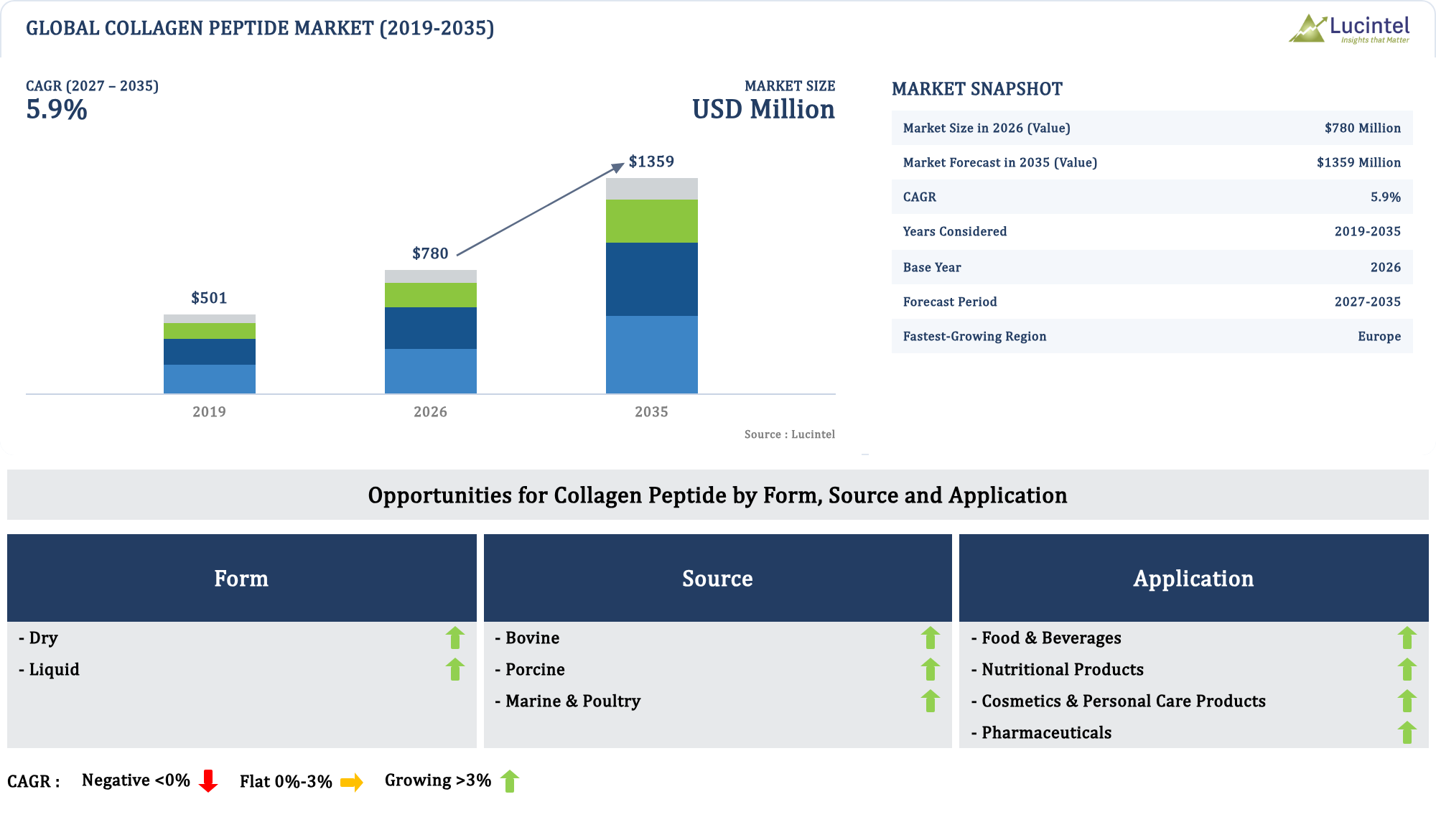
Collagen Peptide Market

Report Metric Details
Market Size in 2026 (Value) $780 Million
Market Estimate in 2027 (Value) $826 Million
Market Forecast in 2035 (Value) $1359 Million
Growth Rate (CAGR) 5.9% from 2019–2035
Years Considered 2019–2035
Base Year 2026
Forecast Period 2027–2035
Market Units Value ($ Million)
Number of Figures and Tables 173
Customization Scope Lucintel provides 10% customization without any additional cost.
Top Companies
  • Tessenderlo Group
  • Gelita AG
  • Holista Colltech
  • Darling Ingredients
  • Nitta Gelatin, Inc.
  • Gelnex
  • Lapi Gelatin S.p.a
  • Weishardt
  • Crescent Biotech
  • Foodmate Co., Ltd.
Growth Driver
  • The increasing demand for functional nutrition products
  • The rising consumer focus on healthy aging
  • The growing use in sports nutrition supplements
Segments Covered
  • By Form :
    • Dry
    • Liquid
  • By Source :
    • Bovine
    • Porcine
    • Marine & Poultry
  • By Application :
    • Food & Beverages
    • Nutritional Products
    • Cosmetics & Personal Care Products
    • Pharmaceuticals
Regions Covered North America, Europe, Asia Pacific, and Rest of the World

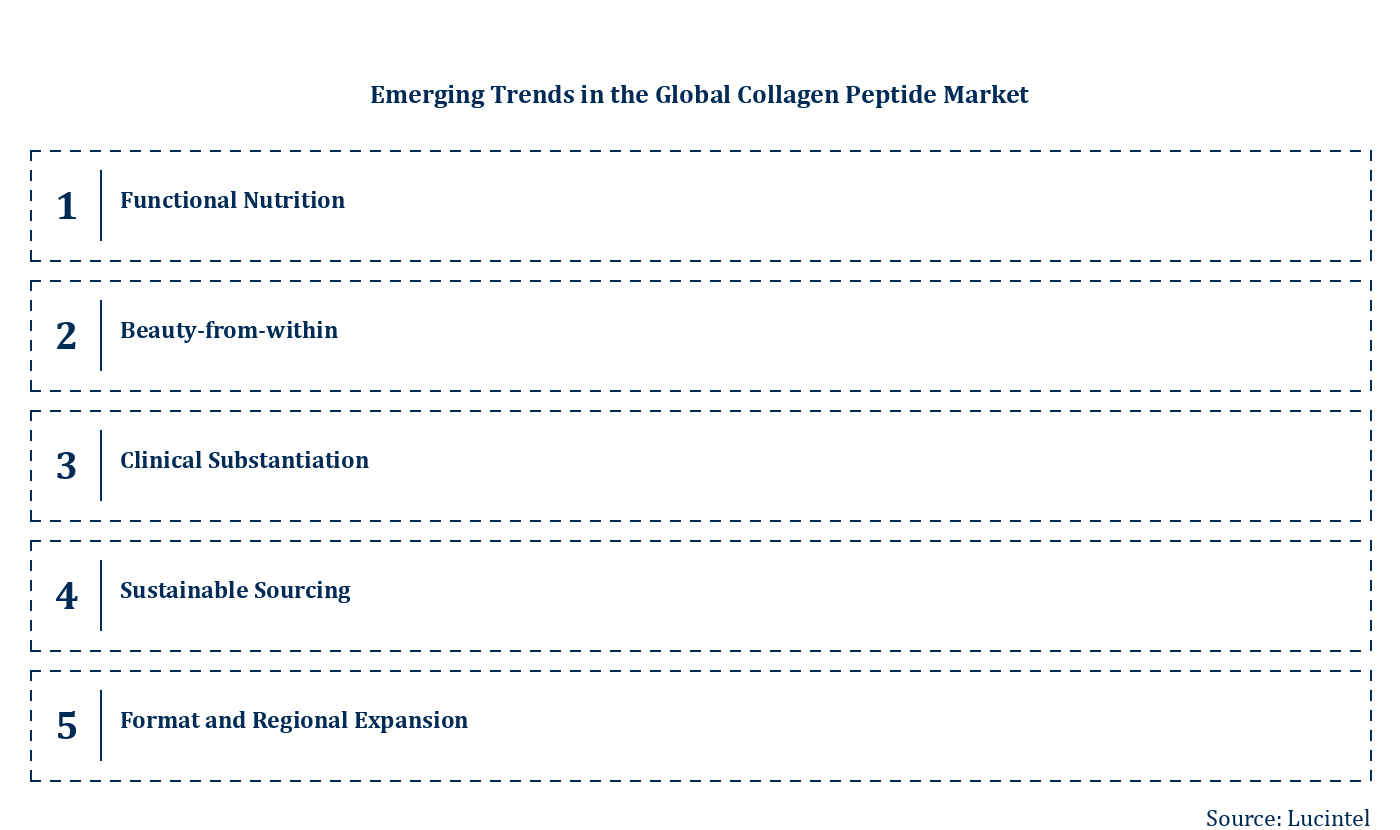
Emerging Trends in the Collagen Peptide Market

The collagen peptide market is differentiating into functional foods, targeted nutrition, and beauty-from-within products and supplements beyond basic collagen supplementation. Demand for collagen peptides will grow post-2025 due to older demographic populations, a rise in sports recovery collagen peptides, preference for clean-label products, and increased market collateral. Suppliers will differentiate with clinical studies, traceable sourcing, custom formulations, and regional manufacturing.

  • Functional Nutrition: Collagen peptides are beginning to penetrate sports nutrition, where brands are including collagen peptides in their ready-to-drink, bar, and powder products. Collagen peptides will also begin to target supplementation of daily wellness as the global sports nutrition market crosses the $40 billion mark by 2025.
  • Beauty-From-Within: The nutricosmetics industry will broaden collagen peptides by producing chewable collagen gummies and sachets, as well as other drinkable formats. A 2025 Innova survey of consumers showed collagen peptide demand for healthy aging of the skin supported its continued growth as consumers demand products to support healthy aging and visible appearance of outer beauty.
  • Clinical Substantiation: Collagen peptide suppliers are focusing on clinical studies exploring topical and internal skin hydration, elasticity, joint pain, and exercise recovery. Published collagen peptide studies conducted between 2015 and 2025 show the need for higher clinical study collagen peptide dosages, 2.5–10 grams daily, will advance claims substantiation and increase demand through physician prescription and retailer market sales.
  • Sustainable Sourcing: With bovine, porcine, and marine sourcing, collagen peptide suppliers are enhancing traceability by focusing on the use of by-products from fish-processing and other manufacturing waste. Collagen peptide sourcing will improve the sustainability of collagen peptide supply chains through higher usage of manufacturing waste and reducing environmental impacts, and increase supply chain resilience.
  • Format and Regional Expansion: Hydrolyzed collagen peptide is set to expand into low-sugar beverages, fortified foods and localized formulations across Asia-Pacific in 2025-2027, while convenient formats and innovative product formats will expand across Europe and North America.

Traditional collagen powder is a strong barrier for product adoption; however, the introduction of convenient formats with localized collagen innovative product formats may appeal to new consumer segments. Collagen peptide demand will remain strong, but the greatest winners will not be the volumetric leaders. Suppliers with differentiated & defensible clinical studies, sustainable sourcing and reliable ingredients will result in the greatest profits for collagen peptide suppliers. Product developers should track claim regulation, pricing pressure and persisting competition from plant alternatives while targeting convenience and specific benefits within the product.
Collagen Peptide Market by country

Recent Developments in the Collagen Peptide Market

The market for collagen peptides is entering an active phase of investing, driven by growing interest in nutrition, beauty, and healthy aging. During the period of 2025 to 2027, suppliers are anticipated to focus on improving capacity, traceability, and innovation of application-focused ingredients. Lucintel predicts a shift in competition from the basic supply of volumes toward clinically substantiated products, regional production, and reformulated products.

  • Capacity Expansion: Rousselot’s parent company, Darling Ingredients, has continued to develop their gelatin and collagen peptide capacity within their global network, driven by an increased need for protein ingredients, by 2025. The additional capacity should allow greater supply contract flexibility for nutrition and food manufacturing customers over the next 3-5 years.
  • Clinical Nutrition Partnerships: Companies are expanding collagen product offerings outside of traditional beauty supplements to include offerings geared toward healthy aging, joint and muscle health, and post-exercise recovery products. By 2025, several branded ingredient suppliers have entered into partnerships with finished product manufacturers to develop clinically substantiated collagen peptides. This is expected to improve physician acceptance and improve margins.
  • Traceability Technology: Collagen vendors are now providing suppliers with technologies that provide an origin, processing, and quality assurance of the collagen. By 2025, major collagen producers have begun to launch more comprehensive product documentation and traceability technologies. This is expected to aid in pricing differentiation and meeting more stringent retail and regulatory requirements.
  • Application Development: Unlike the bulk peptide market, suppliers of collagen-based peptides are introducing formats for nucleation and ready-to-use formats. New formats for sports nutrition, gummy, and beverage technologies were introduced between 2020 and 2025. Improved performance will dictate the ability to secure sustainable multinational engagements.
  • Regulatory Scrutiny: Authorities are placing more restrictions on claims around skin, bone, and joint benefits, while companies are being examined more thoroughly on their sourcing and contaminant control. Participants in the market in 2025 focused more on building substantiation dossiers and testing. Improved regulation will benefit established companies and make it more expensive for less established companies to enter the market.

Through 2027, the demand for collagen peptides is expected to remain strong, though growth will not come from volume growth alone. Collagen peptide suppliers who develop the efficacy of their products and secure stable sources of raw materials will gain market share. The commodity market for collagen peptides will become more competitive, especially in Asia. Regulatory focus will support longer term market positions over the rapidly growing number of emergent product offerings.

Strategic Growth Opportunities in the Collagen Peptide Market

New entrants can capitalize on emerging consumer demands for functional, healthy, clean-label products in sports nutrition and healthy aging. Over the next few years, market consolidation is expected due to better clinical substantiation, expanding functional food and ingredients, and traceable production. Lucintel believes formulation innovation and regional expansions remain the most compelling markets for new entrants.

  • Clinical Nutrition: There is currently demand for collagen peptides to address sarcopenia, wound care, and post-workout recovery. At Vitafoods Europe in May 2025, nearly 1,400 exhibitors showcased their collagen peptides. Clinical approvals should help price margins and attract not only the traditional contract manufacturing organizations and sports nutrition brands, but also hospitals and specialized nutrition brands in the next 3-5 years.
  • Beauty from Within: Brands can charge a premium for beauty from within products formulated with hydrolyzed collagen and targeted skin, hair, and nail claims. According to the Global Wellness Summit, the wellness market was valued at $1.8 trillion in January 2025. The wellness market is expected to favor premium beauty from within collagen supplements over generic protein supplements.
  • Asia-Pacific: Smaller pack sizes and localized flavors for halal and vegetarian formulations can help expand collagen peptide usage in Indonesia, India, and Southeastern Asia. The nutraceutical market in India is estimated to be at $30 billion for January 2025. Consumer adoption will increase with regional manufacturing and distributing partnerships.
  • Sustainable Sourcing: Left over portions of fish such as skin and scales can be used to source collagen to address gaps in sustainable supply. The FAO reported that in February 2025, global fisheries and aquaculture production was 185 million tons and is expected to grow. Traceability will help collagen peptide suppliers secure contracts with large food, beverage, and cosmetics manufacturers.
  • Customized Functional Formulations: Contract manufacturers provide collagen peptides that are soluble, flavored, heat-resistant, and customized to various applications.

According to Innova Market Insights, over 6,000 new collagen-containing product launches occurred globally in 2024, reported in January 2025. Custom formulation services will support smaller brands and promote more rapid innovation beyond capsules.

Consumers will look for products with research and evidenced based claims that suit their regular eating and drinking habits. Raw material suppliers that provide consistent quality and control, and have documented bioactivity, will have the strongest position during negotiations. Continued price wars are anticipated for commodity powders, while clinical nutrition, beauty, and customized food applications command better margins. Scalable operators will differentiate from opportunistic players with compliance in regional markets.

Collagen Peptide Market Drivers and Challenges

The collagen peptide market is impacted by consumer preferences, technological advancements, economic pressures, and changes in regulations. The market has a growing opportunity for convenient nutrition, healthy aging, sports recovery and beauty supplements. Advances in technology have improved absorption, ease of digestion, taste improvement, and design flexibility. Sustainability and cost pressures drive choices in both sourcing and processing technology. Regulations and competition drive how the technologies are brought to market. Lucintel suggests that balancing the development of innovative products and affordability, while providing scientific validation and clear communication of the product benefits on the label, will drive the market.

The primary driving forces impacting the market for collagen peptides include:

  • Consumer Interest: The growth in interest for prevention of the effects and support of the symptoms of aging combined with a growing interest in joint health and sports recovery, will support the growth in the use of collagen peptides to improve skin health. The market for collagen peptides will grow over the next three to five years because of the focus of older adults on wellness programs combined with modern lifestyle rooted in physical activity.
  • Technology Improvements: The technologies of enzymatic hydrolysis, purification, flavor masking, and formulation are resulting in the improvement of collagen peptides in many areas including solubility, digestibility, and sensory performance. In 2025, several rapid cold-water dispersible collagen peptide powder and beverage formulations were introduced to the market. These collagen peptide improvements will impact the market in the next 3 - 5 years because rapid dispersible collagen peptides will enable innovations such as use in ready-to-drink (RTD) beverages, gummies, functional food innovations, and specialized food and medical nutrition products.
  • Product Innovation: In 2025, collagen peptides continued to be formulated as multifunctional product ingredients along with vitamins, minerals, hyaluronic acid, probiotics, and botanical ingredients. Beauty, mobility, sleep, and recovery combination products continued to be formulated and distributed through both retail and online channels. In the next 3 - 5 years, differentiated product formulation will drive the collagen peptide market by commodity reduction, pricing innovation, and convenient product differentiation to fulfill the expectations of customers. Innovation will also result in new formats, such as sachets, capsules, gummies, shots, and snacks.
  • Sustainability: Environmental concerns result in improvements in the use of livestock by-products, improvements in resource use and packaging, and improvements in supply-chain traceability. In 2025, collagen peptide products were marketed along with packaging that was easier to recycle or raw material sourcing that was documented. This will drive the collagen peptide market for the next 3 - 5 years as concerns for responsible production grow and customers and retailers expect improvements in packaging. No improvements to collagen peptide sourcing will result in lost trust of customers and the creation of regulatory risk.
  • Manufacturing Efficiency: Progress made in standardizing the processing of raw materials, hydrolysis, control of quality, and automated packaging helps manufacturing operations be more efficient, comply with quality standards, and stimulate growth. From 2025 onward, the dominant processors of peptides employed high-throughput processing and digital quality systems to accommodate higher demands while preserving specifications of peptides. This factor will affect other industry participants within the next three to five years by increasing the reliability of supply, increasing the capacity of contract manufacturing, and facilitating the integration of collagen peptides into mass market offerings. Collagen peptides will constitute more of the demand in emerging regions where there is greater market potential and a request for consistency in pricing.

This market will face the following challenges:

  • Lack of Clarity of Regulatory Frameworks: There are several disparate regulatory frameworks (e.g., health claims, classification of ingredients, labeling, and advertising) across jurisdictions, channels of trade, and market segments. In 2025, suppliers adjusted their claims to avoid making unsupported statements for the improvement of skin and for the prevention of joint and systemic diseases. This challenge will affect the market in the next three to five years with stricter regulatory frameworks resulting in lengthier market introductions, increased expenses for compliance, and decreased flexibility in market promotions. Those market participants who have such supporting evidence, and who seek to above all comply, will be successful in the long run.
  • Risk of Raw Materials and Supplies: Collagen production relies on hides, bones, scales and skin. The supply is subject to the livestock cycle and disrupted by outbreaks of disease, breakdowns in the supply chain, geopolitical trade barriers, and other factors. There was a disruption in the procurement of ingredients due to fluctuating agricultural and transportation costs in 2025. In the coming 3-5 years, this disruption will drive suppliers to diversify, enhance the supply chain, adopt marine collagen, and sign longer term agreements. These changes will also drive the cost of collagen up and negatively affect the quality assurance of collagen production.
  • Consumer Trust and Scientific Restrictions: Consumers are concerned about product test results, marketing that makes false claims, processing and the treatment of the raw materials, the potential for product contamination, and product bioavailability. For 2025, there were complaints about heavy metals, allergens, unusual side effects, and product variation posted on customer review websites and social media. In the coming 3-5 years, this concern will negatively affect the entire market because of the weak product claims and the competition's inability to substantiate the claims. Consumers expect a company to provide independent tests, recommended dosages, clear labels, and well-conducted studies to provide justification for each product's cost.

The market for collagen peptides will continue to grow due to factors like increasing demand for wellness products, continuous development of new products, improved manufacturing processes, and greater focus on use sustainability. However, there will be challenges like uncertain regulations, fluctuating supply, and skeptical consumers that will either slow down the market growth or incur higher expenses to serve the market. For the next 3-5 years, validating science, source traceability, efficacy in manufacturing, and unique formulations will determine market success. Price, positive product benefits, and responsible company behavior will result in more loyal customers and availability through more sales channels. In the long run, the balance of market supply, regulatory policies, and a focus on the quality of products will result in successful market participation.

List of Collagen Peptide Market Companies

Companies in the market compete on the basis of product quality offered. Major players in this market focus on expanding their manufacturing facilities, R&D investments, infrastructural development, and leverage integration opportunities across the value chain. Through these strategies collagen peptide market companies cater increasing demand, ensure competitive effectiveness, develop innovative products & technologies, reduce production costs, and expand their customer base. Some of the collagen peptide market companies profiled in this report include-

Collagen Peptide Market by Segment

The study includes a forecast for the global collagen peptide market by form, source, application, and region.

  • Collagen Peptide Market by Form [Value from 2019 to 2035]:
    • Dry
    • Liquid
  • Collagen Peptide Market by Source [Value from 2019 to 2035]:
    • Bovine
    • Porcine
    • Marine & Poultry
  • Collagen Peptide Market by Application [Value from 2019 to 2035]:
    • Food & Beverages
    • Nutritional Products
    • Cosmetics & Personal Care Products
    • Pharmaceuticals
  • Collagen Peptide Market by Region [Value ($M) from 2019 to 2035]:
    • North America
    • Europe
    • Asia Pacific
    • The Rest of the World

Country Wise Outlook for the Collagen Peptide Market

The market for collagen peptides is shifting from niche supplements to scaled nutrition, medical, and functional food solutions. Within the next five years, competition will be built on batch capacity, more efficient supply chain traceability, and new delivery options. Lucintel predicts that regional manufacturing will be the most important factor in shaping the market during this period.

  • United States: Currently in the U.S., most of the market is driven by innovation and consolidation of brands. Well known collagen brand Vital Proteins launched its new Marine Collagen Peptides line in January 2025, broadening the collagen supply beyond bovine and porcine sources. Since collagen can be sourced from a variety of animals, this new entry from Vital Proteins gives customers more options and should drive higher prices in the collagen supply channel in the U.S. within the next 3 to 5 years.
  • China: In contrast, Chinese collagen producers are looking to grow their capability in food, cosmetic, and biomedical markets. In March 2025, Jellagen announced a collaboration with a Chinese partner to develop marine collagen, which also grow in the water. Marine collagen has the potential to be more valuable than imported peptides, and because of the collaboration local sourcing and marine technology can be used.
  • Germany: GELITA maintains its specialty collagen ingredient supply and pharmaceutical collagen supply. GELITA reported operating in over 20 countries in 2025 and expanded its branded VERISOL and PEPTAN product lines. GELITA has the collagen supply technology and will likely maintain its specialty position in collagen supply within medium term.
  • India: Nitta Gelatin India collagen peptide capacity was expanded in April 2025 and serves nutrition and biomedical collagen supply. The expansion will likely result in more reliable supply and increased collagen exports from India, as it will reduce India's reliance on imported collagen.
  • Japan: Japanese ingredient suppliers are leaning toward launches of functional foods and the clinical substantiation of these; Nippi has introduced collagen-peptide based formulations for beauty and healthy-aging applications this February 2025. This will influence the market by reinforcing Japan’s evidence-led product development dominance and setting a precedent across Asia.

Features of the Collagen Peptide Market

  • Market Size Estimates: Collagen peptide market size estimation in terms of value ($M).
  • Trend and Forecast Analysis: Market trends (2019 to 2026) and forecast (2027 to 2035) by various segments and regions.
  • Segmentation Analysis: Collagen peptide market size by form, source, application, and region in terms of value ($M).
  • Regional Analysis: Collagen peptide market breakdown by North America, Europe, Asia Pacific, and Rest of the World.
  • Growth Opportunities: Analysis of growth opportunities in different forms, source, applications, and regions for the collagen peptide market.
  • Strategic Analysis: This includes M&A, new product development, and competitive landscape of the collagen peptide market.
  • Analysis of competitive intensity of the industry based on Porter’s Five Forces model.

Table of Contents

1. Executive Summary
14.1 Competitive Analysis Overview

List of Figures

List of Tables

Methodology

Lucintel has been in the business of market research and management consulting since 2000 and has published over 1000 market intelligence reports in various markets / applications and served over 1,000 clients worldwide. This study is a culmination of four months of full-time effort performed by Lucintel's analyst team. The analysts used the following sources for the creation and completion of this valuable report:

  • In-depth interviews of the major players in this market
  • Detailed secondary research from competitors' financial statements and published data
  • Extensive searches of published works, market, and database information pertaining to industry news, company press releases, and customer intentions
  • A compilation of the experiences, judgments, and insights of Lucintel's professionals, who have analyzed and tracked this market over the years.

Extensive research and interviews are conducted across the supply chain of this market to estimate market share, market size, trends, drivers, challenges, and forecasts. Below is a brief summary of the primary interviews that were conducted by job function for this report.

Lucintel's methodology for market research

Thus, Lucintel compiles vast amounts of data from numerous sources, validates the integrity of that data, and performs a comprehensive analysis. Lucintel then organizes the data, its findings, and insights into a concise report designed to support the strategic decision-making process. The figure below is a graphical representation of Lucintel's research process.

Primary interviews by job function

Buy Now

Choose a license that fits your team. Instant PDF delivery.

Market Report

1 User PDF

$4,850
Buy Now

Market Report

2-5 Users PDF

$6,700
Buy Now

Market Report

Corporate PDF

$8,850
Buy Now

Market Report

Global PDF

$10,000
Buy Now

Prices exclude taxes. Instant delivery. Custom licensing available on request.

Frequently Asked Questions

What is the collagen peptide market size?
The global collagen peptide market is expected to reach an estimated $1,359 million by 2035 from $826 million in 2027.
What is the growth forecast for collagen peptide market?
The global collagen peptide market is expected to grow with a CAGR of 5.9% from 2027 to 2035.
What are the major drivers influencing the growth of the collagen peptide market?
The major drivers for this market are the increasing demand for functional nutrition products, the rising consumer focus on healthy aging, and the growing use in sports nutrition supplements.
What are the major segments for collagen peptide market?
The future of the collagen peptide market looks promising with opportunities in the food & beverage, nutritional product, cosmetic & personal care product, and pharmaceutical markets.
Who are the key collagen peptide market companies?

Some of the key collagen peptide companies are as follows:

  • Tessenderlo Group
  • Gelita AG
  • Holista Colltech
  • Darling Ingredients
  • Nitta Gelatin, Inc.
  • Gelnex
  • Lapi Gelatin S.p.a
  • Weishardt
  • Crescent Biotech
  • Foodmate Co., Ltd.
Which collagen peptide market segment will be the largest in future?
Lucintel forecasts that, within the form category, dry is expected to witness higher growth over the forecast period.
In collagen peptide market, which region is expected to be the largest in next 8 years?
In terms of region, Europe will remain the largest region over the forecast period.
Do we receive customization in this report?
Yes, Lucintel provides 10% customization without any additional cost.

Key Questions

  • What are some of the most promising, high-growth opportunities for the collagen peptide market by form (dry and liquid), source (bovine, porcine, and marine & poultry), application (food & beverages, nutritional products, cosmetics & personal care products, and pharmaceuticals), and region (North America, Europe, Asia Pacific, and the Rest of the World)?
  • Which segments will grow at a faster pace and why?
  • Which region will grow at a faster pace and why?
  • What are the key factors affecting market dynamics? What are the key challenges and business risks in this market?
  • What are the business risks and competitive threats in this market?
  • What are the emerging trends in this market and the reasons behind them?
  • What are some of the changing demands of customers in the market?
  • What are the new developments in the market? Which companies are leading these developments?
  • Who are the major players in this market? What strategic initiatives are key players pursuing for business growth?
  • What are some of the competing products in this market and how big of a threat do they pose for loss of market share by material or product substitution?
  • What M&A activity has occurred in the last 5 years and what has its impact been on the industry?
Why Choose Us

The Lucintel Advantage

Trusted partner for strategic intelligence and business growth

25+ Years Excellence

25+ Years Excellence

Quarter century of proven expertise in management consulting and market research across global markets.
Game-Changer Ideas

Game-Changer Ideas

Innovative strategies and actionable insights that help clients become the smartest in their industry.
Global Reach

Global Reach

Extensive coverage across 50+ industries and markets worldwide with localized expertise.
Start Your Growth Journey

Get Your Free
Market Intelligence
Briefing

Receive a complimentary market analysis tailored to your industry. Our analysts will identify key growth opportunities and competitive dynamics specific to your business.

Custom Market Snapshot

Market size, growth rate, and key trend analysis for your specific sector.

Competitive Landscape Overview

Top competitor positioning and market share analysis.

Growth Opportunity Identification

Strategic recommendations backed by data-driven insights.

Subscribe

Subscribe to our Newsletter

Get curated market intelligence and competitive moves straight to your inbox.

By subscribing, you agree to receive our monthly insights. Unsubscribe anytime.

Industry Trends Market Signals Opportunities Competitor Moves
