
Meat Product Market Report: Trends, Forecast and Competitive Analysis to 2040

Key data points: Market size in 2027 = $58 billion and 2035 = $128 billion, growth forecast = 9.4% annually for the next 8 years. Scroll below to get more insights. This market report covers trends, opportunities and forecasts in meat product market to 2035 by type (processed, frozen, canned, chilled, and fresh), packaging (fresh meat packaging, vacuum packaging, and modified atmosphere packaging), nature (conventional and organic), distribution channel (retail, food service, and ecommerce), and region (North America, Europe, Asia Pacific, and the Rest of the World)

Publisher: Lucintel Last Updated: September 2026
See Pricing

Download Sample Report

| ✨ New Download Sample report — Get instant insights! | ✨ New Download Sample report — Get instant insights!

Meat Product Market Report: Trends, Forecast and Competitive Analysis to 2040

Meat Product Market

Market Size, 2026
$58 Billion
Market Forecast, 2040
$128 Billion
CAGR, 2027–2040
9.4%

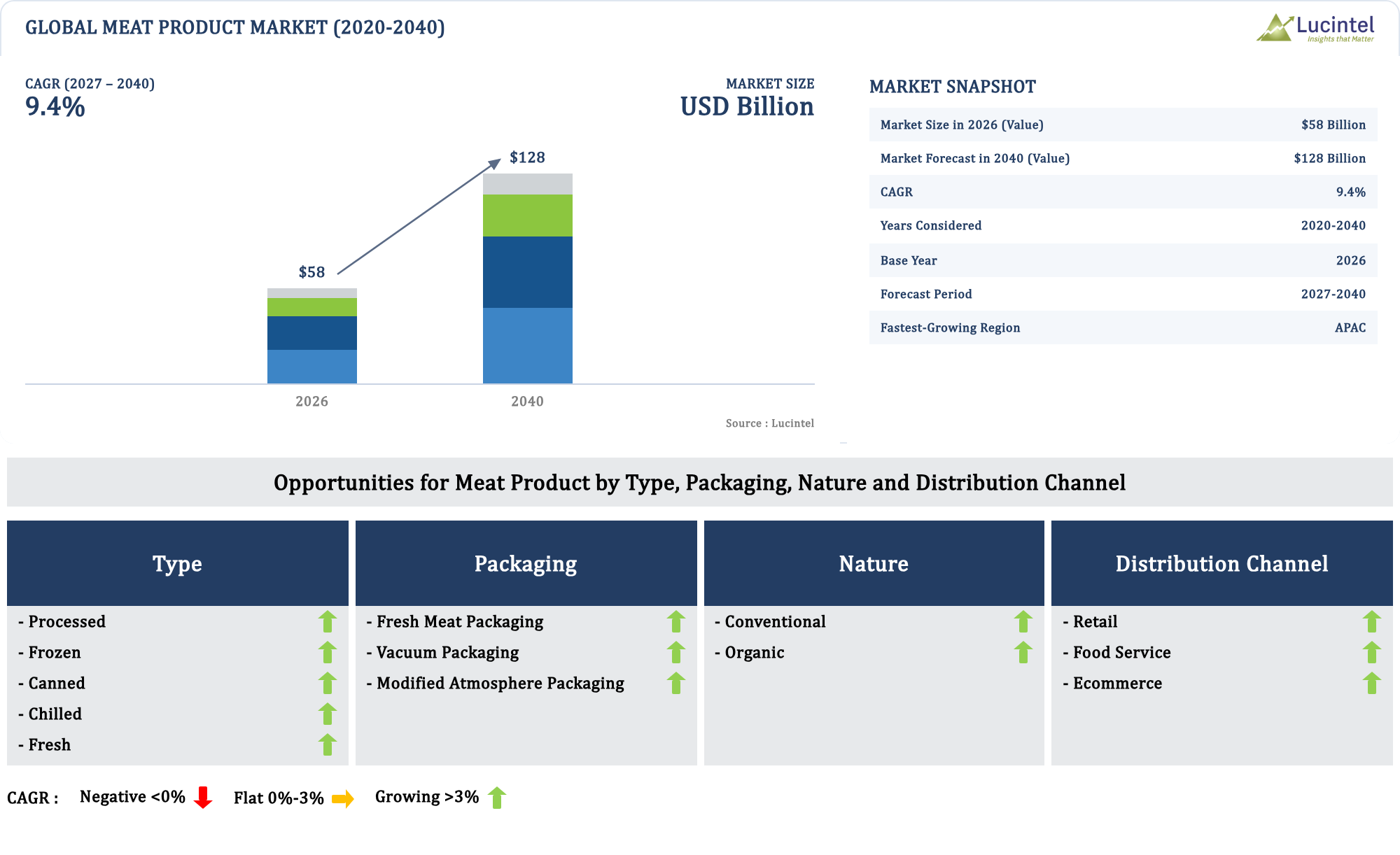
The future of the global meat product market looks promising with opportunities in the retail, food service, and ecommerce markets. The global meat product market is expected to reach an estimated $128 billion by 2035 from $58 billion in 2027 with a CAGR of 9.4% from 2027 to 2035. The major drivers for this market are the increasing demand for processed protein foods, the rising consumption of convenient meat products, and the growing preference for high protein diets.

  • Lucintel forecasts that, within the type category, processed is expected to witness the highest growth over the forecast period due to the increasing demand for convenient and ready-to-use food products.
  • Within the distribution channel category, retail is expected to witness the highest growth over the forecast period due to the expanding retail presence and consumer accessibility.
  • In terms of regions, APAC is expected to witness the highest growth over the forecast period due to the rising food consumption and expanding retail infrastructure.

Gain valuable insights for your business decisions with our comprehensive 150+ page report. Sample figures with some insights are shown below.
Meat Product Market

Report Metric Details
Market Size in 2026 (Value) $58 Billion
Market Forecast in 2040 (Value) $128 Billion
Growth Rate (CAGR) 9.4% from 2020–2040
Years Considered 2020–2040
Base Year 2026
Forecast Period 2027–2040
Market Units Value ($ Billion)
Number of Figures and Tables 192
Customization Scope Yes, Lucintel provides 10% customization without any additional cost.
Top Companies
  • Cargill Incorporated
  • JBS S.A.
  • Tyson Foods Inc.
  • Hormel Foods Corporation
  • Vion Group
Growth Driver
  • The increasing demand for processed protein foods
  • The rising consumption of convenient meat products
  • The growing preference for high protein diets
Segments Covered
  • By Type :
    • Processed
    • Frozen
    • Canned
    • Chilled
    • Fresh
  • By Packaging :
    • Fresh Meat Packaging
    • Vacuum Packaging
    • Modified Atmosphere Packaging
  • By Nature :
    • Conventional
    • Organic
  • By Distribution Channel :
    • Retail
    • Food Service
    • Ecommerce
Regions Covered North America, Europe, Asia Pacific, and Rest of the World

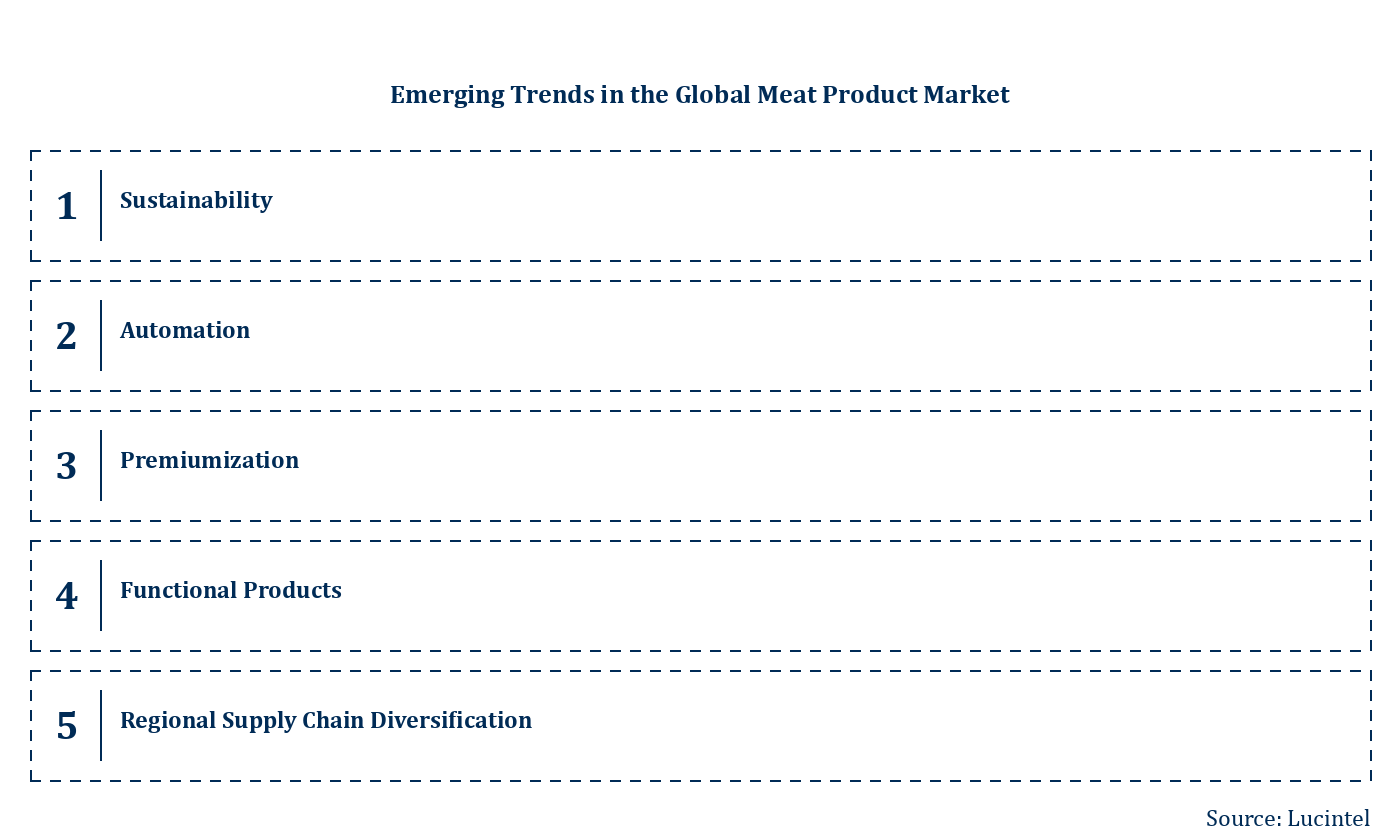
Emerging Trends in the Meat Product Market

The meat product market is moving towards more traceable products with higher protein and lower impact, replacing the volume-based sales model. From 2025-2027, processors will negotiate the balance of inflation sensitive consumers with growth in automation, safety and alternative formats. From their perspective, Lucintel believes the competitive advantage will be with resilient sourcing and unique products.

  • Sustainability: The Tyson Foods 2024 sustainability report and the EU’s 2025 deforestation rules will drive suppliers to provide verified feed and emissions data and use water efficiently. It will impact procurement and store placement opportunities for the next ten years.
  • Automation: In their 2024 annual report, JBS reported continued digital investments, while meat plants are expanding the use of machine vision and robotic cutting. Lack of labor and increasing hurdles for maintaining high standards of cleanliness will drive automation to increase throughput in the next three to five years.
  • Premiumization: Inflation of food products has increased consumer selectivity for meat products, opting for brands, higher quality, and more prepared offerings; higher quality products will increase profits in meat products as processors cater to a more health and time conscious customer.
  • Functional Products: Demand for sports nutrition driven offerings resulted in a 2025 land grab for shelf space for high protein snacks and ready-to-cook meal offerings. Processors will rely on formulation, higher quality ingredients and controlled portions to increase profits.
  • Regional Supply Chain Diversification: Increased exposure to animal disease, trade disruptions, and geopolitical risks has continued to challenge supply chains in Rabobank’s 2025 protein outlook. The industry has added local sourcing, multi-country procurement and cold-chain capacity, making supply resilience a long term concern.

The future of the market favors processors that combine stable supply with authentic sustainability data. Automation will keep margins intact, while the premium and functional formats will create opportunities for market growth beyond basic volume. Regulatory bodies will become more active concerning the origin and the emissions of goods. Companies that choose to invest wisely instead of trying to keep up with every new trend will gain market advantage between 2027 to 2030.
Meat Product Market by country

Recent Developments in the Meat Product Market

Through 2025–2027, activity in the meat product market accelerates due to automation investments, geographic scale and sustainability. Demand is expected to grow unevenly with premium and convenience segments expected to grow, and partially offset by inflation, livestock supply, and a changing dietary preference.

  • Capacity Modernization: In February 2025, Tyson Foods approved a $23 million investment in automation at its Union City, Tennessee, facility. Increased automation improves a processor's margin, as elevated labor costs persist, when projects increase plant throughput and reduce labor.
  • Global Consolidation: In May 2025, JBS received shareholder approval for a dual listing on Brazil's B3 and New York Stock Exchange. With access to international capital, JBS is expected to engage in acquisitions and increase competition in the beef, poultry, and prepared meat product markets.
  • Alternative-protein Repositioning: Beyond Meat launched Beyond IV in January 2025 with an aim to improve the taste and nutrition of plant-based meat while using less saturated fat. Reformulated products will have to improve to regain market share and develop loyal customers beyond early adopters.
  • Traceability Regulation: The EU postponed its deforestation regulation to large operators in December 2025 and to small operators in June 2026. Traceability will continue to increase documentation costs. However, supply will favor those who can prove both the origin of their cattle and the sourcing of their meat from deforested areas.
  • Retail Channel Expansion: In January 2025, Hormel Foods launched Columbus Craft Meats to launch premium category products in charcuterie via convenience and snacking category formats. These products should capture an increased value/kilogram, even in the face of slow overall growth.

In the next three to five years, scale will be important, but it won't be the only factor. Processors with efficient plants and integrated traceability will have the ability to manage regulations and maintain customer relationships. Premium prepared foods will outperform commodity cuts. Alternative proteins will continue to be used selectively, and not in a transformational manner. The cycles of livestock and the costs of feed will continue to determine the profitability of the market alongside the increasing bargaining power of retailers.

Strategic Growth Opportunities in the Meat Product Market

Changes are happening in supermarket meat sections. Consumers want safer, more nutritious meat and meat products with less of an impact on the environment. Over the next few years, there will be less of a need for bulk meat products. Grocery stores will consolidate and investors will focus on meat processing. In the next few years, there will be more demand for meat products packaged in smaller, more convenient formats.

  • Chilled ready-to-use meals and meat products packaged in sliced formats are convenient because they save consumers time. In January 2025, it was reported that in the U.S., convenience retailers sales of prepared foods exceeded $90 billion. Retailers will focus more on providing shelf space to ready-to-go food.
  • High-protein, lower sodium, and clean-label meat products will generate even higher profits. A U.S. consumer survey in March 2025 reported that 71 percent of respondents indicated protein is an important consideration when choosing food.
  • Custom meat products formulated to order can be produced for restaurants, schools, and even delivery businesses. In February 2025, the National Restaurant Association predicted sales for restaurants in the U.S. will be $1.5 trillion for the calendar year. Restaurant food services will order custom products to meet their specific needs.
  • Emerging Market Expansion: There is a growing demand in urban areas of Southeast Asia, the Middle East, and Africa. Producers can enter these markets with the help of a local partner. Developing nations are expected to grow by 4.1 percent in 2025.
  • Sustainable Materials: Partially recyclable trays and packaging and/or lower-waste materials will generate new revenue streams regardless of the product itself. May 2025 goals in the EU required a 5% reduction in packaging waste by 2030. Companies that keep track of their material savings will be viewed more favorably by retailers and multinational food corporations when the time comes for an order placement.

Suppliers have the potential to gain the most ground by integrating the design of their products with each respective sales channel. Increased value per unit can come from designs that incorporate convenience and nutrition. Customization of products will lead to more protected sales. Expanding into new territories means that suppliers must meet new local requirements, especially with regards to halal compliance. Sustainable materials, even if unseen by the consumer, will impact buying decisions. Companies should test focused formats, measure repeat purchase, and only expand if the margins are right.

Meat Product Market Drivers and Challenges

Factors influencing the meat product market include evolving consumer preferences and expectations, technological advancements, fluctuations in the economy, the need for greater sustainability, and increasing regulation. Increased demand for protein generally supports the growth of the market. Inflation, outbreaks of diseases, worries over the environment, concerns over the supply chain, and other market uncertainties can slow the growth of the market. Competitiveness across regions is improving with advancements in product innovation and improvements in processing efficiency. Lucintel is of the view that these forces will fundamentally influence the direction of the market, how profitable it will be, and where it will be possible to invest in the future.

Driving forces of the meat product market include:

  • Customer Demand: The market force for fresh, frozen, processed, or ready-to-eat meat products has increased due to population growth and urbanization. Elevated spending has driven consumer preference for convenient protein products. The consumption of meat continued to grow in 2025 and was expected to continue in the following years with the emerging markets expanding their diets and the food service industry returning to normalcy. It is expected that during the next three to five years demand will be in favor of affordable, convenient, high-protein, and/or premium products and will encourage processed change to include a variety of portion sizes, formats and types of packaging for existing and new products.
  • Technology: New technology such as automation, artificial intelligence, robotics, advanced refrigeration, improved food safety and processing systems, as well as traceability systems, has increased productivity and food safety while also improving consistency of products. In early 2025, the U.S. Department of Agriculture continued the implementation of electronic identification of certain interstate movements of cattle which strengthened digital traceability. In the next three to five years, it is expected that technology will be reducing labor requirements, improving the detection of diseases, and reducing waste, while providing consumers detailed information on the products they are purchasing.
  • Product Innovation: Manufacturing companies are making healthier choices in their formulations, offering a wider variety of cuts, including marinated and frozen varieties, as well as meat snacks that contain meat with nutritional functions and hybrid products and ready-to-eat meals. In 2025, interest in high-protein food remained strong in both retail and food service, motivating companies to extend their product lines and highlight their protein content and convenience. In the next three to five years, innovation in the meat sector will help manufacturers meet the requirements of various markets while at the same time appealing to more diverse consumers.
  • Sustainability: More sustainable farming practices, as well as alternative feed and renewable energy sources and packaging, will become more necessary due to growing concerns about greenhouse emissions, water use, packaging waste, and land impact. By the end of 2025, the EU planned to implement their deforestation regulation on larger operations, amplifying their supply chains’ requirement for agricultural goods’ traceability. In the next three to five years, procurement, the acceptance of retailers, regulations, brand reputation, and even consumer purchasing decisions will be significantly influenced by sustainability.
  • Manufacturing Efficiency: Processing companies are building larger facilities to manage the cold chain and implementing yield management systems and lean production. The high cost of labor in the food industry in 2025 motivated processors to automate inspecting, sorting, packing, and cutting. In the next three to five years, smaller companies will not be able to compete with larger, more efficient companies.

This Market experiences the following issues:

  • Input Cost Volatility: The prices for feed grains, energy, transportation, packaging, labor, and livestock fluctuate as a result of adverse weather, geopolitical turbulence, changes in currency, and supply disruptions. The FAO Food Price Index during the month of April 2025 averaged 128.3 points, showing volatility within global food commodities. Volatility of input costs during the next three to five years will place pressure on margins and will make pricing decisions more difficult and will elevate the need for long-term contracts, a broader selection of sourcing options, efficiency in operations, and flexibility in product range.
  • Disease and Supply Disruptions: African swine fever, avian influenza, cattle diseases, extreme weather, and logistical disruptions can reduce the availability of livestock, increase the cost of livestock, and restrict trade of livestock. During the month of January 2025, highly pathogenic avian influenza impacted the poultry operations in the United States, showing the market's exposure to supply disruptions caused by biological shocks. In the next three to five years, disease control, biosecurity, and regional sourcing, along with the research for vaccines and emergency planning to support stable meat supplies, will be necessary.
  • Regulatory and Environmental Pressure: More stringent regulations dealing with emissions, animal welfare, product labeling, use of antibiotics, food safety, worker protection, and product tracking will increase compliance costs and restrict market access. During the year of 2025, producers experienced more extensive sustainability-related disclosure and supply chain due diligence requests from the major importing countries. In the next three to five years, regulatory discrepancies amongst countries will make exports more difficult, require new reporting frameworks, and benefit companies that have strong compliance, transparent sourcing, and measurable environmental outcomes.

The growing world population will increase demand for protein. The protein demand, coupled with the convenience of meat products, will allow the market to expand significantly. The meat processing industry, being an innovator, will also help the market grow. The opposition to the meat processing industry being an innovator will come from inflation, new diseases, consumer concern about the environment, various government regulations, and uncertainty in the supply chain. The meat processing industry's ability to lower the risk of the competition will come from the ability to manage costs, produce meat in a flexible manner, utilize sustainable resources, and automation. Meat processing companies that can balance producing quality meat and affordable meat will also be successful along with companies that emphasize the quality of the environment. Small companies that focus on premium quality meat will have to follow more regulations and make a larger investment. The future for meat processing will be an improvement for most regions while some regions will experience challenges.

List of Meat Product Market Companies

Companies in the market compete on the basis of product quality offered. Major players in this market focus on expanding their manufacturing facilities, R&D investments, infrastructural development, and leverage integration opportunities across the value chain. Through these strategies meat product market companies cater increasing demand, ensure competitive effectiveness, develop innovative products & technologies, reduce production costs, and expand their customer base. Some of the meat product market companies profiled in this report include-

Meat Product Market by Segment

The study includes a forecast for the global meat product market by type, packaging, nature, distribution channel, and region.

  • Meat Product Market by Type [Value from 2019 to 2035]:
    • Processed
    • Frozen
    • Canned
    • Chilled
    • Fresh
  • Meat Product Market by Packaging [Value from 2019 to 2035]:
    • Fresh Meat Packaging
    • Vacuum Packaging
    • Modified Atmosphere Packaging
  • Meat Product Market by Nature [Value from 2019 to 2035]:
    • Conventional
    • Organic
  • Meat Product Market by Distribution Channel [Value from 2019 to 2035]:
    • Retail
    • Food Service
    • Ecommerce
  • Meat Product Market by Region [Value from 2019 to 2035]:
    • North America
    • Europe
    • Asia Pacific
    • The Rest of the World

Country Wise Outlook for the Meat Product Market

The localization of supply chains, factors of sustainability, and higher-value processing will transform the market for meat products. Between 2025 and 2027, the priority will be for governments on food security and traceability while processors focus on automation and expansion of branded convenience ranges. Lucintel's market report suggests that most of these activities strengthen regional production.

  • United States: New technologies for meat processing. The USDA’s Meat and Poultry Processing Expansion Program focused on supporting independent processors. Tyson Foods planned $1.4 billion for fiscal 2025 capital expenditure (November 2025). These investments will help increase domestic slaughter, capacity of the cold chain, and prepared foods in the next 3 to 5 years.
  • China: Consolidation and automation. WH Group’s 2025 Annual Report indicated continued investment in production and automation, along with value-added pork products, and China’s Ministry of Agriculture sustained its national animal disease traceability system (June 2025). These will help larger integrated processors and bring consistency to meat packaging.
  • Germany: Low-emission processing. Mandatory origin labeling for unpackaged pork, beef, sheep, and goat meat were implemented by Germany’s Federal Ministry of Food and Agriculture. Processors will install low emission equipment. This automation and traceability will help branded domestic products in the next 10 years.
  • India: Investments for greater meat exports. The Agricultural and Processed Food Products Export Development Authority stated buffalo-meat exports reached 1.17 million tons and valued at $3.2 billion for fiscal 2025 (April 2025). Veterinary certification and continued expenditures on a cold chain will help India in frozen and processed meat exports.
  • Japan: Convenience-led product development. In 2025, Nippon Ham introduced new lines of chilled and frozen prepared meat. In FY2025, the company continues to make investments in automation and food safety systems (March 2025). All these would improve processing efficiencies and enable the company to offer more convenience-led premium offerings as the retail landscape changes.

Features of the Meat Product Market

  • Market Size Estimates: Meat product market size estimation in terms of value ($B).
  • Trend and Forecast Analysis: Market trends (2019 to 2026) and forecast (2027 to 2035) by various segments and regions.
  • Segmentation Analysis: Meat product market size by various segments, such as by type, packaging, nature, distribution channel, and region in terms of value ($B).
  • Regional Analysis: Meat product market breakdown by North America, Europe, Asia Pacific, and Rest of the World.
  • Growth Opportunities: Analysis of growth opportunities in different types, packaging, nature, distribution channels, and regions for the meat product market.
  • Strategic Analysis: This includes M&A, new product development, and competitive landscape of the meat product market.
  • Analysis of competitive intensity of the industry based on Porter’s Five Forces model.

Top 5 Companies

Table of Contents

1. Executive Summary

List of Figures

List of Tables

Methodology

Lucintel has been in the business of market research and management consulting since 2000 and has published over 1000 market intelligence reports in various markets / applications and served over 1,000 clients worldwide. This study is a culmination of four months of full-time effort performed by Lucintel's analyst team. The analysts used the following sources for the creation and completion of this valuable report:

  • In-depth interviews of the major players in this market
  • Detailed secondary research from competitors' financial statements and published data
  • Extensive searches of published works, market, and database information pertaining to industry news, company press releases, and customer intentions
  • A compilation of the experiences, judgments, and insights of Lucintel's professionals, who have analyzed and tracked this market over the years.

Extensive research and interviews are conducted across the supply chain of this market to estimate market share, market size, trends, drivers, challenges, and forecasts. Below is a brief summary of the primary interviews that were conducted by job function for this report.

Lucintel's methodology for market research

Thus, Lucintel compiles vast amounts of data from numerous sources, validates the integrity of that data, and performs a comprehensive analysis. Lucintel then organizes the data, its findings, and insights into a concise report designed to support the strategic decision-making process. The figure below is a graphical representation of Lucintel's research process.

Primary interviews by job function

Buy Now

Choose a license that fits your team. Instant PDF delivery.

Market Report

1 User PDF

$4,850
Buy Now

Market Report

2-5 Users PDF

$6,700
Buy Now

Market Report

Corporate PDF

$8,850
Buy Now

Market Report

Global PDF

$10,000
Buy Now

Prices exclude taxes. Instant delivery. Custom licensing available on request.

Frequently Asked Questions

What is the meat product market size?
The global meat product market is expected to reach an estimated $128 billion by 2035 from $58 billion in 2027.
What is the growth forecast for meat product market?
The global meat product market is expected to grow with a CAGR of 9.4% from 2027 to 2035.
What are the major drivers influencing the growth of the meat product market?
The major drivers for this market are the increasing demand for processed protein foods, the rising consumption of convenient meat products, and the growing preference for high protein diets.
What are the major segments for meat product market?
The future of the meat product market looks promising with opportunities in the retail, food service, and ecommerce markets.
Who are the key meat product market companies?

Some of the key meat product companies are as follows:

  • Cargill Incorporate
  • JBS SA
  • Tyson Foods Inc.
  • Hormel Foods Corporation
  • Vion Group
Which meat product market segment will be the largest in future?
Lucintel forecasts that, within the type category, processed is expected to witness the highest growth over the forecast period.
In meat product market, which region is expected to be the largest in next 8 years?
In terms of region, APAC is expected to witness the highest growth over the forecast period.
Do we receive customization in this report?
Yes, Lucintel provides 10% customization without any additional cost.

Key Questions

  • What are some of the most promising, high-growth opportunities for the meat product market by type (processed, frozen, canned, chilled, and fresh), packaging (fresh meat packaging, vacuum packaging, and modified atmosphere packaging), nature (conventional and organic), distribution channel (retail, food service, and ecommerce), and region (North America, Europe, Asia Pacific, and the Rest of the World)?
  • Which segments will grow at a faster pace and why?
  • Which region will grow at a faster pace and why?
  • What are the key factors affecting market dynamics? What are the key challenges and business risks in this market?
  • What are the business risks and competitive threats in this market?
  • What are the emerging trends in this market and the reasons behind them?
  • What are some of the changing demands of customers in the market?
  • What are the new developments in the market? Which companies are leading these developments?
  • Who are the major players in this market? What strategic initiatives are key players pursuing for business growth?
  • What are some of the competing products in this market and how big of a threat do they pose for loss of market share by material or product substitution?
  • What M&A activity has occurred in the last 5 years and what has its impact been on the industry?
Why Choose Us

The Lucintel Advantage

Trusted partner for strategic intelligence and business growth

25+ Years Excellence

25+ Years Excellence

Quarter century of proven expertise in management consulting and market research across global markets.
Game-Changer Ideas

Game-Changer Ideas

Innovative strategies and actionable insights that help clients become the smartest in their industry.
Global Reach

Global Reach

Extensive coverage across 50+ industries and markets worldwide with localized expertise.
Start Your Growth Journey

Get Your Free
Market Intelligence
Briefing

Receive a complimentary market analysis tailored to your industry. Our analysts will identify key growth opportunities and competitive dynamics specific to your business.

Custom Market Snapshot

Market size, growth rate, and key trend analysis for your specific sector.

Competitive Landscape Overview

Top competitor positioning and market share analysis.

Growth Opportunity Identification

Strategic recommendations backed by data-driven insights.

Subscribe

Subscribe to our Newsletter

Get curated market intelligence and competitive moves straight to your inbox.

By subscribing, you agree to receive our monthly insights. Unsubscribe anytime.

Industry Trends Market Signals Opportunities Competitor Moves
