
Report Feature
Collaborative Robot Gripper Market Trends and Forecast
The technologies in the collaborative robot gripper market have undergone significant changes in recent years, with a shift from hydraulic and pneumatic grippers to more advanced electric and vacuum grippers. Electric grippers offer enhanced precision, flexibility, and ease of integration with robotic systems, while vacuum grippers provide an adaptable, lightweight solution, particularly in industries requiring delicate handling. This transition has driven improvements in efficiency and performance across various end-use sectors, including automotive, electronics, and healthcare.

Emerging Trends in the Collaborative Robot Gripper Market
The collaborative robot gripper market is evolving rapidly, with several key trends shaping its future.• Increase in demand for flexible automation: Industries are increasingly adopting flexible automation solutions that can handle a wide variety of products.
• Advancements in electric grippers: Electric grippers are becoming the preferred option due to their precision, energy efficiency, and ease of integration with robotic systems.
• Integration with AI and machine learning: Grippers are being enhanced with AI for better decision-making, object recognition, and adaptive gripping capabilities.
• Focus on ergonomics and user-friendly design: Manufacturers are creating easy-to-use, ergonomic gripper systems to appeal to small and medium-sized businesses.
• Growth of collaborative robotics: As robots are designed to work alongside humans, grippers are evolving to meet the demands of collaborative applications, offering safer and more efficient solutions. These trends are driving innovation, reducing operational costs, and increasing productivity in industries like automotive, healthcare, and logistics, transforming how robots interact with their environments.
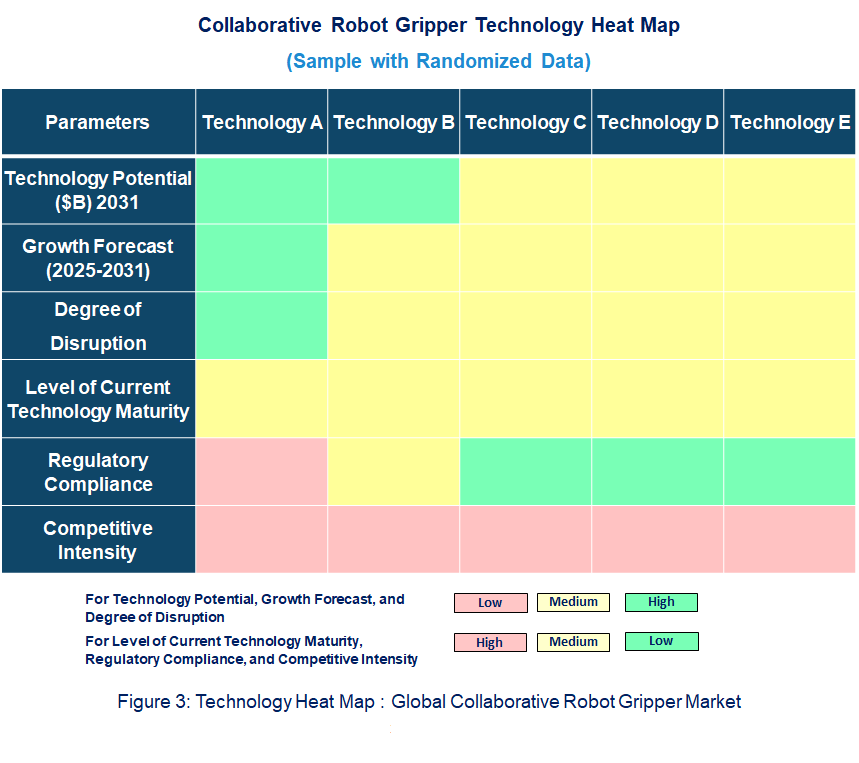
Collaborative Robot Gripper Market : Industry Potential, Technological Development, and Compliance Considerations
The collaborative robot gripper market is driven by several key technologies, including electric, pneumatic, hydraulic, and vacuum grippers.• Technology Potential: These technologies have shown immense potential to disrupt traditional automation processes, offering more flexible, efficient, and cost-effective solutions. Electric grippers, for instance, provide precision and ease of integration, while pneumatic grippers are valued for their speed and simplicity. Hydraulic grippers are powerful and ideal for heavy-duty applications, and vacuum grippers are perfect for delicate handling tasks, making them essential in industries like logistics and healthcare.
• Degree of Disruption: The introduction of these advanced grippers is disrupting conventional manufacturing processes, enabling automation in areas previously reliant on manual labor, particularly in industries such as automotive, electronics, and healthcare.
• Level of Current Technology Maturity: The technology maturity varies. Electric grippers have reached a high maturity level, while pneumatic and hydraulic grippers are still evolving to provide more flexibility in smaller spaces. Vacuum grippers, while efficient, are growing in sophistication, driven by better sensor technology.
• Regulatory Compliance: Compliance with safety regulations is crucial in this market, especially with collaborative robots working alongside humans. Grippers must meet stringent industrial safety standards, including ISO 10218 and ISO/TS 15066, to ensure safe operation. In conclusion, as these technologies evolve, they are set to revolutionize industrial automation, but regulatory hurdles will continue to play a key role in shaping their adoption.
Recent Technological development in Collaborative Robot Gripper Market by Key Players
The collaborative robot gripper market has seen significant developments from key players such as Schunk, Festo, SMC, Robotiq, Zimmer, Destaco, EMI, Applied Robotics, Schmalz, and RAD. These companies have introduced innovations that have impacted a variety of industries.• Schunk: Introduced modular and customizable electric gripper solutions, enhancing precision and flexibility in production environments.
• Festo: Launched new pneumatic grippers designed for complex tasks in automated production lines.
• SMC: Developed lighter, more compact pneumatic grippers that deliver high-speed performance and precision in small-space applications.
• Robotiq: Focused on smart grippers equipped with advanced sensing capabilities for collaborative tasks in various industries.
• Schmalz: Advanced vacuum grippers with high holding force, ideal for handling delicate and non-porous materials in automated logistics. These developments reflect the industry’s move towards more flexible, intelligent, and efficient robotic gripper technologies, setting the stage for more widespread adoption in diverse sectors.
Collaborative Robot Gripper Market Driver and Challenges
The collaborative robot gripper market is experiencing both growth opportunities and challenges. The factors responsible for driving the collaborative robot gripper market are:• Increasing demand for automation: As industries seek efficiency, automation technologies, including robot grippers, are in higher demand.
• Technological advancements: Continued innovation in electric and vacuum grippers will enhance capabilities and expand applications.
• Cost reduction in robotic systems: As prices of robotic systems drop, more industries are able to invest in collaborative robots and grippers.
• Rising labor costs: The push for cost-efficient automation systems, including grippers, helps reduce reliance on manual labor. Challenges facing the global collaborative robot gripper market:
• Complex integration: Integrating collaborative grippers with existing robotic systems remains a technical challenge.
• Safety and regulatory compliance: Ensuring that grippers meet safety and regulatory standards for human-robot interaction is a critical issue.
• Customization limitations: While grippers are becoming more adaptable, the need for highly specialized solutions can be challenging. These growth opportunities and challenges are collectively shaping the future of the collaborative robot gripper market, enhancing automation in diverse industries while overcoming technical and regulatory barriers.
List of Collaborative Robot Gripper Companies
Companies in the market compete on the basis of product quality offered. Major players in this market focus on expanding their manufacturing facilities, R&D investments, infrastructural development, and leverage integration opportunities across the value chain. With these strategies collaborative robot gripper companies cater increasing demand, ensure competitive effectiveness, develop innovative products & technologies, reduce production costs, and expand their customer base. Some of the collaborative robot gripper companies profiled in this report includes.• Schunk
• Festo
• Smc
• Robotiq
• Zimmer
• Destaco
Collaborative Robot Gripper Market by Technology
• Technology Readiness by Technology Type: The competitive intensity and regulatory compliance vary across the different gripper technologies. Electric grippers are highly advanced, offering precision and adaptability, with compliance to global standards for human-robot collaboration. Pneumatic grippers are widely used in high-speed applications, with relatively simpler regulatory requirements, but still need safety measures. Hydraulic grippers are typically used for heavy-duty tasks, and while they are effective, their regulatory compliance is more stringent due to the high force involved, especially when working alongside humans. Vacuum grippers are suitable for delicate applications such as in logistics and healthcare, with regulatory compliance focusing on safety in handling sensitive items. All technologies are at varying stages of maturity, with pneumatic and vacuum grippers being more mature for industrial applications, while electric and hydraulic grippers continue evolving.
• Competitive Intensity and Regulatory Compliance: The competitive intensity in the collaborative robot gripper market differs across technologies. Electric grippers face high competition from a range of manufacturers offering precise and easy-to-integrate solutions. Pneumatic grippers are widely used due to their cost-effectiveness, with moderate competition but increasing innovation in speed and flexibility. Hydraulic grippers are more niche, facing less competition due to their specialized use in heavy-duty tasks, and regulatory compliance is more rigorous in terms of safety standards. Vacuum grippers are growing in demand in sectors like logistics, requiring compliance with food and healthcare safety standards. Overall, all technologies face competition in terms of cost efficiency, innovation, and meeting regulatory safety and operational standards.
• Disruption Potential by Technology Type: The disruptive potential varies across gripper technologies in the collaborative robot market. Electric grippers offer high precision and flexibility, enabling automation in more diverse industries and disrupting traditional manual tasks. Pneumatic grippers are widely used in high-speed processes, disrupting industries by enabling fast, cost-effective automation in mass production settings. Hydraulic grippers, with their heavy-duty lifting capability, disrupt industries like automotive and aerospace by automating processes that were previously reliant on manual labor. Vacuum grippers offer a disruptive solution for handling delicate and sensitive materials in logistics, healthcare, and food industries, enabling increased automation in these areas. All technologies drive automation, cost reduction, and efficiency across a wide range of industries, each offering unique capabilities to address specific market needs. This approach mirrors your example with a clear breakdown of each technology’s readiness, competitive intensity, regulatory compliance, and disruption potential within the collaborative robot gripper market.
Collaborative Robot Gripper Market Trend and Forecast by Technology [Value from 2019 to 2031]:
• Electric Grippers
• Pneumatic Grippers
• Hydraulic Grippers
• Vacuum Grippers
Collaborative Robot Gripper Market Trend and Forecast by End Use Industry [Value from 2019 to 2031]:
• Automotive
• Electronics and Semiconductors
• Food and Beverages
• Healthcare
• Logistics
• Others
Collaborative Robot Gripper Market by Region [Value from 2019 to 2031]:
• North America
• Europe
• Asia Pacific
• The Rest of the World
• Latest Developments and Innovations in the Collaborative Robot Gripper Technologies
• Companies / Ecosystems
• Strategic Opportunities by Technology Type
Features of the Global Collaborative Robot Gripper Market
Market Size Estimates: Collaborative robot gripper market size estimation in terms of ($B). Trend and Forecast Analysis: Market trends (2019 to 2024) and forecast (2025 to 2031) by various segments and regions. Segmentation Analysis: Technology trends in the global collaborative robot gripper market size by various segments, such as end use industry and technology in terms of value and volume shipments. Regional Analysis: Technology trends in the global collaborative robot gripper market breakdown by North America, Europe, Asia Pacific, and the Rest of the World. Growth Opportunities: Analysis of growth opportunities in different end use industries, technologies, and regions for technology trends in the global collaborative robot gripper market. Strategic Analysis: This includes M&A, new product development, and competitive landscape for technology trends in the global collaborative robot gripper market. Analysis of competitive intensity of the industry based on Porter’s Five Forces model.Table of Contents
Methodology
- In-depth interviews of the major players in this market
- Detailed secondary research from competitors’ financial statements and published data
- Extensive searches of published works, market, and database information pertaining to industry news, company press releases, and customer intentions
- A compilation of the experiences, judgments, and insights of Lucintel’s professionals, who have analyzed and tracked this market over the years.


Buy Now
Choose a license that fits your team. Instant PDF delivery.
Prices exclude taxes. Instant delivery. Custom licensing available on request.
Key Questions
- • What are some of the most promising potential, high-growth opportunities for the technology trends in the global collaborative robot gripper market by technology (electric grippers, pneumatic grippers, hydraulic grippers, and vacuum grippers), end use industry (automotive, electronics and semiconductors, food and beverages, healthcare, logistics, and others), and region (North America, Europe, Asia Pacific, and the Rest of the World)?
- • Which technology segments will grow at a faster pace and why?
- • Which regions will grow at a faster pace and why?
- • What are the key factors affecting dynamics of different technology? What are the drivers and challenges of these technologies in the global collaborative robot gripper market?
- • What are the business risks and threats to the technology trends in the global collaborative robot gripper market?
- • What are the emerging trends in these technologies in the global collaborative robot gripper market and the reasons behind them?
- • Which technologies have potential of disruption in this market?
- • What are the new developments in the technology trends in the global collaborative robot gripper market? Which companies are leading these developments?
- • Who are the major players in technology trends in the global collaborative robot gripper market? What strategic initiatives are being implemented by key players for business growth?
- • What are strategic growth opportunities in this collaborative robot gripper technology space?
- • What M & A activities did take place in the last five years in technology trends in the global collaborative robot gripper market?


