
Report Feature
Cockpit Display Market Trends and Forecast
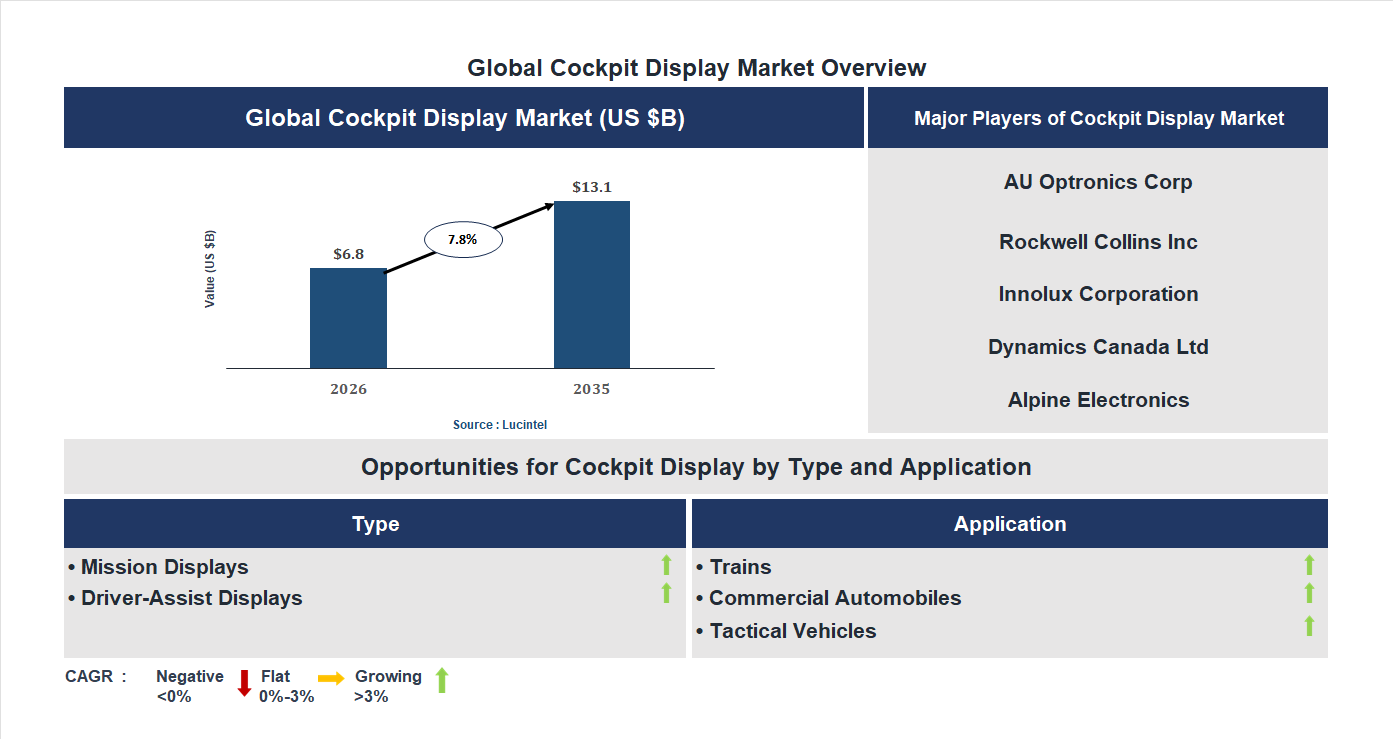
The future of the global cockpit display market looks promising with opportunities in the train, commercial automobile, and tactical vehicle markets. The global cockpit display market is expected to reach an estimated $13.1 billion by 2035 with a CAGR of 7.8% from 2026 to 2035. The major drivers for this market are the increasing demand for advanced infotainment systems, the rising adoption of digital cockpit technologies, and the growing preference for connected vehicle displays.• Lucintel forecasts that, within the type category, mission display is expected to witness higher growth over the forecast period.
• Within the application category, train is expected to witness the highest growth.
• In terms of region, North America is expected to witness the highest growth over the forecast period. Gain valuable insights for your business decisions with our comprehensive 150+ page report. Sample figures with some insights are shown below.
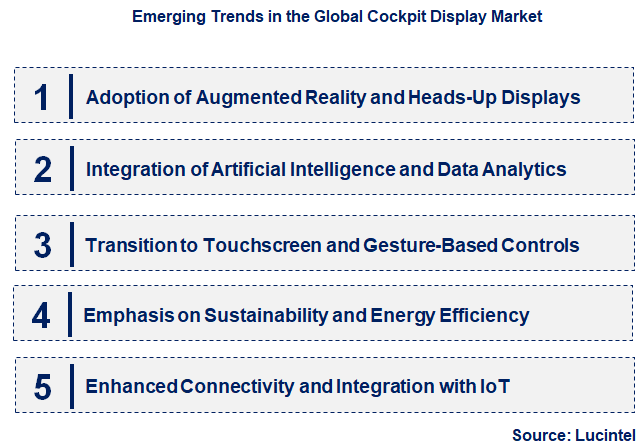
Emerging Trends in the Cockpit Display Market
The cockpit display market is experiencing rapid evolution driven by technological advancements, changing consumer preferences, and the push for enhanced safety and efficiency in aviation and automotive sectors. As aircraft and vehicle manufacturers seek innovative solutions to improve pilot and driver experience, the market is witnessing the emergence of new display technologies, increased integration of digital systems, and a focus on sustainability. These developments are transforming how information is presented, leading to safer, more efficient, and more user-friendly cockpit environments. The following key trends highlight the major shifts shaping this dynamic market landscape.• Adoption of Augmented Reality and Heads-Up Displays: AR and HUDs are increasingly integrated into cockpits to provide pilots and drivers with real-time, contextual information directly in their line of sight. This reduces the need to look away from the primary view, enhancing situational awareness and safety. These displays are becoming more sophisticated, offering high-resolution visuals, night vision capabilities, and interactive features. The trend is driven by advancements in display technology and the demand for improved operational efficiency, especially in commercial aviation and high-end automotive markets.
• Integration of Artificial Intelligence and Data Analytics: AI-powered cockpit displays are transforming data management by offering predictive analytics, automated alerts, and personalized information. These intelligent systems help pilots and drivers make faster, more informed decisions by analyzing vast amounts of data in real time. AI integration enhances safety, reduces workload, and improves operational efficiency. As AI technology becomes more accessible and reliable, its adoption in cockpit displays is expected to grow, leading to smarter, more adaptive environments that can anticipate user needs and respond proactively.
• Transition to Touchscreen and Gesture-Based Controls: Traditional physical controls are increasingly being replaced by touchscreen interfaces and gesture recognition systems. These technologies offer a more intuitive and flexible user experience, allowing for easier customization and faster access to critical information. Touchscreens reduce cockpit clutter and enable dynamic display configurations, while gesture controls facilitate contactless operation, which is especially valuable in high-stress or hazardous environments. This trend is driven by advancements in display materials, sensor technology, and user interface design, making cockpit controls more modern and user-friendly.
• Emphasis on Sustainability and Energy Efficiency: The market is witnessing a shift toward energy-efficient display technologies, such as OLED and microLED, which consume less power and offer better durability. Manufacturers are also focusing on lightweight display components to reduce overall aircraft and vehicle weight, contributing to fuel savings and lower emissions. Sustainable materials and eco-friendly manufacturing processes are gaining importance, aligning with global environmental standards. This trend not only supports regulatory compliance but also appeals to environmentally conscious consumers and operators seeking greener transportation solutions.
• Enhanced Connectivity and Integration with IoT: Cockpit displays are increasingly connected to broader networks and Internet of Things (IoT) systems, enabling seamless data sharing and remote monitoring. This connectivity allows for real-time updates, predictive maintenance, and improved communication between aircraft or vehicles and ground control or service centers. IoT integration enhances operational efficiency, reduces downtime, and facilitates proactive maintenance strategies. As connectivity standards evolve, cockpit displays will become more integrated with other onboard systems, creating a more cohesive and intelligent operational environment that supports the future of connected transportation. In summary, these emerging trends are fundamentally reshaping the cockpit display market by making displays more intelligent, intuitive, sustainable, and connected. They are driving innovations that improve safety, efficiency, and user experience, ultimately leading to smarter, greener, and more integrated cockpit environments across aviation and automotive industries.
Recent Development in the Cockpit Display Market
The cockpit display market is experiencing rapid advancements driven by technological innovations and increasing demand for enhanced pilot situational awareness. As aviation safety and efficiency become paramount, manufacturers are focusing on integrating advanced display systems. These developments are transforming cockpit interfaces, improving operational performance, and meeting stringent regulatory standards. The markets growth is fueled by rising air traffic, modernization initiatives, and the adoption of digital solutions across commercial and military aviation sectors.• Growing Adoption of Augmented Reality Displays: This development enhances pilot awareness by overlaying critical information directly onto the real-world view, improving safety and decision-making. The integration of AR displays allows for real-time data visualization, reducing pilot workload and increasing situational awareness. As AR technology matures, its adoption in cockpits is expected to expand, offering more intuitive interfaces and reducing training time. This trend significantly impacts the market by enabling more advanced, user-friendly cockpit systems.
• Increasing Use of Touchscreen and HMI Technologies: Touchscreens and Human-Machine Interface (HMI) systems are replacing traditional controls, offering more flexible and customizable interfaces. These technologies streamline cockpit operations, reduce physical clutter, and facilitate faster data access. The adoption of touch-based controls improves ergonomics and operational efficiency, especially in modern aircraft. As HMI systems become more sophisticated, they are expected to drive market growth by providing pilots with intuitive, integrated control solutions that enhance safety and performance.
• Integration of Artificial Intelligence for Predictive Maintenance: AI-driven systems analyze data from cockpit displays to predict potential failures and maintenance needs proactively. This development minimizes downtime, reduces maintenance costs, and enhances aircraft safety. AI algorithms enable real-time diagnostics and decision support, helping pilots and maintenance crews address issues before they escalate. The market benefits from increased reliability and operational efficiency, making AI integration a key driver for future cockpit display innovations.
• Development of Lightweight, Energy-Efficient Displays: Advances in display technology focus on reducing weight and power consumption, crucial for modern aircraft. Lightweight displays contribute to overall aircraft efficiency by decreasing fuel consumption and improving payload capacity. Energy-efficient screens also support sustainable aviation initiatives. These innovations enable longer operational hours and reduce environmental impact, making them highly attractive for both commercial and military applications. The market is poised for growth as demand for sustainable, high-performance cockpit displays increases.
• Expansion of Digital Cockpit Solutions in Military and Commercial Sectors: Digital cockpit displays are replacing analog systems, offering enhanced clarity, data integration, and operational flexibility. In military aviation, these systems improve mission effectiveness and survivability. Commercial aircraft benefit from increased automation and better pilot situational awareness. The shift towards digital solutions is driven by regulatory standards and technological advancements, leading to widespread adoption. This development significantly impacts the market by creating new opportunities for innovative display systems across various aviation segments. The overall impact of these developments is a more efficient, safer, and technologically advanced cockpit display market. Enhanced safety features, operational efficiencies, and sustainability initiatives are driving growth, attracting new entrants, and fostering innovation. As these trends continue, the market is expected to see increased adoption of integrated, intelligent, and lightweight display solutions, shaping the future of aviation technology.
Strategic Growth Opportunities in the Cockpit Display Market
The cockpit display market is experiencing rapid expansion driven by technological advancements, increasing aircraft fleet, and demand for enhanced pilot situational awareness. Innovations in display systems, integration of augmented reality, and automation are transforming cockpit interfaces. Market players are focusing on developing lightweight, energy-efficient, and high-resolution displays to meet stringent safety and regulatory standards. These growth opportunities are poised to reshape aviation safety, operational efficiency, and passenger experience, creating a highly competitive landscape with significant potential for strategic investments and technological breakthroughs.• Integration of Augmented Reality for Enhanced Pilot Awareness: Implementing augmented reality in cockpit displays offers pilots real-time, immersive information overlays, improving situational awareness and decision-making. This technology reduces cognitive load and enhances safety during complex maneuvers or adverse conditions. As AR becomes more affordable and reliable, manufacturers are investing in its integration, creating opportunities for innovative display solutions that can be customized for different aircraft types and operational needs.
• Development of Lightweight, Energy-Efficient Display Technologies: The demand for lightweight and energy-efficient cockpit displays is driven by the need to reduce aircraft weight and improve fuel efficiency. Advances in OLED, LCD, and microLED technologies enable the production of compact, high-resolution displays with lower power consumption. These innovations support the development of next-generation cockpits that are more sustainable, cost-effective, and easier to maintain, opening avenues for market expansion across commercial and military aviation sectors.
• Adoption of Touchscreen and Gesture-Control Interfaces: Touchscreen displays and gesture-control systems are transforming traditional cockpit interfaces by providing more intuitive and flexible control options. These technologies streamline pilot interactions, reduce clutter, and facilitate faster access to critical information. As user experience becomes a priority, manufacturers are focusing on ruggedized, multi-touch displays that can operate reliably under harsh conditions, creating new opportunities for customization and integration in modern aircraft.
• Implementation of Advanced Data Visualization and Analytics: Enhanced data visualization tools enable pilots to interpret complex flight data quickly and accurately. Incorporating analytics and predictive insights into cockpit displays improves operational efficiency and safety by providing proactive alerts and recommendations. The growing demand for integrated, real-time data systems encourages the development of sophisticated visualization platforms, fostering opportunities for collaboration between avionics providers and software developers to deliver comprehensive solutions.
• Expansion of Digital Cockpit Ecosystems with Connectivity Features: The shift towards fully digital, connected cockpits allows seamless data sharing between aircraft systems, ground control, and maintenance teams. Connectivity features such as wireless updates, remote diagnostics, and cloud-based data management enhance operational efficiency and reduce downtime. This digital ecosystem expansion creates opportunities for cybersecurity solutions, software upgrades, and integrated communication systems, positioning the market for sustained growth driven by the digital transformation in aviation. The overall market outlook is shaped by these strategic growth opportunities, which are set to enhance safety, efficiency, and innovation in cockpit display systems. As technology continues to evolve, stakeholders will benefit from increased competitiveness, new revenue streams, and improved passenger and crew experiences, ensuring sustained market expansion and technological leadership.
Cockpit Display Market Driver and Challenges
The cockpit display market is influenced by a variety of technological, economic, and regulatory factors that shape its growth trajectory. Advances in display technology, increasing demand for enhanced driver information systems, and stringent safety regulations are key drivers. Conversely, challenges such as high manufacturing costs, rapid technological obsolescence, and regulatory compliance complexities pose significant hurdles. Understanding these drivers and challenges is essential for stakeholders to navigate market opportunities and risks effectively. The evolving landscape demands continuous innovation and strategic adaptation to maintain competitiveness and meet safety standards, ultimately impacting the markets expansion and sustainability. The factors responsible for driving the cockpit display market include:-• Technological Innovation: The rapid development of advanced display technologies such as OLED, LCD, and AR displays enhances driver experience and safety. These innovations enable clearer visuals, better integration with vehicle systems, and improved user interfaces, making vehicles more appealing and safer. As automakers seek to differentiate their offerings, investment in cutting-edge cockpit displays accelerates market growth. Moreover, integration with autonomous vehicle systems and connectivity features further boosts demand, creating a dynamic environment for technological advancements and market expansion.
• Increasing Vehicle Production and Adoption of Advanced Driver Assistance Systems (ADAS): The surge in global vehicle production, especially in emerging markets, directly fuels demand for cockpit displays. Automakers are increasingly incorporating ADAS features like navigation, collision warnings, and lane assist, which rely heavily on sophisticated display systems. The rising consumer preference for connected and smart vehicles also propels the adoption of advanced cockpit displays. This trend is supported by automaker investments in R&D and strategic partnerships, fostering a robust growth environment for the market.
• Regulatory and Safety Standards: Governments worldwide are implementing stringent safety regulations that mandate the inclusion of advanced display systems to improve driver awareness and reduce accidents. These regulations encourage automakers to upgrade cockpit displays with features like heads-up displays (HUDs) and real-time information systems. Compliance with safety standards not only enhances vehicle safety ratings but also provides a competitive edge, driving market growth. Additionally, regulatory incentives and safety mandates are compelling manufacturers to innovate continuously, ensuring the market remains vibrant and aligned with safety objectives.
• Rising Consumer Preference for Enhanced In-Vehicle Experience: Consumers increasingly prioritize comfort, connectivity, and infotainment in their vehicles. This shift drives automakers to incorporate sophisticated cockpit displays that offer seamless integration with smartphones, entertainment systems, and navigation tools. The demand for personalized and intuitive interfaces enhances user experience, making vehicles more attractive. As a result, manufacturers invest heavily in developing innovative display solutions to meet consumer expectations, fueling market expansion and technological evolution. The challenges facing this cockpit display market include:-
• High Manufacturing and Development Costs: Developing advanced cockpit display systems involves significant investment in R&D, high-quality materials, and sophisticated manufacturing processes. These costs can be prohibitive, especially for smaller automakers, limiting market entry and innovation. Additionally, the need for continuous updates and upgrades to keep pace with technological advancements further escalates expenses, impacting profit margins and pricing strategies. This financial barrier can slow down the adoption of new display technologies and restrict market growth, particularly in price-sensitive regions.
• Rapid Technological Obsolescence: The fast-paced nature of display technology means that innovations quickly render existing systems outdated. Automakers face the challenge of balancing current product launches with future-proofing investments. Frequent updates and the need for compatibility with emerging systems increase complexity and costs. This rapid obsolescence can lead to increased warranty and maintenance costs, and may cause consumer dissatisfaction if products become obsolete shortly after purchase, thereby affecting brand reputation and market stability.
• Regulatory Compliance and Standardization Challenges: Navigating diverse and evolving safety, environmental, and technical standards across different regions complicates product development and deployment. Ensuring compliance with varying regulations increases costs and delays product launches. Lack of standardized specifications for cockpit displays can hinder interoperability and integration, creating barriers for global market expansion. Additionally, regulatory uncertainties can deter investment and innovation, constraining the market’s growth potential and leading to fragmented industry practices. In summary, the cockpit display market is driven by technological advancements, increasing vehicle production, safety regulations, and consumer preferences for enhanced in-vehicle experiences. However, high costs, rapid technological changes, and regulatory complexities pose significant challenges. These factors collectively influence the pace of innovation, market expansion, and competitiveness. While growth opportunities are substantial, stakeholders must strategically address these challenges to sustain long-term success and capitalize on emerging trends in the evolving automotive landscape.
List of Cockpit Display Companies
Companies in the market compete on the basis of product quality offered. Major players in this market focus on expanding their manufacturing facilities, R&D investments, infrastructural development, and leverage integration opportunities across the value chain. With these strategies cockpit display companies cater increasing demand, ensure competitive effectiveness, develop innovative products & technologies, reduce production costs, and expand their customer base. Some of the cockpit display companies profiled in this report include-• AU Optronics Corp
• Rockwell Collins Inc
• Innolux Corporation
• Dynamics Canada Ltd
• Alpine Electronics
• Garmin Ltd
• Continental AG
• Japan Display Inc
• Esterline Technologies Corporation
• Texas Instruments Inc
Cockpit Display Market by Segment
The study includes a forecast for the global cockpit display market by type, application, and region.Cockpit Display Market by Type [Value from 2019 to 2035]:
• Mission Displays
• Driver-Assist Displays
Cockpit Display Market by Application [Value from 2019 to 2035]:
• Trains
• Commercial Automobiles
• Tactical Vehicles
Cockpit Display Market by Region [Value from 2019 to 2035]:
• North America
• Europe
• Asia Pacific
• The Rest of the World
Country Wise Outlook for the Cockpit Display Market
The cockpit display market has experienced significant technological advancements driven by increasing demand for enhanced safety, automation, and user experience in the aviation and automotive sectors. Innovations include the integration of augmented reality, improved display resolutions, and the adoption of advanced data management systems. Countries are investing heavily in research and development to stay competitive and meet evolving regulatory standards. The markets growth is also fueled by the rising adoption of digital cockpit solutions in commercial and military aircraft, as well as in high-end automobiles. These developments reflect a global shift towards smarter, more efficient cockpit interfaces that improve pilot and driver situational awareness and operational efficiency.• United States: The US market has seen rapid adoption of augmented reality head-up displays (HUDs) in commercial and military aircraft, driven by defense contracts and technological innovation. Major aerospace companies are developing integrated cockpit systems with enhanced data visualization and automation features. The automotive sector is also integrating advanced digital displays, including curved and 3D screens, to improve the driver experience. Regulatory agencies are pushing for higher safety standards, encouraging manufacturers to adopt more sophisticated display technologies. Additionally, US startups are pioneering AI-driven cockpit solutions, further expanding market capabilities.
• China: China is rapidly expanding its cockpit display market, focusing on domestic aerospace and automotive industries. The government’s emphasis on self-reliance has led to increased investment in indigenous display technologies, including high-resolution LCDs and OLEDs. Chinese companies are developing integrated cockpit systems with AI and IoT capabilities to enhance operational efficiency. The military sector is also adopting advanced cockpit displays for fighter jets and UAVs. Moreover, China’s automotive industry is incorporating digital dashboards and HUDs to meet consumer demand for smart vehicle features, positioning the country as a key player in the global market.
• Germany: Germany remains a leader in aerospace innovation, with a focus on lightweight, energy-efficient cockpit displays for commercial aircraft. The country’s strong automotive industry is integrating advanced digital instrument clusters and augmented reality displays in luxury vehicles. German firms are investing in research to develop holographic and 3D display technologies for enhanced pilot and driver situational awareness. Regulatory standards in Europe are promoting the adoption of safer, more reliable cockpit systems. Collaborations between the aerospace and automotive sectors are fostering cross-industry innovations, positioning Germany at the forefront of cockpit display advancements.
• India: India’s cockpit display market is witnessing steady growth, driven by expanding commercial aviation and automotive sectors. The government’s push for Make in India has encouraged local manufacturing of display components and systems. Indian aerospace companies are adopting digital cockpit solutions to modernize fleet operations, while automotive manufacturers are integrating smart dashboards and HUDs to cater to rising consumer preferences. The focus on defense modernization is also boosting demand for advanced cockpit displays in military aircraft. Investments in R&D and partnerships with global technology firms are expected to accelerate innovation and market penetration in the coming years.
• Japan: Japan is advancing its cockpit display technology through innovations in augmented reality and high-resolution displays for both aerospace and automotive applications. The country’s aerospace industry is developing lightweight, energy-efficient systems to meet strict environmental standards. In automotive, Japanese automakers are integrating sophisticated digital dashboards and HUDs to enhance driver safety and comfort. Japan’s emphasis on robotics and AI is influencing cockpit system development, leading to smarter, more intuitive interfaces. Regulatory frameworks and a focus on safety are driving the adoption of cutting-edge display technologies, ensuring Japan remains a key player in the global cockpit display market.

Features of the Global Cockpit Display Market
Market Size Estimates: Cockpit display market size estimation in terms of value ($B). Trend and Forecast Analysis: Market trends (2019 to 2025) and forecast (2026 to 2035) by various segments and regions. Segmentation Analysis: Cockpit display market size by type, application, and region in terms of value ($B). Regional Analysis: Cockpit display market breakdown by North America, Europe, Asia Pacific, and Rest of the World. Growth Opportunities: Analysis of growth opportunities in different types, applications, and regions for the cockpit display market. Strategic Analysis: This includes M&A, new product development, and competitive landscape of the cockpit display market. Analysis of competitive intensity of the industry based on Porter’s Five Forces model.
FAQ
Q1. What is the market size and growth forecast for cockpit display market? Answer: The global cockpit display market is expected to reach an estimated $13.1 billion by 2035 and grow with a CAGR of 7.8% from 2026 to 2035. Q2. What are the major drivers influencing the growth of the cockpit display market? Answer: The major drivers for this market are the increasing demand for advanced infotainment systems, the rising adoption of digital cockpit technologies, and the growing preference for connected vehicle displays. Q3. What are the major segments for cockpit display market? Answer: The future of the cockpit display market looks promising with opportunities in the train, commercial automobile, and tactical vehicle markets. Q4. Who are the key cockpit display market companies? Answer: Some of the key cockpit display companies are as follows:• AU Optronics Corp
• Rockwell Collins Inc
• Innolux Corporation
• Dynamics Canada Ltd
• Alpine Electronics
• Garmin Ltd
• Continental AG
• Japan Display Inc
• Esterline Technologies Corporation
• Texas Instruments Inc Q5. Which cockpit display market segment will be the largest in future? Answer: Lucintel forecasts that, within the type category, mission display is expected to witness higher growth over the forecast period. Q6. In cockpit display market, which region is expected to be the largest in next 5 years? Answer: In terms of region, North America is expected to witness the highest growth over the forecast period. Q7. Do we receive customization in this report? Answer: Yes, Lucintel provides 10% customization without any additional cost.
Table of Contents
List of Figures
List of Tables
Methodology
- In-depth interviews of the major players in this market
- Detailed secondary research from competitors’ financial statements and published data
- Extensive searches of published works, market, and database information pertaining to industry news, company press releases, and customer intentions
- A compilation of the experiences, judgments, and insights of Lucintel’s professionals, who have analyzed and tracked this market over the years.


Buy Now
Choose a license that fits your team. Instant PDF delivery.
Prices exclude taxes. Instant delivery. Custom licensing available on request.
Key Questions
- • What are some of the most promising, high-growth opportunities for the cockpit display market by type (mission displays and driver-assist displays), application (trains, commercial automobiles, and tactical vehicles), and region (North America, Europe, Asia Pacific, and the Rest of the World)?
- • Which segments will grow at a faster pace and why?
- • Which region will grow at a faster pace and why?
- • What are the key factors affecting market dynamics? What are the key challenges and business risks in this market?
- • What are the business risks and competitive threats in this market?
- • What are the emerging trends in this market and the reasons behind them?
- • What are some of the changing demands of customers in the market?
- • What are the new developments in the market? Which companies are leading these developments?
- • Who are the major players in this market? What strategic initiatives are key players pursuing for business growth?
- • What are some of the competing products in this market and how big of a threat do they pose for loss of market share by material or product substitution?
- • What M&A activity has occurred in the last 7 years and what has its impact been on the industry? For any questions related to Cockpit Display Market, Cockpit Display Market Size, Cockpit Display Market Growth, Cockpit Display Market Analysis, Cockpit Display Market Report, Cockpit Display Market Share, Cockpit Display Market Trends, Cockpit Display Market Forecast, Cockpit Display Companies, write Lucintel analyst at email: helpdesk@lucintel.com. We will be glad to get back to you soon.


