
Market Report · July 22, 2026

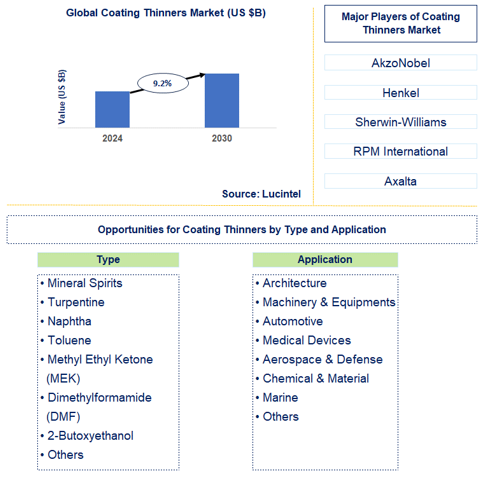
Key data points: The growth forecast = 9.2% annually for the next 6 years. Scroll below to get more insights. This market report covers trends, opportunities, and forecasts in the global coating thinners market to 2030 by type (mineral spirits, turpentine, naphtha, toluene, methyl ethyl ketone (MEK), dimethylformamide (DMF), 2-butoxyethanol, and others), application (architecture, machinery & equipment, automotive, medical devices, aerospace & defense, chemical & material, marine, and others), and region (North America, Europe, Asia Pacific, and the Rest of the World)
We'll send your sample report shortly.
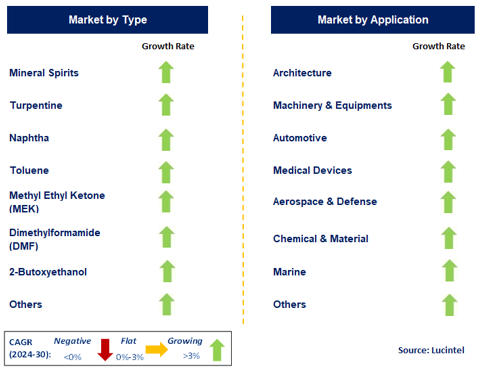
• Lucintel forecasts that, within the type category, the turpentine segment is expected to witness the highest growth over the forecast period.
• Within the application category, the architecture segment is expected to witness the highest growth.
• In terms of regions, APAC is expected to witness the highest growth over the forecast period. Gain valuable insights for your business decisions with our comprehensive 150+ page report.
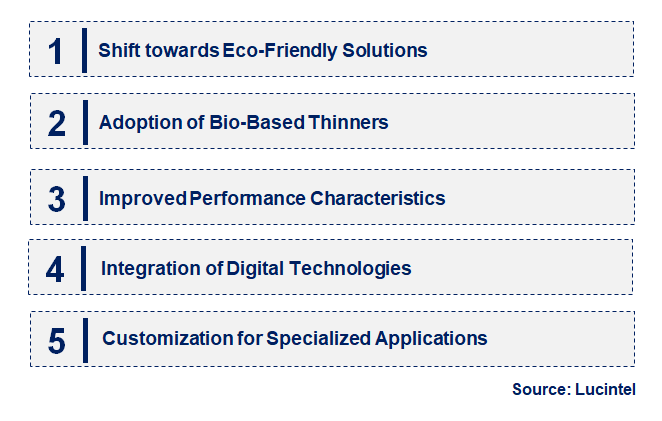
• Shift towards eco-friendly solutions: The demand for low-VOC and water-based thinners is increasing as environmental regulations become stricter. Manufacturers focus on eco-friendly formulations that minimize environmental impact while maintaining performance.
• Adoption of bio-based thinners: Bio-based coated thinners are gaining traction due to their sustainability. These thinners are made from renewable resources, aligning with global efforts to reduce reliance on petroleum-based chemicals.
• Improved performance characteristics: There is a growing emphasis on enhancing the performance of coated thinners, such as improved drying times, corrosion resistance, and durability. These advancements cater to high-demand industries like automotive, aerospace, and construction.
• Integration of digital technologies: Digital tools and IoT are integrated into the coating process, allowing real-time monitoring and optimization. This trend improves application precision and reduces waste in industrial processes.
• Customization for specialized applications: Manufacturers increasingly develop customized coated thinners for specific industries. Tailored formulations are created to meet the unique requirements of sectors like electronics, machinery, and automotive. These emerging trends reshape the coated thinners market by driving innovation in eco-friendly solutions, performance improvements, and customized applications. The market evolves to meet regulatory demands while offering advanced solutions for industrial needs.
• Introduction of low-VOC and water-based thinners: Manufacturers increasingly develop low-VOC and water-based thinners to meet stricter environmental regulations. These formulations reduce harmful emissions while providing effective thinning properties for industrial coatings.
• Advancements in bio-based thinners: Bio-based coated thinners gain popularity due to their sustainable nature. These thinners are derived from renewable resources, offering an eco-friendly alternative to traditional petroleum-based products.
• Enhanced corrosion resistance: Coated thinners with improved corrosion resistance are developed for use in high-performance industries such as automotive and aerospace. These products enhance the longevity and durability of coatings, providing better protection for metal surfaces.
• Digital integration in application: The integration of digital technologies into the coating process improves precision and reduces waste. IoT-enabled tools allow real-time monitoring of coating applications, optimizing the performance of thinners and reducing material usage.
• Customizable formulations for industry-specific applications: Manufacturers develop customized coated thinners tailored to specific industry needs. These specialized formulations address the unique challenges of industries such as electronics, machinery, and construction. These key developments advance the coated thinners market by focusing on eco-friendly solutions, performance enhancements, and customization. The market evolves to provide more sustainable and effective products across various industrial applications.
• Automotive industry: The automotive sector represents a significant growth opportunity for coated thinners. With advancements in eco-friendly formulations and enhanced performance characteristics, thinners are increasingly used in automotive coatings for better durability and environmental compliance.
• Aerospace applications: The aerospace industry requires high-performance coatings, creating opportunities for advanced coated thinners with improved corrosion resistance and durability. Innovations in this sector focus on meeting the stringent safety and performance standards of aerospace coatings.
• Construction and infrastructure: The construction industry is a major user of coated thinners for coatings on metal and concrete surfaces. Growth in this sector is driven by the need for durable and weather-resistant coatings, with eco-friendly and high-performance thinners in demand.
• Electronics and electrical industry: The electronics industry offers growth opportunities for specialized thinners that provide precision in coating applications. These thinners are used in protective coatings for electronic components, offering insulation and durability.
• Marine industry: The marine sector requires high-performance thinners for coatings that withstand harsh environments, such as saltwater and extreme weather conditions. Growth opportunities exist for thinners that enhance the longevity and performance of marine coatings. These growth opportunities highlight the potential for coated thinners in the automotive, aerospace, construction, electronics, and marine industries. Innovations in eco-friendly formulations and high-performance characteristics drive market expansion across these applications.
• Environmental regulations: Increasingly stringent environmental regulations drive demand for low-VOC and eco-friendly thinners. Compliance with these regulations is essential for market growth and product acceptance.
• Industrial growth: Expansion in key industries such as automotive, aerospace, and construction drives demand for coated thinners. These sectors require high-performance and durable coatings, creating growth opportunities.
• Technological innovations: Advances in coating technology and digital integration improve the precision and efficiency of thinners. These innovations enhance product performance and reduce waste in industrial applications.
• Shift towards sustainability: The growing demand for sustainable and bio-based thinners shapes the market. Manufacturers develop eco-friendly formulations that reduce environmental impact while maintaining performance.
• Customization for specific applications: The demand for industry-specific coatings drives the development of customized thinner formulations. Tailored products meet the unique needs of various sectors, enhancing market expansion. Challenges in the coating thinners market are:
• High production costs: The development of eco-friendly and advanced thinners can be expensive, impacting profitability. Balancing performance with affordability is a key challenge for manufacturers.
• Regulatory compliance: Navigating evolving environmental regulations can be complex and costly. Ensuring compliance with regional standards requires continuous investment in research and product development.
• Supply chain disruptions: Fluctuations in raw material availability and supply chain disruptions impact production and pricing. Managing these challenges is crucial for maintaining market stability. The coated thinners market is driven by environmental regulations, industrial growth, and technological innovations but faces challenges related to production costs, regulatory compliance, and supply chain issues. Addressing these factors is critical for achieving sustained growth and competitiveness.
• AkzoNobel
• Henkel
• Sherwin-Williams
• RPM International
• Axalta
• BASF
• Kansai Paint
• 3M
• ExxonMobil Chemical
• PPG
• Mineral Spirits
• Turpentine
• Naphtha
• Toluene
• Methyl Ethyl Ketone (MEK)
• Dimethylformamide (DMF)
• 2-Butoxyethanol
• Others
• Architecture
• Machinery & Equipments
• Automotive
• Medical Devices
• Aerospace & Defense
• Chemical & Material
• Marine
• Others
• North America
• Europe
• Asia Pacific
• The Rest of the World
• United States: In the U.S., stricter environmental regulations drive the development of low-VOC (volatile organic compound) coated thinners. Manufacturers focus on formulations that meet regulatory requirements while providing improved performance in industrial applications like automotive and aerospace coatings.
• China: China's coated thinners market witnesses rapid growth due to industrial expansion. Recent advancements include the adoption of water-based and eco-friendly thinners, addressing environmental concerns while maintaining performance. Local manufacturers also focus on cost-effective production methods.
• Germany: Germany emphasizes the use of sustainable materials in coated thinners. Innovations include bio-based thinners that reduce environmental impact, aligning with the country’s strong environmental policies. German companies also enhance product efficiency to meet the needs of high-performance industries like automotive and machinery.
• India: In India, the coated thinners market expands due to growing demand in construction and industrial sectors. Recent developments focus on improving cost efficiency and product accessibility while addressing environmental regulations. Manufacturers also explore partnerships to enhance production capabilities.
• Japan: Japan leads in the development of high-performance coated thinners for specialized applications. Recent innovations include thinners that offer enhanced corrosion resistance and durability for use in automotive and electronic coatings. Japan’s focus on quality and precision remains a driving force in the market.


• AkzoNobel
• Henkel
• Sherwin-Williams
• RPM International
• Axalta
• BASF
• Kansai Paint
• 3M
• ExxonMobil Chemical
• PPG Q5. Which coating thinners market segment will be the largest in future? Answer: Lucintel forecasts that turpentine segment is expected to witness the highest growth over the forecast period. Q6. In coating thinners market, which region is expected to be the largest in next 5 years? Answer: APAC is expected to witness the highest growth over the forecast period. Q.7 Do we receive customization in this report? Answer: Yes, Lucintel provides 10% customization without any additional cost.


Choose a license that fits your team. Instant PDF delivery.
Prices exclude taxes. Instant delivery. Custom licensing available on request.
Market Report · July 22, 2026
Market Report · July 15, 2026
Market Report · June 30, 2026
Trusted partner for strategic intelligence and business growth


Receive a complimentary market analysis tailored to your industry. Our analysts will identify key growth opportunities and competitive dynamics specific to your business.

Market size, growth rate, and key trend analysis for your specific sector.

Top competitor positioning and market share analysis.

Strategic recommendations backed by data-driven insights.
Get curated market intelligence and competitive moves straight to your inbox.
By subscribing, you agree to receive our monthly insights. Unsubscribe anytime.
Receive a complimentary market analysis tailored to your industry. Our analysts will identify key growth opportunities and competitive dynamics specific to your business.
Market size, growth rate, and key trend analysis for your specific sector.
Top competitor positioning and market share analysis.
Strategic recommendations backed by data-driven insights.
Get curated market intelligence, emerging trends, and competitive moves straight to your inbox each month.
By subscribing, you agree to receive our monthly insights. Unsubscribe anytime.
We'll send your sample report shortly.