
Market Report · July 20, 2026

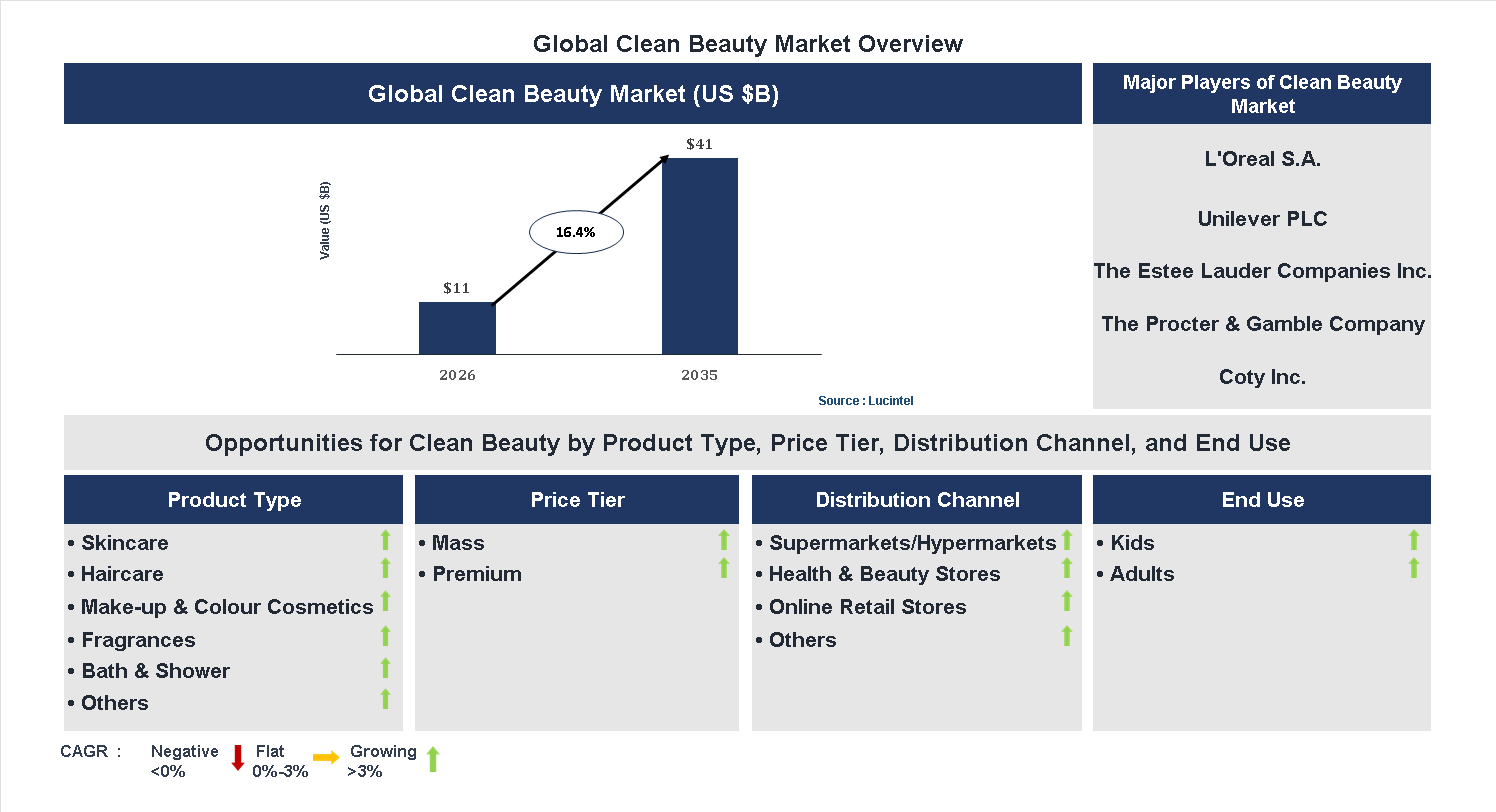
Key data points: The market size in 2035 = $41 billion, growth forecast = 16.4% annually for the next 8 years. Scroll below to get more insights. This market report covers trends, opportunities and forecasts in clean beauty market to 2035 by product type (skincare, haircare, make-up & colour cosmetics, fragrances, bath & shower, and others), price tier (mass and premium), distribution channel (supermarkets/hypermarkets, health & beauty stores, online retail stores, and others), end use (kids and adults), and region (North America, Europe, Asia Pacific, and the Rest of the World)
We'll send your sample report shortly.
• Lucintel forecasts that, within the product type category, skincare is expected to witness the highest growth over the forecast period.
• Within the distribution channel category, health & beauty store is expected to witness higher growth.
• In terms of region, APAC is expected to witness the highest growth over the forecast period. Gain valuable insights for your business decisions with our comprehensive 150+ page report. Sample figures with some insights are shown below.
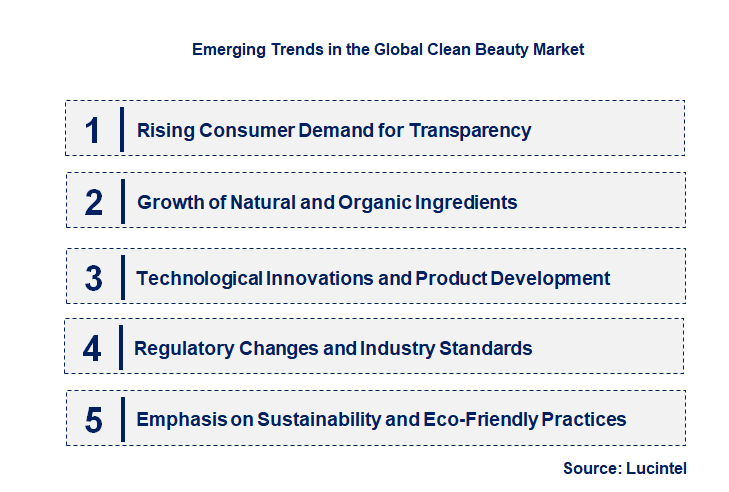
• Rising Consumer Demand for Transparency: Consumers increasingly seek detailed information about product ingredients and sourcing. This trend pushes brands to disclose ingredient lists and supply chain practices, fostering trust and loyalty. Transparency helps consumers make informed choices aligned with their values, such as cruelty-free, vegan, or organic products. As a result, brands are investing in clear labeling, certifications, and storytelling to differentiate themselves. This shift enhances brand credibility and encourages industry-wide standards for honesty and openness, ultimately elevating consumer confidence and driving market growth.
• Growth of Natural and Organic Ingredients: There is a significant shift toward natural, plant-based, and organic ingredients in beauty products. Consumers perceive these ingredients as safer, more sustainable, and environmentally friendly. This trend encourages formulators to innovate with botanical extracts, essential oils, and other natural components, reducing reliance on synthetic chemicals. The demand for certified organic products is also rising, prompting brands to obtain relevant certifications. This focus on natural ingredients not only appeals to health-conscious consumers but also supports sustainability goals, leading to a more eco-friendly product portfolio and expanding market share.
• Technological Innovations and Product Development: Advances in biotechnology, clean extraction methods, and formulation techniques are enabling the creation of more effective and safer products. Innovations such as lab-grown ingredients, biodegradable packaging, and personalized skincare solutions are emerging. These technological developments improve product efficacy while maintaining safety and sustainability standards. Companies are leveraging AI and data analytics to develop tailored products that meet individual needs. This trend enhances consumer experience, fosters innovation, and allows brands to differentiate themselves in a competitive market, ultimately driving growth and consumer loyalty.
• Regulatory Changes and Industry Standards: Governments and industry bodies are implementing stricter regulations and standards for ingredient safety, labeling, and sustainability. These regulations promote transparency and accountability, ensuring products meet high safety and environmental criteria. Compliance with these standards often requires reformulation and certification, which can be costly but ultimately benefits consumers and brands. The evolving regulatory landscape encourages industry players to adopt best practices, innovate responsibly, and build consumer trust. It also levels the playing field, fostering fair competition and encouraging sustainable practices across the market.
• Emphasis on Sustainability and Eco-Friendly Practices: Sustainability is a core focus, with brands adopting eco-friendly packaging, reducing carbon footprints, and sourcing ethically. Consumers favor brands that demonstrate environmental responsibility, influencing purchasing decisions. Initiatives such as refillable containers, biodegradable packaging, and sustainable sourcing are becoming standard. Companies are also investing in carbon offset programs and transparent supply chains. This trend not only appeals to eco-conscious consumers but also aligns with global sustainability goals, prompting the industry to innovate in sustainable practices. As a result, the market is shifting toward more responsible and environmentally friendly products, shaping a greener future for beauty. These trends are collectively transforming the clean beauty market into a more transparent, innovative, and sustainable industry. They are driving consumer engagement, fostering innovation, and setting new standards for safety and environmental responsibility. As these developments continue, the market is poised for sustained growth, with brands increasingly aligning with consumer values and global sustainability objectives.
• Growing Consumer Demand for Natural Ingredients: Consumers are increasingly seeking products free from harmful chemicals, driving brands to develop cleaner formulations. This shift enhances brand trust and loyalty, encouraging innovation in natural ingredient sourcing and product development. As a result, companies are expanding their portfolios to include more plant-based and organic options, which boosts market growth and aligns with sustainability goals.
• Regulatory Tightening and Ingredient Transparency: Governments worldwide are implementing stricter regulations on cosmetic ingredients, compelling brands to disclose ingredient lists and adhere to safety standards. This transparency builds consumer confidence and reduces the risk of legal issues. Companies investing in compliance and clear labeling are gaining competitive advantages, fostering trust and encouraging more consumers to choose clean beauty products.
• Technological Innovations in Product Formulation: Advances in biotechnology and natural extraction techniques enable brands to create more effective, safe, and sustainable products. These innovations improve product efficacy while maintaining clean labels, attracting a broader consumer base. The integration of new technologies also allows for personalized skincare solutions, further enhancing consumer engagement and market differentiation.
• Sustainability and Eco-Friendly Packaging Initiatives: Consumers are prioritizing brands that adopt sustainable practices, including biodegradable, recyclable, or refillable packaging. Companies investing in eco-friendly packaging reduce environmental impact and appeal to eco-conscious buyers. These initiatives not only support brand reputation but also align with global sustainability goals, driving market growth and encouraging industry-wide adoption of greener practices.
• Expansion of E-commerce and Digital Marketing Channels: The rise of online shopping and social media platforms has increased product accessibility and brand visibility. Digital marketing enables targeted campaigns, influencer collaborations, and consumer education, boosting sales and brand loyalty. E-commerce growth allows brands to reach global markets efficiently, accelerating industry expansion and providing consumers with easier access to clean beauty products. These developments are significantly transforming the clean beauty market by fostering innovation, enhancing transparency, and promoting sustainability. Consumer preferences for natural, safe, and eco-friendly products are driving brands to adapt quickly, resulting in increased market competition and growth. Technological advancements and digital channels further facilitate market expansion, making clean beauty more accessible and trusted worldwide. Overall, these opportunities are shaping a more sustainable, transparent, and consumer-centric industry landscape.
• Expanding Product Lines With Natural and Organic Ingredients: Developing diverse clean beauty products using certified organic, plant-based, and non-toxic ingredients can attract health-conscious consumers. Brands that emphasize transparency and efficacy in their formulations will build trust and loyalty, driving sales growth. Innovation in ingredient sourcing and formulation techniques will further differentiate offerings in a competitive landscape.
• Leveraging E-commerce and Digital Marketing Channels: Online platforms provide direct access to a global customer base, enabling brands to showcase their clean beauty credentials effectively. Utilizing social media, influencer collaborations, and targeted advertising can increase brand visibility and consumer engagement. E-commerce also facilitates personalized shopping experiences, subscription models, and data-driven insights to optimize marketing strategies.
• Emphasizing Sustainability and Eco-Friendly Packaging: Consumers increasingly prioritize brands committed to environmental responsibility. Incorporating biodegradable, recyclable, or refillable packaging reduces ecological impact and appeals to eco-conscious buyers. Transparent communication about sustainability initiatives enhances brand reputation and differentiates products in a crowded market, fostering long-term customer loyalty.
• Forming Strategic Partnerships and Certifications: Collaborations with reputable organizations and obtaining certifications (e.g., USDA Organic, Leaping Bunny) validate product claims and build consumer confidence. Partnering with sustainable ingredient suppliers and eco-labeling agencies can strengthen brand credibility and expand market reach, especially among discerning consumers seeking verified clean and ethical products.
• Investing in Research and Innovation for Efficacy and Safety: Continuous R&D efforts to improve product performance while maintaining safety standards are crucial. Developing innovative formulations that deliver visible results without harmful chemicals will meet consumer expectations. Emphasizing clinical testing and safety data can further differentiate brands and foster trust in the clean beauty segment. The overall growth of the clean beauty market is driven by consumer demand for safer, sustainable, and ethically produced products. By capitalizing on these opportunities, brands can enhance their market share, foster brand loyalty, and contribute to a healthier planet, ensuring long-term success in this evolving industry.
• Growing Consumer Awareness and Preference: Consumers are increasingly seeking products free from harmful chemicals, favoring natural and organic ingredients. This shift is driven by heightened awareness of health issues and environmental concerns, leading to a surge in demand for clean beauty products. Brands that emphasize transparency and sustainability are gaining a competitive edge, encouraging more companies to innovate and expand their clean beauty lines. The trend is also supported by social media influence and celebrity endorsements, which amplify consumer interest and trust in clean beauty options.
• Technological Innovations in Product Formulation: Advances in natural ingredient extraction, preservation, and formulation techniques have enabled brands to develop effective, safe, and appealing products. Innovations such as plant-based preservatives and eco-friendly packaging solutions enhance product shelf life and sustainability. These technological developments allow for the creation of diverse product ranges that meet consumer expectations for efficacy and safety, thereby fueling market growth. Continuous R&D investments are crucial for maintaining competitive advantage and addressing evolving consumer needs.
• Regulatory Environment and Standards: Increasing regulatory scrutiny around ingredient safety, labeling, and marketing claims influences market dynamics. Governments and industry bodies are establishing stricter guidelines to ensure consumer protection, which encourages transparency and accountability among brands. Compliance with these standards can be costly but ultimately builds consumer trust and brand credibility. Navigating complex regulatory landscapes across different regions remains a challenge but also an opportunity for brands to differentiate through rigorous safety and quality standards.
• Rising Disposable Income and Urbanization: Economic growth and urbanization have expanded the middle-class population with higher disposable incomes, enabling consumers to afford premium, clean beauty products. Urban lifestyles also increase exposure to global beauty trends and access to specialty stores and e-commerce platforms. This economic shift supports sustained demand for high-quality, ethically produced beauty products, encouraging brands to innovate and diversify their offerings to cater to this expanding customer base.
• Expansion of E-commerce and Digital Marketing: The proliferation of online shopping platforms and digital marketing strategies has made clean beauty products more accessible to a global audience. E-commerce provides convenience, wider product choices, and detailed product information, which influence purchasing decisions. Social media influencers and targeted advertising further boost brand visibility and consumer engagement. This digital shift allows brands to reach niche markets and build loyal customer communities, accelerating market penetration and growth. The challenges facing the clean beauty market include:
• Stringent Regulatory Compliance: The increasing complexity of regulations regarding ingredient safety, labeling, and marketing claims poses significant challenges for market players. Companies must invest heavily in compliance processes, testing, and documentation to meet diverse regional standards. Non-compliance can lead to legal penalties, product recalls, and damage to brand reputation. Navigating these regulatory landscapes requires substantial resources and expertise, which can hinder smaller players and slow overall market expansion.
• Supply Chain and Ingredient Sourcing Difficulties: Sourcing authentic natural ingredients sustainably and consistently remains a challenge due to environmental factors, geopolitical issues, and supply chain disruptions. Ensuring ingredient purity and transparency adds complexity and cost to production. Additionally, the demand for organic and ethically sourced ingredients often exceeds supply, leading to shortages and increased prices. These supply chain issues can delay product launches and impact profitability, requiring brands to develop resilient sourcing strategies.
• Market Saturation and Intense Competition: The rapid growth of the clean beauty sector has led to a crowded marketplace with numerous brands vying for consumer attention. Differentiating products and establishing brand loyalty becomes increasingly difficult amid low entry barriers. Price wars and marketing battles can erode profit margins, while consumer skepticism about product efficacy and authenticity can hinder growth. Companies must innovate continuously and build strong brand narratives to stand out in a saturated environment. The clean beauty market is driven by rising consumer demand for safe, sustainable, and effective products, supported by technological advancements and favorable economic trends. However, regulatory complexities, supply chain challenges, and intense competition pose significant hurdles. These factors collectively influence the market’s growth trajectory, requiring brands to adapt strategically. Successful navigation of these drivers and challenges will determine the market’s future expansion, with innovation, transparency, and resilience being key to sustained success.
• LOreal S.A.
• Unilever PLC
• The Estee Lauder Companies Inc.
• The Procter & Gamble Company
• Coty Inc.
• LOccitane International SA
• Shiseido Company, Limited
• Natura & co Holding SA.
• Beiersdorf AG
• Honest Company Inc.
• Skincare
• Haircare
• Make-up & Colour Cosmetics
• Fragrances
• Bath & Shower
• Others
• Mass
• Premium
• Supermarkets/Hypermarkets
• Health & Beauty Stores
• Online Retail Stores
• Others
• Kids
• Adults
• North America
• Europe
• Asia Pacific
• The Rest of the World
• United States: The US clean beauty market has seen significant growth, with consumers prioritizing organic, cruelty-free, and eco-friendly products. Major brands are expanding their natural product lines, and new startups are entering the space with innovative formulations. Regulatory agencies are working toward clearer labeling standards, boosting consumer confidence. E-commerce sales are booming, driven by digital marketing and social media influencers. Additionally, there is a rising trend in personalized clean beauty solutions, integrating technology for tailored skincare routines. Sustainability initiatives, such as biodegradable packaging, are becoming industry standards.
• China: Chinas clean beauty market is rapidly expanding, fueled by rising middle-class income and increasing awareness of health and wellness. Domestic brands are gaining prominence by offering affordable, natural products tailored to local preferences. International brands are also entering the market, adapting formulations to meet Chinese consumers demand for safety and efficacy. Regulatory reforms are improving transparency and safety standards, encouraging brand trust. E-commerce platforms like Tmall and JD.com are vital distribution channels. There is a growing interest in herbal and traditional ingredients, blending modern science with cultural heritage. Sustainability practices are gradually gaining importance among consumers.
• Germany: The German clean beauty market is characterized by a strong emphasis on organic certification, environmental sustainability, and ethical sourcing. Consumers are highly conscious of product ingredients and manufacturing processes, favoring brands with transparent supply chains. The market is witnessing increased innovation in biodegradable packaging and refillable products. Regulatory frameworks are strict, ensuring high safety standards and truthful labeling. German consumers also show interest in cruelty-free and vegan products, aligning with broader European Union regulations. Local startups are pioneering eco-friendly formulations, and collaborations with environmental organizations are common. Digital platforms are crucial for product education and transparency.
• India: The Indian clean beauty market is experiencing rapid growth, driven by increasing awareness of natural ingredients and traditional herbal remedies. Consumers are seeking affordable, effective, and chemical-free products, often blending Ayurveda with modern skincare. Domestic brands are expanding their offerings, emphasizing sustainability and ethical sourcing. Regulatory standards are evolving, with a focus on safety and ingredient transparency. E-commerce is a significant distribution channel, especially among urban youth. There is a rising trend in herbal and plant-based formulations, reflecting cultural preferences. Brands are also adopting eco-friendly packaging to appeal to environmentally conscious consumers.
• Japan: Japans clean beauty market is marked by a focus on high-quality, innovative formulations that combine traditional ingredients with cutting-edge technology. Consumers value safety, efficacy, and minimalism, favoring products with natural and organic ingredients. The market is witnessing increased demand for cruelty-free and environmentally sustainable products. Japanese brands are leading in research and development, integrating advanced skincare science with natural extracts. Regulatory standards are stringent, ensuring product safety and transparency. The trend toward eco-conscious packaging and ethical sourcing is growing. Digital marketing and influencer collaborations play a vital role in shaping consumer preferences and expanding market reach.


• LOreal S.A.
• Unilever PLC
• The Estee Lauder Companies Inc.
• The Procter & Gamble Company
• Coty Inc.
• LOccitane International SA
• Shiseido Company, Limited
• Natura & co Holding SA.
• Beiersdorf AG
• Honest Company Inc. Q6. Which clean beauty market segment will be the largest in future? Answer: Lucintel forecasts that, within the product type category, skincare is expected to witness the highest growth over the forecast period. Q7. In clean beauty market, which region is expected to be the largest in next 5 years? Answer: In terms of region, APAC is expected to witness the highest growth over the forecast period. Q8. Do we receive customization in this report? Answer: Yes, Lucintel provides 10% customization without any additional cost.


Choose a license that fits your team. Instant PDF delivery.
Prices exclude taxes. Instant delivery. Custom licensing available on request.
Market Report · July 20, 2026
Market Report · July 15, 2026
Market Report · July 15, 2026
Trusted partner for strategic intelligence and business growth


Receive a complimentary market analysis tailored to your industry. Our analysts will identify key growth opportunities and competitive dynamics specific to your business.

Market size, growth rate, and key trend analysis for your specific sector.

Top competitor positioning and market share analysis.

Strategic recommendations backed by data-driven insights.
Get curated market intelligence and competitive moves straight to your inbox.
By subscribing, you agree to receive our monthly insights. Unsubscribe anytime.
Receive a complimentary market analysis tailored to your industry. Our analysts will identify key growth opportunities and competitive dynamics specific to your business.
Market size, growth rate, and key trend analysis for your specific sector.
Top competitor positioning and market share analysis.
Strategic recommendations backed by data-driven insights.
Get curated market intelligence, emerging trends, and competitive moves straight to your inbox each month.
By subscribing, you agree to receive our monthly insights. Unsubscribe anytime.
We'll send your sample report shortly.