
Market Report · July 22, 2026

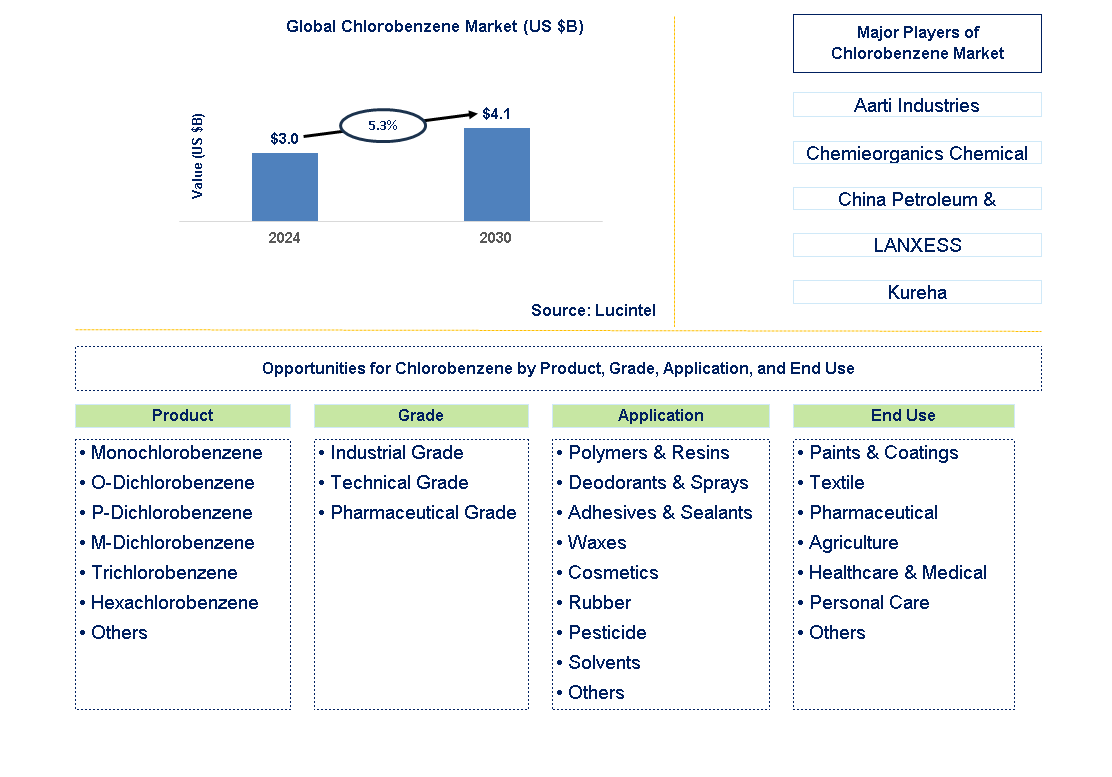
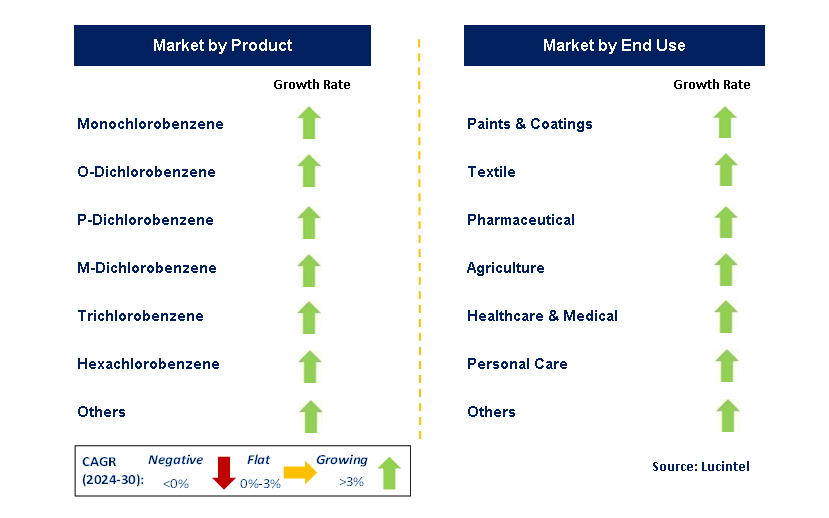
Key data points: The market size in 2030 = $4.1 billion, growth forecast = 5.3% annually for the next 6 years. Scroll below to get more insights. This market report covers trends, opportunities, and forecasts in the global chlorobenzene market to 2030 by product (monochlorobenzene, o-dichlorobenzene, p-dichlorobenzene, m-dichlorobenzene, trichlorobenzene, hexachlorobenzene, and others), grade (industrial grade, technical grade, and pharmaceutical grade), application (polymers & resins, deodorants & sprays, adhesives & sealants, waxes, cosmetics, rubber, pesticide, solvents, and others), end use (paints & coatings, textile, pharmaceutical, agriculture, healthcare & medical, personal care, and others), and region (North America, Europe, Asia Pacific, and the Rest of the World)
We'll send your sample report shortly.
• Lucintel forecasts that, within the product category, monochlorobenzene will remain the largest segment over the forecast period due to its growing demand from nitrochlorobenzene and diphenyl oxide manufacturers.
• Within the application category, solvent will remain the largest segment due to wide use of chlorobenzene in the manufacturing of paints, coatings with abrasives, adhesives, sealants, and polishes.
• In terms of regions, APAC will remain the largest region over the forecast period due to rapid population growth and significant usage of chlorobenzene in various end use industries, such as pharmaceuticals, dyes & pigments, pesticide and other organic chemicals in the region. Gain valuable insights for your business decisions with our comprehensive 150+ page report.
• Green Chemistry Initiatives: Green chemistry initiatives are becoming increasingly important in the Chlorobenzene market today. Companies are focusing on creating production processes that are more environmentally friendly and reduce the use of hazardous substances. The primary goal of green chemistry innovations is to minimize waste and improve efficiency in order to support broader sustainability goals. This trend is expected to lead to the adoption of cleaner technologies, improving the overall environmental performance of Chlorobenzene production.
• Increased Demand for Specialty Chemicals: The demand for specialty chemicals, such as those derived from Chlorobenzene, is increasing. Specialty chemicals have high-value applications in areas such as pharmaceuticals, agrochemicals, and electronics, among others. This growing demand is driving the growth of the Chlorobenzene market as manufacturers strive to produce more specialized, high-quality products. This trend shows that both advanced and niche applications are incorporating Chlorobenzene.
• Technological Advancements in Production: Technological advancements in Chlorobenzene production have significantly altered this sector. New technologies, such as more efficient catalytic processes and improved distillation techniques, can boost productivity while simultaneously lowering costs. These advancements also support sustainable manufacturing practices, improving overall efficiency in producing Chlorobenzene. This trend is expected to stimulate further technological improvements, increasing competition within this field.
• Stringent Environmental Regulations: Stringent environmental regulations are shaping the Chlorobenzene market. Governments have implemented stricter regulations to control emissions and reduce environmental impact. These regulations are driving the development of cleaner technologies and processes. This trend has influenced production practices, leading to more environmentally friendly methods of Chlorobenzene production. Companies are investing in technology required to meet regulatory standards and improve environmental performance. These trends—green chemistry initiatives, increased demand for specialty chemicals, technological advancements, stringent environmental regulations, and global supply chain adjustments—are reshaping the Chlorobenzene industry. Consequently, these trends drive new product development, determine sustainability goals, and affect how products are made. As these trends progress, they will profoundly impact the future direction of the Chlorobenzene market and its competitive landscape.

• Augmentation of Manufacturing Capacities: The expansion of manufacturing capacities is a key development in the Chlorobenzene sector. Companies are building new facilities and renovating existing ones to accommodate growing demand. This expansion is driven by increased use in the pharmaceutical and agrochemical sectors. New facilities feature state-of-the-art technology that boosts productivity while reducing adverse environmental effects. This development ensures the availability of Chlorobenzene to meet the needs of various industries, supporting market growth.
• Transitioning to Green Chemistry Approaches: The adoption of green chemistry practices is reshaping the Chlorobenzene market. Producers are employing greener technologies that reduce Chlorobenzene’s environmental impact and minimize hazardous waste materials produced during its manufacture. For instance, many producers now use more sustainable raw materials and enhance process efficiencies through green chemistry. This shift aligns with global environmental standards while boosting market sustainability.
• Increased Governmental Monitoring: Increasing government control is affecting the Chlorobenzene industry. Governments across the globe have imposed stricter environmental laws to control emissions and ensure safe production practices. Compliance with these regulations requires cleaner technologies and stricter monitoring. Such changes are driving innovation within production processes, encouraging companies to adopt eco-friendly practices that align with regulatory benchmarks.
• Technological Innovations in Manufacture: Technological innovations in Chlorobenzene production are advancing the market. The industry is now making use of more efficient catalytic processes and improved distillation technologies. These innovations aim to ensure high-quality products, lower costs, and better production efficiency. Their integration into corporate operations enables firms to meet the growing demand for high-purity Chlorobenzene across various applications. These recent developments—expanded manufacturing capacities, green chemistry trends, increased regulatory focus, technological advancements, and fluctuations in raw material prices—are reshaping the Chlorobenzene sector. They enhance production efficiency, support sustainability, and ensure compliance with regulations. As a result, these trends continue to influence both supply and demand, impacting the chlorobenzene industry’s market dynamics.
• Pharmaceutical Applications: The Chlorobenzene market presents significant growth opportunities in pharmaceutical applications. This compound is used in the production of active pharmaceutical intermediates (APIs) and other chemicals. The expanding pharmaceutical industry is creating opportunities for Chlorobenzene suppliers as demand for healthcare products continues to increase alongside drug development. Changing needs in pharmaceutical formulations and increased drug production have driven rising demand for Chlorobenzene within this sector.
• Agrochemical Production: The agrochemical sector presents growing opportunities for Chlorobenzene. It is employed as an intermediate chemical in the production of crop protection agents, such as insecticides and herbicides. Demand for agrochemicals is increasing due to the need for crop protection and sustainable agricultural practices, which has led to higher demand for products like Chlorobenzene, used in their manufacture. These developments have resulted in advances in formulations and increased agricultural outputs, further supporting this growth opportunity.
• Electronics and Semiconductor Industry: The electronics and semiconductor industry presents a fast-growing opportunity for Chlorobenzene. It functions as a solvent and cleaner during the manufacturing of electronic components and semiconductors. As electronic devices become more popular and advanced semiconductor technologies drive up demand, the need for high-purity Chlorobenzene increases. This trend is fueled by technological advancements and the growing number of electronic devices produced globally.
• Automotive Industry: The automotive sector is a significant growth area for Chlorobenzene. It is used in the production of various automotive components, including adhesives and coatings. The rising demand for Chlorobenzene is linked to the growth of the automotive industry, driven by increased vehicle production and technological advancements. Innovation in automotive materials and manufacturing processes further supports this growth opportunity. Strategic growth opportunities in the Chlorobenzene market are driven by high-value applications such as pharmaceuticals, agrochemicals, electronics, the automotive industry, and solvents. These opportunities arise from emerging uses of Chlorobenzene, which attract higher prices as demand for technologically advanced products increases.
• Technological Innovation: The Chlorobenzene market is largely driven by technological innovations. Advanced production technologies, such as the use of more efficient catalysts and advanced distillation methods, have increased productivity while lowering costs. These developments enhance companies' abilities to increase output and quality, thereby boosting growth in the global Chlorobenzene market.
• Rising Demand from Key Applications: The primary demand-generating sectors for Chlorobenzene include pharmaceuticals, agrochemicals, and electronics. These sectors are expected to expand further in the future, which will increase the demand for Chlorobenzene as a precursor and solvent. This rising preference will drive investment in additional capacities and enhanced technologies within the sector.
• Regulatory Support for Sustainability: Government initiatives aimed at reducing environmental impact through regulations are driving the Chlorobenzene industry forward. Compliance with these regulations encourages the adoption of cleaner technologies, leading to more sustainable markets. It also fosters innovation among producers committed to global sustainability efforts. Challenges in the Chlorobenzene Market:
• Compliance with Regulations: Compliance with regulations poses a significant challenge for the Chlorobenzene industry. Implementing these regulations requires substantial investment in cleaner technologies or process improvements, which can increase costs and impact profit margins. Companies must strike the right balance between regulatory compliance and efficient operations.
• Environmental Concerns: One key challenge facing the Chlorobenzene market is environmental conservation. The production and use of Chlorobenzene can pose environmental risks, such as pollution due to emissions and waste disposal. Companies need to address these risks while striving to remain profitable.
• Supply Chain Disruptions: The Chlorobenzene market has been affected by disruptions within its supply chain. Political upheavals, trade policies, and logistical challenges, such as difficulties in accessing raw materials or final products, may hinder effective operations. Companies must address these challenges to maintain stability in the market. Impact of Drivers and Challenges on the Chlorobenzene Market: Major drivers, such as technological advances, growing demand from key applications, governmental support for sustainable practices, and economic growth driven by industrial expansion, have shaped the Chlorobenzene industry into what it is today.
• Aarti Industries
• Chemieorganics Chemical
• China Petroleum & Chemical
• LANXESS
• Kureha
• Seya Industries
• Panoli Intermediates India
• J&K Scientific
• Jiaxing Zhonghua Chemical
• Meryer Chemical Technology
• Monochlorobenzene
• O-Dichlorobenzene
• P-Dichlorobenzene
• M-Dichlorobenzene
• Trichlorobenzene
• Hexachlorobenzene
• Others
• Industrial Grade
• Technical Grade
• Pharmaceutical Grade
• Polymers & Resins
• Deodorants & Sprays
• Adhesives & Sealants
• Waxes
• Cosmetics
• Rubber
• Solvents
• Others
• Paints & Coatings
• Textile
• Pharmaceutical
• Agriculture
• Healthcare & Medical
• Personal Care
• Others
• North America
• Europe
• Asia Pacific
• The Rest of the World
• United States: Expansion of production facilities is a significant development in the U.S. Chlorobenzene market. Companies are constructing new plants and upgrading existing ones to meet higher demand. This expansion is driven by growth in pharmaceuticals and agrochemicals. Additionally, progressive manufacturing technologies are reducing inefficiencies and pollution, positioning the U.S. as a global leader in the Chlorobenzene market.
• China: In China, compliance with regulations and capacity building are key developments. Cleaner production technologies have been adopted due to stricter environmental regulations. To meet the growing domestic and international demand for Chlorobenzene, companies are expanding their production capacities. By adhering to these regulations, China aims to maintain its competitive edge in the global market while addressing environmental concerns.
• Germany: Germany is witnessing innovation in its Chlorobenzene production processes. Companies are investing in cutting-edge technologies to enhance energy efficiency and reduce waste. These efforts align with Germany’s commitment to environmental sustainability, ensuring the production of eco-friendly Chlorobenzene.
• India: In India, Chlorobenzene consumption is increasing, driven by growth in the pharmaceutical and agrochemical sectors. Companies are focusing on expanding production capacities and improving supply chain efficiencies to meet this rising demand. India is becoming an important player in the global Chlorobenzene industry.
• Japan: Japan emphasizes environmental sustainability in its Chlorobenzene production. The country is investing in methods that minimize waste and emissions while increasing energy efficiency. These efforts align with Japan’s broader environmental goals and position the country as a leader in sustainable Chlorobenzene production.
• Aarti Industries
• Chemieorganics Chemical
• China Petroleum & Chemical
• LANXESS
• Kureha
• Seya Industries
• Panoli Intermediates India
• J&K Scientific
• Jiaxing Zhonghua Chemical
• Meryer Chemical Technology Q6. Which chlorobenzene market segment will be the largest in future? Answer: Lucintel forecasts that, within the product category, monochlorobenzene will remain the largest segment over the forecast period due to its growing demand from nitrochlorobenzene and diphenyl oxide manufacturers. Q7. In chlorobenzene market, which region is expected to be the largest in next 5 years? Answer: In terms of regions, APAC will remain the largest region over the forecast period due to rapid population growth and significant usage of chlorobenzene in various end use industries, such as pharmaceuticals, dyes & pigments, pesticide and other organic chemicals in the region. Q.8 Do we receive customization in this report? Answer: Yes, Lucintel provides 10% customization without any additional cost.


Choose a license that fits your team. Instant PDF delivery.
Prices exclude taxes. Instant delivery. Custom licensing available on request.
Market Report · July 22, 2026
Market Report · July 22, 2026
Market Report · July 22, 2026
Trusted partner for strategic intelligence and business growth


Receive a complimentary market analysis tailored to your industry. Our analysts will identify key growth opportunities and competitive dynamics specific to your business.

Market size, growth rate, and key trend analysis for your specific sector.

Top competitor positioning and market share analysis.

Strategic recommendations backed by data-driven insights.
Get curated market intelligence and competitive moves straight to your inbox.
By subscribing, you agree to receive our monthly insights. Unsubscribe anytime.
Receive a complimentary market analysis tailored to your industry. Our analysts will identify key growth opportunities and competitive dynamics specific to your business.
Market size, growth rate, and key trend analysis for your specific sector.
Top competitor positioning and market share analysis.
Strategic recommendations backed by data-driven insights.
Get curated market intelligence, emerging trends, and competitive moves straight to your inbox each month.
By subscribing, you agree to receive our monthly insights. Unsubscribe anytime.
We'll send your sample report shortly.