
Report Feature
Central Laboratory CRO Services Market Trends and Forecast
The future of the global central laboratory CRO services market looks promising with opportunities in the pharmaceutical companies, biotechnology companies, academic & research institutes and others markets. The global central laboratory CRO services market is expected to grow with a CAGR of 6.1% from 2025 to 2031. The major drivers for this market are rising operational costs, pharmaceutical companies and increase in personalized and precision medicine. Lucintel forecasts that, within the type category, biomarker services is expected to witness the highest growth over the forecast period. Within the application category, pharmaceutical companies is expected to witness the highest growth. In terms of region, APAC is expected to witness the highest growth over the forecast period. Gain valuable insights for your business decisions with our comprehensive 150+ page report. Sample figures with some insights are shown below.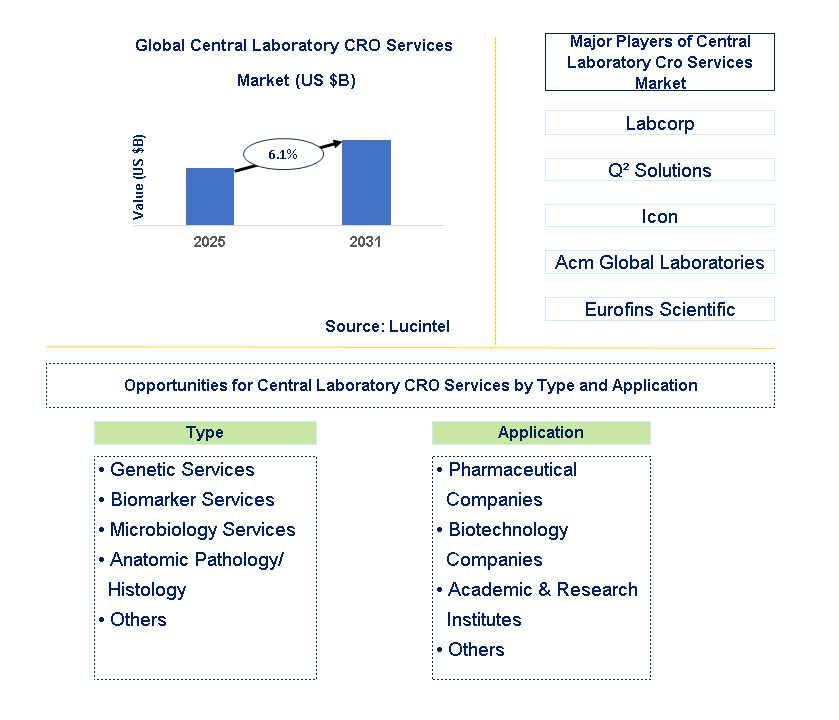
Central Laboratory CRO Services Market by Segment
• Precision Medicine and Biomarker Discovery: As personalized medicine continues to gain traction, central laboratories are expanding their services to focus on precision medicine, which tailors treatments based on genetic, environmental, and lifestyle factors. Biomarker discovery is a critical component of this trend, allowing for more accurate patient stratification and targeted therapies. CROs are investing in advanced technologies like genomics and proteomics to support this growing field, opening new opportunities for drug development and clinical trials.
• Regulatory Compliance and Data Security: With increasing global regulatory scrutiny, there is a growing emphasis on maintaining regulatory compliance and ensuring data security in clinical trials. Central laboratories are adopting advanced technologies to streamline regulatory reporting and ensure data integrity. This trend is particularly relevant as regulatory authorities like the FDA and EMA continue to refine guidelines around clinical trial data. In addition, data security measures are being bolstered to protect sensitive patient information, especially as trials become more digital and data-intensive.
• Expansion of Clinical Trial Services: Central laboratory CROs are expanding their service offerings to meet the evolving needs of clinical trials. Beyond traditional testing, CROs are increasingly providing integrated services like clinical trial management, patient recruitment, data management, and regulatory support. This trend reflects the growing demand for end-to-end solutions that help streamline the entire clinical trial process. As clinical trials become more complex and global in scale, the need for comprehensive and coordinated services is rising.
• Growth in Global Clinical Trial Outsourcing: As pharmaceutical companies look to reduce costs and enhance trial efficiencies, there has been a significant increase in the outsourcing of clinical trials to CROs, including central laboratories. Emerging markets, such as India and China, are becoming key destinations for clinical trial outsourcing due to cost advantages and a large patient pool. CROs in these regions are capitalizing on the demand for low-cost, high-quality services, allowing pharmaceutical companies to conduct trials at a lower overall cost while maintaining high standards. These emerging trends are reshaping the central laboratory CRO services market by introducing new technologies, expanding service offerings, and enhancing operational efficiencies. The integration of AI, the focus on precision medicine, heightened regulatory compliance, and the growth of global clinical trial outsourcing will continue to drive the evolution of this market in the coming years." src="Emerging Trends in the Central Laboratory CRO Services Market" style="height: auto;width: auto;" title="The central laboratory CRO services market is undergoing significant transformation due to several emerging trends. These trends are influenced by technological advancements, changing regulatory landscapes, and the growing complexity of clinical trials. Below are five key trends reshaping the market and influencing its growth trajectory.
• Integration of Artificial Intelligence and Machine Learning: AI and machine learning technologies are increasingly being integrated into central laboratory services to improve data analysis, enhance predictive capabilities, and optimize trial outcomes. By automating data management and analysis, AI reduces human error, accelerates the processing of clinical trial data, and enhances decision-making in real time. This trend is expected to revolutionize the CRO sector, making clinical trials more efficient and cost-effective.
• Precision Medicine and Biomarker Discovery: As personalized medicine continues to gain traction, central laboratories are expanding their services to focus on precision medicine, which tailors treatments based on genetic, environmental, and lifestyle factors. Biomarker discovery is a critical component of this trend, allowing for more accurate patient stratification and targeted therapies. CROs are investing in advanced technologies like genomics and proteomics to support this growing field, opening new opportunities for drug development and clinical trials.
• Regulatory Compliance and Data Security: With increasing global regulatory scrutiny, there is a growing emphasis on maintaining regulatory compliance and ensuring data security in clinical trials. Central laboratories are adopting advanced technologies to streamline regulatory reporting and ensure data integrity. This trend is particularly relevant as regulatory authorities like the FDA and EMA continue to refine guidelines around clinical trial data. In addition, data security measures are being bolstered to protect sensitive patient information, especially as trials become more digital and data-intensive.
• Expansion of Clinical Trial Services: Central laboratory CROs are expanding their service offerings to meet the evolving needs of clinical trials. Beyond traditional testing, CROs are increasingly providing integrated services like clinical trial management, patient recruitment, data management, and regulatory support. This trend reflects the growing demand for end-to-end solutions that help streamline the entire clinical trial process. As clinical trials become more complex and global in scale, the need for comprehensive and coordinated services is rising.
• Growth in Global Clinical Trial Outsourcing: As pharmaceutical companies look to reduce costs and enhance trial efficiencies, there has been a significant increase in the outsourcing of clinical trials to CROs, including central laboratories. Emerging markets, such as India and China, are becoming key destinations for clinical trial outsourcing due to cost advantages and a large patient pool. CROs in these regions are capitalizing on the demand for low-cost, high-quality services, allowing pharmaceutical companies to conduct trials at a lower overall cost while maintaining high standards. These emerging trends are reshaping the central laboratory CRO services market by introducing new technologies, expanding service offerings, and enhancing operational efficiencies. The integration of AI, the focus on precision medicine, heightened regulatory compliance, and the growth of global clinical trial outsourcing will continue to drive the evolution of this market in the coming years." />
Emerging Trends in the Central Laboratory CRO Services Market
Recent Development in the Central Laboratory CRO Services Market
The central laboratory CRO services market is seeing multiple key developments that are expanding its scope and improving service delivery. These developments are shaped by advances in technology, the increasing complexity of clinical trials, and the growing demand for global clinical research services. Below are five key developments that are having a significant impact on the market.• Expansion of Genomic and Proteomic Services: Central laboratory CROs are increasingly offering advanced genomic and proteomic services as part of their clinical trial support. With the rise of precision medicine and personalized treatments, the ability to analyze genetic and protein biomarkers is becoming essential. As a result, CROs are investing in cutting-edge sequencing technologies and bioinformatics tools to provide these services. This development is allowing pharmaceutical companies to better understand the molecular mechanisms of diseases and optimize drug discovery efforts.
• Automation and Digital Transformation of Lab Services: To improve efficiency and reduce costs, many CROs are embracing automation and digital technologies in their laboratory operations. This includes the use of robotic systems for sample analysis, electronic lab notebooks for data management, and cloud-based platforms for data sharing and collaboration. Automation is streamlining workflows, reducing human error, and accelerating the pace of clinical trials. As the industry continues to digitize, these innovations will play a critical role in improving service delivery and trial timelines.
• Focus on Global Expansion and Market Penetration: Central laboratory CROs are expanding their reach to emerging markets to capitalize on the growing demand for clinical trial services in regions like Asia-Pacific and Latin America. This includes opening new labs, forming partnerships with local organizations, and offering localized services to cater to regional needs. With the increasing globalization of clinical trials, CROs are also focusing on building infrastructure and regulatory expertise to meet international standards.
• Partnerships with Biotech and Pharma Companies: Many CROs are forming strategic partnerships with biotechnology and pharmaceutical companies to enhance their service offerings. These partnerships often involve the co-development of new therapies, as well as the provision of specialized testing services, such as biomarker analysis and companion diagnostics. By partnering with industry leaders, central laboratory CROs are gaining access to proprietary technologies and expanding their service capabilities, which can lead to greater market share and enhanced customer loyalty.
• Increased Focus on Data Management and Analytics: With the growing volume of clinical trial data, there is an increasing focus on data management and analytics in the central laboratory CRO space. CROs are leveraging advanced data analytics platforms and AI-powered tools to handle large datasets, streamline data reporting, and derive actionable insights. This is enabling more efficient clinical trial monitoring and decision-making, as well as improving patient outcomes by identifying trends and anomalies more effectively. These key developments are transforming the central laboratory CRO services market by improving service delivery, expanding global reach, and leveraging technological advancements. As the market evolves, these developments are expected to enhance the efficiency and quality of clinical trials, driving continued growth in the sector.
Strategic Growth Opportunities in the Central Laboratory CRO Services Market
The central laboratory CRO services market offers numerous growth opportunities, driven by technological advancements, evolving clinical trial needs, and increasing global demand for high-quality data and testing services. These opportunities exist across various applications, including precision medicine, clinical trial management, and data analytics. Below are five key growth opportunities in the market, highlighting areas where Central Laboratory CRO services are set to expand.• Expansion in Precision Medicine: The growing demand for personalized and precision medicine represents a major growth opportunity for Central Laboratory CRO services. With advancements in genomics, biomarkers, and gene therapies, there is an increasing need for laboratory services that can support these tailored treatments. CROs offering specialized testing and analytical services for precision medicine are well-positioned to capitalize on this trend.
• Growth in Contract Research for Emerging Biotechs: Biotech startups and emerging pharma companies often require specialized CRO services for drug discovery, clinical trials, and regulatory compliance. By providing tailored support for these companies, Central Laboratory CROs can tap into a rapidly growing segment of the market. This includes offering specialized expertise in biologics, regenerative medicine, and complex therapeutic areas like rare diseases.
• Global Market Expansion: With increasing clinical trial outsourcing and the globalization of drug development, Central Laboratory CRO services have a significant opportunity to expand into emerging markets such as India, China, and Latin America. These regions offer cost advantages, a large patient pool, and regulatory reforms that make them attractive destinations for clinical trials, thereby driving demand for CRO services in these regions.
• Advancements in Digital and Remote Trials: The shift towards digital and remote clinical trials, accelerated by the COVID-19 pandemic, presents a major growth opportunity for Central Laboratory CROs. As remote patient monitoring, telemedicine, and decentralized clinical trials become more common, there is a need for laboratory services that can support these new models of care and data collection.
• Partnerships with Pharma for Companion Diagnostics: There is an increasing demand for companion diagnostics, particularly in oncology, where biomarker testing is essential for treatment decisions. Central Laboratory CROs that form partnerships with pharmaceutical companies to develop and deploy these tests can unlock significant growth opportunities, as the use of companion diagnostics continues to rise. The Central Laboratory CRO Services market is poised for significant growth driven by innovations in precision medicine, global market expansion, and digital transformation. By capitalizing on these strategic growth opportunities, CROs can strengthen their position in the market and contribute to the next generation of drug development.
Central Laboratory CRO Services Market Driver and Challenges
The central laboratory CRO (Contract Research Organization) services market is influenced by a variety of technological, economic, and regulatory factors. These factors include advancements in laboratory automation, increasing demand for clinical trials, rising outsourcing trends, and evolving regulatory frameworks. Technological improvements in laboratory testing and data management are driving market growth, while the increasing complexity of global clinical trials presents challenges. Additionally, the growing trend of outsourcing laboratory services to specialized providers creates both opportunities and hurdles. The regulatory landscape, with its increasing complexity, impacts the efficiency and speed of laboratory services. Understanding these drivers and challenges is crucial for navigating the market. The factors responsible for driving the Central Laboratory CRO Services market include: 1. Advancements in Laboratory Automation and Technology: Technological advancements, particularly in laboratory automation and testing technologies, are major drivers of the Central Laboratory CRO Services market. Automated systems improve the accuracy, efficiency, and scalability of laboratory processes, leading to faster turnaround times and reduced human errors. Innovations in data analytics, machine learning, and artificial intelligence further enhance data management and analysis, making it easier to manage large datasets and derive meaningful insights from clinical trials. As clinical trials grow in complexity, these technologies are essential for maintaining quality control and managing the increasing volume of test samples. 2. Rising Demand for Clinical Trials and Outsourcing: The global demand for clinical trials is increasing as pharmaceutical companies work to develop new drugs and therapies. This has led to a surge in the need for reliable, high-quality laboratory services to support these trials. In response, many companies are increasingly outsourcing their laboratory testing services to specialized Central Laboratory CROs. Outsourcing provides access to state-of-the-art facilities, expertise, and cost efficiencies. This trend is especially prominent in emerging markets, where companies seek to expand their research capabilities without investing heavily in infrastructure and personnel. 3. Growth of Biopharmaceutical and Personalized Medicine Sectors: The growth of the biopharmaceutical industry, especially with the rise of personalized medicine, is contributing significantly to the expansion of the Central Laboratory CRO Services market. As the demand for individualized therapies grows, more complex and specialized laboratory testing is required. Personalized medicine, which involves tailoring medical treatment to the individual characteristics of each patient, relies heavily on advanced diagnostic tests. As biopharmaceutical companies continue to develop new treatments for niche patient populations, the need for specialized laboratory services to support these therapies will continue to rise, fueling market growth. 4. Regulatory and Quality Compliance Pressure: As clinical trials become more globalized, regulatory bodies such as the FDA, EMA, and other national authorities are imposing stricter guidelines on laboratory testing, quality assurance, and data management. Central Laboratory CROs must comply with these regulations to ensure that the data they generate is credible and can be used for regulatory submissions. Adhering to strict Good Clinical Practice (GCP), Good Laboratory Practice (GLP), and other quality standards is essential for ensuring that clinical trials meet regulatory approval. The increasing pressure for compliance pushes CROs to invest in better processes, systems, and technologies, contributing to the market’s growth. 5. Increasing Focus on Data Security and Integration: With the growing reliance on digital tools and platforms in clinical trials, data security and integration have become a key priority. Central Laboratory CROs are increasingly focused on maintaining the integrity and confidentiality of sensitive patient data while ensuring compliance with regulations such as GDPR and HIPAA. Additionally, the integration of data from multiple sources and the ability to provide real-time data analytics are becoming critical for the success of clinical trials. CROs that can offer seamless data integration solutions are likely to gain a competitive advantage, driving growth in the market. Challenges in the Central Laboratory CRO Services market are: 1. Regulatory Complexity and Compliance Risks: One of the major challenges faced by Central Laboratory CROs is the complexity of navigating the regulatory environment. Different countries and regions have varying regulatory requirements for clinical trials and laboratory testing, making it difficult for CROs to ensure compliance across multiple jurisdictions. Additionally, as regulatory frameworks evolve, CROs must continually update their processes to remain compliant, which can be time-consuming and costly. Non-compliance can lead to delays in trials, legal consequences, and damage to a CRO’s reputation, making regulatory adherence a significant challenge in the industry. 2. High Cost of Technological Investment and Maintenance: Despite the advantages of advanced laboratory technologies, the cost of implementing and maintaining these systems can be prohibitive for many Central Laboratory CROs. Investing in state-of-the-art automation tools, testing equipment, and data management platforms requires significant capital expenditure. Moreover, regular maintenance, software updates, and employee training add to the ongoing costs. Small and mid-sized CROs may find it particularly challenging to compete with larger organizations that have more financial resources to invest in cutting-edge technology. High technological costs may limit the ability of some CROs to scale operations and provide competitive pricing. 3. Talent Shortages and Skills Gaps: The increasing complexity of clinical trials, coupled with the rapid advancement of laboratory technologies, has created a significant demand for skilled professionals in the CRO industry. However, there is a shortage of qualified talent in fields such as clinical research, laboratory science, data analysis, and regulatory affairs. This skills gap is a major challenge for Central Laboratory CROs, as it affects their ability to deliver high-quality services efficiently. Recruiting and retaining experienced professionals, particularly in specialized areas such as personalized medicine and biopharmaceuticals, remains a key challenge. Additionally, staff turnover and the training of new employees add to operational costs and inefficiencies. The central laboratory CRO services market is being driven by advances in technology, growing demand for clinical trials, and increasing investment in personalized medicine. However, the market also faces significant challenges, including regulatory complexity, high technological costs, and talent shortages. While these drivers offer substantial growth opportunities, the challenges must be addressed to ensure sustainable market expansion. The ability to navigate the evolving regulatory landscape, invest in technology efficiently, and attract skilled talent will be crucial for CROs to remain competitive and meet the increasing demands of the global clinical trials market.List of Central Laboratory CRO Services Companies
Companies in the market compete on the basis of product quality offered. Major players in this market focus on expanding their manufacturing facilities, R&D investments, infrastructural development, and leverage integration opportunities aCROss the value chain. With these strategies central laboratory CRO services companies cater increasing demand, ensure competitive effectiveness, develop innovative products & technologies, reduce production costs, and expand their customer base. Some of the central laboratory CRO services companies profiled in this report include-• Labcorp
• Q² Solutions
• Icon
• Acm Global Laboratories
• Eurofins Scientific
• Cerba Research
• Sonic Healthcare
• Celerion
• Cirion Biopharma Research
• Clinical Reference Laboratory
Central Laboratory CRO Services Market by Segment
The study includes a forecast for the global central laboratory CRO services market by type, application, and region.Central Laboratory CRO Services Market by Type [Value from 2019 to 2031]:
• Genetic Services
• Biomarker Services
• MiCRObiology Services
• Anatomic Pathology/Histology
• Others
Central Laboratory CRO Services Market by Application [Value from 2019 to 2031]:
• Pharmaceutical Companies
• Biotechnology Companies
• Academic & Research Institutes
• Others
Central Laboratory CRO Services Market by Region [Value from 2019 to 2031]:
• North America
• Europe
• Asia Pacific
• The Rest of the World
Country Wise Outlook for the Central Laboratory CRO Services Market
The central laboratory contract research organization (CRO) services market plays a vital role in the pharmaceutical, biotechnology, and clinical research industries by offering comprehensive laboratory support. This includes testing, analysis, and clinical trial services, which are essential for drug development. With the increasing complexity of clinical trials and the rising demand for high-quality data, the market is experiencing rapid growth. Key players in this space are focusing on technological advancements, regulatory compliance, and service expansion to meet the evolving needs of global healthcare markets. This section highlights recent developments in the Central Laboratory CRO Services market across key countries: the United States, China, Germany, India, and Japan.• United States: The U.S. is a global leader in the Central Laboratory CRO Services market, driven by its robust healthcare infrastructure, significant investments in clinical research, and large pharmaceutical industry. Companies such as LabCorp Drug Development and Quest Diagnostics have expanded their laboratory capabilities to support complex clinical trials, including genomics, biomarker testing, and personalized medicine. Recent trends show a strong emphasis on precision medicine and digital innovations, with the integration of artificial intelligence (AI) and machine learning (ML) to enhance data analysis. Additionally, increased regulatory scrutiny and the growing demand for faster trial timelines are pushing CROs to develop more efficient, automated processes.
• China: China’s market for Central Laboratory CRO Services has been growing rapidly, with strong government support for clinical research and regulatory reforms aimed at improving the efficiency of clinical trials. Leading Chinese CROs, such as Wuxi Optec, are expanding their laboratory services to include genomic sequencing, drug testing, and other specialized services to cater to both domestic and international clients. In particular, the government’s push to advance biotechnology and the pharmaceutical industry has spurred innovations, creating a growing demand for laboratory services that meet global standards. China’s focus on enhancing regulatory processes for drug approvals is further boosting CRO services in the region.
• Germany: Germany remains one of the key players in Europe for Central Laboratory CRO Services, owing to its well-established healthcare system and strong scientific community. CROs in Germany, like Bioanalytical Services, have made significant advancements in areas such as biomarker research, clinical diagnostics, and personalized medicine. The market is being shaped by the country’s growing emphasis on regulatory compliance and data privacy. Germany is also a hub for clinical trials, with an increasing number of international pharmaceutical companies choosing the country for conducting trials in the European Union. Furthermore, partnerships with biotech companies and research institutions are helping to drive innovation in the CRO space.
• India: India has become an attractive market for Central Laboratory CRO Services, particularly due to its cost-effective clinical trial services and large patient population. Several CROs in India, including Syngeneic International and Labcorp, have expanded their laboratories to provide a wide range of testing services, including clinical trial management, bioanalytical testing, and pharmacokinetic studies. With India’s growing expertise in genomics, molecular diagnostics, and biomarker analysis, the demand for specialized laboratory services is increasing. Regulatory reforms and India’s focus on becoming a clinical research hub have contributed to the country’s success in attracting global CRO services and pharmaceutical companies.
• Japan: Japan’s Central Laboratory CRO Services market is rapidly expanding, supported by the country’s advanced healthcare system and high-quality clinical trial infrastructure. Japanese CROs, such as EPS Corporation, have been investing heavily in lab services, focusing on areas like genetic testing, biomarker analysis, and clinical trial data management. Japan’s regulatory environment, which prioritizes patient safety and scientific rigor, is increasingly attracting global pharmaceutical companies to conduct clinical trials in the region. Additionally, Japan’s government initiatives to advance biotechnology and streamline the approval process for innovative drugs are also contributing to the growth of the CRO services sector.

Features of the Global Central Laboratory CRO Services Market
Market Size Estimates: Central laboratory CRO services market size estimation in terms of value ($B). Trend and Forecast Analysis: Market trends (2019 to 2024) and forecast (2025 to 2031) by various segments and regions. Segmentation Analysis: Central laboratory CRO services market size by type, application, and region in terms of value ($B). Regional Analysis: Central laboratory CRO services market breakdown by North America, Europe, Asia Pacific, and Rest of the World. Growth Opportunities: Analysis of growth opportunities in different type, application, and regions for the central laboratory CRO services market. Strategic Analysis: This includes M&A, new product development, and competitive landscape of the central laboratory CRO services market. Analysis of competitive intensity of the industry based on Porter’s Five Forces model.
FAQ
Q1. What is the growth forecast for central laboratory CRO services market? Answer: The global central laboratory CRO services market is expected to grow with a CAGR of 6.1% from 2025 to 2031. Q2. What are the major drivers influencing the growth of the central laboratory CRO services market? Answer: The major drivers for this market are rising operational costs, pharmaceutical companies and increase in personalized and precision medicine. Q3. What are the major segments for central laboratory CRO services market? Answer: The future of the central laboratory CRO services market looks promising with opportunities in the pharmaceutical companies, biotechnology companies, academic & research institutes and others markets. Q4. Who are the key central laboratory CRO services market companies? Answer: Some of the key central laboratory CRO services companies are as follows:• Labcorp
• Q² Solutions
• Icon
• Acm Global Laboratories
• Eurofins Scientific
• Cerba Research
• Sonic Healthcare
• Celerion
• Cirion Biopharma Research
• Clinical Reference Laboratory Q5. Which central laboratory CRO services market segment will be the largest in future? Answer: Lucintel forecasts that biomarker services is expected to witness the highest growth over the forecast period. Q6. In central laboratory CRO services market, which region is expected to be the largest in next 5 years? Answer: APAC is expected to witness the highest growth over the forecast period. Q7. Do we receive customization in this report? Answer: Yes, Lucintel provides 10% customization without any additional cost.
Table of Contents
Methodology
- In-depth interviews of the major players in this market
- Detailed secondary research from competitors’ financial statements and published data
- Extensive searches of published works, market, and database information pertaining to industry news, company press releases, and customer intentions
- A compilation of the experiences, judgments, and insights of Lucintel’s professionals, who have analyzed and tracked this market over the years.


Buy Now
Choose a license that fits your team. Instant PDF delivery.
Prices exclude taxes. Instant delivery. Custom licensing available on request.
Key Questions
- • What are some of the most promising, high-growth opportunities for the central laboratory CRO services market by type (genetic services, biomarker services, miCRObiology services, anatomic pathology/histology, and others), application (pharmaceutical companies, biotechnology companies, academic & research institutes, and others), and region (North America, Europe, Asia Pacific, and the Rest of the World)?
- • Which segments will grow at a faster pace and why?
- • Which region will grow at a faster pace and why?
- • What are the key factors affecting market dynamics? What are the key challenges and business risks in this market?
- • What are the business risks and competitive threats in this market?
- • What are the emerging trends in this market and the reasons behind them?
- • What are some of the changing demands of customers in the market?
- • What are the new developments in the market? Which companies are leading these developments?
- • Who are the major players in this market? What strategic initiatives are key players pursuing for business growth?
- • What are some of the competing products in this market and how big of a threat do they pose for loss of market share by material or product substitution?
- • What M&A activity has occurred in the last 5 years and what has its impact been on the industry? For any questions related to Central Laboratory CRO Services Market, Central Laboratory CRO Services Market Size, Central Laboratory CRO Services Market Growth, Central Laboratory CRO Services Market Analysis, Central Laboratory CRO Services Market Report, Central Laboratory CRO Services Market Share, Central Laboratory CRO Services Market Trends, Central Laboratory CRO Services Market Forecast, Central Laboratory CRO Services Companies, write Lucintel analyst at email: helpdesk@lucintel.com. We will be glad to get back to you soon.


