
Report Feature
Cement Grinding Aid and Performance Enhancer Market Trends and Forecast
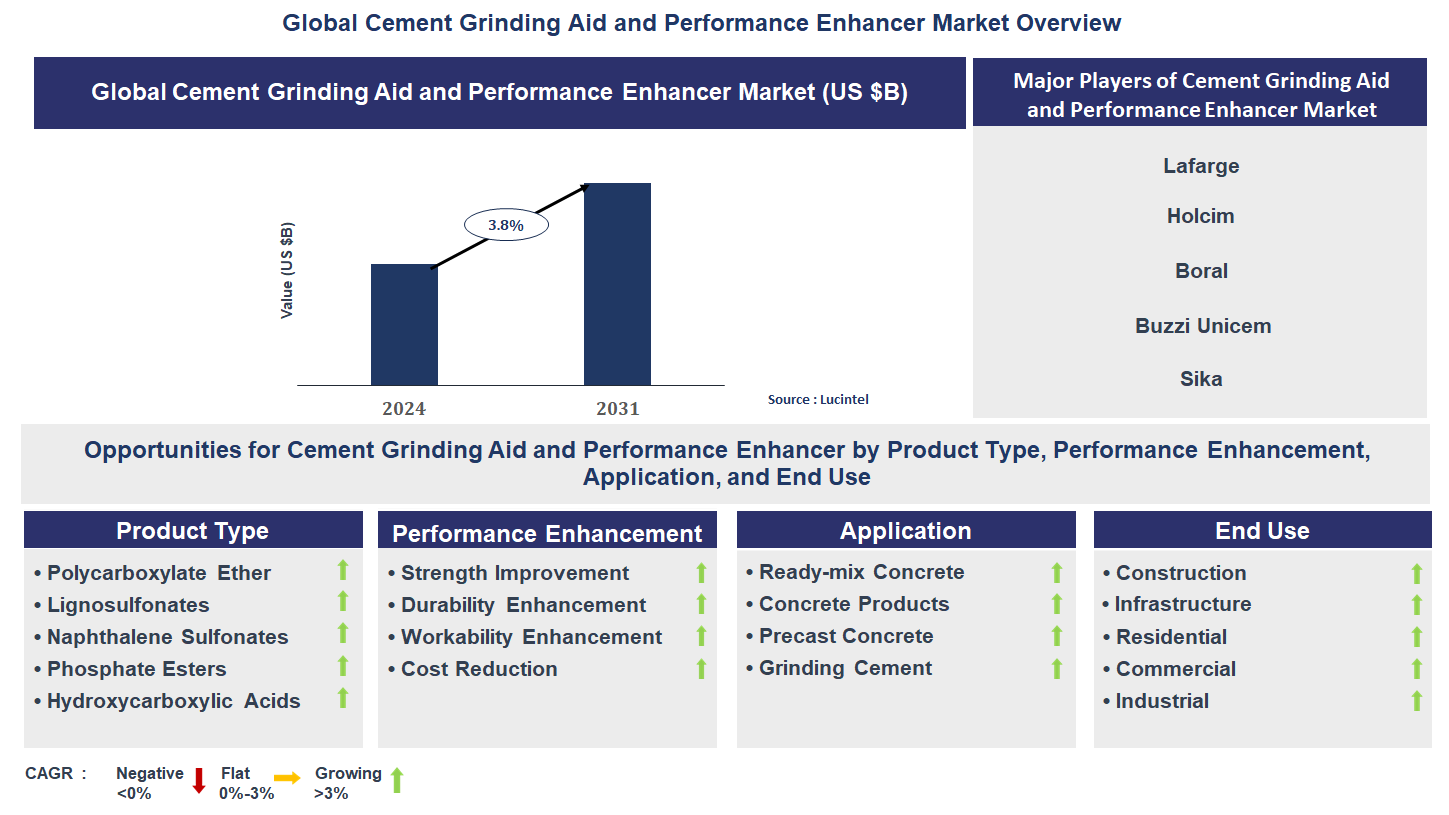
The future of the global cement grinding aid and performance enhancer market looks promising with opportunities in the construction, infrastructure, residential, commercial, and industrial markets. The global cement grinding aid and performance enhancer market is expected to grow with a CAGR of 3.8% from 2025 to 2031. The major drivers for this market are the increasing construction activities, the rising demand for high-quality cement, and the growing focus on sustainable practices.• Lucintel forecasts that, within the product type category, polycarboxylate ether is expected to witness the highest growth over the forecast period.
• Within the end use category, infrastructure is expected to witness the highest growth.
• In terms of region, APAC is expected to witness the highest growth over the forecast period. Gain valuable insights for your business decisions with our comprehensive 150+ page report. Sample figures with some insights are shown below.
Emerging Trends in the Cement Grinding Aid and Performance Enhancer Market
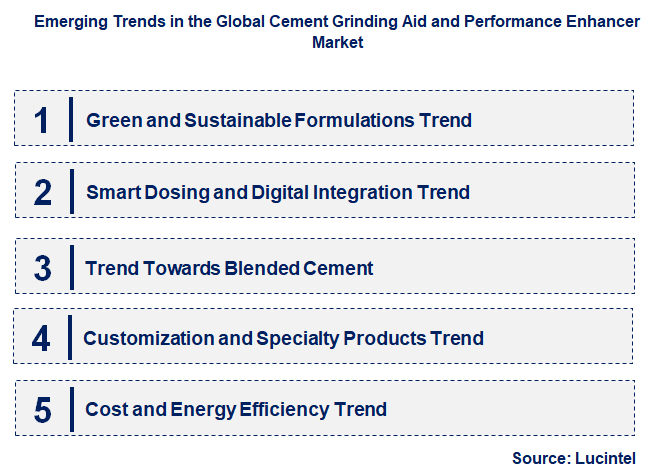
The cement grinding aid and performance enhancer market is experiencing a dramatic transformation driven by worldwide calls for sustainability, efficiency, and advanced material performance. The introduction of new chemical compositions and the use of digital technologies are transforming the production and consumption of cement. These shifts are not only focused on minimizing the environmental impact of the cement sector but also on improving the quality, long-term performance, and affordability of the end product. The industry is heading towards a future where specialized, high-performance additives are an integral component in cement production.• Green and Sustainable Formulations Trend: The sector is experiencing a significant transition towards sustainable additives. This encompasses the creation of non-toxic and bio-based grinding aids and performance enhancers. These new recipes are formulated to minimize the carbon footprint of cement manufacture through a higher clinker substitution rate with industrial by-products such as fly ash and slag. This development is led by strict environmental policies as well as increasing pressure from the building industry for eco-friendly building materials. These green additives are a key role player in helping make the cement industry more sustainable.
• Smart Dosing and Digital Integration Trend: Smart dosing and digital integration are increasing trends where digital technologies like real-time monitoring and automated dosing systems are being incorporated in the manufacture of cement. Manufacturers can accurately control the addition of grinding aid and performance enhancer to the mixture through this process. The accuracy ensures optimized use of additives, minimum waste, and stable product quality. It also makes it possible to make real-time adjustments to offset raw material variations, resulting in increased grinding efficiency and lower energy usage.
• Trend Towards Blended Cement: One of the trends is the rise in the use of blended cement that includes supplementary cementitious materials (SCMs). Grinding aids and performance improvers are critical for this trend because they enhance the grindability of SCMs and the quality of the finished product. The additives offset possible declines in early strength and workability with high SCM content, allowing blended cement to perform. This trend forms the basis for decreasing the clinker-to-cement ratio and consequently reducing the carbon footprint of cement.
• Customization and Specialty Products Trend: The industry is witnessing increasing demand for tailored additive solutions for particular project needs and local variations in raw materials. Manufacturers are designing specialty products that can solve specific challenges, including enhancing durability in extreme environments or attaining certain aesthetic characteristics for building concrete. This trend is away from universal, off-the-shelf solutions to a more consultative direction, where suppliers collaborate with cement producers to develop tailor-made additives for maximum performance.
• Cost and Energy Efficiency Trend: One of the prime drivers in the market is the ongoing demand for cost reduction and energy efficiency in cement production. Grinding aids and performance-enhancing additives directly counteract this by lowering the energy demand for grinding, which is among the most energy-consuming aspects of the manufacturing process. By enhancing mill efficiency and producing cement with greater fineness, these additives facilitate higher throughput and reduced specific energy consumption per ton of cement manufactured. These trends are ultimately redefining the cement grinding aid and performance enhancer market. The emphasis has shifted from merely increasing production to delivering comprehensive solutions that meet sustainability, efficiency, and performance requirements. The market is now characterized by innovation in green formulations, digital control integration, and shifting towards customized, high-performance products. These advances are rendering the cement industry more sustainable, affordable, and able to respond to the sophisticated needs of contemporary construction.
Recent Development in the Cement Grinding Aid and Performance Enhancer Market
The international market for cement grinding aid and performance enhancer has experienced a number of significant developments prompted by the global drive for improved efficiency, sustainability, and improved product quality. The market is shifting away from conventional chemical compositions towards new materials and technologies. These advancements are not incremental but a strategic realignment that seeks to address the cement industry’s biggest issues, such as high energy use and huge carbon footprint.• Advanced DEIPA and TIPA Blends: The industry has experienced huge innovation in the development of Diethanolisopropanolamine (DEIPA) and Triisopropanolamine (TIPA) grinding aid formulation. New blends provide superior performance parameters, like increased early and final compressive strength of concrete. The manufacturers are blending these amines with other chemicals to develop hybrid products that have multiple advantages, such as better grindability, low water demand, and improved durability. This trend is vital to fulfilling the requirements of high-performance concrete for contemporary infrastructure development.
• Emergence of Bio-based and Eco-friendly Additives: One of the key recent trends is the increased emphasis on the development of bio-based and biodegradable grinding aids. This is a direct consequence of escalating environmental laws and the cement sector’s aspiration towards decarbonization. These additives, as they are sourced from renewable resources, provide a substitute for conventional chemical-based additives. They not only decrease the environmental footprint of the additives themselves but also enable the utilization of alternative raw materials in the production of cement, which reduces the overall carbon footprint of the industry even further.
• Smart Dosing and Automation System Adoption: The use of automation and digital control systems within cement factories has been a major development. Smart dosing systems utilize sensors and real-time information to accurately measure and dispense grinding aids and performance improvers. The technology reduces the possibility of human mistakes, guarantees consistent product quality, and maximizes the utilization of additives. It also prevents over-dosing and, therefore, results in considerable cost reduction and minimizes waste.
• Grinding Aid Innovation for Vertical Roller Mills: Since VRMs have become the technology of choice for grinding in most new and expansion cement plants, there has been considerable innovation in specialized grinding aids for VRMs. The newly formulated products are specifically created to counteract the unique issues of VRMs, including unpredictable particle size distribution and material tendency to clump. The specialty additives enhance fineness and grinding efficiency with a better end-product quality and less energy used in such sophisticated milling equipment.
• Addition of Performance Enhancers for Specialty Cement: There has been a significant innovation in the market for performance enhancers for specialty cements. Products for high-durability concrete, self-compacting concrete, and low-heat cement are included. These additives are designed to confer special properties, such as sulfate and chloride resistance, enhanced workability without loss of strength, or restrained heat of hydration. This innovation is enabling cement manufacturers to make bespoke products for specialist applications, unleashing new market opportunities and solving intricate construction problems. All these newer developments are collectively shaping the cement grinding aid and performance improver market by taking it towards more technological advancement and environmental harmony. The business is no longer merely about maximizing efficiency but is now all about offering innovative solutions that contribute to sustainable construction. The emphasis on high-performance formulation, intelligent technology, and green products is essentially transforming the position of these additives, turning them into the hub of the future of cement production.
Strategic Growth Opportunities in the Cement Grinding Aid and Performance Enhancer Market
The market for cement grinding aid and performance enhancer presents strong strategic growth opportunities, most notably in the key applications. The changing needs of the construction sector, fueled by urbanization, infrastructure growth, and an emphasis on sustainability, are opening up new opportunities for growth. Companies that are able to capitalize on these opportunities through the creation of niche, value-added products and services will be well-positioned for competitive success.• High-Performance Concrete Growth: The demand for high-rise buildings, long-span bridges, and other intricate structures is escalating the demand for High-Performance Concrete. This provides a significant growth opportunity for performance chemicals that can enhance strength, durability, and workability. By creating high-tech formulations that allow for greater compressive strength and chemical resistance, producers can address this high-end segment. The potential to improve the properties of HPC while also allowing the use of substitute materials is a big strategic benefit.
• Precast and Pre-stressed Concrete: The precast and pre-stressed concrete segment is increasing owing to its advantages of speed and quality control in construction. This product offers a growth potential for grinding aids and performance improvers shortening setting time and facilitating earlier gain in strength. Products enabling de-molding at faster rates and fewer cycles of production are very much sought after in this market. Establishing additives enhancing workability and finish quality for precast components can harvest this growing market, where efficiency and accuracy are issues of concern.
• Concrete Growth for Green and Sustainable Buildings: The world-wide movement towards green building certification, including LEED, is driving a high growth opportunity for additives which aid sustainable processes. This involves grinding aids which facilitate increased clinker replacement using materials such as fly ash and blast furnace slag, thus lowering the carbon footprint of cement. Producers can concentrate on producing and selling products that are tailored to sustainable cement blends and emerge as major players in the sustainable construction value chain.
• Ready-Mix Concrete Application Opportunity: RMC is a high-volume use area that demands consistent performance and quality. There are opportunities for growth with developing multifunctional additives which can be readily integrated into RMC facilities. These products must provide advantage in terms of enhanced slump retention, controlled setting time, and increased workability. By delivering integrated solutions that maximize the RMC production process and produce a high-quality final product at the job site, manufacturers can gain a greater portion of this lucrative market segment.
• Infrastructure and Mass Concrete Project Growth: Large infrastructure projects such as dams, tunnels, and highways are a significant driver of cement demand. These uses demand specialized properties like low hydration heat and long-term strength. An opportunity exists for performance enhancers that can manage the heat of hydration in cement and avoid cracking of mass concrete structures. By providing specialty products for such demanding uses, manufacturers can fill a real need and become a go-to supplier for high-profile construction projects. Such strategic development prospects are transforming the cement grinding aid and performance improver market by bringing the spotlight from generic-purpose additives to specialized, application-oriented solutions. Future success will rely on the capability of manufacturers to innovate and create products that not only enhance manufacturing efficiency but also address the unique technical issues of various concrete applications. This will result in a more value-oriented and diversified market, whereby products are customized to address the specific needs of a contemporary construction sector.
Cement Grinding Aid and Performance Enhancer Market Driver and Challenges
The cement grinding aid and performance improver market is impacted by a complex interrelation of key drivers and challenges, which encompass regulatory aspects, economic changes, and technological developments. The market is driven by expanding international demand for cement but also by several obstacles that affect cost, supply, and regulatory compliance. It is essential to appreciate these factors so that any industry participant can handle the market successfully and exploit opportunities as they emerge while avoiding risks. The factors responsible for driving the cement grinding aid and performance enhancer market include: 1. Growing International Demand for Cement: The main driver is the growth in international construction activity, especially in developing economies. Accelerating urbanization and infrastructure development in terms of big projects like roads, bridges, and public structures are driving high demand for cement. Grinding aids and performance enhancers become necessary to enhance the efficiency of cement manufacturing to cope with this demand, minimize energy intake, and improve product quality for application in these types of projects. 2. Emphasis on Cost Reduction and Energy Efficiency: Grinding is an energy-intensive operation in cement manufacturing, and grinding aids are a major impetus as they have the potential to decrease the energy needed in milling, resulting in huge cost benefits for manufacturers. Emphasis on operational efficiency and profit is a strong impetus for manufacturers to use these additives, and therefore they form an essential component of contemporary cement-making processes. 3. Stringent Environmental Regulations: Rising environmental regulations and an international thrust towards lowering carbon emissions are a significant driver. Grinding aids and performance enhancers allow the use of a greater percentage of supplementary cementitious materials (SCMs) such as fly ash and slag, which lowers the clinker content and, in turn, the CO2 emissions associated with cement manufacture. This regulatory pressure and the company’s own sustainability targets are fueling demand for green additives. 4. Technological Developments in Formulations: Persistent chemistry formulation innovation is an important driver. New and more efficient grinding aids and performance enhancers like newer polycarboxylate ether (PCE) and glycol-based products are being developed, which enhance their performance. New formulations have more superior benefits like greater strength gain and improved workability, promoting their usage by cement producers aiming to develop better-quality products. 5. High-Performance Concrete Demand: The increasing need for high-performance concrete to support new, sophisticated infrastructure projects is a dominant driver. Performance modifiers are necessary for their ability to deliver the necessary durability, strength, and other specialty characteristics of such concrete blends. With increasing standards of construction and more ambitious project targets, demand for such additives to design cement properties according to application necessity will increase. Challenges in the cement grinding aid and performance enhancer market are: 1. Price Volatility of Raw Materials: One major issue is the volatility in the price of the major raw materials employed in the manufacture of grinding aids, including triethanolamine and other petroleum chemicals. Price fluctuations may affect manufacturers’ cost of production and may destabilize the market. Such volatility may complicate it for small players to sustain their margins and can destabilize the supply chain, threatening market growth. 2. Elevated Research and Development Expenses: New additives with enhanced performance and sustainability need huge research and development investments. Testing and formulating such advanced chemicals can prove to be a big entry barrier for new companies. The pressure to constantly innovate as per industry requirements and regulatory updates puts a financial strain on firms, hindering development speed. 3. Insufficient Awareness and Standardization: In a few developing countries, there is insufficient awareness among smaller cement manufacturers about the advantages of applying grinding aids and performance enhancers. There is also insufficient standardization in product specifications and testing procedures, which can result in quality control problems and resistance to the use of such additives. Such an issue can impede market penetration and constrain growth in some geographical markets. The combined effect of these drivers and challenges is a dynamic, but also complex, market. While demand and a drive for sustainability are driving the market forward, it is also being held back by challenges in cost, technology investment, and penetration into markets. Those players who can utilize the drivers by creating sustainable and high-performance products with innovation and manage the challenges profitably by implementing strategic sourcing, research, and market education will be the successful players.List of Cement Grinding Aid and Performance Enhancer Companies
Companies in the market compete on the basis of product quality offered. Major players in this market focus on expanding their manufacturing facilities, R&D investments, infrastructural development, and leverage integration opportunities across the value chain. With these strategies cement grinding aid and performance enhancer companies cater increasing demand, ensure competitive effectiveness, develop innovative products & technologies, reduce production costs, and expand their customer base. Some of the cement grinding aid and performance enhancer companies profiled in this report include-• Lafarge
• Holcim
• Boral
• Buzzi Unicem
• Sika
• Clariant
• HeidelbergCement
• Cemex
• BASF
• Evonik Industries
Cement Grinding Aid and Performance Enhancer Market by Segment
The study includes a forecast for the global cement grinding aid and performance enhancer market by product type, performance enhancement, application, end use, and region.Cement Grinding Aid and Performance Enhancer Market by Product Type [Value from 2019 to 2031]:
• Polycarboxylate Ether
• Lignosulfonates
• Naphthalene Sulfonates
• Phosphate Esters
• Hydroxycarboxylic Acids
Cement Grinding Aid and Performance Enhancer Market by Performance Enhancement [Value from 2019 to 2031]:
• Strength Improvement
• Durability Enhancement
• Workability Enhancement
• Cost Reduction
Cement Grinding Aid and Performance Enhancer Market by Application [Value from 2019 to 2031]:
• Ready-mix Concrete
• Concrete Products
• Precast Concrete
• Grinding Cement
Cement Grinding Aid and Performance Enhancer Market by End Use [Value from 2019 to 2031]:
• Construction
• Infrastructure
• Residential
• Commercial
• Industrial
Cement Grinding Aid and Performance Enhancer Market by Region [Value from 2019 to 2031]:
• North America
• Europe
• Asia Pacific
• The Rest of the World
Country Wise Outlook for the Cement Grinding Aid and Performance Enhancer Market
The international cement grinding aid and performance enhancer market is undergoing a dramatic shift. Fueled by the twin imperatives of sustainability and technological progress, the market is transforming to serve the needs of a twenty-first-century construction sector that values efficiency, quality, and environmental stewardship. These additives, used to enhance the grinding process and the quality of cement, are becoming invaluable to cement producers globally. The trend is most evident in big economies such as the United States, China, Germany, India, and Japan, which are driving sustainable construction.• United States: The US market is being driven by a vigorous drive towards green building projects and upgrade of infrastructure. There is an emphasis on the development and use of performance enhancers that enhance the durability and workability of low-clinker cement, aligning with the country’s decarbonization efforts. One of the important developments is the growing application of high-end polycarboxylate ether (PCE) and glycol-type additives, which result in better performance and enable increased substitution rates of clinker using materials such as fly ash and slag.
• China: China’s market is characterized by its enormous size and a state-led mandate for industrial upgrading and environmental conservation. Recent trends focus on the large-scale use of high-efficiency grinding aids to minimize energy consumption in cement manufacturing. Strong trends exist to incorporate smart, automated dosing systems to optimize the use of additives and provide stable product quality. The nation is also a significant force in the drive for innovation in new chemical formulations, such as those to function with locally available materials and to improve blended cement properties.
• Germany: In Germany, a leading force in sustainable construction, the demand for these additives is skewed strongly by strict European Union environmental legislation. The emphasis is on research and development of highly technical, bio-based grinding aids that have minimal environmental footprint. Indian manufacturers are the leading players in creating solutions that not only enhance grinding efficiency but also ensure long-term durability and performance of concrete structures.
• India: The Indian market features high rates of urbanization and mass-scale infrastructure development. This has translated into tremendous demand for high-strength and quick-setting cement. Recent trends involve the use of newer and more sophisticated grinding aids like triisopropanolamine (TIPA) and diethanolisopropanolamine (DEIPA) in order to enhance early and final strength. The market is competitive, but there are increasing numbers of domestic and foreign players. Cost-effective solutions are the focus that can satisfy high volume requirements of construction, enhancing product quality, and minimizing energy expenses.
• Japan: Japan’s market is mature and highly developed with high-performance and specialty cement as a focus for hardy infrastructure. Progress is based on accuracy and quality assurance. Implementation of sophisticated additives for specific performance properties, for example, high durability and seismic resistance, is the primary trend. Japanese manufacturers are also looking into the application of additives to enhance the efficiency in the manufacture of specialty cement, including low-heat cement for mass concrete use.

Features of the Global Cement Grinding Aid and Performance Enhancer Market
Market Size Estimates: Cement grinding aid and performance enhancer market size estimation in terms of value ($B). Trend and Forecast Analysis: Market trends (2019 to 2024) and forecast (2025 to 2031) by various segments and regions. Segmentation Analysis: Cement grinding aid and performance enhancer market size by various segments, such as by product type, performance enhancement, application, end use, and region in terms of value ($B). Regional Analysis: Cement grinding aid and performance enhancer market breakdown by North America, Europe, Asia Pacific, and Rest of the World. Growth Opportunities: Analysis of growth opportunities in different product type, performance enhancement, application, end use, and regions for the cement grinding aid and performance enhancer market. Strategic Analysis: This includes M&A, new product development, and competitive landscape of the cement grinding aid and performance enhancer market. Analysis of competitive intensity of the industry based on Porter’s Five Forces model.
FAQ
Q1. What is the growth forecast for cement grinding aid and performance enhancer market? Answer: The global cement grinding aid and performance enhancer market is expected to grow with a CAGR of 3.8% from 2025 to 2031. Q2. What are the major drivers influencing the growth of the cement grinding aid and performance enhancer market? Answer: The major drivers for this market are the increasing construction activities, the rising demand for high-quality cement, and the growing focus on sustainable practices. Q3. What are the major segments for cement grinding aid and performance enhancer market? Answer: The future of the cement grinding aid and performance enhancer market looks promising with opportunities in the construction, infrastructure, residential, commercial, and industrial markets. Q4. Who are the key cement grinding aid and performance enhancer market companies? Answer: Some of the key cement grinding aid and performance enhancer companies are as follows:• Lafarge
• Holcim
• Boral
• Buzzi Unicem
• Sika
• Clariant
• HeidelbergCement
• Cemex
• BASF
• Evonik Industries Q5. Which cement grinding aid and performance enhancer market segment will be the largest in future? Answer: Lucintel forecasts that, within the product type category, polycarboxylate ether is expected to witness the highest growth over the forecast period. Q6. In cement grinding aid and performance enhancer market, which region is expected to be the largest in next 5 years? Answer: In terms of region, APAC is expected to witness the highest growth over the forecast period. Q7. Do we receive customization in this report? Answer: Yes, Lucintel provides 10% customization without any additional cost.
Table of Contents
List of Figures
List of Tables
Methodology
- In-depth interviews of the major players in this market
- Detailed secondary research from competitors’ financial statements and published data
- Extensive searches of published works, market, and database information pertaining to industry news, company press releases, and customer intentions
- A compilation of the experiences, judgments, and insights of Lucintel’s professionals, who have analyzed and tracked this market over the years.


Buy Now
Choose a license that fits your team. Instant PDF delivery.
Prices exclude taxes. Instant delivery. Custom licensing available on request.
Key Questions
- • What are some of the most promising, high-growth opportunities for the cement grinding aid and performance enhancer market by product type (polycarboxylate ether, lignosulfonates, naphthalene sulfonates, phosphate esters, and hydroxycarboxylic acids), performance enhancement (strength improvement, durability enhancement, workability enhancement, and cost reduction), application (ready-mix concrete, concrete products, precast concrete, and grinding cement), end use (construction, infrastructure, residential, commercial, and industrial), and region (North America, Europe, Asia Pacific, and the Rest of the World)?
- • Which segments will grow at a faster pace and why?
- • Which region will grow at a faster pace and why?
- • What are the key factors affecting market dynamics? What are the key challenges and business risks in this market?
- • What are the business risks and competitive threats in this market?
- • What are the emerging trends in this market and the reasons behind them?
- • What are some of the changing demands of customers in the market?
- • What are the new developments in the market? Which companies are leading these developments?
- • Who are the major players in this market? What strategic initiatives are key players pursuing for business growth?
- • What are some of the competing products in this market and how big of a threat do they pose for loss of market share by material or product substitution?
- • What M&A activity has occurred in the last 5 years and what has its impact been on the industry? For any questions related to Cement Grinding Aid and Performance Enhancer Market, Cement Grinding Aid and Performance Enhancer Market Size, Cement Grinding Aid and Performance Enhancer Market Growth, Cement Grinding Aid and Performance Enhancer Market Analysis, Cement Grinding Aid and Performance Enhancer Market Report, Cement Grinding Aid and Performance Enhancer Market Share, Cement Grinding Aid and Performance Enhancer Market Trends, Cement Grinding Aid and Performance Enhancer Market Forecast, Cement Grinding Aid and Performance Enhancer Companies, write Lucintel analyst at email: helpdesk@lucintel.com. We will be glad to get back to you soon.


