
Report Feature
Cell to Chassis Technology Market Trends and Forecast
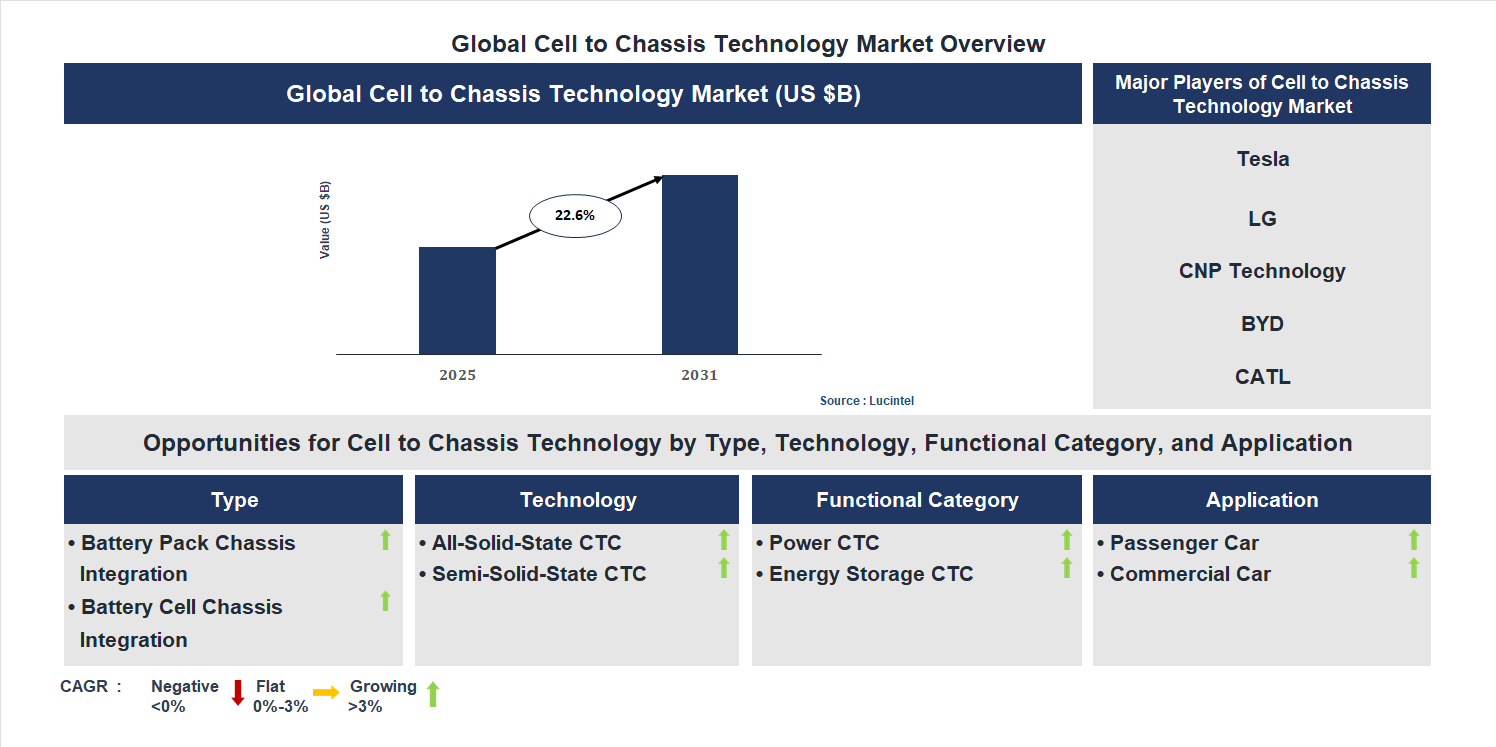
The future of the global cell to chassis technology market looks promising with opportunities in the passenger car and commercial car markets. The global cell to chassis technology market is expected to grow with a CAGR of 22.6% from 2025 to 2031. The major drivers for this market are the increasing demand for electric vehicle efficiency, the rising adoption of integrated battery solutions, and the growing focus on reducing vehicle weight.• Lucintel forecasts that, within the type category, battery cell chassis integration is expected to witness higher growth over the forecast period.
• Within the application category, passenger car is expected to witness higher growth.
• In terms of region, APAC is expected to witness the highest growth over the forecast period. Gain valuable insights for your business decisions with our comprehensive 150+ page report. Sample figures with some insights are shown below.
Emerging Trends in the Cell to Chassis Technology Market
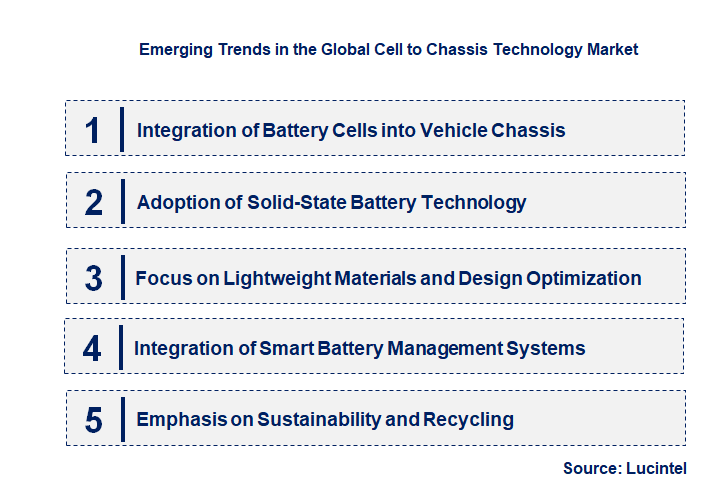
The cell to chassis technology market is experiencing rapid evolution driven by advancements in electric vehicle (EV) design, manufacturing efficiencies, and sustainability goals. As automakers seek to improve battery performance, reduce costs, and enhance vehicle safety, innovative technologies are emerging to redefine the industry landscape. These developments are not only transforming how batteries are integrated into vehicles but also influencing supply chains, consumer preferences, and regulatory standards. The following key trends highlight the major shifts shaping this dynamic market, reflecting a move toward more efficient, sustainable, and cost-effective electric vehicle solutions.• Integration of Battery Cells into Vehicle Chassis: This trend involves directly integrating battery cells into the vehicle chassis, eliminating traditional modules and packs. This approach improves space utilization, reduces weight, and enhances structural integrity, leading to better vehicle performance and safety. By embedding batteries within the chassis, manufacturers can design more compact and lightweight EVs, which can result in increased driving range and lower manufacturing costs. Additionally, this integration minimizes the risk of battery damage during collisions, improving overall safety standards. As a result, automakers are increasingly adopting this technology to meet consumer demands for safer, more efficient electric vehicles.
• Adoption of Solid-State Battery Technology: Solid-state batteries are gaining prominence as a promising alternative to conventional lithium-ion batteries. They offer higher energy density, enabling longer driving ranges for EVs, and support faster charging times, reducing downtime for users. Moreover, solid-state batteries are inherently safer due to their non-flammable electrolyte materials, decreasing the risk of fires. This technology also promises a longer lifespan and better thermal stability. As research progresses and manufacturing scales up, automakers are investing heavily in solid-state battery integration into cell to chassis designs, which could revolutionize EV performance and consumer acceptance in the near future.
• Focus on Lightweight Materials and Design Optimization: To maximize the benefits of cell to chassis technology, manufacturers are emphasizing the use of lightweight materials such as aluminum, carbon fiber, and advanced composites. These materials reduce overall vehicle weight, which directly enhances energy efficiency and driving range. Design optimization techniques, including topology optimization and modular construction, are also being employed to streamline manufacturing processes and improve structural performance. This trend not only contributes to better vehicle dynamics and handling but also aligns with sustainability goals by reducing material consumption and emissions during production. The focus on lightweight design is pivotal in making EVs more competitive with traditional internal combustion engine vehicles.
• Integration of Smart Battery Management Systems: Smart BMS is becoming integral to cell to chassis technology, providing real-time monitoring and control of battery health, temperature, and charge levels. These systems enhance safety by preventing overcharging, overheating, and thermal runaway. They also optimize battery performance and lifespan, reducing maintenance costs and improving reliability. Advanced BMS incorporates AI and IoT technologies for predictive analytics, enabling proactive maintenance and efficient energy management. The integration of smart BMS is crucial for scaling up EV adoption, as it addresses consumer concerns about battery safety and longevity, and supports the development of more intelligent, connected vehicles.
• Emphasis on Sustainability and Recycling: Sustainability is a key driver in the evolution of cell to chassis technology. Manufacturers are focusing on eco-friendly materials, energy-efficient manufacturing processes, and end-of-life battery recycling. Innovations in recycling technologies aim to recover valuable materials like lithium, cobalt, and nickel, reducing reliance on mining and minimizing environmental impact. This trend aligns with global regulatory pressures and consumer preferences for greener products. Developing closed-loop recycling systems and sustainable supply chains ensures the long-term viability of the market. As sustainability becomes a core aspect of product development, it is reshaping the entire lifecycle approach of EV batteries and chassis integration. In summary, these trends are collectively transforming the cell to chassis technology market by enhancing vehicle safety, performance, and sustainability. They are driving innovation, reducing costs, and addressing consumer and regulatory demands, ultimately leading to more efficient, safer, and environmentally friendly electric vehicles. This evolution is set to redefine industry standards and accelerate the adoption of electric mobility worldwide.
Recent Development in the Cell to Chassis Technology Market
The cell to chassis technology market is experiencing rapid innovation driven by the demand for lightweight, efficient, and sustainable vehicle solutions. Advances in battery integration and manufacturing processes are transforming electric vehicle design, offering improved performance and safety. As automakers seek to reduce costs and enhance vehicle range, these developments are creating new growth opportunities. The integration of cutting-edge technology is also influencing supply chains and competitive dynamics within the automotive industry, making this a pivotal period for market evolution.• Enhanced Battery Integration for Improved Vehicle Range: Cell to Chassis technology enables direct integration of battery cells into the vehicle structure, reducing weight and increasing energy density. This innovation significantly extends vehicle range, addressing consumer demand for longer-lasting electric vehicles. Automakers benefit from simplified assembly processes and reduced manufacturing costs. The improved efficiency attracts more consumers to electric vehicles, accelerating market adoption and fostering competitive advantages for early adopters.
• Cost Reduction Through Manufacturing Efficiency: The adoption of Cell to Chassis technology streamlines production by eliminating the need for modules and pack assembly. This simplification reduces labor and material costs, making electric vehicles more affordable. Manufacturers can scale production more effectively, leading to increased profitability and market penetration. Cost reductions also enable automakers to offer competitive pricing, expanding consumer access, and driving overall market growth.
• Enhanced Safety and Structural Integrity: Integrating battery cells directly into the chassis enhances vehicle safety by providing better crash protection and structural rigidity. This design minimizes the risk of battery damage during accidents, reducing fire hazards. Improved safety features increase consumer confidence and meet stringent regulatory standards. Automakers leveraging this technology can differentiate their products through superior safety profiles, boosting brand reputation and market share.
• Sustainability and Environmental Benefits: Cell to Chassis technology promotes sustainability by reducing material usage and manufacturing waste. The streamlined design facilitates easier recycling and disposal of batteries, aligning with environmental regulations. This eco-friendly approach appeals to environmentally conscious consumers and investors. As sustainability becomes a key market driver, this technology positions automakers as responsible industry leaders, fostering long-term growth and compliance with global environmental standards.
• Innovation in Vehicle Design and Performance: The technology allows for more flexible vehicle architectures, enabling innovative designs and improved aerodynamics. Enhanced structural integration results in better handling, stability, and overall performance. Automakers can develop lighter, more efficient vehicles that meet diverse consumer preferences. This innovation drives differentiation in a competitive market, attracting new customer segments and expanding the application scope of electric vehicles across various segments. The recent developments in Cell to Chassis technology are significantly transforming the market by enabling lighter, safer, and more cost-effective electric vehicles. These innovations are driving increased adoption, improving vehicle performance, and supporting sustainability goals. As automakers leverage these advancements, the market is poised for accelerated growth, increased competitiveness, and broader consumer acceptance. Overall, these developments are shaping a more efficient and innovative future for the automotive industry.
Strategic Growth Opportunities in the Cell to Chassis Technology Market
The cell to chassis technology market is experiencing rapid growth driven by advancements in electric vehicle (EV) design, increasing demand for lightweight and efficient batteries, and the need for enhanced safety features. Innovations in cell integration and manufacturing processes are creating new opportunities for automakers and technology providers. As the industry shifts towards sustainable mobility solutions, strategic investments in this technology are expected to significantly influence market dynamics and competitive positioning.• Integration of Cells Directly Into Vehicle Chassis: This opportunity involves embedding battery cells directly into the vehicle chassis, reducing weight and space while improving structural integrity. It enables more efficient use of space, enhances safety by minimizing fire risks, and simplifies manufacturing processes. Automakers adopting this approach can achieve higher energy density and better vehicle performance, making EVs more appealing to consumers and accelerating market adoption.
• Development of Modular Cell-to-Chassis Systems: Modular systems allow for scalable and customizable battery configurations, facilitating easier assembly and maintenance. This flexibility supports diverse vehicle models and sizes, reducing production costs and time-to-market. By enabling quick upgrades and repairs, modular cell-to-chassis solutions also extend vehicle lifespan and improve overall sustainability, attracting manufacturers seeking adaptable and cost-effective energy storage options.
• Advancements in Battery Safety and Thermal Management: Improving safety features through innovative thermal management techniques reduces risks of overheating and thermal runaway. Enhanced safety protocols increase consumer confidence and meet stringent regulatory standards. These advancements also enable higher energy densities and longer battery life, which are critical for the widespread adoption of EVs. Companies investing in safety innovations can differentiate their offerings and gain competitive advantages.
• Expansion of Manufacturing Capabilities for Cell to Chassis Integration: Scaling up manufacturing facilities to produce integrated cell-to-chassis components is vital for meeting rising demand. This expansion involves adopting automation, robotics, and advanced assembly techniques to ensure quality and efficiency. Increased production capacity supports mass-market EV deployment, reduces costs, and accelerates technological adoption. Manufacturers focusing on capacity expansion can better capitalize on market growth and establish industry leadership.
• Adoption of Sustainable Materials and Recycling Technologies: Incorporating eco-friendly materials and advanced recycling methods in cell-to-chassis manufacturing reduces environmental impact. This approach aligns with global sustainability goals and regulatory requirements, appealing to environmentally conscious consumers. Recycling technologies also enable resource recovery, lowering raw material costs and supply chain risks. Companies leading in sustainable practices can enhance brand reputation and ensure long-term viability in a competitive market. The overall impact of these growth opportunities is poised to transform the cell to chassis technology market by fostering innovation, improving safety, reducing costs, and supporting sustainability. These developments will enable automakers to deliver more efficient, safe, and environmentally friendly EVs, driving widespread adoption and shaping the future landscape of electric mobility.
Cell to Chassis Technology Market Driver and Challenges
The cell to chassis technology market is influenced by a variety of technological, economic, and regulatory factors that shape its growth trajectory. Advances in battery design and manufacturing processes are driving innovation, while economic considerations such as cost reduction and supply chain stability impact market expansion. Regulatory policies aimed at reducing carbon emissions and promoting sustainable transportation further influence development. Additionally, consumer demand for longer-range, faster-charging electric vehicles (EVs) fuels the adoption of advanced cell-to-chassis solutions. Navigating these complex factors requires industry stakeholders to adapt swiftly to technological breakthroughs, economic shifts, and evolving regulatory landscapes, ultimately determining the market's future growth potential and competitive dynamics. The factors responsible for driving the cell to chassis technology market include:• Technological Innovation: The continuous development of advanced battery chemistries and manufacturing techniques enhances energy density, safety, and lifespan, making EVs more attractive to consumers. Cell-to-chassis technology integrates battery cells directly into the vehicle's structure, reducing weight and improving efficiency. This innovation enables faster charging, longer driving ranges, and better thermal management, which are critical for consumer acceptance and market growth. As automakers invest heavily in R&D, technological breakthroughs are expected to further accelerate adoption, positioning this market as a key enabler of next-generation electric vehicles.
• Cost Reduction and Economies of Scale: As production volumes increase, economies of scale significantly lower manufacturing costs for cell-to-chassis batteries. This cost reduction makes EVs more affordable for consumers and increases profit margins for manufacturers. Additionally, advancements in manufacturing processes, such as automation and modular design, contribute to cost efficiencies. Lower costs facilitate wider adoption of EVs across different market segments, including commercial vehicles, thereby expanding the market scope. Cost competitiveness is crucial for overcoming price sensitivity among consumers and fostering mass-market penetration.
• Regulatory and Policy Support: Governments worldwide are implementing stringent emission standards and offering incentives for electric vehicle adoption. Policies such as subsidies, tax credits, and mandates for zero-emission vehicles create a favorable environment for cell-to-chassis technology. Regulatory frameworks also promote research and development efforts, encouraging automakers to innovate and adopt sustainable solutions. These policies not only accelerate market growth but also influence investment flows and strategic partnerships within the industry, ensuring that technological advancements align with environmental goals.
• Growing Consumer Demand for EVs: Increasing awareness of environmental issues and rising fuel prices are driving consumers toward electric vehicles. The demand for longer-range, faster-charging, and safer EVs is pushing automakers to adopt advanced battery technologies like cell-to-chassis. Consumer preferences for innovative features and sustainability are shaping product development strategies, leading to higher adoption rates. As the market matures, consumer acceptance and confidence in EVs will be pivotal in sustaining growth, making technological reliability and performance critical factors.
• Strategic Collaborations and Investments: Major automakers, battery manufacturers, and technology firms are forming strategic alliances to develop and commercialize cell-to-chassis solutions. These collaborations facilitate knowledge sharing, resource pooling, and accelerated innovation. Significant investments in R&D and manufacturing infrastructure are fueling market expansion. Such partnerships also help mitigate risks associated with technological uncertainties and supply chain disruptions. The increasing flow of capital into this sector underscores its potential, fostering a competitive environment that drives continuous improvement and market penetration. The challenges in the cell to chassis technology market are:
• High Development and Manufacturing Costs: Despite cost reduction trends, the initial investment required for developing and scaling cell-to-chassis technology remains substantial. Advanced manufacturing facilities, specialized equipment, and skilled labor contribute to high capital expenditure. These costs can hinder entry for smaller players and slow down widespread adoption. Additionally, the need for rigorous testing and certification to ensure safety and reliability adds to expenses. Overcoming these financial barriers is essential for market expansion, but the high costs pose a significant challenge, especially in regions with limited capital availability.
• Technological Complexity and Integration Issues: Integrating battery cells directly into the vehicle chassis involves complex engineering challenges. Ensuring structural integrity, thermal management, and safety standards requires sophisticated design and manufacturing processes. Compatibility with existing vehicle architectures and supply chain coordination further complicates implementation. Any failure in integration can lead to safety risks, recalls, and increased costs. Overcoming these technical hurdles demands continuous innovation and rigorous testing, which can delay product launches and increase development timelines, impacting overall market growth.
• Regulatory and Safety Concerns: While policies support EV adoption, stringent safety regulations for high-capacity batteries pose challenges. Ensuring fire safety, crashworthiness, and environmental compliance requires extensive testing and certification, which can be time-consuming and costly. Regulatory uncertainties regarding battery disposal, recycling, and second-life applications also create compliance complexities. These safety and regulatory concerns can slow down deployment, increase costs, and create barriers for new entrants, thereby affecting the pace of market expansion and technological adoption. In summary, the cell to chassis technology market is driven by rapid technological advancements, cost efficiencies, supportive policies, consumer preferences, and strategic collaborations. However, high development costs, technical complexities, and regulatory hurdles present significant challenges. The interplay of these factors will shape the market’s evolution, with innovation and strategic adaptation being key to overcoming obstacles. Overall, the market holds substantial growth potential, provided stakeholders effectively navigate the technological and regulatory landscape to capitalize on emerging opportunities.
List of Cell to Chassis Technology Companies
Companies in the market compete on the basis of product quality offered. Major players in this market focus on expanding their manufacturing facilities, R&D investments, infrastructural development, and leverage integration opportunities across the value chain. With these strategies cell to chassis technology companies cater increasing demand, ensure competitive effectiveness, develop innovative products & technologies, reduce production costs, and expand their customer base. Some of the cell to chassis technology companies profiled in this report include-• Tesla
• LG
• CNP Technology
• BYD
• CATL
Cell to Chassis Technology Market by Segment
The study includes a forecast for the global cell to chassis technology market by type, technology, functional category, application, and region.Cell to Chassis Technology Market by Type [Value from 2019 to 2031]:
• Battery Pack Chassis Integration
• Battery Cell Chassis Integration
Cell to Chassis Technology Market by Technology [Value from 2019 to 2031]:
• All-Solid-State CTC
• Semi-Solid-State CTC
Cell to Chassis Technology Market by Functional Category [Value from 2019 to 2031]:
• Power CTC
• Energy Storage CTC
Cell to Chassis Technology Market by Application [Value from 2019 to 2031]:
• Passenger Car
• Commercial Car
Cell to Chassis Technology Market by Region [Value from 2019 to 2031]:
• North America
• Europe
• Asia Pacific
• The Rest of the World
Country Wise Outlook for the Cell to Chassis Technology Market
The cell to chassis technology market has experienced significant advancements driven by the increasing demand for lightweight, efficient, and high-performance electric vehicle components. Innovations in battery design, manufacturing processes, and integration techniques are transforming the automotive industry globally. Countries are investing heavily in research and development to enhance battery safety, energy density, and cost-effectiveness. These developments are crucial for the adoption of electric vehicles and sustainable transportation solutions. The market's evolution reflects broader trends toward electrification, environmental sustainability, and technological integration, with key players and governments actively supporting innovation to maintain competitive advantages.• United States: The US market has seen rapid advancements in cell-to-chassis integration, with major automakers like Tesla and GM leading innovation. Investments in battery manufacturing plants and R&D centers have increased, focusing on improving energy density and safety. Regulatory support for EV adoption and government incentives have accelerated market growth. Companies are exploring solid-state batteries and advanced thermal management systems to enhance vehicle range and performance. The US also emphasizes sustainable manufacturing practices, aiming to reduce environmental impact while maintaining technological leadership in the sector.
• China: China remains the largest market for cell-to-chassis technology, driven by government policies promoting electric vehicle adoption and local manufacturing. Major Chinese firms such as CATL and BYD are pioneering innovations in battery integration, reducing costs and improving efficiency. The country is investing heavily in research to develop next-generation batteries, including solid-state and lithium-silicon technologies. Infrastructure development, such as charging networks, complements technological advancements, supporting widespread EV adoption. China's focus on domestic supply chain strengthening and export expansion positions it as a global leader in this market.
• Germany: Germany's automotive industry is rapidly integrating cell-to-chassis technology, with companies like Volkswagen and BMW investing in advanced battery systems. The focus is on enhancing vehicle safety, reducing weight, and improving energy efficiency through innovative design. Germany emphasizes sustainable production methods and the integration of renewable energy sources into manufacturing processes. Collaborations between automakers and technology firms are fostering breakthroughs in battery management and thermal regulation. The country's strategic initiatives aim to maintain its competitive edge in premium electric vehicles and contribute to Europe's broader sustainability goals.
• India: The Indian market is witnessing growing interest in cell-to-chassis technology, primarily driven by government initiatives like the Faster Adoption and Manufacturing of Hybrid & Electric Vehicles (FAME) scheme. Local startups and established automakers are exploring cost-effective battery integration solutions suitable for the Indian climate and infrastructure. Focus areas include reducing manufacturing costs, improving battery lifespan, and developing affordable EV models. The government’s push for EV adoption and the expansion of charging infrastructure are creating a conducive environment for technological advancements. India aims to become a significant player in the global EV supply chain through innovation and strategic partnerships.
• Japan: Japan continues to innovate in cell-to-chassis technology, with companies like Panasonic and Toyota investing in next-generation batteries and integration techniques. The emphasis is on enhancing safety, longevity, and energy density, with a focus on solid-state battery development. Japan's automotive sector is also exploring lightweight materials and advanced thermal management to improve vehicle performance. The government supports research initiatives aimed at sustainable manufacturing and reducing environmental impact. Japan's expertise in battery technology and strong R&D ecosystem position it as a key player in advancing cell-to-chassis solutions for both domestic and international markets.

Features of the Global Cell to Chassis Technology Market
Market Size Estimates: Cell to chassis technology market size estimation in terms of value ($B). Trend and Forecast Analysis: Market trends (2019 to 2024) and forecast (2025 to 2031) by various segments and regions. Segmentation Analysis: Cell to chassis technology market size by various segments, such as by type, technology, functional category, application, and region in terms of value ($B). Regional Analysis: Cell to chassis technology market breakdown by North America, Europe, Asia Pacific, and Rest of the World. Growth Opportunities: Analysis of growth opportunities in different types, technologies, functional categories, applications, and regions for the cell to chassis technology market. Strategic Analysis: This includes M&A, new product development, and competitive landscape of the cell to chassis technology market. Analysis of competitive intensity of the industry based on Porter’s Five Forces model.
FAQ
Q1. What is the growth forecast for cell to chassis technology market? Answer: The global cell to chassis technology market is expected to grow with a CAGR of 22.6% from 2025 to 2031. Q2. What are the major drivers influencing the growth of the cell to chassis technology market? Answer: The major drivers for this market are the increasing demand for electric vehicle efficiency, the rising adoption of integrated battery solutions, and the growing focus on reducing vehicle weight. Q3. What are the major segments for cell to chassis technology market? Answer: The future of the cell to chassis technology market looks promising with opportunities in the passenger car and commercial car markets. Q4. Who are the key cell to chassis technology market companies? Answer: Some of the key cell to chassis technology companies are as follows:• Tesla
• LG
• CNP Technology
• BYD
• CATL Q5. Which cell to chassis technology market segment will be the largest in future? Answer: Lucintel forecasts that, within the type category, battery cell chassis integration is expected to witness higher growth over the forecast period. Q6. In cell to chassis technology market, which region is expected to be the largest in next 5 years? Answer: In terms of region, APAC is expected to witness the highest growth over the forecast period. Q7. Do we receive customization in this report? Answer: Yes, Lucintel provides 10% customization without any additional cost.
Table of Contents
List of Figures
List of Tables
Methodology
- In-depth interviews of the major players in this market
- Detailed secondary research from competitors’ financial statements and published data
- Extensive searches of published works, market, and database information pertaining to industry news, company press releases, and customer intentions
- A compilation of the experiences, judgments, and insights of Lucintel’s professionals, who have analyzed and tracked this market over the years.


Buy Now
Choose a license that fits your team. Instant PDF delivery.
Prices exclude taxes. Instant delivery. Custom licensing available on request.
Key Questions
- • What are some of the most promising, high-growth opportunities for the cell to chassis technology market by type (battery pack chassis integration and battery cell chassis integration), technology (all-solid-state CTC and semi-solid-state CTC), functional category (power CTC and energy storage CTC), application (passenger car and commercial car), and region (North America, Europe, Asia Pacific, and the Rest of the World)?
- • Which segments will grow at a faster pace and why?
- • Which region will grow at a faster pace and why?
- • What are the key factors affecting market dynamics? What are the key challenges and business risks in this market?
- • What are the business risks and competitive threats in this market?
- • What are the emerging trends in this market and the reasons behind them?
- • What are some of the changing demands of customers in the market?
- • What are the new developments in the market? Which companies are leading these developments?
- • Who are the major players in this market? What strategic initiatives are key players pursuing for business growth?
- • What are some of the competing products in this market and how big of a threat do they pose for loss of market share by material or product substitution?
- • What M&A activity has occurred in the last 6 years and what has its impact been on the industry? For any questions related to Cell to Chassis Technology Market, Cell to Chassis Technology Market Size, Cell to Chassis Technology Market Growth, Cell to Chassis Technology Market Analysis, Cell to Chassis Technology Market Report, Cell to Chassis Technology Market Share, Cell to Chassis Technology Market Trends, Cell to Chassis Technology Market Forecast, Cell to Chassis Technology Companies, write Lucintel analyst at email: helpdesk@lucintel.com. We will be glad to get back to you soon.


