
Report Feature
Ceiling Fan Market Trends and Forecast
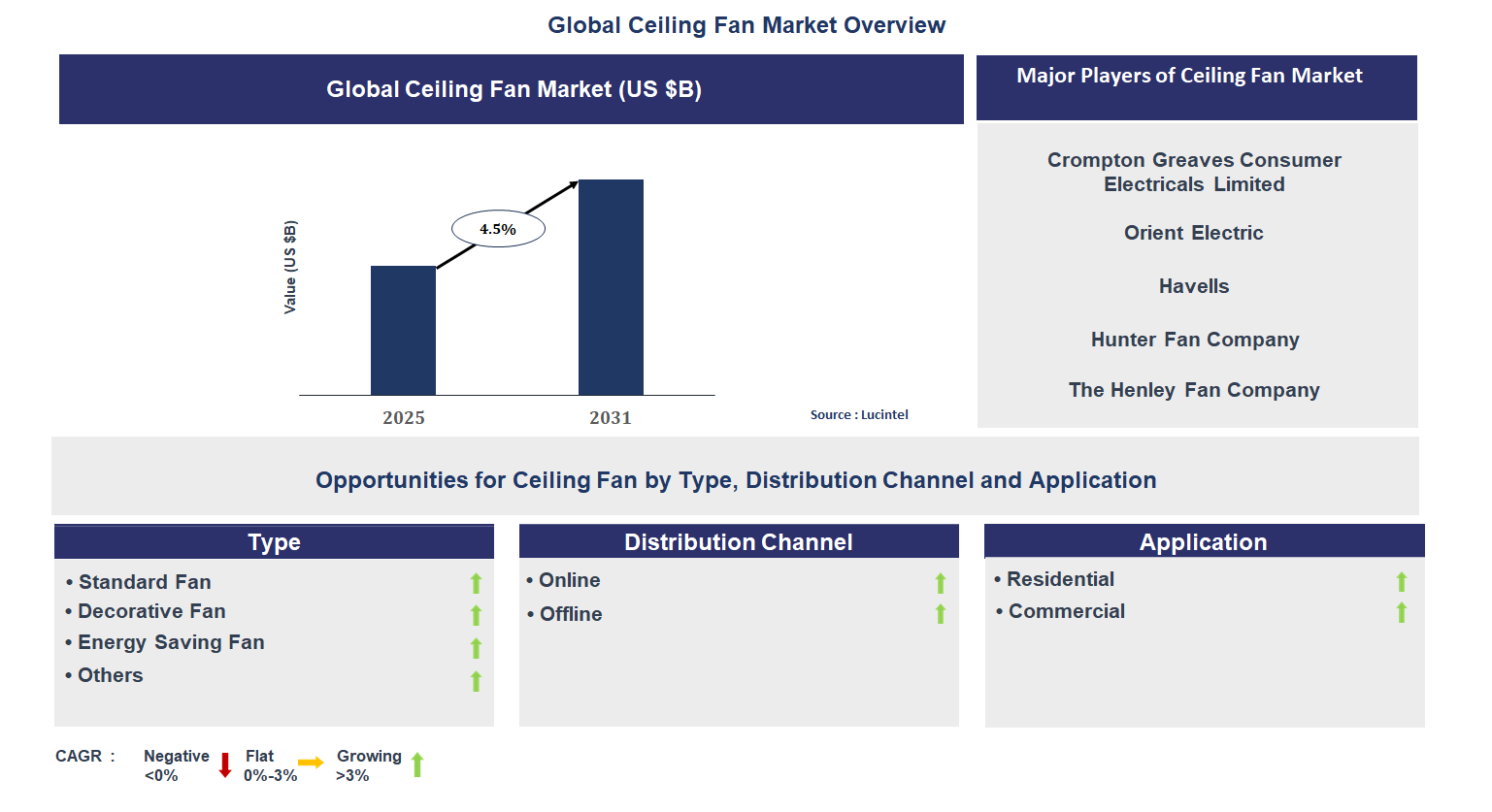
The future of the global ceiling fan market looks promising with opportunities in the residential and commercial markets. The global ceiling fan market is expected to grow with a CAGR of 4.5% from 2025 to 2031. The major drivers for this market are the increasing demand for energy-efficient cooling solutions, the rising adoption of smart home technology features, and the growing preference for stylish home interior designs.• Lucintel forecasts that, within the type category, standard fan is expected to witness the highest growth over the forecast period.
• Within the application category, residential is expected to witness higher growth.
• In terms of region, APAC is expected to witness the highest growth over the forecast period. Gain valuable insights for your business decisions with our comprehensive 150+ page report. Sample figures with some insights are shown below.
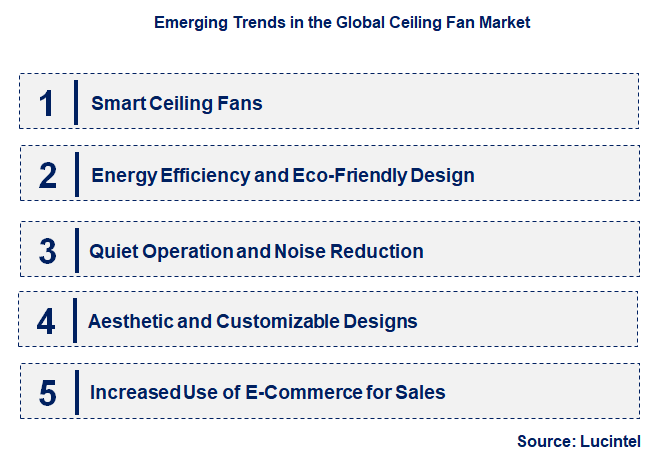
Emerging Trends in the Ceiling Fan Market
The ceiling fan market is witnessing significant shifts due to technological advancements, sustainability goals, and changing consumer preferences. These emerging trends are driving product innovation, creating new market opportunities, and reshaping consumer expectations. Here are five key trends shaping the future of the ceiling fan industry.• Smart Ceiling Fans: The integration of smart technology into ceiling fans is a leading trend. Fans with Wi-Fi, Bluetooth, and voice control capabilities are becoming highly sought after, particularly in smart homes. These fans can be controlled remotely via mobile apps or voice assistants, offering convenience and energy savings. The trend toward connectivity is expanding, making fans more versatile and user-friendly.
• Energy Efficiency and Eco-Friendly Design: As environmental concerns grow, energy-efficient ceiling fans are gaining popularity. Manufacturers are focusing on designing fans that consume less power, often incorporating DC motors and energy-saving technologies. This trend is particularly strong in countries like the U.S. and Germany, where energy consumption is a major concern. Consumers are now willing to invest in eco-friendly solutions for long-term savings.
• Quiet Operation and Noise Reduction: Consumers are increasingly prioritizing quiet ceiling fans that offer noise-free operation. Noise reduction features, such as advanced motor technologies and aerodynamic blades, are becoming standard. This trend is particularly prominent in markets like Japan, where comfort and peaceful living environments are highly valued. The demand for quieter fans is growing, especially in bedrooms and study areas.
• Aesthetic and Customizable Designs: Ceiling fans are no longer just functional devices; they have become a key element of home décor. Consumers are looking for stylish, customizable ceiling fans that complement their interior designs. Manufacturers are offering a variety of designs, colors, and materials, allowing customers to choose fans that match their home’s aesthetic. This trend is most evident in the U.S. and Germany.
• Increased Use of E-Commerce for Sales: Online shopping is rapidly becoming a preferred method for purchasing ceiling fans, particularly in regions like China and India. E-commerce platforms offer consumers a wide range of options, from high-end to budget-friendly models, with detailed specifications, reviews, and easy returns. This trend is expected to continue growing, especially as more consumers embrace the convenience of online shopping. The ceiling fan market is being reshaped by technological innovations, energy-efficiency demands, and design trends. Consumers are now more focused on smart functionality, noise reduction, eco-friendliness, and aesthetic appeal. As these trends continue to evolve, manufacturers will need to prioritize these features to stay competitive in an increasingly sophisticated and environmentally conscious market.
Recent Development in the Ceiling Fan Market
The ceiling fan market is witnessing dynamic developments, driven by technological advancements, environmental concerns, and consumer preferences. These key developments are reshaping the industry by improving product functionality, enhancing user experience, and increasing market competition. Below are five significant developments in the global ceiling fan market.• Introduction of Smart Ceiling Fans: Smart ceiling fans, equipped with Wi-Fi, Bluetooth, and voice control features, are revolutionizing the market. These fans allow users to adjust speed, lighting, and other settings remotely, offering increased convenience and energy savings. The growing demand for smart home products is pushing manufacturers to incorporate advanced technologies, making ceiling fans smarter and more efficient.
• Improved Energy-Efficiency with DC Motors: Energy-efficient ceiling fans equipped with DC motors are gaining popularity as they consume less power and offer better performance than traditional AC motors. This development is especially important in countries where energy costs are high. DC motors enable fans to operate at multiple speed settings with minimal energy consumption, driving market growth, particularly in eco-conscious markets.
• Adoption of Eco-Friendly Materials: Manufacturers are increasingly using sustainable materials, such as recyclable plastics and metal alloys, in ceiling fan production. This shift is in response to growing consumer demand for eco-friendly products. Fans made from sustainable materials are expected to become more popular, especially as environmental concerns take center stage in markets like Germany and the U.S.
• Noise Reduction Technology: The development of noise-reducing technologies is a significant advancement in the ceiling fan market. Manufacturers are improving motor designs, blade shapes, and balancing techniques to minimize operational noise. This has become a key selling point in markets where quiet operation is a priority, such as in bedrooms or study areas, contributing to increased consumer satisfaction.
• Integration of LED Lighting: Many ceiling fans now come with integrated LED lighting, offering both cooling and illumination in a single product. This development is driving consumer interest, as it combines functionality with space-saving design. The popularity of LED lighting, due to its energy efficiency and long lifespan, has prompted many manufacturers to incorporate it into their ceiling fan models. These developments highlight the ongoing transformation in the ceiling fan market, where technological advancements, sustainability, and consumer preferences are playing a major role. As innovations in smart technology, energy efficiency, and design continue to evolve, the market is set to meet the changing needs of consumers and offer more diverse, functional, and eco-friendly products.
Strategic Growth Opportunities in the Ceiling Fan Market
The ceiling fan market offers numerous strategic growth opportunities, particularly in key applications such as residential, commercial, and industrial settings. With shifting consumer demands, manufacturers are capitalizing on new technologies and design trends to expand their reach. Below are five key growth opportunities by application in the ceiling fan market.• Residential Applications: In the residential sector, the growing preference for energy-efficient, smart ceiling fans presents significant growth opportunities. With an increasing number of smart homes, consumers are looking for ceiling fans that offer remote control, customizable settings, and integration with home automation systems. Manufacturers are focusing on providing stylish, eco-friendly, and quiet ceiling fans for modern homes.
• Commercial Applications: The commercial sector, particularly in offices, retail spaces, and restaurants, presents a large market for ceiling fans that provide energy-efficient cooling solutions. As businesses focus on reducing operational costs, ceiling fans with advanced features like motion sensors and automatic speed control are gaining traction. The demand for aesthetically appealing and functional fans is driving growth in commercial spaces.
• Industrial Applications: In industrial settings, ceiling fans are essential for maintaining airflow and cooling large spaces. There is increasing demand for high-performance, durable fans capable of withstanding extreme conditions. Fans designed for large warehouses, factories, and manufacturing plants are becoming more energy-efficient and reliable, providing manufacturers with significant growth opportunities in this sector.
• Outdoor Applications: Outdoor ceiling fans, designed for patios, porches, and other outdoor spaces, are experiencing rising demand. These fans are typically built with weather-resistant materials and offer functionality combined with aesthetic appeal. With growing interest in outdoor living and entertainment areas, manufacturers are capitalizing on the need for stylish and durable outdoor ceiling fans.
• Hospitality and Tourism Applications: Hotels, resorts, and other hospitality establishments are investing in ceiling fans to enhance guest comfort and reduce air conditioning costs. Smart, quiet, and energy-efficient fans are increasingly in demand in these settings. Manufacturers are focusing on creating fans that offer superior comfort, with adjustable speeds and integrated lighting to meet the needs of hospitality customers. These strategic growth opportunities in key applications showcase how manufacturers are capitalizing on consumer trends across various sectors. Whether in residential, commercial, or industrial spaces, the ceiling fan market is expanding, driven by the demand for energy efficiency, advanced features, and enhanced comfort. These opportunities offer significant potential for companies looking to tap into diverse market segments.
Ceiling Fan Market Driver and Challenges
The ceiling fan market is influenced by various drivers and challenges, ranging from technological innovations to environmental regulations. These factors shape product development, consumer preferences, and market dynamics. The factors responsible for driving the ceiling fan market include: 1. Technological Advancements: Technological innovations, such as the integration of smart controls, LED lighting, and noise reduction features, are driving demand in the ceiling fan market. Consumers are increasingly seeking more sophisticated and customizable products, prompting manufacturers to invest in research and development to stay competitive. 2. Energy Efficiency Demand: With rising energy costs and a growing focus on sustainability, there is a significant push toward energy-efficient ceiling fans. DC motor technology and eco-friendly materials are being incorporated into fan designs, offering consumers lower power consumption and long-term savings. This trend is especially prominent in regions with high energy costs. 3. Rising Temperatures and Climate Change: As global temperatures rise, the demand for cooling solutions, including ceiling fans, is growing. Consumers in hot and humid regions are increasingly relying on ceiling fans to supplement air conditioning, particularly as they seek cost-effective alternatives for cooling their homes and offices. 4. Growth of Smart Homes: The adoption of smart home technologies is another key driver in the ceiling fan market. Smart ceiling fans, which can be controlled remotely via mobile apps or voice assistants, are in high demand. This trend is fueled by the increasing popularity of home automation systems and the desire for more convenient, energy-efficient products. 5. Urbanization and Rising Disposable Incomes: As urbanization continues and disposable incomes rise, consumers are investing in home improvements, including ceiling fans. This trend is particularly noticeable in emerging markets like India and China, where increased purchasing power is driving demand for stylish and energy-efficient ceiling fans. Challenges in the ceiling fan market are: 1. High Competition and Price Sensitivity: The ceiling fan market is highly competitive, with many players offering similar products. Price sensitivity, particularly in emerging markets, poses a challenge for manufacturers aiming to maintain profit margins while catering to budget-conscious consumers. Differentiating products based on features and quality is key to overcoming this challenge. 2. Supply Chain Disruptions: The global supply chain disruptions, exacerbated by the COVID-19 pandemic, have impacted the availability of raw materials and components for ceiling fan production. Delays in manufacturing and distribution can hinder market growth, particularly for manufacturers dependent on global supply chains. 3. Environmental Regulations and Compliance: As governments worldwide introduce stricter environmental regulations, manufacturers face challenges in meeting compliance standards. These regulations often require investments in new technologies and processes to reduce energy consumption, improve product durability, and ensure eco-friendly production, which can increase costs. The ceiling fan market is shaped by several key drivers, including technological innovation, energy efficiency, and urbanization. However, challenges like price sensitivity, supply chain disruptions, and regulatory compliance can hinder growth. Understanding these dynamics will be crucial for manufacturers to develop competitive strategies and navigate the evolving market landscape.List of Ceiling Fan Companies
Companies in the market compete on the basis of product quality offered. Major players in this market focus on expanding their manufacturing facilities, R&D investments, infrastructural development, and leverage integration opportunities across the value chain. With these strategies ceiling fan companies cater increasing demand, ensure competitive effectiveness, develop innovative products & technologies, reduce production costs, and expand their customer base. Some of the ceiling fan companies profiled in this report include-• Crompton Greaves Consumer Electricals Limited
• Orient Electric
• Havells
• Hunter Fan Company
• The Henley Fan Company
• Mega Home Appliances
• Emerson Electric
• NuTone
• Shell Electric Holdings Limited
• Fantasia Ceiling Fans
Ceiling Fan Market by Segment
The study includes a forecast for the global ceiling fan market by type, distribution channel, application, and region.Ceiling Fan Market by Type [Value from 2019 to 2031]:
• Standard Fan
• Decorative Fan
• Energy Saving Fan
• Others
Ceiling Fan Market by Distribution Channel [Value from 2019 to 2031]:
• Online
• Offline
Ceiling Fan Market by Application [Value from 2019 to 2031]:
• Residential
• Commercial
Ceiling Fan Market by Region [Value from 2019 to 2031]:
• North America
• Europe
• Asia Pacific
• The Rest of the World
Country Wise Outlook for the Ceiling Fan Market
The global ceiling fan market is experiencing notable growth due to advancements in technology, energy efficiency, and design innovations. As consumer preferences shift toward more sustainable and stylish solutions, manufacturers are adapting to meet these demands across key markets. This overview highlights recent developments in the ceiling fan market in five key countries: the United States, China, Germany, India, and Japan.• United States: The U.S. ceiling fan market is evolving with a strong focus on energy efficiency and smart home integration. Consumers are increasingly opting for energy-efficient ceiling fans equipped with Wi-Fi and voice-control features. Additionally, the demand for stylish, designer fans has grown, with a focus on customized designs and eco-friendly materials. Innovations in blade technology and noise reduction are also gaining popularity.
• China: In China, the ceiling fan market is experiencing rapid expansion, driven by the growing middle class and urbanization. Consumers are prioritizing modern, high-tech ceiling fans that offer energy savings, with an increasing demand for smart ceiling fans. The rise of e-commerce platforms is enabling consumers to easily access a wide variety of fan models, further boosting market growth.
• Germany: Germany’s ceiling fan market is seeing increased demand for high-quality, energy-efficient fans, particularly as sustainability becomes a key concern. German consumers are favoring fans with low power consumption, high durability, and noise reduction features. With the rise of smart home solutions, ceiling fans that integrate seamlessly with home automation systems are also gaining traction in the market.
• India: In India, the ceiling fan market is undergoing a transformation due to rapid urbanization, rising temperatures, and increasing disposable incomes. There is a growing preference for energy-efficient, affordable fans that cater to both aesthetics and functionality. Manufacturers are focusing on offering modern designs and improving motor technology to enhance performance and reduce electricity consumption in the country’s hot climate.
• Japan: Japans ceiling fan market is characterized by a demand for advanced technological features and design sophistication. The market is shifting toward energy-efficient fans with features such as quiet operation and remote control. Consumers are also increasingly looking for ceiling fans that complement their home décor. Japanese manufacturers are integrating innovative cooling technologies to enhance comfort during hot summers.

Features of the Global Ceiling Fan Market
Market Size Estimates: Ceiling fan market size estimation in terms of value ($B). Trend and Forecast Analysis: Market trends (2019 to 2024) and forecast (2025 to 2031) by various segments and regions. Segmentation Analysis: Ceiling fan market size by type, distribution channel, application, and region in terms of value ($B). Regional Analysis: Ceiling fan market breakdown by North America, Europe, Asia Pacific, and Rest of the World. Growth Opportunities: Analysis of growth opportunities in different types, distribution channels, applications, and regions for the ceiling fan market. Strategic Analysis: This includes M&A, new product development, and competitive landscape of the ceiling fan market. Analysis of competitive intensity of the industry based on Porter’s Five Forces model.
FAQ
Q1. What is the growth forecast for ceiling fan market? Answer: The global ceiling fan market is expected to grow with a CAGR of 4.5% from 2025 to 2031. Q2. What are the major drivers influencing the growth of the ceiling fan market? Answer: The major drivers for this market are the increasing demand for energy-efficient cooling solutions, the rising adoption of smart home technology features, and the growing preference for stylish home interior designs. Q3. What are the major segments for ceiling fan market? Answer: The future of the ceiling fan market looks promising with opportunities in the residential and commercial markets. Q4. Who are the key ceiling fan market companies? Answer: Some of the key ceiling fan companies are as follows:• Crompton Greaves Consumer Electricals Limited
• Orient Electric
• Havells
• Hunter Fan Company
• The Henley Fan Company
• Mega Home Appliances
• Emerson Electric
• NuTone
• Shell Electric Holdings Limited
• Fantasia Ceiling Fans Q5. Which ceiling fan market segment will be the largest in future? Answer: Lucintel forecasts that, within the type category, standard fan is expected to witness the highest growth over the forecast period. Q6. In ceiling fan market, which region is expected to be the largest in next 5 years? Answer: In terms of region, APAC is expected to witness the highest growth over the forecast period. Q7. Do we receive customization in this report? Answer: Yes, Lucintel provides 10% customization without any additional cost.
Table of Contents
List of Figures
List of Tables
Methodology
- In-depth interviews of the major players in this market
- Detailed secondary research from competitors’ financial statements and published data
- Extensive searches of published works, market, and database information pertaining to industry news, company press releases, and customer intentions
- A compilation of the experiences, judgments, and insights of Lucintel’s professionals, who have analyzed and tracked this market over the years.


Buy Now
Choose a license that fits your team. Instant PDF delivery.
Prices exclude taxes. Instant delivery. Custom licensing available on request.
Key Questions
- • What are some of the most promising, high-growth opportunities for the ceiling fan market by type (standard fan, decorative fan, energy saving fan, and others), distribution channel (online and offline), application (residential and commercial), and region (North America, Europe, Asia Pacific, and the Rest of the World)?
- • Which segments will grow at a faster pace and why?
- • Which region will grow at a faster pace and why?
- • What are the key factors affecting market dynamics? What are the key challenges and business risks in this market?
- • What are the business risks and competitive threats in this market?
- • What are the emerging trends in this market and the reasons behind them?
- • What are some of the changing demands of customers in the market?
- • What are the new developments in the market? Which companies are leading these developments?
- • Who are the major players in this market? What strategic initiatives are key players pursuing for business growth?
- • What are some of the competing products in this market and how big of a threat do they pose for loss of market share by material or product substitution?
- • What M&A activity has occurred in the last 5 years and what has its impact been on the industry? For any questions related to Ceiling Fan Market, Ceiling Fan Market Size, Ceiling Fan Market Growth, Ceiling Fan Market Analysis, Ceiling Fan Market Report, Ceiling Fan Market Share, Ceiling Fan Market Trends, Ceiling Fan Market Forecast, Ceiling Fan Companies, write Lucintel analyst at email: helpdesk@lucintel.com. We will be glad to get back to you soon.


