
Report Feature
CATV MSO Market Trends and Forecast
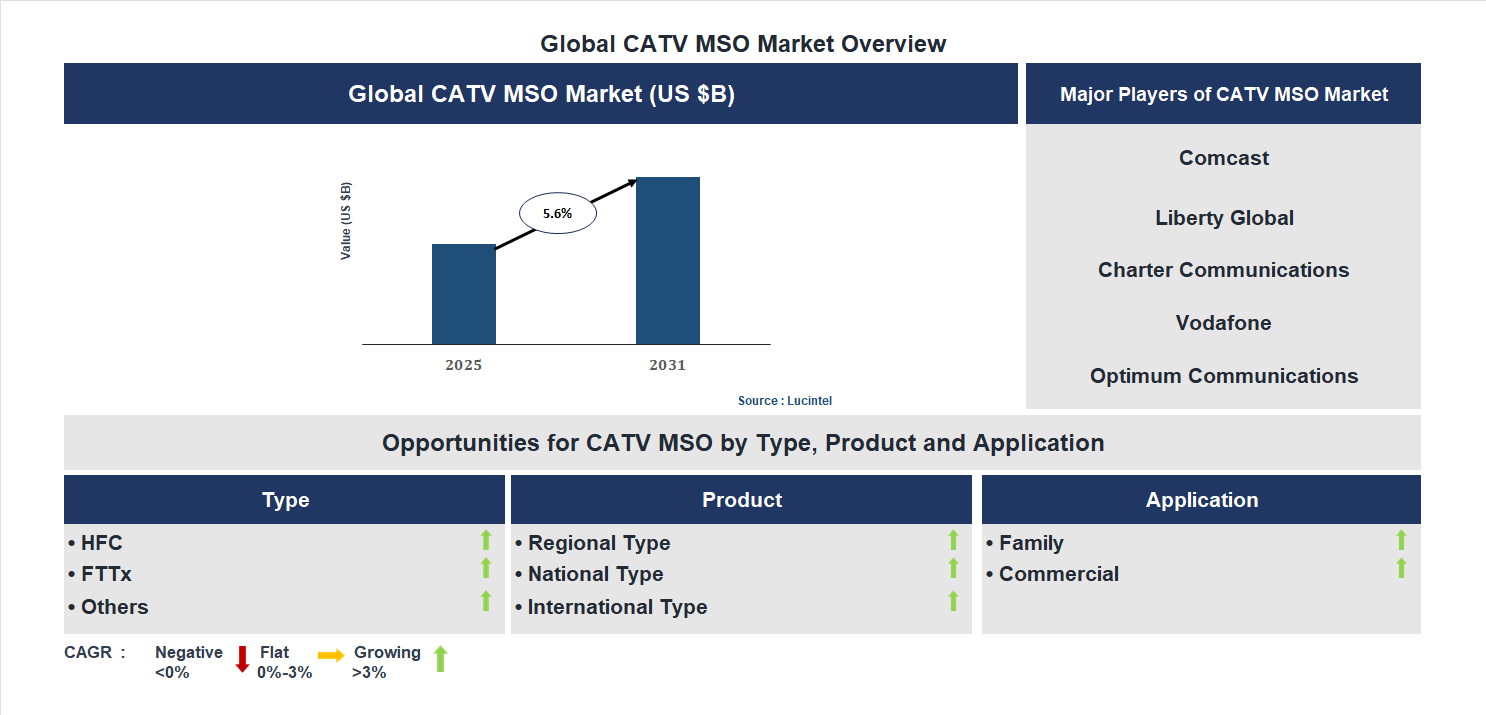
The future of the global CATV MSO market looks promising with opportunities in the family and commercial markets. The global CATV MSO market is expected to grow with a CAGR of 5.6% from 2025 to 2031. The major drivers for this market are the increasing demand for high speed internet, the rising adoption of digital cable services, and the growing investment in network upgrades.• Lucintel forecasts that, within the type category, FFTx is expected to witness higher growth over the forecast period.
• Within the application category, commercial is expected to witness higher growth.
• In terms of region, APAC is expected to witness the highest growth over the forecast period. Gain valuable insights for your business decisions with our comprehensive 150+ page report. Sample figures with some insights are shown below.
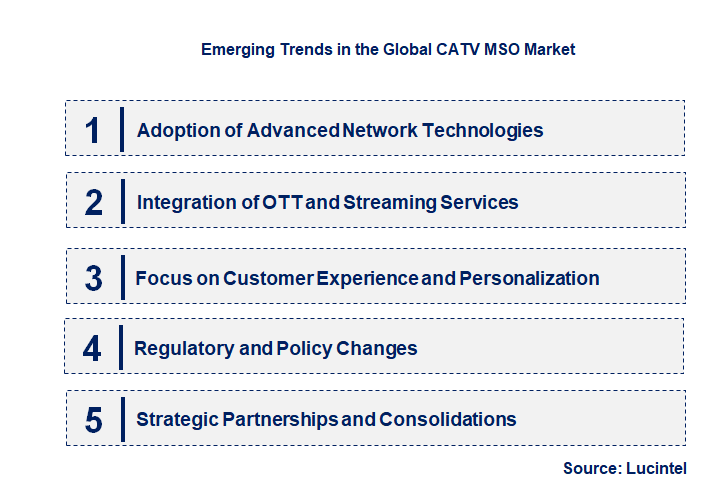
Emerging Trends in the CATV MSO Market
The CATV MSO market is experiencing significant transformation driven by technological advancements, changing consumer preferences, and regulatory shifts. As traditional cable services face increasing competition from streaming platforms and internet-based services, MSOs are innovating to maintain their market share and enhance customer experience. These emerging trends are reshaping the competitive landscape, influencing investment strategies, and prompting operational adjustments. Understanding these key developments is essential for stakeholders aiming to navigate the evolving market effectively and capitalize on new opportunities.• Adoption of Advanced Network Technologies: MSOs are investing in fiber-optic networks and DOCSIS 3.1 technology to improve bandwidth, reliability, and speed. This upgrade enables the delivery of high-definition content, 4K streaming, and enhanced internet services, meeting consumer demand for high-quality digital experiences. The shift reduces latency and increases network capacity, positioning MSOs as competitive players against OTT services. It also facilitates future innovations like 10G networks, ensuring long-term scalability and service quality.
• Integration of OTT and Streaming Services: MSOs are increasingly bundling traditional cable offerings with OTT platforms and streaming services. This hybrid approach caters to changing consumer preferences for on-demand, customizable content. It allows MSOs to diversify revenue streams, attract younger audiences, and reduce churn. By integrating these services into their ecosystems, MSOs enhance customer engagement and provide seamless content access across devices, thus remaining relevant in a digital-first entertainment landscape.
• Focus on Customer Experience and Personalization: Enhanced customer service through digital portals, self-service options, and personalized content recommendations is a key trend. MSOs leverage data analytics to understand viewer preferences and tailor offerings accordingly. This focus improves customer satisfaction, reduces operational costs, and fosters loyalty. Additionally, proactive network monitoring and rapid issue resolution contribute to a superior user experience, helping MSOs differentiate themselves in a competitive market.
• Regulatory and Policy Changes: Evolving regulations around net neutrality, data privacy, and content licensing impact MSO operations. Compliance requires adjustments in service delivery, data management, and content acquisition strategies. Regulatory shifts can also open opportunities for new services or impose restrictions that influence market dynamics. MSOs must stay agile to adapt to these changes, ensuring legal compliance while optimizing their service offerings.
• Strategic Partnerships and Consolidations: To strengthen market position, MSOs are forming alliances with content providers, technology firms, and other telecom operators. Mergers and acquisitions are common to expand geographic reach and diversify service portfolios. These collaborations enable access to exclusive content, advanced technology, and new customer segments. Strategic partnerships also facilitate cost efficiencies and innovation, helping MSOs stay competitive amid industry disruptions. In summary, these trends are fundamentally reshaping the CATV MSO market by driving technological upgrades, diversifying content delivery, enhancing customer engagement, navigating regulatory landscapes, and fostering strategic collaborations. Collectively, they enable MSOs to adapt to a rapidly evolving digital entertainment environment, ensuring sustained growth and relevance in the future.
Recent Development in the CATV MSO Market
The CATV MSO market is experiencing rapid evolution driven by technological advancements, changing consumer preferences, and regulatory shifts. These developments are shaping the competitive landscape, creating new opportunities for growth and innovation. Stakeholders are focusing on expanding infrastructure, adopting new content delivery methods, and enhancing customer experience to stay ahead. Understanding these key developments is essential for strategic planning and investment decisions in this dynamic industry.• Expansion of Fiber Optic Networks: The deployment of fiber optic infrastructure is accelerating, enabling higher bandwidth and improved service quality. This growth opportunity allows MSOs to deliver ultra-high-definition content, support emerging technologies like 4K and 8K streaming, and meet increasing consumer demand for reliable, fast internet. The expansion also reduces latency and enhances overall network efficiency, positioning MSOs for future technological integration and competitive advantage.
• Adoption of Cloud-Based Platforms: MSOs are increasingly adopting cloud technology for content management, delivery, and customer service. Cloud platforms offer scalability, cost-efficiency, and flexibility, allowing operators to quickly adapt to market changes. This shift enhances operational efficiency, enables personalized content offerings, and supports remote management. The move to cloud-based solutions is transforming traditional MSO models, fostering innovation, and improving customer engagement.
• Integration of OTT and Traditional Services: The convergence of Over-the-Top (OTT) streaming with traditional cable services is creating hybrid models that cater to diverse consumer preferences. This integration allows MSOs to expand their content library, offer flexible subscription plans, and reach a broader audience. It also helps retain customers by providing seamless access across devices. The trend is driving revenue growth and increasing market competitiveness through diversified service portfolios.
• Focus on Customer Experience and Digital Transformation: MSOs are investing in digital tools, self-service portals, and advanced analytics to enhance customer experience. These initiatives improve service personalization, reduce churn, and streamline operations. Digital transformation also enables proactive maintenance and faster issue resolution. As customer expectations rise, MSOs that prioritize digital innovation are gaining a competitive edge, fostering loyalty, and increasing revenue streams.
• Regulatory and Policy Changes Favoring Market Growth: Recent regulatory reforms aim to promote competition, improve service quality, and expand broadband access. These policies create a more favorable environment for MSOs to invest in infrastructure and innovate. They also open opportunities for new entrants and partnerships, fostering a more dynamic market. Regulatory support is crucial for sustainable growth, ensuring wider coverage and better service delivery to consumers. The overall impact of these developments is a more competitive, innovative, and customer-centric CATV MSO market. Enhanced infrastructure, technological integration, and regulatory support are driving growth, expanding service offerings, and improving consumer experiences. These trends are positioning the industry for sustained expansion and increased profitability in the evolving digital landscape.
Strategic Growth Opportunities in the CATV MSO Market
The CATV MSO market is experiencing significant growth driven by technological advancements, increasing consumer demand for high-quality content, and expanding broadband services. As operators seek to enhance customer experience and diversify revenue streams, strategic opportunities are emerging across various applications. These opportunities enable MSOs to innovate, improve operational efficiency, and capture new market segments, ensuring sustained growth and competitive advantage in a rapidly evolving digital landscape.• Expansion into High-Speed Broadband Services: MSOs are increasingly investing in fiber-optic infrastructure to deliver high-speed internet, capitalizing on the rising demand for reliable connectivity. This expansion allows operators to diversify revenue streams beyond traditional cable TV, attract new customers, and retain existing ones by offering bundled services. The shift towards gigabit speeds and 5G integration further enhances market potential, positioning MSOs as comprehensive digital service providers.
• Adoption of Advanced Video Analytics and Content Personalization: Leveraging AI and data analytics enables MSOs to offer personalized content recommendations, improving viewer engagement and satisfaction. These technologies facilitate targeted advertising, optimize content delivery, and enhance user experience. By analyzing viewer preferences and behaviors, operators can develop tailored packages, increase advertising revenues, and reduce churn, thereby strengthening their competitive edge in a crowded market.
• Integration of OTT and Streaming Services: Combining traditional cable offerings with over-the-top (OTT) platforms allows MSOs to meet evolving consumer preferences for on-demand content. This integration provides a seamless viewing experience across devices, expands content libraries, and attracts tech-savvy audiences. MSOs can generate additional revenue through partnerships, subscriptions, and targeted advertising, positioning themselves as versatile entertainment providers in the digital age.
• Deployment of Cloud-Based Operations and Management: Transitioning to cloud infrastructure enhances operational efficiency, scalability, and flexibility for MSOs. Cloud solutions enable real-time data management, remote monitoring, and streamlined service provisioning, reducing costs and improving service quality. This technological shift supports the rapid deployment of new services, enhances customer support, and facilitates innovative offerings, ensuring MSOs remain agile and competitive amid market disruptions.
• Focus on Smart Home and IoT Integration: MSOs are exploring opportunities in smart home automation and Internet of Things (IoT) connectivity to diversify their service portfolio. By offering integrated solutions such as security, energy management, and connected devices, operators can increase customer engagement and loyalty. IoT integration also opens new revenue streams, enhances data collection for targeted marketing, and positions MSOs as comprehensive digital ecosystem providers. In conclusion, these strategic growth opportunities are poised to significantly influence the CATV MSO market by enabling operators to innovate, diversify, and expand their service offerings. Embracing technological advancements and consumer-centric solutions will be crucial for MSOs to sustain competitive advantage, capture new revenue streams, and adapt to the rapidly changing digital entertainment landscape.
CATV MSO Market Driver and Challenges
The CATV MSO market is influenced by a variety of technological, economic, and regulatory factors. Rapid advancements in digital technology, increasing consumer demand for high-definition content, and evolving regulatory frameworks shape the market landscape. Economic factors such as rising disposable incomes and increasing internet penetration further drive growth, while regulatory challenges related to licensing and content restrictions pose hurdles. Additionally, technological innovations like fiber-optic networks and OTT (Over-the-Top) streaming services are transforming traditional cable services. Understanding these drivers and challenges is essential for stakeholders to navigate the dynamic environment and capitalize on emerging opportunities. The factors responsible for driving the CATV MSO market include:• Technological Advancements: The integration of digital and fiber-optic technologies has revolutionized cable services, enabling higher bandwidth, better picture quality, and interactive features. These innovations attract more consumers seeking enhanced viewing experiences. The deployment of advanced infrastructure also allows MSOs to offer bundled services like internet and telephony, increasing revenue streams. As technology continues to evolve, MSOs can differentiate themselves through innovative offerings, thus fueling market growth. The shift towards 4K and 8K content further emphasizes the importance of technological upgrades, making this a key driver for market expansion.
• Increasing Consumer Demand for High-Quality Content: Consumers are increasingly seeking high-definition, 4K, and on-demand content, which drives MSOs to upgrade their content delivery systems. The desire for personalized viewing experiences and access to a wide array of channels encourages MSOs to invest in content libraries and digital platforms. This demand also pushes MSOs to collaborate with content providers and streaming services, expanding their offerings. As consumers become more tech-savvy, their expectations for seamless, high-quality content grow, prompting MSOs to innovate continuously. This trend significantly boosts subscriber retention and attracts new customers, propelling market growth.
• Growth of Internet Penetration and Digital Ecosystems: The proliferation of high-speed internet and digital ecosystems has expanded the reach of cable services. MSOs are leveraging internet infrastructure to offer hybrid services combining traditional cable with broadband and OTT streaming, creating integrated digital ecosystems. This convergence allows for targeted advertising, personalized content, and interactive services, enhancing customer engagement. The increasing affordability of internet services and smartphone adoption further facilitates access to cable content across diverse demographics. As digital ecosystems mature, MSOs can tap into new revenue streams and improve customer loyalty, making this a vital growth driver.
• Regulatory Support and Policy Frameworks: Favorable regulatory policies and government initiatives aimed at expanding digital infrastructure and promoting competition bolster the CATV MSO market. Regulations encouraging infrastructure sharing, spectrum allocation, and content licensing facilitate market entry and expansion. Additionally, policies supporting rural connectivity help MSOs extend their reach to underserved areas, increasing subscriber bases. Regulatory clarity on content rights and consumer protection also builds trust and stability within the industry. Such supportive frameworks enable MSOs to innovate and invest confidently, fostering sustainable growth in the market.
• Strategic Partnerships and Mergers & Acquisitions: Collaborations between MSOs, content providers, and technology firms enable the development of comprehensive service offerings. Mergers and acquisitions help MSOs expand their subscriber base, diversify content portfolios, and upgrade infrastructure efficiently. Strategic alliances with OTT platforms and device manufacturers facilitate seamless content delivery across multiple devices. These partnerships also enable cost-sharing and technological innovation, enhancing competitiveness. As the market consolidates, MSOs can leverage combined resources to accelerate growth, improve service quality, and adapt to changing consumer preferences, making strategic collaborations a key driver. The challenges facing this Market include:
• Intense Competition from OTT Streaming Services: The rise of OTT platforms like Netflix, Amazon Prime, and Disney+ has significantly impacted traditional cable subscriptions. Consumers increasingly prefer on-demand, ad-free content accessible via internet-connected devices, reducing reliance on cable TV. MSOs face the challenge of retaining subscribers and adapting their offerings to include OTT content. The competition also pressures MSOs to innovate technologically and offer competitive pricing. Failure to effectively integrate OTT services or differentiate their offerings could lead to subscriber erosion and revenue decline, posing a substantial challenge to market stability.
• Regulatory and Licensing Constraints: Despite supportive policies, regulatory hurdles such as licensing restrictions, content rights issues, and compliance requirements can impede market growth. Stringent regulations may delay infrastructure deployment, limit content offerings, or increase operational costs. Changes in government policies or legal frameworks can introduce uncertainties, affecting investment decisions. Additionally, content licensing complexities across regions can restrict access to popular channels or services, impacting customer satisfaction. Navigating these regulatory landscapes requires significant resources and strategic planning, which can hinder rapid expansion and innovation within the market.
• Infrastructure and Investment Challenges: Upgrading infrastructure to support high-speed internet, fiber optics, and digital services requires substantial capital expenditure. Many MSOs face financial constraints, especially in rural or less developed areas, limiting their ability to expand coverage or improve service quality. The high costs associated with infrastructure deployment and maintenance pose a barrier to entry and growth. Moreover, technological obsolescence necessitates continuous investment, which can strain financial resources. These infrastructure challenges can delay service upgrades, reduce competitiveness, and restrict market penetration, especially in underserved regions. In summary, the CATV MSO market is shaped by rapid technological innovations, increasing consumer demand for high-quality content, expanding digital ecosystems, supportive regulatory frameworks, and strategic partnerships. However, it faces significant challenges from OTT competition, regulatory complexities, and infrastructure investment hurdles. These drivers collectively propel market growth, while the challenges require strategic adaptation and innovation. Overall, the markets future depends on how effectively MSOs can leverage technological advancements and navigate regulatory and infrastructural challenges to meet evolving consumer preferences and maintain a competitive advantage.
List of CATV MSO Companies
Companies in the market compete on the basis of product quality offered. Major players in this market focus on expanding their manufacturing facilities, R&D investments, infrastructural development, and leverage integration opportunities across the value chain. With these strategies CATV MSO companies cater increasing demand, ensure competitive effectiveness, develop innovative products & technologies, reduce production costs, and expand their customer base. Some of the CATV MSO companies profiled in this report include-• Comcast
• Liberty Global
• Charter Communications
• Vodafone
• Optimum Communications
• Cox Enterprises
• Beijing Gehua CATV Network
CATV MSO Market by Segment
The study includes a forecast for the global CATV MSO market by type, product, application, and region.CATV MSO Market by Type [Value from 2019 to 2031]:
• HFC
• FTTx
• Others
CATV MSO Market by Product [Value from 2019 to 2031]:
• Regional Type
• National Type
• International Type
CATV MSO Market by Application [Value from 2019 to 2031]:
• Family
• Commercial
CATV MSO Market by Region [Value from 2019 to 2031]:
• North America
• Europe
• Asia Pacific
• The Rest of the World
Country Wise Outlook for the CATV MSO Market
The CATV MSO market has experienced significant shifts driven by technological advancements, regulatory changes, and evolving consumer preferences. As traditional cable services face increasing competition from streaming platforms and digital services, operators are innovating to maintain market share and enhance customer experience. The United States, China, Germany, India, and Japan each exhibit unique developments reflecting their market dynamics, regulatory environments, and technological adoption rates. These changes include infrastructure upgrades, strategic mergers, new service offerings, and regulatory reforms aimed at improving service quality and expanding reach.• United States: The US market has seen widespread adoption of fiber-optic networks, enabling higher bandwidth and better service quality. Major MSOs are investing heavily in hybrid fiber-coaxial (HFC) upgrades and expanding broadband offerings. There is a growing focus on integrating internet, TV, and phone services into bundled packages. Regulatory efforts aim to improve competition and consumer rights, while some operators explore 5G integration to complement cable services. The shift towards streaming and on-demand content continues to challenge traditional cable subscriptions, prompting MSOs to innovate with new digital platforms and content partnerships.
• China: The Chinese CATV MSO market is characterized by rapid technological upgrades and government support for digital transformation. Operators are expanding fiber networks and deploying 4K and 8K broadcasting capabilities. The government encourages integration of cable services with internet and mobile platforms, fostering convergence. Market consolidation is ongoing, with larger players acquiring smaller firms to enhance scale and service diversity. Additionally, smart home and IoT services are increasingly bundled with traditional cable offerings, creating new revenue streams. Regulatory policies focus on improving service quality and expanding rural coverage to bridge digital divides.
• Germany: The German market is witnessing a transition from traditional cable to more fiber-based infrastructure, driven by EU regulations promoting competition and infrastructure sharing. MSOs are investing in fiber-to-the-home (FTTH) deployments to meet demand for high-speed internet and HD content. There is a notable shift towards hybrid TV services combining traditional cable with OTT streaming platforms. Regulatory reforms aim to foster competition among providers and improve consumer rights, including better transparency and service quality standards. Market players are also exploring innovative content delivery methods, such as cloud-based DVR and interactive TV services, to attract customers.
• India: The Indian CATV MSO market is experiencing rapid growth fueled by increasing internet penetration and digital adoption. Operators are expanding fiber networks and upgrading existing infrastructure to deliver high-definition content and broadband services. The government’s Digital India initiative supports infrastructure development and rural connectivity, broadening market reach. Market consolidation is occurring as larger players acquire regional operators to expand their footprint. Additionally, there is a surge in OTT content integration with traditional cable services, offering consumers more choices. Regulatory efforts focus on licensing reforms and spectrum management to facilitate growth and improve service quality.
• Japan: The Japanese market is characterized by high broadband penetration and advanced infrastructure. MSOs are investing in fiber-optic networks and next-generation broadcasting technologies such as 4K and 8K. There is a focus on integrating cable services with mobile and internet platforms to provide seamless multi-device experiences. Regulatory policies promote competition and innovation, encouraging providers to adopt cloud-based and interactive services. The market also sees a trend toward personalized content and smart home integration. As consumer preferences shift towards on-demand and streaming services, traditional cable providers are adapting by offering hybrid models and enhanced digital content options.

Features of the Global CATV MSO Market
Market Size Estimates: CATV MSO market size estimation in terms of value ($B). Trend and Forecast Analysis: Market trends (2019 to 2024) and forecast (2025 to 2031) by various segments and regions. Segmentation Analysis: CATV MSO market size by type, product, application, and region in terms of value ($B). Regional Analysis: CATV MSO market breakdown by North America, Europe, Asia Pacific, and Rest of the World. Growth Opportunities: Analysis of growth opportunities in different types, products, applications, and regions for the CATV MSO market. Strategic Analysis: This includes M&A, new product development, and competitive landscape of the CATV MSO market. Analysis of competitive intensity of the industry based on Porter’s Five Forces model.
FAQ
Q1. What is the growth forecast for CATV MSO market? Answer: The global CATV MSO market is expected to grow with a CAGR of 5.6% from 2025 to 2031. Q2. What are the major drivers influencing the growth of the CATV MSO market? Answer: The major drivers for this market are the increasing demand for high speed internet, the rising adoption of digital cable services, and the growing investment in network upgrades. Q3. What are the major segments for CATV MSO market? Answer: The future of the CATV MSO market looks promising with opportunities in the family and commercial markets. Q4. Who are the key CATV MSO market companies? Answer: Some of the key CATV MSO companies are as follows:• Comcast
• Liberty Global
• Charter Communications
• Vodafone
• Optimum Communications
• Cox Enterprises
• Beijing Gehua CATV Network Q5. Which CATV MSO market segment will be the largest in future? Answer: Lucintel forecasts that, within the type category, FFTx is expected to witness higher growth over the forecast period. Q6. In CATV MSO market, which region is expected to be the largest in next 5 years? Answer: In terms of region, APAC is expected to witness the highest growth over the forecast period. Q7. Do we receive customization in this report? Answer: Yes, Lucintel provides 10% customization without any additional cost.
Table of Contents
List of Figures
List of Tables
Methodology
- In-depth interviews of the major players in this market
- Detailed secondary research from competitors’ financial statements and published data
- Extensive searches of published works, market, and database information pertaining to industry news, company press releases, and customer intentions
- A compilation of the experiences, judgments, and insights of Lucintel’s professionals, who have analyzed and tracked this market over the years.


Buy Now
Choose a license that fits your team. Instant PDF delivery.
Prices exclude taxes. Instant delivery. Custom licensing available on request.
Key Questions
- • What are some of the most promising, high-growth opportunities for the CATV MSO market by type (HFC, FTTX, and others), product (regional type, national type, and international type), application (family and commercial), and region (North America, Europe, Asia Pacific, and the Rest of the World)?
- • Which segments will grow at a faster pace and why?
- • Which region will grow at a faster pace and why?
- • What are the key factors affecting market dynamics? What are the key challenges and business risks in this market?
- • What are the business risks and competitive threats in this market?
- • What are the emerging trends in this market and the reasons behind them?
- • What are some of the changing demands of customers in the market?
- • What are the new developments in the market? Which companies are leading these developments?
- • Who are the major players in this market? What strategic initiatives are key players pursuing for business growth?
- • What are some of the competing products in this market and how big of a threat do they pose for loss of market share by material or product substitution?
- • What M&A activity has occurred in the last 6 years and what has its impact been on the industry? For any questions related to CATV MSO Market, CATV MSO Market Size, CATV MSO Market Growth, CATV MSO Market Analysis, CATV MSO Market Report, CATV MSO Market Share, CATV MSO Market Trends, CATV MSO Market Forecast, CATV MSO Companies, write Lucintel analyst at email: helpdesk@lucintel.com. We will be glad to get back to you soon.


