
Report Feature
Carbon Steel Piping Spool Market Trends and Forecast
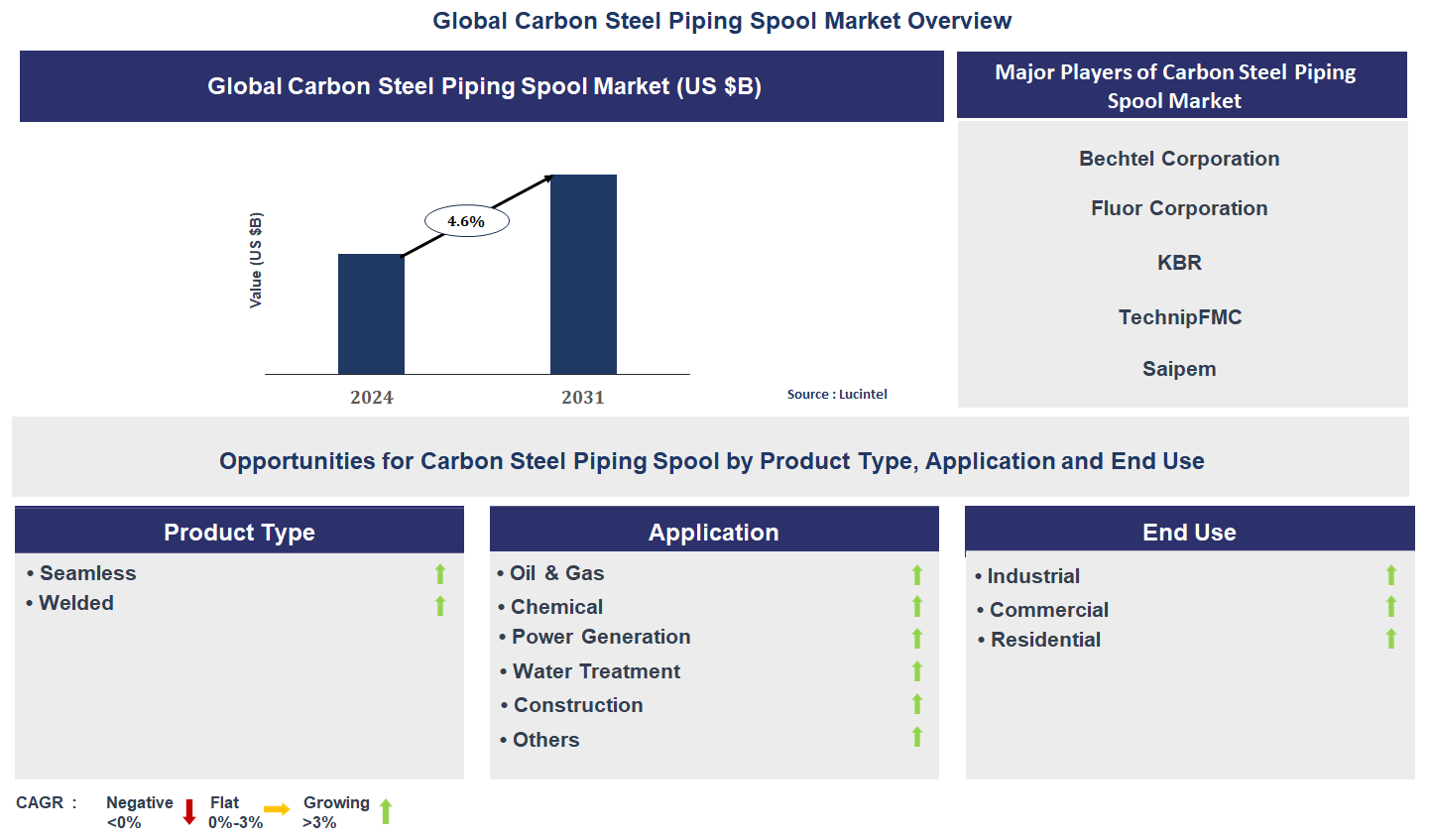
The future of the global carbon steel piping spool market looks promising with opportunities in the industrial, commercial, and residential markets. The global carbon steel piping spool market is expected to grow with a CAGR of 4.6% from 2025 to 2031. The major drivers for this market are the increasing demand for industrial infrastructure, the rising need for durable piping solutions, and the growing adoption of energy-efficient systems.• Lucintel forecasts that, within the product type category, seamless is expected to witness higher growth over the forecast period.
• Within the end use category, industrial is expected to witness the highest growth.
• In terms of region, APAC is expected to witness the highest growth over the forecast period. Gain valuable insights for your business decisions with our comprehensive 150+ page report. Sample figures with some insights are shown below.
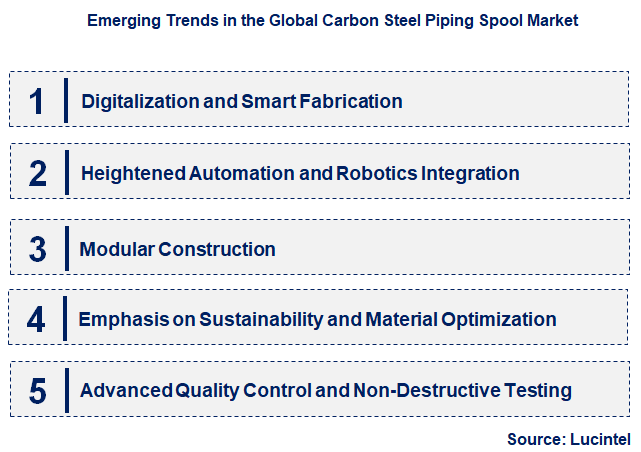
Emerging Trends in the Carbon Steel Piping Spool Market
The carbon steel piping spool market is experiencing a paradigm shift, driven by technological advancement, changing industrial requirements, and global emphasis on efficiency and safety. Such emerging trends are transforming the industry from emphasis on simple functionality to that of intelligent, integrated, and highly specialized solutions. With industries focusing on shortening construction time and enhancing project quality, the pressure to design and supply piping spools capable of handling these challenges competently and safely is mounting.• Digitalization and Smart Fabrication: The lead trend is the digitalization and smart fabrication. The companies are embracing superior software for design, engineering, and manufacturing in order to enhance precision and minimize errors. Building Information Modeling (BIM) and 3D modeling are applied to develop digital twins of entire piping systems prior to the fabrication process so that there is a perfect fit on site. The trend is affecting the market by greatly enhancing operational efficiency and decreasing costs.
• Heightened Automation and Robotics Integration: One of the major trends is the greater integration of automation and robotics. Companies are employing robotic welding and cutting equipment to execute tasks with increased precision and speed than before, as compared to human-based manual methods. This not only results in better weld quality but also increases safety for workers by reducing human interaction with hazardous environments. This trend is affecting the market by radically enhancing operation efficiency and consistency.
• Modular Construction: There is a major new trend towards modular construction. Whole parts of a plant or facility are being constructed off-site as prefabricated modules, including piping spools. This means quicker on-site assembly, and this can save up to 50% of project time. This trend is affecting the market by opening a high-value opportunity within the construction sector.
• Emphasis on Sustainability and Material Optimization: The industry is witnessing a high degree of trend towards emphasis on sustainability and material optimization. Companies are attempting to minimize material loss through the utilization of sophisticated cutting and nesting software. They are also creating new alloys and coatings that can enhance the longevity and corrosion resistance of carbon steel spools, which is a primary concern for numerous businesses and consumers.
• Advanced Quality Control and Non-Destructive Testing: One of the top trends is increasingly focusing on advanced quality control and non-Destructive Testing (NDT). Industry players are applying emerging technologies such as automated ultrasonic testing (AUT) and digital radiography to examine welds and guarantee the quality of piping spools. This is influencing the market by making quality and safety one of the major competitive differentiation factors. These new trends are all coming together to redefine the carbon steel piping spool industry as a whole by evolving it from a conventional business to one that is technologically advanced, efficient, and safe. The intersection of hardware development with software and data analytics is building a more connected and intelligent value chain.
Recent Development in the Carbon Steel Piping Spool Market
The carbon steel piping spool market is undergoing dynamic developments, fueled by the growing complexity of contemporary industrial projects and the global drive towards enhancing construction efficiency and safety. These recent trends are shaping product design, manufacturing operations, and end-use applications. The market is seeing a thrust towards the application of advanced manufacturing technologies and the use of smart tools to improve operational efficiency. These events together indicate a market in transition, changing to fit new economic and industrial circumstances.• Advanced Fabrication and Welding Techniques: An important advancement is the application of advanced fabrication and welding techniques. Companies are introducing new robotic welding systems that can execute intricate welds with greater accuracy and speed than human workers. This minimizes human error and increases the overall quality of the product. This is affecting the market by providing a safer, quicker, and more economical alternative to conventional methods of fabrication.
• Introduction of Integrated Project Management Software: One major development is the introduction of integrated project management software. Emerging software platforms enable EPC companies to manage the entire piping spool fabrication process, from preliminary design through on-site installation. This streamlines communication and ensures that all stakeholders are in alignment, an important competitive advantage.
• Expansion into Clean Technology and Renewable Energy: There is a significant emphasis, as depicted by recent trends, on the expansion into clean technology and renewable energy. The market is recording a high demand for projects involving hydrogen, carbon capture, and biofuels. These types of projects need specialized carbon steel spools with high capacities for new fluids and gases. This is affecting the market by providing a new and profitable avenue for businesses and consumers in vast numbers.
• Strategic Partnerships and Collaborations: The market is witnessing a noteworthy evolution in strategic partnerships and collaborations. Large companies in the industry are collaborating with technology firms to incorporate new capabilities, including automated controls and data analytics, into their offerings. This is having an effect on the market by facilitating a more integrated value chain and enabling companies to provide more complete solutions to customers.
• Emphasis on Sustainable Manufacturing Practices: The swift development in sustainable manufacturing practices is a key point. Manufacturers are embracing new methods that minimize energy usage and material wastage. This encompasses the use of recycled materials and the adoption of sophisticated waste management systems. This is affecting the market by correlating the industry with an overall global emphasis on sustainable manufacturing. These primary developments are mutually influencing the carbon steel piping spool market by propelling a shift towards an enhanced, competitive, and customer-oriented industry. The urgency of technological advancement and the growth of digital solutions are opening up new avenues for growth, while attention to safety and after-sales services is substantially redefining the market.
Strategic Growth Opportunities in the Carbon Steel Piping Spool Market
The carbon steel piping spool market offers considerable strategic growth prospects fueled by changing industrial demands, a worldwide trend towards efficiency, and increasing demand for sophisticated infrastructure solutions. Such opportunities are beyond conventional repair and exist in niche, high-value applications in different industries. To make the most of these chances, players in the market need to emphasize innovation, product differentiation, and strategic alliances.• Venturing into the Power Generation Industry: The power generation industry is a critical strategic growth opportunity. The installation of new power plants, both conventional and alternative power plants, calls for extensive piping systems that can accommodate vast amounts of different fluids and gases. This has an effect on the market by promoting a high-margin application that is less vulnerable to conventional economic cycles.
• Targeting the Water and Wastewater Treatment Sector: The water and wastewater treatment sector presents a prime opportunity for growth. With an expanding population worldwide and an increasing interest in public health, new water treatment facilities and infrastructure become more necessary. Carbon steel pipe spools play an indispensable role in these projects that can minimize waste and support environmental compliance. This affects the market through a steady source of demand from a key sector.
• Cashing in on the Shipbuilding and Marine Industry: The shipbuilding and marine industry has the potential to be an investment opportunity. Offshore platforms and ships need intricate piping systems that have the ability to stand up to harsh and corrosive conditions. Laser cladding is also being applied to produce high-quality, biocompatible surfaces for medical implants and surgical devices. This has an effect on the market by providing a high-value opportunity that is less vulnerable to fluctuations in common manufacturing cycles.
• Solutions Development for the Food and Beverage Sector: There is a strategic opportunity in targeting the food and beverage sector. They need high-quality, sanitary piping systems that are easy to clean and maintain. Although stainless steel is usually used, carbon steel finds applications in some places where corrosion does not pose a significant problem. It has an effect on the market by generating a high-volume, recurring revenue stream.
• Targeting Aftermarket Services and Retrofitting: A strategic area exists in pursuing aftermarket services and retrofitting. As plants get older, the need to replace or repair existing piping systems becomes more prevalent. Providing full-service packages, such as remote monitoring and predictive maintenance, helps companies establish a high-margin, recurring revenue stream. This affects the market in that it provides a high-value, recurring revenue stream. These strategic opportunities for growth are transforming the carbon steel piping spool market by shifting its focus from a bulk commodity to a specialized, value-added product and service business. By targeting high-growth markets and embracing the sustainability trend, businesses can unlock new revenue streams, stand out against competition, and establish a more sustainable market position in the future.
Carbon Steel Piping Spool Market Driver and Challenges
The carbon steel piping spool market is driven by a multifaceted interaction of key drivers and challenges, which encompass a range of technological, economic, and regulatory drivers. The growth of the market is driven by a growing global industrial sector and a high emphasis on efficiency as well as safety. But this increase is balanced by some serious problems in terms of the volatility of raw material prices, stiff competition, and requirements for human resources. It is vital to understand the interactions among these forces to accurately comprehend the state of the market today and predict its future direction. The factors responsible for driving the carbon steel piping spool market include: 1. Growth in Oil and Gas Industry: The growth in the oil and gas industry is the main driver. The increase in global energy demand, especially from the emerging economies, is fueling new production and exploration projects that need vast piping systems. With this industry’s growth, so does the need for carbon steel piping spools. This is one of the most significant growth drivers for the market, which is a decisive success factor in a vast range of projects, from new build to retrofits. 2. Increase in Industrial and Infrastructure Projects: The demand is spurred by the increase in industrial and infrastructure projects across the world. These involve the building of new power generation plants, chemical plants, and water treatment plants. The projects call for extensive use of piping systems, which is a key driver of demand for carbon steel spools. 3. Adoption of Modular Construction and Prefabrication: The industry is fueled by increased adoption of modular construction and prefabrication. Off-site prefabrication of piping spools can decrease project duration and enhance safety through reduced on-site activity. This trend is forcing companies to invest in more sophisticated fabrication technology and remains a leading competitive differentiator. 4. Economy of Carbon Steel: The economy drives the market due to the economy of carbon steel. In comparison to other materials such as stainless steel or special alloys, carbon steel is a less expensive material for most industrial uses. Its great strength and longevity also render it a cost-efficient and safe material for numerous types of projects. 5. Technological Developments in Welding and Fabrication: The industry is spurred on by ongoing technological developments in welding and fabrication. The development of automated cutting and welding systems is enhancing the quality and accuracy of piping spools. This minimizes defects and makes the final product more dependable. Challenges in the carbon steel piping spool market are: 1. Unstable Raw Material Prices: The industry is greatly challenged by unstable raw material prices. Carbon steel price may vary on the basis of a variety of global economic and geopolitical forces. This may create difficulties for the manufacturers to project their costs and may affect their profit margins. 2. Alternative Materials Competition: The industry is highly threatened by strong competition from alternative materials like stainless steel, plastic, and composite pipes. Such materials have a variety of benefits, including corrosion resistance and lower weight, which can make them a better choice in some uses. 3. Specialized and Skilled Labor Requirement: The market is confronted with a major challenge from specialized and skilled labor requirement. Complex welding and fabrication machinery demands specialized technical skills. Inadequate skilled personnel can affect project schedules and raise the cost of labor, which can hamper the growth of the market, especially in certain areas. In summary, the carbon steel piping spool industry stands at the crossroads, with strong drivers driving it and major challenges requiring adaptive strategy. The increasing need for industrial infrastructure and increasing emphasis on efficiency and safety are presenting new growth opportunities. Nevertheless, the market has to deal with fluctuating raw material costs, high competition, and the requirement for trained labor. The capacity of businesses to innovate and deliver high-value, low-cost solutions while exploiting the key drivers will be pivotal to success in this changing and dynamic marketplace.List of Carbon Steel Piping Spool Companies
Companies in the market compete on the basis of product quality offered. Major players in this market focus on expanding their manufacturing facilities, R&D investments, infrastructural development, and leverage integration opportunities across the value chain. With these strategies carbon steel piping spool companies cater increasing demand, ensure competitive effectiveness, develop innovative products & technologies, reduce production costs, and expand their customer base. Some of the carbon steel piping spool companies profiled in this report include-• Bechtel Corporation
• Fluor Corporation
• KBR
• TechnipFMC
• Saipem
• John Wood Group
• McDermott International
• Aker Solutions
• Bilfinger
• China Petroleum & Chemical Corporation
Carbon Steel Piping Spool Market by Segment
The study includes a forecast for the global carbon steel piping spool market by product type, application, end use, and region.Carbon Steel Piping Spool Market by Product Type [Value from 2019 to 2031]:
• Seamless
• Welded
Carbon Steel Piping Spool Market by Application [Value from 2019 to 2031]:
• Oil & Gas
• Chemical
• Power Generation
• Water Treatment
• Construction
• Others
Carbon Steel Piping Spool Market by End Use [Value from 2019 to 2031]:
• Industrial
• Commercial
• Residential
Carbon Steel Piping Spool Market by Region [Value from 2019 to 2031]:
• North America
• Europe
• Asia Pacific
• The Rest of the World
Country Wise Outlook for the Carbon Steel Piping Spool Market
The carbon steel piping spool industry is going through tremendous change, stimulated by worldwide growth in industrial infrastructure and increasing emphasis on efficiency and safety. Piping spools, which are prefabricated piping system sections, play a vital role in large-scale projects in industries such as oil and gas, power generation, and chemicals. Current advances revolve around the incorporation of sophisticated manufacturing methods, including digital modeling and automation, to enhance accuracy and minimize on-site construction time.• United State: In the U.S., the market for carbon steel piping spools is witnessing growth, driven by huge investments in the oil and gas industry and by an impulse towards energy independence. One such development is the general use of digital tools such as Building Information Modeling (BIM) and 3D modeling in piping design and fabrication. This enables detailed prefabrication, which reduces on-site welding and shortens project duration.
• China: The Chinese market for carbon steel piping spools is the largest and most rapidly growing in the world due to huge infrastructure development and industrialization. One of the developments is the rapid expansion of production capacity through advanced automation, such as robotic welding and CNC (Computer Numerical Control) machining. This permits Chinese manufacturers to manufacture huge quantities of piping spools at minimal cost, a key competitive edge.
• Germany: Germany’s carbon steel piping spool industry is dominated by a keen emphasis on engineering accuracy, quality, and adherence to high European standards. The major developments involve design and manufacture of extremely specialized spools for specific industries, most notably in the pharmaceutical and chemical sectors. There is a trend towards incorporating lean manufacturing to minimize waste and streamline production. German firms are using their technical know-how in high-tech welding processes to create highly resilient and dependable piping spools for high-risk projects.
• India: India’s carbon steel piping spool market is in a growth-stage but still nascent state, fueled by aggressive urbanization, infrastructure expansion, and a drive towards domestic production. One of the emerging trends is increased awareness and usage of prefabricated spools as a time-efficient option to in-site fabrication. The market is witnessing an entry of quality, long-lasting products from local and global players.
• Japan: Japan’s carbon steel piping spool market is advanced and characterized by a high focus on reliability, quality assurance, and seismic resistance. Developments over recent times have been aimed at manufacturing highly advanced, automated systems that can conduct sophisticated welding operations with limited manual intervention. The market is witnessing a trend towards the application of high-tech materials and coatings to enhance the corrosion resistivity of carbon steel spools. The emphasis is also placed on developing compact and lightweight structures to enhance operational effectiveness and mitigate space shortages in high-density urban areas.

Features of the Global Carbon Steel Piping Spool Market
Market Size Estimates: Carbon steel piping spool market size estimation in terms of value ($B). Trend and Forecast Analysis: Market trends (2019 to 2024) and forecast (2025 to 2031) by various segments and regions. Segmentation Analysis: Carbon steel piping spool market size by product type, application, end use, and region in terms of value ($B). Regional Analysis: Carbon steel piping spool market breakdown by North America, Europe, Asia Pacific, and Rest of the World. Growth Opportunities: Analysis of growth opportunities in different product types, applications, end uses, and regions for the carbon steel piping spool market. Strategic Analysis: This includes M&A, new product development, and competitive landscape of the carbon steel piping spool market. Analysis of competitive intensity of the industry based on Porter’s Five Forces model.
FAQ
Q1. What is the growth forecast for carbon steel piping spool market? Answer: The global carbon steel piping spool market is expected to grow with a CAGR of 4.6% from 2025 to 2031. Q2. What are the major drivers influencing the growth of the carbon steel piping spool market? Answer: The major drivers for this market are the increasing demand for industrial infrastructure, the rising need for durable piping solutions, and the growing adoption of energy-efficient systems. Q3. What are the major segments for carbon steel piping spool market? Answer: The future of the carbon steel piping spool market looks promising with opportunities in the industrial, commercial, and residential markets. Q4. Who are the key carbon steel piping spool market companies? Answer: Some of the key carbon steel piping spool companies are as follows:• Bechtel Corporation
• Fluor Corporation
• KBR
• TechnipFMC
• Saipem
• John Wood Group
• McDermott International
• Aker Solutions
• Bilfinger
• China Petroleum & Chemical Corporation Q5. Which carbon steel piping spool market segment will be the largest in future? Answer: Lucintel forecasts that, within the product type category, seamless is expected to witness higher growth over the forecast period. Q6. In carbon steel piping spool market, which region is expected to be the largest in next 5 years? Answer: In terms of region, APAC is expected to witness the highest growth over the forecast period. Q7. Do we receive customization in this report? Answer: Yes, Lucintel provides 10% customization without any additional cost.
Table of Contents
List of Figures
List of Tables
Methodology
- In-depth interviews of the major players in this market
- Detailed secondary research from competitors’ financial statements and published data
- Extensive searches of published works, market, and database information pertaining to industry news, company press releases, and customer intentions
- A compilation of the experiences, judgments, and insights of Lucintel’s professionals, who have analyzed and tracked this market over the years.


Buy Now
Choose a license that fits your team. Instant PDF delivery.
Prices exclude taxes. Instant delivery. Custom licensing available on request.
Key Questions
- • What are some of the most promising, high-growth opportunities for the carbon steel piping spool market by product type (seamless and welded), application (oil & gas, chemical, power generation, water treatment, construction, and others), end use (industrial, commercial, and residential), and region (North America, Europe, Asia Pacific, and the Rest of the World)?
- • Which segments will grow at a faster pace and why?
- • Which region will grow at a faster pace and why?
- • What are the key factors affecting market dynamics? What are the key challenges and business risks in this market?
- • What are the business risks and competitive threats in this market?
- • What are the emerging trends in this market and the reasons behind them?
- • What are some of the changing demands of customers in the market?
- • What are the new developments in the market? Which companies are leading these developments?
- • Who are the major players in this market? What strategic initiatives are key players pursuing for business growth?
- • What are some of the competing products in this market and how big of a threat do they pose for loss of market share by material or product substitution?
- • What M&A activity has occurred in the last 5 years and what has its impact been on the industry? For any questions related to Carbon Steel Piping Spool Market, Carbon Steel Piping Spool Market Size, Carbon Steel Piping Spool Market Growth, Carbon Steel Piping Spool Market Analysis, Carbon Steel Piping Spool Market Report, Carbon Steel Piping Spool Market Share, Carbon Steel Piping Spool Market Trends, Carbon Steel Piping Spool Market Forecast, Carbon Steel Piping Spool Companies, write Lucintel analyst at email: helpdesk@lucintel.com. We will be glad to get back to you soon.


