
Report Feature
Carbon-Smart Web Hosting Market Trends and Forecast
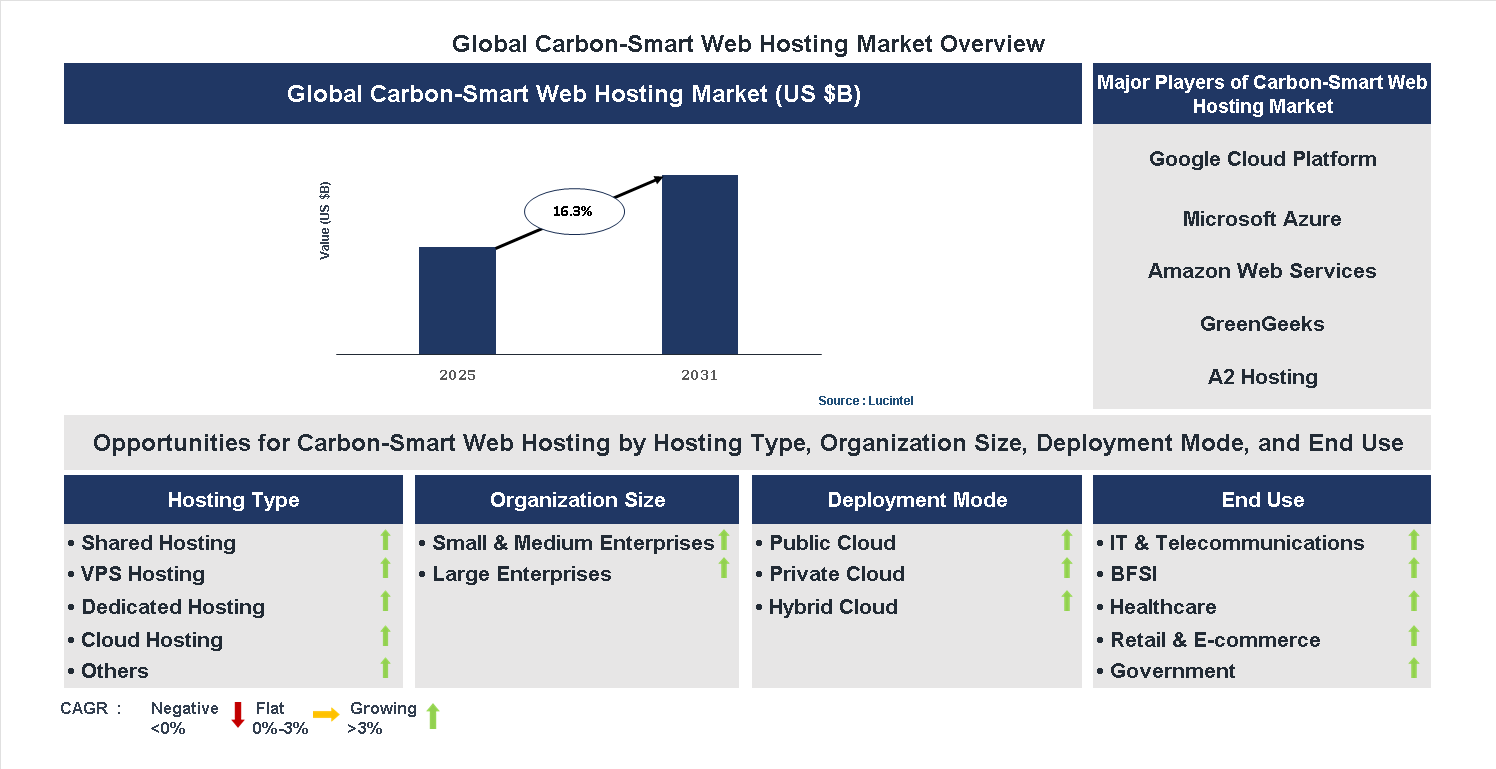
The future of the global carbon-smart web hosting market looks promising with opportunities in the IT & telecommunication, BFSI, healthcare, retail & E-commerce, and government markets. The global carbon-smart web hosting market is expected to grow with a CAGR of 16.3% from 2025 to 2031. The major drivers for this market are the increasing demand for sustainable web solutions, the rising awareness of carbon-neutral technologies, and the growing adoption of green data centers.• Lucintel forecasts that, within the hosting type category, shared hosting is expected to witness the highest growth over the forecast period.
• Within the end use category, IT & telecommunication is expected to witness the highest growth.
• In terms of region, North America is expected to witness the highest growth over the forecast period. Gain valuable insights for your business decisions with our comprehensive 150+ page report. Sample figures with some insights are shown below.
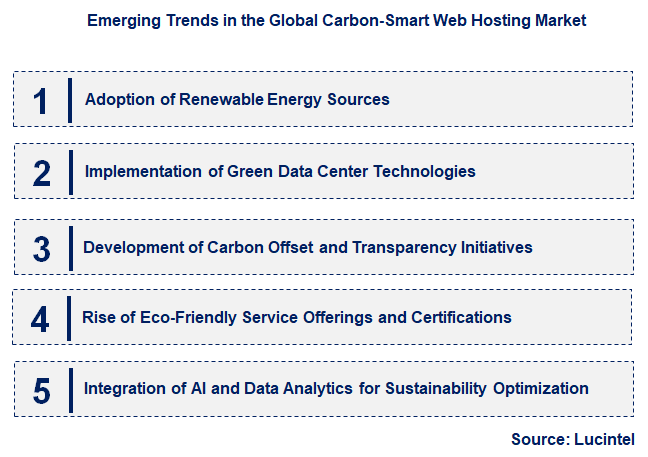
Emerging Trends in the Carbon-Smart Web Hosting Market
The carbon-smart web hosting market is experiencing rapid growth driven by increasing awareness of environmental sustainability and the need for greener digital infrastructure. As businesses and consumers prioritize eco-friendly solutions, providers are innovating to reduce carbon footprints while maintaining high performance. This shift is reshaping the industry landscape, encouraging technological advancements and new business models focused on sustainability. The following trends highlight the key developments influencing this market, reflecting a broader movement toward environmentally responsible digital practices and the integration of renewable energy sources, innovative cooling techniques, and transparent carbon accounting.• Adoption of Renewable Energy Sources: Increasingly, web hosting providers are transitioning to renewable energy such as solar and wind to power their data centers. This shift reduces reliance on fossil fuels, significantly lowering carbon emissions associated with hosting services. Companies investing in renewable energy not only enhance their sustainability credentials but also often benefit from cost savings in the long term. This trend is driven by government incentives, corporate sustainability commitments, and consumer demand for eco-friendly services, making renewable energy a cornerstone of carbon-smart hosting strategies.
• Implementation of Green Data Center Technologies: Data centers are adopting advanced green technologies to minimize energy consumption and environmental impact. Innovations include energy-efficient cooling systems, such as liquid cooling and free-air cooling, and the use of AI to optimize energy use. These technologies improve operational efficiency, reduce greenhouse gas emissions, and lower costs. As data demands grow, the integration of sustainable infrastructure becomes essential for providers aiming to meet environmental standards and appeal to eco-conscious clients, thereby transforming the operational landscape of web hosting.
• Development of Carbon Offset and Transparency Initiatives: Providers are increasingly offering carbon offset programs and transparent reporting of their carbon footprint. This includes purchasing carbon credits, investing in reforestation projects, and providing detailed sustainability reports. Such initiatives build trust with customers and demonstrate a commitment to environmental responsibility. Transparency in carbon accounting also encourages industry-wide accountability and drives continuous improvement, positioning companies as leaders in the emerging green hosting ecosystem.
• Rise of Eco-Friendly Service Offerings and Certifications: Market players are launching specialized hosting plans that emphasize sustainability, such as carbon-neutral hosting and eco-certified services. Certifications like LEED and Green Seal are becoming important differentiators. These offerings appeal to environmentally conscious businesses seeking to align their digital presence with their sustainability goals. The focus on eco-friendly services fosters innovation and competition, pushing the entire industry toward more sustainable practices and standards.
• Integration of AI and Data Analytics for Sustainability Optimization: Advanced AI and data analytics are being employed to monitor, analyze, and optimize energy consumption in real-time. These technologies enable providers to identify inefficiencies, predict cooling needs, and dynamically adjust operations to reduce carbon emissions. The use of AI enhances operational efficiency, reduces costs, and supports sustainability goals. As these tools become more sophisticated, they will play a crucial role in making web hosting more environmentally responsible and efficient. In summary, these emerging trends are fundamentally reshaping the carbon-smart web hosting market by promoting sustainable energy use, technological innovation, transparency, and eco-friendly service offerings. They are driving the industry toward a more environmentally responsible future, aligning business growth with global sustainability objectives and meeting the rising demand for greener digital solutions.
Recent Development in the Carbon-Smart Web Hosting Market
The carbon-smart web hosting market is experiencing rapid growth driven by increasing awareness of environmental sustainability and the demand for eco-friendly digital solutions. As businesses and consumers prioritize reducing their carbon footprint, hosting providers are innovating to meet these needs. Technological advancements, regulatory pressures, and consumer preferences are shaping the market landscape. This evolution reflects a broader shift towards sustainable practices in the tech industry, influencing service offerings, operational strategies, and competitive dynamics. The following key developments highlight the current trajectory and future potential of the Carbon-Smart Web Hosting Market.• Adoption of Renewable Energy Sources: Hosting providers are increasingly powering data centers with renewable energy such as solar and wind, significantly reducing carbon emissions and enhancing sustainability credentials. This shift not only lowers operational costs over time but also appeals to environmentally conscious clients, boosting market competitiveness and encouraging industry-wide adoption of green energy solutions.
• Implementation of Carbon Offset Programs: Many companies are integrating carbon offset initiatives into their hosting services, investing in projects like reforestation and renewable energy credits. These programs allow providers to offer carbon-neutral hosting options, attracting clients committed to sustainability. The impact is a strengthened market reputation and a competitive edge in a growing eco-conscious customer base.
• Development of Green Data Center Technologies: Innovations in cooling systems, energy-efficient hardware, and virtualization are making data centers more sustainable. These technological advancements reduce energy consumption and carbon emissions, enabling providers to operate more efficiently. The result is a more resilient, cost-effective, and environmentally friendly hosting infrastructure that appeals to eco-aware consumers.
• Regulatory and Policy Support: Governments and regulatory bodies are introducing policies and incentives to promote green energy use and reduce carbon emissions in the tech sector. These measures include tax credits, subsidies, and stricter environmental standards, encouraging hosting providers to adopt sustainable practices. Such support accelerates market transformation towards greener hosting solutions.
• Rise of Eco-Friendly Certification and Standards: Industry standards and certifications like LEED and Green Seal are gaining prominence, providing benchmarks for sustainable hosting practices. Providers obtaining these certifications demonstrate their commitment to environmental responsibility, attracting clients seeking verified eco-friendly services. This trend fosters transparency and accountability, further driving market growth. In summary, these developments are collectively propelling the carbon-smart web hosting market towards greater sustainability, innovation, and competitiveness. The integration of renewable energy, technological advancements, supportive policies, and certification standards is fostering a more environmentally responsible industry. As a result, market growth is accelerating, with providers increasingly aligning their offerings with eco-conscious consumer demands and regulatory requirements, shaping a greener digital future.
Strategic Growth Opportunities in the Carbon-Smart Web Hosting Market
The carbon-smart web hosting market is experiencing rapid growth driven by increasing awareness of environmental sustainability and the demand for eco-friendly digital solutions. As businesses and consumers prioritize reducing their carbon footprint, the market is evolving to offer innovative hosting options that align with these values. Key applications such as e-commerce, enterprise solutions, educational platforms, government services, and small-to-medium enterprises (SMEs) are pivotal in shaping this landscape. These sectors are adopting carbon-smart hosting to enhance their sustainability credentials, improve operational efficiency, and meet regulatory requirements. The following are five key growth opportunities across these applications that are shaping the future of this market.• E-commerce Platforms: Expansion of eco-friendly online stores : As online shopping continues to grow, e-commerce platforms are adopting carbon-smart hosting to appeal to environmentally conscious consumers. This shift enhances brand reputation, reduces energy costs, and aligns with sustainability goals, driving increased adoption and market penetration.
• Enterprise Solutions: Integration of sustainable hosting in corporate IT : Large corporations are integrating carbon-smart hosting into their IT infrastructure to meet corporate social responsibility (CSR) objectives. This adoption reduces carbon emissions, improves energy efficiency, and supports compliance with environmental regulations, fostering long-term growth.
• Educational Platforms: Adoption of green hosting for online learning : Educational institutions and e-learning providers are leveraging eco-friendly hosting solutions to promote sustainability awareness among students and staff. This not only reduces operational costs but also enhances institutional reputation and aligns with global sustainability initiatives.
• Government Services: Implementation of sustainable hosting for public portals : Governments are adopting carbon-smart hosting for public service portals to demonstrate environmental responsibility and meet regulatory standards. This enhances transparency, reduces operational costs, and encourages wider adoption of green technologies across public sectors.
• Small-to-Medium Enterprises: Adoption of affordable green hosting solutions : SMEs are increasingly opting for cost-effective, eco-friendly hosting options to reduce their carbon footprint and appeal to environmentally conscious customers. This trend supports sustainable growth and broadens the market base for carbon-smart hosting providers. In summary, these growth opportunities across key applications are significantly impacting the carbon-smart web hosting market by driving innovation, increasing adoption, and aligning digital infrastructure with sustainability goals. This evolution not only benefits the environment but also offers competitive advantages to businesses, fostering a more sustainable digital future.
Carbon-Smart Web Hosting Market Driver and Challenges
The carbon-smart web hosting market is influenced by a variety of technological, economic, and regulatory factors that shape its growth and development. Advances in green technology and increasing awareness of environmental sustainability are driving demand for eco-friendly hosting solutions. Economic considerations, such as cost efficiency and energy savings, also play a significant role. Additionally, regulatory policies aimed at reducing carbon emissions and promoting renewable energy sources impact market dynamics. These drivers and challenges collectively determine the pace at which the market evolves, influencing stakeholders’ strategies and investments. Understanding these factors is essential for navigating the opportunities and risks within this emerging sector. The factors responsible for driving the carbon-smart web hosting market include:• Technological Innovation: The rapid development of energy-efficient data centers and renewable energy integration has significantly reduced the carbon footprint of web hosting services. Innovations such as advanced cooling systems, AI-driven energy management, and green server hardware enable providers to offer sustainable solutions that appeal to environmentally conscious consumers. These technological advancements not only improve operational efficiency but also position companies as leaders in sustainability, fostering competitive advantage and market differentiation.
• Growing Environmental Awareness: Increasing global awareness of climate change and environmental issues has led consumers and businesses to prioritize sustainability. Companies are seeking eco-friendly hosting options to align with their corporate social responsibility goals. This shift in consumer preference drives demand for carbon-neutral hosting services, encouraging providers to adopt greener practices and promote transparency regarding their environmental impact.
• Regulatory Policies and Incentives: Governments worldwide are implementing regulations and incentives to reduce carbon emissions, such as carbon taxes, renewable energy mandates, and sustainability reporting requirements. These policies compel web hosting providers to adopt greener practices to remain compliant and competitive. Incentives like tax credits and subsidies for renewable energy investments further motivate companies to transition toward carbon-smart hosting solutions.
• Cost Savings and Operational Efficiency: The adoption of renewable energy sources and energy-efficient infrastructure reduces operational costs for hosting providers. Lower energy consumption translates into significant savings, making carbon-smart hosting economically attractive. As energy prices fluctuate and sustainability becomes a cost advantage, providers are incentivized to invest in green technologies, which can also enhance brand reputation and customer loyalty. The challenges in the carbon-smart web hosting market are:
• High Initial Investment: Transitioning to carbon-smart infrastructure requires substantial upfront capital for renewable energy installations, energy-efficient hardware, and infrastructure upgrades. These costs can be prohibitive for smaller providers or new entrants, limiting market penetration and slowing adoption rates. Additionally, the return on investment may take several years to realize, creating financial barriers.
• Technological Limitations and Reliability: While green technologies are advancing, some limitations remain regarding their scalability and reliability. Renewable energy sources like solar and wind are intermittent, posing challenges for maintaining consistent service levels. Developing reliable energy storage solutions and integrating them seamlessly into hosting operations is complex and costly, potentially hindering widespread adoption.
• Regulatory Uncertainty: Although policies favor sustainability, regulatory frameworks are still evolving and can vary significantly across regions. Uncertainty regarding future regulations, compliance costs, and potential changes in incentives can deter investment in carbon-smart infrastructure. Companies may hesitate to commit substantial resources without clear, stable policy guidance, impacting market growth. In summary, the carbon-smart web hosting market is shaped by technological innovations, increasing environmental consciousness, supportive regulatory policies, and cost efficiencies. However, high initial investments, technological limitations, and regulatory uncertainties pose significant challenges. These factors collectively influence the pace and direction of market development, requiring stakeholders to balance opportunities with risks. As the market matures, strategic investments and policy clarity will be crucial for fostering sustainable growth and achieving environmental goals.
List of Carbon-Smart Web Hosting Companies
Companies in the market compete on the basis of product quality offered. Major players in this market focus on expanding their manufacturing facilities, R&D investments, infrastructural development, and leverage integration opportunities across the value chain. With these strategies carbon-smart web hosting companies cater increasing demand, ensure competitive effectiveness, develop innovative products & technologies, reduce production costs, and expand their customer base. Some of the carbon-smart web hosting companies profiled in this report include-• Google Cloud Platform
• Microsoft Azure
• Amazon Web Services
• GreenGeeks
• A2 Hosting
• DreamHost
• SiteGround
• Kualo
• Eco Web Hosting
• Krystal Hosting
Carbon-Smart Web Hosting Market by Segment
The study includes a forecast for the global carbon-smart web hosting market by hosting type, organization size, deployment mode, end use, and region.Carbon-Smart Web Hosting Market by Hosting Type [Value from 2019 to 2031]:
• Shared Hosting
• VPS Hosting
• Dedicated Hosting
• Cloud Hosting
• Others
Carbon-Smart Web Hosting Market by Organization Size [Value from 2019 to 2031]:
• Small & Medium Enterprises
• Large Enterprises
Carbon-Smart Web Hosting Market by Deployment Mode [Value from 2019 to 2031]:
• Public Cloud
• Private Cloud
• Hybrid Cloud
Carbon-Smart Web Hosting Market by End Use [Value from 2019 to 2031]:
• IT & Telecommunications
• BFSI
• Healthcare
• Retail & E-commerce
• Government
• Others
Carbon-Smart Web Hosting Market by Region [Value from 2019 to 2031]:
• North America
• Europe
• Asia Pacific
• The Rest of the World
Country Wise Outlook for the Carbon-Smart Web Hosting Market
The carbon-smart web hosting market is experiencing rapid growth driven by increasing awareness of environmental sustainability and the need for greener digital infrastructure. As businesses and consumers prioritize eco-friendly solutions, countries are adopting innovative strategies to reduce carbon footprints associated with web hosting services. Technological advancements, government policies, and corporate commitments are shaping the landscape, making carbon-smart hosting more accessible and efficient worldwide. This evolving market reflects a global shift towards sustainable technology practices, with each country contributing through unique initiatives and investments to promote greener web hosting solutions.• United States: The US market has seen significant investments in renewable energy-powered data centers, with major providers like Google and Amazon committing to carbon neutrality by 2030. Innovations in energy-efficient server technology and increased adoption of green certifications are prominent trends. Regulatory pressures and consumer demand are pushing companies to adopt sustainable hosting practices, leading to a surge in eco-friendly web hosting services. Additionally, startups focusing on carbon offset solutions for web hosting are gaining traction, further accelerating market growth.
• China: China is rapidly expanding its green data center infrastructure, supported by government policies promoting renewable energy use and energy efficiency. Major tech giants like Alibaba and Tencent are investing heavily in carbon-smart hosting solutions, integrating AI to optimize energy consumption. The country’s focus on reducing carbon emissions aligns with its broader environmental goals, leading to increased adoption of solar and wind energy in data centers. Innovations in cooling technologies and energy management systems are also contributing to the market’s development.
• Germany: Germany’s market is characterized by a strong emphasis on renewable energy integration and strict environmental regulations. Leading hosting providers are adopting wind and solar power, with many data centers certified under eco-label standards. The government’s commitment to the European Green Deal has spurred investments in sustainable infrastructure. Germany also promotes transparency and accountability in carbon emissions reporting, encouraging companies to adopt carbon-smart hosting solutions that meet high environmental standards.
• India: India’s web hosting market is witnessing rapid growth driven by digital expansion and increasing awareness of sustainability. The government’s push for renewable energy, especially solar, is facilitating the development of green data centers. Local providers are adopting energy-efficient technologies and partnering with renewable energy suppliers to reduce carbon footprints. The market is also seeing a rise in startups offering eco-friendly hosting options, supported by policies aimed at reducing the country’s overall carbon emissions and promoting sustainable digital growth.
• Japan: Japan is advancing its carbon-smart hosting market through innovations in energy-efficient data center design and the integration of renewable energy sources. The country’s focus on disaster resilience and energy security has led to investments in sustainable infrastructure. Major corporations are adopting green hosting practices, and government initiatives promote the use of solar and wind energy in data centers. Japan’s emphasis on technological innovation and environmental responsibility is positioning it as a leader in sustainable web hosting solutions in Asia.

Features of the Global Carbon-Smart Web Hosting Market
Market Size Estimates: Carbon-smart web hosting market size estimation in terms of value ($B). Trend and Forecast Analysis: Market trends (2019 to 2024) and forecast (2025 to 2031) by various segments and regions. Segmentation Analysis: Carbon-smart web hosting market size by various segments, such as by hosting type, organization size, deployment mode, end use, and region in terms of value ($B). Regional Analysis: Carbon-smart web hosting market breakdown by North America, Europe, Asia Pacific, and Rest of the World. Growth Opportunities: Analysis of growth opportunities in different hosting types, organization sizes, deployment modes, end uses, and regions for the carbon-smart web hosting market. Strategic Analysis: This includes M&A, new product development, and competitive landscape of the carbon-smart web hosting market. Analysis of competitive intensity of the industry based on Porter’s Five Forces model.
FAQ
Q1. What is the growth forecast for carbon-smart web hosting market? Answer: The global carbon-smart web hosting market is expected to grow with a CAGR of 16.3% from 2025 to 2031. Q2. What are the major drivers influencing the growth of the carbon-smart web hosting market? Answer: The major drivers for this market are the increasing demand for sustainable web solutions, the rising awareness of carbon-neutral technologies, and the growing adoption of green data centers. Q3. What are the major segments for carbon-smart web hosting market? Answer: The future of the carbon-smart web hosting market looks promising with opportunities in the IT & telecommunication, BFSI, healthcare, retail & E-commerce, and government markets. Q4. Who are the key carbon-smart web hosting market companies? Answer: Some of the key carbon-smart web hosting companies are as follows:• Google Cloud Platform
• Microsoft Azure
• Amazon Web Services
• GreenGeeks
• A2 Hosting
• DreamHost
• SiteGround
• Kualo
• Eco Web Hosting
• Krystal Hosting Q5. Which carbon-smart web hosting market segment will be the largest in future? Answer: Lucintel forecasts that, within the hosting type category, shared hosting is expected to witness the highest growth over the forecast period. Q6. In carbon-smart web hosting market, which region is expected to be the largest in next 5 years? Answer: In terms of region, North America is expected to witness the highest growth over the forecast period. Q7. Do we receive customization in this report? Answer: Yes, Lucintel provides 10% customization without any additional cost.
Table of Contents
List of Figures
List of Tables
Methodology
- In-depth interviews of the major players in this market
- Detailed secondary research from competitors’ financial statements and published data
- Extensive searches of published works, market, and database information pertaining to industry news, company press releases, and customer intentions
- A compilation of the experiences, judgments, and insights of Lucintel’s professionals, who have analyzed and tracked this market over the years.


Key Questions
- • What are some of the most promising, high-growth opportunities for the carbon-smart web hosting market by hosting type (shared hosting, VPS hosting, dedicated hosting, cloud hosting, and others), organization size (small & medium enterprises and large enterprises), deployment mode (public cloud, private cloud, and hybrid cloud), end use (IT & telecommunications, BFSI, healthcare, retail & E-commerce, government, and others), and region (North America, Europe, Asia Pacific, and the Rest of the World)?
- • Which segments will grow at a faster pace and why?
- • Which region will grow at a faster pace and why?
- • What are the key factors affecting market dynamics? What are the key challenges and business risks in this market?
- • What are the business risks and competitive threats in this market?
- • What are the emerging trends in this market and the reasons behind them?
- • What are some of the changing demands of customers in the market?
- • What are the new developments in the market? Which companies are leading these developments?
- • Who are the major players in this market? What strategic initiatives are key players pursuing for business growth?
- • What are some of the competing products in this market and how big of a threat do they pose for loss of market share by material or product substitution?
- • What M&A activity has occurred in the last 5 years and what has its impact been on the industry? For any questions related to Carbon-Smart Web Hosting Market, Carbon-Smart Web Hosting Market Size, Carbon-Smart Web Hosting Market Growth, Carbon-Smart Web Hosting Market Analysis, Carbon-Smart Web Hosting Market Report, Carbon-Smart Web Hosting Market Share, Carbon-Smart Web Hosting Market Trends, Carbon-Smart Web Hosting Market Forecast, Carbon-Smart Web Hosting Companies, write Lucintel analyst at email: helpdesk@lucintel.com. We will be glad to get back to you soon.


