
Market Report · July 22, 2026

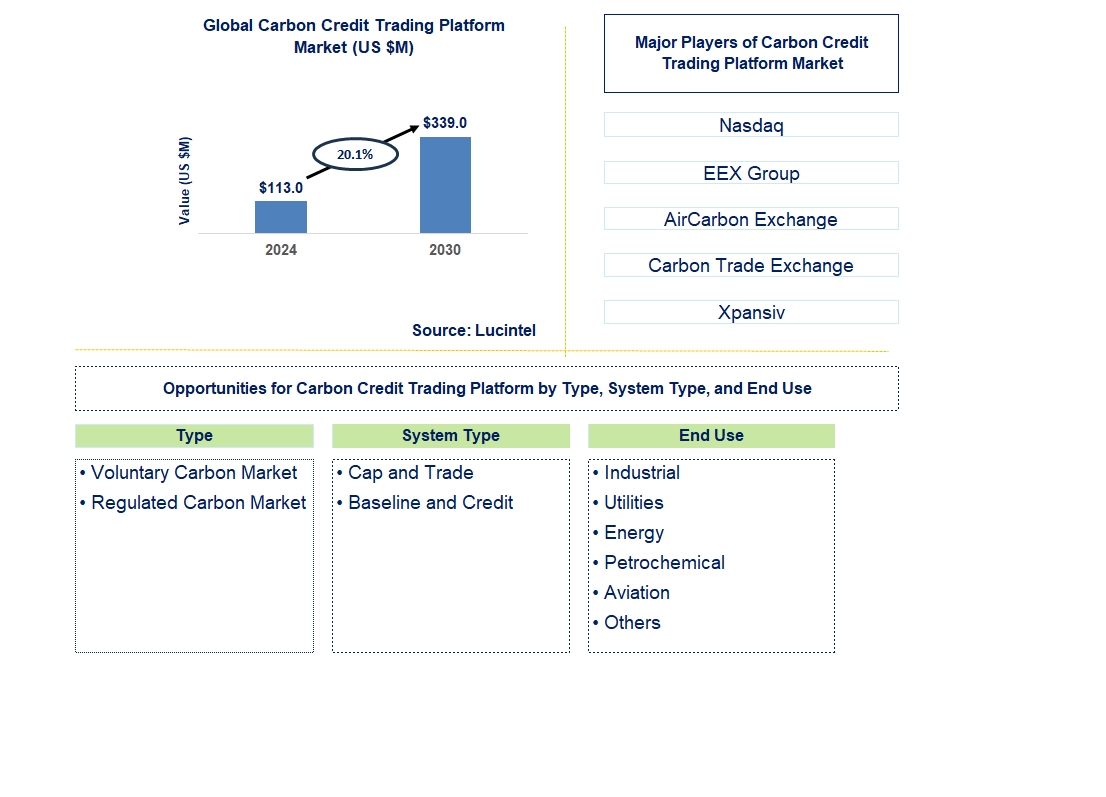
Key data points: The market size in 2030 = $339.0 million, growth forecast = 20.1% annually next 6 years. Scroll below to get more insights. This market report covers trends, opportunities, and forecast in the global carbon credit trading platform market to 2030 by type (voluntary carbon market and regulated carbon market), system type (cap and trade and baseline and credit), end use (industrial, utilities, energy, petrochemical, aviation, and others), and region (North America, Europe, Asia Pacific, and the Rest of the World)
We'll send your sample report shortly.
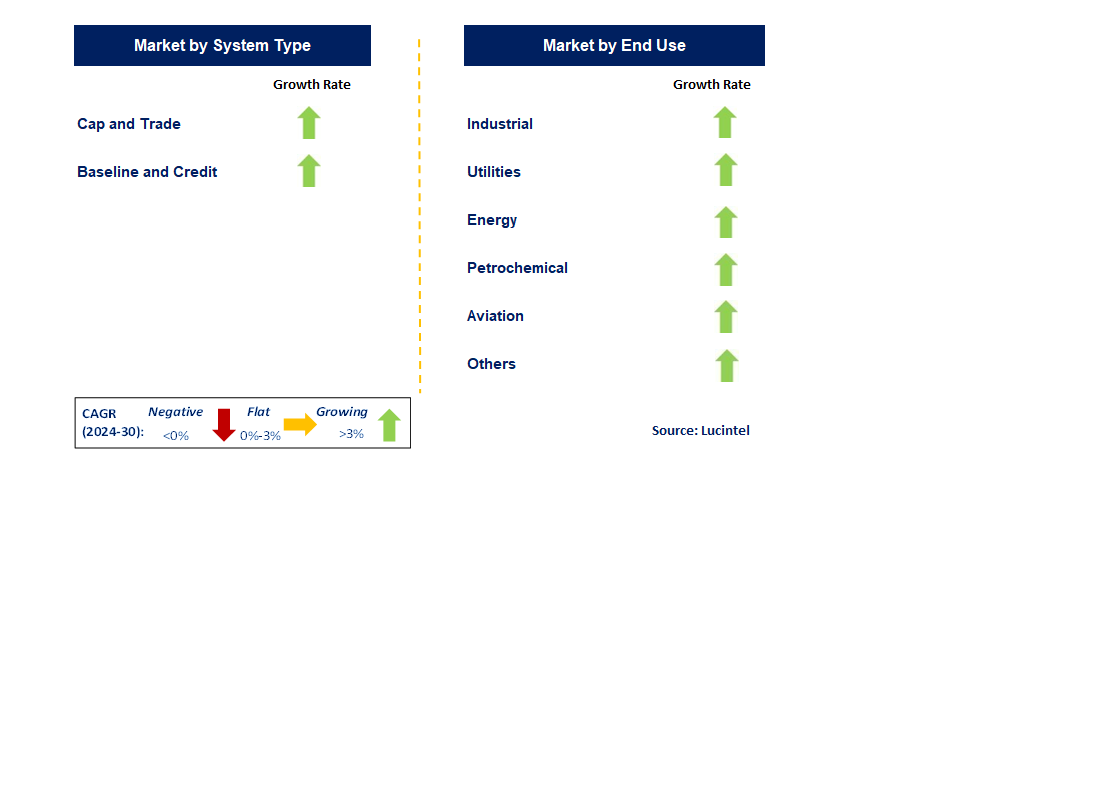
• Lucintel forecasts that cap and trade will remain larger segment over the forecast period because it enables the market to determine a carbon price, which influences investment decisions and market innovation.
• Within this market, utility will remain the largest segment because it runs power plants and other facilities that contribute significantly to greenhouse gas emissions; as a result, they are encouraged to engage in carbon credit trading.
• APAC is expected to witness the highest growth over the forecast period due to rapidly growing economies in APAC, translate to high demand for energy and increased focus on decarbonization solutions. A more than 150-page report is developed to help in your business decisions.
• United States: The boom in the carbon credit trading platforms in the U.S. has resulted from growth in the support of regulations and the interest in the markets. These developmental trends include the creation of more regional overlays in the trading programs and the use of distributed ledger technology to prevent dishonesty in the trading programs.
• China: The rapid expansion and growth of China’s carbon market with the announcement of the National carbon trading system that appeals to a wide range of industries. Such recent developments include the design of modern trading platforms which enhance the trading process as well as modern emission reduction monitoring techniques that employ sophisticated data analytics.
• Germany: Germany has maintained the status of being one of the carbon trading hubs by further investment in the trading infrastructure development. Developments include prediction diversity in the markets enhanced with artificial intelligence and the new trend where carbon credit trading is being complemented with the use of European Union emissions Trading system (EU Tax system) thereby promoting efficiency in the market.
• India: Provision has been made to further develop India's carbon credit trading platforms for its declared climate ambitious goals. New opportunities include the establishment of a national mechanism for trading carbon credits and promoting easy to use technology to encourage involving more sectors.
• India: India is in the process of putting up its carbon credit trading systems in order to meet its desired climate targets. New initiatives include investments into development of a carbon trading framework for the country and making it easy for the public to participate through diversified systems.
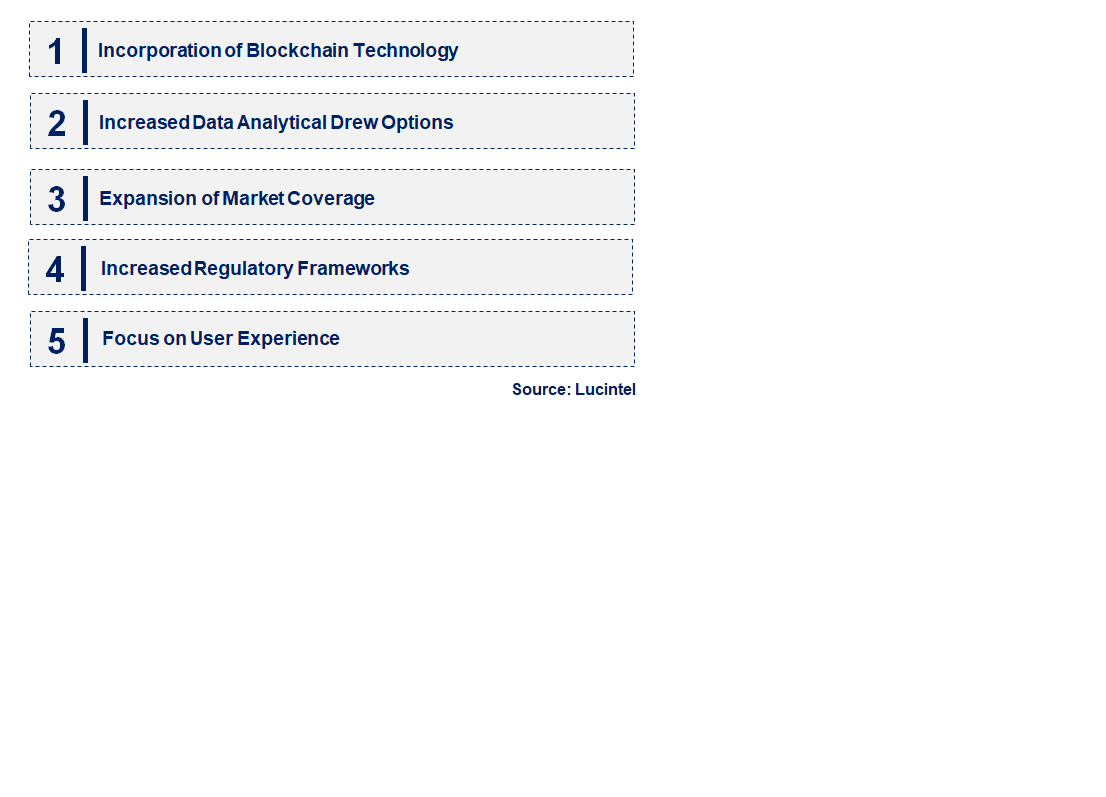
• Incorporation of Blockchain Technology: There is increasing usage of blockchain technology in carbon credit transactions to foster verifiability and minimize cases of corruption. This technology offers a reliable remedy by creating a cage to all past and recent records of actions based on the credibility in the marketplace.
• Increased Data Analytical Drew Options: There is the use of sophisticated technologies of Data Analytics and AI for improving the decision making on the behavior of the market and of the trades executed on the market. This will help to make better and quicker decisions about carbon credits.
• Expansion of Market Coverage: There is a trend of slowly bringing more sectors and geographic regions under the carbon trading scheme. The goal of such growth is to enhance the constructs of the carbon market and thus its overall efficiency towards achieving emission reduction.
• Increased Regulatory Frameworks: There is an increase in the regulations and standards for the carbon trading platforms that are being enforced by the Government. Such frameworks are aimed to maintain the market, the quality of emissions data available and of the market holders and further enhance international efforts geared towards climate change.
• Focus on User Experience: The trading platforms are updating the users’ interface and usability focusing on the trading ease. The trading strategies will depend on more people and businesses perceiving the prospect of engaging in the market. The above trends enhance the Carbon Credit Trading Platform market by increasing transparency, efficiency, and openness. The factors affecting the growth of these platforms are technological and regulatory changes that are making these platforms more effective weapon against climate change.
• Creation of national carbon trading systems: Some countries have also endeavored to establish national carbon trading systems, thus expanding and deepening carbon markets. These systems offer a comprehensive framework for the trade and monitoring of carbon credits across different industries.
• Introduction of new technology for verification: New verification approaches such as legalization, digital tracking and blockchain verification are used to validate carbon credits. Such technologies tackle instances of fraud and bolster confidence in the market.
• Expansion of carbon trading markets: There is increasing growth of carbon trading programs allowing for decentralized trading as well as coherence with specific regional climate targets. Currently, these markets are becoming progressively connected with the national and global systems.
• Improve Market Intelligence Tools: The platforms are advanced enough with the employ of energy practically so as to savor and capture emission trends, market movements and emission data. These analytical tools assist business and regulatory decision makers to make better choices and strategies.
• There Is more funding available for carbon reduction enabling technology: Investment in technologies that help to reduce or trade carbon is also increasing. The new technologies for the storage and production of renewable energy will positively influence the demand for carbon credits thereby changing the market dynamics. These developments are improving the usability, scope, and efficiency of carbon emissary trading platforms. They are part of the ongoing evolution geared towards sophisticated and coherent carbon markets, aimed at climate goals.
• Expansion into Emerging Markets: Developing countries are beginning to implement carbon trading systems which present new opportunities to develop platforms that meet local realities. Adapting solutions to the specifics of the economics of countries will contribute to growth and penetration of the market.
• Integration with Renewable Energy Projects: Developing standalone carbon trading systems and linking them to restructuring renewable energy projects can generate additional revenue and encourage green investments. Such integration promotes diversification of marketable products and services in the future.
• Development of Advanced Verification Tools: Allocating resources in contemporary verification tools and systems will enhance the credibility of the market and encourage more players into the market. Increased verification procedures guarantee the integrity of report submissions and compliance with regulatory policies.
• Growth of Corporate Carbon Management Solutions: Providing corporate specific targeted carbon management solutions will facilitate the acceptance of the platform and increase its use. These solutions help corporations in the efficient management of their carbon footprint, in compliance with the laws.
• Partnerships with Financial Institutions: Working in coordination with financial institutions increases the liquidity of the market as well as develops new financial products linked to the carbon environmentally friendly markets. Partnerships can enhance the geographical coverage of the market and its overall efficiency. These growth opportunities undo the ambiguity over the possibility of growth and innovation within the carbon credit trading platform market. The target line can open new markets and form great growth figures if focused on new countries, origin of new energy, high-end verification, corporate and financial partnership.
• Nasdaq
• EEX Group
• AirCarbon Exchange
• Carbon Trade Exchange
• Xpansiv
• CME Group
• Climate Impact X
• Carbonplace
• Planetly
• Likvidi
• Voluntary Carbon Market
• Regulated Carbon Market
• Cap and Trade
• Baseline and Credit
• Industrial
• Utilities
• Energy
• Petrochemical
• Aviation
• Others
• North America
• Europe
• Asia Pacific
• The Rest of the World
• Lucintel forecasts that cap and trade will remain larger segment over the forecast period because it enables the market to determine a carbon price, which influences investment decisions and market innovation.
• Within this market, utility will remain the largest segment because it runs power plants and other facilities that contribute significantly to greenhouse gas emissions; as a result, they are encouraged to engage in carbon credit trading.
• APAC is expected to witness the highest growth over the forecast period due to rapidly growing economies in APAC, translate to high demand for energy and increased focus on decarbonization solutions.


• Nasdaq
• EEX Group
• AirCarbon Exchange
• Carbon Trade Exchange
• Xpansiv
• CME Group
• Climate Impact X
• Carbonplace
• Planetly
• Likvidi Q6. Which carbon credit trading platform market segment will be the largest in future? Answer: Lucintel forecasts that cap and trade will remain larger segment over the forecast period because it enables the market to determine a carbon price, which influences investment decisions and market innovation. Q7. In carbon credit trading platform market, which region is expected to be the largest in next 5 years? Answer: APAC is expected to witness the highest growth over the forecast period due to rapidly growing economies in APAC, translate to high demand for energy and increased focus on decarbonization solutions. Q.8 Do we receive customization in this report? Answer: Yes, Lucintel provides 10% customization without any additional cost.


Choose a license that fits your team. Instant PDF delivery.
Prices exclude taxes. Instant delivery. Custom licensing available on request.
Market Report · July 22, 2026
Market Report · June 26, 2026
Market Report · May 18, 2026
Trusted partner for strategic intelligence and business growth


Receive a complimentary market analysis tailored to your industry. Our analysts will identify key growth opportunities and competitive dynamics specific to your business.

Market size, growth rate, and key trend analysis for your specific sector.

Top competitor positioning and market share analysis.

Strategic recommendations backed by data-driven insights.
Get curated market intelligence and competitive moves straight to your inbox.
By subscribing, you agree to receive our monthly insights. Unsubscribe anytime.
Receive a complimentary market analysis tailored to your industry. Our analysts will identify key growth opportunities and competitive dynamics specific to your business.
Market size, growth rate, and key trend analysis for your specific sector.
Top competitor positioning and market share analysis.
Strategic recommendations backed by data-driven insights.
Get curated market intelligence, emerging trends, and competitive moves straight to your inbox each month.
By subscribing, you agree to receive our monthly insights. Unsubscribe anytime.
We'll send your sample report shortly.