
Market Report · July 16, 2026

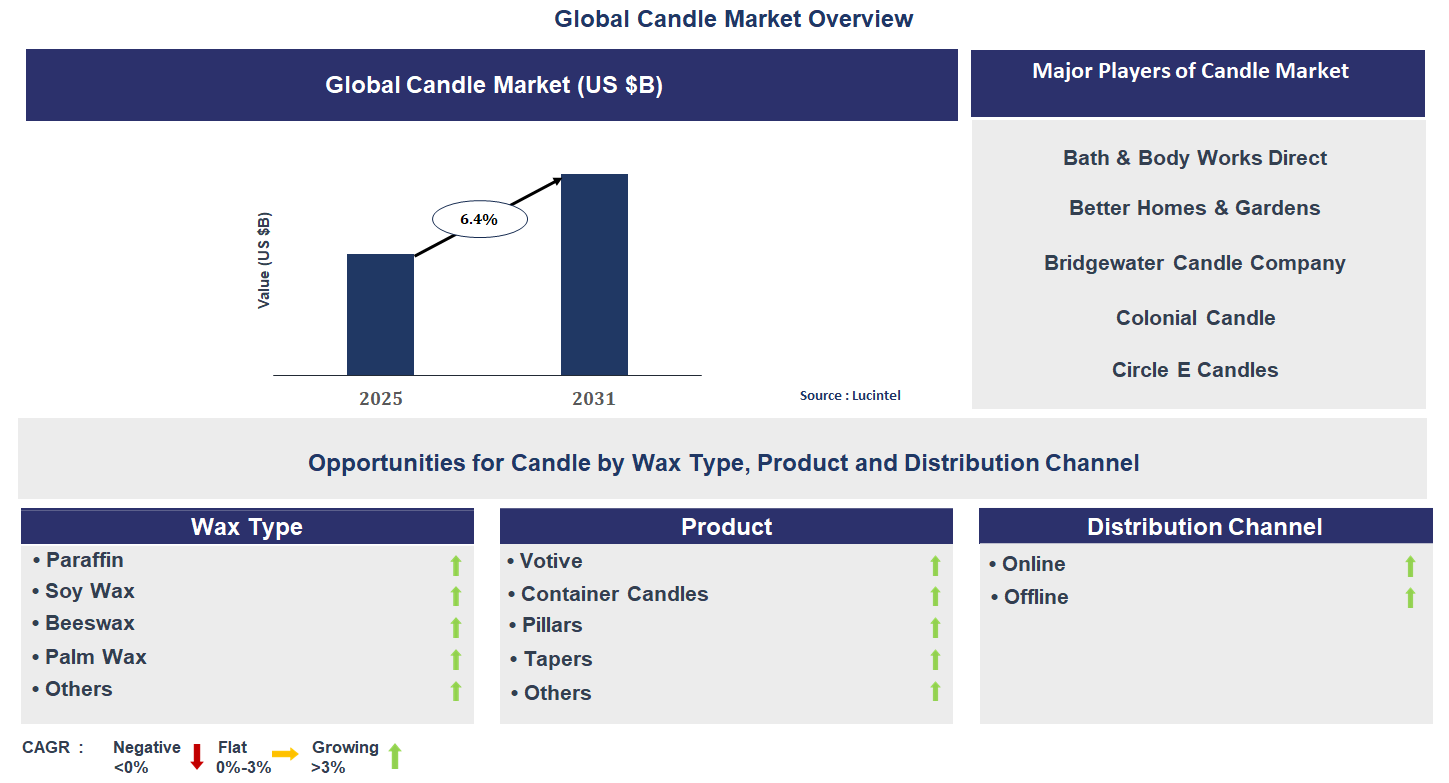
Key data points: The growth forecast = 6.4% annually for the next 7 years. Scroll below to get more insights. This market report covers trends, opportunities and forecasts in candle market to 2031 by wax type (paraffin, soy wax, beeswax, palm wax, and others), product (votive, container candles, pillars, tapers, and others), distribution channel (online and offline), and region (North America, Europe, Asia Pacific, and the Rest of the World)
We'll send your sample report shortly.
• Lucintel forecasts that, within the wax type category, paraffin is expected to witness the highest growth over the forecast period.
• Within the product category, votive is expected to witness the highest growth.
• In terms of region, North America is expected to witness the highest growth over the forecast period. Gain valuable insights for your business decisions with our comprehensive 150+ page report. Sample figures with some insights are shown below.
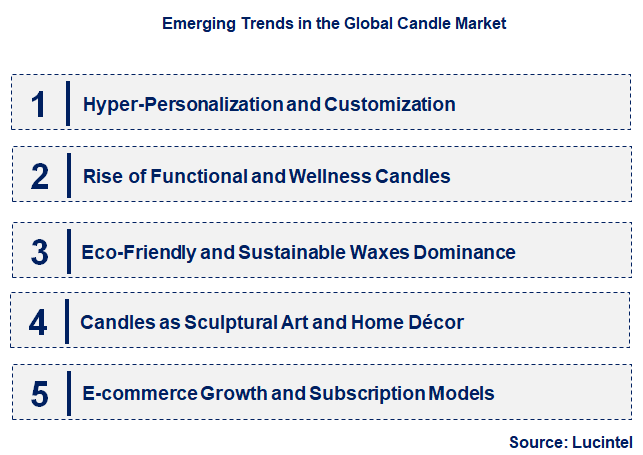
• Hyper-Personalization and Customization: Hyper-personalization trend lets the consumer co-create candles by choosing personalized labels, containers, wax, and even special combinations of fragrances, usually based on memories, mood, or event. This innovation raises the product from a commodity to an individualized lifestyle product, intensifying the emotional bond between the brand and the consumer. Its effect is mostly observed in the gifting and premium categories, where special, bespoke products earn a premium and create brand loyalty.
• Rise of Functional and Wellness Candles: Functional candles are specifically crafted to promote overall wellness, with essential oils for therapeutic purposes such as stress relief, sleep, or uplift. This trend is a direct reflection of the increasing self-care phenomenon, with consumers associating candles with core elements of their mental wellness routines. The demand for aromatherapy and sleep-inducing blends is growing at an exponential rate.
• Eco-Friendly and Sustainable Waxes Dominance: There is a resounding departure from paraffin wax to natural plant-based waxes like soy, beeswax, and coconut wax, fueled by customers own concerns about air quality and non-renewable resources. These environmentally friendly alternatives are promoted as clean-burning, non-toxic, and biodegradable. This trend affects the whole supply chain, driving manufacturers to engage in ethical manufacturing and creative zero-waste packaging, such as refillable jars.
• Candles as Sculptural Art and Home Décor: Candles are more frequently bought because of their aesthetic appeal as sculptural objects and conversation pieces in home furnishings, and less so for their scent. It is a trend that is defined by unusual shape (geometric, abstract), artistic designs, and unusual holders created from materials such as concrete or metals. The result is a convergence of the home furnishings and candle markets. This growth enhances sales through multiple retail channels, as consumers tend to replace candles seasonally or according to interior design schemes, enhancing the products utility for appearance.
• E-commerce Growth and Subscription Models: The explosive expansion of e-commerce has dramatically shifted the way candles are marketed, enabling small artisans and direct-to-consumer brands to access a global consumer base. The use of subscription boxes further cements this trend with carefully curated, regular deliveries of novel or seasonal fragrances. It is convenient for the consumer and builds consistent, recurring revenue for companies. These nascent trends are transforming the candle industry at its core value proposition. The industry is shifting away from a commodity-oriented mass production to an assortment of premium, niche, and experiential products. Wellness and sustainability are no longer niche segments but becoming minimum expectations and pushing brands to create in materials and function. The e-commerce and personalization-driven digitalization of the market is at the same time growing access and raising the cost of distinctive, emotionally engaging products.
• Natural and Plant-Based Waxes: This development entails a speedy market shift from petroleum-based paraffin wax to natural waxes such as soy, beeswax, and coconut wax. It is led by increasing consumer concern about indoor air quality and environmental influence. The changes effect is that clean burning has emerged as a major selling feature, forcing innovation in blending and formulation to enhance scent throw and burn life for these natural waxes. It has established a clear premium segment and forced traditional producers to update their ranges to survive, usually tying long-term deals with sustainable raw material providers.
• Aromatherapy and Wellness Attributes Integration: Candle makers are adding more and more essential oils and therapeutic scents into products, setting them up for stress relief, meditation, and better sleep. This takes the candle beyond mere fragrance and into self-care and wellness. The effect is a dramatic surge in demand, especially in cities where levels of stress are high. Brands are partnering with wellness professionals and leveraging scientific research to support the mood-boosting benefits of particular blends of essential oils, generating fresh sales channels in spas, yoga studios, and specialist well-being retailers.
• E-commerce and Direct-to-Consumer Sales Explosion: The technological revolution has deeply influenced the candle industry, enabling companies to cut out the intermediaries and directly sell to customers through their own webstores and online platforms. This trend minimizes costs and enables more direct control over brand story and consumer information. The effect is two-pronged: it has reduced the entry barrier for small, niche, and artisanal brands to create market fragmentation, and it has allowed large players to introduce very customized products and subscription services, generating predictable, recurring revenue.
• Focus on Decorative and Reusable Containers: The packaging is also a key selling factor today, with brands emphasizing artistically crafted, high-quality, reusable containers fashioned from specially designed materials like distinctive ceramics, colored thick glass, or metal. It extends the product life cycle beyond the last burn. The effect is both raising the perceived value of the product and lowering its environmental impact. This trend drives repeat purchase, with customers inclined to purchase refills for their beautiful, high-quality containers, and enhances brand aesthetic by bringing the candle container into the customers long-term home decor.
• Uptake of Sophisticated Fragrance Encapsulation Technology: Manufacturers are using new technologies to encapsulate the fragrance oils so that they are released more slowly, consistently, and steadily. This overcomes the most frequent consumer complaint of erratic scent throw. The effect is enhanced product performance and greater consumer satisfaction, which merits a premium price. This innovation brings a technical competitive advantage, especially for luxury and premium brands, since it provides an optimum and even sensory experience throughout the candles life. These new innovations are cumulatively transforming the candle industry by essentially repositioning the product as a luxury, wellness, and beauty essential in place of an impulse buy. The two-pronged interest in sustainability (natural wax, refillable containers) and technology (online shopping, perfume chemistry) is fueling a premiumization strategy. The industry is increasingly segmented with distinct lines between mass-market functional candles and upscale, experience-oriented handmade candles.
• Aromatherapy and Mental Wellness Application: This involves creating and selling candles as instruments of mental wellness using essential oils such as lavender for relaxation or citrus for mood improvement. It positions the candle in the therapeutic arena. The effect is tremendous market growth driven by increasing worldwide emphasis on self-care and stress reduction. It enables brands to penetrate high-margin niches, forming strategic partnerships with health and wellness influencers, spas, and clinical aromatherapy professionals, substantiating the products functional value beyond fragrance.
• Luxury Gifting and Special Occasion Use: It entails placing candles as high-end, custom gifts during holidays, weddings, birthdays, and corporate events, highlighting custom packaging, exclusive artisan designs, and high-end fragrances. Emphasis is placed on the emotional worth and luxury. The effect is a seasonal boost in sales and a higher average sale price for the perceived value of an upscale gift.
• Home Staging and Real Estate Decor Application: It takes aim at the interior design and real estate sector, in which candles are employed as integral accessories to add aesthetic beauty and create a welcoming atmosphere in residences, apartments, and business premises. Visual and scent ambiance are the focal points. The effect is a stable B2B income stream from interior designers and real estate professionals who need high-volume, visually consistent, and unobtrusively scented items.
• Hospitality and Fine Dining Ambiance Application: This use case entails providing top-notch, long-lasting, and mildly fragrant candles to hotels, boutique hotels, restaurants, and event spaces to establish a signature atmosphere. Candles are an integral part of the customer experience. The effect is big-scale B2B contracts and the potential for brands to build a reputation for quality and refinement in high-profile exposure.
• Eco-Friendly and Sustainable Home Decor Use: This is a strategy around consumers who value environmental responsibility and is selling candles that are solely made from natural waxes, lead-free wicks, and zero-waste or plan table packaging. The candle is sold on its moral virtues. The result is access to a fast-growing, highly engaged consumer base that will pay a premium for ethical offerings. These growth opportunities on a strategic level are influencing the candle market by opening up its revenue streams across various applications and consumer requirements. They are driving the market away from a retail concentration towards wider B2B and niche B2C segments. By focusing on wellness, luxury presents, and aesthetic uses, brands can position the product at a higher level and charge premium prices. This application-driven strategy is essential for sustainable, long-term market growth, making the candle a relevant and worthwhile product in the changing lifestyle and home sectors.
• Bath & Body Works Direct
• Better Homes & Gardens
• Bridgewater Candle Company
• Colonial Candle
• Circle E Candles
• Diptyque
• Jo Malone London
• MALIN+GOETZ
• NEST Fragrances
• The Yankee Candle Company
• Paraffin
• Soy Wax
• Beeswax
• Palm Wax
• Others
• Votive
• Container Candles
• Pillars
• Tapers
• Others
• Online
• Offline
• North America
• Europe
• Asia Pacific
• The Rest of the World
• United States: The US market, accounting for a high global share, features a strong consumer emphasis on health and home atmosphere. New developments include mass adoption of natural waxes, especially soy wax, in sync with a rising eco-awareness. The market is also witnessing growth in bespoke candles, where consumers can design fragrances and packaging, typically for gifting purposes or bespoke home decor. E-commerce continues to be a key growth driver, with mass brands and artisanal vendors using online channels and subscription platforms to access a large, active base of consumers.
• China: Chinas candle market is growing strongly, boosted by increasing disposable incomes and the expanding popularity of luxury lifestyle and home decor goods among the middle-income group. Major developments are observed in the consumption of upscale, imported perfumed candles, which are considered status products and luxury gifts. The growth of internet-based e-commerce channels plays a significant role in market penetration, enabling foreign brands to penetrate the market and domestic players to expand their decorative and beauty products to meet a rapidly urbanizing population.
• Germany: Germanys German candle market is expected to experience consistent growth, driven by a high demand for high-end, designer, and artisanal candles that beautify living spaces. Current trends reveal increased trendiness of container candles as well as a rapidly expanding segment for tapers, normally used for ceremony and decorative purposes. There is also a strong liking for sustainable choices, which prompts manufacturers to provide products with clean-burning, vegetable-based waxes.
• India: Indias candle industry is on a fast-moving growth trajectory, dominated by festival periods such as Diwali and Christmas, along with the fast-expanding hospitality industry. Recent developments comprise an unprecedented surge in e-commerce, opening up for consumers in urban and semi-urban locales a greater choice of decorative and fragrant candles. There is a noticeable move towards green and sustainable candles using natural waxes, in line with increased consumer consciousness about the environment and the growing practice of incorporating aromatherapy into lifestyle.
• Japan: The Japanese candle market is characterized by a strong desire for simplicity, high quality, and aromatherapy. Current trends indicate growing demand for handmade, subtly scented candles that fit into the minimalist design of Japanese homes, promoting tranquility and Zen environments. The market is becoming increasingly receptive to products based on aromatherapy for wellness and stress relief, with certain therapeutic fragrances being in vogue. The focus is on natural ingredients and light, subtle fragrances which blend into the everyday self-pampering habits of consumers.


• Bath & Body Works Direct
• Better Homes & Gardens
• Bridgewater Candle Company
• Colonial Candle
• Circle E Candles
• Diptyque
• Jo Malone London
• MALIN+GOETZ
• NEST Fragrances
• The Yankee Candle Company Q5. Which candle market segment will be the largest in future? Answer: Lucintel forecasts that, within the wax type category, paraffin is expected to witness the highest growth over the forecast period. Q6. In candle market, which region is expected to be the largest in next 5 years? Answer: In terms of region, North America is expected to witness the highest growth over the forecast period. Q7. Do we receive customization in this report? Answer: Yes, Lucintel provides 10% customization without any additional cost.


Choose a license that fits your team. Instant PDF delivery.
Prices exclude taxes. Instant delivery. Custom licensing available on request.
Market Report · July 16, 2026
Market Report · July 15, 2026
Market Report · July 10, 2026
Trusted partner for strategic intelligence and business growth


Receive a complimentary market analysis tailored to your industry. Our analysts will identify key growth opportunities and competitive dynamics specific to your business.

Market size, growth rate, and key trend analysis for your specific sector.

Top competitor positioning and market share analysis.

Strategic recommendations backed by data-driven insights.
Get curated market intelligence and competitive moves straight to your inbox.
By subscribing, you agree to receive our monthly insights. Unsubscribe anytime.
Receive a complimentary market analysis tailored to your industry. Our analysts will identify key growth opportunities and competitive dynamics specific to your business.
Market size, growth rate, and key trend analysis for your specific sector.
Top competitor positioning and market share analysis.
Strategic recommendations backed by data-driven insights.
Get curated market intelligence, emerging trends, and competitive moves straight to your inbox each month.
By subscribing, you agree to receive our monthly insights. Unsubscribe anytime.
We'll send your sample report shortly.