
Market Report · July 22, 2026

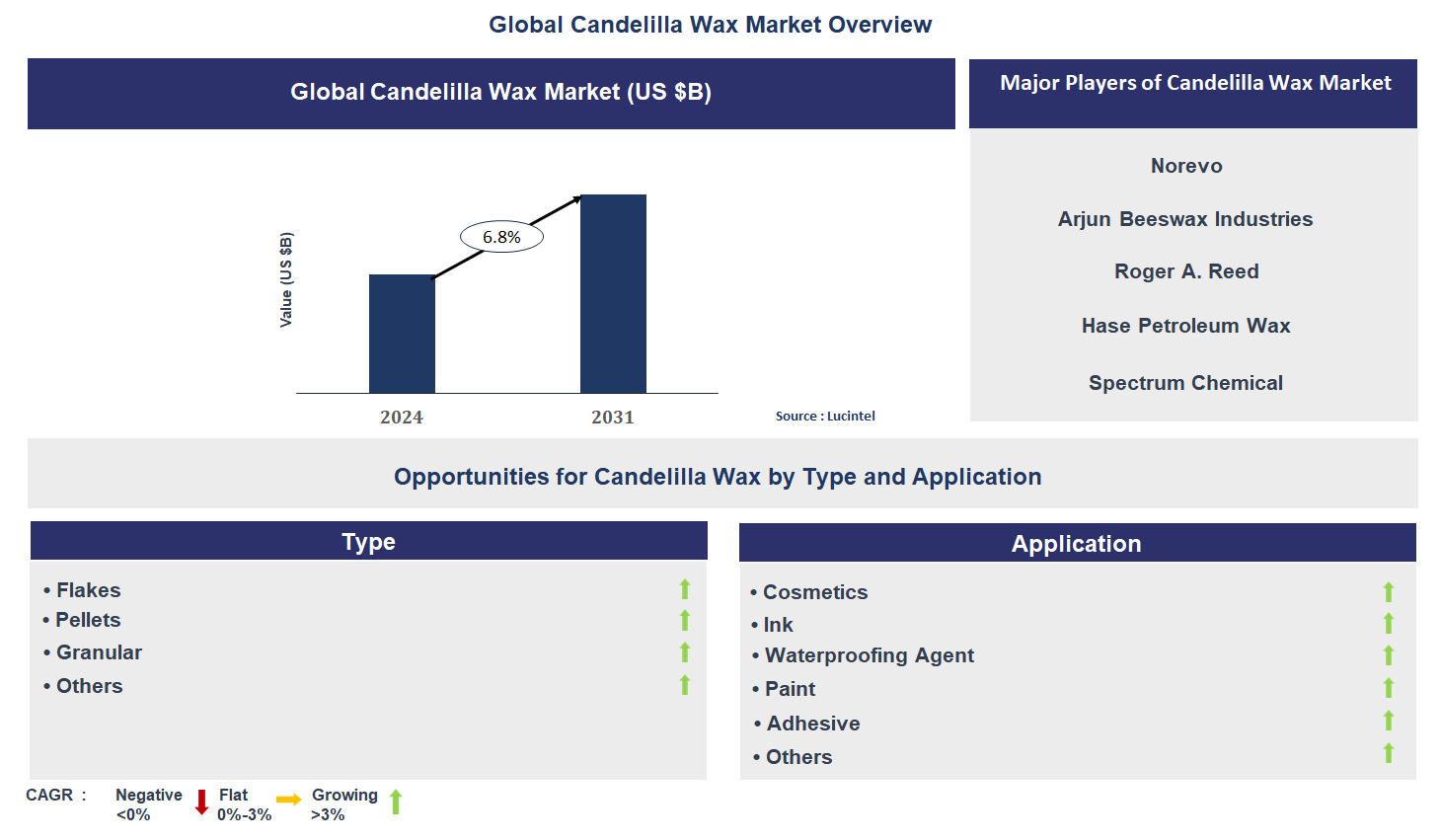
Key data points: The growth forecast = 6.8% annually for the next 7 years. Scroll below to get more insights. This market report covers trends, opportunities and forecasts in candelilla wax market to 2031 by type (flakes, pellets, granular, and others), application (cosmetics, ink, waterproofing agent, paint, adhesive, and others), and region (North America, Europe, Asia Pacific, and the Rest of the World)
We'll send your sample report shortly.
• Lucintel forecasts that, within the type category, pellet is expected to witness the highest growth over the forecast period.
• Within the application category, cosmetic is expected to witness the highest growth.
• In terms of region, APAC is expected to witness the highest growth over the forecast period. Gain valuable insights for your business decisions with our comprehensive 150+ page report. Sample figures with some insights are shown below.
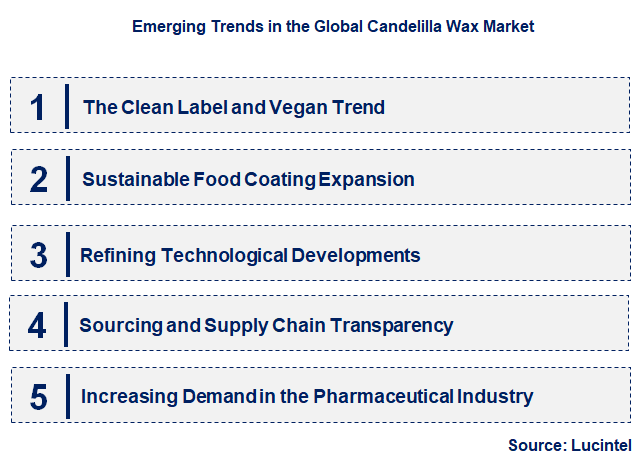
• The Clean Label and Vegan Trend: The most promising trend is the increasing desire for "clean label" and vegan items. Consumers are paying closer attention to the ingredients used in products, seeking natural and plant-based alternatives for artificial or animal-based ingredients such as beeswax. This trend is a big propellant for candelilla wax, making it the go-to vegan wax in cosmetics, personal care, and food lines. This is compelling manufacturers to promote their products as being plant-based and cruelty-free.
• Sustainable Food Coating Expansion: An impending trend is to employ candelilla wax as an edible and sustainable coating for fruits, vegetables, and confectionery. This is because it is focused on minimizing food wastage and fresh produce shelf-life extension. The natural character of the wax forms a shield that retains moisture and prevents microbial development. This is an important market growth area offering a new high-value use outside cosmetics.
• Refining Technological Developments: One of the most important trends is ongoing refinement and processing improvement of candelilla wax. New technologies are being created to enhance the purity, color, and viscosity of the wax. This enables producers to make various grades for particular uses, e.g., wax for tablet coating by the pharmaceutical industry or high-gloss wax for high-end cosmetics. This is assisting the market in alleviating issues of quality control and responding to the high demands of high-value sectors.
• Sourcing and Supply Chain Transparency: There is a high trend towards transparency and ethical sourcing in the candelilla wax supply chain. The wild-harvested characteristic of the wax necessitates careful management to guarantee sustainability and adequate compensation for local harvesters. Businesses are addressing this by adopting certification schemes and traceability systems in order to guarantee customers that the wax is produced ethically and sustainably. This is a key driver in marketing and brand reputation.
• Increasing Demand in the Pharmaceutical Industry: The pharmaceutical industry is a new growth area for candelilla wax. Due to its characteristics as a binder, excipient, and coating material, it is being utilized in the manufacturing of tablets and drug delivery systems. With the movement of the pharmaceutical industry toward natural and vegetable-based excipients, candelilla wax is picking up momentum. The trend is influenced by the demand for stable, non-toxic, and functional ingredients in pharmaceutical preparations. These trends are redefining the market by shifting it towards higher value, specialization, and sustainability. The future of the candelilla wax market is characterized by being able to take advantage of these new opportunities while maintaining a transparent and responsible supply chain.
• Certification and Sustainability Programs: One of the most important recent developments is the emergence of certification schemes and sustainability programs in the candelilla wax sector. These schemes are intended to ensure the wax is harvested on a sustainable basis and local communities are paid a fair price. This development directly addresses consumer and corporate pressure for sustainable products and is boosting the industrys reputation and long-term sustainability.
• Product Formulation Innovation: Another significant development is the product formulation innovation using candelilla wax as a primary ingredient. Companies are creating new personal care and cosmetic products, including vegan lipsticks, organic sunscreens, and natural moisturizers, which emphasize the utilization of candelilla wax. This trend is growing the products application base and establishing new, high-growth market segments.
• Strategic Emphasis on Food and Pharmaceutical Applications: There is an observable trend in the strategic emphasis of market leaders on the food and pharmaceutical industries. Firms are committing research to identifying new applications for candelilla wax as a food additive (E 902) and a pharmaceutical excipient. This trend is expanding the market outside cosmetics and personal care and into new, high-value revenue streams that are less subject to consumer whims.
• Expansion of the E-commerce and Direct-to-Consumer Channels: One key development is the expansion of e-commerce and direct-to-consumer sales channels. These channels provide platforms whereby smaller, artisanal companies can sell products containing Candelilla wax directly to consumers looking for natural and sustainable ingredients. This trend is opening up the market and offering opportunities to a broader spectrum of producers and formulators.
• Mexican Harvesters Partnerships and Collaborations: The recent trend involves strategic partnerships and collaborations between global wax producers and Mexican candelilla wax harvesters. These collaborations are designed to secure a stable and ethical supply chain. This trend is assisting in the professionalization of the harvesting process and providing a regular supply of high-quality wax to cater to the needs of the global market. These advances are influencing the marketplace by promoting a more technologically oriented and specialized strategy. The emphasis has moved from a bulk commodity to a high-value specialty ingredient, with a high priority given to quality, safety, and supply chain reliability.
• Growth in the Vegan Personal Care and Cosmetic Market: The biggest strategic opportunity is the growing vegan personal care and cosmetic market. Candelilla wax is a high-quality, plant-based substitute for beeswax, and its application in lip balms, lipsticks, and creams is increasing exponentially. The opportunity is to place the wax at the center of these products and sell it to customers who are consciously looking for cruelty-free and natural beauty solutions.
• Fruit and Confectionery Food-Grade Coatings: A leading strategic opportunity is offered by the food and beverage sector. Candelilla wax is listed as a food additive (E 902) and may be employed as a glazing compound for confectionery or a protective coating for fruit and vegetables. The niche market is to supply high-quality, food-grade candelilla wax to firms seeking natural means to increase shelf life of their products and satisfy consumer demand for clean labels.
• High-Value Pharmaceutical Excipients: The pharmaceutical sector is a high-value growth prospect. Candelilla wax is applicable as a binder, tablet coat, or excipient in controlled-release drug delivery. With its natural origin and low toxicity, it is a good alternative to artificial excipients. The strategy should be to manufacture and market high-purity, pharmaceutical-grade candelilla wax that has the industrys strict quality and safety requirements.
• Eco-Friendly and Sustainable Polishes: Industrial uses of candelilla wax, especially in leather and furniture polishes, present a strategic opportunity. With consumers and companies becoming more focused on green alternatives to petroleum-based polishes, candelilla wax, due to its protective and high-gloss properties, is a natural replacement. The potential is to position the wax as a green alternative in this market.
• Artisanal and DIY Product Formulations: Expansion of the artisanal and DIY market for cosmetic and personal care products presents a special strategic opportunity. Candelilla wax has become a favorite in small-batch formulations for small-scale formulators to formulate their own lip balms, lotions, and salves. The strategy is to offer candelilla wax in small packaging, along with instructional materials and formulations, to support this new, expanding consumer base. These growth opportunities of a strategic nature are affecting the market by promoting more segmentation and value-driven positioning. The emphasis is on moving away from a mere bulk chemical commodity to a highly specialized ingredient with a range of uses.
• Norevo
• Arjun Beeswax Industries
• Roger A. Reed
• Hase Petroleum Wax
• Spectrum Chemical
• Paramold Manufacturing
• Crystal
• Poth Hille
• Koster Keunen
• International Group
• Flakes
• Pellets
• Granular
• Others
• Cosmetics
• Ink
• Waterproofing Agent
• Paint
• Adhesive
• Others
• North America
• Europe
• Asia Pacific
• The Rest of the World
• United States: The United States candelilla wax market is dominated by the organic and clean beauty trends. Current trends comprise an increased consumer preference for natural, sustainable cosmetic and personal care products, in which candelilla wax takes center stage as a main constituent. The industry is also experiencing more investment in research and development to identify new uses in pharmaceutical excipients and food coatings. Companies are also busy ensuring that there is an open and honest supply chain, which is high on American consumers agendas, who are now more concerned with the origin of their products.
• China: China is a large consumer and increasingly a producer of candelilla wax. Growth is fueled by the countrys booming cosmetics and personal care sector and an expanding middle class with higher purchasing power. Demand for premium and natural beauty products is skyrocketing, which is driving the application of candelilla wax. Chinas food and beverage sector is also a major market for candelilla wax use in glazing and coatings applications. The market is also witnessing investments in technology to enhance the quality of domestically available wax to international standards.
• Germany: The German candelilla wax market is dominated by a high focus on high-quality, ethically sourced ingredients. The latest trends are centered around its application in the natural and organic cosmetics market, which is one of the prime market segments in Germany. The nation also boasts a strong manufacturing platform for specialty chemicals and pharma, where candelilla wax is applied as a binder and coating agent. German companies are leading the way to ensure traceability and sustainability in their supply chains by working with suppliers in Mexico and the U.S. to ensure responsible sourcing.
• India: The Indian candelilla wax market is growing at a fast pace, led by the growth of the cosmetics and personal care segment and increasing health awareness among consumers. Recent trends have included an increasing demand for herbal and ayurvedic-based offerings, where natural waxes form an essential constituent. The food segment, especially in confectionery and snacks, is also a large consumer base. The market is experiencing growth in domestic refining and processing to meet the increasing demand and decrease dependency on imports.
• Japan: Japans market for candelilla wax is mature and specialty-focused. Current trends revolve around its use in high-performance, multi-functional cosmeceutical and skincare products. The Japanese market is renowned for its emphasis on product innovation and quality. Candelilla wax is employed for its distinctive film-forming and emulsifying abilities in lipsticks, creams, and sunscreens. The market also witnesses increasing demand for it to be utilized as a food coating to preserve the shelf life of fresh fruits and vegetables, keeping in view the countries emphasis on food safety and waste reduction.


• Norevo
• Arjun Beeswax Industries
• Roger A. Reed
• Hase Petroleum Wax
• Spectrum Chemical
• Paramold Manufacturing
• Crystal
• Poth Hille
• Koster Keunen
• International Group Q5. Which candelilla wax market segment will be the largest in future? Answer: Lucintel forecasts that, within the type category, pellet is expected to witness the highest growth over the forecast period. Q6. In candelilla wax market, which region is expected to be the largest in next 5 years? Answer: In terms of region, APAC is expected to witness the highest growth over the forecast period. Q7. Do we receive customization in this report? Answer: Yes, Lucintel provides 10% customization without any additional cost.


Choose a license that fits your team. Instant PDF delivery.
Prices exclude taxes. Instant delivery. Custom licensing available on request.
Market Report · July 22, 2026
Market Report · July 22, 2026
Market Report · July 22, 2026
Trusted partner for strategic intelligence and business growth


Receive a complimentary market analysis tailored to your industry. Our analysts will identify key growth opportunities and competitive dynamics specific to your business.

Market size, growth rate, and key trend analysis for your specific sector.

Top competitor positioning and market share analysis.

Strategic recommendations backed by data-driven insights.
Get curated market intelligence and competitive moves straight to your inbox.
By subscribing, you agree to receive our monthly insights. Unsubscribe anytime.
Receive a complimentary market analysis tailored to your industry. Our analysts will identify key growth opportunities and competitive dynamics specific to your business.
Market size, growth rate, and key trend analysis for your specific sector.
Top competitor positioning and market share analysis.
Strategic recommendations backed by data-driven insights.
Get curated market intelligence, emerging trends, and competitive moves straight to your inbox each month.
By subscribing, you agree to receive our monthly insights. Unsubscribe anytime.
We'll send your sample report shortly.