
Market Report · July 15, 2026

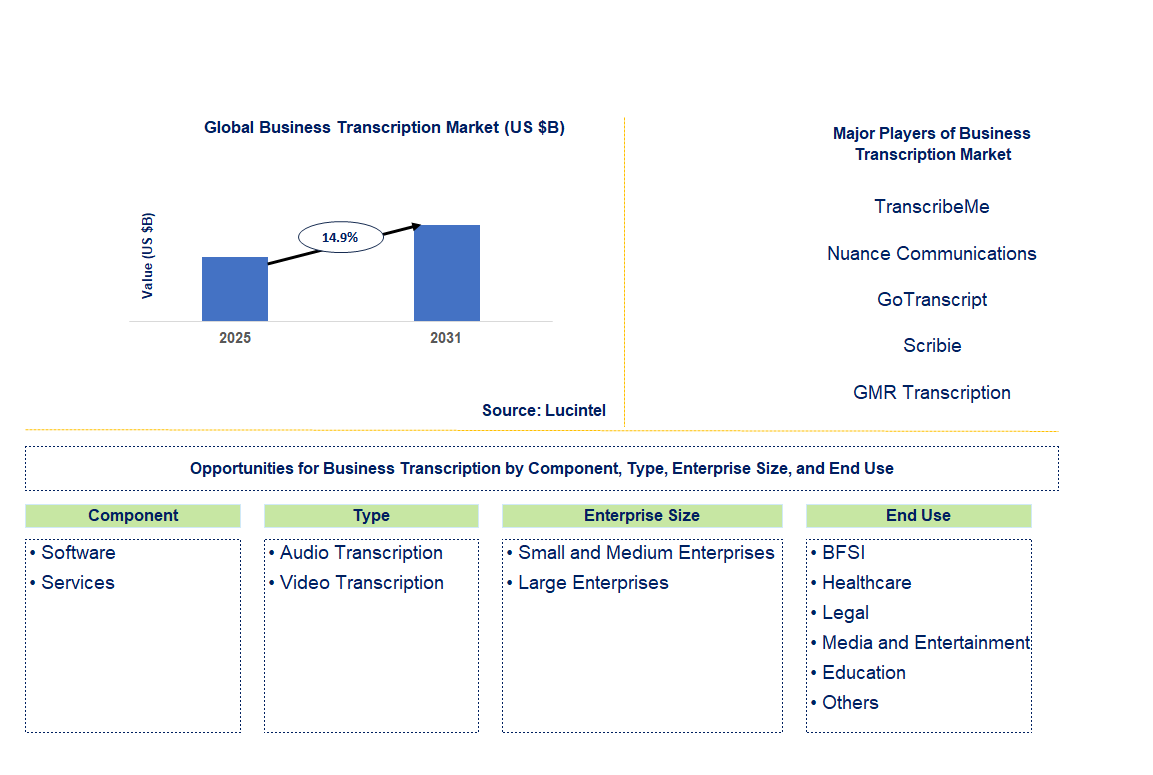
Key data points: The growth forecast = 14.9% annually for the next 7 years. Scroll below to get more insights. This market report covers Trends, opportunity and forecast in business transcription market to 2031 by component (software and services), type (audio transcription and video transcription), enterprise size (small and medium enterprises and large enterprises), end use (BFSI, healthcare, legal, media and entertainment, education, and others), and region (North America, Europe, Asia Pacific, and the Rest of the World)
We'll send your sample report shortly.
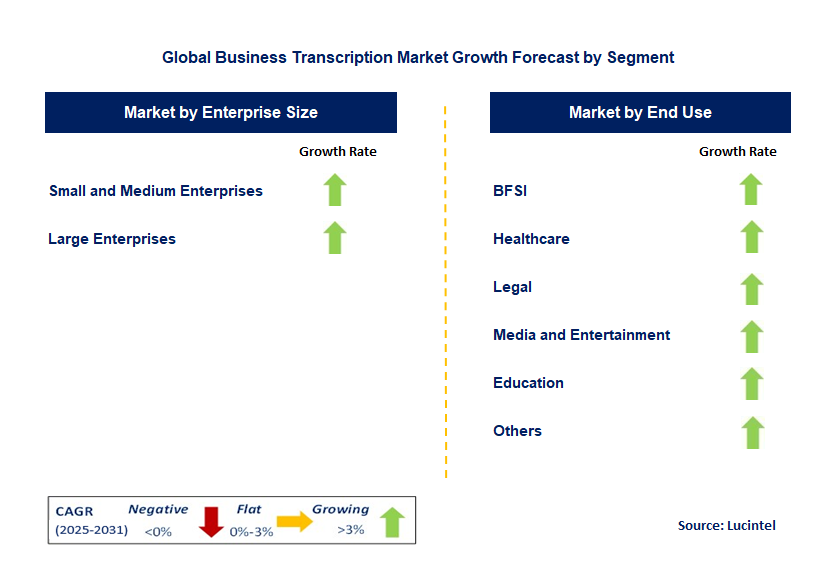
• Lucintel forecasts that, within the enterprise size category, large enterprises will remain larger segment over the forecast period.
• Within the end use category, healthcare is expected to witness the highest growth.
• In terms of region, APAC is expected to witness the highest growth over the forecast period. Gain valuable insights for your business decisions with our comprehensive 150+ page report. Sample figures with some insights are shown below.
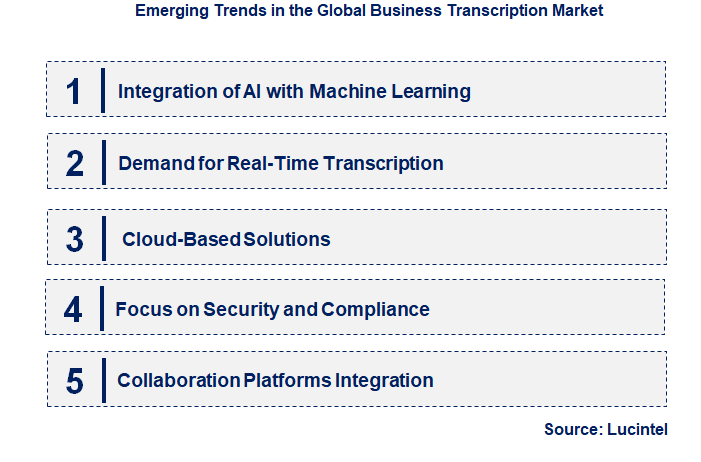
• Integration of AI with Machine Learning: These technologies allow for real-time transcription by automating voice recognition, reducing human error, and enhancing delivery rates. This makes it possible for organizations to quickly process voluminous audio data, thus improving turnaround time while cutting down on expenses. They also enable the system to accommodate different accents and dialects, making transcription versatile across many sectors.
• Demand for Real-Time Transcription: With the increasing adoption of remote work and virtual meetings, firms require real-time transcription services during live calls, conferences, and webinars. This is driven by the need to have instant documentation, as well as a growing dependence on digital collaboration tools. When meetings and talks are accurately recorded in real time, this mode allows easy follow-ups, enhances easy access, and provides extensive business information coverage.
• Cloud-Based Solutions: Cloud computing is revolutionizing business transcription services by enabling easy storage, sharing, and access to transcriptions across various devices and platforms. On top of being scalable, flexible, and secure, cloud-based solutions provide more functionality. Businesses can use these capabilities for real-time collaboration within large transcription projects, which can also be used in other software tools, thus enhancing data security measures for sensitive information.
• Focus on Security and Compliance: Due to the handling of highly confidential corporate information, security and regulatory compliance are becoming increasingly important considerations when choosing transcription services. Companies are looking for transcription options that conform to data protection legislations such as GDPR or HIPAA. This shift emphasizes the importance of safe encryption techniques, secure data storage systems with audit trails, ensuring that customer details remain protected and classified according to confidentiality agreements while complying with rules instituted by law.
• Collaboration Platforms Integration: It is clear that transcription services are currently being integrated with well-known collaboration platforms such as Slack, Zoom, and Microsoft Teams. These connections facilitate workflow integration, where transcriptions take place automatically and are saved in these systems, simplifying the process for organizations. Instead of bridging from one platform to another, embedding transcription capabilities directly into communication tools saves time for other tasks within an organization. By increasing efficiency, accessibility, and security of transcription processes, the above-mentioned trends have transformed the business transcription market. With faster, more precise, and secure transcription services that seamlessly integrate with their existing business tools, companies can now rely on improved versions. These developments have also made it cheaper and easier to use transcriptions, thereby enabling businesses to grow their operations and enhance team communications. In essence, the coming together of these emerging forces lays the foundation for stronger, adaptive business-oriented transcription products.
• Integration of AI and Machine Learning: With their ability to provide live transcriptions, voice recognition, and improve the accuracy of the translation process, AI and ML technologies have radically changed traditional methods of transcription. Transcription automation using these technologies has greatly reduced human error, increasing productivity in businesses and enabling them to handle more data at a faster rate. Speech recognition systems that apply artificial intelligence technology can be adjusted according to various accents or dialects; this versatility is most applicable in industries like healthcare, law, and finance.
• The Booming Demand for Real-Time Transcription Services: The increasing use of remote work and virtual meetings has significantly increased the need for real-time transcription services. During live conferencing, calls, and webinars, businesses require accurate transcriptions to have immediate documentation. In this way, organizations improve team collaboration and can access meeting insights instantly, which enhances decision-making processes and enables prompt follow-ups. Consequently, businesses striving to achieve productivity in the digital era are now including real-time transcription as one of their essential activities.
• Using Cloud-Based Solutions: Cloud computing is revolutionizing business transcription by enabling storage, access, and sharing of transcriptions on a secure and scalable platform. By allowing teams to collaborate on large transcription projects simultaneously, cloud solutions promote teamwork. They also offer more security and privacy for confidential data within industries like the legal and healthcare sectors. It is, therefore, necessary for companies to invest in cloud-based solutions to obtain affordable but flexible transcription services.
• Security and Compliance Take Center Stage: The business transcription market is currently facing concerns over data privacy and confidentiality, which have escalated security and regulatory compliance to the top of the agenda. Transcription services are being developed to meet various regulations, such as GDPR and HIPAA, enabling businesses to securely handle confidential information. Complying has necessitated the adoption of encrypted storage systems, secure methods of sharing data, and stringent audit trails, offering peace of mind when handling sensitive data.
• Collaboration Platform Integration: One of the most significant trends in the business transcription market is the integration of transcription services into collaboration platforms like Zoom, Slack, and Microsoft Teams. Through these integrations, transcriptions can be automatically generated within collaboration tools and saved directly, thus streamlining workflows and increasing productivity. Businesses can now easily access meeting transcriptions, enhancing team communication and eliminating the need to switch between platforms. This enables easier transcription and saves time for employees, allowing them to focus on core responsibilities. In conclusion, these new trends have completely changed the business transcription sector by improving its effectiveness and efficiency. Transcription services are becoming faster and more accurate through AI and ML technologies, while real-time transcription is enabling better collaboration. Security-focused services in cloud-based solutions are enhancing both security and scalability of transcription systems. This has made it possible to integrate them with collaboration tools, simplifying workflows and saving time for companies, which is contributing to the growth of the entire market.
• Real-Time Transcription for Remote Teams: Remote work is rapidly becoming more common, creating a substantial opportunity for firms to implement real-time transcription services during virtual meetings or collaborations. As enterprises use digital tools such as video conferencing more frequently, a real-time text transcript can ensure accurate recording of meeting discussions, leading to better cooperation, follow-ups, and information sharing. This enables enterprises to enhance communication even among geographically dispersed teams.
• Healthcare Transcription: The healthcare industry offers immense potential for transcription services, especially in clinical documentation and patient records. AI-enabled transcription tools can quickly transcribe medical reports and doctor-patient conversations, enhancing the efficiency of healthcare delivery and minimizing administrative hassles. Consequently, the increased demand for transcription services in the healthcare sector has prompted the adoption of HIPAA-compliant systems.
• Legal Compliance Transcription: The legal and compliance sectors are among the primary users of transcription services that place a premium on precision and confidentiality. To satisfy the requirements of courts, law enforcement agencies, and legal practitioners, depositions, hearings, and interviews must be transcribed. As regulations become more intricate, these industries require unassailable documentation, creating a need for tailored transcription solutions. This provides an opportunity for growth by businesses that offer specialized legal transcription services.
• Multilingual Transcription for Market Expansion: In this globalized age, companies are becoming increasingly international and, therefore, require transcription services in many languages. AI-driven multilingual transcription services enable companies to easily expand their customer base into other countries. This is particularly relevant to industries like finance, media, and customer support, where language barriers must be overcome for effective communication across global teams and audiences.
• Voice-Activated Transcription Solutions: For companies looking to streamline their transcription processes, voice-activated transcription tools present an innovative growth area. These tools use AI-enabled speech recognition technology to automatically transcribe audio and video content into written form with minimal human intervention. This is especially important in sectors such as advertising, publishing, and after-sales service, where fast conversion of high-volume content is necessary. These strategic growth opportunities position businesses to leverage emerging trends in the transcription market. As remote work, healthcare, legal, multilingual communication, and voice-activated solutions continue to evolve, businesses are increasingly adopting transcription services that meet their specific needs. Such applications open new avenues for expansion, driving the overall growth of the broader transcription market.
• TranscribeMe
• Nuance Communications
• GoTranscript
• Scribie
• GMR Transcription
• Way With Words
• Speechpad
• Software
• Services
• Audio Transcription
• Video Transcription
• North America
• Europe
• Asia Pacific
• The Rest of the World
• United States: The United States has witnessed a rising demand for enterprise records transcription, especially in medicine and banking. Transcription services have increasingly become part of AI-driven technologies like machine learning, enhancing precision and efficiency in telemedicine, while the digital banking industry continues to grow. Also significant is the use of transcription services by legal practitioners and media companies, which speeds up processing times for court hearings and media interviews, among other corporate documents. Additionally, the regulatory framework is spurring growth in transcription, as sectors like healthcare now require high levels of compliance for specific reasons.
• China: The Chinese market for the written conversion of spoken words has expanded rapidly due to the use of AI and speech-to-text software, which are widely used in healthcare and education. The rising demand for scalable and accurate solutions is being addressed through AI transcription tools. Furthermore, the Chinese government has adopted a pro-AI stance, encouraging citizens to embrace digitalization across sectors, leading to an increase in demand. This trend is fueled by the rise of e-commerce and online customer care, which requires transcription of customer interactions and service logs.
• Germany: Germany has focused on improving transcription services, particularly in law, healthcare, and corporate environments, with an emphasis on integrating speech recognition technologies. Healthcare regulations and financial legislation require accurate documentation, making transcription services essential. Germany's strong legal and insurance industries increasingly use transcription services for court proceedings, legal papers, and processing claims. Additionally, industrial automation trends are driving the adoption of transcription solutions across various sectors.
• India: India is a hub for transcription outsourcing due to the availability of affordable, skilled labor. Indian companies and outsourcing firms are adopting advanced transcription technologies such as speech recognition and natural language processing (NLP) to offer global services. The healthcare sector, in particular, benefits from the rapid growth of medical records and patient consultation transcription services. Furthermore, the rise of e-commerce and customer support industries has led to an increased use of transcription services to handle customer queries and feedback in multiple languages.
• Japan: The Japanese transcription market is growing primarily due to its healthcare and legal sectors. Japanese firms utilize AI-powered transcription tools to meet stringent documentation standards required by regulations. In healthcare, accurate documentation is essential, especially in medical transcriptions. Additionally, corporate Japan has begun using transcription services to enhance meeting notes, conference calls, and internal communications. The country's focus on automation and technological innovation has also made it a strong adopter of transcription services across different sectors.


• TranscribeMe
• Nuance Communications
• GoTranscript
• Scribie
• GMR Transcription
• Way With Words
• Speechpad Q5. Which business transcription market segment will be the largest in future? Answer: Lucintel forecasts that large enterprises will remain larger segment over the forecast period. Q6. In business transcription market, which region is expected to be the largest in next 5 years? Answer: APAC is expected to witness the highest growth over the forecast period. Q7. Do we receive customization in this report? Answer: Yes, Lucintel provides 10% customization without any additional cost.


Choose a license that fits your team. Instant PDF delivery.
Prices exclude taxes. Instant delivery. Custom licensing available on request.
Market Report · July 15, 2026
Market Report · June 26, 2026
Market Report · June 24, 2026
Trusted partner for strategic intelligence and business growth


Receive a complimentary market analysis tailored to your industry. Our analysts will identify key growth opportunities and competitive dynamics specific to your business.

Market size, growth rate, and key trend analysis for your specific sector.

Top competitor positioning and market share analysis.

Strategic recommendations backed by data-driven insights.
Get curated market intelligence and competitive moves straight to your inbox.
By subscribing, you agree to receive our monthly insights. Unsubscribe anytime.
Receive a complimentary market analysis tailored to your industry. Our analysts will identify key growth opportunities and competitive dynamics specific to your business.
Market size, growth rate, and key trend analysis for your specific sector.
Top competitor positioning and market share analysis.
Strategic recommendations backed by data-driven insights.
Get curated market intelligence, emerging trends, and competitive moves straight to your inbox each month.
By subscribing, you agree to receive our monthly insights. Unsubscribe anytime.
We'll send your sample report shortly.