
Market Report · July 31, 2026

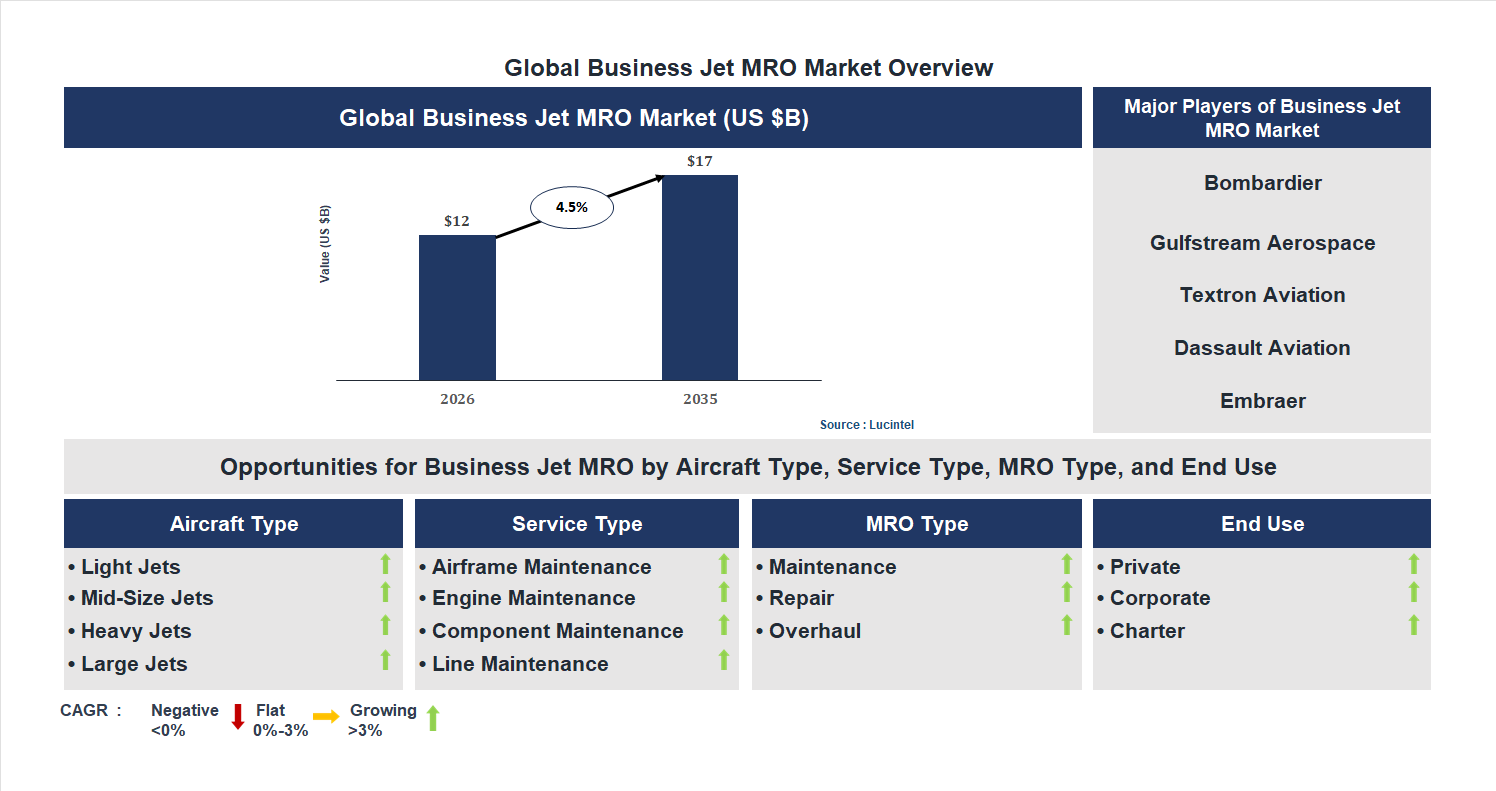
Key data points: The market size in 2035 = $17 billion, growth forecast = 4.5% annually for the next 8 years. Scroll below to get more insights. This market report covers trends, opportunities and forecasts in business jet MRO market to 2035 by aircraft type (light jets, mid-size jets, heavy jets, and large jets), service type (airframe maintenance, engine maintenance, component maintenance, and line maintenance), MRO type (maintenance, repair, and overhaul), end use (private, corporate, and charter), and region (North America, Europe, Asia Pacific, and the Rest of the World)
We'll send your sample report shortly.
• Lucintel forecasts that, within the aircraft type category, light jet is expected to witness the highest growth over the forecast period.
• Within the end use category, private is expected to witness the highest growth.
• In terms of region, APAC is expected to witness the highest growth over the forecast period. Gain valuable insights for your business decisions with our comprehensive 150+ page report. Sample figures with some insights are shown below.
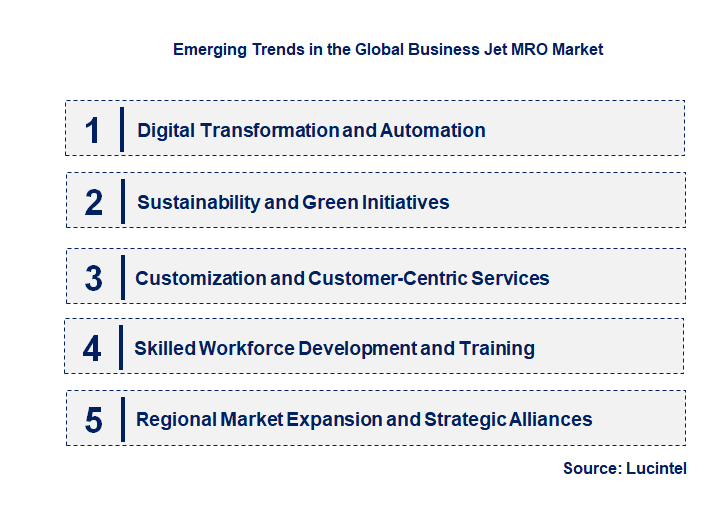
• Digital Transformation and Automation: The integration of digital technologies such as AI, IoT, and data analytics is revolutionizing MRO processes. Automated diagnostics and predictive maintenance enable faster turnaround times, reduce downtime, and lower costs. Digital records improve traceability and compliance, while virtual reality assists in training and repairs. This trend enhances operational efficiency, minimizes errors, and offers personalized services, ultimately leading to increased customer satisfaction and competitive differentiation.
• Sustainability and Green Initiatives: Increasing environmental awareness is prompting MRO providers to adopt eco-friendly practices. This includes the use of sustainable materials, waste reduction, and energy-efficient operations. Innovations like alternative fuels and carbon offset programs are gaining traction. These initiatives not only reduce the environmental footprint but also align with regulatory requirements and customer preferences for sustainable travel. Emphasizing green practices helps companies enhance brand reputation and meet the growing demand for eco-conscious services.
• Customization and Customer-Centric Services: The market is shifting towards highly personalized MRO solutions tailored to individual client needs. This includes flexible scheduling, on-site services, and bespoke maintenance packages. Advanced customer portals and real-time communication improve transparency and engagement. By focusing on customer-centric approaches, providers can foster loyalty, improve service quality, and differentiate themselves in a competitive landscape, ultimately driving revenue growth.
• Skilled Workforce Development and Training: As technology becomes more sophisticated, the need for highly skilled technicians increases. MRO providers are investing in advanced training programs, including virtual reality and simulation-based learning, to enhance workforce capabilities. Attracting and retaining talent is critical amid a competitive labor market. A well-trained workforce ensures high-quality maintenance, safety compliance, and operational reliability, which are vital for customer trust and market reputation.
• Regional Market Expansion and Strategic Alliances: Emerging markets in Asia-Pacific, Middle East, and Africa are witnessing increased demand for business jet services. MRO providers are expanding their footprints through regional facilities and strategic partnerships to tap into these growth areas. Collaborations with OEMs and local service providers facilitate market entry and enhance service offerings. This trend enables companies to diversify revenue streams, reduce logistical complexities, and better serve regional clients, thereby strengthening their global presence. These trends are collectively transforming the business jet MRO market by fostering innovation, sustainability, customer focus, workforce excellence, and geographic expansion. They are driving increased efficiency, environmental responsibility, and market competitiveness, ultimately shaping a more resilient and forward-looking industry landscape.
• Technological Innovations in Maintenance: The integration of AI, IoT, and predictive analytics is revolutionizing MRO services. These technologies enable real-time monitoring of aircraft health, predictive maintenance, and reduced downtime, leading to cost savings and improved safety. As a result, operators can optimize schedules and extend aircraft lifespan, boosting overall efficiency and customer satisfaction.
• Growing Demand for Sustainable Solutions: Environmental regulations and rising eco-consciousness are pushing the industry toward sustainable practices. Companies are adopting eco-friendly materials, fuel-efficient engines, and waste reduction techniques. This shift not only helps comply with regulations but also appeals to environmentally conscious clients, enhancing brand reputation and opening new market segments focused on green aviation.
• Expansion of Regional Markets: Emerging markets in Asia-Pacific and the Middle East are witnessing increased business jet ownership and fleet expansion. This growth creates a substantial demand for localized MRO services, infrastructure development, and skilled workforce training. Market players are establishing regional hubs to capitalize on these opportunities, fostering economic growth and increasing service accessibility in these regions.
• Digitalization of MRO Processes: The adoption of digital platforms for inventory management, workflow automation, and customer engagement is streamlining operations. Digitalization reduces errors, enhances transparency, and accelerates turnaround times. This transformation improves operational efficiency, reduces costs, and provides a competitive edge, especially as clients demand more integrated and responsive services.
• Strategic Partnerships and Mergers: Collaborations between OEMs, MRO providers, and technology firms are driving innovation and expanding service portfolios. Mergers and acquisitions are enabling companies to access new markets, share expertise, and develop comprehensive maintenance solutions. These strategic moves strengthen market positioning and foster a more resilient, adaptable industry landscape. These developments are significantly impacting the business jet MRO market by enhancing operational efficiency, expanding regional reach, and promoting sustainable practices. The integration of advanced technologies and strategic collaborations is fostering innovation, reducing costs, and improving customer experience. As a result, the market is poised for sustained growth, attracting new entrants and increasing competition, ultimately benefiting end-users with better, more reliable services.
• Maintenance, Repair, and Overhaul (MRO) Services for Aging Fleet: The increasing number of aging business jets necessitates comprehensive MRO services to ensure safety, compliance, and operational efficiency. This presents opportunities for specialized maintenance providers to offer tailored solutions, including component repairs, structural refurbishments, and system upgrades. Growing demand for predictive maintenance and digital diagnostics further enhances prospects for innovative service offerings, enabling operators to extend aircraft lifespan and reduce downtime.
• Expansion of Cabin Customization and Retrofit Solutions: As owners seek personalized and upgraded interiors, the market for cabin customization and retrofit services is expanding. Opportunities include installing advanced entertainment systems, luxurious furnishings, and eco-friendly materials. Retrofits also encompass modern avionics, lighting, and connectivity enhancements, catering to evolving passenger preferences. This segment offers high-margin projects, especially for pre-owned aircraft, and supports operators in maintaining aircraft value and competitiveness.
• Adoption of Sustainable Technologies and Green MRO Practices: The push for sustainability is transforming the MRO landscape, with opportunities in implementing eco-friendly maintenance practices and green technologies. This includes the use of sustainable materials, waste reduction, and energy-efficient processes. MRO providers investing in green certifications and environmentally conscious solutions can attract environmentally aware clients, reduce operational costs, and comply with evolving regulations, positioning themselves as industry leaders in sustainable aviation maintenance.
• Digital Transformation and Predictive Maintenance Solutions: The integration of digital tools and IoT-enabled diagnostics is revolutionizing MRO operations. Predictive maintenance reduces unexpected failures, minimizes downtime, and optimizes inventory management. Opportunities lie in developing advanced analytics platforms, remote monitoring, and AI-driven diagnostics. These innovations improve service efficiency, lower costs, and enhance safety, making them attractive investments for MRO providers aiming to deliver smarter, more reliable maintenance services.
• Growing Demand for Regional and On-Demand MRO Services: The rise of regional operators and on-demand maintenance services creates new market avenues. Smaller MRO providers can capitalize on localized needs, offering quick turnaround times and cost-effective solutions. This trend is driven by increasing flight activity in emerging markets and the need for flexible, responsive maintenance options. Developing regional hubs and mobile maintenance units can help providers capture market share and support the expanding global business jet fleet. The overall market outlook is positively influenced by these growth opportunities, fostering innovation, sustainability, and customer-centric services. Companies that strategically invest in these segments will strengthen their competitive position, meet evolving client demands, and drive long-term growth in the business jet MRO market.
• Technological Advancements: The integration of digital tools, predictive maintenance, and automation enhances efficiency and reduces downtime. These innovations enable quicker diagnostics, streamlined workflows, and improved safety standards, making maintenance more cost-effective and reliable. As aircraft become more sophisticated, the demand for advanced MRO services grows, encouraging service providers to adopt cutting-edge technologies to stay competitive and meet evolving client expectations.
• Growing Business Jet Fleet: An increase in the global fleet of business jets, driven by rising corporate wealth and demand for private travel, directly boosts the need for maintenance, repair, and overhaul services. As more aircraft are introduced into service, the requirement for regular maintenance, upgrades, and compliance checks intensifies, creating a steady revenue stream for MRO providers and expanding market opportunities.
• Regulatory and Safety Standards: Stringent safety regulations and certification requirements imposed by authorities such as the FAA and EASA necessitate regular inspections, upgrades, and compliance measures. These regulations ensure safety but also increase the complexity and cost of maintenance activities, prompting MRO providers to invest in specialized training and facilities to meet compliance standards, thereby influencing market dynamics.
• Economic Growth and Corporate Travel Trends: Economic stability and growth in key regions lead to increased corporate travel, which in turn elevates demand for business jets and their maintenance. Conversely, economic downturns or travel restrictions can reduce fleet utilization, impacting MRO revenue. Fluctuations in fuel prices and currency exchange rates also influence operational costs and profitability within the market.
• Environmental Regulations and Sustainability Initiatives: Increasing emphasis on reducing carbon emissions and environmental impact compels MRO providers to adopt eco-friendly practices, such as lightweight materials and fuel-efficient upgrades. These initiatives require additional investments but can also open new revenue streams through sustainable maintenance solutions, shaping the future landscape of the market. The challenges facing the business jet MRO market include:
• High Maintenance Costs: The complexity of modern business jets and the need for specialized skills lead to elevated maintenance expenses. These costs can be a barrier for fleet expansion or renewal, especially for smaller operators. Additionally, the high cost of spare parts and advanced diagnostic tools can strain budgets, impacting profitability and market growth.
• Skilled Workforce Shortage: The industry faces a significant shortage of qualified technicians and engineers with expertise in advanced aircraft systems. This talent gap hampers timely maintenance, increases labor costs, and can compromise safety standards. Addressing this challenge requires substantial investment in training and workforce development, which may slow down market expansion.
• Regulatory Compliance and Certification Delays: Navigating the complex regulatory landscape can cause delays in maintenance approvals and certifications. These delays increase downtime and operational costs, affecting customer satisfaction and profitability. Evolving regulations also demand continuous updates to procedures and training, adding to the operational burden for MRO providers. The business jet MRO market is shaped by technological innovations, fleet growth, regulatory standards, economic trends, and sustainability efforts. While these drivers present significant opportunities for growth and modernization, challenges such as high costs, workforce shortages, and regulatory hurdles pose risks that require strategic management. The interplay of these factors will determine the market’s trajectory, influencing investment decisions, service offerings, and competitive positioning in the coming years. Stakeholders must adapt to technological changes, address workforce needs, and navigate regulatory complexities to sustain growth and capitalize on emerging opportunities.
• Bombardier
• Gulfstream Aerospace
• Textron Aviation
• Dassault Aviation
• Embraer
• Honeywell Aerospace
• Rockwell Collins
• Light Jets
• Mid-Size Jets
• Heavy Jets
• Large Jets
• Airframe Maintenance
• Engine Maintenance
• Component Maintenance
• Line Maintenance
• Maintenance
• Repair
• Overhaul
• Private
• Corporate
• Charter
• North America
• Europe
• Asia Pacific
• The Rest of the World
• United States: The US market remains the largest for Business Jet MRO, with major players investing heavily in digital transformation and sustainable maintenance practices. Recent developments include the adoption of AI-driven diagnostics and increased focus on environmentally friendly materials and processes. The Federal Aviation Administration (FAA) has introduced new regulations to enhance safety standards, prompting upgrades in existing MRO facilities. Additionally, regional MRO hubs are expanding to support the growing fleet of private and corporate jets, with a focus on reducing turnaround times and improving service quality.
• China: China’s Business Jet MRO market is rapidly expanding, driven by rising wealth and government initiatives to develop a domestic aviation industry. Recent developments include the establishment of new MRO facilities and partnerships with international providers to enhance technical expertise. The government’s support for business aviation has led to increased demand for maintenance services, especially in Tier 1 cities. Innovations in digital tracking and predictive maintenance are being integrated into Chinese MRO operations, aiming to improve efficiency and safety standards. The market is also witnessing a push towards greener technologies to align with China’s environmental goals.
• Germany: Germany continues to strengthen its position as a key MRO hub in Europe, with a focus on high-quality, technologically advanced services. Recent advancements include the adoption of Industry 4.0 practices, such as automation and data analytics, to optimize maintenance workflows. German MRO providers are investing in sustainable practices, including the use of eco-friendly materials and waste reduction initiatives. The country’s strict regulatory environment ensures high safety standards, attracting international clients. Additionally, collaborations with aerospace OEMs are facilitating the integration of cutting-edge repair techniques and digital solutions, maintaining Germany’s competitive edge in the global market.
• India: The Indian Business Jet MRO market is witnessing rapid growth, fueled by increasing demand for corporate travel and government initiatives to promote business aviation. Recent developments include the launch of new MRO facilities and the expansion of existing ones to accommodate larger fleets. The adoption of digital maintenance tools and training programs is improving operational efficiency. India is also focusing on developing indigenous MRO capabilities to reduce reliance on imports. The government’s push for sustainable aviation practices is encouraging investments in eco-friendly technologies and alternative fuels, aligning with global environmental commitments.
• Japan: Japan’s MRO market is characterized by a focus on technological innovation and quality assurance. Recent developments include the integration of advanced diagnostic tools and automation to enhance maintenance precision. Japanese MRO providers are emphasizing sustainability, adopting eco-friendly materials and energy-efficient processes. The country’s strong regulatory framework ensures high safety standards, attracting international clients. Collaborations with global aerospace companies are facilitating the transfer of advanced repair techniques and digital solutions. Japan is also investing in workforce training to support the adoption of new technologies, maintaining its reputation for reliability and excellence in business jet maintenance.


• Bombardier
• Gulfstream Aerospace
• Textron Aviation
• Dassault Aviation
• Embraer
• Honeywell Aerospace
• Rockwell Collins Q6. Which business jet MRO market segment will be the largest in future? Answer: Lucintel forecasts that, within the aircraft type category, light jet is expected to witness the highest growth over the forecast period. Q7. In business jet MRO market, which region is expected to be the largest in next 8 years? Answer: In terms of region, APAC is expected to witness the highest growth over the forecast period. Q8. Do we receive customization in this report? Answer: Yes, Lucintel provides 10% customization without any additional cost.


Choose a license that fits your team. Instant PDF delivery.
Prices exclude taxes. Instant delivery. Custom licensing available on request.
Market Report · July 31, 2026
Market Report · July 31, 2026
Market Report · July 22, 2026
Trusted partner for strategic intelligence and business growth


Receive a complimentary market analysis tailored to your industry. Our analysts will identify key growth opportunities and competitive dynamics specific to your business.

Market size, growth rate, and key trend analysis for your specific sector.

Top competitor positioning and market share analysis.

Strategic recommendations backed by data-driven insights.
Get curated market intelligence and competitive moves straight to your inbox.
By subscribing, you agree to receive our monthly insights. Unsubscribe anytime.
Receive a complimentary market analysis tailored to your industry. Our analysts will identify key growth opportunities and competitive dynamics specific to your business.
Market size, growth rate, and key trend analysis for your specific sector.
Top competitor positioning and market share analysis.
Strategic recommendations backed by data-driven insights.
Get curated market intelligence, emerging trends, and competitive moves straight to your inbox each month.
By subscribing, you agree to receive our monthly insights. Unsubscribe anytime.
We'll send your sample report shortly.