
Report Feature
Bus Termination Array Market Trends and Forecast
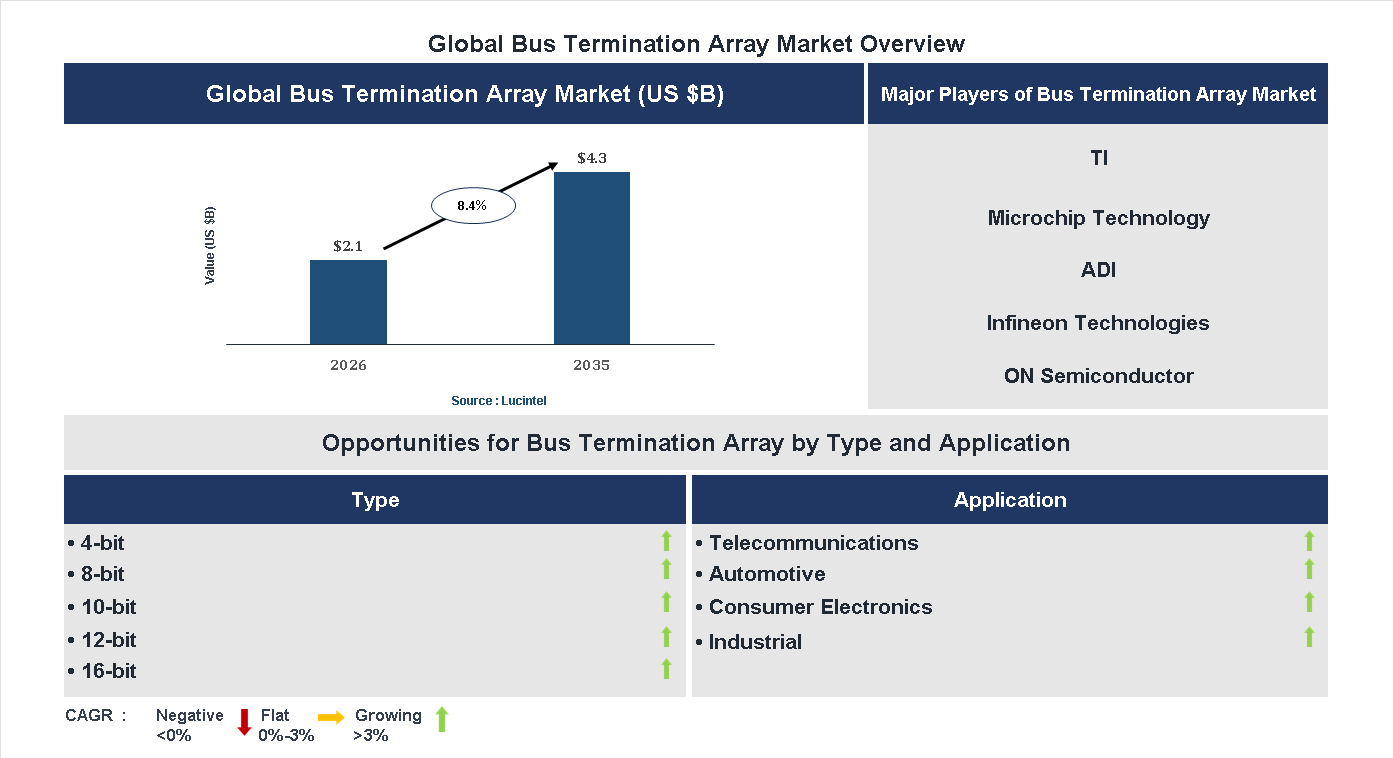
The future of the global bus termination array market looks promising with opportunities in the telecommunication, automotive, consumer electronic, and industrial markets. The global bus termination array market is expected to reach an estimated $4.3 billion by 2035 with a CAGR of 8.4% from 2026 to 2035. The major drivers for this market are the rising demand for high-speed data transmission across industries, the growing adoption of advanced communication protocols in electronics, and the increasing demand focus on energy-efficient electronic systems across sectors.• Lucintel forecasts that, within the type category, 8-bit is expected to witness the highest growth over the forecast period.
• Within the application category, telecommunication is expected to witness the highest growth.
• In terms of region, APAC is expected to witness the highest growth over the forecast period. Gain valuable insights for your business decisions with our comprehensive 150+ page report. Sample figures with some insights are shown below.
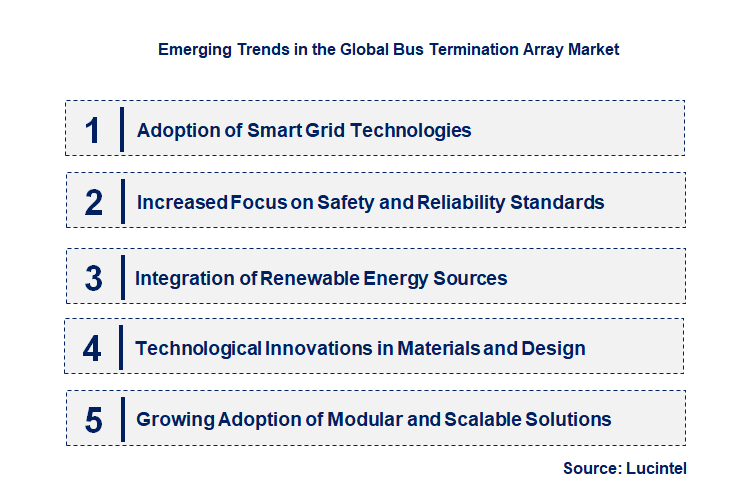
Emerging Trends in the Bus Termination Array Market
The bus termination array market is experiencing rapid evolution driven by technological advancements, increasing demand for efficient power distribution, and the integration of renewable energy sources. As industries seek more reliable and scalable solutions, market players are innovating to meet these needs. The markets growth is also influenced by the rising adoption of smart grid technologies and the need for enhanced safety and performance standards. These developments are transforming how power systems are designed, implemented, and maintained, leading to more sustainable and resilient energy infrastructure. Understanding these emerging trends is crucial for stakeholders aiming to capitalize on new opportunities and stay competitive in this dynamic landscape.• Adoption of Smart Grid Technologies: The integration of smart grid systems is revolutionizing bus termination arrays by enabling real-time monitoring, automation, and improved efficiency. These advanced systems facilitate better load management, fault detection, and predictive maintenance, reducing downtime and operational costs. As utilities and industries prioritize smart infrastructure, the demand for intelligent bus termination solutions is surging. This trend enhances grid reliability and supports the transition toward more sustainable energy management, making bus termination arrays a critical component in modern, interconnected power networks.
• Increased Focus on Safety and Reliability Standards: With the rising complexity of power systems, there is a growing emphasis on safety, compliance, and reliability standards for bus termination arrays. Manufacturers are adopting rigorous testing protocols and high-quality materials to ensure durability and safety under various operating conditions. This focus minimizes risks of failures, electrical faults, and system outages, thereby protecting assets and personnel. As regulatory frameworks tighten globally, compliance becomes a key differentiator, driving innovation in design and manufacturing processes to meet these stringent standards.
• Integration of Renewable Energy Sources: The shift toward renewable energy integration necessitates more adaptable and scalable bus termination solutions. These arrays are now designed to handle variable loads and intermittent power inputs from sources like solar and wind. This trend promotes the development of modular and flexible bus termination systems that can be easily expanded or reconfigured. The ability to efficiently connect and manage renewable sources is crucial for achieving sustainable energy goals, positioning bus termination arrays as vital components in renewable-heavy power grids.
• Technological Innovations in Materials and Design: Advances in materials science and engineering are leading to more durable, efficient, and compact bus termination arrays. Innovations include the use of high-performance insulating materials, improved heat dissipation techniques, and modular designs that simplify installation and maintenance. These technological improvements enhance performance, reduce costs, and extend the lifespan of bus termination systems. As a result, market players are able to offer more reliable and cost-effective solutions, catering to the increasing demand for high-quality power distribution components.
• Growing Adoption of Modular and Scalable Solutions: The market is witnessing a shift toward modular bus termination arrays that offer scalability and flexibility. These systems allow for easy expansion and reconfiguration, accommodating the evolving needs of industrial, commercial, and utility applications. Modular solutions reduce installation time and costs while providing enhanced customization options. This trend supports the deployment of large-scale, complex power systems and facilitates quick upgrades, making bus termination arrays more adaptable to future technological and capacity requirements. These emerging trends are significantly reshaping the bus termination array market by fostering smarter, safer, and more adaptable power distribution solutions. The focus on technological innovation, safety standards, renewable integration, and modularity is driving market growth and enabling the development of resilient, efficient energy infrastructure. These developments are positioning bus termination arrays as essential components in the transition toward sustainable and intelligent power systems.
Recent Development in the Bus Termination Array Market
The bus termination array market is experiencing rapid growth driven by technological advancements and increasing demand for efficient power distribution systems. Innovations in array design and integration are enhancing performance and reliability across various industries, including telecommunications, data centers, and renewable energy. Market players are investing heavily in research and development to meet evolving customer needs. These developments are shaping a competitive landscape, offering new opportunities for expansion and technological integration, ultimately transforming how power is managed and distributed in modern infrastructure.• Technological Innovations in Array Design: The development of advanced bus termination arrays improves electrical performance, reduces energy losses, and enhances system reliability. These innovations enable better integration with existing infrastructure, supporting higher power loads and increasing system efficiency. As industries demand more robust solutions, manufacturers are focusing on miniaturization and modular designs, which facilitate easier installation and maintenance. This progress is driving market growth by meeting the increasing need for scalable and durable power distribution solutions.
• Integration with Renewable Energy Systems: The integration of bus termination arrays with renewable energy sources like solar and wind is expanding rapidly. These arrays help manage fluctuating power outputs and ensure stable energy flow, which is critical for renewable installations. The ability to efficiently connect renewable sources to the grid reduces energy wastage and enhances overall system stability. This development is opening new markets, especially in sustainable energy projects, and is contributing to the global shift toward greener power solutions.
• Adoption of Smart and Digital Technologies: The incorporation of smart technologies into bus termination arrays is revolutionizing power management. Features like real-time monitoring, remote diagnostics, and predictive maintenance improve operational efficiency and reduce downtime. Digital integration allows for better system control and data analysis, enabling proactive management of power distribution. This technological shift is attracting industries seeking reliable, intelligent solutions, thereby expanding market reach and fostering innovation in power infrastructure.
• Focus on Safety and Compliance Standards: Recent developments emphasize enhanced safety features and adherence to strict industry standards. Improved insulation, fail-safe mechanisms, and compliance with international regulations ensure safer operation and reduce risks of faults or failures. These safety enhancements are crucial for high-stakes applications such as data centers and industrial facilities. As safety standards become more rigorous, manufacturers are investing in compliance, which boosts customer confidence and accelerates market adoption of advanced bus termination arrays.
• Expansion into Emerging Markets: Growing infrastructure development in emerging economies is creating significant opportunities for bus termination array manufacturers. Increased investments in power grids, industrialization, and urbanization drive demand for reliable power distribution solutions. Local manufacturers are expanding their product offerings to meet regional needs, often customizing solutions for specific applications. This expansion is fostering market diversification and enabling companies to tap into new revenue streams, ultimately contributing to global market growth and technological dissemination. The overall impact of these developments is a more efficient, reliable, and innovative market landscape. Enhanced technological capabilities and expanding applications are driving growth, attracting investments, and fostering sustainable energy integration. As a result, the bus termination array market is poised for continued expansion, supporting modern infrastructure needs and enabling smarter, safer power distribution systems worldwide.
Strategic Growth Opportunities in the Bus Termination Array Market
The bus termination array market is experiencing rapid growth driven by increasing demand for reliable power distribution and signal integrity in various industries. Advancements in electronic systems, automation, and data centers are fueling the need for efficient bus termination solutions. Market players are focusing on innovation, expanding applications, and strategic collaborations to capture emerging opportunities. This dynamic environment offers significant potential for growth, driven by technological evolution and the rising complexity of electronic architectures across sectors.• Expansion into Data Center Infrastructure: As data centers grow exponentially, the need for high-performance bus termination arrays becomes critical for managing power and signal integrity. These arrays ensure reliable data transmission and reduce electromagnetic interference, supporting faster processing speeds. The increasing deployment of cloud computing and edge data centers amplifies demand, prompting manufacturers to develop scalable, high-density solutions tailored for data-intensive environments, thus opening new revenue streams and market segments.
• Adoption in Automotive Electronics for Enhanced Safety: The automotive industry’s shift toward electric and autonomous vehicles necessitates advanced electronic systems. Bus termination arrays are vital for ensuring stable communication between sensors, controllers, and power modules. Their ability to withstand harsh conditions and provide reliable signal termination enhances vehicle safety and performance. Growing automotive electronics integration presents a lucrative opportunity for suppliers to innovate and supply tailored solutions, aligning with industry standards and safety regulations.
• Integration into Industrial Automation and Robotics: Industrial automation relies heavily on robust electronic communication networks. Bus termination arrays improve signal integrity and reduce noise in complex automation systems, ensuring seamless operation of machinery and robotics. As industries adopt Industry 4.0 principles, the demand for reliable, high-speed electronic components increases. Companies investing in automation infrastructure are seeking durable, efficient bus termination solutions, creating opportunities for market expansion into manufacturing, process control, and robotics sectors.
• Development of Compact, High-Density Solutions for Consumer Electronics: The consumer electronics market demands miniaturized, high-performance components to support sleek device designs and advanced functionalities. Bus termination arrays are evolving to meet these needs by offering compact, high-density configurations that save space without compromising performance. The proliferation of smart devices, wearables, and IoT gadgets drives innovation in this segment, enabling manufacturers to deliver reliable, efficient electronic systems that cater to consumer preferences for portability and connectivity.
• Focus on Customization and Industry-Specific Solutions: Different industries require tailored bus termination solutions to meet unique operational demands. Customization involves designing arrays with specific voltage, current, and environmental specifications. This approach enhances system reliability and performance across sectors like aerospace, healthcare, and telecommunications. Market players are investing in R&D to develop industry-specific products, fostering long-term customer relationships and opening avenues for niche market growth, thereby strengthening their competitive edge in the evolving landscape. The overall market outlook indicates that these growth opportunities will significantly influence the bus termination array market, fostering innovation, expanding application domains, and driving revenue growth. Companies that strategically leverage these opportunities through technological advancements and industry collaborations will be well-positioned to capitalize on the increasing demand for reliable electronic communication solutions across diverse sectors.
Bus Termination Array Market Driver and Challenges
The bus termination array market is influenced by a variety of technological, economic, and regulatory factors that shape its growth and development. Advances in communication infrastructure and the increasing demand for reliable data transmission are key technological drivers. Economic factors such as the expansion of data centers and telecommunication networks contribute significantly to market growth. Regulatory standards and policies aimed at ensuring safety and interoperability also impact market dynamics. Additionally, the push towards 5G and IoT integration further accelerates demand for efficient bus termination solutions. However, the market faces challenges related to high deployment costs, technological complexity, and evolving regulatory requirements, which could hinder growth prospects. The factors responsible for driving the bus termination array market include:• Technological Advancements: Rapid innovations in communication technologies, including 5G and IoT, demand sophisticated bus termination arrays to support high-speed data transfer and network reliability. These advancements enable better signal integrity, reduced latency, and increased bandwidth, which are critical for modern telecommunication infrastructure. As technology evolves, the need for more efficient and scalable bus termination solutions grows, fueling market expansion. Companies investing in R&D to develop next-generation arrays are also contributing to this growth, ensuring compatibility with emerging standards and applications.
• Growing Data Center and Telecom Infrastructure: The surge in data traffic driven by cloud computing, streaming services, and enterprise applications necessitates extensive data center and telecom infrastructure development. Bus termination arrays are essential components in these setups, providing reliable signal termination and distribution. The increasing deployment of 5G networks and fiber optic communication systems further amplifies demand. This economic trend supports market growth by creating a steady need for advanced bus termination solutions capable of handling high data loads and ensuring network stability.
• Regulatory Standards and Compliance: Governments and industry bodies are establishing strict standards for safety, electromagnetic compatibility, and interoperability in communication systems. Compliance with these regulations requires the adoption of certified bus termination arrays that meet specific performance criteria. These standards influence product development and deployment strategies, encouraging manufacturers to innovate and improve their offerings. Regulatory compliance also ensures market acceptance and reduces the risk of legal issues, thereby fostering a more robust and trustworthy market environment.
• Increasing Adoption of IoT and Smart Devices: The proliferation of IoT devices and smart technologies across various sectors, including healthcare, manufacturing, and transportation, drives the need for reliable data transmission solutions. Bus termination arrays play a crucial role in supporting the connectivity and performance of these devices. As IoT applications become more complex and widespread, the demand for specialized bus termination solutions that can handle diverse protocols and high data volumes continues to grow, propelling market expansion.
• Rising Investment in 5G and Edge Computing: The global rollout of 5G networks and the rise of edge computing require advanced bus termination arrays to facilitate high-speed, low-latency data transfer at the network edge. These investments aim to enhance connectivity, reduce latency, and support new applications like autonomous vehicles and smart cities. The deployment of such infrastructure necessitates sophisticated bus termination solutions capable of supporting high-frequency signals and complex architectures, thereby significantly driving market growth. The challenges facing this Market include:
• High Deployment and Maintenance Costs: Implementing bus termination arrays in large-scale networks involves significant capital expenditure. The costs associated with procurement, installation, and ongoing maintenance can be prohibitive, especially for smaller organizations or emerging markets. These financial barriers may slow down adoption rates and limit market expansion. Additionally, the need for specialized skills to install and maintain these systems adds to operational expenses, posing further challenges for widespread deployment.
• Technological Complexity and Compatibility Issues: As communication systems become more advanced, bus termination arrays must support a wide range of protocols and standards. Ensuring compatibility across different platforms and technologies can be complex and challenging. This complexity may lead to integration issues, increased development time, and higher costs. Manufacturers must continuously innovate to keep pace with evolving standards, which can strain resources and delay product deployment, ultimately impacting market growth.
• Evolving Regulatory and Security Concerns: Rapid technological advancements often lead to changing regulatory landscapes, requiring companies to adapt quickly to new compliance standards. Additionally, increasing cybersecurity threats pose risks to data integrity and network security. Ensuring that bus termination arrays meet evolving regulatory and security requirements demands ongoing investment and innovation. Failure to comply or address security vulnerabilities can result in legal penalties, reputational damage, and market setbacks, making regulatory and security challenges a significant concern for industry stakeholders. The bus termination array market is driven by technological innovations, expanding infrastructure, and regulatory standards, which collectively foster growth. However, high costs, technological complexity, and regulatory challenges pose significant hurdles. The overall impact of these drivers and challenges will shape the market’s trajectory, requiring stakeholders to innovate and adapt to sustain growth and competitiveness in a rapidly evolving landscape.
List of Bus Termination Array Companies
Companies in the market compete on the basis of product quality offered. Major players in this market focus on expanding their manufacturing facilities, R&D investments, infrastructural development, and leverage integration opportunities across the value chain. With these strategies bus termination array companies cater increasing demand, ensure competitive effectiveness, develop innovative products & technologies, reduce production costs, and expand their customer base. Some of the bus termination array companies profiled in this report include-• TI
• Microchip Technology
• ADI
• Infineon Technologies
• ON Semiconductor
• STMicroelectronics
• Diodes Incorporated
Bus Termination Array Market by Segment
The study includes a forecast for the global bus termination array market by type, application, and region.Bus Termination Array Market by Type [Value from 2019 to 2035]:
• 4-bit
• 8-bit
• 10-bit
• 12-bit
• 16-bit
Bus Termination Array Market by Application [Value from 2019 to 2035]:
• Telecommunications
• Automotive
• Consumer Electronics
• Industrial
Bus Termination Array Market by Region [Value from 2019 to 2035]:
• North America
• Europe
• Asia Pacific
• The Rest of the World
Country Wise Outlook for the Bus Termination Array Market
The bus termination array market has experienced significant growth driven by technological advancements, increasing demand for efficient data transmission, and expanding applications across various industries. As digital infrastructure expands globally, countries are investing heavily in developing innovative solutions to enhance connectivity and performance. The markets evolution is marked by the integration of advanced materials, improved manufacturing processes, and the adoption of smart technologies. These developments are shaping the competitive landscape and influencing future growth trajectories in key regions. Here is a country-wise overview of recent developments in this market.• United States: The US market has seen substantial innovation with the integration of high-speed data transfer capabilities and smart bus termination arrays. Leading tech companies are investing in R&D to develop more reliable and scalable solutions, especially for data centers and telecommunications infrastructure. The adoption of IoT and 5G technologies has further accelerated demand, prompting manufacturers to focus on miniaturization and enhanced durability of arrays. Regulatory support and government initiatives for digital infrastructure expansion are also fueling market growth.
• China: China has emerged as a major player, with rapid advancements in bus termination array technology driven by the countrys focus on 5G deployment and smart city projects. Local manufacturers are investing in developing cost-effective, high-performance arrays to meet domestic and export demands. The government’s emphasis on digital transformation and infrastructure modernization has led to increased adoption across sectors such as manufacturing, transportation, and telecommunications. Strategic collaborations and investments are further boosting innovation and production capacity.
• Germany: The German market is characterized by a focus on high-quality, precision-engineered bus termination arrays suitable for industrial automation and automotive applications. Companies are emphasizing the integration of robust materials and advanced manufacturing techniques to ensure reliability and longevity. The push towards Industry 4.0 and smart factories has increased demand for sophisticated connectivity solutions. Additionally, Germany’s emphasis on sustainability is encouraging the development of eco-friendly and energy-efficient array solutions, fostering innovation in the sector.
• India: India’s market is witnessing rapid growth driven by expanding digital infrastructure, government initiatives like Digital India, and increasing adoption of smart technologies. Local manufacturers are focusing on developing affordable, scalable bus termination arrays to cater to the growing demand in telecommunications, data centers, and industrial automation. The rise of start-ups and increased foreign investment is fostering innovation and expanding the product ecosystem. Efforts to improve manufacturing capabilities and supply chain efficiencies are also contributing to market expansion.
• Japan: Japan’s market is characterized by a focus on high-performance, durable bus termination arrays tailored for advanced electronics and industrial applications. The country’s emphasis on technological innovation and quality standards has led to the development of sophisticated, reliable solutions. Japan is also investing in research to improve the miniaturization and integration of arrays with other electronic components. The growing adoption of automation and robotics in manufacturing sectors is further driving demand for advanced bus termination array solutions, supporting the country’s position as a technology leader.

Features of the Global Bus Termination Array Market
Market Size Estimates: Bus termination array market size estimation in terms of value ($B). Trend and Forecast Analysis: Market trends (2019 to 2025) and forecast (2026 to 2035) by various segments and regions. Segmentation Analysis: Bus termination array market size by type, application, and region in terms of value ($B). Regional Analysis: Bus termination array market breakdown by North America, Europe, Asia Pacific, and Rest of the World. Growth Opportunities: Analysis of growth opportunities in different types, applications, and regions for the bus termination array market. Strategic Analysis: This includes M&A, new product development, and competitive landscape of the bus termination array market. Analysis of competitive intensity of the industry based on Porter’s Five Forces model.
FAQ
Q1. What is the bus termination array market size? Answer: The global bus termination array market is expected to reach an estimated $4.3 billion by 2035. Q2. What is the growth forecast for bus termination array market? Answer: The global bus termination array market is expected to grow with a CAGR of 8.4% from 2026 to 2035. Q3. What are the major drivers influencing the growth of the bus termination array market? Answer: The major drivers for this market are the rising demand for high-speed data transmission across industries, the growing adoption of advanced communication protocols in electronics, and the increasing demand focus on energy-efficient electronic systems across sectors. Q4. What are the major segments for bus termination array market? Answer: The future of the bus termination array market looks promising with opportunities in the telecommunication, automotive, consumer electronic, and industrial markets. Q5. Who are the key bus termination array market companies? Answer: Some of the key bus termination array companies are as follows:• TI
• Microchip Technology
• ADI
• Infineon Technologies
• ON Semiconductor
• STMicroelectronics
• Diodes Incorporated Q6. Which bus termination array market segment will be the largest in future? Answer: Lucintel forecasts that, within the type category, 8-bit is expected to witness the highest growth over the forecast period. Q7. In bus termination array market, which region is expected to be the largest in next 5 years? Answer: In terms of region, APAC is expected to witness the highest growth over the forecast period. Q8. Do we receive customization in this report? Answer: Yes, Lucintel provides 10% customization without any additional cost.
Table of Contents
List of Figures
List of Tables
Methodology
- In-depth interviews of the major players in this market
- Detailed secondary research from competitors’ financial statements and published data
- Extensive searches of published works, market, and database information pertaining to industry news, company press releases, and customer intentions
- A compilation of the experiences, judgments, and insights of Lucintel’s professionals, who have analyzed and tracked this market over the years.


Buy Now
Choose a license that fits your team. Instant PDF delivery.
Prices exclude taxes. Instant delivery. Custom licensing available on request.
Key Questions
- • What are some of the most promising, high-growth opportunities for the bus termination array market by type (4-bit, 8-bit, 10-bit, 12-bit, and 16-bit), application (telecommunications, automotive, consumer electronics, and industrial), and region (North America, Europe, Asia Pacific, and the Rest of the World)?
- • Which segments will grow at a faster pace and why?
- • Which region will grow at a faster pace and why?
- • What are the key factors affecting market dynamics? What are the key challenges and business risks in this market?
- • What are the business risks and competitive threats in this market?
- • What are the emerging trends in this market and the reasons behind them?
- • What are some of the changing demands of customers in the market?
- • What are the new developments in the market? Which companies are leading these developments?
- • Who are the major players in this market? What strategic initiatives are key players pursuing for business growth?
- • What are some of the competing products in this market and how big of a threat do they pose for loss of market share by material or product substitution?
- • What M&A activity has occurred in the last 7 years and what has its impact been on the industry? For any questions related to Bus Termination Array Market, Bus Termination Array Market Size, Bus Termination Array Market Growth, Bus Termination Array Market Analysis, Bus Termination Array Market Report, Bus Termination Array Market Share, Bus Termination Array Market Trends, Bus Termination Array Market Forecast, Bus Termination Array Companies, write Lucintel analyst at email: helpdesk@lucintel.com. We will be glad to get back to you soon.


