
Market Report · July 29, 2026

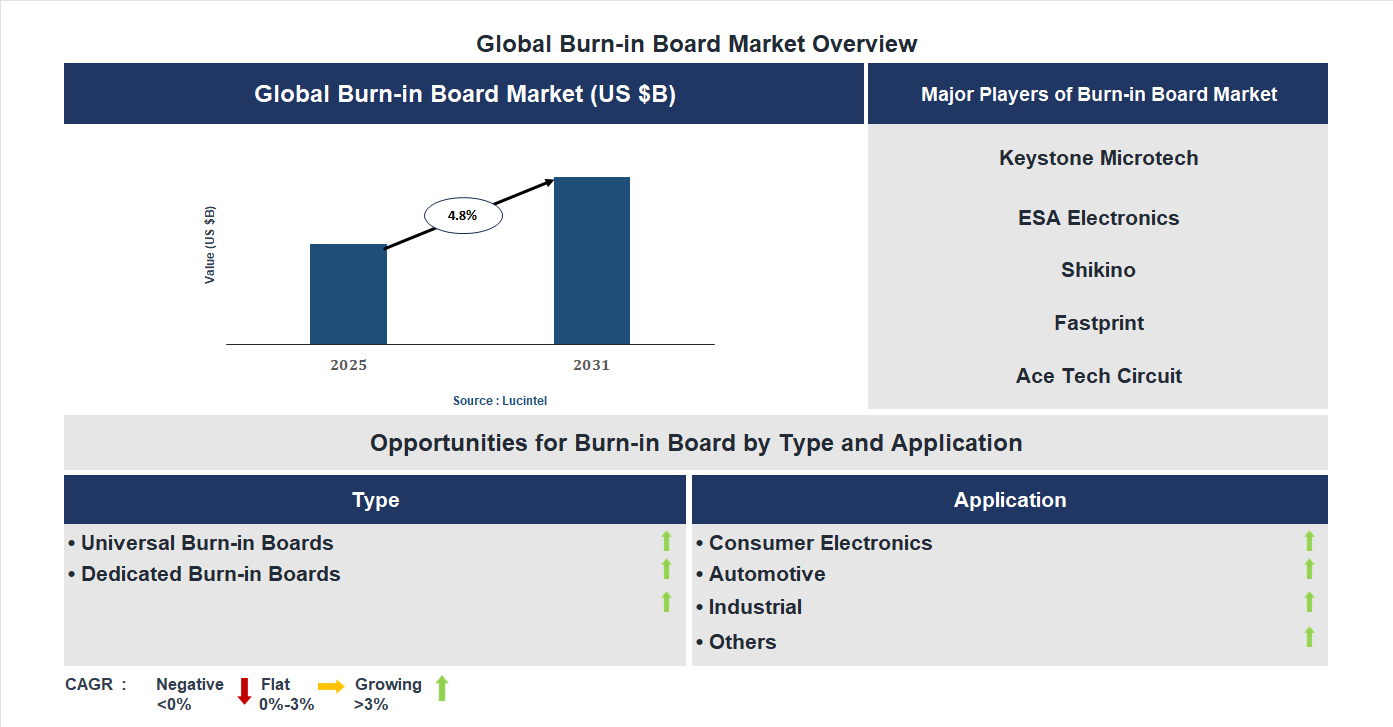
Key data points: The growth forecast = 4.8% annually for the next 7 years. Scroll below to get more insights. This market report covers trends, opportunities and forecasts in burn-in board market to 2031 by type (universal burn-in boards and dedicated burn-in boards), application (consumer electronics, automotive, industrial, and others), and region (North America, Europe, Asia Pacific, and the Rest of the World)
We'll send your sample report shortly.
• Lucintel forecasts that, within the type category, dedicated burn-in board is expected to witness higher growth over the forecast period.
• Within the application category, automotive is expected to witness the highest growth.
• In terms of region, APAC is expected to witness the highest growth over the forecast period. Gain valuable insights for your business decisions with our comprehensive 150+ page report. Sample figures with some insights are shown below.
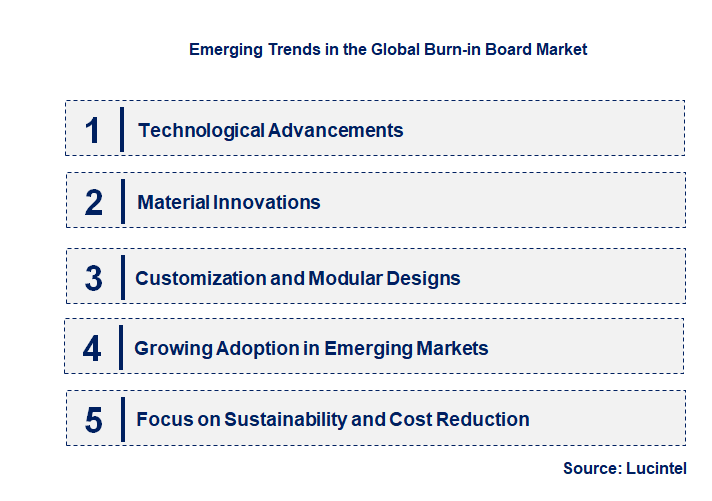
• Technological Advancements: Integration of automation and IoT in burn-in testing processes is streamlining operations. Automated systems reduce human error, increase testing speed, and improve data accuracy, leading to higher throughput and better quality control. IoT-enabled burn-in boards allow real-time monitoring and remote diagnostics, enhancing efficiency and reducing downtime. These innovations are enabling manufacturers to meet the increasing demand for faster, more reliable testing, ultimately improving product reliability and customer satisfaction.
• Material Innovations: The development of new materials for burn-in boards, such as high-temperature resistant substrates and advanced composites, is enhancing durability and performance. These materials can withstand harsher testing conditions, extend the lifespan of burn-in boards, and improve thermal management. As a result, manufacturers can conduct more rigorous testing without compromising the integrity of the boards, leading to more reliable electronic components and reducing overall testing costs.
• Customization and Modular Designs: The market is witnessing a shift towards customizable and modular burn-in boards tailored to specific testing requirements. Modular designs allow easy upgrades and scalability, accommodating various device sizes and testing parameters. Customization ensures compatibility with diverse electronic components, improving testing accuracy and efficiency. This flexibility is particularly valuable in rapidly evolving industries like consumer electronics and automotive, where product specifications frequently change.
• Growing Adoption in Emerging Markets: Increasing industrialization and technological adoption in emerging markets such as Asia-Pacific and Latin America are driving market growth. These regions are witnessing a surge in electronic manufacturing, necessitating reliable burn-in testing solutions. Local manufacturers are adopting advanced burn-in boards to ensure product quality and meet international standards, fueling demand. This trend is expanding the market footprint and encouraging regional innovation and competition.
• Focus on Sustainability and Cost Reduction: Companies are emphasizing eco-friendly materials and energy-efficient burn-in testing solutions to reduce environmental impact. Innovations include low-power burn-in boards and recyclable materials, aligning with global sustainability goals. Additionally, cost reduction strategies such as designing multi-functional boards and improving manufacturing processes are making burn-in testing more affordable. These efforts are making advanced testing solutions accessible to a broader range of manufacturers, fostering market growth and supporting sustainable industry practices. In summary, these trends are collectively reshaping the burn-in board market by enhancing testing efficiency, reliability, and sustainability. The integration of advanced materials, automation, customization, and a focus on emerging markets is driving innovation and expanding market opportunities. As these developments continue, the market is poised for significant growth, supporting the increasing demand for high-quality, reliable electronic components across various industries.
• Technological Innovation: Integration of advanced materials and design improvements has enhanced burn-in board durability and performance, leading to more reliable testing processes and longer lifespan of boards, which reduces overall costs for manufacturers.
• Automation and Smart Testing: The adoption of automation and IoT-enabled smart testing systems has increased efficiency, reduced human error, and enabled real-time monitoring, significantly accelerating testing cycles and improving accuracy.
• Customization and Modular Designs: Increasing demand for tailored testing solutions has driven the development of customizable and modular burn-in boards, allowing manufacturers to adapt to specific product requirements and streamline production workflows.
• Cost Reduction Strategies: Manufacturers are focusing on cost-effective manufacturing techniques, such as bulk production and material optimization, to lower prices without compromising quality, making burn-in testing more accessible to smaller firms.
• Regulatory and Quality Standards: Stricter industry standards and certifications have prompted the development of compliant burn-in boards, ensuring higher quality assurance and fostering trust among end-users and OEMs. These developments are collectively transforming the burn-in board market by enhancing product reliability, reducing testing costs, and enabling more flexible and efficient testing solutions. As a result, the market is becoming more competitive, with increased adoption across various sectors, ultimately supporting the production of higher-quality electronic devices.
• Consumer Electronics: Enhanced testing for miniaturized devices : The rise in consumer electronics, including smartphones and wearables, demands precise burn-in testing to ensure product longevity and performance, driving market growth in this segment.
• Automotive Industry: Testing for safety and reliability : As vehicles incorporate more electronic systems, burn-in boards are crucial for testing automotive electronics, ensuring safety, reliability, and compliance with industry standards.
• Aerospace & Defense: High-reliability testing requirements : The aerospace sector requires rigorous testing for critical components, leading to increased adoption of advanced burn-in boards to meet stringent quality and safety standards.
• Telecommunications: Ensuring network equipment durability : The expansion of 5G infrastructure and data centers necessitates robust testing solutions, boosting demand for specialized burn-in boards to enhance network equipment reliability.
• Industrial Equipment: Testing for industrial automation : Growing industrial automation systems require durable electronic components, prompting increased use of burn-in boards to verify long-term operational stability. These growth opportunities are significantly impacting the market by expanding its scope across diverse sectors, fostering innovation, and emphasizing quality assurance. As industries prioritize reliability and performance, the demand for sophisticated burn-in testing solutions continues to rise, positioning the market for sustained expansion and technological advancement.
• Technological Innovation: The continuous development of advanced burn-in testing techniques and materials enhances product reliability and performance. Innovations such as automated testing systems and real-time monitoring improve efficiency, reduce testing time, and lower costs. As electronic devices become more complex, the demand for sophisticated burn-in boards increases, fueling market growth. Companies investing in R&D are able to offer more reliable and customizable solutions, attracting a broader customer base. This technological evolution ensures the market remains competitive and aligned with industry standards, supporting long-term expansion.
• Growing Semiconductor and Electronics Industry: The rapid expansion of the semiconductor and electronics sectors directly boosts demand for burn-in boards. As devices become smaller, faster, and more integrated, rigorous testing is essential to ensure quality and durability. The proliferation of IoT devices, smartphones, and data centers necessitates reliable testing infrastructure, driving market growth. Manufacturers are increasingly adopting burn-in testing to prevent failures and enhance product lifespan, which in turn stimulates demand for specialized burn-in boards tailored to various applications. This sector-driven growth sustains the markets momentum and encourages innovation.
• Increasing Focus on Quality Assurance and Reliability: The rising emphasis on product quality and reliability across industries compels manufacturers to adopt comprehensive testing solutions. Burn-in testing helps identify early failures, reducing warranty costs and enhancing brand reputation. Regulatory standards in sectors like automotive, aerospace, and healthcare mandate rigorous testing protocols, further propelling demand. Companies are investing in high-quality burn-in boards that can handle complex testing requirements, ensuring compliance and customer satisfaction. This focus on quality assurance sustains market growth by creating a steady demand for advanced testing equipment.
• Technological Integration and Automation: The integration of automation and Industry 4.0 principles into testing processes enhances efficiency and accuracy. Automated burn-in boards reduce manual intervention, minimize errors, and enable large-scale testing with minimal human oversight. The adoption of IoT-enabled systems allows real-time data collection and analysis, facilitating predictive maintenance and process optimization. This technological integration not only improves productivity but also lowers operational costs, making burn-in testing more accessible and scalable. As automation becomes standard, the market benefits from increased demand for intelligent, connected burn-in boards.
• Expansion of End-User Industries: The growth of end-user industries such as telecommunications, automotive, aerospace, and consumer electronics significantly impacts the burn-in board market. These sectors require rigorous testing to meet safety, durability, and performance standards. The increasing adoption of electric vehicles and autonomous systems in automotive industries, for example, necessitates specialized burn-in solutions. Similarly, the expansion of 5G infrastructure and satellite technology drives demand for reliable testing components. This broad industry expansion creates diverse opportunities for market players to develop tailored burn-in board solutions, fostering sustained growth. The challenges facing this burn-in board market include:
• High Cost of Advanced Burn-in Boards: The development and deployment of sophisticated burn-in boards involve significant capital investment in technology, equipment, and skilled personnel. High manufacturing costs can limit accessibility for smaller companies and constrain market growth. Additionally, the need for frequent upgrades to keep pace with technological advancements further escalates expenses. These costs may lead to longer ROI periods and restrict widespread adoption, especially in price-sensitive markets. Managing cost efficiency while maintaining quality remains a critical challenge for industry players.
• Rapid Technological Obsolescence: The fast-paced evolution of electronic components and testing requirements results in frequent obsolescence of existing burn-in board designs. Companies must continuously innovate to stay relevant, which involves substantial R&D expenditure and resource allocation. Obsolete equipment can lead to increased downtime and reduced competitiveness. Keeping pace with technological changes while ensuring compatibility and compliance is a persistent challenge, requiring strategic planning and agility from manufacturers.
• Regulatory and Compliance Challenges: Stringent regulatory standards across various industries impose complex compliance requirements on burn-in testing processes. Variations in international standards can complicate product development and market entry. Ensuring that burn-in boards meet safety, environmental, and quality regulations demands rigorous testing and documentation, increasing operational complexity and costs. Non-compliance can result in legal penalties, product recalls, and damage to reputation, making regulatory adherence a critical yet challenging aspect of market operations. In summary, the burn-in board market is driven by technological innovation, industry growth, quality focus, automation, and expanding end-user sectors. However, high costs, rapid obsolescence, and regulatory complexities pose significant challenges. These factors collectively influence market dynamics, requiring stakeholders to balance innovation with cost management and compliance. The overall impact is a competitive landscape that demands agility, strategic investment, and continuous adaptation to sustain growth and meet evolving industry standards.
• Keystone Microtech
• ESA Electronics
• Shikino
• Fastprint
• Ace Tech Circuit
• MCT
• Sunright
• Micro Control
• Xian Tianguang
• EDA Industries
• Universal Burn-in Boards
• Dedicated Burn-in Boards
• Consumer Electronics
• Automotive
• Industrial
• Others
• North America
• Europe
• Asia Pacific
• The Rest of the World
• United States: The US market is witnessing increased adoption of advanced burn-in testing solutions driven by the growth of the semiconductor and electronics sectors. Major players are investing in automation and IoT-enabled testing equipment to improve efficiency and accuracy. Regulatory standards are also evolving, prompting companies to upgrade their testing infrastructure. The rise of AI and machine learning integration into testing processes is further enhancing predictive maintenance and quality control. Additionally, the US government’s focus on semiconductor innovation and manufacturing resilience is boosting market demand.
• China: China is rapidly expanding its burn-in board manufacturing capacity to meet domestic and export demands. The government’s emphasis on self-reliance in semiconductor technology has led to increased R&D investments. Chinese companies are adopting innovative materials and design techniques to improve burn-in testing performance. The market is also benefiting from the growth of consumer electronics, 5G infrastructure, and automotive electronics, which require rigorous testing. E-commerce and industrial automation are driving demand for cost-effective and scalable testing solutions, positioning China as a key player in the global market.
• Germany: Germany’s market growth is driven by its strong automotive and industrial machinery sectors, which require high-reliability electronic components. The focus on quality assurance and compliance with stringent European standards is prompting the adoption of sophisticated burn-in testing equipment. German companies are investing in sustainable and energy-efficient testing solutions, aligning with the country’s environmental goals. The integration of Industry 4.0 principles is enabling smarter testing processes, reducing downtime, and enhancing product reliability. Collaboration between research institutions and industry is fostering innovation in burn-in board technologies.
• India: India’s burn-in board market is experiencing rapid growth due to expanding electronics manufacturing and government initiatives like Make in India. The increasing demand for consumer electronics, telecom equipment, and automotive electronics is fueling market expansion. Local manufacturers are adopting cost-effective testing solutions to cater to domestic needs and export markets. The government’s focus on developing semiconductor and electronics manufacturing ecosystems is encouraging investments in R&D and infrastructure. Additionally, rising automation and Industry 4.0 adoption are improving testing efficiency and quality standards across the industry.
• Japan: Japan remains a key player in the burn-in board market, driven by its advanced electronics and automotive industries. The country emphasizes high-precision testing and reliability, integrating cutting-edge technologies such as AI and robotics into testing processes. Japanese firms are investing in innovative materials and sustainable testing solutions to meet global environmental standards. The focus on miniaturization and high-density testing boards aligns with the trend toward smaller, more powerful electronic devices. Collaboration with global tech firms and continuous R&D efforts are maintaining Japan’s leadership position in the development of advanced burn-in testing solutions.


• Keystone Microtech
• ESA Electronics
• Shikino
• Fastprint
• Ace Tech Circuit
• MCT
• Sunright
• Micro Control
• Xian Tianguang
• EDA Industries Q5. Which burn-in board market segment will be the largest in future? Answer: Lucintel forecasts that, within the type category, dedicated burn-in board is expected to witness higher growth over the forecast period. Q6. In burn-in board market, which region is expected to be the largest in next 5 years? Answer: In terms of region, APAC is expected to witness the highest growth over the forecast period. Q7. Do we receive customization in this report? Answer: Yes, Lucintel provides 10% customization without any additional cost.


Choose a license that fits your team. Instant PDF delivery.
Prices exclude taxes. Instant delivery. Custom licensing available on request.
Market Report · July 29, 2026
Market Report · July 20, 2026
Market Report · July 20, 2026
Trusted partner for strategic intelligence and business growth


Receive a complimentary market analysis tailored to your industry. Our analysts will identify key growth opportunities and competitive dynamics specific to your business.

Market size, growth rate, and key trend analysis for your specific sector.

Top competitor positioning and market share analysis.

Strategic recommendations backed by data-driven insights.
Get curated market intelligence and competitive moves straight to your inbox.
By subscribing, you agree to receive our monthly insights. Unsubscribe anytime.
Receive a complimentary market analysis tailored to your industry. Our analysts will identify key growth opportunities and competitive dynamics specific to your business.
Market size, growth rate, and key trend analysis for your specific sector.
Top competitor positioning and market share analysis.
Strategic recommendations backed by data-driven insights.
Get curated market intelligence, emerging trends, and competitive moves straight to your inbox each month.
By subscribing, you agree to receive our monthly insights. Unsubscribe anytime.
We'll send your sample report shortly.