
Close Lucintel Chat
Didn't Find What You're Looking for?
Call us at +1972 636 5056 or write at helpdesk@Lucintel.com
Ask an Expert Provide Custom Requirements Download Sample Report Search Available Reports
  • helpdesk@Lucintel.com
  • |
  • Call Lucintel +1 972 636 5056
  • |
  • Login
  • |
  • Register
  • |
  • Search
  • |
'
...

The Impact of COVID-19 is included in Brick Trowel Market Report. Buy it today to get an advantage.

Request the impact of COVID-19 on your product or industry


Brick Trowel Market Trends and Forecast

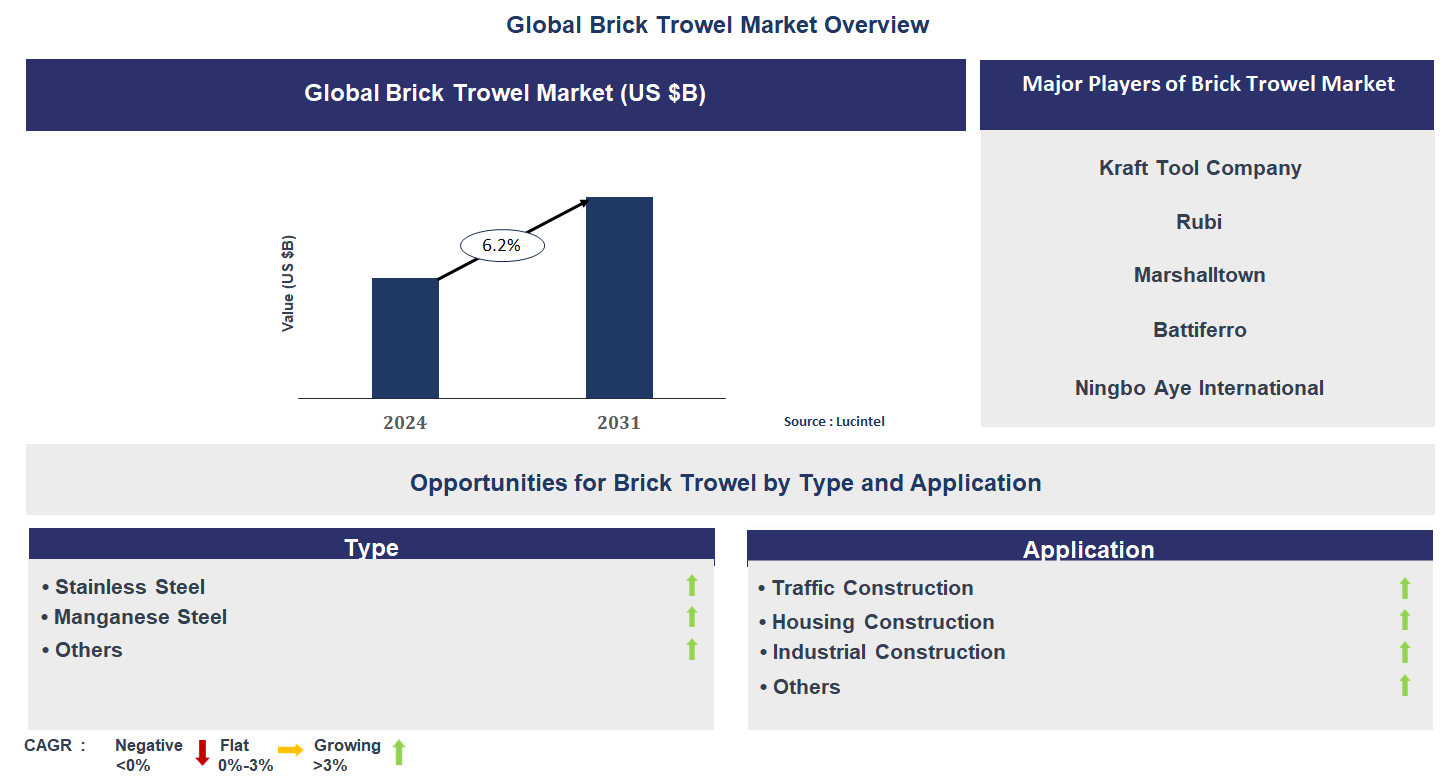
The future of the global brick trowel market looks promising with opportunities in the traffic construction, housing construction, and industrial construction markets. The global brick trowel market is expected to grow with a CAGR of 6.2% from 2025 to 2031. The major drivers for this market are the increasing demand for quality masonry tools, the rising construction activities in residential buildings, and the growing preference for durable trowel materials.

• Lucintel forecasts that, within the type category, stainless steel is expected to witness the highest growth over the forecast period.
• Within the application category, housing construction is expected to witness the highest growth.
• In terms of region, APAC is expected to witness the highest growth over the forecast period.
Gain valuable insights for your business decisions with our comprehensive 150+ page report. Sample figures with some insights are shown below.
Brick Trowel Market Trends and Forecast

Emerging Trends in the Brick Trowel Market

The brick trowel industry itself is experiencing a quiet but profound shift, driven by a demand for greater ergonomics, better material science, and attention to specialized use. These new trends are reshaping the design, functionality, and usage of such hand tools beyond the conventional, generic designs. The use of advanced materials, user comfort and protection, and creating application-specific tools are the drivers in the direction of this change. These trends are not only addressing the demands of a contemporary construction sector but also developing new market prospects and competitive sources for producers.
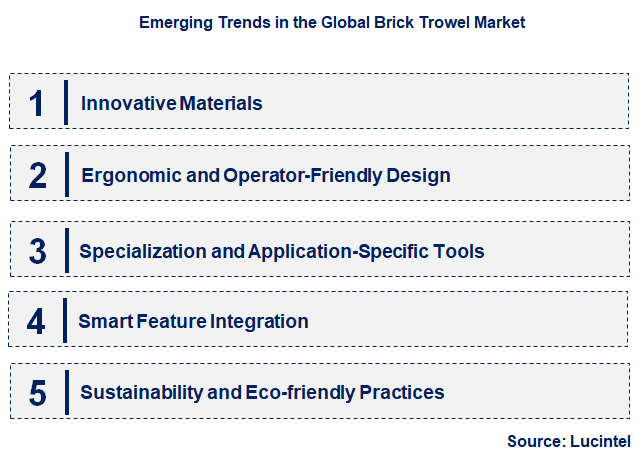
• Innovative Materials: The application of advanced materials to both the blade and the handle is one of the most important developing trends. Traditional steel is still popular, but producers are looking at using high-carbon steel and other alloys that provide an improved balance between strength, flexibility, and weight. For handles, the direction is shifting from wood to encompassing such materials as soft-grip rubber and hardwearing plastics that offer greater comfort, improved grip, and resistance to water and cracking, thus prolonging the life of the tool.
• Ergonomic and Operator-Friendly Design: There is increasing attention given to ergonomic design in order to minimize operator fatigue and the possibility of repetitive strain injuries. Manufacturers are creating trowels with precision-balanced blades and handles that offer a secure and comfortable grip. This design direction leverages the physical nature of bricklaying, which is a physically demanding profession. By putting the well-being of users first, manufacturers are not only achieving safety regulations but also enhancing the overall user experience and commercial attractiveness of their products, which is a competitive advantage.
• Specialization and Application-Specific Tools: Although the traditional brick trowel is general-purpose, there is a tendency towards creating specialized tools for particular uses. This comprises trowels with special blade shapes for particular types of bricks or using them in confined areas. This is an indication of the need for more precision and efficacy in contemporary construction. By providing a variety of specialized tools, manufacturers are able to meet the unique requirements of professional masons and stoneworkers, increasing their product offerings.
• Smart Feature Integration: The market is experiencing the infancy stages of smart technology integration, something that is still in its early stages for hand tools. These may be such things as trowels with sensors embedded in them to monitor the volume of mortar being spread or the angle of the trowel. Though not commonplace yet, this trend is suggestive of a future where even basic hand tools can give data-driven information to assist masons to work more precisely and efficiently.
• Sustainability and Eco-friendly Practices: Although a hand tool does not appear to be of significant environmental impact, the trend is moving towards sustainability in its manufacture. Examples include the use of recycled or sustainably sourced material for the handle and blade and developing manufacturing processes that minimize waste and energy use. This movement copies the larger construction industry’s trend toward more environmentally friendly practices and appeals to green-conscious contractors and consumers.
These trends are transforming the brick trowel industry by compelling manufacturers to innovate and produce more efficient, safer, and technology-advanced tools. The industry is shifting from traditional hand tools to a new generation of intelligent, ergonomic, and sustainable equipment. This is prompted by the needs of a contemporary construction industry that prizes productivity, quality, and environmental sustainability, revolutionizing the way masonry work is done.
Emerging Trends in the Brick Trowel Market

Recent Development in the Brick Trowel Market

The brick trowel industry has experienced various key developments due to the demand for better durability, greater ergonomics, and improved functionality. These innovations are revolutionizing how masons and bricklayers perform their work, so the task is less physically stressful and more effective. The emphasis is on designing new materials and principles to produce equipment that is not only stronger and more durable but also more comfortable to handle and use, having a direct bearing on the quality of the end-product and the efficiency of the user.
• High-Tech Forging and Manufacture: One of the major developments is the application of high-tech forging and manufacturing processes. Most contemporary trowels today are made out of a single piece of high-carbon steel, which eradicates weak spots and makes them stronger and more durable. What this does is produce a stronger tool that can endure the constant use on a construction site without easily getting worn down. This innovation is in direct response to a call for more dependable and longer-lasting tools that decrease the frequency of replacements.
• Ergonomic Grips and Grip Technology: In order to counteract the physical fatigue on workers, there has been a major innovation in the creation of more ergonomic grips. Companies are incorporating substances such as soft-grip rubber, cork, and composite plastics that not only ensure a safe and comfortable grip but also absorb vibrations and minimize fatigue, which is extremely important for masons who handle the tool over prolonged periods. This innovation is making bricklaying easier and safer to do for workers.
• Specialized Blade Designs: Although the classic London and Philadelphia designs remain prevalent, an important trend is the use of specialized blade designs. These newer blades are designed for a particular application, e.g., cutting large concrete blocks or in confined spaces. These specialized trowels enable masons to work with greater precision and effectiveness, leading to a more refined finish. This trend shows a strong focus on task-specific tools to maximize performance and skill.
• Lightweight Materials: Lightweight material development, including high-strength aluminum alloys and other composites, is a significant trend. Although conventional steel trowels remain the norm, the move towards lighter materials is to decrease the overall weight of the tool without diminishing strength. A lighter trowel can assist in the mitigation of muscle strain and fatigue, making it simpler for masons to work for more extended periods. This innovation is a result of a call for tools that are more comfortable and easier to use.
• Enhanced Tang and Blade-to-Handle Relationship: Manufacturers are improving the tang and the blade-to-handle relationship. The tang refers to the portion of the blade that protrudes into the handle. By enhancing its design and the manner in which it is fastened, manufacturers are making a more stable and long-lasting tool. Such an improvement ensures that the trowel will be able to resist the strain of mixing and applying heavy mortar without the handle detaching or the blade curving.
These new innovations are all converging to change the brick trowel industry by setting a new standard for durability, ergonomics, and performance. The trend is toward highly engineered products that are not only robust and durable but also user-friendly and comfortable to handle. These innovations are enabling masons to produce better outcomes faster and with greater safety, increasing the overall masonry operation and reducing its physical demands.

Strategic Growth Opportunities in the Brick Trowel Market

The brick trowel market provides numerous strategic growth prospects in key applications, as a result of continuous building activities and the need for improved masonry work. By targeting individual end-user segments and their distinct requirements, manufacturers and suppliers can successfully capitalize on these prospects and achieve a competitive edge. The market is not only about creating a better tool but also about recognizing and catering to the varied needs of various projects, ranging from small residential work to commercial buildings on a large scale.
• Residential Construction and Renovation: The residential construction and renovation market is a significant growth opportunity. As houses are increasingly built and remodeled, there is a continuous need for brick, block, and stone-laying tools for foundations, walls, and patios. The marketing opportunity here is to design and sell a series of sturdy, economy-priced, and user-friendly brick trowels that will attract professional residential builders as well as the emerging do-it-yourself market.
• Commercial and Industrial Construction: Commercial and industrial industries, such as warehouses, factories, and shopping malls, present a large growth potential because of their enormous masonry needs. These uses require high-quality, durable, and consistent tools that are able to bear heavy use and leave a high-quality finish. The strategic potential is to concentrate on designing high-end, professional-grade trowels with innovative features and a brand name for long-term performance.
• Public Works and Infrastructure: Major infrastructure projects like the building of bridges, tunnels, and public buildings provide a special opportunity for brick trowels. These types of projects require specialized tools for specialized use. The strategic opportunity is to specialize in and market heavy-duty trowels and other masonry equipment that are made for hard, high-volume use. By doing business with this high-value market, manufacturers can develop a reputation for quality and dependability.
• Specialty Masonry and Restoration: The specialty masonry and restoration market, encompassing historic building preservation and decorative stone work, represents a strong growth opportunity. These markets tend to demand specialized, application-specific tools that can work with fine details and accuracy. The strategic potential is to offer a line of specialized, niche trowels and other tools that are specified for this kind of craftsmanship. This part provides an opportunity to serve the high-end and artistic market and create a reputation for quality and experience.
• Leasing and Equipment Rental: The leasing market for equipment is a significant growth potential. Contractors, especially small and medium-sized ones, like to rent instead of buying costly equipment. The strategic potential is to collaborate with equipment leasing companies in order to obtain extensive distribution of brick trowels. This enables producers to extend their market penetration without asking contractors to invest a large amount of money upfront, thus extending the overall base of customers and tool applications.
These expansion prospects are defining the brick trowel market by promoting an increasingly segmented and application-driven product strategy. By recognizing and addressing the special requirements of various end-users, ranging from builders in residential construction to industrial contractors and the restoration market, firms can realize new sources of revenue. The future of the market depends on delivering value, efficiency, and performance for each category of masonry project through customized solutions.

Brick Trowel Market Driver and Challenges

The brick trowel market is a vibrant sector influenced by a mix of principal drivers and challenges. The drivers are essentially a product of a strong construction and remodeling industry as well as a persistent drive towards technological advancement in tool technology. The challenges, on the other hand, are established on economic uncertainty and market competition. Grasping this dynamic interaction is important for players in the market to create effective strategy.
The factors responsible for driving the brick trowel market include:
1. Expanding Construction and Remodeling Industry: One of the main drivers for the market is the worldwide growth of the building industry. Urbanization, infrastructure growth, and continued growth of both residential and commercial buildings make there a constant demand for brick trowels. Since these are must-haves in the production of bricks and masonry, their need directly relates to the well-being of the building industry and hence are a necessary piece of equipment for builders across the globe.
2. Focus on Finish Quality: There is a growing call for high-quality, long-lasting, and attractive masonry work. It is especially so in residential and commercial construction, where a professional finish is the norm. Brick trowels play an important role in attaining that quality of finish. The demand for a professional-grade finish that can withstand wear and tear is a key driver, as it ensures long-term durability and attractiveness of the structure.
3. Productivity and Efficiency Demand: With increased labor costs and the lack of skilled masons in most areas, there is a big demand for equipment that will deliver more productivity. Although a brick trowel is an uncomplicated tool, its balance, material, and ergonomic shape can make an enormous difference in how fast and efficiently a mason can work. This productivity savings in turn leads to reduced cost of projects and quicker completion, which is a strong motivation for contractors to invest in quality equipment.
4. Material Technology Advancements: Continuous advancements in materials are a major market driver. Producers are employing advanced alloys and forging technologies to develop trowels that are more robust, flexible, and resilient. The creation of innovative handle materials that minimize vibration and increase grip comfort is another main driver. These developments enhance user experience and tool longevity, thereby propelling market growth.
5. DIY Segment Growth: A key driver is the growth of the do-it-yourself (DIY) and home improvement market. With increasing numbers of homeowners taking up small-scale building or repair works, the demand for masonry tools that are cost-friendly and easy to use is on the rise. This trend is expanding the market for customers of brick trowels and presenting new avenues for companies to sell their products through retailing and internet marketing.
Challenges in the brick trowel market are:
1. Price Sensitivity of Consumers: One of the primary challenges for the market is the price sensitivity of consumers, particularly in developing economies. While professional contractors may invest in premium tools, the average consumer or small-scale builder may opt for a cheaper, less durable alternative. This can limit market growth for high-quality, more expensive products.
2. Fierce Competition: Brick trowel is a highly competitive market with a large number of players competing for market share. Fierce competition can result in price wars, which compress profit margins. Low-cost substitutes offered by developing economies are a huge challenge for established, high-quality brands that have to continuously innovate to remain premium priced and to consolidate their position in the market.
3. Substitute Products: The market for brick trowels is threatened by substitute products and different building techniques. Building pre-fabricated walls and other building materials that don’t need the conventional masonry can see demand for brick trowels cut back. This isn’t a common threat, but rather an influence that might hamper the long-term growth of the market and one that needs the industry to be flexible and innovative.
Overall, the market for brick trowels is witnessing strong growth as a result of a high-performing construction industry and demand for more efficient, technology-driven, and ergonomic products. The growth is, however, modest compared to the challenges of price sensitivity, high competition, and threat from substitute products. Whether the industry will be able to overcome these challenges and succeed with a strategy of innovation, quality, and customer-oriented design remains critical to its future prosperity and growth.

List of Brick Trowel Companies

Companies in the market compete on the basis of product quality offered. Major players in this market focus on expanding their manufacturing facilities, R&D investments, infrastructural development, and leverage integration opportunities across the value chain. With these strategies brick trowel companies cater increasing demand, ensure competitive effectiveness, develop innovative products & technologies, reduce production costs, and expand their customer base. Some of the brick trowel companies profiled in this report include-
• Kraft Tool Company
• Rubi
• Marshalltown
• Battiferro
• Ningbo Aye International
• Civord Industrial
• Vicker Tools

Brick Trowel Market by Segment

The study includes a forecast for the global brick trowel market by type, application, and region.

Brick Trowel Market by Type [Value from 2019 to 2031]:


• Stainless Steel
• Manganese Steel
• Others

Brick Trowel Market by Application [Value from 2019 to 2031]:


• Traffic Construction
• Housing Construction
• Industrial Construction
• Others

Brick Trowel Market by Region [Value from 2019 to 2031]:


• North America
• Europe
• Asia Pacific
• The Rest of the World

Country Wise Outlook for the Brick Trowel Market

The market for brick trowel is experiencing a quiet but profound transformation, as a worldwide emphasis is being placed on enhancing the performance, longevity, and comfort of conventional hand tools. Although they may look straightforward, such tools are vital to masons and bricklayers alike, and their construction is evolving to satisfy the needs of a contemporary building sector. Evolution is around innovative materials, better handles, and niche blade designs to enhance productivity and minimize strain on the user.
• United States: The United States’ brick trowel market is mature and is oriented towards professional-grade quality tools. Recent innovations incorporate more focus on ergonomic handle designs, frequently incorporating soft-grip or anti-vibration materials to minimize the fatigue and risk of repetitive strain injuries for the operators. Strong demand also exists for long-lasting, forged steel blades that are engineered to be durable and withstand the demands of large-scale commercial and residential construction projects, indicative of an emphasis on long-term value and performance.
• China: The Chinese brick trowel industry is growing at a fast rate, driven by the rapid development of China’s construction industry and huge infrastructure projects. Although the market for trowels is generally price-driven, increasing demand for better-quality and long-lasting products is being witnessed. Local manufacturers are shifting their attention to manufacturing trowels that strike a better balance between performance and price. The market is also witnessing the trend towards a greater diversity of specialty trowels to suit various applications, as professional working procedures become more subtle and efficient.
• Germany: Germany’s market for brick trowels has a strong focus on accuracy, quality, and adherence to tough regulations. Recent trends are focused on making highly durable, carefully engineered tools with emphasis on lifespan and performance. The Indian market values operator safety and ergonomic usability, with finely crafted handles that ensure control and comfort. German masons are prepared to pay for high-quality equipment that offers a perfect finish and an extended service life, a testament to the nation’s reputation for professional-grade, high-quality tools.
• India: The Indian market for brick trowels is growth-oriented, fueled by government investments in infrastructure and a growing real estate market. The market is driven primarily by a demand for tough, inexpensive, and simple-to-maintain equipment. But as the construction sector becomes increasingly organized and quality-oriented, there is an inevitable drift toward technologically equipped semi-automated models. The development of e-commerce platforms and a more advanced distribution system are bringing more diversified ranges of domestic as well as foreign brands within the reach of contractors in the country.
• Japan: The Japanese market for trowels made of bricks is very advanced, with a preference for light-weight, folding, and high-technological equipment. The newer products concentrate on making very handier tools suitable for urban construction and small-sized jobs. There is heavy stress on automation and incorporating exact controls to deliver a high-quality finish. The industry is also experiencing growth in the use of electric and battery-powered versions to accommodate stringent noise and environmental standards, a reflection of national priorities around sustainability and precision.

Lucintel Analytics Dashboard

Features of the Global Brick Trowel Market

Market Size Estimates: Brick trowel market size estimation in terms of value ($B).
Trend and Forecast Analysis: Market trends (2019 to 2024) and forecast (2025 to 2031) by various segments and regions.
Segmentation Analysis: Brick trowel market size by type, application, and region in terms of value ($B).
Regional Analysis: Brick trowel market breakdown by North America, Europe, Asia Pacific, and Rest of the World.
Growth Opportunities: Analysis of growth opportunities in different types, applications, and regions for the brick trowel market.
Strategic Analysis: This includes M&A, new product development, and competitive landscape of the brick trowel market.
Analysis of competitive intensity of the industry based on Porter’s Five Forces model.

Lucintel Consulting Services

FAQ

Q1. What is the growth forecast for brick trowel market?
Answer: The global brick trowel market is expected to grow with a CAGR of 6.2% from 2025 to 2031.
Q2. What are the major drivers influencing the growth of the brick trowel market?
Answer: The major drivers for this market are the increasing demand for quality masonry tools, the rising construction activities in residential buildings, and the growing preference for durable trowel materials.
Q3. What are the major segments for brick trowel market?
Answer: The future of the brick trowel market looks promising with opportunities in the traffic construction, housing construction, and industrial construction markets.
Q4. Who are the key brick trowel market companies?
Answer: Some of the key brick trowel companies are as follows:
• Kraft Tool Company
• Rubi
• Marshalltown
• Battiferro
• Ningbo Aye International
• Civord Industrial
• Vicker Tools
Q5. Which brick trowel market segment will be the largest in future?
Answer: Lucintel forecasts that, within the type category, stainless steel is expected to witness the highest growth over the forecast period.
Q6. In brick trowel market, which region is expected to be the largest in next 5 years?
Answer: In terms of region, APAC is expected to witness the highest growth over the forecast period.
Q7. Do we receive customization in this report?
Answer: Yes, Lucintel provides 10% customization without any additional cost.

This report answers following 11 key questions:

Q.1. What are some of the most promising, high-growth opportunities for the brick trowel market by type (stainless steel, manganese steel, and others), application (traffic construction, housing construction, industrial construction, and others), and region (North America, Europe, Asia Pacific, and the Rest of the World)?
Q.2. Which segments will grow at a faster pace and why?
Q.3. Which region will grow at a faster pace and why?
Q.4. What are the key factors affecting market dynamics? What are the key challenges and business risks in this market?
Q.5. What are the business risks and competitive threats in this market?
Q.6. What are the emerging trends in this market and the reasons behind them?
Q.7. What are some of the changing demands of customers in the market?
Q.8. What are the new developments in the market? Which companies are leading these developments?
Q.9. Who are the major players in this market? What strategic initiatives are key players pursuing for business growth?
Q.10. What are some of the competing products in this market and how big of a threat do they pose for loss of market share by material or product substitution?
Q.11. What M&A activity has occurred in the last 5 years and what has its impact been on the industry?

For any questions related to Brick Trowel Market, Brick Trowel Market Size, Brick Trowel Market Growth, Brick Trowel Market Analysis, Brick Trowel Market Report, Brick Trowel Market Share, Brick Trowel Market Trends, Brick Trowel Market Forecast, Brick Trowel Companies, write Lucintel analyst at email: helpdesk@lucintel.com. We will be glad to get back to you soon.
                                           Table of Contents

            1. Executive Summary

            2. Market Overview

                        2.1 Background and Classifications
                        2.2 Supply Chain

            3. Market Trends & Forecast Analysis

                        3.1 Macroeconomic Trends and Forecasts
                        3.2 Industry Drivers and Challenges
                        3.3 PESTLE Analysis
                        3.4 Patent Analysis
                        3.5 Regulatory Environment
                        3.6 Global Brick Trowel Market Trends and Forecast

            4. Global Brick Trowel Market by Type

                        4.1 Overview
                        4.2 Attractiveness Analysis by Type
                        4.3 Stainless Steel : Trends and Forecast 2025 to 2031
                        4.4 Manganese Steel : Trends and Forecast 2025 to 2031
                        4.5 Others : Trends and Forecast 2025 to 2031

            5. Global Brick Trowel Market by Application

                        5.1 Overview
                        5.2 Attractiveness Analysis by Application
                        5.3 Traffic Construction : Trends and Forecast 2025 to 2031
                        5.4 Housing Construction : Trends and Forecast 2025 to 2031
                        5.5 Industrial Construction : Trends and Forecast 2025 to 2031
                        5.6 Others : Trends and Forecast 2025 to 2031

            6. Regional Analysis

                        6.1 Overview
                        6.2 Global Brick Trowel Market by Region

            7. North American Brick Trowel Market

                        7.1 Overview
                        7.2 North American Brick Trowel Market by Type
                        7.3 North American Brick Trowel Market by Application
                        7.4 The United States Brick Trowel Market
                        7.5 Canadian Brick Trowel Market
                        7.6 Mexican Brick Trowel Market

            8. European Brick Trowel Market

                        8.1 Overview
                        8.2 European Brick Trowel Market by Type
                        8.3 European Brick Trowel Market by Application
                        8.4 German Brick Trowel Market
                        8.5 French Brick Trowel Market
                        8.6 Italian Brick Trowel Market
                        8.7 Spanish Brick Trowel Market
                        8.8 The United Kingdom Brick Trowel Market

            9. APAC Brick Trowel Market

                        9.1 Overview
                        9.2 APAC Brick Trowel Market by Type
                        9.3 APAC Brick Trowel Market by Application
                        9.4 Chinese Brick Trowel Market
                        9.5 Indian Brick Trowel Market
                        9.6 Japanese Brick Trowel Market
                        9.7 South Korean Brick Trowel Market
                        9.8 Indonesian Brick Trowel Market

            10. ROW Brick Trowel Market

                        10.1 Overview
                        10.2 ROW Brick Trowel Market by Type
                        10.3 ROW Brick Trowel Market by Application
                        10.4 Middle Eastern Brick Trowel Market
                        10.5 South American Brick Trowel Market
                        10.6 African Brick Trowel Market

            11. Competitor Analysis

                        11.1 Product Portfolio Analysis
                        11.2 Operational Integration
                        11.3 Porter’s Five Forces Analysis
                                    • Competitive Rivalry
                                    • Bargaining Power of Buyers
                                    • Bargaining Power of Suppliers
                                    • Threat of Substitutes
                                    • Threat of New Entrants
                        11.4 Market Share Analysis

            12. Opportunities & Strategic Analysis

                        12.1 Value Chain Analysis
                        12.2 Growth Opportunity Analysis
                                    12.2.1 Growth Opportunity by Type
                                    12.2.2 Growth Opportunity by Application
                        12.3 Emerging Trends in the Global Brick Trowel Market
                        12.4 Strategic Analysis
                                    12.4.1 New Product Development
                                    12.4.2 Certification and Licensing
                                    12.4.3 Mergers, Acquisitions, Agreements, Collaborations, and Joint Ventures

            13. Company Profiles of the Leading Players Across the Value Chain

                        13.1 Competitive Analysis
                        13.2 Kraft Tool Company
                                    • Company Overview
                                    • Brick Trowel Market Business Overview
                                    • New Product Development
                                    • Merger, Acquisition, and Collaboration
                                    • Certification and Licensing
                        13.3 Rubi
                                    • Company Overview
                                    • Brick Trowel Market Business Overview
                                    • New Product Development
                                    • Merger, Acquisition, and Collaboration
                                    • Certification and Licensing
                        13.4 Marshalltown
                                    • Company Overview
                                    • Brick Trowel Market Business Overview
                                    • New Product Development
                                    • Merger, Acquisition, and Collaboration
                                    • Certification and Licensing
                        13.5 Battiferro
                                    • Company Overview
                                    • Brick Trowel Market Business Overview
                                    • New Product Development
                                    • Merger, Acquisition, and Collaboration
                                    • Certification and Licensing
                        13.6 Ningbo Aye International
                                    • Company Overview
                                    • Brick Trowel Market Business Overview
                                    • New Product Development
                                    • Merger, Acquisition, and Collaboration
                                    • Certification and Licensing
                        13.7 Civord Industrial
                                    • Company Overview
                                    • Brick Trowel Market Business Overview
                                    • New Product Development
                                    • Merger, Acquisition, and Collaboration
                                    • Certification and Licensing
                        13.8 Vicker Tools
                                    • Company Overview
                                    • Brick Trowel Market Business Overview
                                    • New Product Development
                                    • Merger, Acquisition, and Collaboration
                                    • Certification and Licensing

            14. Appendix

                        14.1 List of Figures
                        14.2 List of Tables
                        14.3 Research Methodology
                        14.4 Disclaimer
                        14.5 Copyright
                        14.6 Abbreviations and Technical Units
                        14.7 About Us
                        14.8 Contact Us

                                               List of Figures


            Chapter 1

                        Figure 1.1: Trends and Forecast for the Global Brick Trowel Market

            Chapter 2

                        Figure 2.1: Usage of Brick Trowel Market
                        Figure 2.2: Classification of the Global Brick Trowel Market
                        Figure 2.3: Supply Chain of the Global Brick Trowel Market

            Chapter 3

                        Figure 3.1: Trends of the Global GDP Growth Rate
                        Figure 3.2: Trends of the Global Population Growth Rate
                        Figure 3.3: Trends of the Global Inflation Rate
                        Figure 3.4: Trends of the Global Unemployment Rate
                        Figure 3.5: Trends of the Regional GDP Growth Rate
                        Figure 3.6: Trends of the Regional Population Growth Rate
                        Figure 3.7: Trends of the Regional Inflation Rate
                        Figure 3.8: Trends of the Regional Unemployment Rate
                        Figure 3.9: Trends of Regional Per Capita Income
                        Figure 3.10: Forecast for the Global GDP Growth Rate
                        Figure 3.11: Forecast for the Global Population Growth Rate
                        Figure 3.12: Forecast for the Global Inflation Rate
                        Figure 3.13: Forecast for the Global Unemployment Rate
                        Figure 3.14: Forecast for the Regional GDP Growth Rate
                        Figure 3.15: Forecast for the Regional Population Growth Rate
                        Figure 3.16: Forecast for the Regional Inflation Rate
                        Figure 3.17: Forecast for the Regional Unemployment Rate
                        Figure 3.18: Forecast for Regional Per Capita Income
                        Figure 3.19: Driver and Challenges of the Brick Trowel Market

            Chapter 4

                        Figure 4.1: Global Brick Trowel Market by Type in 2019, 2024, and 2031
                        Figure 4.2: Trends of the Global Brick Trowel Market ($B) by Type
                        Figure 4.3: Forecast for the Global Brick Trowel Market ($B) by Type
                        Figure 4.4: Trends and Forecast for Stainless Steel in the Global Brick Trowel Market (2019-2031)
                        Figure 4.5: Trends and Forecast for Manganese Steel in the Global Brick Trowel Market (2019-2031)
                        Figure 4.6: Trends and Forecast for Others in the Global Brick Trowel Market (2019-2031)

            Chapter 5

                        Figure 5.1: Global Brick Trowel Market by Application in 2019, 2024, and 2031
                        Figure 5.2: Trends of the Global Brick Trowel Market ($B) by Application
                        Figure 5.3: Forecast for the Global Brick Trowel Market ($B) by Application
                        Figure 5.4: Trends and Forecast for Traffic Construction in the Global Brick Trowel Market (2019-2031)
                        Figure 5.5: Trends and Forecast for Housing Construction in the Global Brick Trowel Market (2019-2031)
                        Figure 5.6: Trends and Forecast for Industrial Construction in the Global Brick Trowel Market (2019-2031)
                        Figure 5.7: Trends and Forecast for Others in the Global Brick Trowel Market (2019-2031)

            Chapter 6

                        Figure 6.1: Trends of the Global Brick Trowel Market ($B) by Region (2019-2024)
                        Figure 6.2: Forecast for the Global Brick Trowel Market ($B) by Region (2025-2031)

            Chapter 7

                        Figure 7.1: Trends and Forecast for the North American Brick Trowel Market (2019-2031)
                        Figure 7.2: North American Brick Trowel Market by Type in 2019, 2024, and 2031
                        Figure 7.3: Trends of the North American Brick Trowel Market ($B) by Type (2019-2024)
                        Figure 7.4: Forecast for the North American Brick Trowel Market ($B) by Type (2025-2031)
                        Figure 7.5: North American Brick Trowel Market by Application in 2019, 2024, and 2031
                        Figure 7.6: Trends of the North American Brick Trowel Market ($B) by Application (2019-2024)
                        Figure 7.7: Forecast for the North American Brick Trowel Market ($B) by Application (2025-2031)
                        Figure 7.8: Trends and Forecast for the United States Brick Trowel Market ($B) (2019-2031)
                        Figure 7.9: Trends and Forecast for the Mexican Brick Trowel Market ($B) (2019-2031)
                        Figure 7.10: Trends and Forecast for the Canadian Brick Trowel Market ($B) (2019-2031)

            Chapter 8

                        Figure 8.1: Trends and Forecast for the European Brick Trowel Market (2019-2031)
                        Figure 8.2: European Brick Trowel Market by Type in 2019, 2024, and 2031
                        Figure 8.3: Trends of the European Brick Trowel Market ($B) by Type (2019-2024)
                        Figure 8.4: Forecast for the European Brick Trowel Market ($B) by Type (2025-2031)
                        Figure 8.5: European Brick Trowel Market by Application in 2019, 2024, and 2031
                        Figure 8.6: Trends of the European Brick Trowel Market ($B) by Application (2019-2024)
                        Figure 8.7: Forecast for the European Brick Trowel Market ($B) by Application (2025-2031)
                        Figure 8.8: Trends and Forecast for the German Brick Trowel Market ($B) (2019-2031)
                        Figure 8.9: Trends and Forecast for the French Brick Trowel Market ($B) (2019-2031)
                        Figure 8.10: Trends and Forecast for the Spanish Brick Trowel Market ($B) (2019-2031)
                        Figure 8.11: Trends and Forecast for the Italian Brick Trowel Market ($B) (2019-2031)
                        Figure 8.12: Trends and Forecast for the United Kingdom Brick Trowel Market ($B) (2019-2031)

            Chapter 9

                        Figure 9.1: Trends and Forecast for the APAC Brick Trowel Market (2019-2031)
                        Figure 9.2: APAC Brick Trowel Market by Type in 2019, 2024, and 2031
                        Figure 9.3: Trends of the APAC Brick Trowel Market ($B) by Type (2019-2024)
                        Figure 9.4: Forecast for the APAC Brick Trowel Market ($B) by Type (2025-2031)
                        Figure 9.5: APAC Brick Trowel Market by Application in 2019, 2024, and 2031
                        Figure 9.6: Trends of the APAC Brick Trowel Market ($B) by Application (2019-2024)
                        Figure 9.7: Forecast for the APAC Brick Trowel Market ($B) by Application (2025-2031)
                        Figure 9.8: Trends and Forecast for the Japanese Brick Trowel Market ($B) (2019-2031)
                        Figure 9.9: Trends and Forecast for the Indian Brick Trowel Market ($B) (2019-2031)
                        Figure 9.10: Trends and Forecast for the Chinese Brick Trowel Market ($B) (2019-2031)
                        Figure 9.11: Trends and Forecast for the South Korean Brick Trowel Market ($B) (2019-2031)
                        Figure 9.12: Trends and Forecast for the Indonesian Brick Trowel Market ($B) (2019-2031)

            Chapter 10

                        Figure 10.1: Trends and Forecast for the ROW Brick Trowel Market (2019-2031)
                        Figure 10.2: ROW Brick Trowel Market by Type in 2019, 2024, and 2031
                        Figure 10.3: Trends of the ROW Brick Trowel Market ($B) by Type (2019-2024)
                        Figure 10.4: Forecast for the ROW Brick Trowel Market ($B) by Type (2025-2031)
                        Figure 10.5: ROW Brick Trowel Market by Application in 2019, 2024, and 2031
                        Figure 10.6: Trends of the ROW Brick Trowel Market ($B) by Application (2019-2024)
                        Figure 10.7: Forecast for the ROW Brick Trowel Market ($B) by Application (2025-2031)
                        Figure 10.8: Trends and Forecast for the Middle Eastern Brick Trowel Market ($B) (2019-2031)
                        Figure 10.9: Trends and Forecast for the South American Brick Trowel Market ($B) (2019-2031)
                        Figure 10.10: Trends and Forecast for the African Brick Trowel Market ($B) (2019-2031)

            Chapter 11

                        Figure 11.1: Porter’s Five Forces Analysis of the Global Brick Trowel Market
                        Figure 11.2: Market Share (%) of Top Players in the Global Brick Trowel Market (2024)

            Chapter 12

                        Figure 12.1: Growth Opportunities for the Global Brick Trowel Market by Type
                        Figure 12.2: Growth Opportunities for the Global Brick Trowel Market by Application
                        Figure 12.3: Growth Opportunities for the Global Brick Trowel Market by Region
                        Figure 12.4: Emerging Trends in the Global Brick Trowel Market

                                               List of Tables


            Chapter 1

                        Table 1.1: Growth Rate (%, 2023-2024) and CAGR (%, 2025-2031) of the Brick Trowel Market by Type and Application
                        Table 1.2: Attractiveness Analysis for the Brick Trowel Market by Region
                        Table 1.3: Global Brick Trowel Market Parameters and Attributes

            Chapter 3

                        Table 3.1: Trends of the Global Brick Trowel Market (2019-2024)
                        Table 3.2: Forecast for the Global Brick Trowel Market (2025-2031)

            Chapter 4

                        Table 4.1: Attractiveness Analysis for the Global Brick Trowel Market by Type
                        Table 4.2: Market Size and CAGR of Various Type in the Global Brick Trowel Market (2019-2024)
                        Table 4.3: Market Size and CAGR of Various Type in the Global Brick Trowel Market (2025-2031)
                        Table 4.4: Trends of Stainless Steel in the Global Brick Trowel Market (2019-2024)
                        Table 4.5: Forecast for Stainless Steel in the Global Brick Trowel Market (2025-2031)
                        Table 4.6: Trends of Manganese Steel in the Global Brick Trowel Market (2019-2024)
                        Table 4.7: Forecast for Manganese Steel in the Global Brick Trowel Market (2025-2031)
                        Table 4.8: Trends of Others in the Global Brick Trowel Market (2019-2024)
                        Table 4.9: Forecast for Others in the Global Brick Trowel Market (2025-2031)

            Chapter 5

                        Table 5.1: Attractiveness Analysis for the Global Brick Trowel Market by Application
                        Table 5.2: Market Size and CAGR of Various Application in the Global Brick Trowel Market (2019-2024)
                        Table 5.3: Market Size and CAGR of Various Application in the Global Brick Trowel Market (2025-2031)
                        Table 5.4: Trends of Traffic Construction in the Global Brick Trowel Market (2019-2024)
                        Table 5.5: Forecast for Traffic Construction in the Global Brick Trowel Market (2025-2031)
                        Table 5.6: Trends of Housing Construction in the Global Brick Trowel Market (2019-2024)
                        Table 5.7: Forecast for Housing Construction in the Global Brick Trowel Market (2025-2031)
                        Table 5.8: Trends of Industrial Construction in the Global Brick Trowel Market (2019-2024)
                        Table 5.9: Forecast for Industrial Construction in the Global Brick Trowel Market (2025-2031)
                        Table 5.10: Trends of Others in the Global Brick Trowel Market (2019-2024)
                        Table 5.11: Forecast for Others in the Global Brick Trowel Market (2025-2031)

            Chapter 6

                        Table 6.1: Market Size and CAGR of Various Regions in the Global Brick Trowel Market (2019-2024)
                        Table 6.2: Market Size and CAGR of Various Regions in the Global Brick Trowel Market (2025-2031)

            Chapter 7

                        Table 7.1: Trends of the North American Brick Trowel Market (2019-2024)
                        Table 7.2: Forecast for the North American Brick Trowel Market (2025-2031)
                        Table 7.3: Market Size and CAGR of Various Type in the North American Brick Trowel Market (2019-2024)
                        Table 7.4: Market Size and CAGR of Various Type in the North American Brick Trowel Market (2025-2031)
                        Table 7.5: Market Size and CAGR of Various Application in the North American Brick Trowel Market (2019-2024)
                        Table 7.6: Market Size and CAGR of Various Application in the North American Brick Trowel Market (2025-2031)
                        Table 7.7: Trends and Forecast for the United States Brick Trowel Market (2019-2031)
                        Table 7.8: Trends and Forecast for the Mexican Brick Trowel Market (2019-2031)
                        Table 7.9: Trends and Forecast for the Canadian Brick Trowel Market (2019-2031)

            Chapter 8

                        Table 8.1: Trends of the European Brick Trowel Market (2019-2024)
                        Table 8.2: Forecast for the European Brick Trowel Market (2025-2031)
                        Table 8.3: Market Size and CAGR of Various Type in the European Brick Trowel Market (2019-2024)
                        Table 8.4: Market Size and CAGR of Various Type in the European Brick Trowel Market (2025-2031)
                        Table 8.5: Market Size and CAGR of Various Application in the European Brick Trowel Market (2019-2024)
                        Table 8.6: Market Size and CAGR of Various Application in the European Brick Trowel Market (2025-2031)
                        Table 8.7: Trends and Forecast for the German Brick Trowel Market (2019-2031)
                        Table 8.8: Trends and Forecast for the French Brick Trowel Market (2019-2031)
                        Table 8.9: Trends and Forecast for the Spanish Brick Trowel Market (2019-2031)
                        Table 8.10: Trends and Forecast for the Italian Brick Trowel Market (2019-2031)
                        Table 8.11: Trends and Forecast for the United Kingdom Brick Trowel Market (2019-2031)

            Chapter 9

                        Table 9.1: Trends of the APAC Brick Trowel Market (2019-2024)
                        Table 9.2: Forecast for the APAC Brick Trowel Market (2025-2031)
                        Table 9.3: Market Size and CAGR of Various Type in the APAC Brick Trowel Market (2019-2024)
                        Table 9.4: Market Size and CAGR of Various Type in the APAC Brick Trowel Market (2025-2031)
                        Table 9.5: Market Size and CAGR of Various Application in the APAC Brick Trowel Market (2019-2024)
                        Table 9.6: Market Size and CAGR of Various Application in the APAC Brick Trowel Market (2025-2031)
                        Table 9.7: Trends and Forecast for the Japanese Brick Trowel Market (2019-2031)
                        Table 9.8: Trends and Forecast for the Indian Brick Trowel Market (2019-2031)
                        Table 9.9: Trends and Forecast for the Chinese Brick Trowel Market (2019-2031)
                        Table 9.10: Trends and Forecast for the South Korean Brick Trowel Market (2019-2031)
                        Table 9.11: Trends and Forecast for the Indonesian Brick Trowel Market (2019-2031)

            Chapter 10

                        Table 10.1: Trends of the ROW Brick Trowel Market (2019-2024)
                        Table 10.2: Forecast for the ROW Brick Trowel Market (2025-2031)
                        Table 10.3: Market Size and CAGR of Various Type in the ROW Brick Trowel Market (2019-2024)
                        Table 10.4: Market Size and CAGR of Various Type in the ROW Brick Trowel Market (2025-2031)
                        Table 10.5: Market Size and CAGR of Various Application in the ROW Brick Trowel Market (2019-2024)
                        Table 10.6: Market Size and CAGR of Various Application in the ROW Brick Trowel Market (2025-2031)
                        Table 10.7: Trends and Forecast for the Middle Eastern Brick Trowel Market (2019-2031)
                        Table 10.8: Trends and Forecast for the South American Brick Trowel Market (2019-2031)
                        Table 10.9: Trends and Forecast for the African Brick Trowel Market (2019-2031)

            Chapter 11

                        Table 11.1: Product Mapping of Brick Trowel Suppliers Based on Segments
                        Table 11.2: Operational Integration of Brick Trowel Manufacturers
                        Table 11.3: Rankings of Suppliers Based on Brick Trowel Revenue

            Chapter 12

                        Table 12.1: New Product Launches by Major Brick Trowel Producers (2019-2024)
                        Table 12.2: Certification Acquired by Major Competitor in the Global Brick Trowel Market

.

Buy full report or by chapter as follows

Limited Time Offer

Price by License Type:
[-] Hide Chapter Details
[Chapter Number] [Chapter Name] [Chapter Number Of Pages] [Chapter Price]
Title/Chapter Name Pages Price
Full Report: Brick Trowel Market Report: Trends, Forecast and Competitive Analysis to 2031 Full Report $ 2,990
A 150 Page Report
Lucintel has been in the business of market research and management consulting since 2000 and has published over 1000 market intelligence reports in various markets / applications and served over 1,000 clients worldwide. This study is a culmination of four months of full-time effort performed by Lucintel's analyst team. The analysts used the following sources for the creation and completion of this valuable report:
  • In-depth interviews of the major players in this market
  • Detailed secondary research from competitors’ financial statements and published data 
  • Extensive searches of published works, market, and database information pertaining to industry news, company press releases, and customer intentions
  • A compilation of the experiences, judgments, and insights of Lucintel’s professionals, who have analyzed and tracked this market over the years.
Extensive research and interviews are conducted across the supply chain of this market to estimate market share, market size, trends, drivers, challenges, and forecasts. Below is a brief summary of the primary interviews that were conducted by job function for this report.
 
Thus, Lucintel compiles vast amounts of data from numerous sources, validates the integrity of that data, and performs a comprehensive analysis. Lucintel then organizes the data, its findings, and insights into a concise report designed to support the strategic decision-making process. The figure below is a graphical representation of Lucintel’s research process. 
 

Please sign in below to get report brochure - Brick Trowel Market Report.

At Lucintel, we respect your privacy and maintain the confidentiality of information / data provided by you
(Please enter your corporate email. * These fields are mandatory )

Follow us on