
Report Feature
Brewing Ingredient Market Trends and Forecast
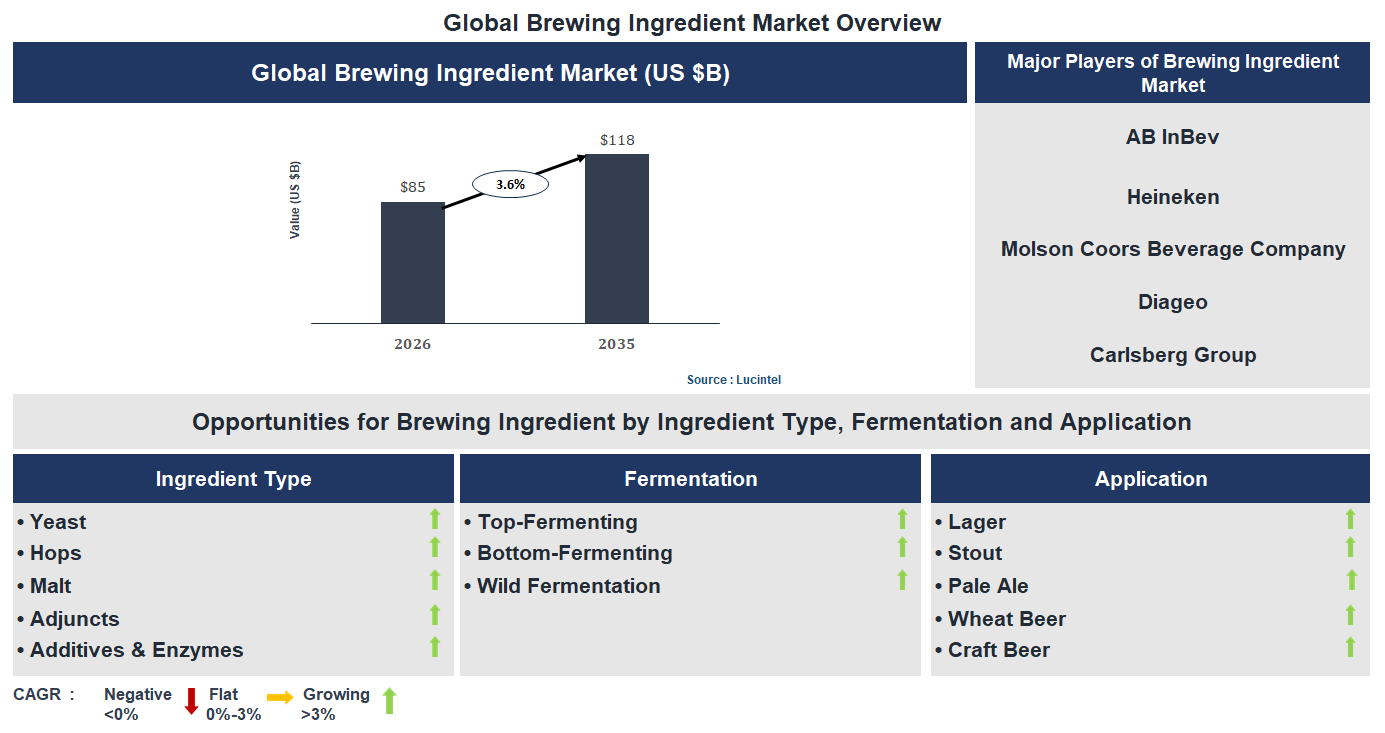
The future of the global brewing ingredient market looks promising with opportunities in the lager, stout, pale ale, wheat beer, and craft beer markets. The global brewing ingredient market is expected to reach an estimated $118.0 billion by 2035 with a CAGR of 3.6% from 2026 to 2035. The major drivers for this market are the increasing demand for craft beer ingredients, the rising popularity of organic brewing products, and the growing focus on sustainable brewing practices.• Lucintel forecasts that, within the ingredient type category, malt will remain the largest segment over the forecast period.
• Within the application category, lager will remain the largest segment.
• In terms of region, North America is expected to witness the highest growth over the forecast period. Gain valuable insights for your business decisions with our comprehensive 150+ page report. Sample figures with some insights are shown below.
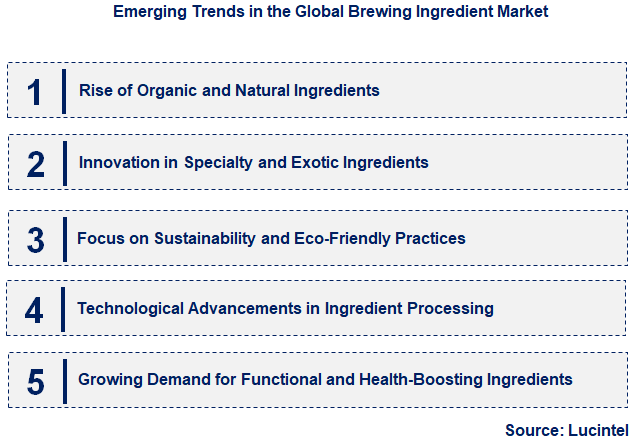
Emerging Trends in the Brewing Ingredient Market
The brewing ingredient market is experiencing rapid evolution driven by changing consumer preferences, technological advancements, and sustainability concerns. As craft brewing gains popularity and health-conscious choices influence purchasing decisions, the industry is adapting to meet these demands. Innovations in ingredient sourcing, processing, and product development are shaping the future landscape. Market players are focusing on quality, diversity, and eco-friendly practices to stay competitive. These emerging trends are not only transforming product offerings but also redefining supply chains and marketing strategies, ultimately creating a more dynamic and responsive brewing ingredient market.• Rise of Organic and Natural Ingredients: Increasing consumer demand for organic and natural ingredients is pushing breweries to incorporate these into their products. This trend emphasizes health benefits, transparency, and sustainability, leading to a shift away from synthetic additives. Breweries are sourcing organic grains, hops, and adjuncts to cater to health-conscious consumers. The adoption of organic ingredients enhances product appeal, supports eco-friendly practices, and aligns with regulatory standards. This shift is driving market growth and encouraging suppliers to expand organic offerings, fostering innovation and differentiation in the brewing industry.
• Innovation in Specialty and Exotic Ingredients: Breweries are exploring unique, exotic ingredients to create distinctive flavors and attract niche markets. This includes the use of rare hops, herbs, spices, and fruit extracts. Such innovations enable craft brewers to develop signature products that stand out in a competitive landscape. The incorporation of these ingredients also appeals to adventurous consumers seeking novel taste experiences. This trend encourages suppliers to develop specialized sourcing and processing techniques, fueling product diversification and expanding the market’s flavor profile. It ultimately enhances consumer engagement and brand loyalty.
• Focus on Sustainability and Eco-Friendly Practices: Sustainability is becoming a core aspect of ingredient sourcing and production. Breweries are prioritizing environmentally friendly practices such as using locally sourced ingredients, reducing water and energy consumption, and adopting biodegradable packaging. Suppliers are innovating with sustainable farming methods and waste reduction techniques. This trend appeals to eco-conscious consumers and aligns with global sustainability goals. It influences supply chain decisions and encourages transparency. As a result, the market is witnessing a shift towards greener practices, which enhances brand reputation and supports long-term industry resilience.
• Technological Advancements in Ingredient Processing: Cutting-edge technologies like precision agriculture, fermentation optimization, and extraction methods are revolutionizing ingredient processing. These innovations improve ingredient quality, consistency, and yield while reducing costs. Advanced processing techniques also enable the development of new ingredient forms, such as concentrates or extracts, expanding product versatility. This technological progress enhances supply chain efficiency and product innovation, allowing breweries to meet diverse consumer preferences more effectively. It fosters a competitive edge for industry players and accelerates the development of novel brewing ingredients, shaping the future of the market.
• Growing Demand for Functional and Health-Boosting Ingredients: Consumers are increasingly seeking ingredients that offer health benefits, such as probiotics, antioxidants, and adaptogens. Breweries are incorporating these functional ingredients into their products to cater to wellness trends. This includes the use of superfoods, herbal extracts, and fortified grains. The integration of health-boosting ingredients enhances product appeal and opens new market segments. It also encourages ingredient suppliers to develop innovative functional options. This trend is transforming the market by blending health and flavor, leading to a broader consumer base and more diverse product offerings. These trends are reshaping the brewing ingredient market by emphasizing health, innovation, sustainability, and technological progress. They are driving product differentiation, improving supply chain practices, and aligning the industry with evolving consumer values. As a result, the market is becoming more dynamic, competitive, and responsive to global trends, ensuring sustained growth and innovation in the brewing industry.
Recent Development in the Brewing Ingredient Market
The brewing ingredient market is experiencing rapid innovation driven by consumer preferences, technological advancements, and sustainability initiatives. As craft brewing and health-conscious choices grow, the industry adapts by exploring new ingredients, improving production processes, and emphasizing eco-friendly practices. These developments are shaping the future landscape, creating opportunities for market expansion and diversification. Stakeholders are focusing on quality, sustainability, and novel flavors to meet evolving demands, positioning the market for sustained growth and competitive advantage.• Innovation in Natural Flavors: Expanding flavor profiles through natural ingredients enhances product appeal and meets consumer demand for clean-label products, driving market growth and offering brewers a competitive edge.
• Sustainable Sourcing Practices: Emphasizing eco-friendly ingredient sourcing reduces environmental impact, appeals to eco-conscious consumers, and aligns with global sustainability goals, fostering brand loyalty and market differentiation.
• Use of Alternative Grains: Incorporating grains like sorghum, millet, and quinoa diversifies ingredient options, reduces reliance on traditional barley, and caters to gluten-free and health-focused markets, broadening consumer base.
• Technological Advancements in Processing: Implementing cutting-edge extraction and fermentation technologies improves ingredient efficiency, enhances flavor consistency, and reduces production costs, boosting overall market competitiveness.
• Growing Demand for Functional Ingredients: Incorporating ingredients with health benefits, such as probiotics and antioxidants, meets consumer interest in wellness, creating new product segments and increasing market revenue. These developments are significantly transforming the brewing ingredient market by fostering innovation, sustainability, and health-focused products. They enable industry players to meet changing consumer preferences, improve operational efficiency, and expand market reach. As a result, the market is poised for robust growth, increased diversification, and enhanced competitiveness in the global brewing industry.
Strategic Growth Opportunities in the Brewing Ingredient Market
The brewing ingredient market is experiencing rapid expansion driven by increasing consumer demand for diverse beer styles, craft brewing growth, and innovations in ingredient sourcing. Technological advancements and sustainability initiatives are also shaping new opportunities for market players. As the industry evolves, strategic investments in quality, product innovation, and supply chain efficiency will be crucial for capturing market share and meeting the dynamic needs of brewers worldwide.• Expansion of Organic and Natural Brewing Ingredients: Growing consumer preference for organic and natural products is prompting suppliers to develop and offer organic malt, hops, and yeast. This trend aligns with health-conscious and environmentally aware consumers, creating opportunities for premium product offerings. Breweries seeking to differentiate their brands are increasingly adopting these ingredients, driving demand and encouraging innovation in sustainable sourcing and certification processes.
• Innovation in Specialty and Flavored Ingredients: The demand for unique, flavored, and specialty ingredients is rising among craft brewers and consumers seeking novel experiences. This includes exotic hops, fruit extracts, spices, and adjunct grains that enhance flavor profiles. Companies investing in R&D to develop innovative ingredients can capitalize on this trend, offering brewers versatile options to create distinctive beers, thereby expanding market share and catering to evolving taste preferences.
• Adoption of Sustainable and Eco-Friendly Sourcing Practices: Sustainability is becoming a key factor influencing ingredient procurement. Market players are focusing on eco-friendly farming, water conservation, and renewable energy use in ingredient production. These practices appeal to environmentally conscious consumers and brewers aiming to reduce their carbon footprint. Developing sustainable supply chains and transparent sourcing can provide competitive advantages and meet increasing regulatory and consumer expectations.
• Integration of Technology for Quality Control and Supply Chain Optimization: Advanced technologies such as blockchain, IoT, and AI are transforming ingredient quality assurance and logistics. These innovations enable real-time tracking, improved traceability, and enhanced quality control, reducing waste and ensuring consistency. Implementing such technologies can streamline operations, lower costs, and build trust with customers, positioning companies as leaders in quality and efficiency within the brewing ingredient market.
• Growing Demand for Local and Artisanal Ingredients: There is a rising trend toward sourcing ingredients locally to support regional agriculture and reduce transportation emissions. This approach appeals to consumers valuing authenticity and community support. Local sourcing can also ensure fresher ingredients and foster unique regional flavors, providing brewers with a competitive edge. Developing local supply networks and promoting artisanal ingredients can open new markets and strengthen brand loyalty. The overall growth opportunities in the brewing ingredient market are poised to significantly influence industry dynamics by fostering innovation, sustainability, and quality. Companies that strategically leverage these opportunities can enhance their market position, meet evolving consumer demands, and contribute to a more sustainable and diverse brewing landscape.
Brewing Ingredient Market Driver and Challenges
The brewing ingredient market is influenced by a complex interplay of technological advancements, economic shifts, and regulatory frameworks. Innovations in ingredient processing, sustainable sourcing, and product customization are shaping consumer preferences and industry practices. Economic factors such as fluctuating raw material costs and global trade dynamics impact supply chains and profitability. Regulatory policies concerning food safety, labeling, and environmental standards also play a crucial role in market development. Navigating these diverse drivers and challenges is essential for stakeholders aiming to capitalize on growth opportunities while mitigating risks in this evolving landscape. The factors responsible for driving the brewing ingredient market include:-• Technological Innovation: The adoption of advanced processing techniques and ingredient formulations enhances product quality and diversity. Innovations like enzyme technology and natural flavor extraction enable brewers to create unique, high-quality products efficiently. These technological advancements reduce production costs, improve consistency, and meet evolving consumer demands for natural and functional ingredients, thereby expanding market potential.
• Growing Consumer Preference for Natural and Organic Ingredients: Increasing awareness about health and wellness drives demand for natural, organic, and non-GMO ingredients in brewing. Consumers are seeking cleaner labels and sustainable products, prompting brewers to incorporate organic barley, hops, and other natural additives. This trend boosts market growth by opening new segments focused on health-conscious consumers and premium products.
• Rising Craft Beer Popularity: The surge in craft beer consumption worldwide fuels demand for diverse brewing ingredients. Craft brewers prioritize unique, high-quality ingredients to differentiate their products. This trend encourages the use of specialty malts, exotic hops, and innovative adjuncts, thereby expanding the variety and availability of brewing ingredients and stimulating market growth.
• Expansion of Plant-Based and Functional Ingredients: The incorporation of plant-based proteins, superfoods, and functional additives into brewing ingredients caters to health-conscious consumers. These ingredients enhance nutritional profiles and functional benefits, such as probiotics and antioxidants, creating new opportunities for product innovation and market expansion. The challenges facing the brewing ingredient market include:-
• Volatility in Raw Material Prices: Fluctuations in the costs of key ingredients like barley, hops, and malt impact profit margins and pricing strategies. Factors such as weather conditions, geopolitical tensions, and supply chain disruptions contribute to price volatility, making it difficult for manufacturers to plan and invest confidently.
• Stringent Regulatory Environment: Evolving food safety standards, labeling requirements, and environmental regulations pose compliance challenges. Navigating diverse regional regulations can increase operational costs and delay product launches, hindering market agility and growth.
• Supply Chain Disruptions: The global nature of ingredient sourcing makes the market vulnerable to supply chain interruptions caused by pandemics, transportation issues, or geopolitical conflicts. These disruptions can lead to shortages, increased costs, and delays in product availability, affecting overall market stability. The brewing ingredient market is driven by technological innovations, consumer preferences for natural and functional ingredients, and the growth of craft beer. However, it faces challenges such as raw material price volatility, regulatory complexities, and supply chain disruptions. These factors collectively influence market dynamics, requiring stakeholders to adapt strategically. While opportunities for innovation and expansion are significant, managing risks associated with costs and compliance is crucial for sustained growth. Overall, the markets future hinges on balancing these drivers and challenges to meet evolving consumer demands and regulatory standards effectively.
List of Brewing Ingredient Companies
Companies in the market compete on the basis of product quality offered. Major players in this market focus on expanding their manufacturing facilities, R&D investments, infrastructural development, and leverage integration opportunities across the value chain. With these strategies brewing ingredient companies cater increasing demand, ensure competitive effectiveness, develop innovative products & technologies, reduce production costs, and expand their customer base. Some of the brewing ingredient companies profiled in this report include-• AB InBev
• Heineken
• Molson Coors Beverage Company
• Diageo
• Carlsberg Group
• SABMiller
• Asahi Group Holdings
• Constellation Brands
• Kirin Holdings Company
• Angel Yeast Co. Ltd.
Brewing Ingredient Market by Segment
The study includes a forecast for the global brewing ingredient market by ingredient type, fermentation, application, and region.Brewing Ingredient Market by Ingredient Type [Value from 2019 to 2035]:
• Yeast
• Hops
• Malt
• Adjuncts
• Additives & Enzymes
Brewing Ingredient Market by Fermentation [Value from 2019 to 2035]:
• Top-Fermenting
• Bottom-Fermenting
• Wild Fermentation
Brewing Ingredient Market by Application [Value from 2019 to 2035]:
• Lager
• Stout
• Pale Ale
• Wheat Beer
• Craft Beer
Brewing Ingredient Market by Region [Value from 2019 to 2035]:
• North America
• Europe
• Asia Pacific
• The Rest of the World
Country Wise Outlook for the Brewing Ingredient Market
The brewing ingredient market has experienced significant shifts driven by technological innovations, changing consumer preferences, and regulatory updates across the globe. As craft brewing gains popularity and health-conscious trends influence ingredient choices, countries are investing in sustainable sourcing, product diversification, and advanced production techniques. These developments reflect a dynamic landscape where traditional practices are evolving to meet modern demands, fostering competition and innovation. The following summaries highlight recent key advancements and strategic movements within the United States, China, Germany, India, and Japan, illustrating their unique contributions and challenges in this evolving market.• United States: The US brewing ingredient market has seen increased demand for organic and non-GMO ingredients, driven by health-conscious consumers. Craft breweries are innovating with unique hop varieties and specialty malts, expanding product portfolios. Technological advancements in extraction and processing have improved ingredient quality and sustainability. Additionally, there is a rising trend in locally sourced ingredients, supporting regional agriculture. Regulatory changes favoring transparency and labeling have also influenced market dynamics, encouraging companies to adopt cleaner, more sustainable practices. Overall, innovation and consumer preferences continue to shape growth in this sector.
• China: China’s brewing ingredient market is rapidly expanding, fueled by a booming craft beer industry and increasing domestic consumption. The country is investing in the development of indigenous hop and barley varieties to reduce reliance on imports. There is a growing focus on functional ingredients, such as probiotics and antioxidants, to cater to health-conscious consumers. Modern processing techniques are being adopted to improve yield and quality. Government policies supporting agricultural sustainability and local sourcing are also impacting the market. Additionally, collaborations between international and local companies are fostering innovation and expanding product offerings, positioning China as a significant player in the global brewing ingredients market.
• Germany: Germany remains a leader in brewing ingredients, emphasizing traditional methods combined with modern innovations. The focus on high-quality malts and hops continues, with an increasing interest in organic and biodynamic ingredients. Sustainable sourcing and environmentally friendly production processes are prioritized, aligning with Germany’s strong environmental policies. Research and development efforts are exploring new hop varieties and flavor profiles to meet craft brewing demands. The country also benefits from a well-established supply chain and a reputation for premium ingredients, which are exported globally. Overall, Germany’s market is characterized by a blend of tradition and innovation, maintaining its global influence.
• India: The Indian brewing ingredient market is experiencing rapid growth due to rising beer consumption and expanding domestic breweries. Local sourcing of ingredients like barley and hops is gaining importance to reduce costs and dependence on imports. The market is witnessing increased adoption of advanced malting and brewing technologies. There is also a focus on developing ingredients suitable for the tropical climate, such as heat-tolerant barley varieties. The government’s support for agricultural development and export initiatives is boosting the industry. Additionally, health and wellness trends are encouraging the use of functional ingredients, creating new opportunities for innovation and diversification within the market.
• Japan: Japan’s brewing ingredient market is characterized by a focus on premium and craft products, with an emphasis on quality and unique flavor profiles. The country is investing in research to develop new hop varieties and specialty malts that cater to the craft beer segment. Sustainable and organic ingredients are increasingly in demand, aligning with Japan’s environmental consciousness. Technological advancements in brewing processes, such as precision fermentation, are enhancing ingredient efficiency and product consistency. The market also benefits from a strong domestic supply chain and a culture of innovation. Overall, Japan’s market is evolving through a combination of tradition, quality focus, and technological progress.

Features of the Global Brewing Ingredient Market
Market Size Estimates: Brewing ingredient market size estimation in terms of value ($B). Trend and Forecast Analysis: Market trends (2019 to 2025) and forecast (2026 to 2035) by various segments and regions. Segmentation Analysis: Brewing ingredient market size by ingredient type, fermentation, application, and region in terms of value ($B). Regional Analysis: Brewing ingredient market breakdown by North America, Europe, Asia Pacific, and Rest of the World. Growth Opportunities: Analysis of growth opportunities in different ingredient types, fermentation, applications, and regions for the brewing ingredient market. Strategic Analysis: This includes M&A, new product development, and competitive landscape of the brewing ingredient market. Analysis of competitive intensity of the industry based on Porter’s Five Forces model.
FAQ
Q1. What is the brewing ingredient market size? Answer: The global brewing ingredient market is expected to reach an estimated $118.0 billion by 2035. Q2. What is the growth forecast for brewing ingredient market? Answer: The global brewing ingredient market is expected to grow with a CAGR of 3.6% from 2026 to 2035. Q3. What are the major drivers influencing the growth of the brewing ingredient market? Answer: The major drivers for this market are the increasing demand for craft beer ingredients, the rising popularity of organic brewing products, and the growing focus on sustainable brewing practices. Q4. What are the major segments for brewing ingredient market? Answer: The future of the brewing ingredient market looks promising with opportunities in the lager, stout, pale ale, wheat beer, and craft beer markets. Q5. Who are the key brewing ingredient market companies? Answer: Some of the key brewing ingredient companies are as follows:• AB InBev
• Heineken
• Molson Coors Beverage Company
• Diageo
• Carlsberg Group
• SABMiller
• Asahi Group Holdings
• Constellation Brands
• Kirin Holdings Company
• Angel Yeast Co. Ltd. Q6. Which brewing ingredient market segment will be the largest in future? Answer: Lucintel forecasts that, within the ingredient type category, malt will remain the largest segment over the forecast period. Q7. In brewing ingredient market, which region is expected to be the largest in next 5 years? Answer: In terms of region, North America is expected to witness the highest growth over the forecast period. Q8. Do we receive customization in this report? Answer: Yes, Lucintel provides 10% customization without any additional cost.
Table of Contents
List of Figures
List of Tables
Methodology
- In-depth interviews of the major players in this market
- Detailed secondary research from competitors’ financial statements and published data
- Extensive searches of published works, market, and database information pertaining to industry news, company press releases, and customer intentions
- A compilation of the experiences, judgments, and insights of Lucintel’s professionals, who have analyzed and tracked this market over the years.


Buy Now
Choose a license that fits your team. Instant PDF delivery.
Prices exclude taxes. Instant delivery. Custom licensing available on request.
Key Questions
- • What are some of the most promising, high-growth opportunities for the brewing ingredient market by ingredient type (yeast, hops, malt, adjuncts, and additives & enzymes), fermentation (top-fermenting, bottom-fermenting, and wild fermentation), application (lager, stout, pale ale, wheat beer, and craft beer), and region (North America, Europe, Asia Pacific, and the Rest of the World)?
- • Which segments will grow at a faster pace and why?
- • Which region will grow at a faster pace and why?
- • What are the key factors affecting market dynamics? What are the key challenges and business risks in this market?
- • What are the business risks and competitive threats in this market?
- • What are the emerging trends in this market and the reasons behind them?
- • What are some of the changing demands of customers in the market?
- • What are the new developments in the market? Which companies are leading these developments?
- • Who are the major players in this market? What strategic initiatives are key players pursuing for business growth?
- • What are some of the competing products in this market and how big of a threat do they pose for loss of market share by material or product substitution?
- • What M&A activity has occurred in the last 7 years and what has its impact been on the industry? For any questions related to Brewing Ingredient Market, Brewing Ingredient Market Size, Brewing Ingredient Market Growth, Brewing Ingredient Market Analysis, Brewing Ingredient Market Report, Brewing Ingredient Market Share, Brewing Ingredient Market Trends, Brewing Ingredient Market Forecast, Brewing Ingredient Companies, write Lucintel analyst at email: helpdesk@lucintel.com. We will be glad to get back to you soon.


