
Market Report · July 22, 2026

Key data points: The market size in 2035 = $55,789 million, growth forecast = 5.5% annually for the next 8 years. Scroll below to get more insights. This market report covers trends, opportunities and forecasts in bopet film market to 2035 by function (barrier, safety, decorative, microporous, and others), thickness (thin and thick), end use (packaging, industrial, electrical & electronics, imaging, and magnetic media), and region (North America, Europe, Asia Pacific, and the Rest of the World)
We'll send your sample report shortly.
• Lucintel forecasts that, within the Function category, barrier is expected to witness the highest growth over the forecast period.
• Within the application category, packaging is expected to witness the highest growth.
• In terms of region, APAC is expected to witness the highest growth over the forecast period.
Gain valuable insights for your business decisions with our comprehensive 150+ page report. Sample figures with some insights are shown below.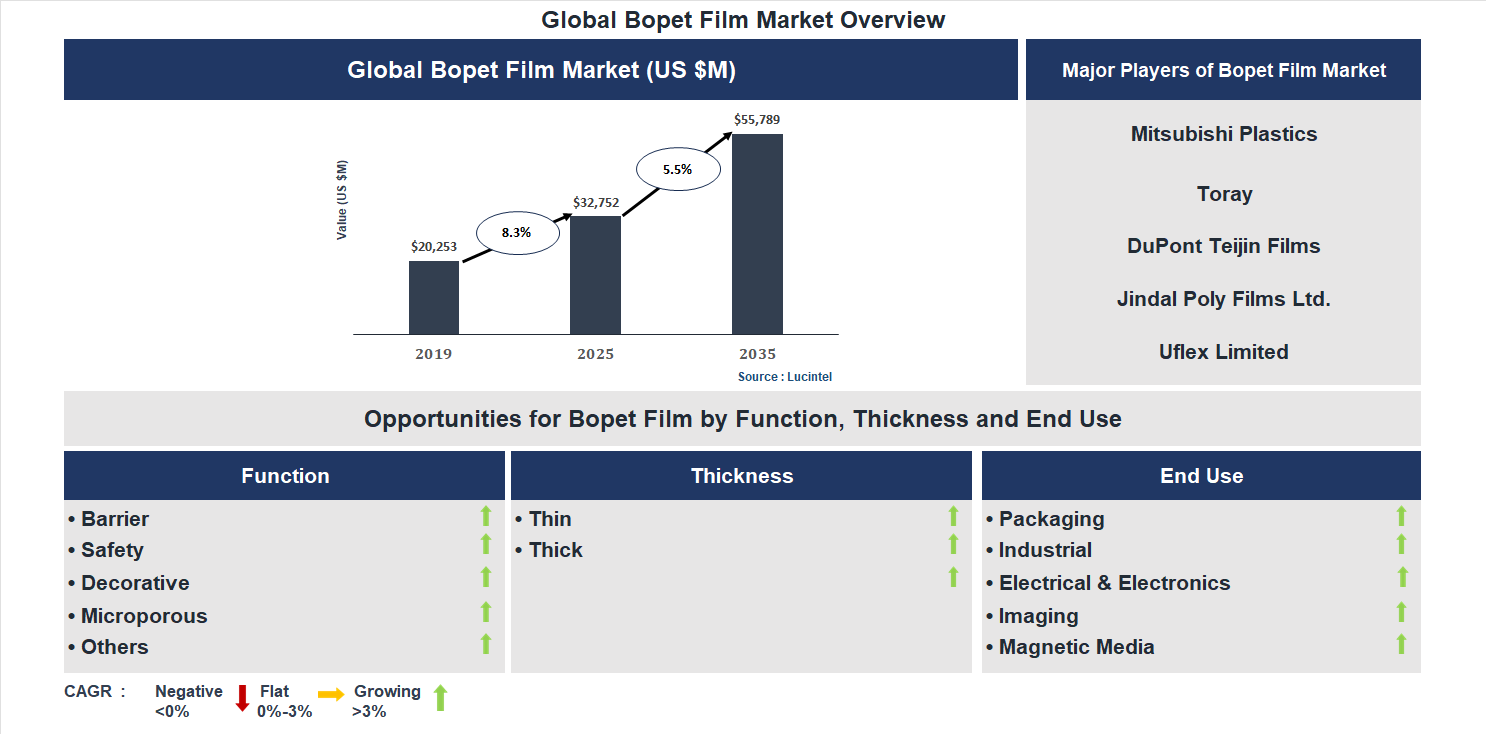
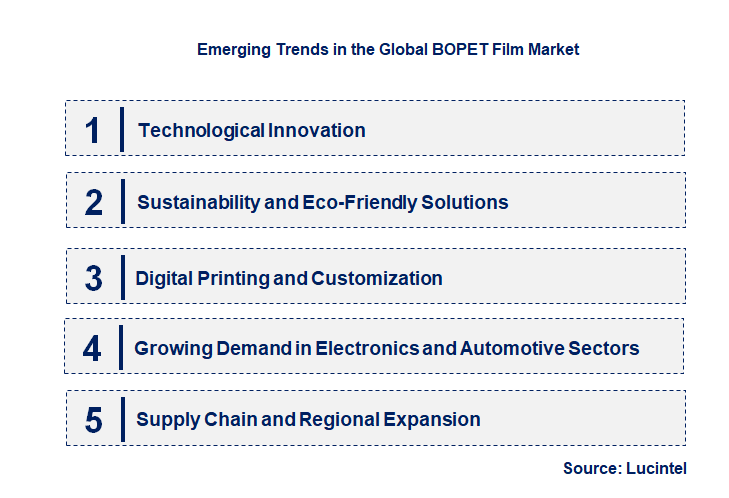
• Technological Innovation: Advancements in manufacturing processes and coating technologies are enhancing film properties such as clarity, strength, and barrier performance. These innovations enable BOPET films to meet the specific needs of high-end applications like flexible packaging, electronics, and industrial uses. Improved production techniques also reduce costs and waste, making the films more sustainable and economically viable. As technology continues to evolve, the market will see more specialized and high-performance BOPET films, driving growth and opening new application avenues.
• Sustainability and Eco-Friendly Solutions: Increasing environmental concerns are pushing manufacturers to develop biodegradable, recyclable, and eco-friendly BOPET films. Innovations include using renewable raw materials and improving recyclability to reduce plastic waste. Regulatory pressures and consumer demand for sustainable packaging are accelerating this trend. Companies adopting green practices are gaining competitive advantages, and the market is witnessing a shift towards sustainable product portfolios. This trend is reshaping the industry by emphasizing eco-conscious production and encouraging circular economy initiatives.
• Digital Printing and Customization: The rise of digital printing technologies is enabling high-quality, customized BOPET films for branding, labeling, and packaging. This trend allows brands to create visually appealing, personalized products with shorter lead times and lower costs. The ability to print intricate designs directly onto films enhances product differentiation and consumer engagement. As digital printing becomes more sophisticated, the demand for customized BOPET films is expected to grow, influencing market dynamics and encouraging manufacturers to invest in advanced printing capabilities.
• Growing Demand in Electronics and Automotive Sectors: The electronics industry’s need for flexible, durable, and high-performance films is boosting BOPET film demand. Similarly, the automotive sector uses BOPET films for insulation, wiring, and decorative applications. These sectors require films with excellent thermal stability, chemical resistance, and transparency. The expanding use of BOPET films in these high-tech industries is driving market growth, encouraging innovation to meet specific technical standards. This trend highlights the increasing importance of BOPET films in advanced technological applications, broadening their market scope.
• Supply Chain and Regional Expansion: The market is witnessing a shift towards regional manufacturing hubs to reduce logistics costs and meet local demand efficiently. Emerging economies in Asia-Pacific, especially China and India, are becoming key production and consumption centers. This regional expansion is driven by increasing industrialization, urbanization, and infrastructure development. Additionally, supply chain resilience is a focus due to global disruptions, prompting companies to diversify sourcing and production locations. These changes are making the market more competitive and accessible, fostering innovation and localized solutions that cater to regional needs.
• Growing Demand from Packaging Industry: The increasing use of BOPET films in food, beverage, and pharmaceutical packaging is boosting market growth. Their excellent barrier properties, durability, and clarity make them ideal for packaging solutions. As consumer awareness about product safety and shelf life rises, manufacturers are adopting BOPET films more extensively. This trend is expected to continue, driven by the need for sustainable and lightweight packaging options, thereby expanding market opportunities and encouraging innovation in film formulations.
• Technological Advancements in Manufacturing: Innovations such as enhanced coating techniques and improved extrusion processes are elevating BOPET film quality. These advancements lead to films with better mechanical strength, heat resistance, and optical clarity. Consequently, manufacturers can cater to more demanding applications, including electronics and industrial uses. The improved production efficiency also reduces costs, making BOPET films more competitive. This technological progress is fostering product diversification and opening new markets globally.
• Focus on Sustainability and Eco-Friendly Solutions: The industry is shifting towards biodegradable and recyclable BOPET films to meet environmental regulations and consumer preferences. Companies are investing in eco-friendly raw materials and sustainable production methods. These initiatives help reduce carbon footprints and waste, aligning with global sustainability goals. The adoption of green practices is enhancing brand reputation and market acceptance. As sustainability becomes a key purchasing criterion, the market is poised for significant growth in eco-conscious product segments.
• Expansion in Electronics and Industrial Applications: BOPET films are increasingly used in electronics for insulation, flexible circuits, and display components due to their excellent dielectric properties. In industrial sectors, they serve as insulation materials and protective films. The rising demand for electronic devices and industrial equipment is driving this expansion. Innovations in film formulations tailored for specific industrial needs are further boosting adoption. This diversification into high-tech applications is creating new revenue streams and strengthening the market position of BOPET films.
• Strategic Collaborations and Market Expansion: Companies are forming alliances to enhance product offerings and expand into emerging markets. These collaborations facilitate technology transfer, joint research, and access to new customer bases. Market expansion efforts focus on regions with growing industrialization and infrastructure development. Such strategic moves are enabling companies to stay competitive, innovate faster, and meet diverse customer requirements. Overall, these collaborations are accelerating market growth and fostering a more dynamic, globally integrated BOPET film industry.
• Growing Demand for Sustainable Packaging Solutions: The increasing focus on eco-friendly packaging is driving the adoption of biodegradable and recyclable BOPET films. Manufacturers are developing films with enhanced barrier properties and reduced environmental impact, aligning with regulatory standards and consumer preferences. This shift opens new avenues for market expansion, especially in food, beverage, and retail sectors, where sustainability is a key purchasing criterion.
• Expansion of Electronics and Electrical Applications: BOPET films are increasingly used in flexible electronics, display screens, and insulation materials due to their excellent dielectric properties and durability. The rising adoption of wearable devices, smartphones, and electronic gadgets fuels demand for high-performance films. Innovations in thin, lightweight, and heat-resistant BOPET films are expected to further boost their application scope in the electronics industry.
• Technological Advancements in Film Manufacturing: Continuous improvements in film production processes, such as enhanced biaxial orientation and coating technologies, are leading to higher quality, thinner, and more versatile BOPET films. These advancements enable manufacturers to meet diverse application requirements, reduce costs, and improve sustainability. Enhanced manufacturing efficiency and product customization are key factors driving market growth and competitiveness.
• Increasing use in Industrial and Automotive Sectors: BOPET films are gaining traction in industrial applications like electrical insulation, printing, and lamination, as well as in automotive components for lightweight and durable materials. The demand for high-performance films that withstand harsh environments and provide excellent mechanical properties is rising. This diversification into industrial and automotive markets offers significant growth opportunities amid expanding manufacturing activities.
• Rising Investments in R&D and Product Innovation: Companies are investing heavily in research and development to create advanced BOPET films with superior barrier, optical, and mechanical properties. Innovations such as UV resistance, anti-fog coatings, and enhanced clarity are expanding application possibilities. These efforts help meet evolving customer needs, comply with stringent regulations, and maintain competitive advantage, thereby fostering sustained market growth and technological leadership.
• Technological Innovation: The continuous development of advanced manufacturing techniques enhances film quality, durability, and functionality. Innovations such as nano-coatings and improved biaxial orientation processes enable the production of films with superior barrier properties, heat resistance, and clarity. These technological advancements expand applications in packaging, electronics, and industrial sectors, fueling market growth. Moreover, automation and digitalization in production processes reduce costs and improve efficiency, making high-quality BOPET films more accessible to a broader customer base. As industries demand more specialized films, ongoing R&D efforts are critical in maintaining competitive advantage and meeting evolving consumer needs.
• Growing Packaging Industry: The global packaging industry is experiencing rapid growth driven by increasing demand for food, beverages, pharmaceuticals, and consumer goods. BOPET films are favored for their excellent mechanical strength, transparency, and barrier properties, making them ideal for flexible packaging solutions. The rise in e-commerce and retail sectors further boosts demand for lightweight, durable packaging materials that ensure product safety and extend shelf life. Additionally, the shift towards sustainable packaging practices encourages the adoption of recyclable BOPET films, aligning with environmental regulations and consumer preferences. This expanding packaging landscape significantly propels the BOPET film market forward.
• Environmental Regulations and Sustainability Trends: Stringent environmental policies and increasing awareness about sustainability are shaping the BOPET film industry. Governments worldwide are imposing regulations to reduce plastic waste and promote recycling, prompting manufacturers to develop eco-friendly films. The demand for biodegradable and recyclable BOPET films is rising, encouraging innovation in material composition and production processes. Companies are also investing in sustainable sourcing and waste management practices to comply with regulations and meet consumer expectations. These trends drive market players to adopt greener technologies, which, while challenging, open new avenues for growth in eco-conscious markets.
• Rising Electronics and Electrical Applications: The expanding electronics industry significantly impacts the BOPET film market. BOPET films are used extensively in capacitors, insulation, flexible printed circuits, and display components due to their excellent dielectric properties, thermal stability, and mechanical strength. The proliferation of consumer electronics, IoT devices, and renewable energy systems increases demand for high-quality films. As technology advances, the need for miniaturized, lightweight, and durable electronic components grows, further boosting BOPET film applications. This sector‘s growth directly correlates with increased investments in electronics manufacturing, making it a vital driver for the market.
• Increasing Demand from Automotive Industry: The automotive sector is increasingly utilizing BOPET films for applications such as electrical insulation, decorative trims, and lightweight composites. The push for fuel efficiency and emission reduction encourages the adoption of lightweight materials, with BOPET films offering an ideal combination of strength and weight savings. Additionally, the demand for high-performance films in vehicle interior components, safety systems, and electronic modules is rising. As automakers focus on innovation and sustainability, the use of BOPET films is expected to expand, supporting the overall growth of the market. This trend underscores the importance of advanced materials in modern automotive design.
• Fluctuating Raw Material Prices: The BOPET film industry heavily depends on petrochemical-based raw materials such as polyethylene terephthalate (PET). Volatility in crude oil prices directly impacts the cost of raw materials, leading to unpredictable manufacturing expenses. Price fluctuations can hinder profit margins and complicate pricing strategies for manufacturers. Additionally, supply chain disruptions, geopolitical tensions, and environmental regulations can further exacerbate raw material shortages or price spikes. Managing these fluctuations requires strategic sourcing, inventory management, and cost optimization, which can be resource-intensive and impact overall market stability.
• Recycling and Waste Management Challenges: Despite the push for sustainability, recycling BOPET films remains complex due to their multilayer structures and contamination issues. Efficient collection, sorting, and processing infrastructure are often lacking, especially in developing regions. The difficulty in recycling impacts environmental goals and increases disposal costs for manufacturers and consumers. Regulatory pressures to improve waste management practices add further complexity, requiring investments in new technologies and processes. Overcoming these challenges is essential for the industry to meet sustainability commitments and maintain consumer trust, but it demands significant technological and infrastructural advancements.
• Regulatory and Compliance Pressures: The BOPET film market faces increasing regulatory scrutiny related to environmental impact, safety standards, and product labeling. Compliance with diverse international regulations can be complex and costly, especially for global manufacturers. Stringent rules on chemical usage, emissions, and recyclability require continuous adaptation of production processes and formulations. Non-compliance can lead to legal penalties, product recalls, and damage to brand reputation. Navigating these regulatory landscapes demands substantial resources and expertise, posing a significant challenge for market participants aiming to expand globally while adhering to evolving standards.
• Mitsubishi Plastics
• Toray
• DuPont Teijin Films
• Jindal Poly Films Ltd.
• Uflex Limited
• Aj Plast
• Kolon.
• Barrier
• Safety
• Decorative
• Microporous
• Others
• Thin
• Thick
• Packaging
• Industrial
• Electrical & Electronics
• Imaging
• Magnetic Media
• North America
• Europe
• Asia Pacific
• The Rest of the World
• United States: United States, the market has seen increased adoption of eco-friendly BOPET films, driven by stringent environmental regulations and consumer demand for sustainable packaging. Major players are investing in advanced manufacturing processes to improve film quality and reduce carbon footprint. The growth of the e-commerce sector has further boosted demand for flexible packaging solutions, including BOPET films. Innovations in barrier properties and transparency are enhancing product applications. Additionally, collaborations between industry leaders and research institutions are fostering technological advancements, positioning the U.S. as a key hub for high-performance BOPET films.
• China: China‘s BOPET film market is rapidly expanding due to robust industrial growth and a booming packaging industry. The country is witnessing significant capacity additions and technological upgrades to meet domestic and export demands. Chinese manufacturers are focusing on developing thinner, lightweight films with enhanced barrier and optical properties to cater to diverse applications. Government policies supporting manufacturing innovation and sustainability are encouraging investments in eco-friendly BOPET solutions. The rise of e-commerce and food packaging sectors continues to drive market growth, making China a dominant player in the global BOPET film industry.
• Germany: Germany‘s market is characterized by a strong emphasis on sustainability and high-quality standards. German companies are investing in innovative, environmentally friendly BOPET films with improved recyclability and reduced environmental impact. The automotive and electronics sectors are key consumers, demanding films with superior durability and performance. The country is also a leader in research and development, collaborating with European institutions to develop advanced BOPET solutions. Regulatory frameworks promoting circular economy practices are influencing product development, positioning Germany as a leader in sustainable BOPET film production within Europe.
• India: India‘s BOPET film market is experiencing rapid growth driven by expanding packaging, electronics, and industrial sectors. The increasing urbanization and rising disposable incomes are fueling demand for premium packaging solutions. Indian manufacturers are adopting advanced technologies to produce thinner, high-performance films at competitive prices. The government’s initiatives to promote manufacturing and exports are further boosting the market. Additionally, the shift towards sustainable packaging practices is encouraging the development of eco-friendly BOPET films. The market is expected to continue its upward trajectory, supported by infrastructural development and increasing consumer awareness.
• Japn: Japan‘s market is characterized by technological innovation and a focus on high-performance BOPET films for electronics, packaging, and industrial applications. Japanese companies are investing heavily in R&D to develop films with enhanced barrier properties, heat resistance, and recyclability. The country’s emphasis on sustainability and environmental regulations is driving the adoption of eco-friendly materials. Japan also leads in the development of specialty BOPET films used in high-tech applications such as flexible displays and electronic components. Strategic collaborations and technological advancements are strengthening Japan’s position as a key player in the global BOPET film market.


• Mitsubishi Plastics
• Toray
• DuPont Teijin Films
• Jindal Poly Films Ltd.
• Uflex Limited
• Aj Plast
• Kolon.
Q6. Which bopet film market segment will be the largest in future?

Choose a license that fits your team. Instant PDF delivery.
Prices exclude taxes. Instant delivery. Custom licensing available on request.
Market Report · July 22, 2026
Market Report · July 22, 2026
Market Report · July 22, 2026
Trusted partner for strategic intelligence and business growth


Receive a complimentary market analysis tailored to your industry. Our analysts will identify key growth opportunities and competitive dynamics specific to your business.

Market size, growth rate, and key trend analysis for your specific sector.

Top competitor positioning and market share analysis.

Strategic recommendations backed by data-driven insights.
Get curated market intelligence and competitive moves straight to your inbox.
By subscribing, you agree to receive our monthly insights. Unsubscribe anytime.
Receive a complimentary market analysis tailored to your industry. Our analysts will identify key growth opportunities and competitive dynamics specific to your business.
Market size, growth rate, and key trend analysis for your specific sector.
Top competitor positioning and market share analysis.
Strategic recommendations backed by data-driven insights.
Get curated market intelligence, emerging trends, and competitive moves straight to your inbox each month.
By subscribing, you agree to receive our monthly insights. Unsubscribe anytime.
We'll send your sample report shortly.